
Snow Fence Installation – How It Works and Where to Put It

This post may contain affiliate links. Read my full disclosure here.



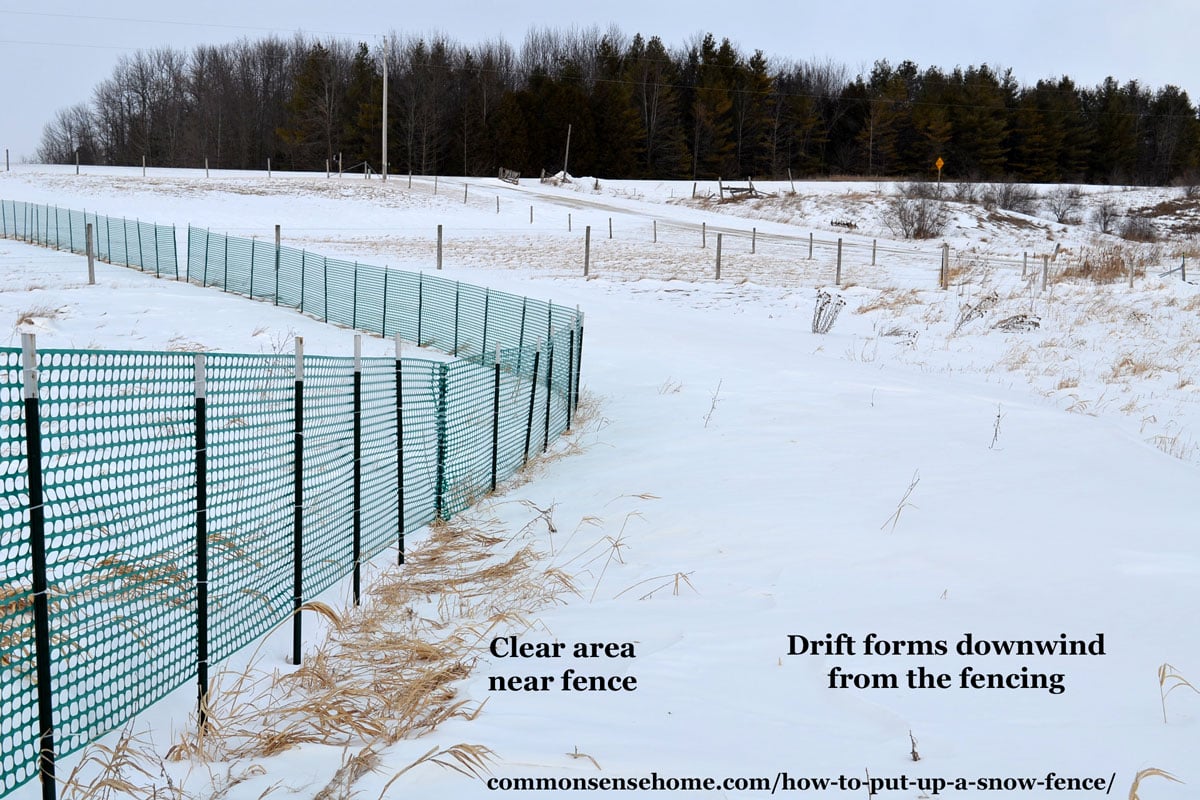
A snow fence doesn’t stop snow. It controls where drifting snow gets deposited.
Put the fence in the right location, and blowing snow piles up harmlessly in a field or yard instead of drifting across your driveway. Put it too close to the area you’re trying to protect, and you may make the drifting worse.
We’ve used several hundred feet of seasonal snow fencing on our windy northeast Wisconsin property for years. The biggest lesson we’ve learned is that placement matters more than almost anything else.
In this article, I’ll explain how snow fence works, how far to place a it from a driveway, how we install ours, and what we’ve learned from years of use.
Would you like to save this?
Table of Contents
Snow Fence Quick Start
If you just need the basics:
- Place the snow fence upwind of the driveway, road, walkway, or other area you want to protect.
- Allow plenty of room for the drift to form. A common guideline for a 50% porous fence on relatively flat ground is around 35 times the height of the fence.
- Use porous fencing, not a solid barrier. Snow fencing is designed to slow the wind rather than stop it completely.
- Leave a gap under the fence. For a four-foot fence, we leave roughly 5 to 6 inches between the ground and the bottom of the fencing.
- Use sturdy posts. Wind and drifting snow put considerable pressure on the fence. We suggest a quantity of 7 to 11 posts (depending on spacing) for 50 ft of fencing.
- Attach the fencing to the windward side of the posts. This lets the wind push the fencing against the posts instead of pulling it away from them.
- Watch the snow after installation. Your actual drift patterns are one of the best guides for fine-tuning placement.
Every property is different. Buildings, hills, trees, existing vegetation, wind direction, fence height, and the amount of blowing snow all affect where the snow eventually lands.
Why We Started Using a Snow Fence
Snow fences have been part of my winters for as long as I can remember. When I was growing up on our family farm, my grandmother had a long wooden fence that was put up each fall to protect the driveway from drifting snow.
Eventually, my brother planted trees to replace Grandma’s fence. The trees grew into a permanent living windbreak.
When we built our own home, we planted windbreak trees, too. Trees take time to grow, so until ours were large enough to do the job, we needed another option. Also, part of our driveway lies next to our neighbor’s field, so there’s no room for trees there.
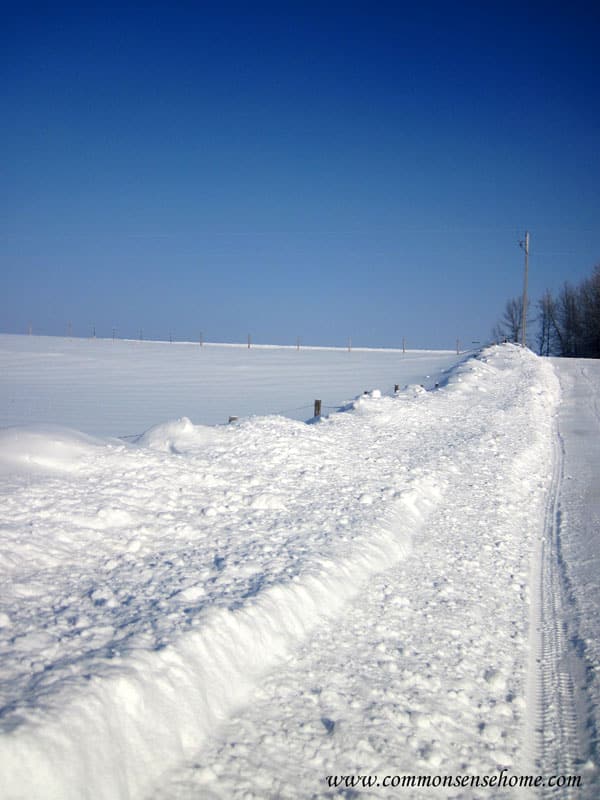
Our home sits in an exposed location surrounded by open farm fields. When winter winds get moving, there’s plenty of snow available to blow across the landscape and pile up wherever the wind slows down.
We got tired of having our driveway constantly blocked one snowy winter, and decided to invest in fencing the next year.
What is a Snow Fence?
A snow fence is a porous barrier designed to control blowing and drifting snow.
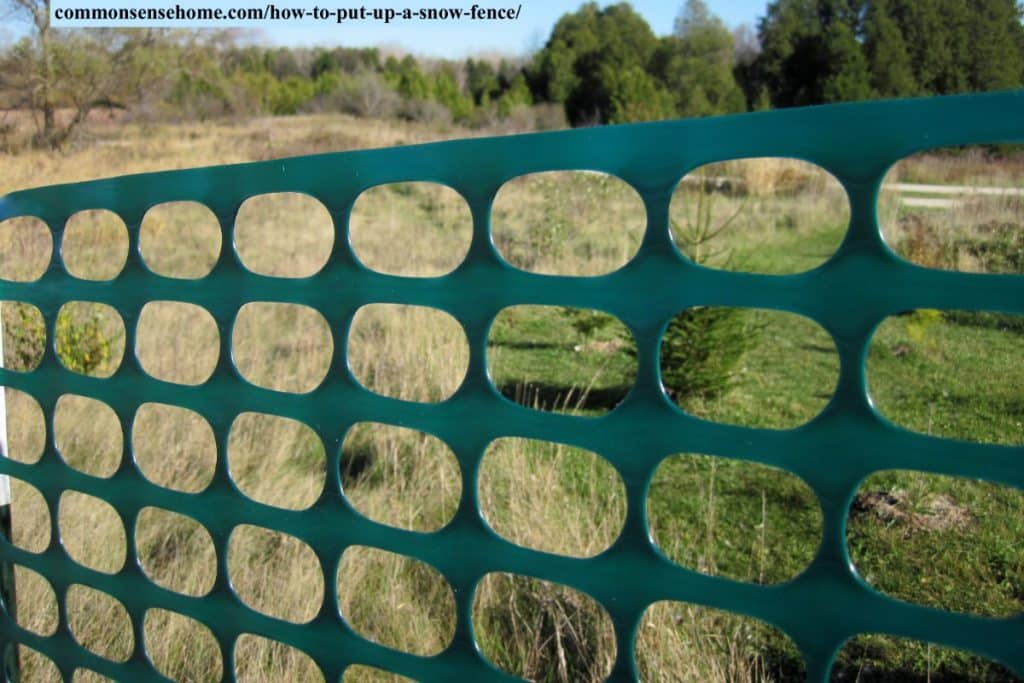
Traditional snow fences were often made from wooden slats held together with wire. Today, plastic mesh is common because it’s lightweight, relatively inexpensive, and easy to roll up for storage.
Permanent fences, shrubs, and rows of trees can also act as snow fences when they’re designed and placed correctly. The important point is that an effective snow fence is not solid.
How Does a Snow Fence Work?
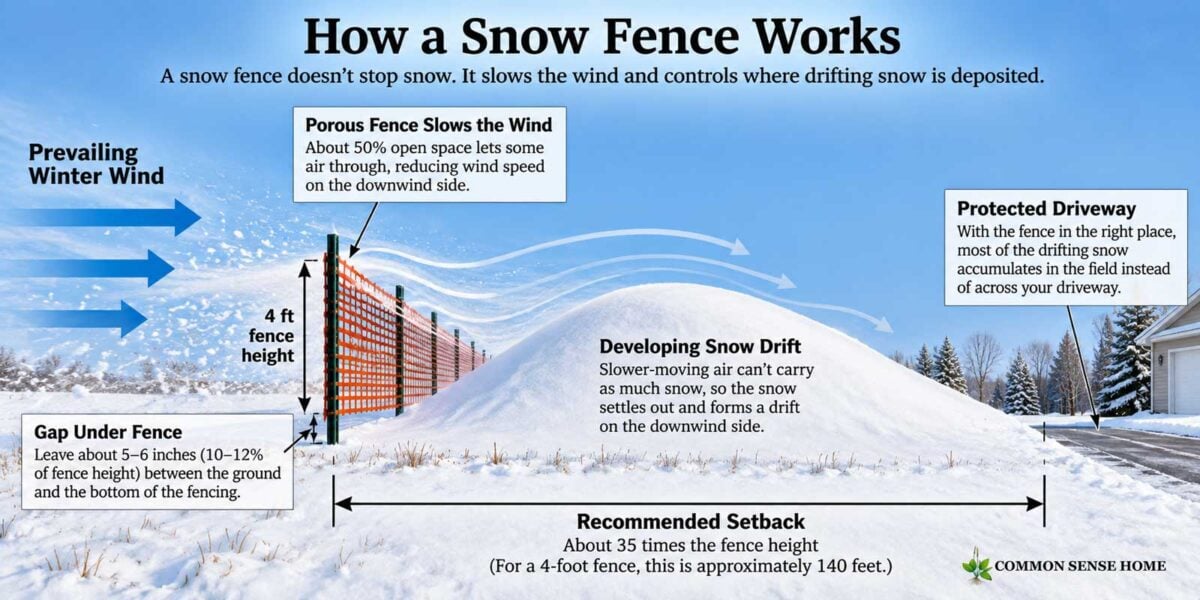
A snow fence works by slowing the wind. As wind passes through and over the fence, wind speed drops on the downwind side. Slower-moving air can’t carry as much snow, so the snow settles out and forms a drift.
This is why putting up a solid wall isn’t necessarily better.
Snow fencing is typically around 50% porous, meaning roughly half of the surface is open space. This allows some wind to pass through it while still reducing its speed enough to encourage snow deposition.
Think of the fence as telling the snow:
“Drop your load here instead of fifty yards farther down the driveway.”
That’s also why snow fence placement is so important. You aren’t eliminating the drift. You’re choosing a better place for it to form. In some areas, farmers purposely stack the drifts so they melt and flow into a water basin in spring.
Where Should You Put a Snow Fence?
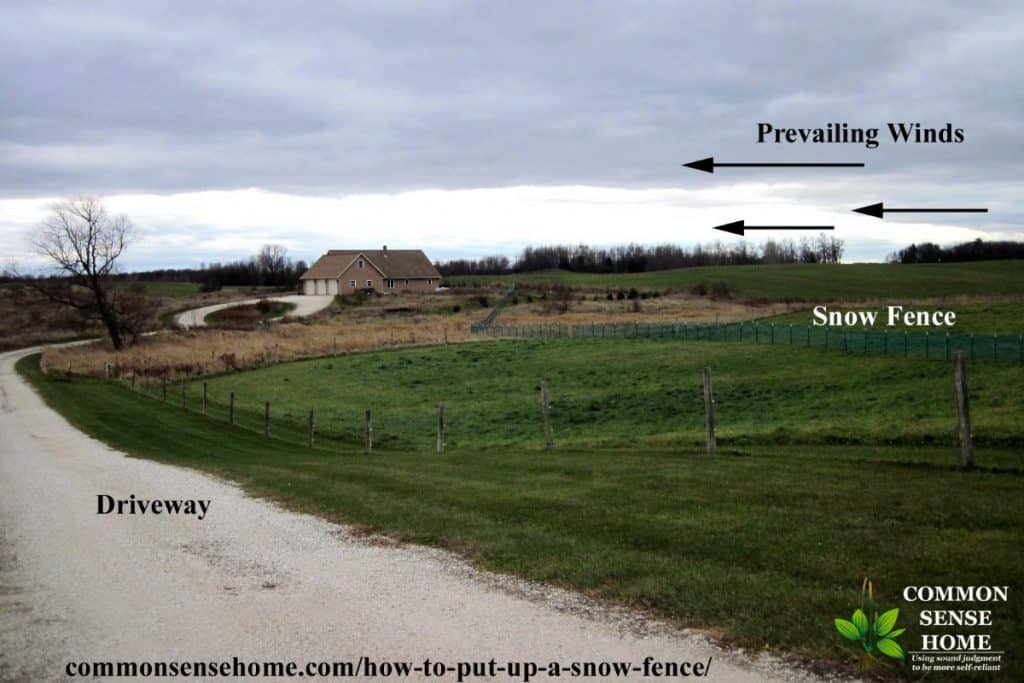
The fence should be upwind of the area you want to protect.
Start by identifying the direction your strongest snow-carrying winter winds normally come from. Don’t assume your winter winds behave exactly like winds during the rest of the year. Look at your property.
- Where do drifts normally form?
- Which side of buildings stays scoured clean?
- Where does snow collect behind trees, shrubs, fences, or other obstacles?
Those patterns give you clues about how wind moves across your site.
How Far Should a Snow Fence Be From a Driveway?
One commonly used guideline is to place it about 35 times the fence height away from the area you want to protect.
That gives you approximately:
| Snow Fence Height | Approximate 35H Setback |
|---|---|
| 3 feet | 105 feet |
| 4 feet | 140 feet |
| 5 feet | 175 feet |
| 6 feet | 210 feet |
This doesn’t mean every four-foot snow fence must be exactly 140 feet from a driveway. The formula is a starting point.
Terrain, vegetation, fence porosity, wind direction, snowfall, and the amount of snow blowing across the site all influence the size and location of the drift.
When we first installed our fence, we experimented with different distances. Over time, we watched where the snow actually accumulated and adjusted sections of fencing to better match our site.
The snow will show you whether your fence is in the right place.
If the drift reaches the driveway, you probably need more setback, more snow-storage capacity, or a different fence configuration.
Don’t Forget the Ends
Snow doesn’t always travel perpendicular to the fence. Wind direction changes during storms, and snow can sweep around the ends of a short fence.
Extend the fence beyond the area you’re trying to protect (if possible) so it still provides coverage when the wind comes in at an angle. I know sometimes space is tight and there’s limited room for fencing.
How to Install a Snow Fence
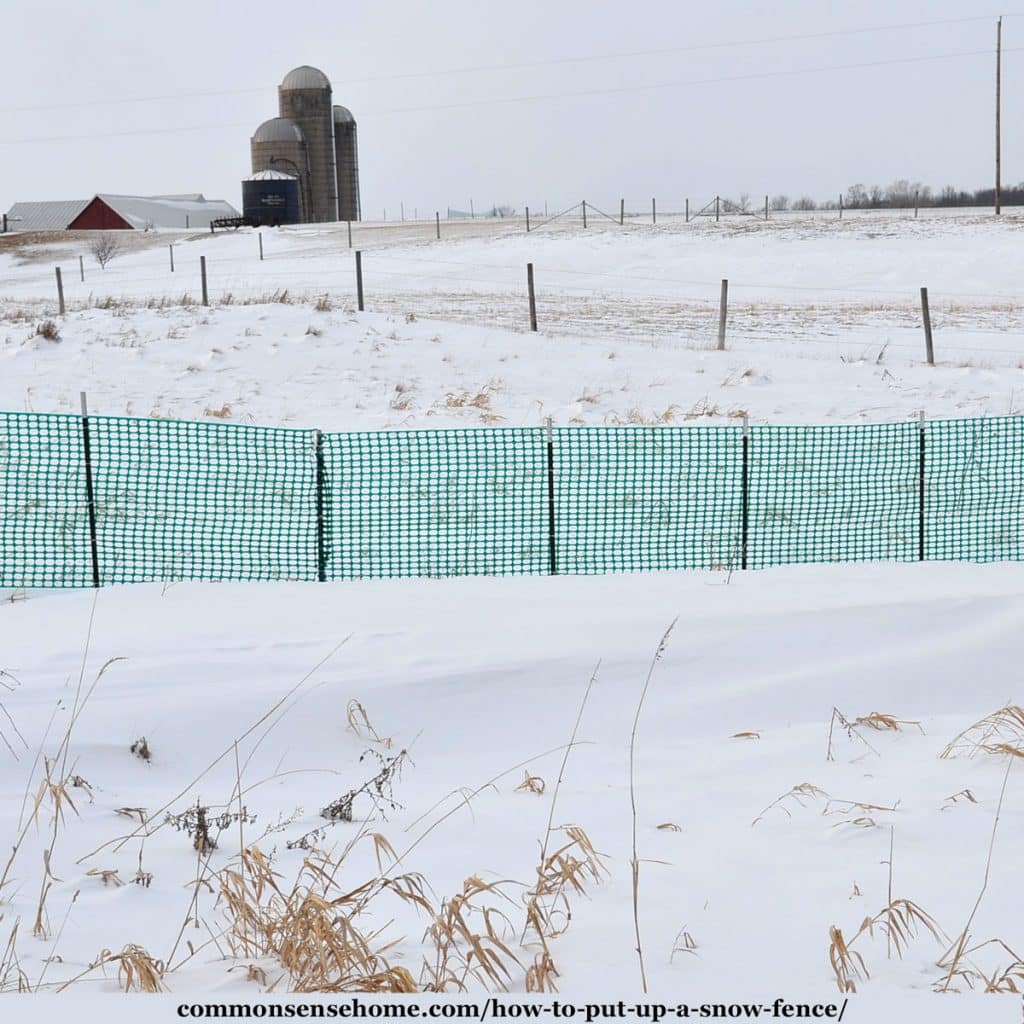
Our installation is fairly simple. We use plastic snow fencing attached to metal T-posts.
Materials
You’ll need:
- Snow fencing
- Sturdy fence posts
- Fence ties, wire, or heavy-duty zip ties rated for outdoor use (3-4 per post)
- Post driver
- Tape measure
- Gloves
We prefer sturdy T-posts because our site gets strong winter winds. Lightweight posts may work in more sheltered locations, but wind and snow can put a surprising amount of pressure on a fence.
1. Mark the Fence Location
Once you’ve identified the prevailing winter wind direction, mark the line where you want the fence. Remember that you’re really choosing where you want the snow drift to form.
Make sure there’s enough open space between the fence and the driveway or other protected area for snow to accumulate.
2. Set the Posts
Drive the posts deeply enough to stay secure through winter winds and frost. We generally space our posts about five feet apart because our location is exposed and windy. A more sheltered location may allow wider spacing, but I’d rather use a few extra posts than find the fence flattened after the first major storm.
Install the fence before the ground freezes. Driving T-posts into frozen Wisconsin soil is not my idea of a good time. We use 7 foot post driven approximately 1.5 feet deep for 4 foot tall fencing.
3. Leave a Gap Under the Fence
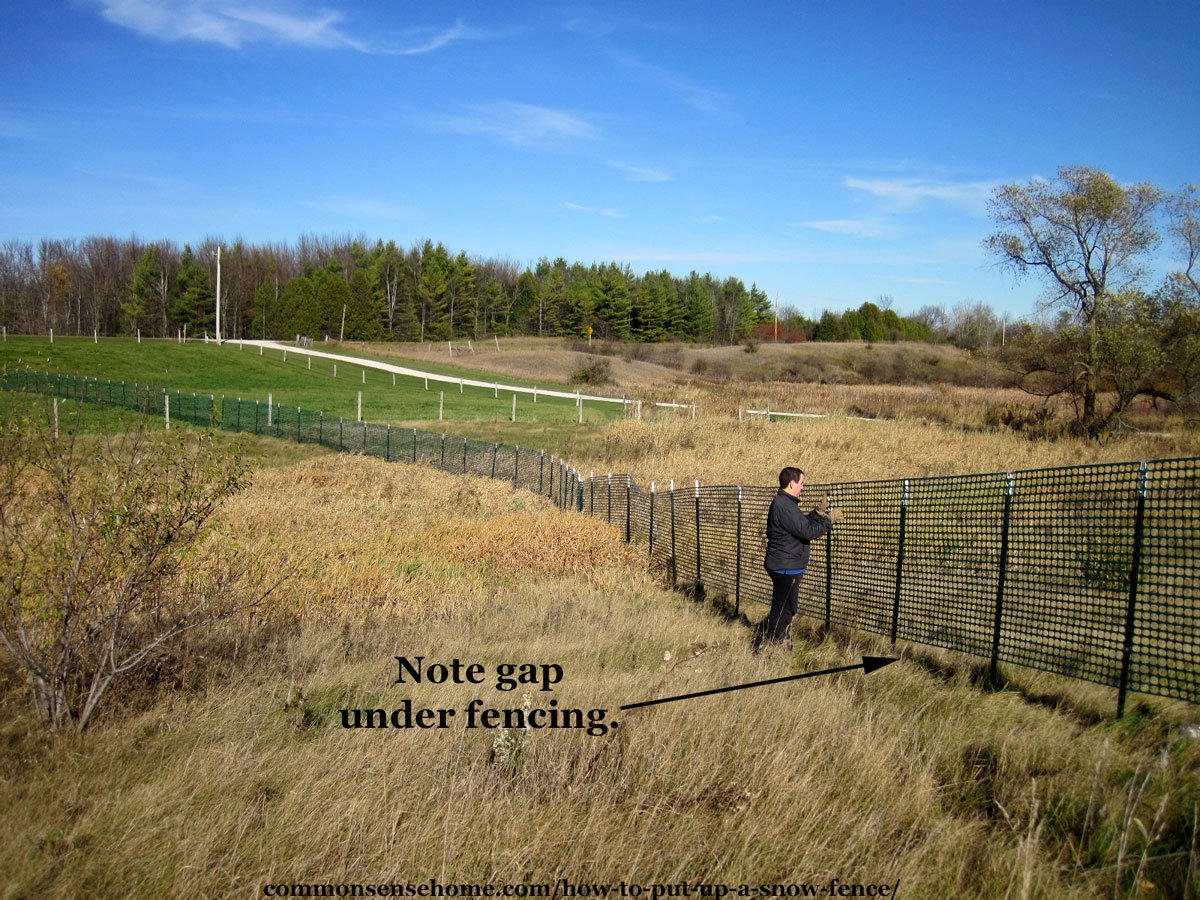
Don’t install the bottom of the snow fencing directly against the ground. We generally leave about 5 to 6 inches of open space under a four-foot fence. This allows air to move under the fence and helps create the airflow pattern needed to deposit snow farther downwind.
Keep tall grass and weeds in mind, too. If vegetation fills the gap, it changes how air moves through the fence. Mowing the fence line before installation makes the job easier.
4. Put the Fencing on the Windward Side of the Posts
Attach the snow fencing to the side of the posts facing the prevailing wind. That way, wind pressure pushes the fencing against the posts. If the fencing is installed on the opposite side, every strong gust pulls against the fasteners instead.
5. Stretch and Secure the Fence
Unroll the fencing along the posts and pull it reasonably snug. You don’t need to stretch plastic fencing like a guitar string, but you don’t want large loose sections flapping in the wind. Secure the fence at several points on each post.
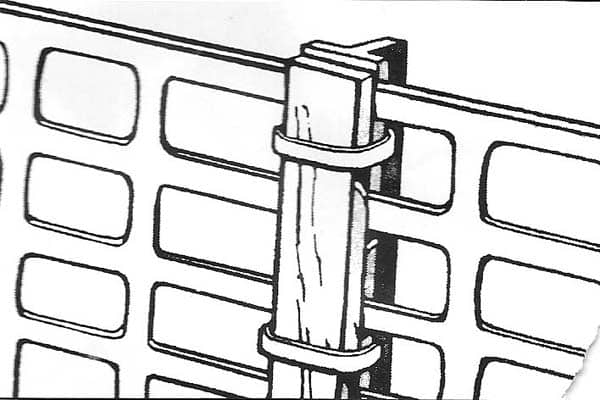
In high wind areas, it is highly recommended that the fence be sandwiched between the flat side of the metal posts and a 1″x 2″ wood slat. (See below.)
6. Check the Fence After the First Major Storm
Once you get a good drifting snow, take a walk outside and look at what happened.
- Where did the snow pile up?
- How far does the drift extend downwind?
- Is snow still reaching the driveway?
- Is one section of fence doing more work than another?
This information is more useful than blindly following a formula because it shows how snow actually behaves on your property. Take photos if you can (or drone footage). They’re handy when you’re setting the fence up again next year.
Does a Snow Fence Really Work?
Yes—when it’s placed correctly. We’ve seen a dramatic difference between areas protected by our snow fence and areas without fencing. Instead of snow sweeping across the open field and dropping into the driveway, much of it accumulates behind the fence.
In our case, we clearly see the drifting on the downwind side of the fence. The video below is from February 2019. (Please make sure adblockers are disabled so video displays correctly.)
The fence doesn’t eliminate snow removal. We still live in Wisconsin. It simply puts a lot more of the snow somewhere we’d rather have it. And when the wind is howling and the driveway stays mostly open instead of filling with a deep drift, that’s a worthwhile improvement.
Taking Down and Storing a Snow Fence
The fence comes down each spring once the main risk of heavy snow is past. We use a wire clipper to remove the zip ties, and gather them up for disposal. Then we roll the fencing and store it for the summer. We remove the posts and knock the dirt off.
We don’t leave the snow fence up all season, because the materials would degrade sooner due to sunlight and general weathering. Part of the fence goes through the neighbor’s hay field, so he needs access during the growing season.
Snow Fence Alternatives
A temporary snow fence isn’t the only way to control drifting. Depending on your property, other options include:
- Wooden slat snow fencing
- Permanent porous fencing
- Shrubs
- Evergreen trees
- Mixed tree and shrub windbreaks
- Existing hedgerows
- Strategic landscaping and earthworks
Permanent plantings take longer to establish, but they can provide benefits beyond snow control, including wind protection, wildlife habitat, privacy, and reduced heat loss around buildings.
From Snow Fence to Living Windbreak
A temporary snow fence can actually help with permanent planning because it lets you experiment before committing to trees that may be there for the next fifty years.
Watch where the snow moves. Notice which areas stay sheltered. Pay attention to wind direction. Then use those observations when planning permanent windbreaks.
Learn more about windbreak design.
This approach applies to more than snow fencing. Good homestead design starts with paying attention to what the land is already telling you.
Make Your Home More Winter Resilient
Keeping snow off the driveway is only one part of making winter easier. If you live where cold, snow, ice, and winter power outages are part of life, a little preparation ahead of time can save a lot of trouble later.
You may also find these helpful:
- Winter Preparedness Checklist – Simple steps to get your home, vehicles, supplies, and family ready before severe winter weather arrives.
- How to Stay Warm During a Power Outage – Practical ways to conserve heat and stay safe when the power goes out.
- How to Prevent Frozen Pipes – Protect your plumbing before temperatures plunge.
Winter preparedness doesn’t have to mean preparing for some dramatic disaster. Sometimes it simply means not having to shovel the same stretch of driveway three times after one windy snowstorm.
Build Resilience One Practical Step at a Time
Snow fencing is a good example of the way we approach preparedness at Common Sense Home. You don’t need to anticipate every possible emergency or change everything at once.
Look at the problems you’re most likely to face. Start with practical improvements that make everyday life easier. Pay attention to what works, and build from there.
That’s how resilience grows—from ordinary skills, useful supplies, thoughtful design, and small actions repeated over time.
If you’d like help deciding where to start, download our Common Sense Preparedness Quick Start Checklist for practical steps you can take this week.
Get the Common Sense Preparedness Quick Start Checklist.
And for a more complete approach to food, water, home and shelter, hygiene and waste, and developing a prepared state of mind, see Common Sense Preparedness: Building Resilience for Uncertain Times.
Have any questions? Leave a comment below.
About the Author

Laurie Neverman has a BS in Math/Physics and an MS in Mechanical Engineering. She and her family have spent more than 20 years building and adapting their northeast Wisconsin homestead for cold, windy winters. Their home and property incorporate passive solar design, wood heat, renewable energy systems, backup power, windbreak plantings, and several hundred feet of seasonal snow fencing.
Laurie is the author of Common Sense Preparedness: Building Resilience for Uncertain Times and the creator of Common Sense Home, where she shares practical ways to build a more resilient and abundant life.
Originally posted in 2015, last updated in 2026.
Hi we live in colorado on the plains we are looking at installing a wood 6 foot fence to keep snow from building up on the goat yard. i saw you say its 6 footx 35 feet we already have a wood fenc to keep dogs in and its about 210 feet away we have high winds here we thought if we put the fence about 50 feet away frim the walkway going to the animals. it possibly would break enough of the wind/snow what do you suggest we had a blizzard already with 6 feet high not including drifts. we thought wed put a few 6 ft high panels up to try it before we get crazy laying it. thanks for any suggestions
If I’m following correctly, you want to layer your fences, correct? This is a functional thing and should help with the snow build up.
For more information on layering fences, I’d recommend checking out the article on Windbreak Design. There’s a section near the end of the article specifically about our windbreak setup that includes a video showing where the snow stacked up after a storm with different windbreak combinations. There’s a shrub line, trees in combination with fencing, other types of vegetation, and a snow fence on its own. There are also diagrams with layout suggestions.
The instructions say to use T posts but the pictures show what looks to be driveway markers for posts. What type of posts are the best to use for a snow fence? I want it to serve as a snow and windbreak fence in Kansas with high prevailing winds.
6 foot tall T-posts should be used, as noted in the instructions. In the photos, the fence itself is 4 feet tall. The T-posts it is mounted to are 6 feet tall, as noted. They are driven into the ground about 1 1/2 feet, so that there’s a half foot gap below the fence.
We get a fair amount of wind, so we place our posts about 5 feet apart, as noted. I have not used the extra wood slats on the fence posts to reinforce the fence and it is still holding up. My son standing next to the fence in the 4th photo is just under 6 feet tall, for a size comparison.
I’m looking for a snow fence or wall to keep my neighbors snow from his roof coming down into my yard. He’s above us we’re down below. His snow from his roof is like a Avalanche into my yard, I would like to hold it back somehow. Any ideas?
Standard snow fences aren’t going to help with a situation like that.
If you built some sort of heavy duty fence/barricade with a slope back towards his yard, that would shove the snow back towards him, but gravity is going to want to push it down towards you.
Maybe you could talk to your neighbor and try to work out some sort of snow clearing agreement?
Hello Laurie:
We put up our snow fence last fall and it has worked very well up to now. It just recently became buried in snow and is no longer doing such a good job. We drove the 6 foot T-posts in 2 feet and used 4 foot vinyl snow fence. As a result we did exactly what you said not to do !!!
As our fence crosses the TransCanada Pipe Line, we have to have their employees come and mark the area so we do not have issues with damaging the Pipe Line. Because of this we plan on leaving the wind fence up year round until the line of spruce trees gets big enough to take over. I know spruce trees work very well because we have another area similar area further along the road that is protected by a line of trees that was put in 30 or 40 years ago and we never have problems with that section of roadway (same road and wind direction).
What I want to know is do you think I could just lift the T-rails up 6 inches leaving the fence attached and thus creating a 6 inch gap under a 4 foot high snow fence. The T-rails are standing in clay. Do you think they would slip back down or become floppy?
I would welcome any suggestions you may have.
Sincerely, Esther
How bad are your winds? If you leave the fence up year round, it’s going to take a lot of extra wear and tear. We generally notice some degree of sagging by end of snow season, so I’m sure it would get worse if left up year round. Sunlight breaks down plastic over time, so it would shorten the lifespan of your fence, too.
I’ll vouch for the effectiveness of evergreen trees where you can plant them. Now that our treeline has grown up, we skip the fence in that area. The open field still needs the fence.
What I would suggest is leaving the posts in place but taking the plastic fencing down in the off season. That’s what we do in our stretch that goes between the farm field and the treeline that’s through a swampy area. That way you don’t need to remark the fence each year (or pound all those posts in), but your fencing will last a lot longer to give your trees time to grow.
Thanks for posting this. It was helpful. We have some gaps in the caragana trees that allow for drifting. The trees are on the outside of the fence. The drifting has grown up the fence and now our Pyrenees dogs have found freedom haha.
There’s an old fence on the outside perimeter which is outside the windward side of the property where I was thinking of putting a snow fence. I don’t think I can use the neighbour’s field, so I was thinking of using that old fence. I wonder if it would still work? It’s pretty close to the caragana row and against them in some spots
Thoughts?
A fence will slow down the wind, fi the angles are right. If you put up a temporary fence, you can see if you like the results. Then, if it’s acceptable, you can restore the permanent fence if you prefer.
Good call. I’ll try that this season, then make it more robust and permanent in the summer if it works over the winter.
Thanks
You’re welcome. I hope you figure out a functional solution.
After reading your post here from a few years ago, I decided to try a strip of snow fence this winter to prevent the annual big drift at the end of my drive way. I have to say I’m impressed after our first snow and very strong winds this past week in central Saskatchewan. I too went with the 60 foot distance with the snow fence running parallel to my lane. I put up a 50 foot length , 6 foot posts and 4 inches off the ground. Worked like a charm. Now I’m thinking how I can put up more fence line around my property to redirect snow in other trouble spots.
We still put up ours every year. 🙂
Hello, I have been following your comments for months and they are excellent. I have a much different problem. I cannot (and I have tried) to put a snow fence up anywhere from 20 to 35H away from my road in the mountains of CO. I have installed had to take my existing 10 ft high Wyoming snow fences and make them into barrier fences. So, I need your help?
What angle should I put up the fences? They are currently 10-15 degrees? I have taken the porosity from 50% to solid 7 feet high with 3 feet remaining at top. Do I need to make solid all the way up? And lastly how much distance should I have from the ground to the where the fence starts?
They are now 6 feet from my road.
Thanks, Tony
Hi Tony.
A snow fence 6 feet from your road is going to want to stack the snow right on your road.
I’m not sure what you mean by the angle for the fence. We put ours straight up and down (vertical, 90 degrees from horizontal), parallel to the road, perpendicular to the prevailing winds.
Your description doesn’t say where your winds are coming from in relation to your driveway, or what your terrain is like, but snow fences don’t work in every location.
I don’t recommend solid snow fences, for the reasons explained in the post. The gap between the fence and the ground should be high enough to accommodate expected drifting and still keep most of the fence above the drifts.
Laurie you have been fantastic at answering all these questions! I wnt through them all hoping mine would be answered but didn’t see it.
How far from the main road does the fence need to ‘end’ (for snow plows going by on the road). I have a long N/S driveway and due to an open field on the west side, the end of my driveway drifted constantly last year! I’d like to get the most bang for my buck without ending up with snow plow driver issues.
Would I benefit from making a ‘U’ shape where I do end it? To catch snow blowing/drifting around at the end?
Again, thank you so much for this!
Hi Bonnie.
Rules for required distance from road vary by state. If your area has ditches, I’d keep the fence on the house side of the ditch. Practically speaking, the area the snow plow needs is going to vary based on the terrain and amount of snowfall. We’ve had some winters where they had to break out the double decker blades that shove back the tops of the drifts above and beyond where the base of the drift is pushed back from the road.
Another option, if you happen to be friends with the neighbor across the road, would be to place a fence to the north of the road across the road – but that may be of limited help because it needs to be set back far enough that it doesn’t drift onto the road.
An extra loop of snow fence might help. It all depends on which direction those winds come from and if you can get that loop upwind of your problem spot. The only way to know for sure is to try it, and results may vary from year to year as wind patterns and snow fall shifts.
Thanks Laurie,
I’m also in Wisconsin and in the country. So, no ditch. I actually have cornfields on 3 sides of my house and just one house that’s nextdoor on east side. My house is on North side of my property so it stops drifting there. I get it terrible at the south end of my driveway though which is right by the road. It is a country road so plows come through maybe 6 times a year only so I doubt drivers will complain too loudly if my fence is too close!
Bonnie
We have sizable ditches – it varies from area to area.
There’s still likely a minimal setback requirement for visibility. You don’t want anything obstructing your view seeing out of the end of the driveway, or preventing others on the road from seeing you pulling out. If there are utility poles, you shouldn’t go out past the utility poles.
My driveway 20ftx30ft runs west of garage. The wind in the winter is dominant out of the north. Will a snow fence be ok 35 to 40 ft. north of drive way??
I would think it should help from what you have described. The only way to know for sure how effective it is is to test it.
Hi Laurie
So far your article has been the clearest addressing the problem of drifting snow but I still can’t figure out how to address my situation. I live in central Minnesota in the middle of farm country. My house sits on just over an acre on a corner. My house and driveway face west. My driveway is about 60 (?) feet long with a slight incline. There are fields all around me. The snow drifts terribly on the apron in front of the garage. Wind direction is from the west/north in the winter. There are small trees and bushes on the northwest corner of the property. Where should I put a snow fence?
Thanks for your help!
Valinda
Unfortunately, if I’m understanding your layout correctly, your driveway and home are not well positioned to be helped by a snowfence. If the slope is towards the house, and that garage door faces west – where much of the wind comes from – the snow is naturally going to be driven right down the driveway to pile up in front of the garage. You may see some improvement by putting a fence (or more plantings) to the north of the driveway, but if the wind comes from the west and the driveway comes from the west, you can’t block one without blocking the other.
My husband and I are spending our first winter in our new house, and have already come across the problem of our driveway drifting shut. We got a snow blower, which made a vast improvement, but the wind drifted it all back over again during the night. At this point, is it too late to put up fencing for this season? I was hoping we wouldn’t have too many problems, because the high-wind side is already supported by a property-line fence. Unfortunately, the wind whips around it instead, since that isn’t the purpose of the fence. I could probably figure out the best placements for the fencing using this page as a guideline (as well as some trial and error), but not sure if I’m getting it too late for this year. We’ve spent most of the weekend under blizzard-like conditions (and it’s Monday now, with a blizzard warning in effect until Tuesday at noon), so definitely could use a snow fence.
Can you physically put the fence up? Around here, our ground is frozen, so it would be extremely tough to put a fence up at this time of year. If you can put the fence up, it’s not too late. Plenty of winter left.
We have some pretty tall drifting, and our ground is likely frozen. We’re in southeastern Notth Dakota, so it may be too late for this year to get anything up at this point.
Yeah, if you’re in North Dakota, odds are your ground is frozen by this point.
What a great article and follow up comments. I am considering this solution to prevent snow drifts from blocking off heater and hot water ventilation pipes, which then shut down my systems. The only thing is the drifts occur between my neighbor and my house where We only have roughly a 30 foot corridor. The wind is coming from east and I was thinking of placing fence angled past the back of my house running it north/south, or would it be better closer to these ventilation pipes. The drifts get so bad that I have to go out in the middle of the night during a storm to clear out the area. I am 70 years old now and cannot see myself doing that much longer. Is there a particular mesh design that is better than others? Thank you for your insight.
Without a site diagram it’s a little tough to tell exactly what’s going on, but with the tight conditions, you might want to try putting the fence directly on the ground so that the snow starts to pile up as close to the fence as possible – not near your vent pipes.
Remember, the goal of the fence is to slow down the wind and drop the snow near the fence instead of in the area you’re trying to keep clear. So – east wind + north south fence = makes sense. Farther away from pipes – check. If snow gets so deep it is likely to bury fence on ground, mount fence with gap underneath. If snow gets less deep, ground mount will probably get the job done, and be a little easier to get done.
From what I’ve seen, snow fence comes in standard mesh size, just a couple different colors. There’s also the wooden fence, but that’s a little heavier and bulkier. If you can draft some young muscle into helping put up the fence, so much the better. The shorter rolls are lighter, of course, so get only as much as you need. You can usually find it in 25′, 50′ and 100′ lengths.
Can you attach a snow fence to an existing fence? Say a five strand wire fence.
Possibly. You’d need supports at least every 8 feet, and a way to attach to your fence posts. If you’re already using t-posts an the fence is not electrified, it should be fairly straightforward to add on a snow fence seasonally. The location for one fence might not be the optimal location for the other, but if you have a situation where it is, so much the better.