
Phytophotodermatitis – Plants That Cause It, How to Treat It

This post may contain affiliate links. Read my full disclosure here.
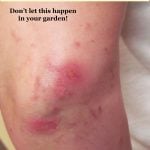
I’m sharing my story here so you don’t make the same mistake I did, and end up with Phytophotodermatitis (PPD). Phytophotodermatitis is also known as plant and sun dermatitis, parsnip burn, and sometimes lime disease (not to be confused with Lyme disease) or margarita photodermatitis. You get it from exposure to plant sap or juice and sunlight, as outlined below. We’ll cover plants that cause phytophotodermatitis and how to treat it.
Would you like to save this?
This was not parsnip burn from exposure to some “poison parsnip” or giant hogweed. I was working in my garden. Garden parsnips and wild parsnips are the same species, and it turns out they can cause the same problems. Several other plants can cause the problem, too.
I originally wrote this post in 2014, and unfortunately ended up with another smaller case in 2018. I thought I was being careful, but apparently not careful enough.
The pain doesn’t start until days after sap and sun exposure. By then, the damage is done, and all you can do is treat the symptoms.
What is Phytophotodermatitis?
Medscape defines Phytophotodermatitis as:
Phytophotodermatitis (PPD) is a cutaneous phototoxic inflammatory eruption resulting from contact with light-sensitizing botanical substances and long-wave ultraviolet (UV-A 320-380 nm) radiation. The eruption usually begins approximately 24 hours after exposure and peaks at 48-72 hours.[1] The phototoxic result may be intensified by wet skin, sweating, and heat.
In other words, your skin erupts with blisters and itchy, burning red areas because you were in contact with plant chemicals (in this case, parsnip and carrot sap) and exposed to sunlight.
You don’t realize you’re in trouble until several days after exposure, by which point, you’re skunked. This is one of the aspects that makes PPD different from most other contact dermatitis. If you’re working with wet plants on a hot summer day, it’s going to be worse. (That’s what happened to me.)
If you visit the Medscape website, they go into a detailed explanation of how the chemicals in the plants that cause the damage (Furocoumarins) are activated in stages under different conditions, and how they actually damage the DNA of the skin.
You cannot “wash off” phytophotodermatitis chemicals with soap and water once they are activated by UV radiation. I did shower after working in the garden, but it didn’t do any good. Washing may help limit additional damage.
Is Phytophotodermatitis contagious?
Nope. Only those directly exposed to the problem plants and conditions experience skin reactions.
The only case that might be an exception is berloque dermatitis, a special type of phytophotodermatitis caused by perfumes. There are older perfumes that used oil of bergamot. (Bergamot is one of the citrus fruits that can trigger PPD.)
If one person applied the problem perfume and was in close contact with another person, they might spread the perfume – and the skin condition. It’s unlikely, but possible.
I do think that the fluid from the blisters *might* encourage the formation of additional blisters (on the same person). I’ve had blistered areas spread without additional plant exposure. It’s possible some of the fluid from the blisters got smeared over a wider area due to the blister being bumped or scratched. I have not been able to confirm this.
Which Plants Cause Phytophotodermatitis?
Here’s a kicker – there are wide range of plants that can cause this condition that you might never suspect.
Plants that may cause phytophotodermatitis include (but are not limited to):
- Parsnips (Pastinaca sativa)
- Carrots (Daucus carota subsp. sativus)
- Celery (Apium graveolens)
- Gas plant (Dictamnus albus)
- Parsley (Petroselinum crispum)
- Wild Parsnip (Pastinaca sativa)
- Queen Anne’s Lace (Wild Carrot) (Daucus carota)
- Giant Hogweed (Heracleum mantegazzianum)
- Limes (Citrus × aurantiifolia)
- Figs (Ficus carica)
- Chrysanthemums – Chrysanthemum genus, aster family
- Common Rue (Ruta graveolens)
- Russian sage (Perovskia atriplicifolia)
Those who are into botany will notice that the top six plants on the list are all related to each other (they are members of the Apiaceae family). Some of you may have also heard about getting blisters from wild parsnip or poison parsnip, but may not have realized the garden parsnips can also cause burns. Garden parsnip and wild parsnip are both different varieties of the same species – Pastinaca sativa. The veggies typically cause burns on agricultural workers and grocers, who handle large quantities of plant material.
The Medscape site shows a rather nasty blister that covers about 1/3 of the forearm of a flight attendant who spilled lime juice on her skin. The phytophotodermatitis from limes is also referred to as “margarita dermatitis” because of all those poor folks who have sucked on their limes in the summer sun.
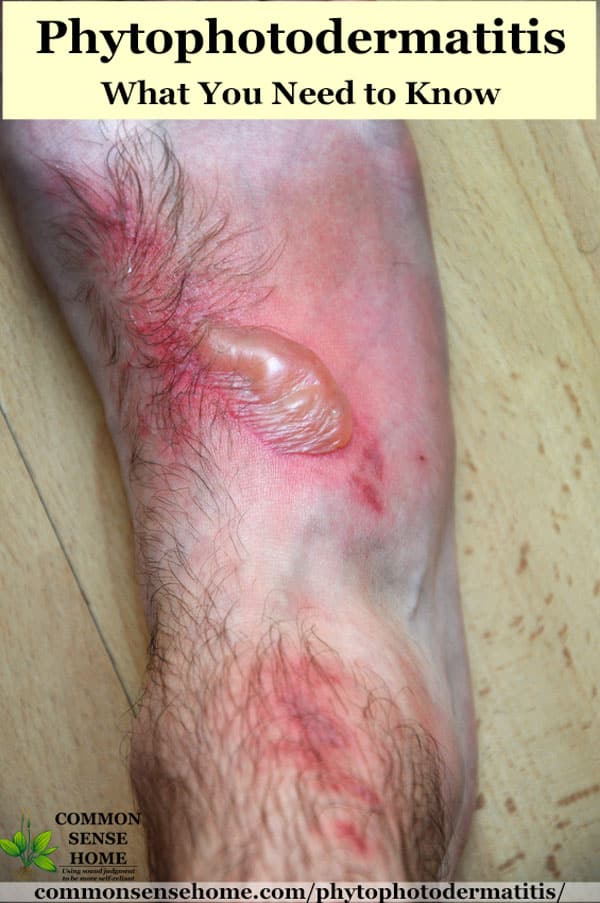
The wild parsnip burns (and those from other wild plants like hogweed or queen Anne’s lace) can be some of the worst, because people do terrible things like running weed whackers with shorts on and get their legs all covered with little bits of parsnip (and sap), like the poor guy featured in the article “Burned by Wild Parsnip” in Wisconsin Natural Resources magazine. The photo below is as example of how large the blisters can get.
I’m Going to Stop Growing “Poison Parsnips” Because They’re Too Dangerous
No. I’m not. I’m not skipping the carrots, parsley or celery, either.
In all my years of gardening, these past couple of decades on my own and helping mom out growing up, I’ve never been burned by garden parsnip before. I did get about an inch long blister from wild parsnip, but none from garden parsnip.
Here’s what I screwed up:
I was working in the morning, so the plants were covered in dew. More moisture = wet skin.
It was hot, so I was sweating = more wet skin + heat, both triggers for phytophotodermatitis.
The area I was working on was roughly 80 square feet, very thickly planted, mostly with carrots and parsnips. I had thinned and weeded the patch when the plants were younger, but this round of thinning took place when the plants were a couple feet tall.
The only way to reach the roots to pull them out was to stick my arm into lots of foliage. (Lots of exposure.) I gathered up the bundles of plant tops after removing the roots with my bare arms. (More exposure.)
By the time I finished, it was pushing midday, with a bright, beaming blue sky = lots of nice, intense sunlight.
In my 2018 case of phytophotodermatitis, I allowed queen Anne’s lace to grow in the greenhouse as companion plants for the tomatoes. I was trying to thin them out as the greenhouse became more crowded. It was hot, humid and sunny. I must have broken some of the stems, and got the sap on my hands and feet.
What I Should Have Done:
The simplest thing I could have changed was to wear long sleeves and gloves to cover up my skin. Problem solved.
Alternatively, not handling the broken plants with bare skin, or thinning harder when the plants were small so I didn’t need to stick my arms into a thicket would probably also have done the trick. That said, we have been enjoying the carrots and parsnips I picked. 🙂 No more wild carrots in the greenhouse. It’s simply too easy to get accidental exposure while working around the plants in close quarters.
How do you Treat Phytophotodermatitis
Like a standard burn, you can apply cool compresses to relieve the pain, and try to keep blisters intact as long as possible to protect the tender skin underneath. Over the counter itch cream like those for poison ivy may also help, along with anesthetic creams like Aspercreme.
I hit the pantry and the garden for treatment options.
On the first couple of blisters, I used fresh plantain and yarrow leaves, mashed and applied as a poultice. As more blisters showed up, I coated the worst blisters with manuka honey to promote healing and fight infection. You can read more about using honey for wound treatment in the post, “Honey as Medicine“. With over 30 blisters on my arms and hands, the honey was a little awkward to try and use on all of them, so I made up some comfrey salve with lavender essential oil.
I coated the burns several times per day with the salve, and at one week after exposure, some of the scabs fell off to expose new skin underneath. The burns on my hands and elbow didn’t heal quite as fast. My hands spend way too much time being beat up during canning and gardening season, so I can’t keep bandages on them, and the elbow is just awkward to keep bandaged.
Be patient. Badly affected areas may take weeks to months to heal, depending on the damage. I still have dark areas on my skin a year after exposure from the worst spots.
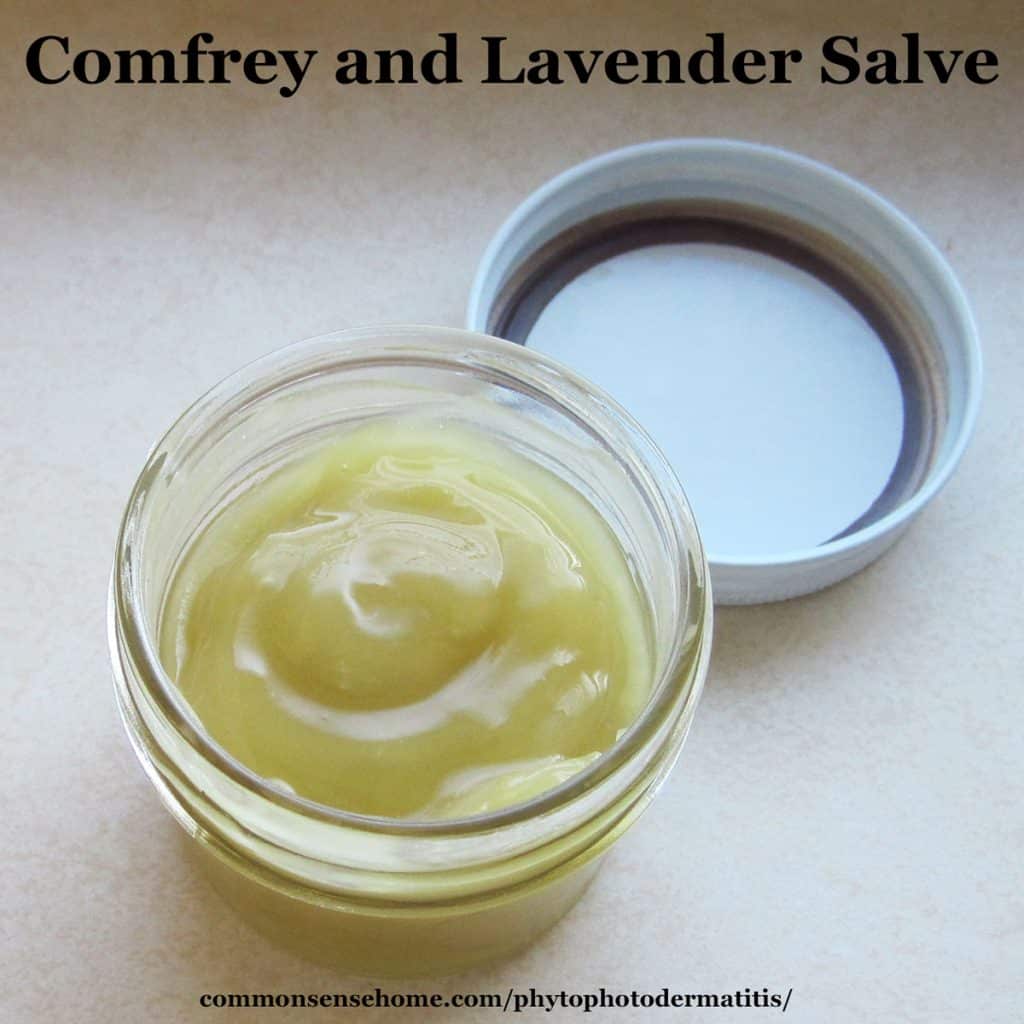

Comfrey and Lavender Salve Recipe
Adapted from the Herbal Academy
Ingredients
- 1 cup organic extra virgin olive oil
- 50 drops of lavender essential oil
- 1 ounce organic dried comfrey leaf
- 1 ounce beeswax
Directions
- Pour olive oil into a double boiler or small, heavy bottom pot. Add comfrey leaves.
- Heat over low heat for 60 minutes, stirring occasionally. You’re looking for gentle heat, not boiling.
- Remove from heat. Strain and compost comfrey, reserving infused oil.
- Melt beeswax in a clean pan over low heat.
- Once melted, add herbal infused oil and lavender essential oil. Mix well.
- Quickly pour salve into tins or glass jars and allow to cool before placing lids on and labeling.
The HANE website notes that “Comfrey contains allantoin, an anti-inflammatory phytochemical that speeds would healing and stimulates growth of new skin cells.” The HANE burn cream recipe also includes one ounce each of dried plantain, calendula and St. John’s wort to bump up the healing power a little more.
Photos of Phytophotodermatitis
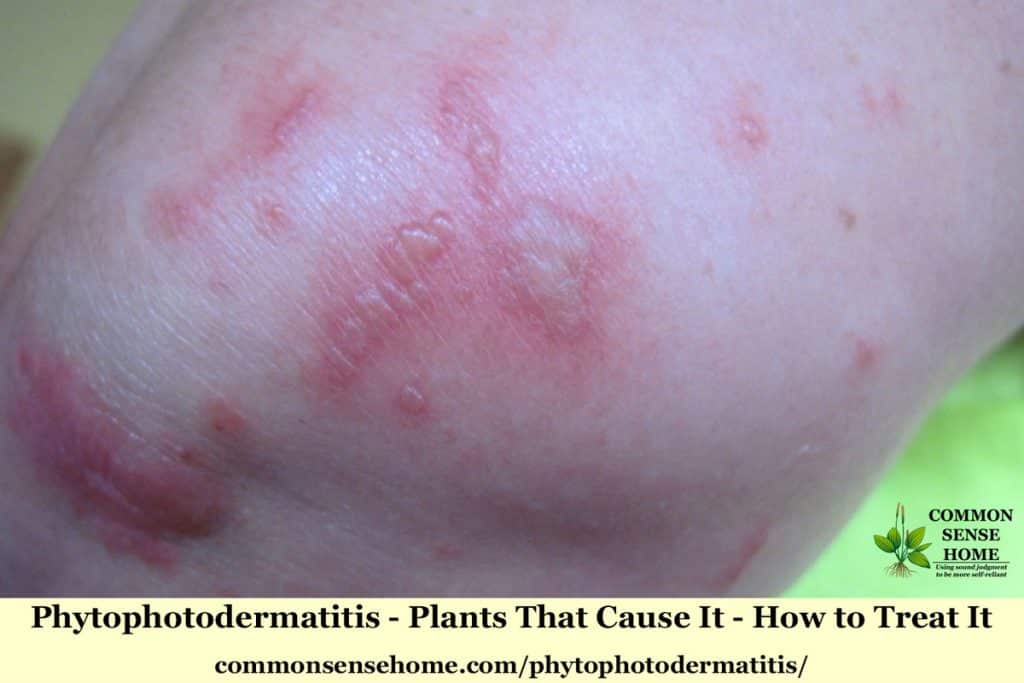
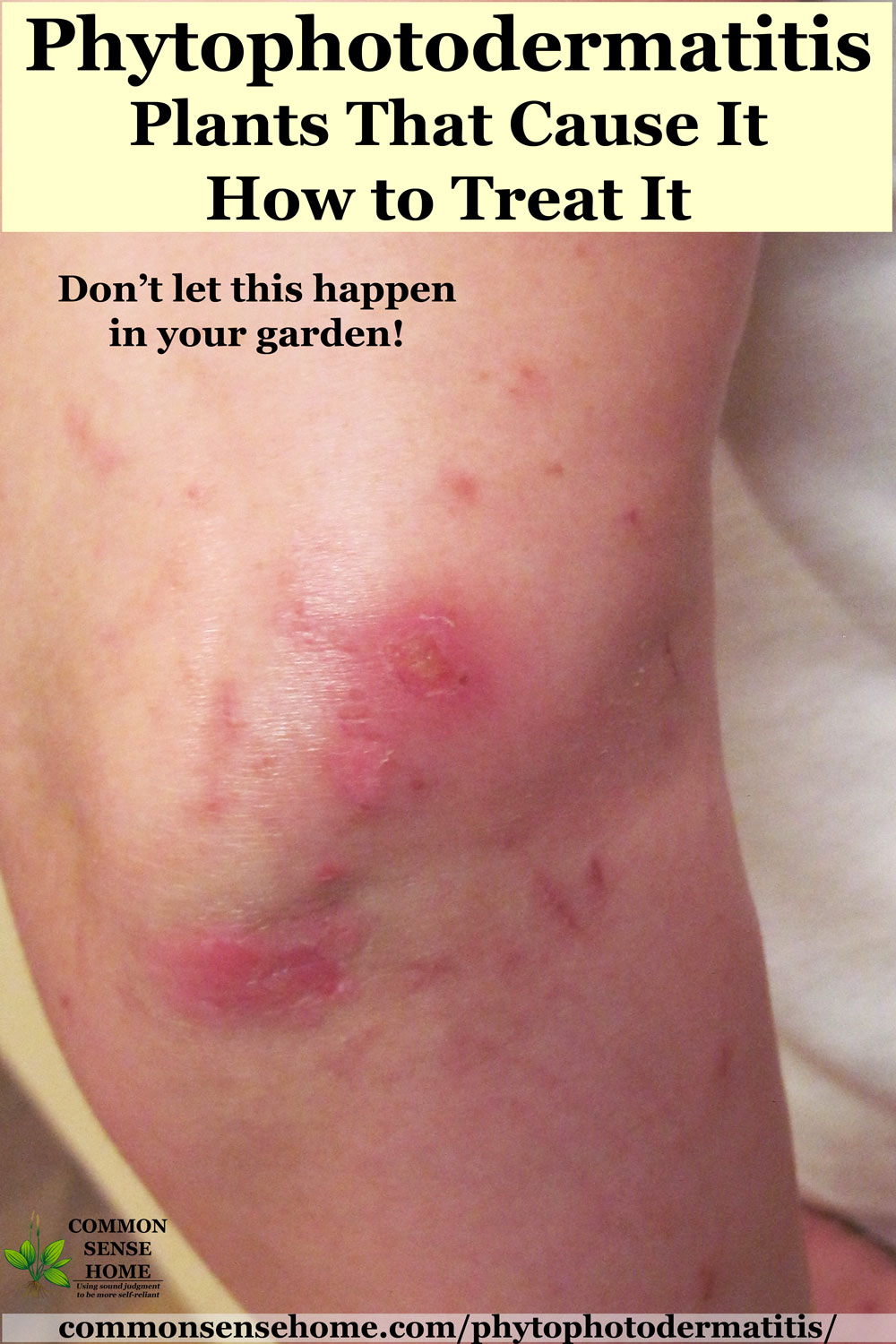
Just so you can see how the eruptions progressed, I’ve included some comparison photos of the affected skin below. The image at the top of the post is my left elbow on day three after exposure. 24 hours earlier (48 hours after exposure), there was only one blister.
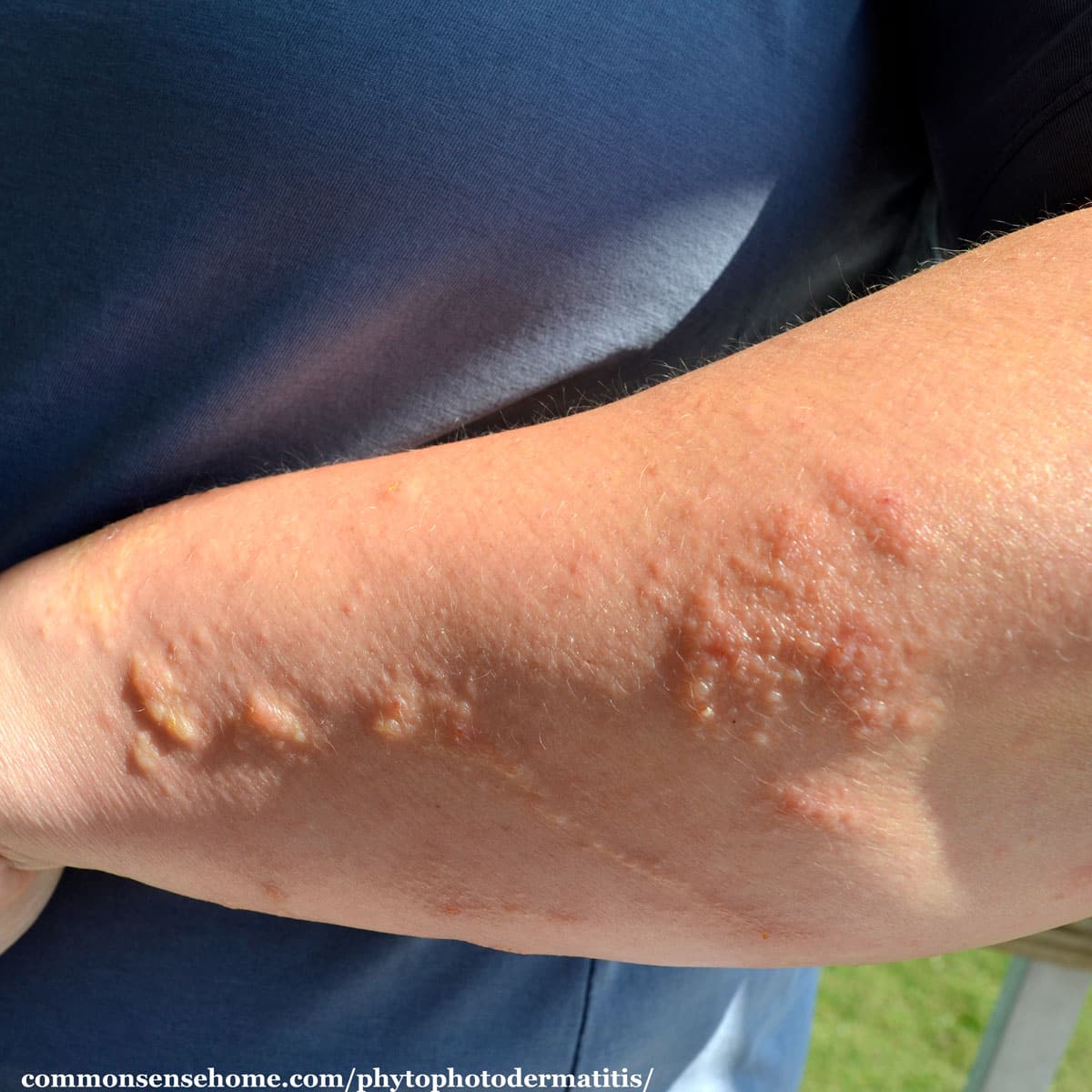
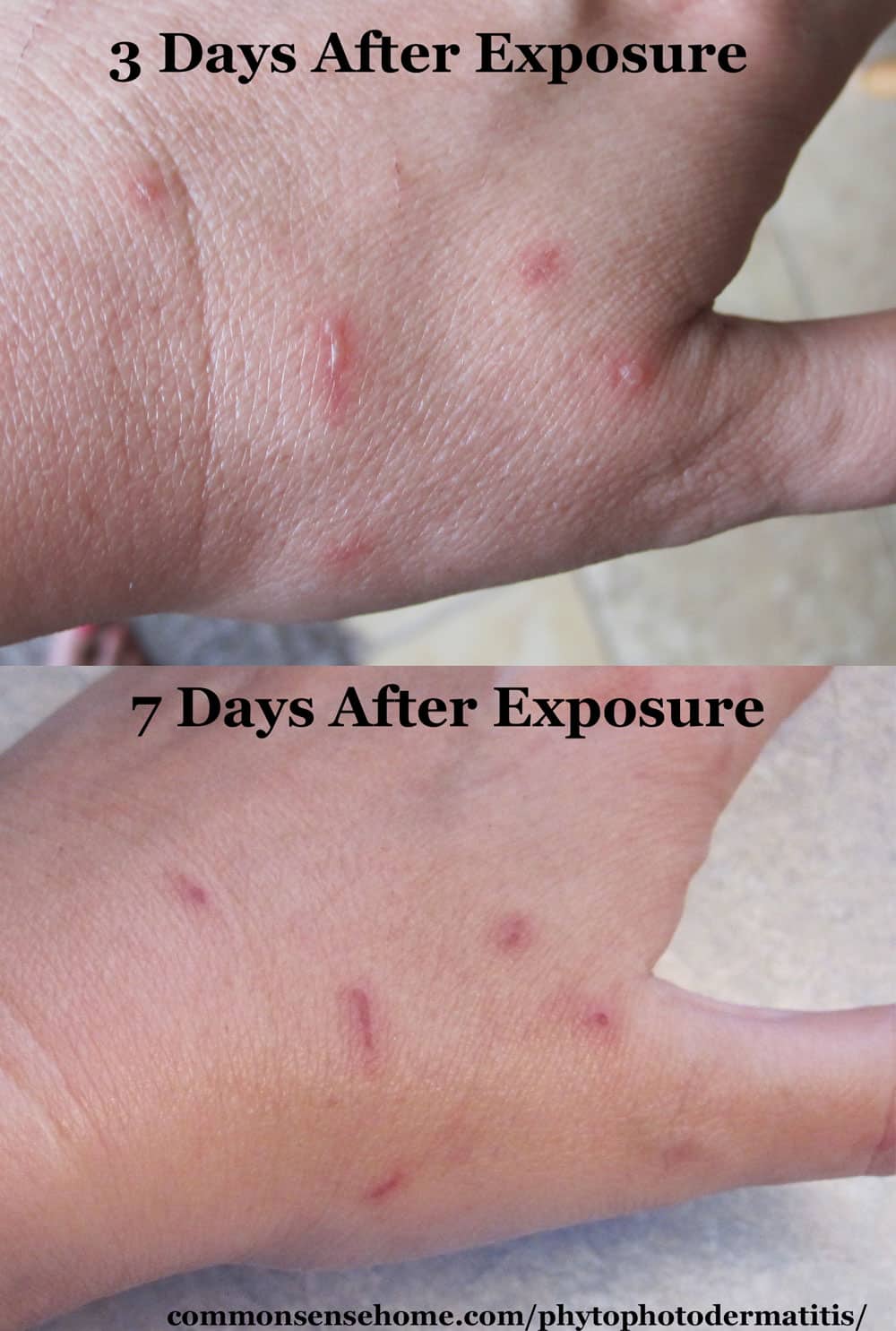
My left hand at day 3 and day 7 after exposure. Day seven may not look much better, but it feels much better. No more burning and itching.
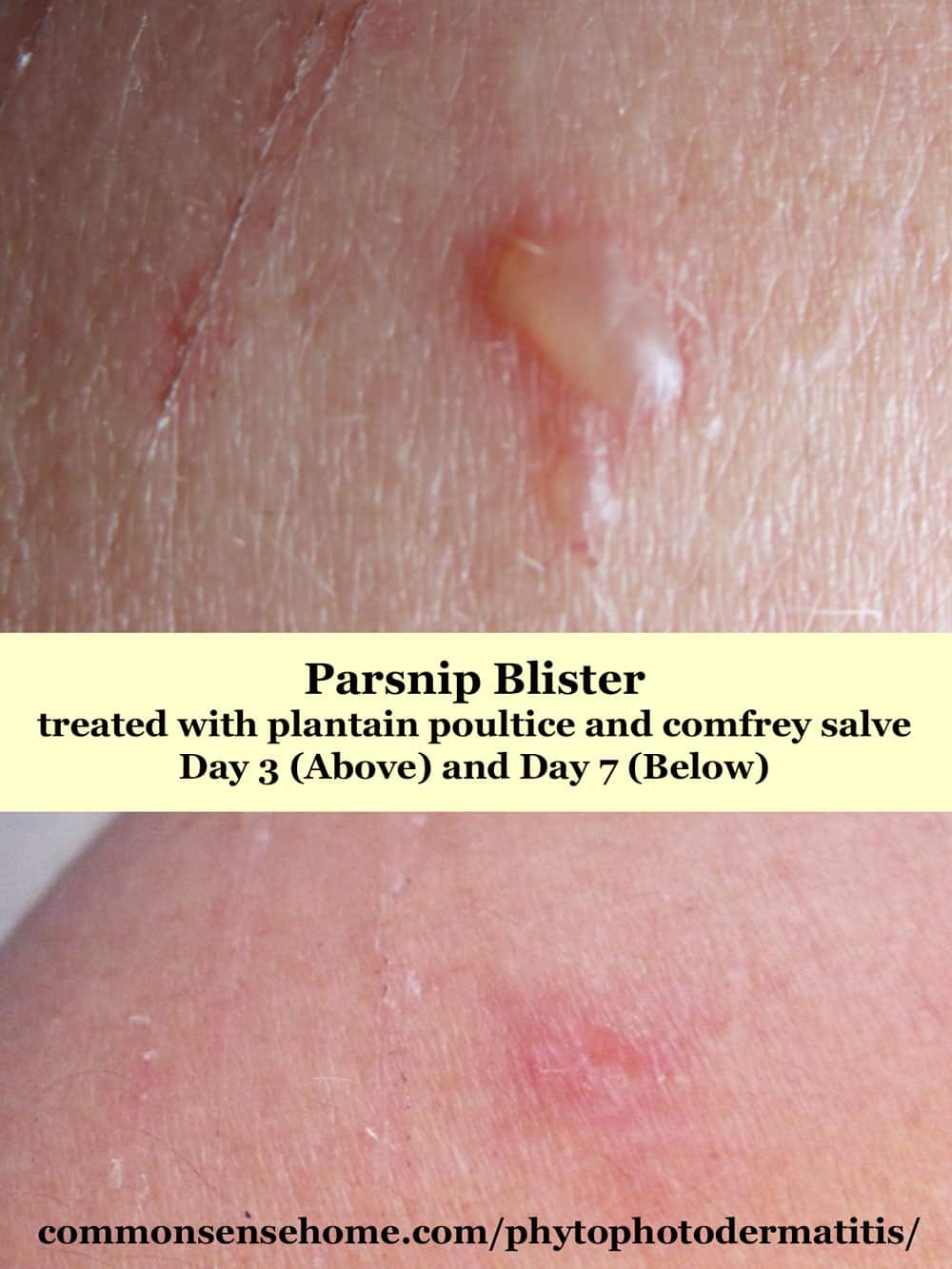
One last shot. A blister on my right arm that was one of the first to appear that I treated with a plantain poultice followed up by a day of honey and ongoing use of the comfrey salve.
Don’t fear the plants, just don’t handle them in such a way that you set yourself up for some serious discomfort. Learn from my mistakes. 🙂
July 2019 – I’ve run into this again. After helping to clear an overgrown area near the greenhouse in shorts and a t-shirt, I ended up with blisters on my arms and legs. I didn’t see any queen Anne’s lace or other trigger plants, but they must have been in the mix.
I suspect repeated exposure may make you more likely to have a skin reaction.
The video below highlights this year’s exposure. (Make sure any ad blockers are off to get the video to display.)
You may also find useful:
- 9 Home Remedies for Dry Skin – Soothe Dry and Flaking Skin Naturally
- Grandma Called it Medicine Leaf
- Herbal Antibiotics – the Top 15 Herbal Antibiotics
Originally posted in 2014, updated in 2018.
What a timely post. Last night my son came to me with something that looks more like you 7 day photos but some did have what I thought was a bite mark but could have been a blister forming. He had about 5 spots on his arms, one on his ankle, and one very big one on his foot. He had helped some friends of ours harvest hay a few days before. I thought something had bit him in his bed but now I think it may have been something in the hay. When I thought it was a bite, I used a charcoal paste on it. The swelling is some better and there still isn’t signs of a blister yet. Just thought I would share the charcoal part in case it would help someone else. Thanks again!
Thanks, Penny. I hope he feels better soon. Charcoal is a good detox agent.
Hi. I know this isn’t a blog for Poison Oak, but many have mentioned it here. I recently had a big scare regarding the burning of Poison Oak. I deliver mail in rural areas. Every year, when people begin burning, I get VERY nervous! This year, I drove by someone in the brush, burning. Usually, it is 72 hours before I feel the burning and stinging of the rash beginning to come out on my skin after exposure. less than 24 hours later, I felt it. PANIC! I found a doc.x I had copied with these instructions, very different from the over 100 pages of P.O. remedies:
“Bringing down the inflammation
Even so, there’s more to healing the poison ivy rash than just eliminating the itch. To bring down the inflammation from the inside, it’s important for one to eat the powdered roots of burdock (1tsp.), turmeric (2T), and ginger (1T), up to three times a day.”
“It’s equally important for one to submerge the affected areas in an infusion of water mixed with oatmeal, apple cider vinegar, activated charcoal, and various essential oils like tea tree and frankincense. Taking baths in this mixture helps. If the poison has invaded one’s face or eyes, it’s safe for one to dunk their face into a sink that is full of these ingredients several times throughout the day.”
“Drawing the poison out and disinfecting the area
After soaking the affected area in these anti-inflammatory and soothing treatments, one should use a skin-drawing and pore cleansing clay mixture to pull poisons and toxins from the skin. This skin mask, which includes bentonite clay, activated charcoal, turmeric, and red Moroccan clay, is powerful, especially when used with tea tree essential oil and water to make the clay into a paste. After allowing this mixture to dry on the skin for 30 minutes, the poisons are drawn out. At this point one can disinfect the area by washing with soap and water.”
I immediately began the internal drink, taking it three times a day, and made a mask of turmeric, redmond clay, (bentonite clay), activated charcoal, Apple cider vinegar, oatmeal ground fine, a drop each of tea tree and frankincense essential oils, and a tiny bit of water to make a paste. I used the mask three times at the first sign of the burning and stinging. I only got one tiny blister on the bottom of one eyelid! The face and scalp did have “phantom” itching, and still do days later, but no sign of the weeping oozing blisters for a minimum of 7-10 days!
There has NEVER, and I do mean NEVER been anything that has helped me with Poison oak, until this. leave the mask on for at least 30 minutes, then rinse with cool water, making sure not to rub too hard, or at all. This WORKS! The clays and Activated charcoal and turmeric draw out the toxic oils, and the ACV and E.O’s help with the antibacterial aspect. Oatmeal is soothing for skin irritations.
I bet it would also work on this type of ‘burn’.
Wow! How awful. Thanks for sharing your experience and the remedies that you used. It could save someone a lot of misery.
I want to see a picture of the plant that caused this. Thanks
All the plants in the carrot family can cause this, such as:
Carrots
Parsnips
Celery
And parsley
Are Angelica and Lovage in the same family? Their appearance is similar to parsley and they get very large, though not as large as Giant Hogweed. Thought I have never had a reaction to any of the herbs in this family besides cow parsnip, I have never tangled with Giant Hogweed. I do eat a lot of celery leaf, celery stalk and parsley and love the scent of angelica stalks. I wonder if the edible cousins in this family might tend to de-sensitize us?
Yes, same family “Angelica archangelica, commonly known as garden angelica, Holy Ghost, wild celery, and Norwegian angelica, is a biennial plant from the Apiaceae family” and “Lovage, Levisticum officinale, is a tall perennial plant, the sole species in the genus Levisticum in the family Apiaceae, subfamily Apioideae, tribe Apieae.”
I eat a lot of carrots, parsley and celery, but under the right (or wrong) conditions, I still ran into trouble.
That looks almost exactly like what my daughter and I get when exposed to gluten. I had it on my elbows and off for years and did not really know what it was. My daughter had hers on her knees and the dermatoligist decided it needed to be biopsied because he had tried everything he could think of. It came back as celiacs! That is not a pleasant rash, itches like crazy!! I may try your salve. I’m all about natural remedies!!
Did you see the psoriasis series? Unrelated to this (I think), my skin went nuts last year. Turned out to be a combination of psoriasis and candida overgrowth. I didn’t test positive for celiac, but am eating gluten free and adjusting my diet in other ways, and it has made a huge difference.
First post in the series – https://commonsensehome.com/psoriasis-the-year-my-face-exploded/
I have a terrible rash, it started as a spot on my waist, i thought maybe a spider bit me while I was gardening. Then a rash developed and started to spread.
The first doc thought impetego, gave me medicine. The rash got worse. Second doc said hives, a reaction to something my skin came in contact with, gave me benadryl and hydrocortisone..and something to supress my immune system. The rash is spreading all over in little new eruptions on legs and arms and neck…the original one is all over my torso a solid block and my skin feels like leather there. Third doc thinks a reaction to a plant.
I’m not sure if I’m making it worse with epsom salt baths but it relieves the pain for a short while.
It looks like the wild parsnip burn but maybe it is infected or something. I am in Eastern Ontario, and the doctors here don’t seem to be familiar with this rash or have any good information on how to treat it.
There’s no way I can safely diagnose over the internet. If it was parsnip or other topical exposure, the wounds should have healed over time, not spread. Have they checked for Lyme’s diesease? I’ve heard of rashes associated with that. Another possibility might be candida overgrowth. For many months last year and into the first part of this year, I battled what looked like a weird rash. You can see some photos of my midsection here – https://commonsensehome.com/psoriatic-skin-causes/, and there are links to other post in the series. My skin has gone through a lot in these past couple of years, but thankfully I’m doing much better now.
You may also want to be checked by a dermatologist to see if you have psoriasis. This sounds very similar to my own experience. It started out as small blisters and red/rough spots, and spread like a rash. After a couple of musdiagnoses, a dermatologist finally identified it as guttate psoriasis. Weirdly enough, my brother, who lives 600 miles away from me, developed the same condition 3 months after I did.
Hello Laurie, This is the second time I have broken out in this rash since moving into a new area of Ontario. Both times I was working outside thankfully with gloves on but exposed arms on a hot sunny day. The first time with the rash it took a month to heal and the doctors didn’t know what it was but now I know… I have the red spots which at first look like mosquito bites since they are itchy but then they develop the puss filled blisters and intensely itchy!!! The thing that puzzles me is as each day goes by I seem to develop small itchy spots which get bigger and turn into small blisters compared to the first ones that showed up. The whole rash is hot to touch and feels so much better when cold compresses applied. I find it hard to sleep since anything coming into contact with the rash makes it more ITCHY….. Think I will try the salve you recommend, does it help with the itch??
Yes, the salve helps with the itch, especially of you include plantain.
Last week I believe I was exposed to wild comfrey. Although the exposure was an indirect exposure (from the fur of my neighbours dog) I received a burn like I never had in my life. I have blisters 1/4 inch high oozing liquids and then crusting up. I washed the area 5 times with soap and baking soda when it first appeared , it doubled in size a day later. I tried jewel weed, It doubles in size again a day later. The arm finally crusted up in 3/8 inch thick crystalline type scabs. Every time I moved my wrist the scabs would crack and the oozing would start again. I am an outdoors man and think of my self as hardened but this thing was starting to unnerve me. ( days later I went to see my doctor who said it was a classic parsnip burn and not a meat eating disease. I was relieved to hear this. She also told me that the wound was infected and that I needed to go on anti biotics to help heal it from the inside. The wound is now an are of 10 x 4 inches but the swelling has subsided and it appears to be healing . Day 2 on anti biotics and the scabs have fallen off but I am getting itchy all over my body. Even the slightest exposure to direct sunlight on the actual old wound starts the tiny blisters again which go away after a few hours in the dark. I will be a lot more careful of touching neighbours dogs in the future. I know what wild parsnip looks like and am not afraid of it, it the mysterious 2 nd hand exposures that keep me on my toes. Wolf from Ontario
Wow – that’s nasty. The secondary infection would keep the wounds from healing properly, too. Good thing you got it checked, and glad that you are on the mend. I hadn’t even considered secondary exposure, but that makes sense.
Just out of question, is this stuff contagious to other people? i have some on my right arm after hacking away at some (blissfully unaware to what it was). if the blisters open, does the liquid spread the infection? can it infect other people?
In my experience, it has not been readily transmitted to others. That said, if one were in prolonged intimate contact, say for some reason you decided to rub the affected limb against someone for 10 minutes while doing the horizontal mambo, there *might* be a slight risk of transmission, but I think the odds are slim to none. A) The burn/blisters show up after the sap has been absorbed by the skin and the skin is exposed to the sun. The pus is the blisters is filled with plasma, not sap, so even if you were to rub your blisters on someone, any sap concentration should be miniscule. B) These blisters hurt! I can’t imagine wanting to maintain extended contact with anything or anyone if you could avoid it.
I came in contact with wild parsnip and went home and caked and washed with soap do you think this got it off in time. The sun was not out when I came in contact with the plant. Please let me know.
There’s no way to tell until the time has passed. Hopefully you’ll be okay.
Wow, thanks so much for sharing. I have had many run-ins wih poison ivy, and then a number of other times where I’m not sure what caused a rash. I have fig trees, so that could be it. I’m going to start growing comfrey – sounds like a good thing for me to have.
That might be it. Other readers have reported fig tree reactions, too.
I read so many articles about Comfrey…being used by doctors in the war for wounded men and so when visas a itty bitty tiny plant with the name tag “Comfort” in it I grabbed it excitedly and said you are coming home with me….lol. Well after giving it a special place in the flower bed with a picket fence around it I let it grow. A few years went by and it grew to three feet tall and three feet around but I hadn’t used it for anything but had been ranting to everyone about how great it was supposed to be. Well we went to a friends and stayed over night in their basement guestroom and my husband felt a sharp prick on his leg and this turned into a inflamed deep open hole the size of a nickel which refused to heal over the next 4th months causing much agony…I finally convinced him to see a doctor and the dr. Was alarmed that his blood pressure was 238/132 and said forget about your leg we need to get this blood pressure down. Well of course his body was trying to fix the leg… I was so upset and when we got home I grabbed three big leaves off the comfort plant and poured boiling water over top and let it sit until cool enough to handle and placed them over top the wounded leg and wrapped with a white cotton cloth and thought we would try this for a few weeks. We went to bed and in the morning to our great amazement when he removed the cloth the hole was closed up abd no longer inflamed. He shouted my name for me to come and look as we both could not believe our eyes. To this day I cannot believe that I had this wonderful miracle working herb growing beside my house and it took me that long to realize or even think to use it..lesson learned. I just wanted to share this and thank you fir the recipe so I can carry it with us and have it for easier use.
The main thing to watch for with comfrey is that it aids healing so much that there have been incidences where a deep wound healed at the surface and trapped the infection inside.
I found this interesting, I’m sorry for your discomfort but a big thanks for sharing with us. Where would I get comfrey?
The life of a blogger – sunburn = write a post on sunburn remedies, parsnip burn = write a post on parsnip burn, got the flu = write a post on home remedies for the flu. 😉
Mountain Rose Herbs (mentioned in the post) stocks good quality dried herbs, or you may be able to grow it yourself.
Thanks so much for the information! We couldn’t figure out how the heck we caught poison oak in the back yard by the fig tree! *laughing* Now I know it wasn’t the ‘wretched poison oaks’ (my son’s name for the rash) *snert giggle snert* but ‘the wretched PPD’ instead!
Have a day filled with love joy and laughter!
Gina
Twas likely the wretched fig tree instead. 😉
Can you get this from pulling strange weeds in your yard? I had tons of weeds or jungle and I pulled all of them. Took a shower later in the evening and noticed a rash all over my hands, lower arms and my legs. Didn’t really sting until late evening, felt like a sunburn but man thought i was having an allergic reaction. I kept using cold water and started covering up, used lots of lotion took over week and a half to almost get rid of the bumps, rash, hives? My skin now feels old kind of from the rash. I use lots of lotion everyday to keep them soft and glove up and wear a long sleeve shirt. I love being outside so can’t let that stop me, just work around it.
Yes, certain weeds can trigger this reaction, or something similar, including wild parsnip and giant hogweed, as mentioned in the post. Poison ivy and oak also cause reactions, and I’m sure there are any number of other weeds, too. You may want to try to identify all your weeds so that you can cover your skin to avoid contact in the future with the problem plant (or plants).
Thanks I was out today pulling some wild parsnips. Also some poison ivy and false strawberries. I have jewel weed in bees wax and olive oil. Gonna try that
Ouch! I hope you had gloves and long sleeves.
I was just wondering if you thought rubbing alcohol would help? The last time few times I have gotten poison ivy I used that because I had read about it in Prescription for Healing. The rubbing alcohol would begin to dry up those areas.
I’m not sure, it might. It’s a slightly different type of chemical damage. I hope to not have the chance to give it a try again.
Do you think Jewelweed would have helped? It grows wild on my property and when my grand kids brush up against poison ivy I just snap off a stem, break it open and rub it over the rash. I have also made an infusion of it by boiling the whole plant for 20 minutes and then keeping it refrigerated. So far it has helped with allergy rashes and even spider bites.
It might have, if I had it available, because it is useful for different types of dermatitis.
Both of my sons, 4 and 8, have phytophotodermatitis from picking limes at a friends house and jumping in the trampoline with them! I know, I know. The 4 year old, had blisters on his hands and knees but seems to be healing faster than his older brother, Jonah, who seems to have the worst of the hyperpigmentation. The “rashes” or burns appeared on Aug. 24th all over their knees, hands, elbows, and forearms. They barely seemed to have faded. They just look dirty and other parents warn against touching them because of the hyperpigemntation. It’s disheartening to see, as they aren’t a threat but are becoming a little self-conscious. Do you have a home remedy you could suggest to me that may lighten or heal the sites faster? The burn and blister period is far gone. Is there any help or hope?
Regular applications of the comfrey salve may help. I know my spots are much less obvious than my previous run in with wild parsnip. I stopped applying the salve regularly once they faded. Most of them are barely noticable at this point. Burdock tea or tincture is also supposed to be very good for skin conditions.
Has anyone had it on their eyelids? I have something similar on my eyelid and inside corner of my eye. It will clear up a little and flake then it’s back again.
I’m sure it’s possible, but thankfully I haven’t. Are you sure it’s not a sty?
I had the same thing happen to me on my leg & arm getting blisters & red spots. I got this from touching the Rue plant under wrong conditions…
Another reader also mentioned they had run into trouble with rue.