
How to Make Maple Syrup and Maple Syrup Substitute

This post may contain affiliate links. Read my full disclosure here.
This is a guest post by Bette Lambert of Silloway Maple.
Maple syrup is a delicious, healthy alternative to refined sugar, and is enjoyed on the table as well as in many recipes. It’s simple to make maple syrup in the backyard, though once bitten by the sugaring bug, many go on to expand their operations!
Would you like to save this?
Note: If you’re here from the “50 Things You Should Make Instead of Buy” article, we do have a quick and easy homemade maple syrup substitute at the bottom of the page.
7 Steps to Make Maple Syrup
- Identify your maple trees and wait for the right temperature.
- Gather your syrup making equipment.
- Tap the trees.
- Gather the sap.
- Boil the sap.
- Filter and bottle the syrup.
- Enjoy your real maple syrup!
#1: Identify Maple Trees and Wait for the Right Temperature Range
There are many species of maple trees. The sap gathered from all of them can be boiled down into syrup.
Most syrup is produced in the northern states, but can be made as far south as Tennessee.
The temperature must drop below freezing at night and rise above during the day for the sap to run. Trees should have at least a twelve inch diameter before being tapped.
When the maple trees start budding, sugaring is over, as the sap produces bitter syrup.
#2: Gather Your Syrup Making Equipment
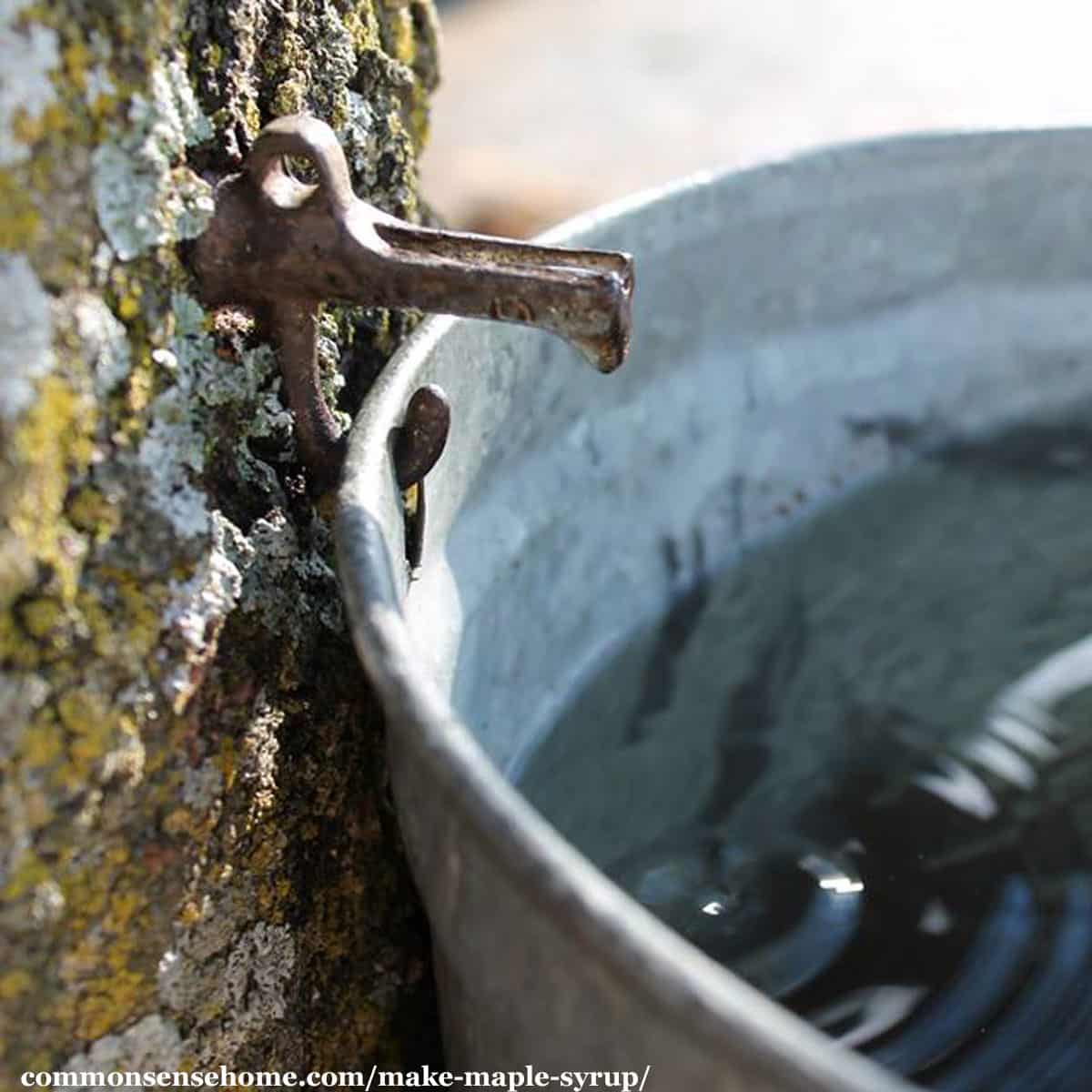
Traditional maple syrup making equipment includes sap spouts, buckets, and covers; which are available in hardware stores, from maple sugaring equipment suppliers, or used from other sugarmakers.
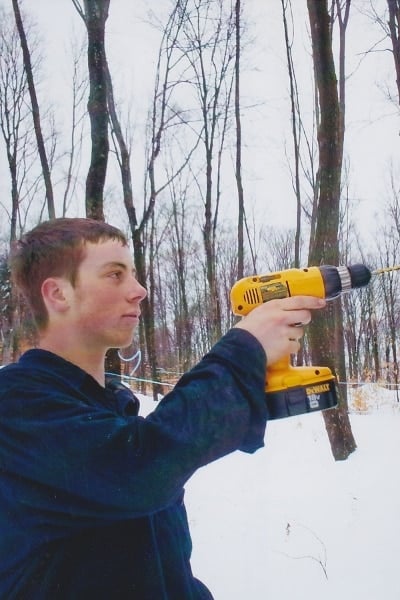
To tap the trees you will need a drill and bit, and a hammer. The minimum that a backyard sugarmaker must do is to drill the taphole and tap in the spout.
To collect the sap: Milk jugs or even plastic bags can be hung on the spout; or plastic, food-grade tubing can be connected to the spout and the sap run into a bucket or collecting tank on the ground.
To boil the sap into syrup: Plan how you will boil the sap – a simple pan on the stove, a turkey fryer, an outside set-up over a fire-place, or a larger, purchased arch and evaporator.
Editor’s note: a friend of mine cooked her maple syrup down in her kitchen – once. It left a sticky film on every surface. I highly recommend processing outside or in a sugar shack.
#3 – Tapping Maple Trees
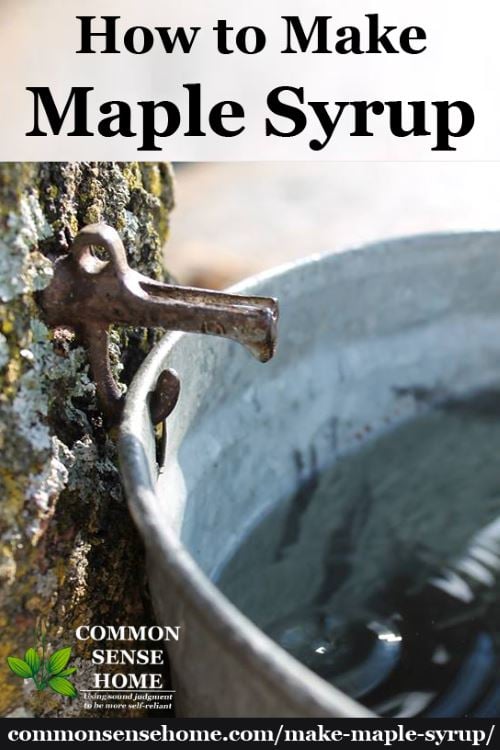
Tap the trees in the early spring, as daytime temperatures rise above freezing. Drill a hole the size of your spout, at a slight incline. (Note angle above.)
Tap the spout into the hole firmly, hang the bucket, and put the cover on to keep out rain and bugs. This is the magic moment, as the first drop of clear, sweet sap runs off the spout – often onto an eagerly waiting tongue!
#4 – Gather the Sap
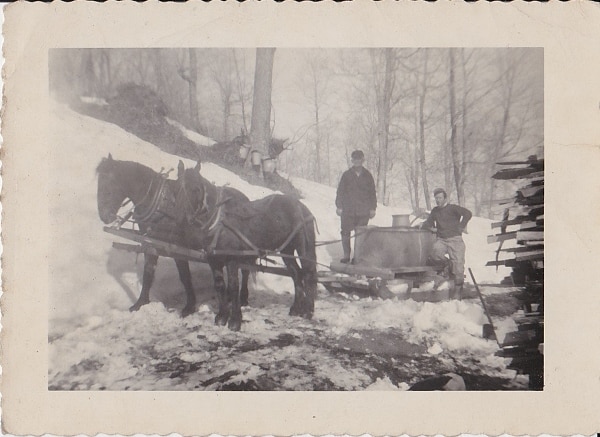
Sap is perishable, and should be gathered and boiled daily, or kept cold in a storage container until boiling. Filter the sap to remove any impurities.
#5 – Boil the Sap
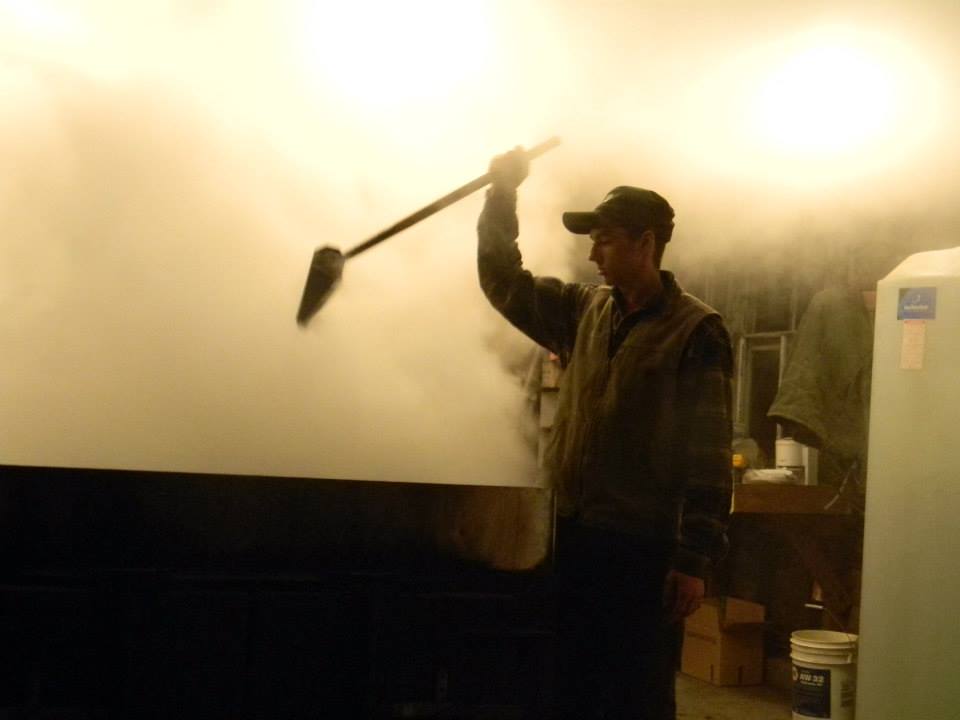
Boil the sap until it reaches seven degrees above the boiling point of water on that day, or until it “aprons”, or runs off a spoon in a sheet. You can also test to see if your maple syrup is ready by using a hydrometer. (See Syrup Hydrometer Instructions to learn how a hydrometer is used for syrup making.)
Whenever maple sap is boiled, it tends to foam up and boil over the side of the pan. Rubbing a little butter around the rim of the pan, or dripping in a few drops of milk or dairy cream during boiling will keep the sap or syrup from boiling over.
My Dad always said, “Never turn your back on boiling sap!” The amount of milk is just a few drops to any size kettle, though dripping in a few more drops is more frequently needed with a larger quantity.
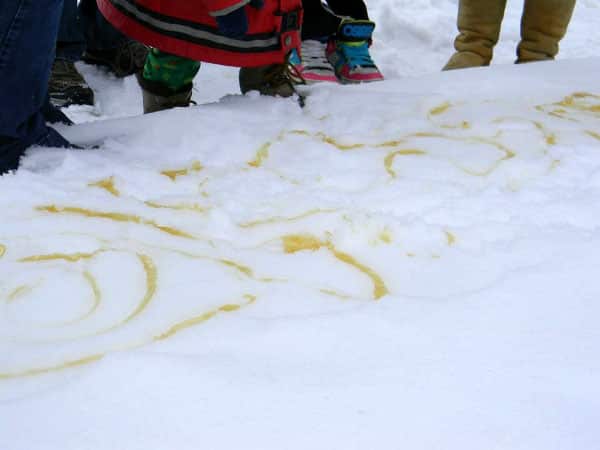
Sugar on Snow
Sugar on snow is made by boiling pure maple syrup to 233 degrees, on a candy thermometer. Do not stir.
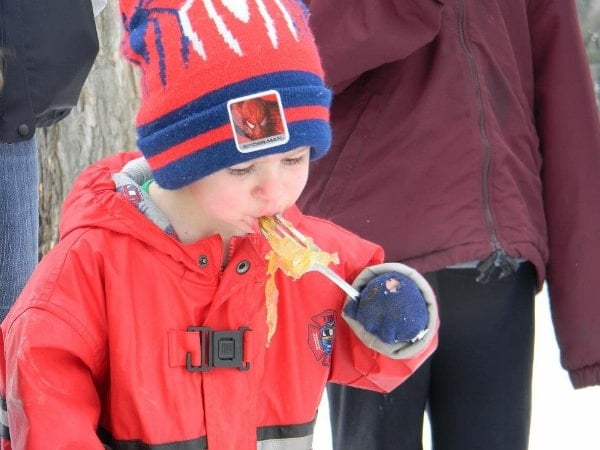
We drizzle the hot syrup over pans of packed snow-or directly onto fresh snowbanks! Each person is given a fork to twirl the taffy-like candy up on.
Those in warmer climates may use purchased maple syrup and pour it over crushed ice.
Maple Cream and Candies
We produce maple cream by boiling it to the soft ball stage, cooling it without moving to room temperature, and whipping into a smooth, creamy spread.
Candies, traditionally shaped in molds as maple leaves, are made by boiling the syrup to 243 degrees, and then stirring the syrup while it is hot and pouring into molds before it sets up.
My children used to boil the syrup, and then roll the candy into little balls, pressing in nutmeats. A wonderful treat, made from their big sugar maple in the yard.
#6 – Filter and Bottle the Syrup
Filter the hot syrup through clean wool or synthetic syrup filters to remove niter, or sugar sand. Niter occurs naturally. It is gritty and gives the syrup a cloudy appearance.
Syrup is canned in Mason jars, commercial syrup containers, or kept in either the refrigerator or freezer.
At Silloway Maple, we can our syrup in glass and in plastic jugs by heating it up to 180 degrees. We leave no head space and do not process it in a canner.
The syrup keeps indefinitely, though some say the flavor is best preserved for long periods by freezing. It does not expand, when frozen, like cider.
Once the container has been opened, it should be refrigerated. If any mold does form on your syrup, it is harmless and can be removed by gently heating and skimming off.
#7 – Enjoying Your Maple Syrup
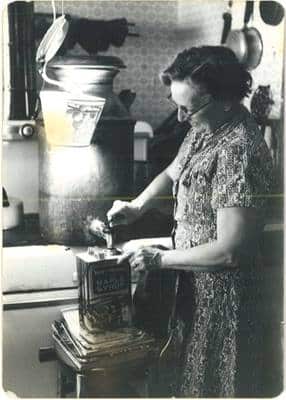
Maple syrup makes many sweet treats. Enjoy your syrup as pure maple cream, hard sugar, fudge, and maple sugar on snow.
How to substitute maple syrup for sugar (works for most recipes):
- Use ¾-1 cup of maple syrup for each cup of sugar.
- Decrease liquid by 2-4 tablespoons for each cup of syrup used.
- Add ¼ teaspoon of baking soda.
- Decrease oven temperature by 25 degrees.
Maple granola is one of our family favorites, and is very easy to make.
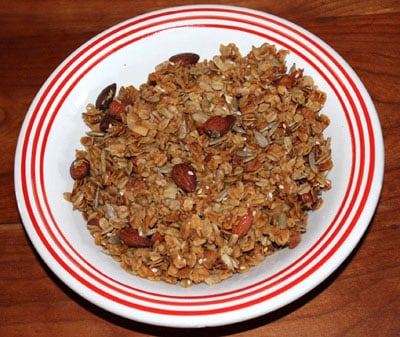
Maple Granola Recipe
Courtesy of Silloway Maple
Ingredients
- 7 c. rolled oats
- 1 c. coconut
- 1 c. almonds
- 1 c. sunflower seeds
- 1 c. oil
- 1 c. maple syrup
- 1 T. vanilla
Directions
Combine the dry ingredients in a large bowl. Mix the oil, syrup and vanilla in a separate bowl, and pour over the oat mixture. Mix well, and spread on baking sheets.
Bake in 300 degree oven for two hours, stirring occasionally. Remove from oven, and add raisins or any additional dried fruit. Store in a tightly closed container.
Is Maple Syrup Healthy?
While maple syrup is a sugar and should be enjoyed in moderation, it does contain naturally occurring minerals such as calcium, manganese, potassium and magnesium.
It’s also a natural source of beneficial antioxidants and phenolic compounds. (See “54 beneficial compounds discovered in pure maple syrup” for more information.)
Why are these compounds important?
A quote from the article linked above notes, “We know that the compounds are anti-inflammatory agents and that inflammation has been implicated in several chronic diseases, such as heart disease, diabetes, certain types of cancers and neurodegenerative diseases, such as Alzheimer’s.”
The researcher (Seeram) further concludes, “I can guarantee you that few, if any, other natural sweeteners have this anti-oxidant cocktail of beneficial compounds.”
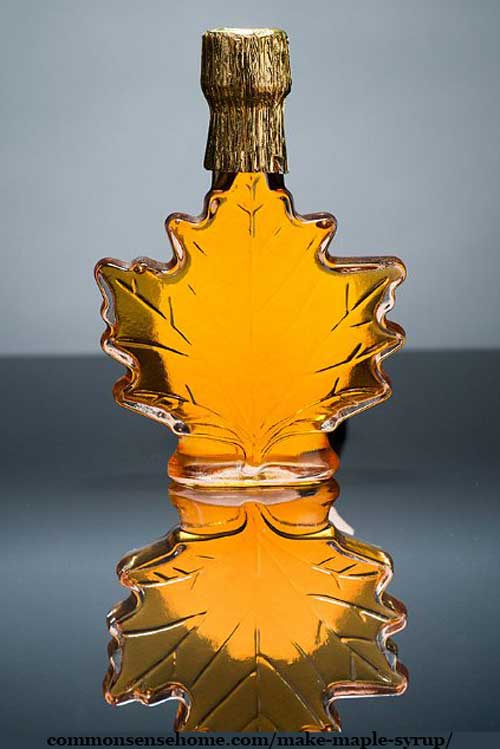
I hope this post will encourage you to make maple syrup, and that it will become a tradition for your family like it is for mine.
Visit Silloway Maple in Vermont
If you don’t have access to maple trees, we do sell Pure Vermont Maple Syrup, Maple Cream and Maple Sugar Coated Nuts in our online store, or you can visit a local producer near you to enjoy some real maple syrup.
This is a guest post by Bette Lambert of Silloway Maple in Randolph Center, Vermont. Bette is the mother of six children, all homeschooled. She is a maple sugarmaker and homemaker.
Silloway Maple is family owned and operated. They recently built a new solar-powered sugarhouse, which also produces part of the energy used on the family dairy farm.
Daughter Laura manages the business Facebook page, Silloway Maple, where you can view photos of their sugarhouse, as well as an extensive library of maple syrup making photos.
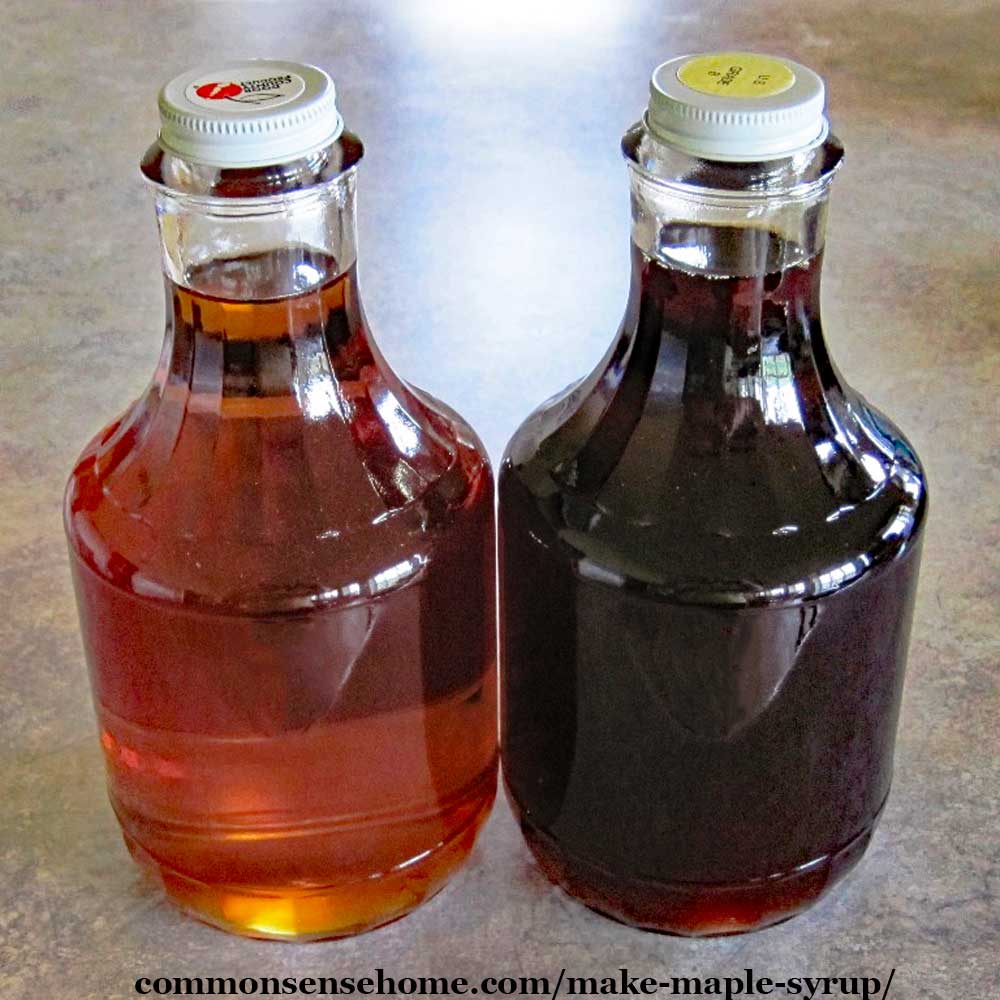
More Maple Goodness
For more information on how to make maple syrup and other maple products:
Some featured recipes:
- Maple Leaf Cookies Made with Real Maple Syrup and Maple Glaze
- Easy Candied Walnuts – For Snacking or Gifts
- Pumpkin Spice Waffles with Maple Cinnamon Whipped Cream
- Maple Macaroons – Refined Sugar Free, Gluten Free, Delicious!
- Indian Pudding
Want to stock up on syrup? Learn how to store it for best shelf life.
For those of you visiting from the “50 Things You Should Stop Buying and Start Making” post who don’t happen to have maple trees available and were looking for a quick and easy homemade maple syrup substitute.
Homemade Maple Syrup Substitute
For those who want to make maple syrup substitute at home.
Adapted from All Recipes.com
Ingredients
- 1 cup water
- 1 cup white sugar
- 1 cup brown sugar or sucanat
- 1 tablespoon maple flavored extract (buy pure maple extract here)
Directions
Bring the water and sugars to a boil in a saucepan over medium-high heat. Reduce heat to medium-low, and stir in the maple extract; simmer 3 minutes longer.
Use immediately, or store in a mason jar in the refrigerator for up to two weeks. For a thicker syrup, use two cups brown sugar. You may also substitute 2 cups sucanat (less refined cane sugar) for the sugars. Makes 2 cups of syrup.
I still highly recommend real maple syrup. Real maple syrup has trace minerals and flavor that can’t be matched with refined sugars and extract.


Originally published in 2014, updated in 2015, 2018.
Just tapped my trees at my new home in Washington State. No idea what kind of maple trees they are but I was able to gather 8 gallons of sap thus far, mostly from one tree. Anyway, I brought the first 4 gallons to boil in an old turkey fryer and reduced it down to about a gallon and then brought it inside to finish it off. Pulled if from the heat at 217 degrees and I have to say it was pretty dang good. My second batch was a few days later and it is completely different. The same method was used however this batch is much darker and has a much better maple flavor. I am really having a good time with this. My Wife has Family in PA that own and operate a syrup company and they have been helpful in teaching me the ways. This was a good read!
I haven’t tried a tree syrup yet that I didn’t enjoy. All the subtleties of flavor are amazing (and delicious) to me.
We are tapping, getting ready for another season. We tap 6,200 trees, so it takes a while!
I was thinking that it’s about that time of year again. Today our high is a whooping 10 degrees, so spring is not arriving ahead of schedule here.
Just this morning I had pancakes and real maple syrup made by my family in Canada. I hsve never bought syrup from the store.
What a blessing to have ready access to syrup you can trust.
I have several jars of 3 year old maple syrup it is getting dark if I bring it to a boil would it be still good to put on waffles.
If it hasn’t been opened and there are no signs of spoilage (such as mold or off flavor or smell), it should be fine.
I collect my sap in March 2016 – boiled some down but not fully to syrup. I out it in gallon plastic container and its been in the fridge ever since. I just took it out to finish it by boiling and when I poured it into the pot it was thick like mucilage glue – like thick snot – sorry that’s best to describe it. hat happened is it still good – should I just boil it or throw it out?
I’m 99% sure that some sort of bacteria has moved in and would not recommend cooking and/or eating the snot-like syrup.
I know the season is long gone by…I was talking with my cousin from Coleman Wisconsin who has been making syrup for a lot of years when she told me something I have never heard of before…Using eggs to clear out the sugar sands…she is sending me the directions on how it’s used…have you ever heard of this?
I know the ladies making coffee in the huge coffee pots at church when I was growing up would use eggs to clear the coffee. I’m guessing the process is similar, but I’ve never done it.
We just went for our first maple syrup experience here in Canada. We just came to the right time, freezing at night and above zero during the day. Walking into that sugar shack with all the steam is an image I will never ever forget again. (not to mention the smell)
I tap my (Silver Maples) in Colorado. Sap to Syrup = about 40 to 1. My trees are approx. 15 inches in diameter. I worry about damaging the trees when I tap them, So each year I drill the tap hole at different locations on the tree i.e. North, East, South, West. and height, one year 3 feet above ground, next year 6 feet above the ground. Am I wasting my time?
Minnesota Maple Syrup Producers website states:
“You should drill a new hole at least 6 inches away from the prior tap every year, because the previous year’s tap hole will result in some scarred tissue. Do not “girdle” the tree by tapping in an exact circle at the same height year after year.”