
Phytophotodermatitis – Plants That Cause It, How to Treat It

This post may contain affiliate links. Read my full disclosure here.
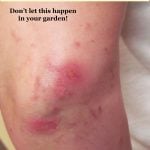
I’m sharing my story here so you don’t make the same mistake I did, and end up with Phytophotodermatitis (PPD). Phytophotodermatitis is also known as plant and sun dermatitis, parsnip burn, and sometimes lime disease (not to be confused with Lyme disease) or margarita photodermatitis. You get it from exposure to plant sap or juice and sunlight, as outlined below. We’ll cover plants that cause phytophotodermatitis and how to treat it.
Would you like to save this?
This was not parsnip burn from exposure to some “poison parsnip” or giant hogweed. I was working in my garden. Garden parsnips and wild parsnips are the same species, and it turns out they can cause the same problems. Several other plants can cause the problem, too.
I originally wrote this post in 2014, and unfortunately ended up with another smaller case in 2018. I thought I was being careful, but apparently not careful enough.
The pain doesn’t start until days after sap and sun exposure. By then, the damage is done, and all you can do is treat the symptoms.
What is Phytophotodermatitis?
Medscape defines Phytophotodermatitis as:
Phytophotodermatitis (PPD) is a cutaneous phototoxic inflammatory eruption resulting from contact with light-sensitizing botanical substances and long-wave ultraviolet (UV-A 320-380 nm) radiation. The eruption usually begins approximately 24 hours after exposure and peaks at 48-72 hours.[1] The phototoxic result may be intensified by wet skin, sweating, and heat.
In other words, your skin erupts with blisters and itchy, burning red areas because you were in contact with plant chemicals (in this case, parsnip and carrot sap) and exposed to sunlight.
You don’t realize you’re in trouble until several days after exposure, by which point, you’re skunked. This is one of the aspects that makes PPD different from most other contact dermatitis. If you’re working with wet plants on a hot summer day, it’s going to be worse. (That’s what happened to me.)
If you visit the Medscape website, they go into a detailed explanation of how the chemicals in the plants that cause the damage (Furocoumarins) are activated in stages under different conditions, and how they actually damage the DNA of the skin.
You cannot “wash off” phytophotodermatitis chemicals with soap and water once they are activated by UV radiation. I did shower after working in the garden, but it didn’t do any good. Washing may help limit additional damage.
Is Phytophotodermatitis contagious?
Nope. Only those directly exposed to the problem plants and conditions experience skin reactions.
The only case that might be an exception is berloque dermatitis, a special type of phytophotodermatitis caused by perfumes. There are older perfumes that used oil of bergamot. (Bergamot is one of the citrus fruits that can trigger PPD.)
If one person applied the problem perfume and was in close contact with another person, they might spread the perfume – and the skin condition. It’s unlikely, but possible.
I do think that the fluid from the blisters *might* encourage the formation of additional blisters (on the same person). I’ve had blistered areas spread without additional plant exposure. It’s possible some of the fluid from the blisters got smeared over a wider area due to the blister being bumped or scratched. I have not been able to confirm this.
Which Plants Cause Phytophotodermatitis?
Here’s a kicker – there are wide range of plants that can cause this condition that you might never suspect.
Plants that may cause phytophotodermatitis include (but are not limited to):
- Parsnips (Pastinaca sativa)
- Carrots (Daucus carota subsp. sativus)
- Celery (Apium graveolens)
- Gas plant (Dictamnus albus)
- Parsley (Petroselinum crispum)
- Wild Parsnip (Pastinaca sativa)
- Queen Anne’s Lace (Wild Carrot) (Daucus carota)
- Giant Hogweed (Heracleum mantegazzianum)
- Limes (Citrus × aurantiifolia)
- Figs (Ficus carica)
- Chrysanthemums – Chrysanthemum genus, aster family
- Common Rue (Ruta graveolens)
- Russian sage (Perovskia atriplicifolia)
Those who are into botany will notice that the top six plants on the list are all related to each other (they are members of the Apiaceae family). Some of you may have also heard about getting blisters from wild parsnip or poison parsnip, but may not have realized the garden parsnips can also cause burns. Garden parsnip and wild parsnip are both different varieties of the same species – Pastinaca sativa. The veggies typically cause burns on agricultural workers and grocers, who handle large quantities of plant material.
The Medscape site shows a rather nasty blister that covers about 1/3 of the forearm of a flight attendant who spilled lime juice on her skin. The phytophotodermatitis from limes is also referred to as “margarita dermatitis” because of all those poor folks who have sucked on their limes in the summer sun.
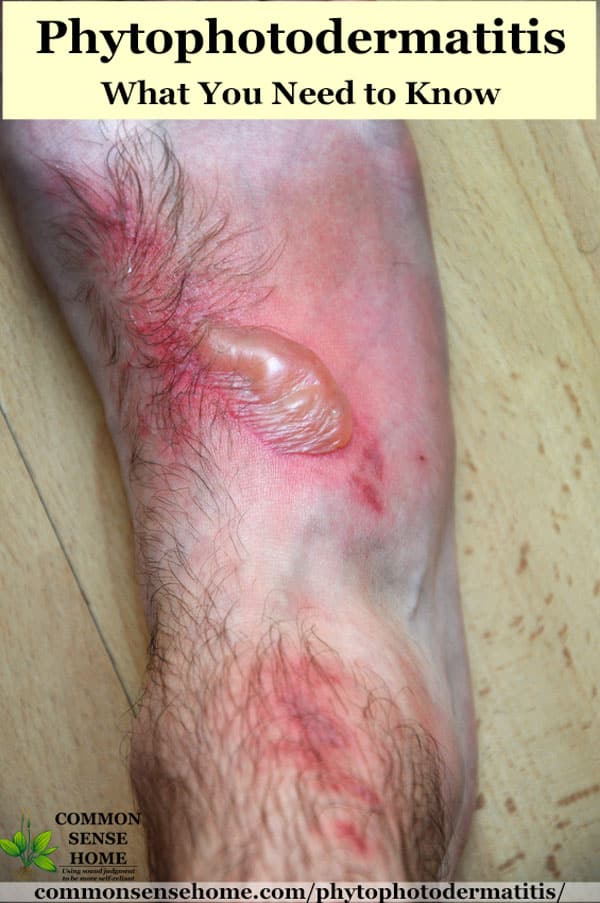
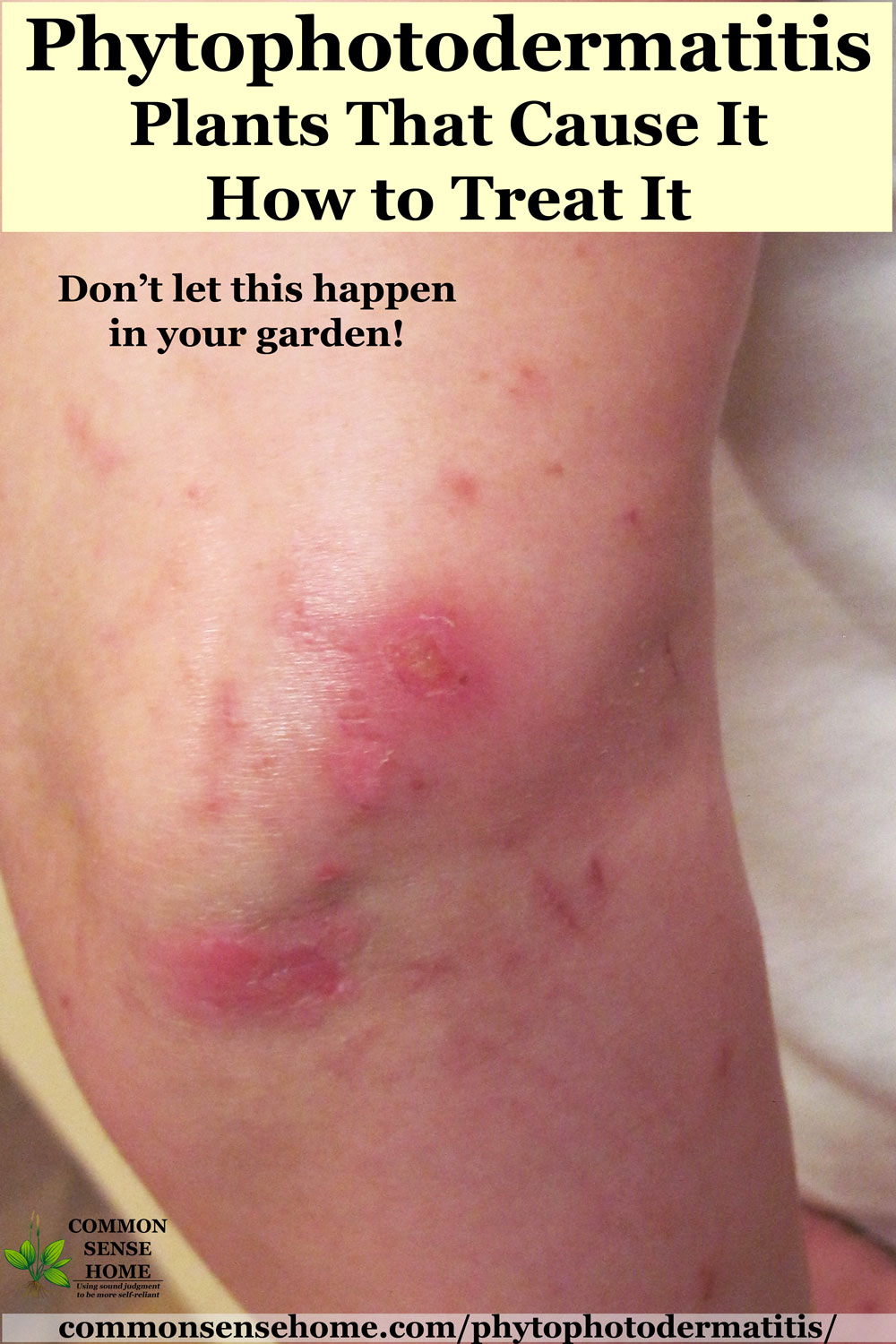
The wild parsnip burns (and those from other wild plants like hogweed or queen Anne’s lace) can be some of the worst, because people do terrible things like running weed whackers with shorts on and get their legs all covered with little bits of parsnip (and sap), like the poor guy featured in the article “Burned by Wild Parsnip” in Wisconsin Natural Resources magazine. The photo below is as example of how large the blisters can get.
I’m Going to Stop Growing “Poison Parsnips” Because They’re Too Dangerous
No. I’m not. I’m not skipping the carrots, parsley or celery, either.
In all my years of gardening, these past couple of decades on my own and helping mom out growing up, I’ve never been burned by garden parsnip before. I did get about an inch long blister from wild parsnip, but none from garden parsnip.
Here’s what I screwed up:
I was working in the morning, so the plants were covered in dew. More moisture = wet skin.
It was hot, so I was sweating = more wet skin + heat, both triggers for phytophotodermatitis.
The area I was working on was roughly 80 square feet, very thickly planted, mostly with carrots and parsnips. I had thinned and weeded the patch when the plants were younger, but this round of thinning took place when the plants were a couple feet tall.
The only way to reach the roots to pull them out was to stick my arm into lots of foliage. (Lots of exposure.) I gathered up the bundles of plant tops after removing the roots with my bare arms. (More exposure.)
By the time I finished, it was pushing midday, with a bright, beaming blue sky = lots of nice, intense sunlight.
In my 2018 case of phytophotodermatitis, I allowed queen Anne’s lace to grow in the greenhouse as companion plants for the tomatoes. I was trying to thin them out as the greenhouse became more crowded. It was hot, humid and sunny. I must have broken some of the stems, and got the sap on my hands and feet.
What I Should Have Done:
The simplest thing I could have changed was to wear long sleeves and gloves to cover up my skin. Problem solved.
Alternatively, not handling the broken plants with bare skin, or thinning harder when the plants were small so I didn’t need to stick my arms into a thicket would probably also have done the trick. That said, we have been enjoying the carrots and parsnips I picked. 🙂 No more wild carrots in the greenhouse. It’s simply too easy to get accidental exposure while working around the plants in close quarters.
How do you Treat Phytophotodermatitis
Like a standard burn, you can apply cool compresses to relieve the pain, and try to keep blisters intact as long as possible to protect the tender skin underneath. Over the counter itch cream like those for poison ivy may also help, along with anesthetic creams like Aspercreme.
I hit the pantry and the garden for treatment options.
On the first couple of blisters, I used fresh plantain and yarrow leaves, mashed and applied as a poultice. As more blisters showed up, I coated the worst blisters with manuka honey to promote healing and fight infection. You can read more about using honey for wound treatment in the post, “Honey as Medicine“. With over 30 blisters on my arms and hands, the honey was a little awkward to try and use on all of them, so I made up some comfrey salve with lavender essential oil.
I coated the burns several times per day with the salve, and at one week after exposure, some of the scabs fell off to expose new skin underneath. The burns on my hands and elbow didn’t heal quite as fast. My hands spend way too much time being beat up during canning and gardening season, so I can’t keep bandages on them, and the elbow is just awkward to keep bandaged.
Be patient. Badly affected areas may take weeks to months to heal, depending on the damage. I still have dark areas on my skin a year after exposure from the worst spots.
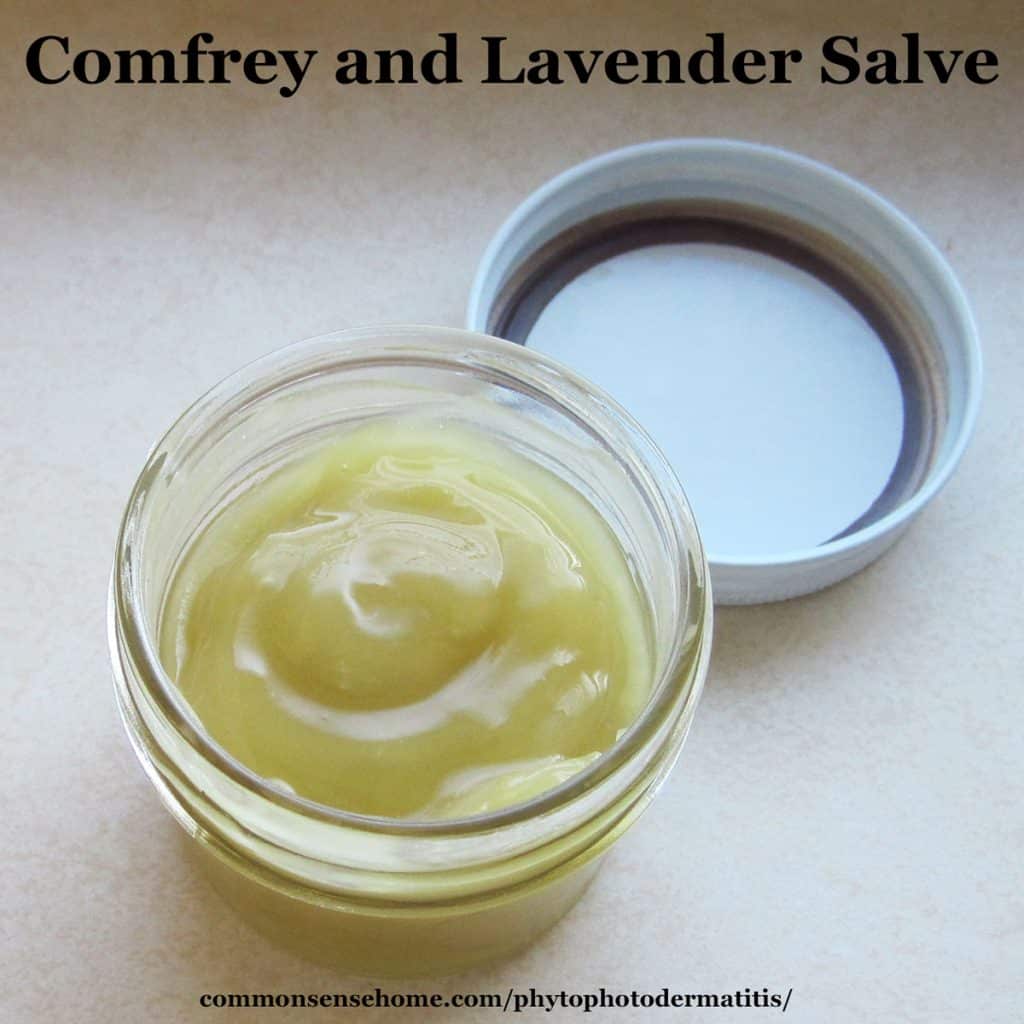

Comfrey and Lavender Salve Recipe
Adapted from the Herbal Academy
Ingredients
- 1 cup organic extra virgin olive oil
- 50 drops of lavender essential oil
- 1 ounce organic dried comfrey leaf
- 1 ounce beeswax
Directions
- Pour olive oil into a double boiler or small, heavy bottom pot. Add comfrey leaves.
- Heat over low heat for 60 minutes, stirring occasionally. You’re looking for gentle heat, not boiling.
- Remove from heat. Strain and compost comfrey, reserving infused oil.
- Melt beeswax in a clean pan over low heat.
- Once melted, add herbal infused oil and lavender essential oil. Mix well.
- Quickly pour salve into tins or glass jars and allow to cool before placing lids on and labeling.
The HANE website notes that “Comfrey contains allantoin, an anti-inflammatory phytochemical that speeds would healing and stimulates growth of new skin cells.” The HANE burn cream recipe also includes one ounce each of dried plantain, calendula and St. John’s wort to bump up the healing power a little more.
Photos of Phytophotodermatitis
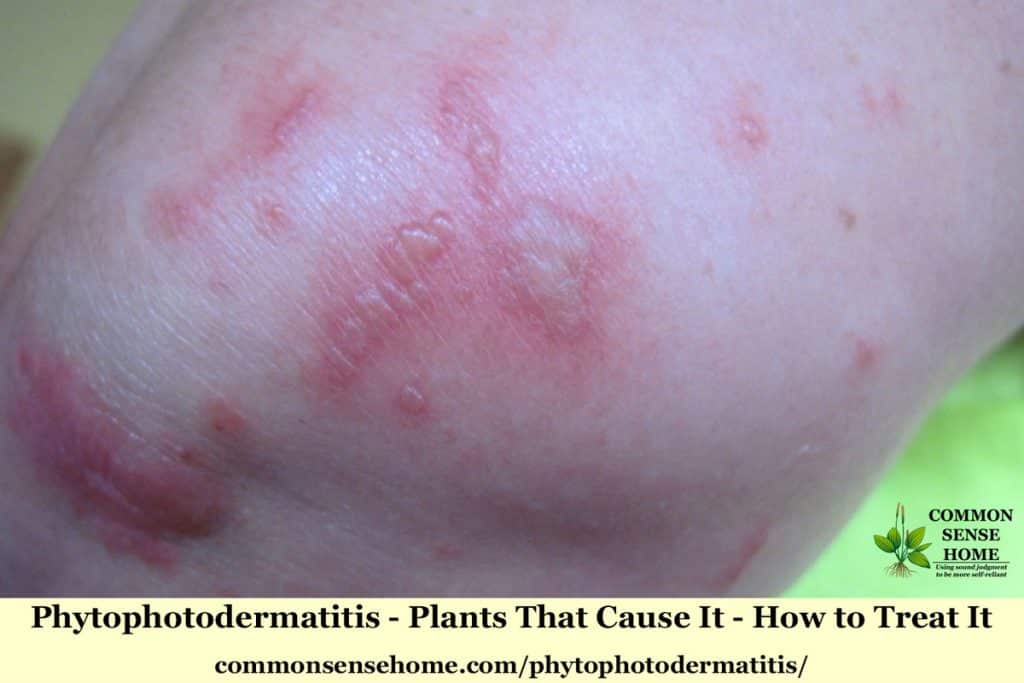
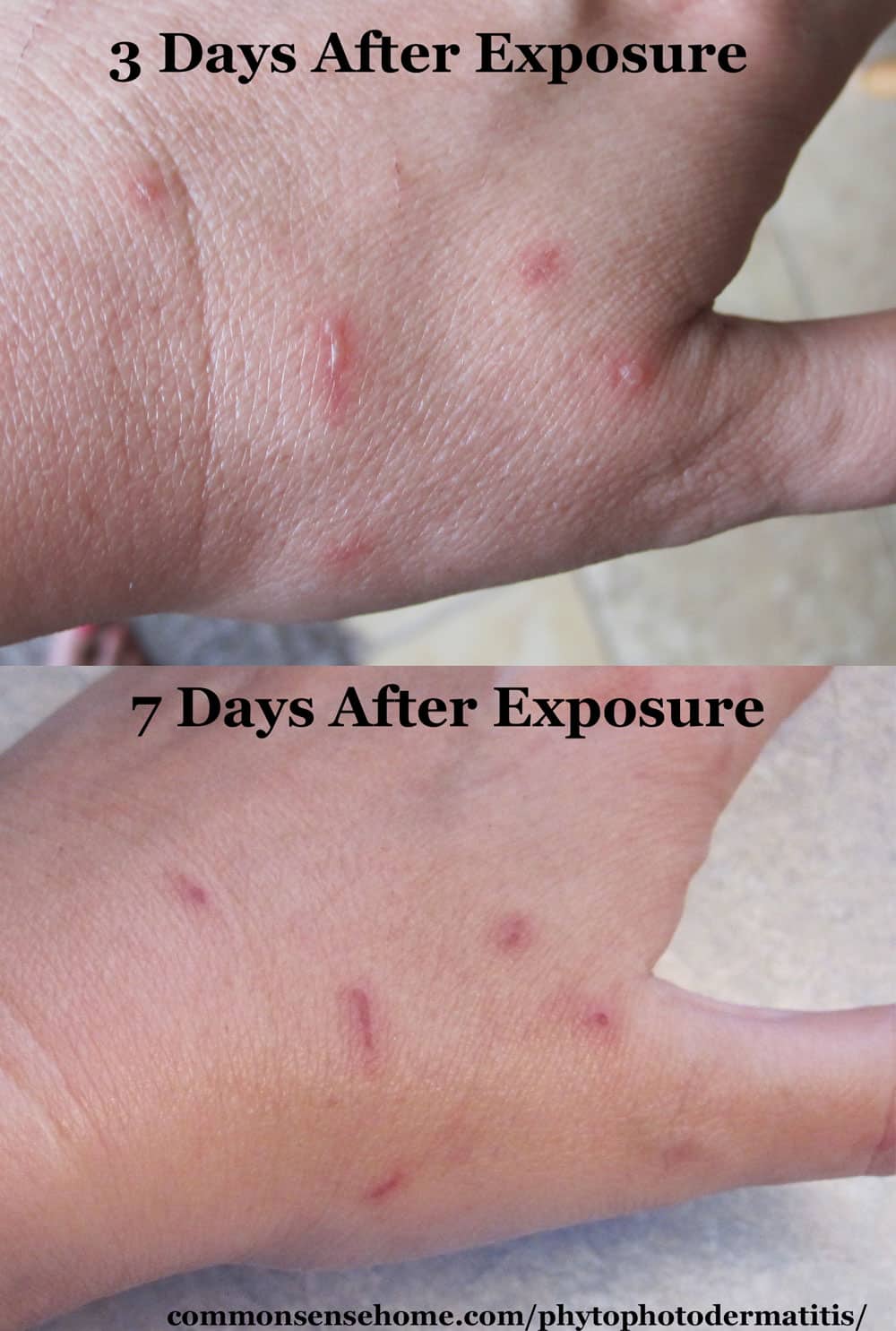
Just so you can see how the eruptions progressed, I’ve included some comparison photos of the affected skin below. The image at the top of the post is my left elbow on day three after exposure. 24 hours earlier (48 hours after exposure), there was only one blister.
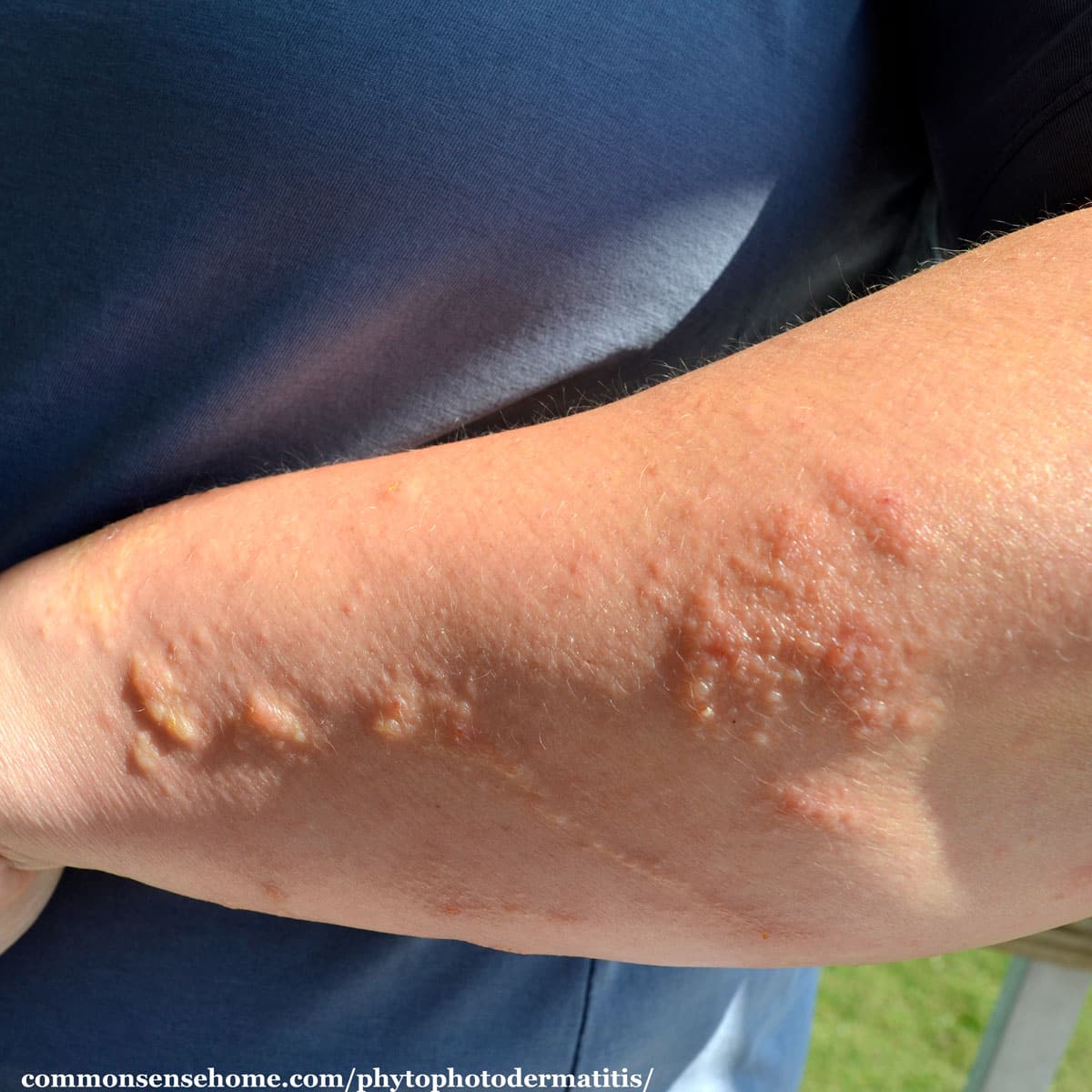
My left hand at day 3 and day 7 after exposure. Day seven may not look much better, but it feels much better. No more burning and itching.
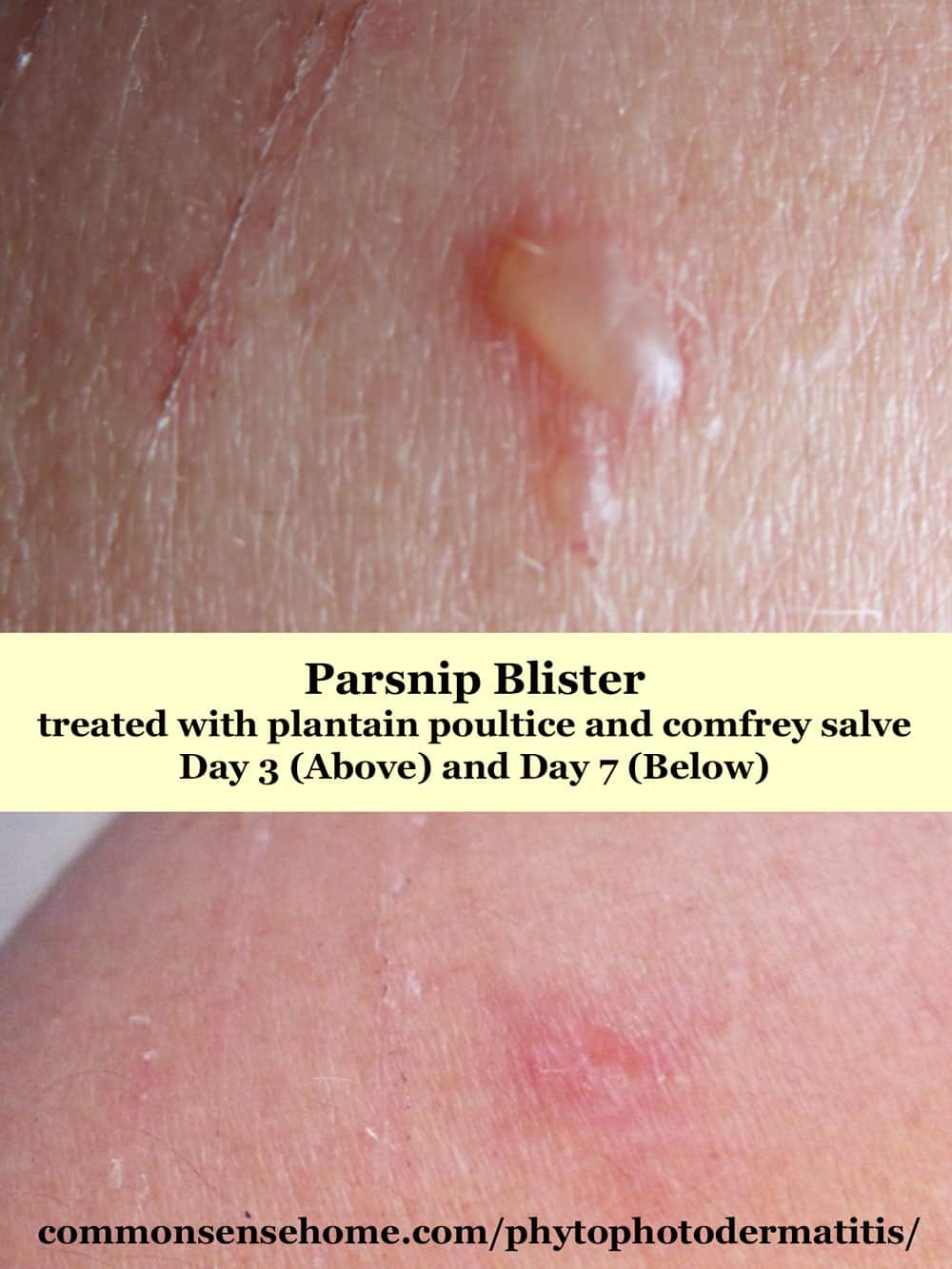
One last shot. A blister on my right arm that was one of the first to appear that I treated with a plantain poultice followed up by a day of honey and ongoing use of the comfrey salve.
Don’t fear the plants, just don’t handle them in such a way that you set yourself up for some serious discomfort. Learn from my mistakes. 🙂
July 2019 – I’ve run into this again. After helping to clear an overgrown area near the greenhouse in shorts and a t-shirt, I ended up with blisters on my arms and legs. I didn’t see any queen Anne’s lace or other trigger plants, but they must have been in the mix.
I suspect repeated exposure may make you more likely to have a skin reaction.
The video below highlights this year’s exposure. (Make sure any ad blockers are off to get the video to display.)
You may also find useful:
- 9 Home Remedies for Dry Skin – Soothe Dry and Flaking Skin Naturally
- Grandma Called it Medicine Leaf
- Herbal Antibiotics – the Top 15 Herbal Antibiotics
Originally posted in 2014, updated in 2018.
Thank you for the info. Wild Parsnips are spreading like wildfire in the U.P. I came in contact with it about a week ago after falling off a log and accidentally grabbing this plant and now blisters are appearing on my hand. One went away, but another on has came out right next to it. They are like burns , that itch. The second one is leaking fluid. Pretty ugly, but now I know what to stay away from.
Watch out for the Queen Anne’s lace, too. Our yard is loaded with it this year.
I hope your hand heals quickly.
Thank you so much for posting this. I have a bumps, streaks, and blisters that look exactly like these pictures which developed over a period of days after I went strawberry picking followed by several hours of biking in the sun after being drenched by a rainstorm. Not sure if strawberry plants are the culprit or another plant I was exposed to, but after seeing several doctors who thought it was impetigo then poison ivy (even though I haven’t been around any), this explains all of my symptoms much better, making me feel much better!!!
Sorry you are hurting, but glad you found a match for your symptoms, and I hope it feels better soon. As you and many others have found, most doctors don’t easily recognize the reaction.
Strawberry plants aren’t known to cause phytophotodermatitis, though sometimes they do cause a rash in sensitive individuals. What you’re describing sounds more like PPD, so it was probably another plant.
My exposure that I thought had “healed” returned 3 years later after receiving the J&J Covid vaccine.
It’s possible that it somehow triggered something from the original exposure, but I’ve seen reports of skin issues with the jab from those whole never had PPD. You should probably check in with your healthcare provider, and have them register the issue with the reaction database.
I’ve been getting this every year for the last 4 years or so and I could never figure it out. The DR I see at the VA wasn’t sure either and just recommended an anti itch cream. Thank you so much for sharing this!! Now I know I get it from weeding in my yard and trail running. Running and sweating always seemed to make it worse, but that didn’t make any sense to me… Now it does!
I’m glad you found us and now have a better idea of what to avoid. Lots of doctors are confused by phytophotodermatitis, and because the blisters show up well after exposure, it’s tough to pinpoint the trigger if you don’t know what you’re looking for.
Is aloe on this list? And do antihitimines help?
Aloe can help with the burns. Antihistamines are not likely to be of much help, as it is a chemical burn.
Thank you so much for your post!!! LOL I thought shingles broke out on me but it came out after I worked in my garden and I didn’t get the connection! —- Parsnips greens. I love parsnips but never knew and I live in Florida!! The rashes were in places that didn’t make sense for shingles! Left ear. around the chin and mouth and on my writs and underarm near the wrists! they are in a pot which I moved! They were high growth, hence the leaves hitting my neck and ear as I picked up the big pot and moved it to another place. I’m keeping it. I used dead leaves to put around my pepper plants and want to see if it will keep pests away! That is what the parsnips plant is doing!! But now I going to buy long garden gloves and NOT move the pot with my face in it! WOW! thank you!!! No need to get a vaccine for shingles! I’m thrilled!
I’m glad you were able to find the site and find an answer to your mystery symptoms. The blisters are pretty miserable while they last, but thankfully they do heal without medical intervention in most cases.
Found this too late. I worked with figs, parsnip, carrots and parsley all on a sunny and super hot day… two days later i woke up with blisters on my arms (top and bottom over 50).. looked like someone splashed me with acid. I thought it was from the fig sap. Month later, more blisters appeared (not too many).. so I was like.. but I didn’t touch the fig? Only plant I worked with was parsnip (first year growing it). Crazy. Two weeks later.. my mom got also a blister although she was being careful given what happened to me. I enjoy to eat it more now (my revenge haha) and considered not planting it again – so thank you for the ‘how’ to stay safe 🙂
At least now you know and can be more careful in the future.
Thank you for putting so much thought and information into this post! I have discovered my own sensitivity to Virginia Creeper. After doing some research I found that this vine contains oxalate crystals on the leaves and can, in some people, create an allergic reaction very much like the urushiol in poison ivy.
I try very hard to not come in contact with plants I have noted that are not friendly to my skin – your list and information is very helpful!
After being very careful myself I would add that ; I have to be even more diligent as any stirring of offending plants (mowing) can put the irritants in the air and still give me a reaction (usually mild though). This year I handled my husbands clothes after he had been in a lot of growth and from the secondary contact have developed a bad breakout.
What is even more frustrating is that it will trigger a response in areas I previously had the rash (I guess that is systemic or neurological?). So, it is not just the exposed area . But seemingly my whole body reacting to one exposure 🙁 .
That said I am very interested in digging a little deeper into all the information you have provided. It can be hard to find and you did a wonderful job.
Thank you!
I ran into Virginia Creeper trouble this year, too! We had some try to strangle a rose and sneak into the greenhouse this year, and I’m 99% sure I got a streak of sap on my forearm from the roots that had me dealing with PPD again. I wore gloves, but it was crazy hot in the greenhouse so I had short sleeves. One of the roots whipped up and smacked my arm as I was pulling.
I’m so thankful you shared your experience, because no one dealing with this seems to share much information online, especially those of us who have gotten exposed more than once and from incidental contact.
I don’t know if someone has already asked this, but could medications that make you photosensitive be a factor in this? I have been hiking and romping half of my life in a certain wooded area in WA state with cow parsnip, Queen Anne’s Lace, Meadow Grass, and poison hemlock. I have never had ANY sort of reaction, but within the last 2 months started taking duloxetine (antidepressant, anti anxiety) and all of the sudden am having an intense reaction after having lied down in a meadow playing a game with my kids.
I don’t believe the question has been asked, but it wouldn’t surprise me at all if they also increased the risk for phytophotodermatitis.
From RXlist duloxetine side effects listing:
(But you probably guessed that yourself, since you mentioned photosensitivity.)
I can’t find anything online that confirms a connection, but many doctors don’t even know phytophotodermatitis when they see it.
I have no experience with this rash but do have a lot with poison ivy. We have a large family and live in rural Michigan. I have found the best treatment on exposure is washing with cold water and a lot of soap followed by liver boosting herbs like dandelion, milk thistle, etc. My children rarely get whelts or blisters anymore. We just drink a tea or take a supplement guided dosing by the return of itching. Hope this is helpful for someone.
Thank you for sharing your experience.
Hi, thanks for the article. I have this from pulling out morning glory vine. Was not thinking when I reached down to remove the small vine. One vine lead to another and now my hands are covered in blisters that itch and are very angry.
First day there was just a blister on one finger so I covered it up so it wouldn’t get bumped. By day 3 it’s angry, very swollen and painful and there are many more. My whole finger is a mess.
I googled it and the only article I found to confirm my guess was yours. I appreciate the info. Didn’t know the sun was a factor.
A few years ago I was pulling out the same stuff and it started to rain. It made it cooler so I kept gardening. I guess the wet vine slung sap in my eye because a day later it was horrible with a chemical burn. A trip to the eye doctor, drugs and $150 later it improved over a few weeks. I hadn’t remembered this incident when I started to pull weeds. Thanks again for sharing.
Hi Donna.
So sorry about your eye. That must have been so painful.
One of the worst things about phytophotodermatitis is how the pain and blisters build over several days. I haven’t found independent data to confirm this, but it seems like the pus from the blisters can spread the burn (at least, that’s what it looked like on my arms last year), so be extra careful to try to not spread it around on your finger/hand if you are able. (Next to impossible when you keep working, I know.)
I hope you heal up soon.
Hi, I came in contact with large philodendron plant that had grown around a tree we were cutting down. I now have what looks like a poison oak rash. Can philodendron plants cause this also?
It looks like philodendrons can cause contact dermatitis, not phytophotodermatitis. Still irritating, but hopefully it will heal faster than PPD.
Can anyone describe the symptoms in detail for me, and by symptoms, I mean the sensations in the sores or wounds? I have two blisters. I have no clue where they came from, but I was pulling up weeds beside the house two to three days before these erupted. They itch, and about three to four inches around them itch intensely. More importantly though to me is a weird, very warm tingle that is accompanying them.i even have the three to four inch area around them constantly tingling and feeling warm from the inside and radiating outward. It is a weird feeling. The only thing that has helped so far is Jewelweed cream that I bought years ago (it is actually long expired) that has plantain and a few other herbs in it. I would love some input on the sensations that everyone has experienced, especially if anyone has had the weird tingling too. Like nerve tingling.
I haven’t had what I would call nerve tingling, but I have had the area effect itching. When I inadvertently broke the blisters while scratching (or when bumped), the area exposed to the blister fluid also reacted.
I’d describe the discomfort from exposure (at its peak) as mostly intense burning and itching. This year I even broke out some Aspercreme with Lidocaine to dull the intensity of it because my legs below the knees and forearms were completely covered.
Thanks, Laurie. I don’t have any comfrey handy but I can give the cabbage poultice a try. Is there any advantage to a particular color of cabbage being used?
Not that I know. I think any will get the job done.
Hi Laurie, Thanks for creating this discussion. I think I may have found an answer to my dilemma! Almost a week ago, I noticed a slight burning rash on the tops of my feet, the right side much more predominant. I was at work and noticed the friction of my right shoe/sandal rubbing against the skin was really irritating it. At first I thought maybe an insect bite but there was no itching just burning. By that evening and the following morning it had blistered on the right side making shoes incredibly uncomfortable to wear.
I live in Hawaii and had family visiting last weekend. Before this started we went to the beach, I sat under the shaded pavilion. We went snorkeling and again was under the shade on the boat. I had ruled out sunburn and it wasn’t acting like a typical sunburn (for me). Initially it was thought I picked something up from the snorkel fin.
The cause still felt like a mystery to me even after going to Urgent care and talking with my doctor. They said whatever it was, was behaving as a burn. Urgent care gave me burn cream but it didn’t change anything. My ND suggested Lavender oil and raw honey. After a conversation with a friend and noting the shape and location of the “burn”, just under my slippah (flip flop) strap, I realized that is where I put a drop of Bergamot essential oil most days – a photosensitive oil!
I recently changed brands, but it seems more like the circumstances of having it on my skin, probably some residual oil on my shoe strap, and exposure to the intense UVA rays during the summer here all contributed. The suns’ rays are intense this time of year! Could have happened on the boat after my feet were wet..??
Walking around with my foot wrapped aggravates it. I got some Manuka honey yesterday and started applying it, it feels good on and I was able to walk flat footed for the first time in 4-5 days, but not much change in the red color or painful big blister yet. I will stay hopeful!
Cool water foot baths and Aloe have also been soothing but not much change in appearance. Thanks again for the post! (Any thoughts of when to get something stronger if no change?)
Be patient. It sounds like you’ve effectively given yourself a chemical burn that goes deep into the tissue, and it will take a while to heal.
You may want to try a comfrey poultice, if you have some available, or a cabbage poultice or drawing ointment, to see if you can pull some of the residual oil and swelling out of the tissues and speed healing.
This has to be the oddest thing! I have been gardening since shortly after the Earth cooled, and have never even heard of this! Is it possible some people are immune? We pretty well grow all the vegetables listed, and have never encountered any of the listed symptoms!
lol – I haven’t been gardening quite that long, but I never had an issue with it in the garden until just recently. Thankfully, as noted, the conditions have to be just right for phytophotodermatitis. I do suspect that some people are likely more sensitive than others, but with enough exposure in the right conditions I think anyone would have trouble.
I chopped down a large century plant in my mom’s back yard… the sap not only made blisters all over my hands and arms, but burned holes in my clothes! Luckily, washing took care of it, though the blisters had to run their healing course.
Yes, Century plant (Agave americana) is one of those that causes phytodermatitis, not phytophotodermatitis – no specific sun exposure required, although some conditions can worsen the reaction. Sorry you had no warning until you were exposed.
The Washington State Department of Labor and Industries has a huge list of plants that cause phytodermatitis. Agave americana is listed in the mechanical and irritant categories:
I did the same salve for my exposure. It healed to a point. Then I tried Reversol 8% alpha hydroxy acid. It’s only been a few times, but I’ve seen improvement. I think the acid in it restores the skin’s phbalance.
http://www.reversa.ca/index_en/04_skinsmoothing/04_skinsmoothing_01.html
*this cream is not for use in the sun*
*wash it off before sun exposure*
When my blisters reappeared I used 1 bottle Hydrogen Peroxide + ¼ cup baking soda as a wash. I sloughed off the dry skin and reapplied the wash until the skin wasn’t dry anymore.
Also I tried a poison oak remedy: a paper bag soaked in apply cider vinegar and applied as a poultice for 10 min. So far so good.
I am on day 6 of phytophotodermatitis after trimming alders in a possible young hemlock bed while camping. I thought I had mosquito bites, and scratched under the blanket all night. Zinc oxide allows me to function in the garden. I am thinking of throwing away the blanket from camping. I’m afraid the hemlock oil may be spread to other clothes via the washing machine. Am I just being paranoid?
From what I’m seeing, it doesn’t look like the sap that causes the irritation would spread in the washer. It’s not an oily type of sap. To be extra cautious, you can use plenty of detergent, a double rinse, and wash is separately from other laundry.
Good timing on this article for me as I will have carrots to pull soon. It’s also a good reminder to wear long sleeves and gloves while picking veggies.
I tend to be sensitive to squash plants (not as much now as years ago) and my ex-MIL was sensitive to Okra plants. No blisters for either of us, but itchy red skin. She always recommended wearing a light weight, long sleeved shirt when harvesting and it really worked. I tend to be in shorts and a tank top these days, but will at least try to remember when I pull my carrots.
A number of garden plants can cause contact dermatitis for sensitive individuals. Nightshades (tomatoes, okra, potatoes, etc), beans, and cucurbits (squash, cucumbers, melons) and weeds like ragweed (that one gives me itchy bumps). I like working barehanded when possible, but like you, sometimes I need to cover up for safety. My eldest gets congested from working around thickly growing tomato vines.