
Burn Barrel Guide – How to Make and Safely Use a Burn Barrel

This post may contain affiliate links. Read my full disclosure here.
A burn barrel can be a practical tool—especially in rural areas where other disposal options are limited. But before you grab a match, it’s important to understand how to build and use a burn barrel properly. You also need to know whether it’s even allowed where you live.
In this guide, we’ll cover everything you need to know about burn barrels, from what they are and how to make one, to legal considerations, safety tips, and what you can (and shouldn’t) toss in the fire.
Would you like to save this?
Table of Contents
What is a burn barrel?
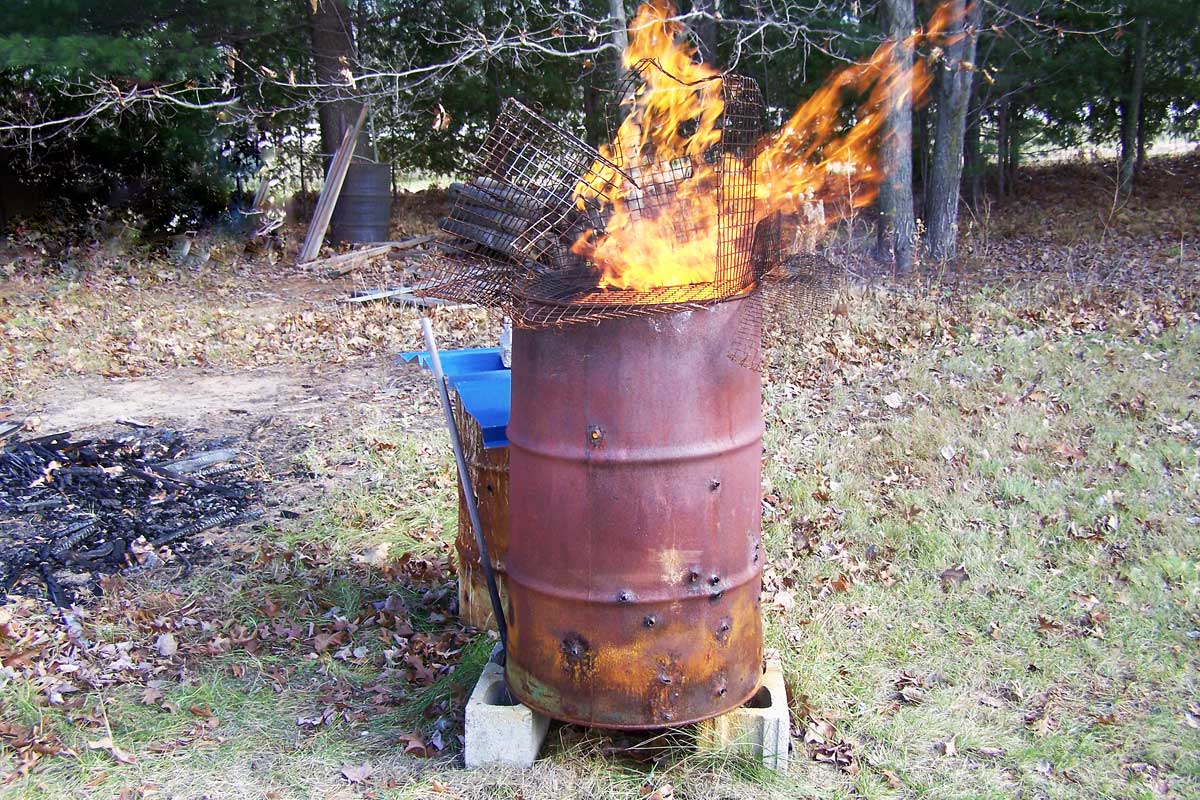
A burn barrel is a DIY incinerator made from a repurposed steel drum. It’s designed to contain and manage small-scale open burning. This allows you to safely dispose of dry organic material and paper waste in one controlled area. Think of it as a rugged homestead solution for burning responsibly—without creating a fire hazard.
Burn barrels are especially common in rural communities, where hauling debris to a landfill isn’t always practical. Most are simple: a 55-gallon metal drum with air holes, a stand to raise it off the ground, and a mesh screen to prevent flying embers.
Burn Barrel Legality: What You Need to Know
Before you make or light up a burn barrel, check the rules in your area. Open burning is heavily regulated in many places due to concerns about wildfires and air pollution.
- Local laws vary widely—some rural areas allow burn barrels year-round, while others ban them entirely.
- Your town or county website often has burn guidelines or seasonal fire bans.
- Contact your local fire department or Department of Natural Resources (DNR) if you’re unsure. They’ll let you know if a burn permit is required.
Ignoring these rules could land you with a fine—or worse, cause a dangerous wildfire.
Pros and Cons of Using a Burn Barrel
Pros:
- Reduces the volume of organic waste
- Useful in emergencies or for off-grid living
- Saves time compared to hauling trash
- Inexpensive to make
Cons:
- Can be illegal depending on local laws
- Produces smoke and particulates
- Risk of fire if not used safely
- Doesn’t handle all types of waste
Burn barrels are best used for dry, natural materials—not garbage with chemicals and plastics.
How to Make a DIY Burn Barrel
You should be able to assemble a burn barrel in an afternoon or evening. It’s not complicated, but there are a few steps you want to take to get a clean burn and help your barrel last.
Materials needed for a burn barrel:
- 55 gallon, open head (open on one end) steel drum (unlined, not plastic)
- Handgun or Drill with 1/2″ drill bit for making air holes
- 2 concrete blocks
- Hammer and punch (or angle grinder if cutting a door)
- Expanded metal mesh or steel grate or heavy fencing section to cover barrel opening
- Piece of sheet metal to cover barrel opening when not in use
- Optional: heat resistant paint, ash door
Where to Locate a Burn Barrel
Choose a clear spot, at least 25 feet from buildings, trees, or flammable materials. Locate the barrel downwind from the prevailing wind by your home. Some locals dig up the sod under their barrels and fill in with sand. This is nice, but not necessary.
Step-by-Step Instructions
You need holes for drainage and improved air flow. How you put holes in the drum is up to you. Some people use a drill, others use a handgun. Don’t drill too many or your barrel will rust out faster.
- Drill four 1/2 inch holes in the BOTTOM of the drum to allow any rainwater to run out.
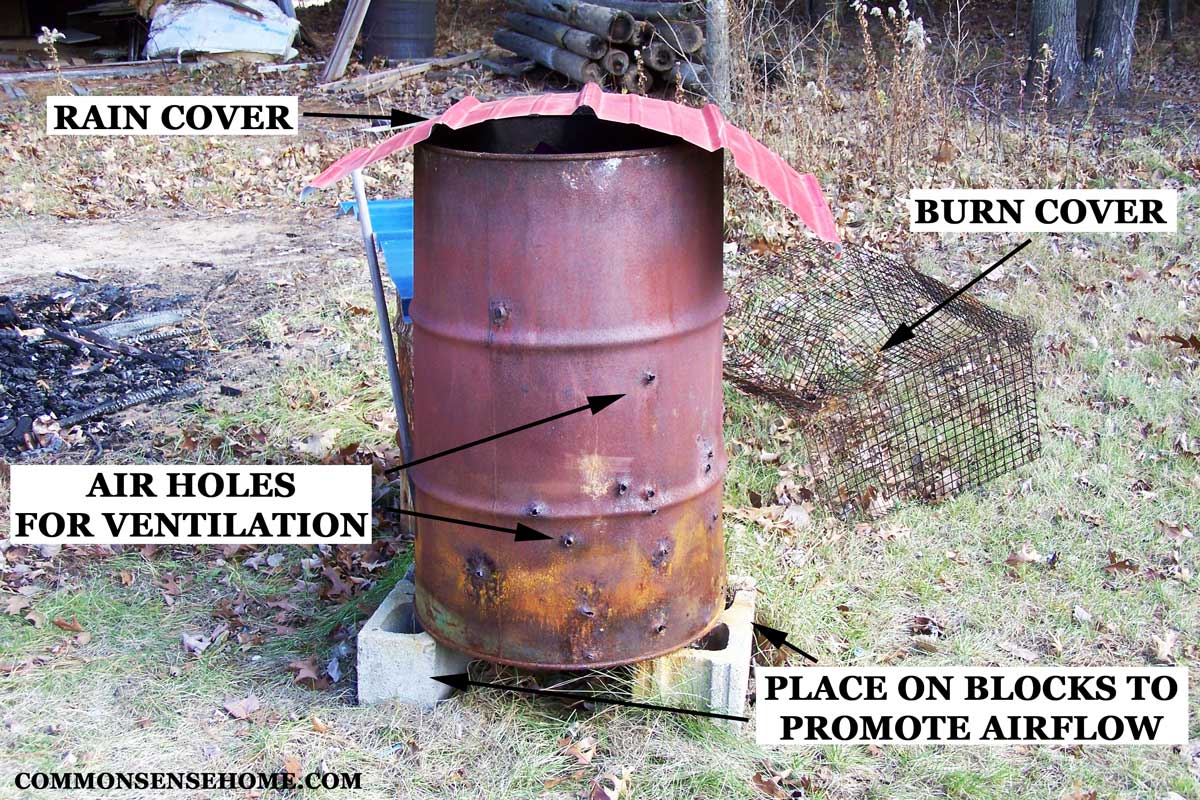
- Drill approximately 20 holes in the sides of the drum, at varying heights. These holes allow air to enter during the burning process.
- Create a fire cover using an old grill top or fencing. Bend it so it fits on loosely, but keeps embers in the barrel.
- Cut a piece of steel siding or roofing as a “rain cover”. Put hooks or a tie on it if you have strong winds.
- Once the holes are in place, set the barrel, open end up, onto some concrete blocks. Make sure the edges of the barrel are on the blocks but there is an airspace directly under the barrel. This increases airflow and helps with drainage.
Optional:
- Painting the exterior of the barrel with heat resistant paint may extend the life of the barrel.
- For frequent use, consider cutting a small cleanout door near the bottom to remove ash.
Burn Barrel Covers
When the barrel is in use, the opening should be covered by a burn cover. A burn cover is a metal grate, fencing or hardware cloth that will trap burning materials in the barrel. This limits the risk of embers escaping the barrel.
When not in use, cover the barrel with the sheet metal rain cover. A cover keeps the contents dry and make for an easier burn, if you have trash waiting to burn. It will also keep the barrel from rusting as quickly.
What can I burn in a burn barrel?
Households produce trash. It’s a fact of life. The efficiency of how well your barrel will operate begins in your kitchen.
DON’T BURN:
- Recyclables
- Food scraps (compost or feed to chickens)
- Other non-combustible items, like light bulbs
- Household hazardous waste, such as paint and chemicals. Contact your local municipality for proper disposal options.
- Don’t burn furniture or any large items, such as bags from silage. This is strictly for small amounts of easily burnable trash.
DO BURN:
- Paper and cardboard not suited for recycling (waxy or coated with food waste)
- Small untreated wood scraps (if you don’t have a wood stove)
- Non-recyclable plastic (I’m talking the occasional small container, not large volume waste.)
- Food wrappers
- Dry leaves or twigs (composting is better with these)
Recycle and Compost
Separate out any recyclables and use your local recycle centers. #1 and #2 plastics are recyclable in most areas. Many retailers accept plastic grocery bags for recycling. #5 containers (such as yogurt cups, sour cream containers, lip balm containers and others) are difficult to recycle.
Separate out your food scraps and feed them to your animals or throw them in your composting bin. (EVERYONE should have one!) The EPA estimates that roughly 21.6% of municipal solid waste is food scraps, and 12.1% is yard trimmings. That’s over 30% of waste.
Throw other items into the trashcan as usual. When your burn bag is full, take it out to the burn barrel!
How do I use a burn barrel?
This is where a lot of folks screw up. The results of which lead to smoky, stinky operation of burn barrels that irritate neighbors and are just plain nasty.
Place your bag of trash into the burn barrel. Burn your trash ONE bag at a time!!!! If you fill your burn barrel with too much trash, it will not burn completely and will smolder instead of burn.
Start the burn by lighting up some dry paper. If you wipe out greasy pans with newspaper or paper towels before washing, those make good fire starters, too. If you can get a charcoal grill or campfire started, you should be able to start a trash fire. If you need fire starting tips, visit Camp Fire Dude.
If you have more then one bag of trash, you can either:
- Light the first one and wait for it to burn down then insert the next bag or
- As most locals do, have another barrel with a rain cover. Insert the second bag into the second barrel and cover to burn at a later time.
Note: Common Sense Home and CJ Harrington assume no liability for burn barrel use. Please be careful.
What do I do with the ashes and unburned contents in the barrel?
After using your barrel for awhile, you will have a build up of ash and small un-burned/un-burnable items in your barrel. What do you do with it?
Locals will wait until the barrel is about ½ full of ash. Make sure the barrel and contents are completely cool. Empty the burn barrel into a large, heavy-duty trash bag and take it to the local dump. If you cut a clean out door, you may want to clean more frequently.
Seems silly to take the “leftovers” from a burn barrel to the dump? Not really. When you consider the money saved by burning many bags of trash, or the space you are saving in a landfill, it makes sense. Also the ash may contain metals and other chemicals you don’t want in your compost or yard.
Burn Barrel Safety and Other Considerations
For safety, don’t burn on windy days. Place your trash in your barrel and put the rain cover on and wait for a calm day.
Watch your weather. If it’s hot and dry, there might be a fire ban in effect. Take your trash to the dump until they lift the ban.
Never leave a fire unattended. Have water or a fire extinguisher nearby. Use dry materials only. Wet or green materials smolder and smoke.
Make ABSOLUTELY SURE there are NO aerosol cans in your trash! They WILL explode in your barrel! If your barrel has too many holes in it or is badly rusted, this could cause the barrel to fail, sending flaming trash everywhere!
Be considerate of your neighbors! Don’t burn your trash during the evening, when people are eating dinner or enjoying sitting out on their deck. In this case, try to burn your trash during the day when the neighbors are at work.
Some locals will come together and arrange a time to burn. That way, no one is hanging clothes out on the line or having a party in the yard when the neighbor lights up his burn barrel.

If You’re Going to Burn, Burn Safely
More and more people are returning to the traditions they grew up with and going back to using burn barrels. Look in backyards, behind garages…. you will still see them in use. If you choose use a burn barrel, do it the right way, stay safe and keep it neat.
Buy a Burn Barrel
For those that are not inclined to make their own, there are an assortment available for purchase. Some include:
- Behrens has a 20 gallon metal trash can burn barrel. It has handles and a built in chimney, made for light duty burning.
- Burn Right has an Extra Large 100% Stainless Steel Hi-Temp Burn Barrel. High capacity and made in the USA.
- DR Burncages fold flat for storage and are high capacity.
More Frugal Tips
A little elbow grease and ingenuity goes a long way to keeping costs down and managing daily needs.
- 25 Cheap Ways to Keep Your House Warm in Winter
- 50 Ways to Become More Self-Reliant
- How to Reduce Your Electric Bill (Small Changes Add Up)
- 23 Common Sense Ways to Stretch Your Food Budget
- 12 Best Tips for Keeping Your House Cool without AC
This post was written by Laurie Neverman, in cooperation with a friend, CJ Harrington, who homesteads in northern Wisconsin. Laurie and her husband, August, homestead on 35 acres in northeast Wisconsin.
Originally posted in 2012, last updated in 2025.
I know that this article is old, but… you say that you didn’t provide instructions for using an accelerant due to “liability issues,” yet you tell people to shoot holes in the barrel with a handgun!? I’d be more scared of a ricochet than a fire risk.
Anything larger than .22 caliber is not going to ricochet, provided it is not frangible or hollow point. 50 gallon barrels are not that tough. If you are not familiar enough with guns and ammunition to choose those that will puncture metal, please use a drill with a metal bit. Guns are designed to put holes in things. Accelerant canisters generally are not designed for that purpose.
Thanks for the well-considered reply Laurie. That’s a crappy stat about the landfills. Maybe some day there will be an alternative to the heavy waste stream that humans seem to have to buy into to survive.
There are ongoing attempts to reduce waste, but they are often ill-considered and poorly organized. As an example – to give the appearance of reducing packaging on items, a friend who worked stocking at a local retailer said that they were instructed to take items (like snow globes) out of their packaging for display. Then they would throw away the packaging. When customers purchased the items, they would ask if there were boxes available – which had been thrown away. Bogus “greenwashing” made things worse instead of better.
Other attempts, like using truly biodegradable materials, are gaining some traction, but the majority of the population opts for cheap and easy. As such, we are drowning in our own waste.
You may find the book Cradle to Cradle interesting. It talks about manufacturing that produces products that can be reused again and again. I thought it was a great idea when I first read it. Alas, it’s been nearly 20 years since it was written, and I don’t see much improvement, but perhaps some day.
DO BURN Non-recyclable plastic? Am I the only one who thinks this is crazy? The thing that has me looking this up is that I just had to clean the contents of an old burn barrel that was left on the property by a previous owner. It was disgusting. He had burned tons of plastic and layered on a bunch of dirt, and it’s obviously a mess of toxic hydrocarbons. I’m throwing it all in garbage bags and getting it off my property.
When I google “burning plastic” this is what comes up: “When plastic is burned, it releases dangerous chemicals such as hydrochloric acid, sulfur dioxide, dioxins, furans and heavy metals, as well as particulates.” Why the F would anyone routinely engage in such a practice? If you have non-recyclable plastic, why wouldn’t you just throw it out?!
It sounds like the burn barrel on your place was poorly managed. We’re not suggesting that people burn large quantities of plastic, like silage bags, but an occasional bread bag, wrapper, or small container. Ash is gathered and taken to the dump, where it takes up much less room because the hydrocarbons have been burned off.
Why not just throw it out? Because landfills are filling up.
This article from 2018 notes:
Since China stopped accepting many materials for recycling, most recyclables that we carefully sort out now go into the trash. I’ve watched my trash guys. I sort into two bins, they empty both into one receptacle.
Exactly, I lived in Seattle many years back and those clowns sorted their refuse into several different containers…on trash day a lone truck came by and picked up all of it.
wut.
Oh my lyn you MUST be so proud of yourself!!!
HEY LOOK EVERYONE, THIS LYN BTCH IS A TOTAL SNITCH AND SNITCHES NEED STITCHES!!! I truly hope you got yours!!!
If not…… you WILL!!!
How can I get one of these metal barrels to burn leaves not gonna be burning anything else but leaves so how can I get one?
You can order the linked burn cages online, but to find metal 50 gallon drums locally, you’d have to inquire around your area at places that use them. Avoid any chemicals that may outgas when the drum is used for burning.
I found you by accident while trying to find When I can burn leaves where I live… And…
Now! I’ll ask here IF can burn Leaves in my Soon to purchase Barrel, (Hopefully:)
Barring local regulations that say you can’t, I don’t see why not. Just follow the same rules as for burning anything else in terms of dryness, airflow and safety. We compost our leaves. They’re great for the garden.
I’m happy to hear this, Lauryn. I also have had an awakening and purchased a burning barrel and have cancelled our garbage pick up. Between composting and recycling, there’s very little left. I am also thinking about what convenience foods I am purchasing and have started making as much as I can from scratch. I love who I am becoming! and this will probably make you feel very wise, for I am 69 y.o. and still growing, learning, loving every minute! So, good for you! and, keep learning!!!
I have about 50 lbs of personal papers to get rid of & decided today, I was not going to pay 0.75 cents/lb to have them shredded at the local store. As i was pondering the issue, I again concluded we have come so far from a former state self reliance. To even consider paying that price is absurd. We had a burn barrel growing up & im going to make or buy one. I had the same ‘awakening’ last week as I picked up a package of dehydrated instant potatoes. Great for emergency or survival food but no reason except laziness to use them daily cooking. I
Instead bought 5 lb bag potatoes &
made my own. Gotta fight against the
urge to place convenience about
Self reliance. Bagged potatoes are a convenience themselves. No need for bagged instant. Im glad I woke up, Ive been walking along like a sheeple. Not the way I was raised. Burn barrel it is.
It’s easy to fall into a habit of convenience over self-reliance. Glad you had your epiphany.
Thanks for this guide. I have learnt a lot from it. My problem so far has been that I need to burn dry branches but whenever I do that smoke is generated and this bothers the neighbours (especially when they have their washing out to dry) , so I am trying to find a smokeless (or at least reduced smoke) method. I have access to a metal tank such as you describe so its is already a step forward to use that as opposed to an open bonfire, but was thinking that apart from holes on the sides I could maybe add a couple of fans (the type used in computers) connected to the side towards the bottom end (by a hose) to drive air into the fire. Would more air being pushed in help reduce the smoke or just make things worse? Thanks.
More air flow will get you a hotter burn, which may reduce your smoke levels, but will reduce the lifespan of your barrel. Adding air holes as described and elevating the barrel should be adequate. If you decided to add extra airflow, be really careful putting anything near our fire that could melt or catch on fire.
One of the most critical parts of a low smoke fire is to get whatever you’re burning as dry as possible. Small diameter pieces will keep the burn quicker, also reducing smoke levels.
Thanks for clarifying. May I ask what in practise happens to the barrel over time, apart from it rusting from being out in the garden? Does the iron get consumed by the fire over time so it gets thinner and weaker? In this respect I don’t know if it worth the cost but I remember there used to be some paint for stoves, which was like an enamel coating for hot surfaces. Maybe painting the barrel with something like this would keep it going for longer? Now you might say well its only a barrel and does not cost much to replace. While that may be true, it is still a hassle to obtain and lug one (especially when one does not have access to a van or trailer) and one also has to clean it out of oil or whatever, so I would imagine that it might pay to invest some time in protecting it as best one can. Or is any such effort a waste of time?
The cover will help with the rust. (Standing water in your burn barrel will shorten the life significantly.) You could paint it if you want, and it may extend the lifespan a little longer. Many barrels have some sort of coating to start.
The reason that higher temps may shorten the lifespan of the burn barrel is basic expansion and contraction. The wider the temperature range your material sees, the more it’s going to expand and contract. It’s a relatively small difference, not something that’s visible to the naked eye, but it adds up over time. I don’t think the paint would help much with that, unless it was somehow insulating, too. (That might be an option. I haven’t looked into high temperature paints lately.)
As an example – we have a masonry stove. Our house is almost thirteen years old at this time. Most of the stove is in pretty good shape, although it did settle a little on the foundation. The inner burn box of refractory cement is fine, the external masonry is fine, the doors are fine. The only thing that busted is the bottom ash grate. About eight years in, my son was cleaning it off outside on the lawn, and it slipped through his hands, about a foot down to the ground. It shattered into several pieces – on grass. This was a heavy duty steel grate that got extremely brittle simply due to repeated extreme heat. Storage barrels are not generally designed for extreme heat.
If you follow my guide a few posts above for making a small fluidized bed combustion fire pit, you avoid all the trappings that containerized burning entails, in addition you never need to concern yourself with replacing barrels ever again due to corrosion.
The more free the flow of air is to the bottom of a fire, the hotter it will burn thus generating far less smoke than stuffing things inside a burn barrel. There is never any maintenance to my burn pit except once in awhile to scoop out ash that falls between the 1-2 foot shale rock walls using a spade shovel. Oversize branches from yard cleanup are easily dropped onto a burning fire pit with zero risk of burning yourself when trying to stuff material into the confines of a barrel.
To save costs of recycling plastic jug and what not. When shopping, bring old gallon glass jugs or large mason jars you have labeled yourself, go to the stores big rubbish bins( in the back of the store usually)
Fill the appropriate labeled glass containers you brought to the store with the corresponding item you just bought from the store. Toss the emptied plastic into the stores rubbish bin. Waaalaaa! Problems solved. Money you saved. Time you saved.
Thank you foe the advice, I in vacation in haiti it’s a such a hassle for garbage, we had to burn them in our backyard, I thought there should be be a better way. So gave me a good idea about barrel burning trash it is so great again thanks, my vacation is a little bit more relaxing now……
Stay safe.