
Home Freeze Drying – Read this Before You Buy a Freeze Dryer

This post may contain affiliate links. Read my full disclosure here.

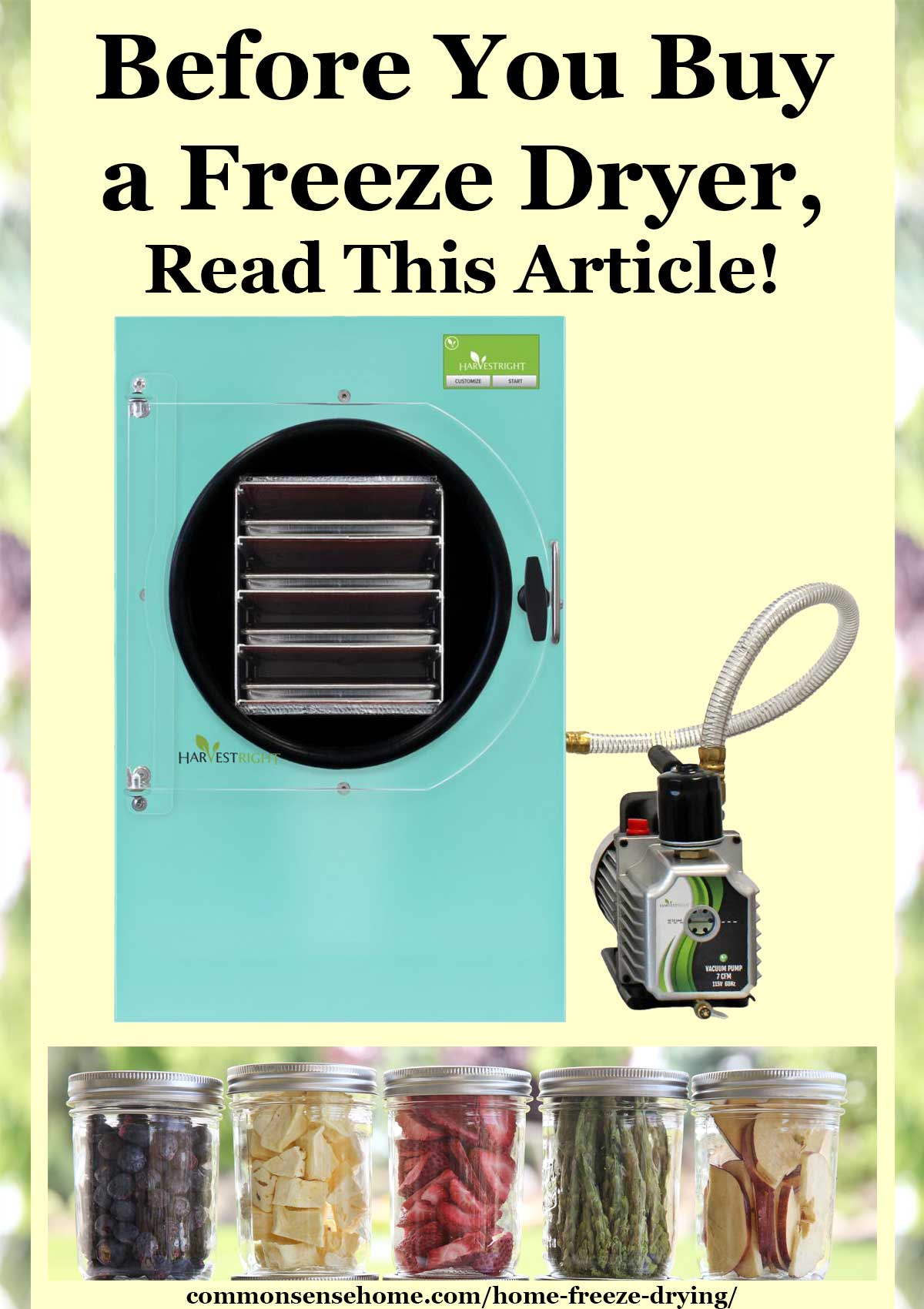
Thinking about getting a freeze dryer? We’ll explain how home freeze drying works, and answer questions about freeze dried food storage for emergencies and more.
Why get a freeze dryer?
I’ve been curious about home freeze drying ever since I did an interview with Dr. Prepper back in 2015. The doc raved about his home freeze dryer. He loved the quality of the food, how much money it saved him, and what a great addition it was to his preps.
In early 2016 Harvest Right home freeze dryers contacted me to do a review of their product. I could purchase it at a discount, as long as I did a review. My other option was to get it for free, if I committed to a series of endorsements.
Being the stubborn individual that I am, I didn’t want to commit to selling you something that was such a big investment without thoroughly testing it. I purchased a freeze dryer and have been using it since May 2016.
My conclusion – if you want long term food storage or portable food storage, check out freeze drying. Commercial freeze dried foods are pricey and often have questionable ingredients. Home freeze drying puts you in control.
How Does Freeze Drying Work?
Here’s the official definition of freeze drying (Lyophilization) from the FDA:
Lyophilization or freeze drying is a process in which water is removed from a product after it is frozen and placed under a vacuum, allowing the ice to change directly from solid to vapor without passing through a liquid phase.
The process consists of three separate, unique, and interdependent processes; freezing, primary drying (sublimation), and secondary drying (desorption).
So, how do we do that at home?
- First, you get a heavy duty freezer (the Harvest Right units drop to -30°F (-34°C) or colder).
- Second, you pair this up with a completely airtight chamber that can hold a vacuum (no oxygen) every single time you use it.
- Third, you tie in a high end vacuum pump strong enough to suck the stripes off a zebra.
- Fourth, you add a heater and thermostat, so you can cycle the temps up and down, repeating the sublimation process for hours on end.
- Fifth, tie in a humidity sensor to make sure the water is out, triggering the cycle completion.
There’s a reason the big commercial freeze drying units are priced from $5000 to over $100,000 – the freeze drying process is significantly more complicated than other home food preservation options.
If you’re wondering how freeze drying compares to dehydrating, you can read more about that in the post “What’s the Difference Between Dehydrating and Freeze Drying?“
Harvest Right Home Freeze Dryer Basic Information
Here’s some information everyone should know before buying a Harvest Right freeze drying machine. Since the time this review was originally posted, Harvest Right made a number of upgrades. They now have HR pumps in two different styles, slight design changes in the main units, and new software that speeds up freeze drying times.
Freeze Dryer Dimensions
Harvest Right has three sizes of home freeze dryers – large, medium and small.
Each unit includes a detachable vacuum pump weighing 35 lbs that sits outside the freeze dryer. They also have a drain hose that routes below the unit. Oil free pumps are available at an additional cost. (More on this below.)
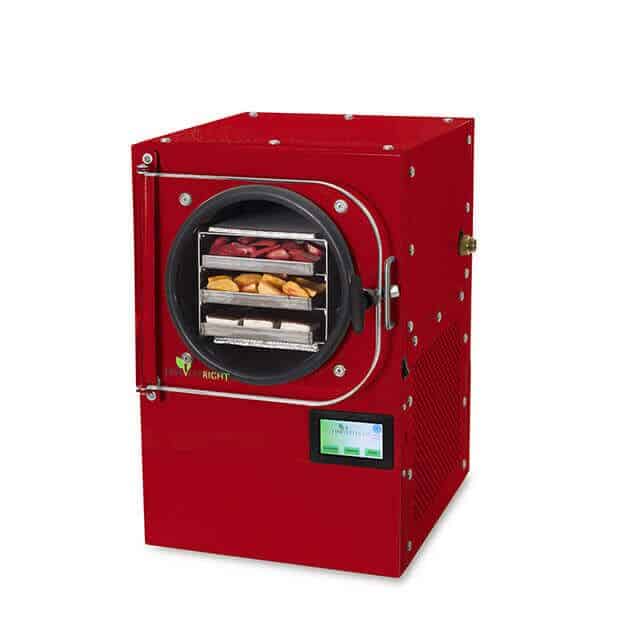
Small Freeze Dryer
- Overall product dimensions: 16.5″ W x 18.5″ D x 25″ H
- 3 trays (7.75″ W x 14″ L x 0.75″ H)
- 61 lbs.
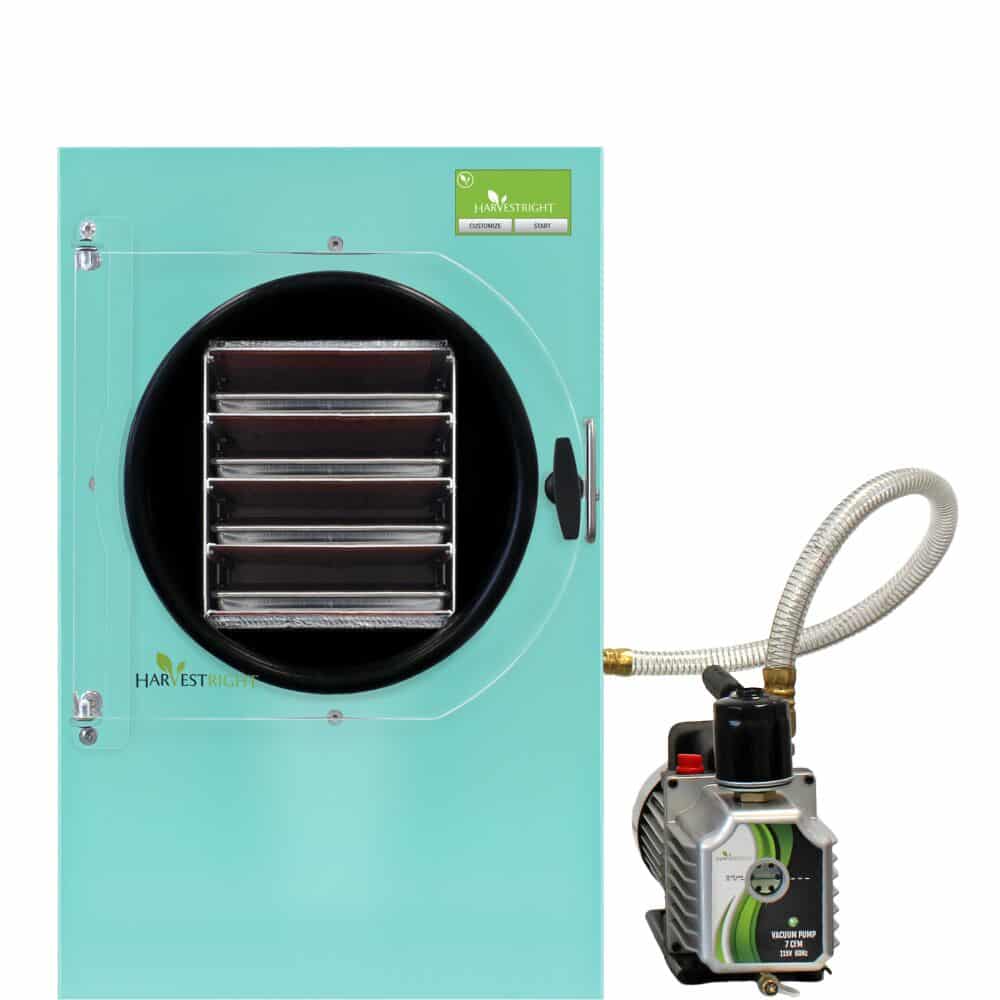
Medium Freeze Dryer
- Overall product dimensions: 18″ W x 21.25″ D x 28.5″ H
- 4 trays (7.5″ W x 18″ L x 0.75″ H)
- 112 lbs.
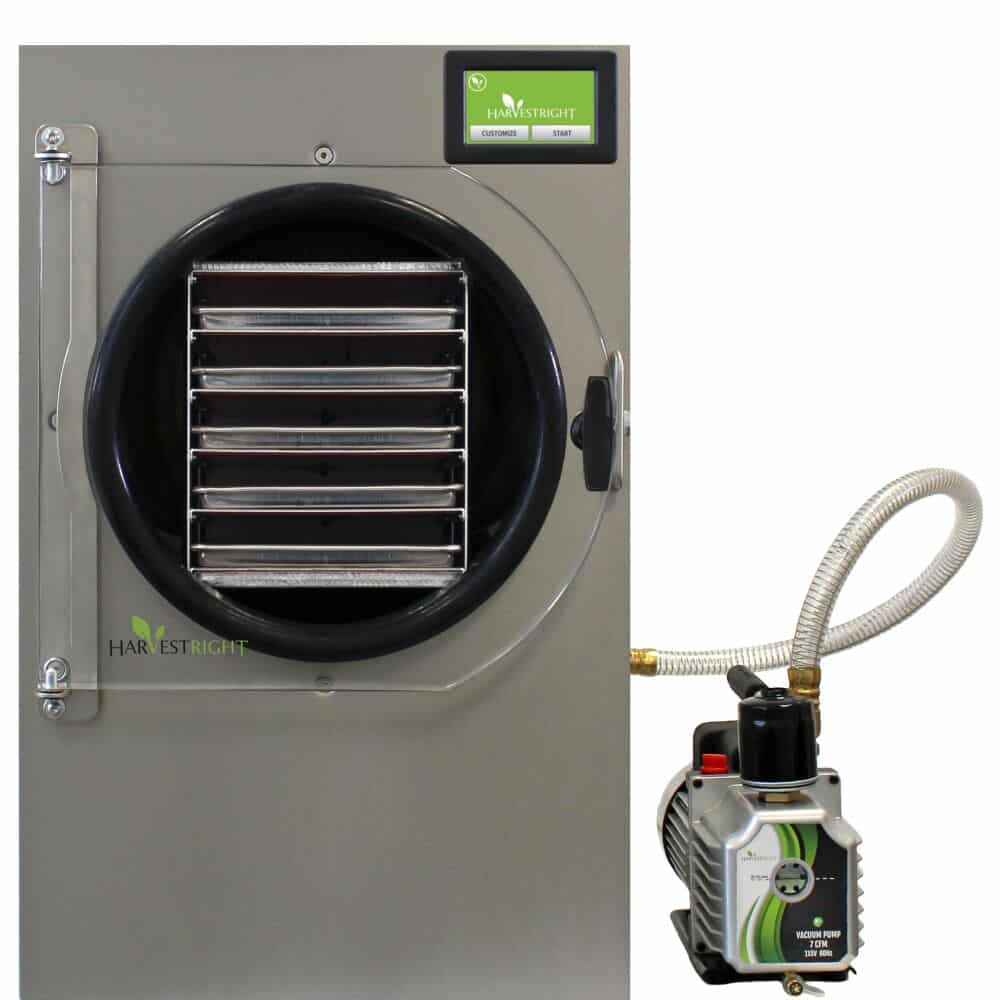
Large Freeze Dryer
- Overall product dimensions: 20.25 ” W x 23.75″ D x 30.75″ H
- Perfect for counter top, cart, or table.
- 5 trays (9″ W x 20.5″ x 0.75″ H)
- 138 lbs.
Moving these units is a two person job, unless you put it on a rolling cart, which many owners do.
I have a mid-sized unit of the old design, updated with new software.
How much food can you freeze dry?
Small Freeze Dryer
- Freeze dry 840 pounds of fresh food per year (4-7 pounds per batch).
- In a year’s time, you can freeze dry 195 gallons of food.
Medium Freeze Dryer
- Freeze dry 1,450 pounds of fresh food per year (7-10 pounds per batch, roughly equal to 1.5 to 2 #10 cans).
- In a year’s time, you can freeze dry 312 gallons of food.
Large Freeze dryer
- 2,500 pounds of fresh food per year (12-16 pounds per batch).
- In a year’s time, you can freeze dry 546 gallons of food.
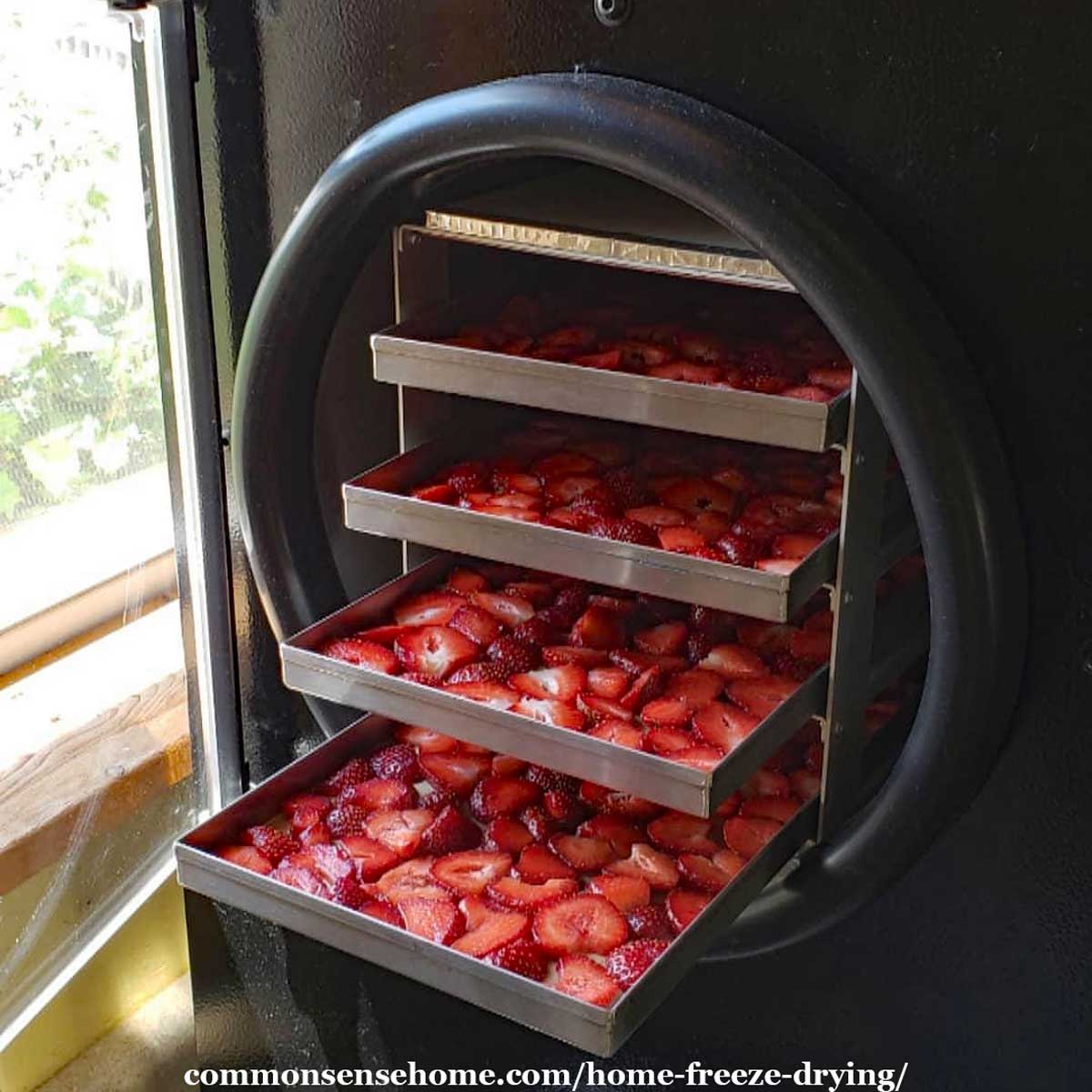
Why can’t I stuff more food in, and stack those trays fuller? During the freeze drying process, ice builds up on the walls of the freeze drying chamber. Add too much food, and the ice buildup will get too thick for the unit to work properly.
Freeze Dried Food Q&A
What foods can you freeze dry?
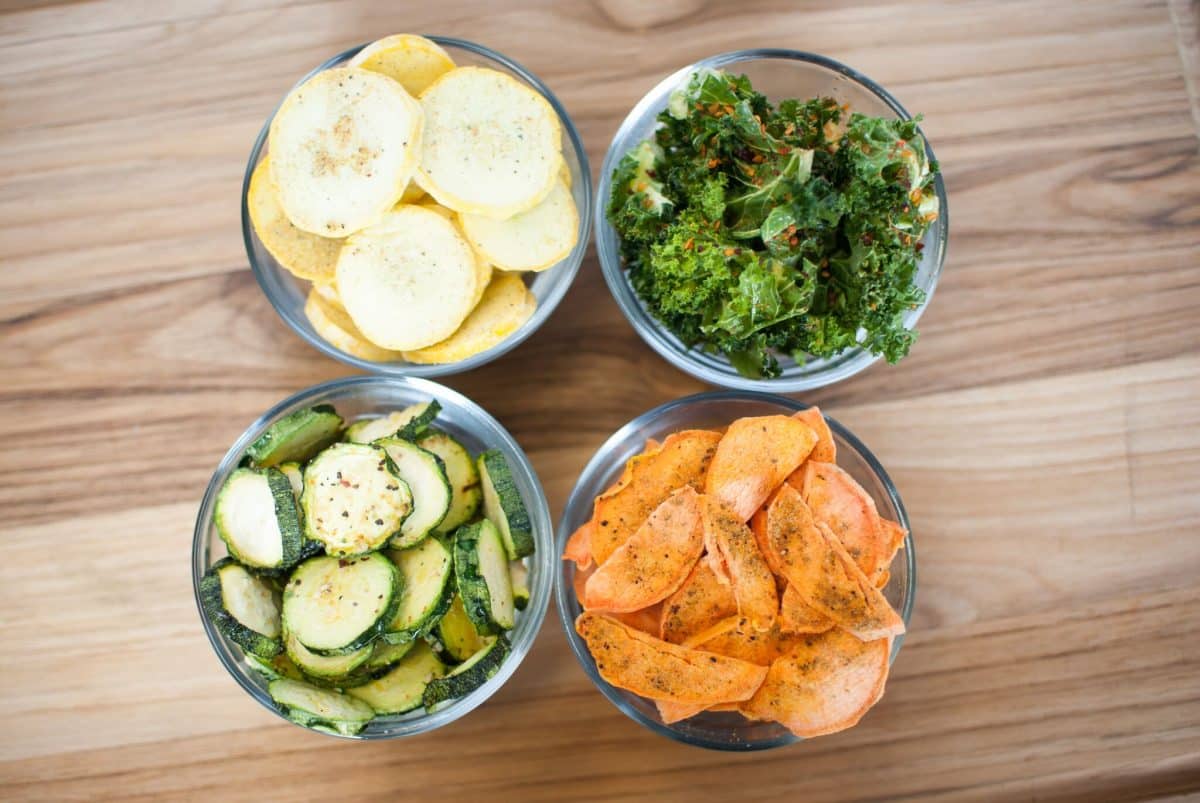
Fruits, vegetables, meats, dairy products, meals, desserts, and more. Freeze drying is safe for preserving cooked pasta and grains, unlike canning.
Those of you who follow me on Instagram know that I’ve freeze dried plenty of fruits and veggies, but I also tried some more interesting items like scrambled eggs and fajita filling.
What foods can’t you freeze dry?
Anything that’s mostly fat or mostly sugar will not freeze dry well. Fat won’t dry – but it can heat up and melt in the unit and coat every surface. When I tried pre-cooked pork sausage patties, they made a big mess.
Sugar binds to water, trapping it in the food. This is great for inhibiting bacteria growth, but it means you can’t freeze dry jams and jellies that are mostly sugar. Plain fruit and most desserts are fine.

How long does freeze drying take?
Around 24 hours was the estimated freeze drying time for an average load, but with the new software, I’ve freeze dried loads in as little as 13 hours. Warm, humid conditions increase drying time.
When you load up your home freeze dryer and hit “Start”, the unit takes you through a short menu. You select whether the food going in is already frozen (or not), and whether it is solid or liquid. Then the freeze dryer prompts you to close the drain valve and begin the cycle.
The new software is smart. The main differences between the old and new software are as follows:
- It measures the freezing temperatures (it used to only measure the warming temps)
- The vacuum pump is used as part of the freeze (when the temp of the food hits 0 degrees F, the pump turns on). This is important because the food gets colder faster.
- Once the food is frozen cold enough, it clicks immediately into drying (it doesn’t wait for the full freeze time to finish)
- The drying phase ramps up to the specified shelf temperature (this helps you get a better finished product)
- The final dry is the same
The biggest benefits occur if you put pre-frozen food it. However, there is still a decrease in the processing times for foods that aren’t pre-frozen. Anyone who gets a new freeze dryer also gets the new software.
The new software will be sold as an upgrade to older users, due to the customer service involved with it. Harvest Right has almost 50,000 freeze dryer customers. I received a copy of the new software to test and review.
Can you mix foods in the freeze dryer?
Yes, but watch placement. The website claims that flavors don’t mix, but we have found that they do. We ended up with freeze dried kiwis with a hint of green beans. Advice from the freeze drying groups suggests placing stronger flavored items on the upper shelves, milder items on the lower shelves.
As always, proper food safety rules should be observed. Avoid cross contamination, dry thoroughly, and package promptly.
How do I know the food is done freeze drying?
The freeze dryer senses the moisture content of the food and finishes the cycle automatically, but sometimes it’s a little off and you need to add extra time.
When you first remove food from the dryer, it will be a little cool from the ice buildup inside the chamber, but not “cold”. I always break open some larger pieces and check inside for cold spots. If you find cold spots, put the trays back in and add time to the drying cycle. Your freeze dryer will prompt you to check for dryness.
One of our readers, Rose, shares what she does to check dryness:
One thing I did choose to add to my arsenal for safety was a FLIR thermal imaging camera. With one easy picture, I can quickly identify areas on the tray that might not be completely dry, and pose an issue for long term storage. The image will show as being “cold” in the area that is not completely dry.
In the MANY loads I have done, I have only had one that didn’t pass (the pre-mashed potatoes) the very center of the tray was still cold. I was able to quickly extend the dry period for a couple more hours and produce a perfectly done product with no fear!
FLIR ONE IOS Thermal Imaging Camera for iPhone – works with the phone
FLIR C2 Compact Thermal Imaging System – standalone camera
How do I use freeze dried foods in recipes?
The book “Freeze-Drying the Harvest” provides detailed guidance for using your freeze dryer and rehydrating your freeze dried foods.
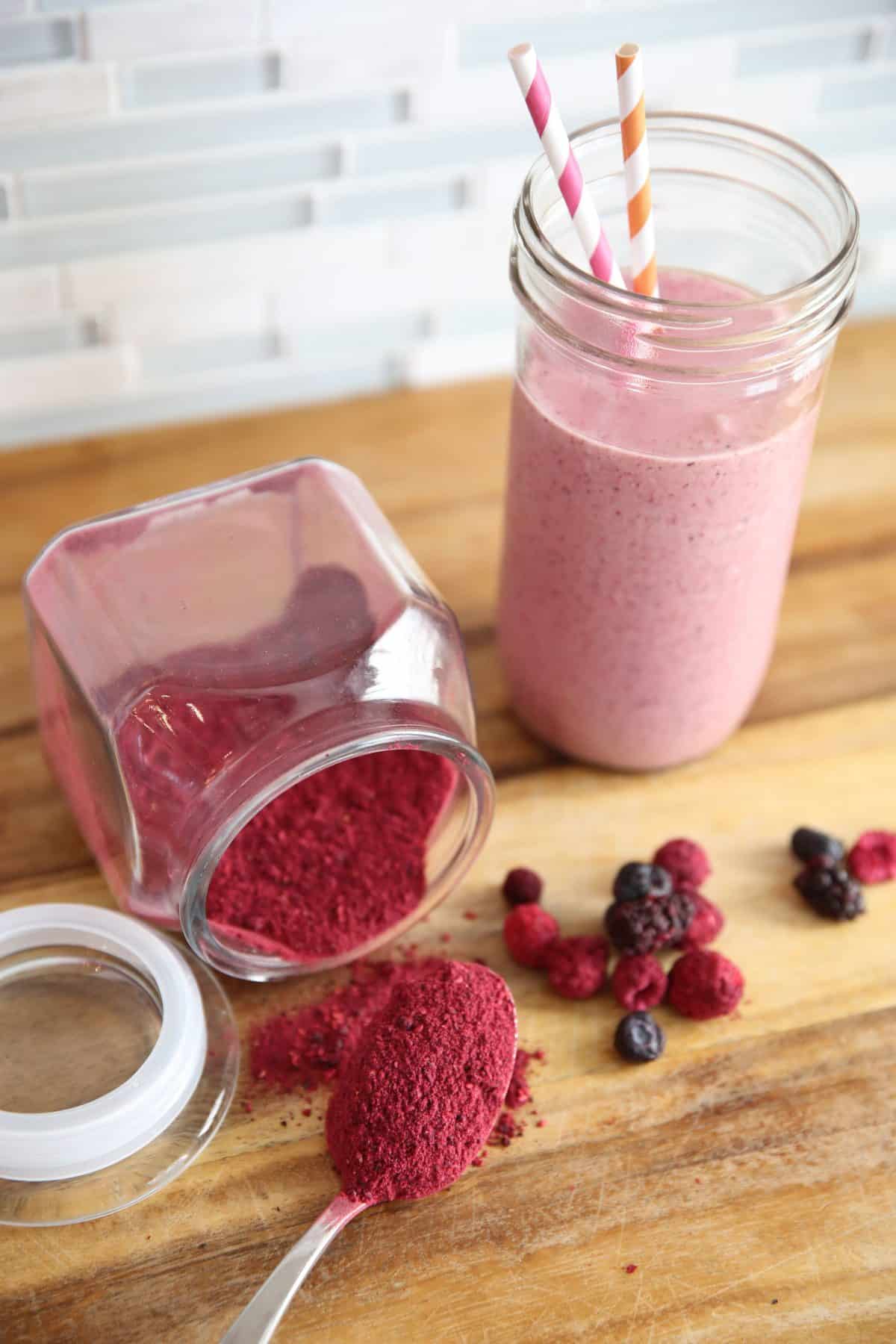
Freeze dried fruits and vegetables (those with less sugar) get so dry they are easily crushed into a powder in a blender or food processor. The resulting powder is bright in color and intensely flavored. You can use this powder in smoothies, or for flavoring. For instance, add strawberry powder to make strawberry flavored whipped cream.
How do I store the freeze dried food?
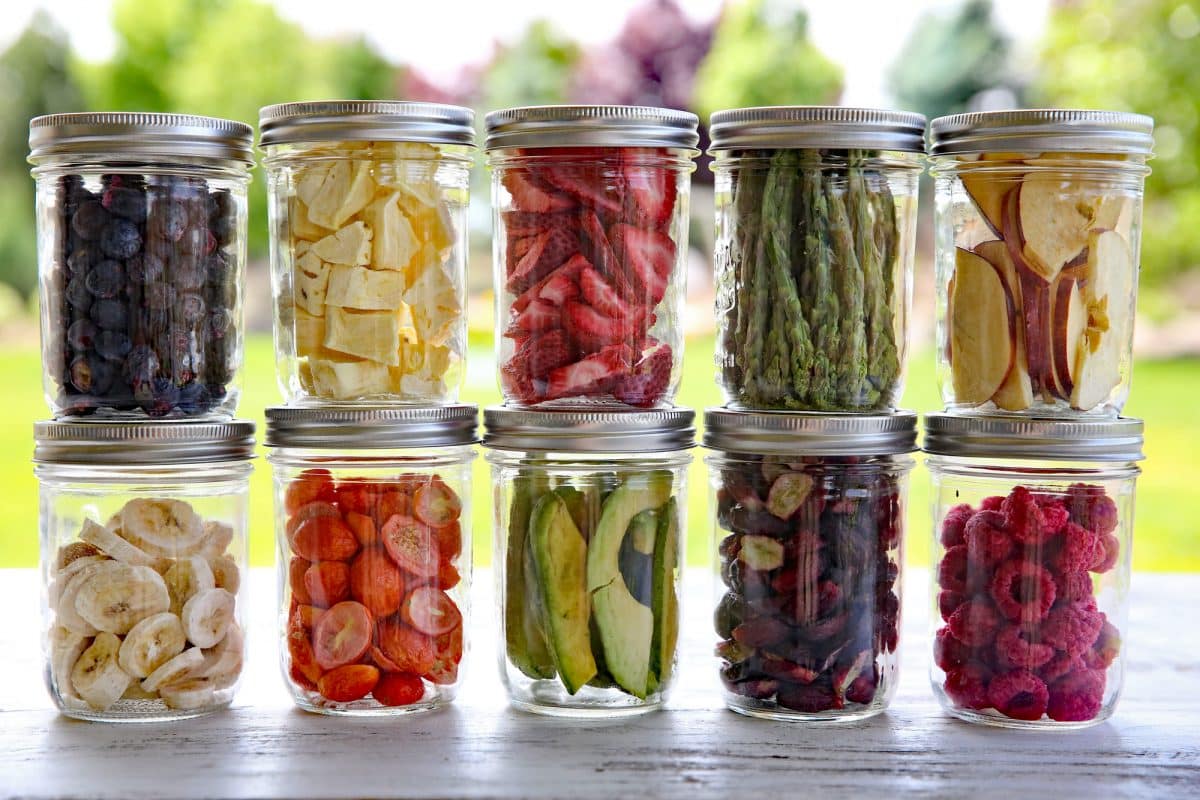
THIS IS VERY IMPORTANT! Once the freeze dry cycle is complete, you must package the food in containers that moisture and oxygen proof, such as Mylar, mason jars or cans. Adding an oxygen absorber helps to ensure freshness.
Meat with any amount of fat will go rancid in a matter of weeks if not properly sealed in an airtight container with oxygen absorber. Putting it in a mason jar and screwing on the lid won’t cut it. (We made that mistake only once.)
We use Mylar bags for most of our long term storage because they are light and durable. You can reuse Mylar, but of course the bag will be slightly smaller. Mylar is great for camping and travel.
Mason jars are a good choice if you:
- Aren’t concerned about the weight
- Have room for glass jars
- Don’t deal with tectonic disturbances or any type of disasters that might tip over your storage
You can use a Foodsaver attachment to vacuum seal jars, or remove the shelving from your Harvest Right freeze dryer and use the vacuum cycle. For long term storage, food is vacuum packed with oxygen absorbers in the jars. For short term storage, I vacuum seal without oxygen absorbers.
Can I use FoodSaver plastic bags for storing freeze dried foods?
No, not for long term.
Would you like to save this?
My friend Gale discusses the difference between Mylar and foodsaver bags in her post “Using Mylar Bags for Food Storage“:
First and foremost, the term “Mylar” is actually one of many trade names for a polyester film called BoPet film. For the technically inclined and the curious, that stands for “Biaxially-oriented polyethylene terephthalate”. This film was developed by DuPont in the 1950’s and was first used by NASA for mylar blankets and long term storage as it increases the shelf life of food by eliminating oxygen. Think superpowered aluminum foil.
Since then, many uses for Mylar have been embraced due to its high tensile strength and its moisture, light, gas and aroma barrier properties. Mylar is also a good insulator against electrical disturbances, which is why it is used for making emergency blankets.
For all of these reasons and more, Mylar bags are considered the gold standard when it comes to long-term food storage.
What about Vacuum Sealed Bags?
Vacuum seal bags, such as those for the FoodSaver are a wonderful convenience and easy to use. But alas, they do not have the thickness nor the strength of Mylar bags and they may start to leak after 3 or 4 years.
They are still a great alternative for your short-term and mid-term storage items, especially if you are diligent about rotating foods and using them for your normal meal preparation activities.
Your FoodSaver bags do not need to be improperly sealed to let air and moisture in. They are simply not as thick or as tough as Mylar.
Alternatives to the HarvestRight Freeze Dryer
There are knockoffs available from China. Based on reviews, they are inconsistent in quality and operations. Although they are cheaper we do not recommend them. We only recommend HarvestRight.
How much is a freeze dryer?
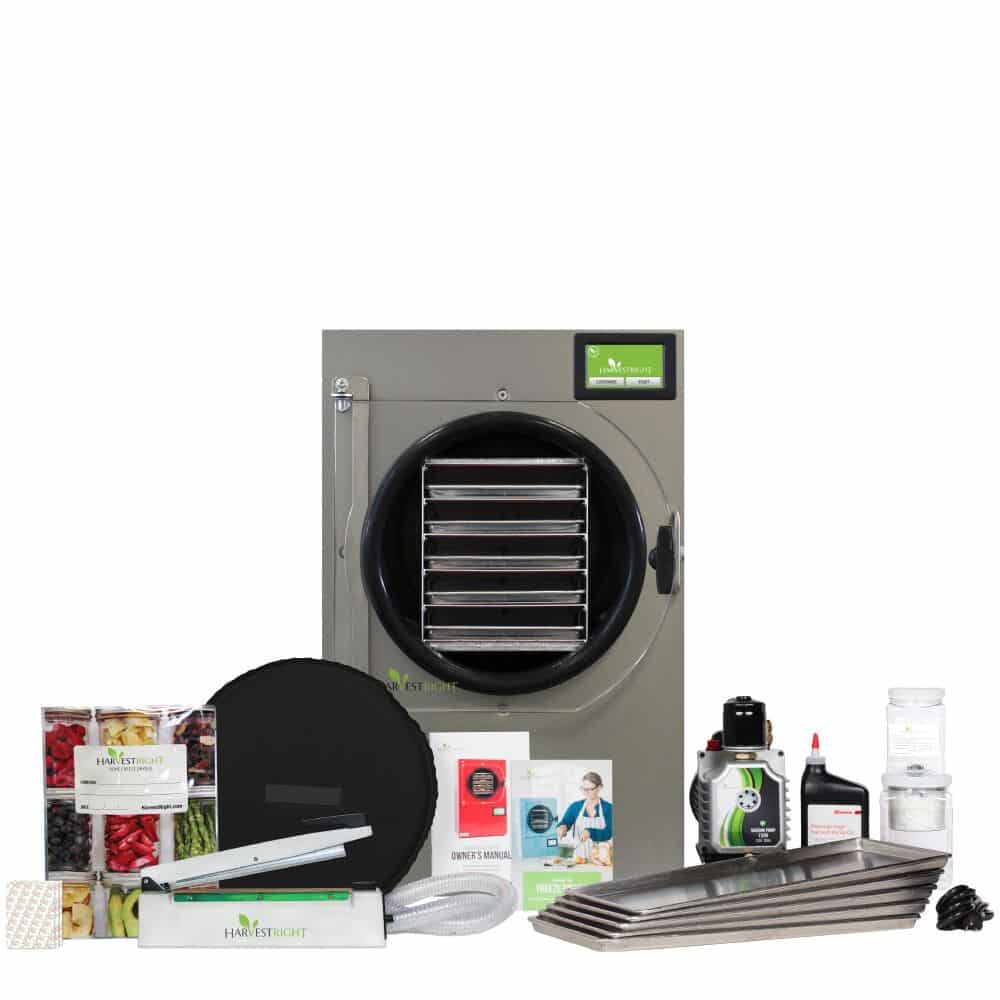
Home freeze dryers range in price from $1,995 to $3,495, depending on size and exterior finish. This cost includes the Freeze Dryer, Vacuum Pump, Vacuum Pump Oil, Oil Filter, Stainless Steel Trays, Mylar Bags (50 ct), Oxygen Absorbers (50 ct), Impulse Sealer, and HR Guide to Freeze Drying.
All units have a 3 year Limited Warranty, versus the one year warranty on many appliances.
Harvest Right also offers 0% interest financing, allowing you to lock in sale prices with a $250 minimum down payment. You pay as much as you want, when you want.
When you reach the designated down payment for the unit of your choice, they ship your unit. You then pay the remaining balance over 12 months with 0 interest.
Harvest Right also offers different accessories separately, such as extra trays, mats, Mylar bags and oxygen absorbers.
These units are a big investment. If you know you’re only going to use it a couple times per year (or not at all), spend the money on something else you know that you will use.
If you want more food security and food preservation options, read on. Home freeze drying is more affordable than ever.
Layaway Option
Harvest Right offers a layaway option so you can lock in sale prices or reserve your machine. (They are experiencing a backlog in orders right now.)
How the layaway works:
- Lock in your sale price with a downpayment ($250 minimum)*
- Pay as much as you want, when you want
- Receive 0% interest until paid in full. Your freeze dryer will ship after you’ve made your final payment.
Locating your Freeze Dryer
Freeze drying machines eat up a fair amount of real estate. This is not a toaster oven or blender. The main unit is about the size of a dorm fridge, plus it has a hose and vacuum pump. Many owners buy a heavy duty rolling table to hold the unit, but a counter top or table can get the job done.
I currently have mine on a counter in the garage, against a wall. The on/off switch is at the rear of the unit, plus the pump has its own on/off switch. You need to be able to access both of those and have clearance for power cords.
Power requirements: The small and medium units use a standard 110 volt outlet, but it’s best to have it on its own circuit if possible. If you try to pair it with another heavy load appliance, you’re likely to trip a breaker. (I found that out the hard way, and we installed a dedicated circuit.)
The large unit requires a 110 volt (NEMA 5-20) outlet and a dedicated 20 amp circuit.
Watch the temperature. The recommended temperature range for operation is 35-90°F. The most efficient temperature range is between 50-75°F.
Although safe, operating your freeze dryer in temperatures above 90°F will affect batch times and reduce the life of the condensing unit (freezer).
As the temperature rises where your freeze dryer operates, so does the length of time it takes to finish batches of food. This happens because with hotter operating temperatures it is harder to reach the extreme cold required by freeze drying.
Don’t operate the unit below freezing. You are likely to have water within the compressor, and it can freeze and destroy your compressor.
Home Freeze Dryer Noise
During the first part of the cycle, the refrigeration unit is running. During the second part of the cycle, the vacuum pump is running. The noise isn’t super loud – think vacuum cleaner, not jackhammer – but it is noticeable. I’d highly recommend planning to have it in an area where the door can be closed.
Freeze Dryer Maintenance
As I mentioned earlier, the freeze dryer does a complicated job, so there’s a little more to it than just flipping a switch.
Think lawn mower, not kitchen mixer. If you regularly abuse your power tools and don’t do basic maintenance, don’t get a freeze dryer. I know many of my readers fix and maintain not only their own things, but other’s people’s equipment, too, so I’m not too concerned about this.
We drain the oil after each use and refill the vacuum pump with clean oil. Oil is filtered and reused. Before filtering, we freeze the oil. After freezing, we pour the oil off the top of the container into the filter. The water (as ice) sits in the bottom of the container.
Visit “Harvest Right Freeze Dryer Oil Change and Filtering” to see a video of the oil change itself and the use of an inexpensive homemade oil filter that works.
Oil-Free Freeze Dryer Pumps Now Available
Harvest Right listened to customer feedback, and they’ve developed a premium oil-free pump. All new freeze dryers ship with standard Harvest Right brand pumps, but the oil-free pumps may be purchased at an additional cost.
If doing an oil change every time you’re freeze drying sounds like a bit of a hassle, the oil free pump may be right for you.
Note that the oil free pump does use slightly more electricity than the default vacuum pump.
Things I Love About the Harvest Right Freeze Dryer
Home Freeze Dried Food is Tasty
Hands down, my favorite thing about the Harvest Right freeze dryer is the quality of the food. The commercial freeze dried food I’ve tried has been okay, but our home freeze dried products are amazing. I mailed some to a friend recently as part of a gift exchange, and she wrote back, “Okay, Laurie, spill the beans on how you freeze dried the fruits. My kids are absolutely in love with them!”
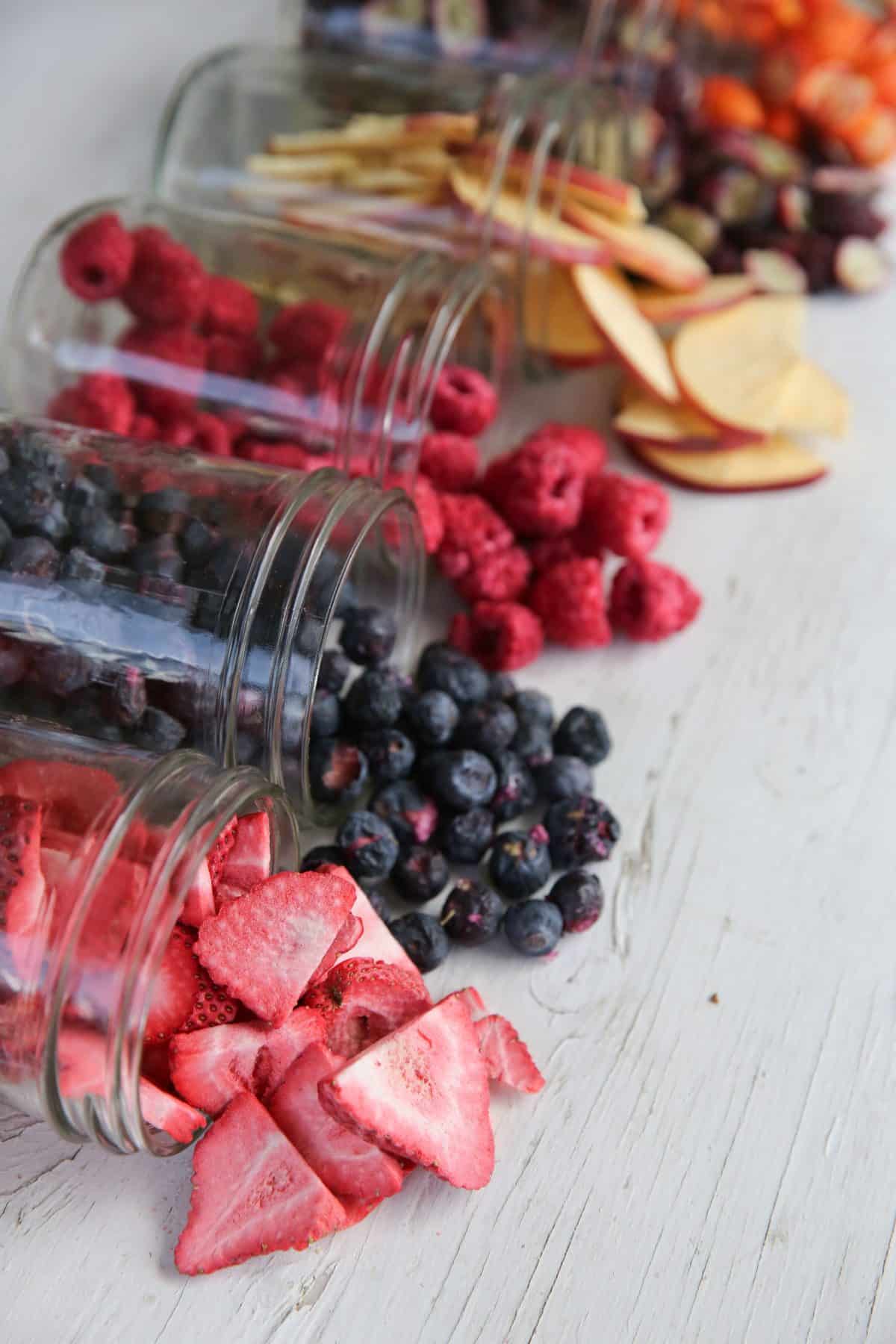
The texture of freeze dried food is light and crisp – more like chips than jerky – even freeze dried meat. We freeze dried fajita meat strips, and they tasted like crunchy little meat flavored Cheetos, the boys called them Meatos.
When we prepped freeze dried fajita filling for dinner, all we did was add a little water to the pan with the food, cover and heat through. Dinner was ready in less than 5 minutes. (If you happen to have a Sun Oven, they work well for rehydrating freeze dried meals.)
The fruit is so good – absolutely, intensely fruity, light and crisp. You can also powder your freeze dried fruits and veggies and use them as natural food colors (and flavors), as noted above.
Home Freeze Dried Food is Easy to Make
Filling the unit is easy. For meals or other prepared food items, simply cook your food and let it cool. Cut into small piece, or thin slices (if needed). Load the food on the trays; place the trays in the unit.
For freeze drying fruits and vegetables, I prep them as I would for freezing or dehydrating. Blanching is recommended for vegetables, especially for cabbage family crops like broccoli. Without blanching, they may outgas during storage, potentially bursting the storage seal.
If you want to freeze dry soup or liquids (like milk), you can do that, too. It helps if you reduce the amount of water to cut drying time, but you can freeze dry “as is”.
You Can’t Beat Freeze Drying for Long Term Food Storage
The shelf life of properly stored freeze dried foods is amazing. Low fat content foods like fruits, vegetables, lean meat, rice, noodles, etc. have a shelf life of 20+ years when packaged properly. Higher fat foods have a 10-15 year shelf life. No other food supply compares for long term food storage.
Why bother with food storage that lasts so long? Because life happens. One year I might have an amazing crop of a particular item, then crop failures for several years. If there’s a job loss or an emergency, with my freeze dried food I know we’ll have a stash of food we actually like to eat.
Food prices keep creeping up, so why not preserve food now to take advantage of lower prices?
Freeze Drying at Home Can Be Allergy Friendly
Food allergies and sensitivities are becoming more and more common. Freeze drying allows you to safely preserve a wider variety of foods than any other food preservation technique. You know you’re only minutes from a safe meal. When traveling, you don’t need to keep food in a cooler.
I have a friend whose daughter has EoE (an allregic swallowing disorder). She found that freeze dried foods didn’t trigger her gag reflex, and was finally able to eat more of a variety of foods.
Home Freeze Drying is Cool
Pun or no pun, home freeze drying allows you to experiment with options you won’t see with commercial freeze dried foods – or other food preservation techniques.
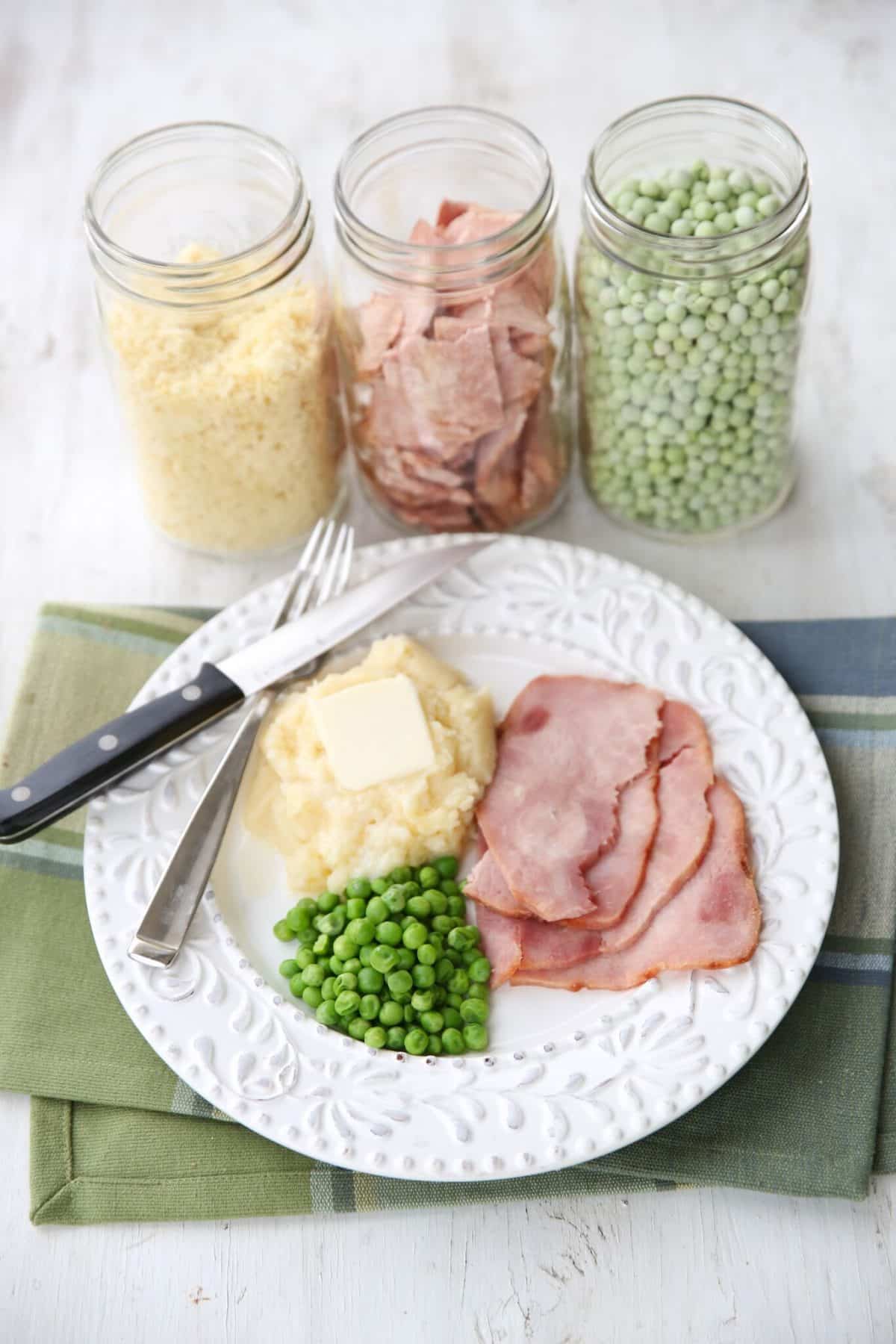
One member of an online forum had his aging grandmother cook her favorite meals. He then freeze dried them to share with the family after she was gone. What an amazing gift to be able to taste a loved one’s cooking one more time.
Another couple was freeze drying some of their wedding cake and the bride’s bouquet. Still another took meal pouches to work and just added hot water to have a real meal while her co-workers were gnawing on granola bars as they worked through lunch.
My boys love crunchy snacks, so we’ve freeze dried things from sweet potato fries to pickled beet slices as chip and cracker alternatives. Freeze dried yogurt drops turn bulk yogurt into a special treat. Combining berries and yogurt into cute silicon molds makes a melt in your mouth dessert bursting with creamy berry flavor.

Are you ready to invest in a Home Freeze Dryer?
Do you:
- Want more options for long term, healthy food storage that your family will enjoy eating?
- Have someone with allergies who needs safe food options?
- Need ready made meals to go?
- Try to store abundant produce for when harvests aren’t so good?
- Get excited about trying new food options and preserving special memories?
If any of these sounds like a fit, take a closer look at freeze drying. I’m happy to answer any questions you may have. If I can’t answer them, I’ll find someone who can. Leave a comment and let me know your thoughts!

My referral link: https://affiliates.harvestright.com/115.html
If you choose to purchase a Harvest Right freeze dryer through my site, I receive a commission at no extra cost to you. (Thank you!)
You can watch the video below to see how I freeze dry strawberries. (These are the berries that had my friend’s kids raving about them.)
You may also find useful:
- The 5 Best Freeze Dried Foods
- Dehydrator Versus Freeze Dryer – What’s the Difference?
- 11 Freeze Drying Mistakes to Avoid for Best Storage Quality
- Harvest Right Freeze Dryer – Cost Analysis and Optimizing Load Size
- Home Food Preservation – 10 Ways to Preserve Food at Home
Originally published in 2016 with the title “Home Freeze Drying – The Good, the Bad and the Ugly”, updated in 2019 to current title. Harvest Right fixed “the ugly”, which was the original messy pump, so I took that out of the title. I’ve also added information based on reader feedback. Please scroll through the comments for more Q&A!
Hi Laurie,
I am glad I came across this post, I have been thing Harvest Right for a while, but I feel it is a bit pricey as we are just a two member household. Are there any discounts available on these any time of the year ?
They do regularly run promotions. I just got an email about their November promotion yesterday.
They’ve also recently introduced a slightly smaller unit at a lower price point.
I just found you via Mother Earth News online Homesteading Summit with host Marjory Wildcraft. I haven’t been successful downloading your bread baking pdf from that show, but found this Harvest Right freeze-drying review roaming around your site. I’m hooked on your common sense approach, and I have a unit on layaway. The latest I read from Harvest Right: Three sizes – the first regular one and now a larger one and a smaller one – at three prices. They also have drawings for give-aways and monthly sales on the units and related supplies.
PS: On your bread-baking video from the Summit this morning I did not catch the name of the yeast you used. Could you spell it for me, please? I am really interested in reading more.
Thanks, Marsha
Welcome Marsha. I’ll be sending out the link to that download again this Saturday for those who missed it. I also forgot the bread recipe in the first version I put on the site – whoops! That’s what I get for working too late at night.
The troubleshooting guide is based on this post – https://commonsensehome.com/bake-perfect-bread/, and there are links to bread recipes there, too. The yeast that I use most often is called Saf Instant yeast.
Harvst Right did just come out with new sizes. I need to update the post!
Thank you for this article! I want a freeze dryer for making soups for travel or soup for my dogs, that just need water. Do you think that bone broth, with meat and veggies would freeze dry well? How lean does it all need to be? You mentioned fat doesn’t freeze dry well.
A little fat isn’t an issue, it’s just extremely high fat products that don’t work well. Items that contain fat will have a shelf life of around 5 years properly stored instead of 20 years. If you’re comfortable eating it, odds are it isn’t too much fat.
I’ve been looking at this, but the cost for me would be prohibitive and the oil maintenance and issues would prove to be problematic with me.
Sometimes a group purchase can make it work. Other times you end up sticking with other food preservation methods. I’m glad that a home freeze drying option is available, but it took me a while to take the plunge, too.
Would this still be cost effective if you didn’t have a garden?
Like any tool, it depends on how you use it. While we focus largely on produce that we grow, you could also bulk buy produce at a discount and preserve it. The same goes for meat, dairy or anything else you care to stock up on. People use it to preserve batch cooking or leftovers. If you use it regularly to stock up on foods at better prices and eat what you preserve, it would be worth it. Food prices rarely go down in the long term, so I look at it as part of our investment strategy. What we put up in food will still be worth as much or more as it is today in five years. I can’t say the same for the money I have in the bank.
So if you ate a piece of freeze dried food, whatever it was, before re-constituting it, would it reconstitute in your stomach? Just curious. Really looking hard into this, but let me ask you…hypothetically (think conceptually here now, not literally like “well canning doesn’t last 10 years”…that is irrelevant to the question). Lets say you made a great big wonderful Thanksgiving dinner that you and your family absolutely loved, and you took 1/3rd of it and freeze dried it, took another 1/3rd and de-hydrated it, and then you took another 1/3rd of it and canned it. Lets say the doomsday preppers were right and there was an apocalyptic event and the stores were closed for a LONG time…10 years go by in fact. With me so far? OK, you haven’t had a great meal like that in the longest time and you had forgotten all about those dinners…you run across quite by accident one day way in the back shelves of your pantry, and you and your family decided to have one. But you could only choose one. You and your family is really excited about having a grand old Thanksgiving dinner again that you haven’t had in ages…which would you choose to eat? Would you be more inclined to eat the reconstituted freeze dried thanksgiving dinner, the reconstituted de-hydrated thanksgiving dinner, or the canned dinner?
Reconstituted freeze dried dinner – no question. I can’t safely can or dehydrate a number of the foods I regularly make for Thanksgiving.
When you eat freeze dried food without reconstituting, yes, it rehydrates in your stomach. If you eat a larger amount, you’d certainly want plenty of liquid to go with, or you’d be passing a brick later. That is an advantage of canning things that are safe to can. Compared to dehydrated foods, I’ve found freeze dried foods rehydrate more quickly and easily.
Hi Laurie! Thanks for such a thorough review. This looks like a terrific way to preserve food and a huge cost savings. I imagine it would pay for itself in no time. BTW, I love the t-shirt you were wearing in the video – “Everything I want to do is illegal”. Good one!
Glad you like the review and the shirt. I got the shirt from Polyface Farm (Joel Salatin).
Thanks so much for your reviewing and teaching about Harvest Right, I have been coveting them and learning all things freeze dried so when I can afford ( or I win one of the contests for a reduced price) I will be ready to go 🙂
I especially like your review of the cost breakdowns from Harvest Right. I have been talking to everyone one I meet/know about Harvest Right… I work/live with a high population of preparedness people so I shared your blog and review with them.
Blessings,
Lisa
Glad that you enjoyed the review. We’re currently prepping pears. Freeze dried fruit is tastier than candy, and I’m hoping to preserve enough to use some for Christmas gift giving.
Do pears need any special prep done … ie, do you have to ‘treat’ with a citric wash first to prevent browning?
I usually dip mine in acid water (typically lemon water) to prevent browning. If you could load your trays quickly, you might be able to get away without it.
Thank you for sharing your experiences with home freeze drying so thoroughly and honestly. I’m currently working on a feature article for farmers regarding the freeze drying process, and am searching for someone with experience with this home unit to interview.
If you’re willing to consider being an interviewee for this article, I can privately send you more information on the publication I’m writing for, who its audience is, more about who I am, etc., to help you make a decision. In most cases, interviewees’ websites are included in a resources section of the articles. I am working on a deadline, though, so would need to hear from you soon.
Barbara – shoot me an email at laurie at commonsensehome dot com.
Laurie! Was pleased to read your review. I too, have a HR and LOVE it! One thing I did choose to add to my arsenal for safety was a FLIR thermal imaging camera. With one easy picture, I can quickly identify areas on the tray that might not be completely dry, and pose an issue for long term storage. The image will show as being “cold” in the area that is not completely dry. In the MANY loads I have done, I have only had one that didn’t pass (the pre-mashed potatoes) the very center of the tray was still cold. I was able to quickly extend the dry period for a couple more hours and produce a perfectly done product with no fear! Looking forward to reading your future adventures!
Whoa – that’s hardcore. How much did that cost (if you don’t mind my asking)? We usually taste test any thick spots.
No problem! I purchased the one that attaches to the Android Cell phone. No need for one of the REAL expensive ones! It was about $250. For me, and mine . . . it’s worth the investment. I also found that I could find wax moth larva in my beehives with it, so I’m real pleased! 🙂 http://www.flir.com/store/
How do you use it to find the moth larva? We’re hoping to get bees next year.
Wow! Like Laurie says, that’s hardcore! I’m impressed! I’m just starting to research freeze drying, and this is exactly the type of tip that I like to see. For us to reproduce the conditions that commercial freeze dry operations use, this would certainly help us with consistent results.
Yes I have also been looking into freeze drying but have not been able to afford it , how much is this unit
As noted in the post, just under $3000 for this unit and other colors. Stainless steel units are just over $3K.
I think that I am just about ready to purchase one. There is only my husband and myself, would the small unit be good for us? Should I spend the extra money on the stainless or are the colors just as good. Are they offering any specials right now? Thanks
The small freeze dryer holds 4 to 6 pounds of fresh food, the standard holds 7 to 10 pounds, and the large holds 12 to 16 pounds. I personally am not a fan of stainless, but it’s trendy right now in appliances so I’m sure that’s why they stock it. The underlying material is the same, it just has a different finish. I’d rather put my money towards a bigger freeze dryer.
As to which is better, it really depends on how much you think you would use it. I know a lot of people say, “Get the biggest one you can afford”, but if you don’t tend to be a big batch cooker or have a lot of produce to store at one time, the small unit is likely to work just fine.
On the flip side, if you’ve decided that you’re serious about stocking up and want to prep a year (or two) of meals (or more), or are willing to prep extra for friends and family, the standard unit could help you do that significantly faster. For instance, we’ve prepared emergency meals for my in-laws in addition to the ones for ourselves. The meals are also good simply to have on hand when you don’t feel like cooking, or when you get busy with other projects and then realize it’s time for supper and you haven’t thawed meat or soaked beans or done any other prep you really should have done sooner. Home freeze dried food tastes like food, not package or preservatives. I had some samples out during our recent open house and people kept coming back for more.
They have the standard discount running now with Small units starting at $1795, standard at $2195, and 0% interest financing.
We have now had our machine for 3 mths,still experimenting with it. Had problem with spray called harvest Right no answer back, but after reading your comment about oil level…will put a little less oil in. Have had little trouble with dryness after machine says it’s done(you need to double double check product before selecting done). So far only using mason jars….want to watch if product tries to reconstitute. Over all we think it’s a great machine. Tomorrow doing 5 dozen eggs
Thanks for sharing your experience. My son is talking over my shoulder…
He said that the trick they figured out is to make sure the drain valve is open and turn on the pump (very briefly)by plugging it into the wall and flipping the switch. When the pump kicks on, the siteglass will show the real oil level while, which is typically much higher than when the unit is off. Then they adjust as necessary and recheck.
I try to make sure to cut everything as even as possible, and not too thick, and not spread anything too thick. I initially started packing in mason jars, but then I had vacuum seals opening in storage, so I switched to Mylar for things I’m planning to store longer that I trust are dry. We always eat a few thick pieces of each batch to double check, too. I ordered plenty of oxygen absorbers, so those are going into both mason jars and the Mylar.
It’s finally cooling off here so I’ll be able to run the machine more again and experiment more. We had high temps and humidity for much of the summer, which just killed the performance since my unit is currently in the garage.
Hello Laurie, I personally prefer using Mason jars since they are varmin-proof, also, I’m not at all sure Mylar won’t eventually leach unnatural things into my food over long periods of time. Here’s a trick to prevent jar seals from failing: vacuum seal your food with an oxygen eater as usual, then turn your seals jars upside down in a box and pour about two inches of bentonite clay into the box so that your jar lids are completely buried. Among many other uses, bentonite clay is a desiccant sometimes used in place of silica gel, so it serves to not only keep air away from the jars but also absorb any moisture in your long term storage boxes. I buy bentonite clay in 50 pound bags for just $9.10 at our local feed store, it’s super-cheap and very useful. Believe it or not, applying poultices made with bentonite clay and activated charcoal several times a day for three weeks completely healed my baseball-sized brown recluse spider bite last year, the stuff is magic!
Thanks, Christana.
I hadn’t heard of that storage method before, but I have heard about the wonders of bentonite clay. Glad that it took care of your bite. Brown recluse bites can be so dangerous. Right now I don’t have nearly enough jars (we still do quite a bit of canning, too), but may have to go on the hunt for more.
What about upside down dipping in melted wax a few times to build up a thick air-tight coating (less heavy-storage)? But the bentonite clay idea also sounds amazing, if your statistics are correct. Have you tried this, and do you have any long-term statistics as to the viability of the food, after storage and upon consumption?
I was also thinking that if packages and jars, etc are waxed, that they are impervious to water damage from floods, humidity, etc.
I’m interested in maintence, please tell me more. Do you have to change oil after every run time or several run times?
It’s best if you drain it after each use, but it only takes a few minutes. I freeze my oil and then pour it into a filter, leaving the icy bits behind in the original container. The filter I’m using now is an old Brita pitcher. Instead of a Brita filter, it has a tightly rolled section of toilet paper inside a coffee filter. Inexpensive and it works beautifully
I would love to see a picture or pictures of your “filter” when you make a new one. Still using the one it came with but it’s slowing down. I am also freezing my oil before I put it through the filter. The water and the little particles freeze and the oil just gets sluggish. My oil looks a lot better since I started doing this. I keep 2 sets of oil going so it doesn’t slow me down! LOL! Thanks for all of your posts and help. It has really made this a lot easier for me and I’m sure everyone else on your blog. I am making HuliHuli chicken today, some to eat for dinner and the rest to freeze dry. Hope it turns out!!
I’ll do my best to get some photos and video up on the site in the next couple of weeks.
I too am among those that have held off due to cost concerns. The second reason is the maintenance. I read another detailed review about the unit on a blog about 4-5 years ago that experienced very similar results as you, so I would buy it if I could afford it.
On that note, the cost comparison is EXCELLENT! Most importantly is you can’t buy a lot of freeze dried ORGANIC foods, much less tasty meals. That alone is sufficient motivation.
So here’s my solution. Start a club or Co-op. Just for the unit. Each member “owns” the unit and signs up for its use. You would only need 3-5 people and that would be easy to coordinate. I would keep it in the sugar shack for my use, until winter, then move it inside. I also thought about asking my food Co-op to purchase one for members to use, with an additional cost, of course.
And, the price has come down from when I first looked at these.
Great article Laurie and so relevant. I’m gonna pin the pic of you and the unit to my homestead board.
Pam
That would be a great solution if you had members you were very comfortable working with who lived nearby. The unit is heavy, so it’s definitely something you don’t want to move more than you need to. Also, high humidity is not great for performance, so climate controlled conditions are best if available.
Yes, I thought of that after I posted my comment. And I also thought that there would have to be a solid contract or agreement, due to food bourne illnesses, the maintenance issues and our litigious leanings. So a small town set up or Co-op set up would likely never fly for those reasons. This would work for a small group of people in a gun club or CSA.
What kind of cautionary notes regarding food safety, did Harvest Right post with the instructions?
I’d have to double check, but if I recall correctly, there’s not much mention of food safety. I expect they figure people will use their common sense.
I was in a situation previously where a simple trailer was shared between family members. Every time a particular member of the extended family (brother in law of my brother in law) used the trailer, it would come back with lights busted or some other damage. One time I used it after he had used it (and didn’t notice the damage immediately) and it shorted out the lights on my van so we ended up driving home in the dark with no headlights. Thankfully the moon was really bright that night and we didn’t have too far to go. My brother in law eventually gave up his claim to the “family” trailer, because he got tired of fixing it after his brother in law trashed it.
I would definitely be interested in a “reader’s discount”, Laurie! I’ve been eyeballing Harvest Right for a little while after seeing you freeze dry some items. Price is the ONLY reason I’ve not ordered one yet.
thanks for the great review. I have looked at their web site several times and almost “pulled the trigger.” now I am much closer thanks to your review. If you can come up with a discount for purchase through your site, count me in.
Planning to contact them this week and show them the comments on this post. 🙂
Thanks for the review. It answered a number of questions and concerns that I had.
I’ve been dehydrating for about 10 years and canning for over 30 years and would love to be able to add freeze drying to my options, but $3k is a bit much for me. I’ll keep an eye out and get one when the price comes down, if it comes down.
They have a sale on until the end of November – $500 off plus free starter kit of bags and sealer. I’m considering the small unit, which with shipping will be about $2500. I’m 60 years old and the price of food will just keep going up, so this is one way to save money for the future.
I think there is a $900 of right now from Harvest Right. I’m a first timer on freeze drying and I couldn’t be happier. Yes you can buy the store bought stuff but I’m very sensitive to the preservatives some of them use. When I do my own I have control over what goes into my food and also I have control over how much I bag or jar. Great for camping or one of those nights I just don’t feel like cooking.
If you go to their site and sign up, they will send you notices when they have a sale going on.
Thank you.I have been interested in the freeze drying process. I purchase freeze dried foods from commercial sources, but have considered doing it my self. Your video was helpful.
I am thinking about purchasing a freeze dryer from Harvest Right. Thank you for posting this article with some of the things I can’t learn from their website. I look forward to reading more of your successes as well as any failures you may have with this machine.
Glad you found it helpful, Leslie. I have a load of green beans in right now that I sauteed. Since they have butter, they won’t keep as long as plain beans, but I think they’ll be more flavorful to heat and eat as a side dish.
Laurie,
Love reading your thoughts on this topic…. quick question, with the butter added to your green beans how will you judge the shelf-life..
We’ll plan on using those within 5 years, which should be well within the range for good food quality.
Hi again Laurie. I made and freeze dried potato soup that has milk and butter in it. Do you think that the shelf life would be 5 years? Anything with butter or milk 5 years? What about things with tomato base like spaghetti? On a different note, can I freeze dry fruit like blueberries that came FROZEN, without cutting them in half or poking holes in them? Do I have to cut FRESH blueberries or raspberries in half or can I freeze them first and then freeze dry whole? Thanks
It’s really tough to say exactly how long things will last in storage, because there’s so much variation in home products. I think 5 years would be given, but up to 10 years would be likely.
I tried freeze drying blueberries that came frozen, and ended up with a half-dry sticky mess. We tried briefly pulsing them in the food processor to nick the skins, but instead it cut some in half and did nothing to others. I put the half-dried berries in the freezer and have been using them in baking. These were larger berries – I don’t know if wild blueberries would work better since they have a smaller diameter.
I think fresh raspberries would work better, since they don’t have the waxy coating of blueberries. I know I’ve seen photos online of home freeze dried raspberries. I’m hoping for a good season this year so we have enough of our own berries to give it a try.
Ms. Laurie-
In the sparring comments with Mr. Jay, I don’t believe the vastly superior nutritional value of FD food was mentioned, nor, how we can make our own CONVENIENCE healthy snacks that ARE NOT available commercially: Where can I find pineapple/spinach/mixed greens/sweet pepper/yogurt FD crispies, slightly sweetened w/stevia??? And if we’re growing a lot of our own food to FD, there’s little to no expense there (of course I ONLY plant my saved heirloom seed). And Mr. Jay should deduct some expense for the physical exercise we partake in, that benefits the whole body (and mind), and most likely saves us on medical costs…
Get THAT out of a can, if you can…
I’m with you, but it’s not for everyone. We love being able to have food that we trust in long term storage, rather than dealing with ingredient lists a mile long, or food that tastes like “can”.
I love the concept of freeze drying but haven’t yet taken that next step. I anticipate that it would great to have but the price is still a big no- no. If the price were $2000-2500 it would be easier to project cost effectiveness.
Here’s some info I received from Harvest Right, running numbers for freeze dried food comparisons.
The following compares the cost of purchasing prepared meals from a leading freeze dried food company to that of freeze drying it yourself.
*The prices used here are sale prices or in-season prices. Prices for produce may vary. You can use your own numbers to calculate cost savings.
Cottage Cheese Retail Price: #10 can has 20, ½ cup servings and costs $65.39
Harvest Right Comparison:
20 ½ cup servings from grocery store $9.69
Power to run machine= $1.80 (approx. High because you get about two #10 cans of food per 24 hours)
Mylar Pouch=$.50
Oxy. Absorber=$.25
Total for Harvest Right #10 can=$12.24
Savings: As much as $53.15 saved per #10 can
Strawberries Retail Price: #10 can, 3.75 lbs. of strawberries costs $29.49, ($7.86 lb.)
Harvest Right Comparison:
3.75 lbs. of strawberries ($.99 per pound)= $3.71
Power to run the machine=$1.80 (approx. High because you get about two #10 cans of food per 24 hours)
Mylar Pouch= $.50
Oxy. Absorber=$.25
Total for Harvest Right #10 can=$6.26
Savings: As much as $23.23 saved per #10 can
Blueberries Retail Price: #10 Can, 6 lbs. of blueberries $45.00, ($7.50 lb.)
Harvest Right Comparison:
6 lbs. of blueberries ($1.70 lb.) =$10.20
Power to run machine= $1.80 (approx. High because you get about two #10 cans of food per 24 hours)
Mylar pouch=$.50
Oxy. Absorber=$.25
Total for Harvest Right #10 can=$12.75
Savings: As much as $32.25 saved per #10 can
Peaches Retail Price: #10 Can, 7lbs. of peaches $43.00, ($6.14 lb.)
Harvest Right Comparison:
7lbs. of peaches ($.99 lb.)=$6.93
Power to run machine=$1.80 (approx. High because you get about two #10 cans of food per 24 hours)
Mylar pouch=$.50
Oxy. Absorber=$.25
Total for Harvest Right #10 can =$9.48
Savings: As much as $33.52 saved per #10 can
Pineapple Retail Price: #10 Can, 5 lbs. of pineapple $38.99, ($7.80 lb.)
Harvest Right Comparison:
5lbs. of pre-cut pineapple ($.89 lb.)= $4.45
Power to run machine=$1.80 (approx. High because you get about two #10 cans of food per 24 hours)
Mylar pouch=$.50
Oxy. Absorber=$.25
Total for Harvest Right #10 can =$7.00
Savings: As much as $31.99 saved per #10 can
Bananas Retail Price: MH #10 Can, 3 lbs. of bananas $25.69, ($8.56 lb.)
Harvest Right Comparison:
3 lbs. of bananas ($.69 lb.)= $2.07
Power to run machine= $1.80 (approx. High because you get about two #10 cans of food per 24 hours)
Mylar pouch=$.50
Oxy. Absorber=$.25
Total for Harvest Right #10 can=$4.62
Savings: As much as $21.07 saved per #10 can
Raspberries Retail Price: #10 can=3.5 lbs. of raspberries, $42.99, ($12.28 lb.)
Harvest Right Comparison:
3.5 lbs. of raspberries ($1.70 lb.)=$5.95
Power to run machine= $1.80 (approx. High because you get about two #10 cans of food per 24 hours)
Mylar pouch=$.50
Oxy. Absorber=$.25
Total for Harvest Right #10 can=$8.50
Savings: As much as $34.49 saved per #10 can
Cheddar Cheese Retail Price: #10 can= 7 lbs. of cheese, $49.95, ($7.14 lb.)
Harvest Right Comparison:
7 lbs. of cheddar cheese ($2.99 lb.) = $20.93
Power to run machine= $1.80 (approx. High because you get about two #10 cans of food per 24 hours)
Mylar pouch=$.50
Oxy. Absorber=$.25
Total for Harvest Right #10 can=$23.48
Savings: As much as $26.47 saved per #10 can
Mozzarella Cheese Retail Price: #10 can= 7 lbs. of cheese, $46.00, ($6.57 lb.)
Harvest Right Comparison:
7 lbs. of mozzarella cheese ($2.99 lb.)=$20.93
Power to run machine= $1.80 (approx. High because you get about two #10 cans of food per 24 hours)
Mylar pouch=$.50
Oxy. Absorber=$.25
Total for Harvest Right #10 can=$23.48
Savings: As much as $22.52 saved per #10 can
Laurie,
Those figures are misleading as they do not cover the cost of production,ie wages, taxes, ins,
facilities maintenance and depreciation, equipment repair or replacement, plus profit.
Put a pencil to your efforts and see what you could reasonably sell your finished product for.
I suspect the true savings would be less than half of what is listed.
Think about it.
There is no such thing as a free lunch.
Grover
I didn’t put a cost comparison in the original article because prices vary so widely. Of course the company will try to put their product in the best light, and as you mentioned, it’s an overly simplified analysis. That said, I do think it’s a worthwhile investment for some people.
For those with allergies, it’s nearly impossible to find food storage products that don’t have ingredients you need to avoid. We had friends over recently, and their daughter has a long list of foods she needs to avoid. No wheat, no gluten, no dairy, no tree nuts, no peanuts, no sunflower seeds (or sunflower seed oils), no soy and a few other things. I was still able to mix up an assortment of foods for snacks that allowed her to eat “normal”. I made a “cheese” dip with a pea protein based cheese spread and dried herbs, served with fresh veggies and home gluten free crackers. I made coconut oil fudge, sweetened with honey, and topped with freeze dried strawberries. My strawberries were safe for her to eat. Many commercial dried foods are coated with sunflower seed oils to prevent sticking. We had finger gelatin and fresh apple slices. As the kids spent the evening playing board games, they snacked on more freeze dried fruit. Everyone enjoyed the food, and she didn’t feel like a pariah.
For us, because we have a large garden, and will soon have a wider variety of fruits coming into production, I love the option of being able to have truly long term storage for bumper crops. I also like the convenience of having our own ready to go meals that taste good instead of “okay”. Did I absolutely need a freeze dryer? Probably not. Do I like it and find it to be a useful tool? Absolutely. Like any tool, its value depends on how you use it.
I have no opinion on these machines and only came here to read your review on them and to get a second opinion after reading the company’s Web site, but I would like to point out that the “savings” that are outlined in the company-provided information would not be realized by most owners in such a way as to justify the purchase and maintenance cost of the machine, which is clearly the way the company (and you by reprinting them) intend them to be understood.
In your review, you are honest and stated your reason for having one was an unforeseen and unlikely emergency that might prevent you from getting food from another source – “If there’s a job loss or an emergency, with my freeze dried food I know we’ll have a stash of food we actually like to eat.” Realistically and honestly, that is the only reason that 99.x% of buyers have for buying this type of unit. People with EOE represent less than 1% of the population, and the eccentric few who want to buy a $4,000 freeze drier to save a piece of their wedding cake or to continue eating their mother’s food for 25 years after she dies, can be safely dismissed as being wildly out of the normal group of buyers. That isn’t to say they aren’t important, but their use of the product is so abnormal that it is not statistically significant when evaluating the purchasing needs of the main body of consumers.
That being said, the important point to remember about the company’s claimed food savings is that they will never be realized until the entirety of the freeze dried food is consumed, and only then if they are compared to other retail FREEZE DRIED food products. For example, one item in the list is peaches, for which the company quotes a comparative retail price of $43.00 or $6.14/lb, which is the price for the canned freeze dried food equivalent, rather than standard canned food equivalent, which is also suitable for long term storage and costs FAR less. The normal retail price at Wal-Mart for a 6.6lb can of brand name peaches is $6.98, and the price for a 1.81lb can is $2.50, times 4 is $10, for more than 7 pounds. Their store brand is only $1.86 for the same 1.81lb amount. Comparing the highest of the three prices for normal hydrated canned food ($10) to the company’s estimate of $9.48 for the same amount of freeze dried peaches is only saving $0.52 per 7 pound load, not $33.52.
In addition, the company is using 24 hours for a machine cycle time in its savings estimate, which directly contradicts the time estimate on their Web site, where they give a 20-40 hour range, and state that high water content foods like fruit will take longer than low water content foods like meat. I would guess that means closer to 40 hours than 20 for peaches, but without exact data on the timing of a load of peaches, I’ll just give them the 24 hour figure, even though it seems incorrect. Using their 24 hour figure, the cost for the electricity is incorrect though, because they quote a usage amount of 900 watts by the machine, and the average price per kilowatt hour for electricity in the US is $0.12, which means that 24 x 900 = 21.6 kwh x 0.12 = $2.59 per 24 hours of run time. That’s a difference of over 79 cents per day, and $289 per year for those you say are running their units 365 days a year. While you might laugh at a <$1 cost per day, it adds up over time, and when you are making realistic comparisons to normal hydrated canned food, it represents an enormous cost factor.
Another big problem is the cost per pound of fresh fruit in their cost estimates. Since national averages are the only thing we can accurately use for the whole country, I checked the USDA Web site (they survey over 3,000 grocery store prices each week) to get the national average cost per pound of peaches last year, which was $2.50/lb. Prices are much lower in the Midwest, but the only time I ever see them for $0.99/lb is VERY infrequently as a top fold weekend sale item. The national average price last week was $2.47/lb. Raspberries, bluberries, and strawberries were also dramatically different in the official USDA average retail price list. It doesn't seem fair or accurate to use the lowest-sale-price-available-in-the-Midwest as the quoted comparative price for consumers nationwide, many of whom pay FAR more than we do.
In my opinion, the accurate cost comparison based on the real numbers would be:
Brand name canned peaches, 7.24lbs, 4 1.81lb cans x $2.50 = $10.00
vs
Harvest Right freeze dried peaches, 7lbs:
7lbs fresh peaches x $2.50 = $17.50
Electricity 900w x 24 hours = 21.6 kwh x $0.12/kwh = $2.59
Mylar pouch = $.50 (I could be an SOB and make you use 4 pouches to be fair lol :-D)
Oxy. Absorber = $.25
Total cost of Harvest Right freeze dried peaches = $20.84
Obviously, using real world figures, the cost per batch is much higher than buying canned food at the store, but even using the company's own numbers, the cost savings is only $0.52 per BATCH. Savings per SERVING would be substantially less, because the bacth sizes are often dozens of servings. I won't go through data for all of the other real canned food prices for the examples the company gave, but they are all as large or larger than the difference with the peaches. Canned hydrated meat also is the same.
Therefore, given that the machine costs a few thousand dollars, you would need to eat several thousand BATCHES, not servings (careful here), to recover the cost of the machine, and since each batch has dozens of servings in it, you are talking about needing to consume many tens of thousands of servings to recover your investment. Of course, this also assumes that there is no maintenance cost whatsoever for the machine.
One other thing I noticed that you didn't mention in your discussion of how you packaged the food, was how the food got in the Mylar bag. I am assuming you use a machine like a FoodSaver vacuum sealer, which would also need to be purchased. My quick look on the Web shows they cost between $50 for the bargain cheapie model to $200 for the heavy duty model. I am going to guess if you are using it to do several pounds of food every single day, you would probably not be well served by the cheapest model, but I don't have one and don't know how well they work. The cost of the FoodSaver device, while small relative to the cost of the freeze drying machine, should also be considered if it is going to be another $150 expense.
I think a more pragmatic view on these devices would be that they are very good and useful for people who have a necessity for freeze drying for a specific purpose such as treating a food allergy, saving their wedding cake, or saving their mother's food for 10 years after she dies, and who have enough disposable income to make cost irrelevant. It also sounds great for people who prefer eating freeze dried food more than regular food for reasons of personal taste or convenience, and who also have enough disposable income to indulge their preference. However, on a strictly cost-savings basis, it would seem almost impossible to recover the cost of the device in the savings achieved over simply going to Sam's Club, Costco, Wal-Mart, or Aldi and buying a bunch of normal canned food.
Most importantly, for those consumers who are getting their food via food stamps or other subsidized program/source, the cost of a normally hydrated canned food stockpile would be fully funded by that subsidized source, whereas to do the freeze drying they would have to use their own money for the machine and supplies and maintenance, so that would be another factor for those on a budget to consider.
One last point – There is also a distinct advantage to having real canned food, rather than freeze dried, for people who purchase systems for the reason you did (emergencies), because rehydrating food requires a supply of clean water, which may be unavailable during/after a natural disaster. Hydrated food requires nothing but an opener.
Loved your review, and thought it very informative! Thanks, and good job! 🙂
Hi Jay.
Very detailed analysis.
You’re absolutely correct in that this is not a low budget machine, and that the Harvest Right numbers may be a best/worst (depending on how you look at it) scenario. The thing is, I’d say that the odds are that people who buy a freeze dryer with saving money on food storage as their primary goal are probably one in a million. It’s a high end food preservation machine. That’s why I still feature a wide variety of other food preservation techniques on the site.
That said, some of the same people who shop at Walmart to save money on food would thing nothing about blowing hundreds (or even thousands) of dollars on cable TV or entertainment tickets or 6 wheelers or new phones or bling or… I choose to invest in another food preservation option that I can trust. It’s worth it to me (and many thousands of other customers) to have a wider variety of food options in storage.
One factor you failed to note in your analysis was rising food prices. In ten years, that canned food stash will taste like can, but the foods I freeze dried will still likely be in good condition – and harvested at home or purchased at today’s lower prices.
The Mylar bags (or canning jars) and oxygen absorbers are an additional cost. Mason jars can be vacuum sealed using the freeze dryer itself with just the vacuum pump turned on. To seal my Mylar bags, I picked up an old hair straightening iron at the thrift store for $2. Works like a charm.
In the various posts in the Preparedness series, I do mention the need for extra water (and water filtration) if you stock dried food items for emergencies. The freeze dried foods are very light and easy to carry – easier than cans, even when you add in the container of water to rehydrate. Pretty much everything we’ve freeze dried has tasted good dried, even without being rehydrated, so in a pinch you could even stack and drink water.
And one other thing – EOE is rare (thankfully) but the rates of food allergies are sky high. I have a close friend who deals with several family members with a variety of allergies, and I think the average allergy free person would be surprised at how difficult it is to find safe foods. Dried fruit (like raisins) are coated with sunflower or other oils to reduce sticking. Many prepackaged items have sulfates or other preservatives that they need to avoid. Carrageenan is a common thickening agent that raises hell with gut health. Dairy, soy – they’re in so many products. And sugars! Ugh. It’s amazing how many savory foods are loaded with sugar.
I am very new to the concept of home canning, dehydrating and freeze drying. I can see where a mix could be beneficial to many home and lifestyles. It’s funny that I just discovered the Harvert Right line a day or so ago and the your very informative review. My question is how potatoes, corn on the cob, tomatoes and other similar “home garden” vegetables hold up and if they need any special care?
Jonnie
Potatoes, corn and tomatoes do require some prep before freeze drying. Potatoes should be cooked in some fashion, and sliced, shredded, cubed or mashed.You always want to avoid trying to freeze dry food that is too thick, because it’s next to impossible to get the center completely dry. (This is similar to dehydrating.) If there’s an “instant” store potato product, you could probably make a homemade version for freeze drying.
I wouldn’t try corn on the cob, but corn boiled and sliced off the cob is delicious. It tastes amazingly fresh. The kernels are light and crisp, not chewy like dehydrated corn – great for snacking.
Tomatoes are very high in liquid, so they’d take a long time to dry. You couldn’t do whole tomatoes, because the moisture can’t escape through the skin. They’d need to be sliced or chopped, and draining off excess juice before drying would be a good idea.
I’ve seriously thought about purchasing a home freeze dryer. Does anyone have a comparison of cost between purchased freeze dried foods vs home freeze dried foods? Laura in your review you mentioned freeze dried milk, is it possible to freeze dry goats milk? If so how long would it last as it is full fat?
There’s a site called Family Canning that does cost analysis of freeze dried food in extreme detail. You can check out their numbers here – https://www.familycanning.com/freeze-drying/cost-analysis/
Goat’s milk should freeze dry as well or better than cow’s milk. I know people freeze dry human breast milk, too. I would think that it should have at least a 5-10 shelf life if properly stored.
Canned goods have varying shelf lives. But generally about 5 years, and less for high acid items. Freeze dried, by comparison, will last at least 20 years; potentially longer. The monetary issue says to me “yes this is costly, but if you use this enough, you will actually recover a significant part of the cost”.
Hi BillH,
Pretty much everything you said except the “canned goods have varying shelf lives” is incorrect. If you go to the store today and buy a can of corn or green beans, your grandchildren will be very safe eating it decades after you’ve died. Dates on cans are selected unscientifically by whatever the manufacturer decides is desireable for market conditions (store display rotation, label style changes, appearance, etc.), not because the product is not good after that date. Water is dated for the same reasons. Cans of food more than a hundred years old have been recovered and eaten from shipwrecks and basements with no ill effects. The US used to keep its fallout shelters stocked with canned food in 25 year lots. Very high acid content foods such as raw tomatoes or pineapple have shorter shelf lives, but those foods would never be chosen for 25 year storage by any means anyway.
The monetary issue should say to you “yes, this is costly, and no matter how much you use it, you will never recover the cost.” That’s why I gave specific verfiable data for the points I made, all of which can be very quickly and easily checked online, while ALL of the data the company gives for their figures is directly contradicted by every bit of available online data. As I proved with objective third party data, there is either no savings whatsoever or a savings of a few cents per BATCH, not serving, which means no savings at all over the life of the machine. That is because if you use it enough to make those few cents add up to hundreds of dollars, you’ll need to pay additional costs for maintenance on the machine which will absorb the savings.
In other words, it’s kinda like buying a Tesla to save money because you worship Elon Musk and blindly believe everything he says. After personally owning a Tesla, I can tell you that you will NOT save money by owning one, and if you thought you would, you need to learn to evaluate corporate sales pitches better. Obviously, if Teslas paid for themselves or saved people money, virtually 100% of the population would have bought one a long time ago. Same thing with freeze drying machines.
These machines have benefits of course, but you should think of them as a luxury item like a premium cable channel, a Ferrari, or a Blu-ray player. All are great products, very useful, fun to own, and can make your life better, but none are going to save you any money.
I guess that’s all true enough, if one enjoys eating food that tastes like the inside of a can…
Well, given that the average household canned food consumption in the US is 600 cans per household, and over 200 billion cans of food are sold every year worldwide, it’s a safe bet that one won’t mind the taste too much. Also, since BillH was talking about surviving some cataclysm for 20 years of time, I am guessing that not being able to bathe, have a working flush toilet, or having any electricity or motor vehicle will be a LOT harder to bear than the suffering of having to eat corn that comes from a can rather than a Mylar bag. lol
Given the results seen after natural disasters like Hurricanes Katrina and Sandy, I don’t think the majority of can buyers (or the majority of people, period) would survive 20 weeks, let alone 20 years, so it’s pretty much a moot point. I (and I suspect, a number of my readers), rarely buy standard commercial canned goods due to concerns with contamination from herbicides, fungicides and other things I’d rather not eat. (I find canned peas particularly unpleasant.) Freeze dried food may indeed be a “luxury” item, but it’s certainly a much more practical luxury item than most of the things that people blow money on.
EXACTLY. You’re proving my point. In the case of a natural disaster, all of you would be a long time dead before the 20 year mark ever arrived, so asserting that freeze dried food is better because it is going to last longer than cans is ridiculous. Your point about not wanting to eat any food you haven’t grown yourself in a hermetically sealed lab so that you never get any herbicides or fungicides in it is a very valid one, and I agree. I similarly do not like to eat any food unless it is with my solid silver tableware so that it can sterlize any contaminants that might be present in my food, and I always wear a gas mask when I go outside my home so that I don’t have to breathe all the toxic fumes from the motor vehicles that seem to be everywhere nowadays. If only we could jail all the farmers who use powered tractors and vehicles instead of the time-honored tradition of hand tilling and picking their fields, we would be a much healthier people! We could ban Buccaneer too! Write your congressman! 😉
Yep, you’re absolutely right. I’m so anti-technology that I went out and got a silly math and physics degree and mechanical engineering degree. What was I thinking? I also built an ICF house with that dangerous internet stuff and electricity, instead of living in a mud hut and communicating to people around the globe with passenger pigeons. Oh, the horror! I’ll have to talk to the husband about that hermetically sealed lab for food growing, though, since mostly we’ve been growing it outside in the dirt and composted manure. Maybe we could add it to the underground bunker near the thorium reactor.
Good grief Jay, please stop trying to prove your point and let us be interested in freeze drying. If you’re not, please move along. There is nothing here for you to see.
Heidi, this is just a fun discussion. No one is really taking any of it seriously, I’m sure. Take it all with a good sense of humor. 😉
Wink faces do not make insults fun. True story.
Hi Laurie. If someone has misunderstood my posts and thought they were meant as insults, please delete them all, including this one. My intention was simply to cite some simple math to illustrate a factual point that had not been stated here and that I thought might be helpful to those who were evaluating the ROI of a unit. I certainly did not intend for them to be insulting in any way to anyone, and thought they were even a little bit humorous, which is why I put a wink face after some of them. Given the type of responses my information has generated though, apparently my data was just beyond the understanding of many people reading it, so I would rather just have it deleted so it does not continue to confuse people. I would delete the posts myself but don’t know how, or if it is even possible for a user. Thanks in advance, and sorry for any trouble and/or confusion generated by me or my posts, as that was not my intention.
I don’t believe your posts were misunderstood at all, including this one.
Jay,
First of all, I was not talking about being able to store food with 20 year shelf life so that I can store 20 years of food. I have been prepping (in some informal sense) for some time now. You don’t just prep for a disaster that happens this week. You prep for a disaster in the far future. If your stored food doesn’t have a long shelf life, only very rigorous inventory control (rotation) will prevent spoilage.
You must be new to prepping.
My statements on shelf life of commercially canned food are based on my EXPERIENCE, NOT some blog statements about rare cases of very old food being eaten without harm. I have thrown way more canned food than I like to think about. If the can is bulged out on the ends, then botulism is present. For safety, I throw out all cans for the same items of the same age. Survival isn’t just about doing things like preps. It is about NOT doing things that are life threatening.
It isn’t just raw tomatoes and pineapple that are acidic and thus have short shelf lives. All tomato-based products have the issue. Tomato sauce and paste, sardines in tomato sauce, and ravioli are examples. Not to mention many canned fruits. These are items that you want to have in your diet, canned or otherwise.
I stand by my statements. Two years for acidic foods and five for others. Double that is quite possible and ideal, but introduces risk. Risking food poisoning is not a recipe for survival, as I see it.
Thank you, Bill.
exactly ….thinking I was preparing and stocking up on canned goods,,,,my fruit based canned goods started blowing up….so canned goods are NOT the way to go
LOVED the review, Laurie. Please don’t take the “in your face” comments from others to heart as they must not know how their food is canned, prepared, or grown or they wouldn’t really challenge your review. Your review convinced me to buy one based on a few of your points. I can’t wait to get it. I am buying it because of the prepping aspect in addition to drought and other natural disasters possibilities. I am prepping for my whole family, so I don’t care what the cost is, how much per serving, whether it’s economical, practical, or anything else. I am most interested in the QUALITY and being able to prepare for my future while I can. Your article and review were excellent and it covered a lot. Thanks for taking the time to share with us!!
Thank you, Chris, and I hope you find your freeze dryer as useful as we find ours.
Lets not forget what to me is the most important. The foods you grow can be pesticide free non gmo poison. That would be worth how much?
The commenter who argues about “cost-effectiveness” makes sense only if he can prove to me that one can eat currency and get nutritional value from it, and survive… or lick ones hand held display screen showing their savings account balance, and get their RDA of protien and calories.
The point I see the author making is to use something while it is available without massive control (currency and electricity), to create something that will keep one alive for 3 years and beyond, when money will be useless and electricity just may be permanently out… along with the Internet.
In my view, this website is priceless and full of amazing Off-Grid hints which could enable one to be fully full food and water independent in as little as 6 months, if one performs the due diligence and planning and is not afraid to reduce their savings to gain sustenance to survive for quite a long time in the event of a massive lock-down again or worse.
Yes, the Harvest Right is “expensive” but it spins pure gold that one can eat and sustain one’s self… when the word “expensive” will not equate to worthless cash… but a barter system, where if one has freeze dried packages, they can trade for items they want, with others who don’t have what one has.
There is no such a thing as “cost-effective” when the items being weighed against each other are, on the one hand, useless fiction that will soon go digital, and on the other hand, pure life-sustaining food for years to come in one’s own home.
Banks print fiction.
The Harvest Right is like a legal currency maker in one’s own home… for a currency that will soon outweigh in value any fiction very soon. I am almost sort of surprised that this method of survival hasn’t been declared illegal *chuckle* because people like me see its worth as higher than any paper, metal or rock.
Well… I just wanted to express my opinion. The guy going on about saving worthless fiction to spite something that can still be gotten, but not for long, sort of beggared my sensibilities and logic.
Don’t give the powers that be any ideas about making it illegal. There’s already stuff on the books about “hoarding” that I suspect could be used to justify all sorts of interference.
Inflation is getting uglier every day, and I don’t see that changing any time soon.
Yep! Mis-Leading. But not because of the obvious reason! Your not comparing apples to apples. Once you’ve freeze dried, it can’t be compared to a canned product for price due to a couple of reasons. 1) it is not a canned product with a relatively short shelf life. 2) it’s not being compared as a *per serving* cost. 3) freeze dried lasts for upwards of 20 years.
Compare the prices of bulk fruit packages to one of the “Survival Food” places, 1 Bag/28 1/4 c servings costs $42.00. .84 a serving.
So with all the other costs, what is the price per serving when all is said and done, and what is the *value* of having great food around for up to 20+ years if SHTF?
I found another interesting snippet at Food Assets Shelf Life of Freeze Dried and Dehydrated Food:
JayWindthowup, you sound like you’re in politics. You completely spin things, bend facts to support a narrative, and then when everyone proves you are a misinformed pompous jerk who is convinced his head is a suppository, you simply say it’s everyone else being too stupid to understand your message. Find out how that explanation worked for the last presidential candidate that used it. If I’d never owned a car are even seen one I wouldn’t be so full of myself to go on and on about em.
Thank you SO much for the excellent review! I’ve been contemplating these units for some time now. Really well done- not so afraid now hahahaha I subscribe to the local CSA for produce but am only just one person in my household now, so often can’t eat everything- I give it away. BUT it would solve a lot of issues that you pointed out above such as having a food you like when it’s not available, etc.
Thanks again.
Glad you found it helpful, Dianne. So far for produce, we’ve freeze dried peaches, apricots, strawberries, bananas, green beans, and sweet corn. All were delicious, although the apricots were pretty tart to eat straight. You can freeze dry greens, too, but they will rehydrate limp, not crisp. (Of course, you can powder them and use them in smoothies, sauces, etc., too.)
I what does “powder them” mean?
When fruit is freeze dried (except for very high sugar fruits) it gets so dry that it can be easily crushed into a powder. The fasted was to do this would be a blender or food processor, but you could crumble by hand if you didn’t mind uneven pieces. The resulting powder is bright in color and intensely fruit flavored.
I have been dehydrating my herbs to dry them, but herbs are very sensitive to heat. I am thinking freeze drying them would be a better option. Then I could use them whole or grind them up while keeping more of their healing properties.
Freeze drying has long been used for laboratory samples to preserve them with the least amount of damage, so I think it’s safe to say that it would also protect the quality of your herbs.
Grind in grinder. Put in soups, smoothies
I bet that beet, wheat and barley grass powders taste fabulous when made from home grown and freeze dried.
Hi, is a Foodsaver a good way to store the Freeze dried food ?
No.
Although FoodSaver bags seem airtight, they do allow both air and moisture penetration. They’d be fine for short term storage, but for long term storage, opt for Mylar or glass, and include an oxygen absorber.
Ok, thanks
Regarding the use of FoodSaver bags. If air and moisture is getting in then it was not sealed properly. I have vacuum sealed different items. The ones I vacuum sealed over five years ago are still rock hard and dry on the inside (oats).
That being said…do take advantage of oxygen and moisture obsorbers and do store in a cool dark environment to obtain maximum shelf life. Even items stored in “dark” containers should be stored in a dark environment.
Now for my question. What temperature does the “drying” part of the process get to?
My friend. Gale, discusses the difference between Mylar and foodsaver bags in her post “Using Mylar Bags for Food Storage“:
Your FoodSaver bags do not need to be improperly sealed to let air and moisture in. They are simply not as thick or as tough as Mylar.
After searching the manual. I can’t find a specific maximum temperature for the food inside the dryer. The sublimation process starts at around 7F, and the product does not reach sterilization temperatures. The trays are sometimes warm when emptying the machine, but never hot.
Edited – Bill emailed and says his unit displays up to 140F during drying. I don’t normally watch my panel very closely.
Can the Mylar bags be vacuum sealed using a FoodSaver sealer? Would there be any benefit to vacuum sealing a Mylar bag?
You can seal Mylar bags with a FoodSaver sealer, but you can’t put a vacuum on a Mylar bag, at least, not easily.
The FoodSaver bags have a textured surface, which allows air to flow through the channel before the bag is sealed. Since Mylar is smooth, the air can’t flow easily through the clamped down area. You can work around this by cutting a little strip of textured bag and inserting it in the seal area, but it’s a bit of a hassle. It’s much easier just to toss in an oxygen absorber.
If you’re using mason jars, vacuum sealing is easier, and a good option.
Foodsaver has a mason jar attachment (sucks the air out of the jar). I think this would be a good option for longer shelf life.
Mylar and other plastic bags should be avoided, IMO. They can’t be reused or recycled and they’re contributing to the terrible plastic pollution problem. They can be chewed open by mice or rats (and if you don’t think you have rodents, you’re dreaming – they’re everywhere. If you want something more secure, and you’re interested in avoiding plastic bags because of their environmental impact, try mason jars. They are cheap, reusable, recyclable, have lids that create and maintain an airtight seal, and are rodent and insect proof. You can store them anywhere that’s reasonably dry (so the lids don’t rust), and the contents and their condition are immediately visible. They come in half-pint, pint, quart, liter and even gallon sizes, and have standard or wide-mouth lids.
Glass is certainly functional, as I mentioned, but does have some drawbacks. It’s bulky, heavy and not impact resistant. If you have the room for glass jars and don’t deal with tectonic disturbances or any type of disasters that might tip over your storage, glass is a suitable choice.
That information is incorrect.
Mylar can indeed be recycled. It’s polyester resin. That’s it. It’s not any form of plastic.
Mylar can indeed be reused. The pkg will be a bit small each time, for the simple reason that to open, you had to cut a little off the top.
They can be chewed by rodents. What a rodent smells, a rodent chews. In the case of mylar, however, part of why it’s so useful for foods is because it’s impermeable by moisture and smell. Put mylar bags in any bucket with a lid and no rodent can chew it even out of boredom.
Mason jars are great for lots of things but they aren’t for everything. They aren’t cheap, they don’t travel well, storage can be fine as long as you don’t live in tornado/hurricane/earthquake places, but glass does break and mylar doesn’t.
All you had to do is a quick google search “can mylar be recycled”.
They said mylar bags with oxygen absorbers
1.What is the over all power consumption pet batch say for fruits like mangoes or ovacadoes
2. How long does it take to dry
3. How many trays in the commercials dryers
1. How many mangoes or avocados in which size freeze dryer under what room conditions? The post Harvest Right Freeze Dryer Cost Analysis and Optimization lists energy use for an assortment of foods.
2. Drying time will vary based on the unit size, amount of food in the unit, whether or not the food is pre-frozen and conditions in the room where the freeze dryer is located. Some loads can finish in as little as 13 hours, some may take 2 days.
3. If you’re referring to the Harvest Right commercial freeze dryers, it looks like they have five trays.
Can the waste water from the ice be used. It would make sense that if you did a tray of blueberries, that the ice would contain blueberry in it that could then be simmered down into an extract. Have you tried this?
I don’t think there’s enough fruit particles in the water to make it worth the attempt. The water never has any aroma (even from something fragrant like strawberries or bananas). I just went out and tasted it (we finished a batch of scrambled eggs earlier today). No flavor. I do use it to water my plants.
Do you have to keep it in the freezer when it is finished, or on a shelf?
Freeze dried food is shelf stable – no refrigeration or freezer required for storage. The “freeze” part only comes in during the freeze drying process.
When you take the food out of the freeze drying chamber, it’ll be slightly chilled (since there’s ice built up inside the chamber), but should soon warm to room temp. If food stays cold or has cold pockets inside, it’s not as dry as it should be and requires additional drying time.
After the food has been freezed dried,, can it be frozen? I live on the prairies in Canada. I will only be able to store it outside in a shed. Some winters can go to -50C. Will this product keep at that temperature?
Freezing shouldn’t be a problem if the food is properly dry. High temperatures and huge temperature swings may shorten shelf life.
I agree! I’m saving my money now… hopefully I can buy one before my summer crops start yeilding! I can’t wait!!!
Beth,call Harvest Right and ask them about the lay a way plan they have,it is $250.00 down and you can pay it off over time,and it locks in the price at the time you put it on lay a way This is the e-mail of the person I dealt with,send him a note and see what you can work out with him.
scott.neville@harvestright.com
I also bought my Green House on the lay away plan
I just may do this! Thanks for the info!!
You are welcome,on another note,Laurie,do you get a commission on the greenhouses and the shelters also,or just on the freeze dryers and the supplies,if so I will use your link for future supplies that I get from them?
Just on the freeze dryers and accessories, as far as I know, but I don’t have any access to customer records so I’m not completely sure. I’ll have to ask Matt at Harvest Right after the holiday.
Do you think these machines would work for tea ?
As in, you want to brew tea, and then freeze dry the brewed tea, or you want to freeze dry the tea leaves?
I know people have freeze dried coffee after brewing extremely strong coffee. I would assume the same is possible with tea.
Also, people freeze dry other herbs, so again, I would assume you could freeze dry tea. It would be likely you would lose some aromatic compounds in both cases.
can I use the freeze dryer for bird nest, I want to the bird nest can ready to eat after put some hot water.
can you help me make this idea become true.
many thanks
I’m not familiar with edible bird’s nests, but as long as they are less than 1/2 inch thick at the thickest, they should dry okay.
It’s a disgusting Asian food. Pretty rare/expensive. A particular bird (shirling? something like that) makes their nests with hardened saliva.
Yeah.
(I love most Asian stuff but there are a few things that are just gross 😉