
What’s a Healthy Bowel Movement? (7 Tips for Better BMs)

This post may contain affiliate links. Read my full disclosure here.

Talking about bodily functions doesn’t generally make for polite conversation. Judging by the stunning array of constipation medications at the drugstore, maybe we do need to talk about healthy bowel movements. (I was looking for ipecac syrup, which they no longer carry, to keep in our emergency medical kit.)

Would you like to save this?
Table of Contents
What’s a healthy bowel movement?
Believe it or not, some scientists in England (Bristol, to be precise), came up with a chart to describe the range of typical bowel movements. This is called the Bristol Stool Chart (or as we like to call it, the Poop Chart).
The following is a summary based on information from www.gutsense.org. Please speak with a health care provider for specific medical advice.
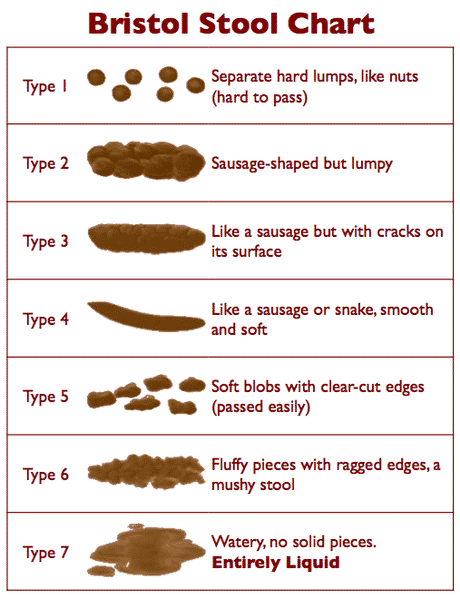

Type 1: Separate hard lumps, like nuts
These stools are not soft and squishy, because bacteria are missing and there is nothing to retain water. The lumps are hard and abrasive, the typical diameter ranges from 1 to 2 cm (0.4–0.8”), and they’re painful to pass, because the lumps are hard and scratchy.
This is a common side effect of antibiotic treatments. It may also occur for people attempting fiber-free, meat and fat heavy (low-carb) diets. Flatulence isn’t likely, because fermentation of fiber isn’t taking place.
Type 2: Sausage-like but lumpy
This type represents Type 1 “nuggets” clumped together by fiber and some bacteria. It’s typical for organic constipation.
The diameter is 3 to 4 cm (1.2–1.6”). This type is the most destructive by far because its size is near or exceeds the maximum opening of the anal canal’s aperture (3.5 cm).
It’s bound to cause extreme straining during elimination, and most likely to cause anal canal laceration, hemorrhoidal prolapse, or diverticulosis. To attain this form, the stools must be in the colon for at least several weeks instead of the normal 72 hours.
Adding more fiber is dangerous for Type 2, because the expanded fiber has no place to go. It may cause a hernia, obstruction, or perforation of the small and large intestine alike.
See 10 Home Remedies for Constipation to Keep Things Moving
Type 3: Like a sausage but with cracks in the surface
This form has all of the characteristics of Type 2 stools, but the transit time is faster, between one and two weeks. Typical for latent constipation. The diameter is 2 to 3.5 cm (0.8–1.4”). Irritable bowel syndrome is likely.
Flatulence is minor, because of dysbacteriosis. The fact that it hasn’t became as enlarged as Type 2 suggests that the defecations are regular. Straining is required. Type 3 has the same adverse effects typical for Type 2, especially hemorrhoids.
Type 4: Like a sausage or snake, smooth and soft
This form is normal for someone defecating once daily. The diameter is 1 to 2 cm (0.4–0.8”). The larger diameter suggests a longer transit time or a large amount of dietary fiber in the diet.
Type 5: Soft blobs with clear-cut edges
The authors of www.gutsense.org consider this form ideal. It is typical for a person who has stools twice or three times daily, after major meals. The diameter is 1 to 1.5 cm (0.4–0.6”).
*Note – many other sites list 4 and 5 as preferred shapes.
Type 6: Fluffy pieces with ragged edges, a mushy stool
These kind of stools may suggest a slightly hyperactive colon (fast motility), excess dietary potassium, or sudden dehydration or spike in blood pressure related to stress (both cause the rapid release of water and potassium from blood plasma into the intestinal cavity).
It can also indicate a hypersensitive personality prone to stress, too many spices, drinking water with a high mineral content, or the use of osmotic (mineral salts) laxatives. Iron supplements may also cause diarrhea.
Type 7: Watery, no solid pieces
This, of course, is diarrhea. It’s typical for people (especially young children and infirm or convalescing adults) affected by fecal impaction—a condition that follows or accompanies type 1 stools.
During paradoxical diarrhea the liquid contents of the small intestine (up to 1.5–2 liters/quarts daily) have no place to go but down, because the large intestine is stuffed with impacted stools throughout its entire length. Some water gets absorbed, the rest accumulates in the rectum.
This is called “paradoxical diarrhea” because the person has diarrhea and constipation at the same time.
See How to Stop Diarrhea Fast: Home Remedies That Help
Strange Colored Stool
Healthy bowel movements come in range of colors, most of which are some variation of brown. If a stool is more green or yellow, it may contain more bile.
Foods may not be the same color coming out that they are going in, especially with artificial food colors. One notable example of this was the black bun Whopper from Burger King, which made people pass neon green stools.
My boys used to pass bright green stools when their grandmother fed them artificially colored fruit leather when they were little. (Now we make our own fruit leather.)
Will more fiber help me poop better?
We are bombarded with advertisements for FIBER! FIBER! FIBER! Is a large amount of fiber the real solution we’re looking for?
Based on personal experience, I’d have to say, “no”. I’ve read some articles that say that if you eat a lot of fiber, it can actually make bowel problems worse, depending on your situation (such as #2 poop problems from the chart).
We need to look at the colon as not only a part of your digestive system, but part of the body as a whole. Did you know that an under active thyroid can contribute to constipation? And that the gastrocolic reflex (the urge to poop) typically weakens as we age?
I (unfortunately) found this information out first hand when my thyroid became sluggish. The good news is that by changing my diet, I am now happily in the 4-5 range. Here are some of the changes I’ve made that have helped me.
7 Tips for Healthy Bowel Movements
Better health and better bowel movements go hand in hand. Gut biomes vary from person to person, so you may need to try different strategies to see what works best for you.
For instance, the carnivore diet works well for some people, while others eat plant based. We’re working to raise most of our food, so we eat a mix.
If you have food intolerances or sensitivities, that will impact your digestive tract and bowel habits. You should be having a bowel movement at least three times a week. Daily or several times per day means your system is moving food through more evenly.
1) Avoid highly processed foods
When the boys were younger, we did a little homeschool science experiment where we took samples of different foods and subjected them to “digestive forces”. We soaked them in vinegar, “smushed” them in a plastic bag, and finally forced them through on old nylon stocking.
The foods we examined were a piece of meat, a piece of apple, some celery, some oatmeal, and saltine crackers. When we got to the saltine crackers, they basically coated the inside of the stocking like glue.
The same thing happens in your guts. Highly processed foods lack soluble and insoluble fiber. They are also typically quite dry, so they can be easily compressed in your guts, forming hard, dense bowel movements.
2) Eat plenty of vegetables and moderate amounts of fruit
I’ve been eating less fruit lately since I am cutting back on carbs, but I do make sure to get plenty of plant material each day. Plants provide a good ratio of fiber to water that is generally easy on the digestive system.
Many plants are high in soluble fiber, which swells and bulks up the stool for easy transit, and insoluble fiber, which acts somewhat like a “broom” to “sweep” the colon clear.
3) Eat plenty of high quality saturated fats
Fats are our bodies natural lubricants. They provide a feeling of satiation so you are less likely to overeat. Nutiva coconut oil, organic butter and ghee are my personal favorites.
3) Stay hydrated
I’m not fanatical about how much water I drink. I think the eight glasses a day recommendation seems a little over the top, unless you’re in a situation where you’re sweating heavily. Realistically, would our ancestors have consumed that much fresh water daily? I think it’s unlikely.
That said, I think most of us have a higher toxin load from our environments, so we want to keep things moving through our systems.
4) Eat and drink plenty of probiotic foods and beverages
As we age, our bodies naturally produce less digestive enzymes. Our digestive systems slow down (and sometimes even stop – not good).
Live culture foods and drinks like sauerkraut, kimchi, fermented salsas and chutneys, kombucha, kefir, and kvass all help “jump start” your digestive system and often contribute to the healing of many digestive ailments.
If you want to learn more about these foods and how to make them at home, visit the Live Culture Foods Section of the recipe page.
Check out Enzyme Nutrition and/or Enzymes & Enzyme Therapy for even more information.
7) Try Adding Magnesium
Many people suffer from constipation due to magnesium deficiency. According to WebMD, “Dietary sources of magnesium include legumes, whole grains, vegetables (especially broccoli, squash, and green leafy vegetables), seeds, and nuts (especially almonds). Other sources include dairy products, meats, chocolate, and coffee. Water with a high mineral content, or “hard” water, is also a source of magnesium.”
Natural Calm Magnesium Beverage mix is an easy way to take extra magnesium. A glass in the evening may also help you get a more restful night’s sleep and reduce nighttime leg cramps.
7) Try squatting, and stay physically active
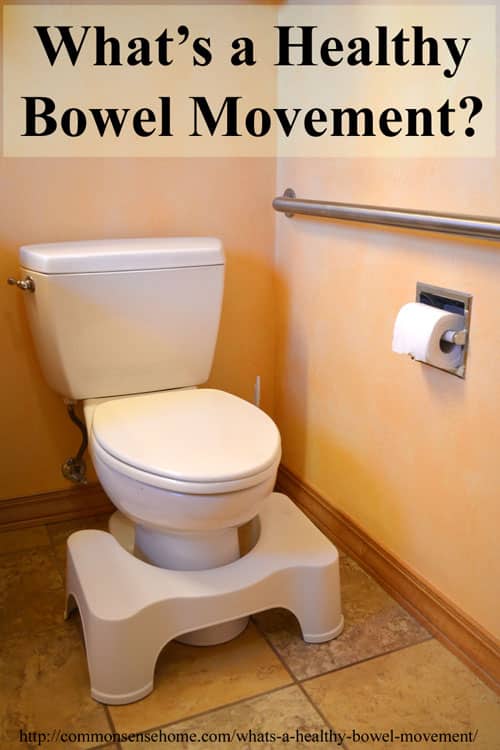
Squatting is the natural position for making a bowel movement, because it helps your guts to line up correctly to pass stool more easily. This can be accomplished with lower toilets, or through the use of a simple step like the Squatty Potty®, pictured below.
We love our Squatty Potties and have one next to each toilet. They are easy to use, easy to clean, and tuck out of the way next to the toilet when not in use.
Staying physically active also helps with healthy bowel movements. When you move, it helps to keep your digestive system moving. It’s no coincidence that many people have a bowel movement first thing in the morning. Your body does “clean up” at night, and then you get up, and move the waste out.
Keeping active during the day also helps, like taking a 30 minute walk after lunch. You don’t need to be setting world records, just keep moving.
So the next time you visit the bathroom, take a peek at what’s going on before you flush. If you’re not in the 4-5 range, you may want to consider making some changes in your diet.

This article is written by Laurie Neverman. Laurie is a lifelong learner with a passion for natural remedies and holistic healing. She’s successfully improved her eyesight, cleared her psoriasis, and gotten off of prescription medication.
Originally written in 2011, last updated in 2023.
Passing a stool is also helped by a forward-rocking motion much better than just straining the lower bowel for a movement, which can cause problems.
Just as the seated (rather than squatting) position is less helpful for passing stool, so too is the complete stillness and slackness of the abdomen when just sitting there. It’s too passive and unnatural, so nothing may happen.
Instead, when you rock *gently* back and forth it often quickly encourages the stool (or several!) to get moving without having to push. You are physically shifting the abdominal organs around the bowel, and you are gently tensioning and releasing your abdominal muscles. It really works!
Good to note, Jono. As we age, the peristalsis muscle contractions that move food through our digestive tract tend to weaken, so anything that can give them a gentle jumpstart may be helpful.
My daily movement is usually after breakfast with an average of 6-7 inches in length with a diameter of 4-5 inches does this seem normal?
If I’m understanding correctly, you’re passing a BM daily that more closely resembles a soda can than a rope. I am not a trained medical professional, but it sounds like you’re dealing with something in the type 2-3 range, which would indicate a chronic constipation issue even though you are pooping daily.
At that diameter, that’s a sphincter stretcher for sure and may lead to anal canal laceration, hemorrhoids and other issues, as noted in the post (if it hasn’t already). DO NOT ATTEMPT TO ADD A BULK FIBER LAXATIVE! As noted above, additional fiber could be dangerous. If the general recommendations above do not provide relief, please see a trained healthcare professional, as each person is different and there may be secondary issues contributing to your constipation.
This is a serious matter, because if waste is sitting in your colon too long, it can be reabsorbed into the body, contributing to inflammation and chronic illness over time.
When i have bowel movements i never look i usually just flush but i looked today I’m type 3
Sounds like maybe some more produce, healthy fats, and water may be in order.
As a CNA in a nursing home, poo is one thing I have to know about to keep my residents healthy. I strongly suggest that if you have 5 thru 7 with an extremely foul smell, especially after a bout with gastroenteritis or other G. I. tract illness or antibiotic use, see a health professional and ask about c.diff. Its a spore that is not usually found in the intestines, but it can linger for a long time in the colon and on surfaces. It usually isn’t diagnosed until the situation I described happens, and it is treatable, but also highly contagious. Sorry I couldn’t get it to link. http://www.cdc.gov/HAI/organisms/cdiff/Cdiff_infect.html
Hi Laurie, I used to have good bowel movements until I had an appendectomy. Then had candida issues and many other problems. It turns out that appendicitis is the place for great gut bacteria and since mine didn’t have a proper home, I ended up with many gut related issues, IBS, Constipation, candida etc etc and thanks to probiotics through capsules and food, I’m much better now.
I have a question about that footstool near the potty. I bet that helps with a good squatting position. could you share what it is called and where I can get one please.
That’s a 7 inch Squatty Potty toilet stool. They are available at the manufacturer’s website, or on Amazon.com at 7 inch Squatty Potty toilet stool. (affiliate link)
Nice article. I use psyllium fiber and sometimes the width of my stools is 4cm. They come out in about 30-40 seconds. I go to the bathroom for a movement movement daily.
Glad you’re enjoying a good BM daily. 🙂
Thanks for publishing this. For the first part of my life, a bowel movement was something that happened, except when it didn’t, usually because of a lack of privacy or due to travel. Then I changed my diet to vegan and noticed a real change – mostly for the better. That extra plant matter does move things along.
The descriptions are a little odd to me, as I used to be 2 and 3 with 1s as well, but I didn’t notice pain or much straining – except when I couldn’t go. Now travel doesn’t bother me and my bowel movements are more frequent and are 4 and 5 and something times 6. I’m glad to find out that “the snake” is not necessarily bad.
I found it interesting to read that the urge to poop changes with age. 50+ for me has led to less frequency, typically once every other day. However, when its ready I do get a very strong urge to push. My stools tend to be very hard and lumpy (between 2 and 3 on the scale). The two things that bother me most are that 1) it takes a good 5-10 minutes to have a bowel movement as the stool is quite thick and long and, although I try not to, I do have to strain some while it is coming out; and 2) sometimes the urge to push happens at the most inopportune times when I’m not able to use a toilet right away. This tends to happen at work and it is so difficult sometimes to concentrate on work when I have this intense right there and ready need to poop.
One thing that I don’t think the article mentions is the relief that one feels after a bowel movement. I’m guessing it has to do with how our bodies react after eliminating waste. Do you have any insight into this question?
If at all possible, do try to poop ASAP, as ignoring urges can lead to other trouble. Maybe some of the ideas suggested in the article can help provide a more comfortable and convenient experience.
I tend to be a first thing in the morning bathroom user, with BMs during the day if I’m eating more bulky produce, but don’t really notice a significant feeling of relief after taking care of business, except for no more pressure by my bum. If you are going more than 24 hours between BMs, I would think that there would be a more significant pressure build up and reduction.
Consistency, frequency, etc. all fine. But the very expensive Metametrix Stool Test showed stuff that has probably been with me since I was born that medical profession has missed all my life…….I would highly recommend it to anybody who may be having other inexplicable health issues that the average practitioner cannot or won’t address. Was started on some Betaine HCL with Pepsin, other GI stuff and more to go. Getting better…….Like my practitioner states – you have to fix the gut before anything else will start to heal……
Laura, as a nurse, I often have patients, friends and even family with severe halitosis. Sometimes I can detect that if they would evacuate their bowels more frequently, the problem would clear up. Do you or anyone have any studies about that connection?
Donna – how about this?
http://www.ncbi.nlm.nih.gov/pmc/articles/PMC3093012/
Slow Transit Constipation Associated With Excess Methane Production and Its Improvement Following Rifaximin Therapy: A Case Report
I dont see mine, Shredded vegetables
No doubt about it, I smell poop when I am reading this….
westeran a price was a great man and says how healthy the nz maori were he say the healthiest on the planet.. pre white man they ate poteen green veg and kumra ( sweet potato ) and there diet was the best way to eat but in his book he says eat lots of fruit .. there was no fruit in nz untill the white man came perhaps fruit is part of the poison
A note about water consumption – tap water and bulk water are not as absorbable as what our ancestors had to drink – they are not ‘natural’ waters but are adulterated water and are not very hydrating. I’ve read you absorb less than 20%. Even when drinking ‘good’ water you still need plenty – a minimum of 1/2 ounce per pound and ideally 3/4 to 1 ounce per pound of body weight – especially if you are overweight or have health issues. We do not eat like our ancestors ate either – processed, packed foods do not have the hydrating properties of freshly picked produce. Cat @ http://www.keepitkangen.com
While I am comfortably about 5, with 2 visits first thing in the morning and 1 after every meal, and my husband is similar, our 12 year old daughter is more like a 2-3. What concerns me is that her poop is huge and floats – actually causes problems with getting the toilet to flush all the way. I am sure that floating is indicative of something, but can’t remember what. I try to encourage acidophilus daily, but it is hit & miss. I have supplements available to her, but she only takes them when in the mood. The majority of the meals I make for her are healthy, generally 1 egg either lightly sautéed with veggies or fried and a leafy kale & spinach veggie & fruit smoothie with almond milk and flax seed for breakfast, meals prepared by Revolution Foods (supervised by Whole Foods) in school at lunch, and some form of protein with either sautéed veggies or salad with cabbage, broccoli, onions, etc. for dinner. She does eat cheese sticks or granola bars as snacks, or something similar, when she is going through a ‘growth spurt’ (her words). She occasionally eats fast food, maybe once a week, and would live on sweets if given the opportunity, but they are limited to something on Saturday so as to not affect school. She does take daily meds for ADHD & ODD. Any thoughts?
Constipation is one of the less common side effects of many ADHD medications, so that could be the issue. Would it be possible for you to work with a natural health practitioner and possibly wean her off of the medication? There are herbal options with fewer (or no) side effects, or there may be dietary triggers that effect behavior.
i have had #1 and #2 for a long time and had been wondering … (i had an illeus close to 50 years ago) and it seem to be getting worse – sometimes its 7 days before i have a bowl movement- so what can i do … drink more water, eat walnuts (i eat lots of them)
Too many nuts could be contributing to slow moving bowels. Nuts don’t have much moisture in them, and tend to pack pretty tight once they are chewed up.
You may want to try some of the suggestions listed in the post, like more vegetables and fruits, and live culture foods like yogurt, kefir, sauerkraut or kimchi. Enzyme supplements like Garden of Life Omega-Zyme Digestive Enzyme Blend, Caplets, 180-Count Bottle are another option that might help.
I think you contradict yourself by saying you think people’s suggestions to eat more fiber to solve this issue isn’t warranted and then turn around and list a top 5 that includes eating more fiber. #2 says eat plenty of veggies and fruit. That is ALL fiber. Fiber IS the solution. The problem is the wrong types of saturated fats, as well as CARAGEENAN and sulfites. By eliminating bad fats, ALL CHEMICALS, especially fast food, and upping the intake of WATER and REAL fiber, not fiber from Metamucil or any of that other synthetic garbage, you will become a lot closer to normal.
Fruits and vegetables also come with a lot of water – not just fiber. What I’m referring to is the products like Metamucil or “magic fiber pills” instead of eating real food.
My father has major issues with his bowels that have had him hospitalized three times in the past three years. He starts throwing up and can’t stop throwing up, and it is black looking like coffe grinds. This will go on for days till he just gets dehydrated and has to go to the hospital. The doctors say he has major constipation and that when his bowels get full it then fills up his stomach which makes him vomit and it’s fecal matter that is coming up. They pump him full of liquids, give him laxatives, enemas and anything else that will make him go to the bathroom. Now he has to take milk of magnesium every other day and enemas if he doesn’t go the bathroom every three days. I truely believe he has some kind of blockage but the catscans and colonoscamies show nothing. My concern is that I too will have the same issue when I get my dads age cause I have never had “normal” bowels. I go for days, usually maybe every 4-7 days, before having a bowel movement. I have gona as long as 17 days without a bowel movement. I have to tak stool softeners on a regular basis and laxatives when that doesn’t work. My stools are always a 1 or 2 unless I take laxatives then they are a 7. Any suggestions or help with this matter?
If possible I’d suggest you work with a trained natural health practitioner to take a look at your diet and lifestyle. Bowels that are that sluggish are struggling to do their job. In addition to the suggestions in the post, you may also want to consider digestive enzymes (for you and your dad) which help your body to do its job breaking down food. You may also have a food sensitivity that you haven’t recognized, such as gluten or lactose. Food allergies can really throw a monkey wrench in the whole system. I’m not a doctor, just a former engineer with a lot of interest in helping the body to heal itself, but I encourage you to start asking questions and look for help near you, and to try changing your diet to help your body heal.
Your post is now 5 years old. I hope your father is doing well. What the Doctors told to your father that stool is is in the stomach so he has to throw up. It is unlikely. Tell to your Doctor to check about Mesenteric Artery Syndrome.
Great post … addresses a universal yet seldom talked topic.
One clarification though. I am not sure if the cycle is 72 hours! Isn’t it 14-16hours … but a max of 24hours. anything more could be classified as borderline constipation.
On the topic of probiotic … nothing remotely comes close to a cup of yogurt or curd. Even better if it is homemade!
It’s not 72 hours between bowel movements, which would certainly be a concern.
Verified from another source, Colorado State”Gastrointestinal Transit: How Long Does It Take?“:
Food usually takes an average of 1-3 days to be processed and up to 90% of the time is spent in the colon.
My dad has told often of always having beans on the table at every meal (even breakfast) as a child. Mostly because people were poor and beans were planted and grown, dried and stored. They were plentiful when everything else ran out. He says there was no flatulence problems then!! But as a teen, his buddies and him conjured up this poetic verse to impress their teachers, but amuse themselves because it was all about flatulence!!
“Speak to me! Oh toothless one!!
Let me seek out thy sweet lips!!”
Brenda, I am of the generation and so are my adult children, when beans were served quite frequently. In fact my family discussed the other day how we used to make baked bean sandwiches, yum yum. I don’t remember having a flatulence problem when I was young, but my brothers seemed to be able to “toot” on command, and ask each other to name how many and how long. Disgusting to us girls! One of the more prolific poems of my childhood was: Beans, beans, good for your heart, the more you eat, the more you —-. (fill in the blanks)