
Natural Allergy Relief for Seasonal Allergies

This post may contain affiliate links. Read my full disclosure here.
Looking for natural allergy relief when pollen starts flying? These simple home remedies can help reduce exposure to allergens, clear irritated nasal passages, and ease common allergy symptoms such as a runny nose, congestion, sneezing, and itchy eyes.
Seasonal allergies, also called hay fever or allergic rhinitis, happen when the immune system overreacts to substances such as pollen, mold spores, dust mites, or pet dander. The resulting release of histamine and other inflammatory compounds causes the familiar itching, dripping, sneezing, and stuffiness.
Would you like to save this?
Table of Contents
Natural Allergy Relief via Reducing Exposure and Home Remedies
Thankfully, there are several simple ways to reduce your exposure and ease symptoms. Our goal is to calm down the immune response and promote better breathing.
1. Rinse Your Nose with Saline
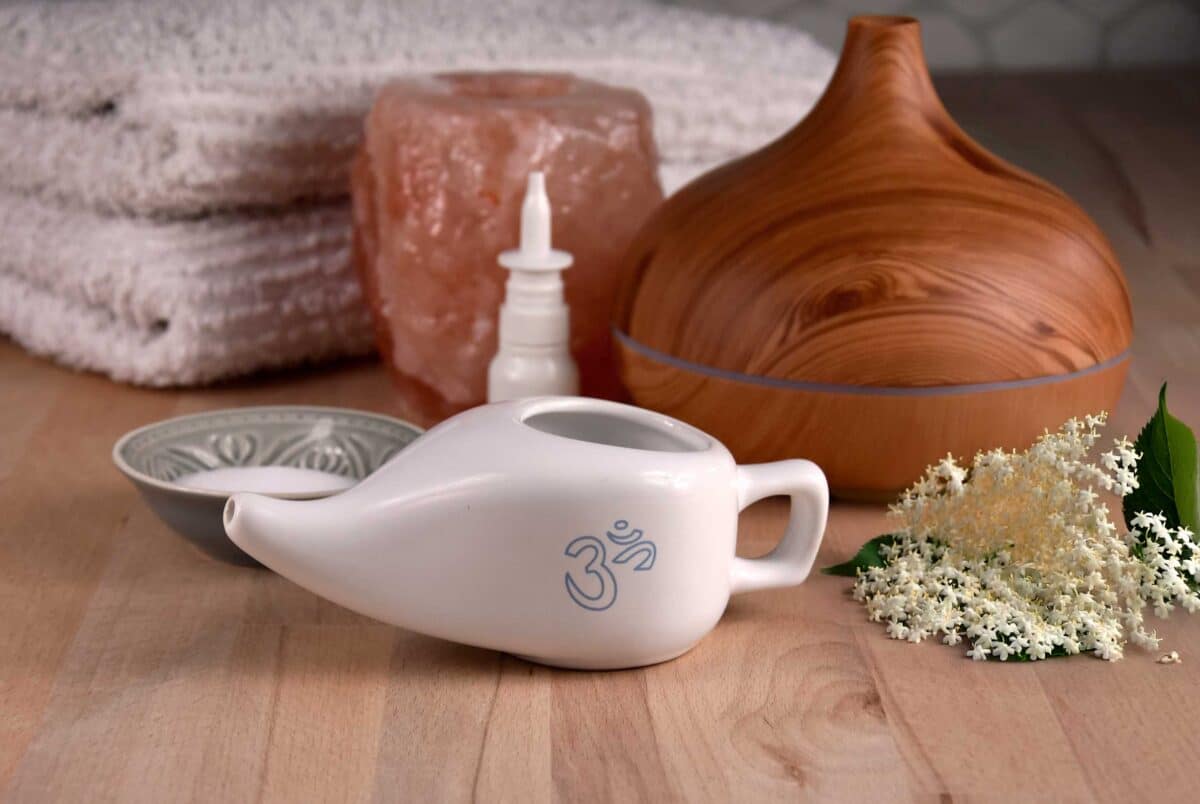
A neti pot, squeeze bottle, or other nasal irrigation system is one of the simplest options for natural allergy relief. Saline nasal rinses wash pollen, dust, mucus, and other irritants out of the nasal passages. Research suggests they can reduce symptoms of allergic rhinitis.
Use a rinse after gardening, mowing, or spending significant time outside during allergy season. This doesn’t work if you have a deviated septum (like my husband). The water flows in, but doesn’t flow back out very well.
Important: Never use untreated tap water for nasal irrigation. Use distilled or sterile water, or water that has been boiled and cooled. Clean and dry the device after use.
2. Keep Pollen Outside
Reducing exposure is often easier than trying to calm an allergic reaction after it starts.
During allergy season:
- Check the local pollen count before spending long periods outdoors.
- Change clothes after gardening or mowing.
- Wash your face and hands when you come inside.
- Rinse pollen from your hair before bed after heavy exposure.
- Avoid line-drying bedding when pollen counts are high.
- Keep windows closed on especially bad pollen days.
If pets spend time outside, their fur may also carry pollen into the house. A quick wipe-down can help.
3. Reduce Indoor Allergens
Not all allergy triggers come from outside. Dust mites, pet dander, mold, and household dust can contribute to year-round symptoms.
Vacuum regularly, damp mop hard floors, and consider a HEPA air cleaner in the rooms where you spend the most time. Wash bedding regularly and keep indoor humidity under control. Excess humidity encourages both dust mites and mold.
If you’re allergic to pets, keeping them out of the bedroom may reduce nighttime exposure. We keep the cats out of beds, and cover the couch with blankets that get washed regularly.
4. Try Stinging Nettle
Stinging nettle (Urtica dioica) has a long history of use for seasonal allergy symptoms. It contains plant compounds that may help with reducing inflammation, although clinical research is still limited.
Try nettle as tea, tincture, or capsules as an allergy treatment. If you’re harvesting your own, remember that they’re called “stinging” nettles for a reason. Gloves are your friend.
5. Goldenrod and Elderflower
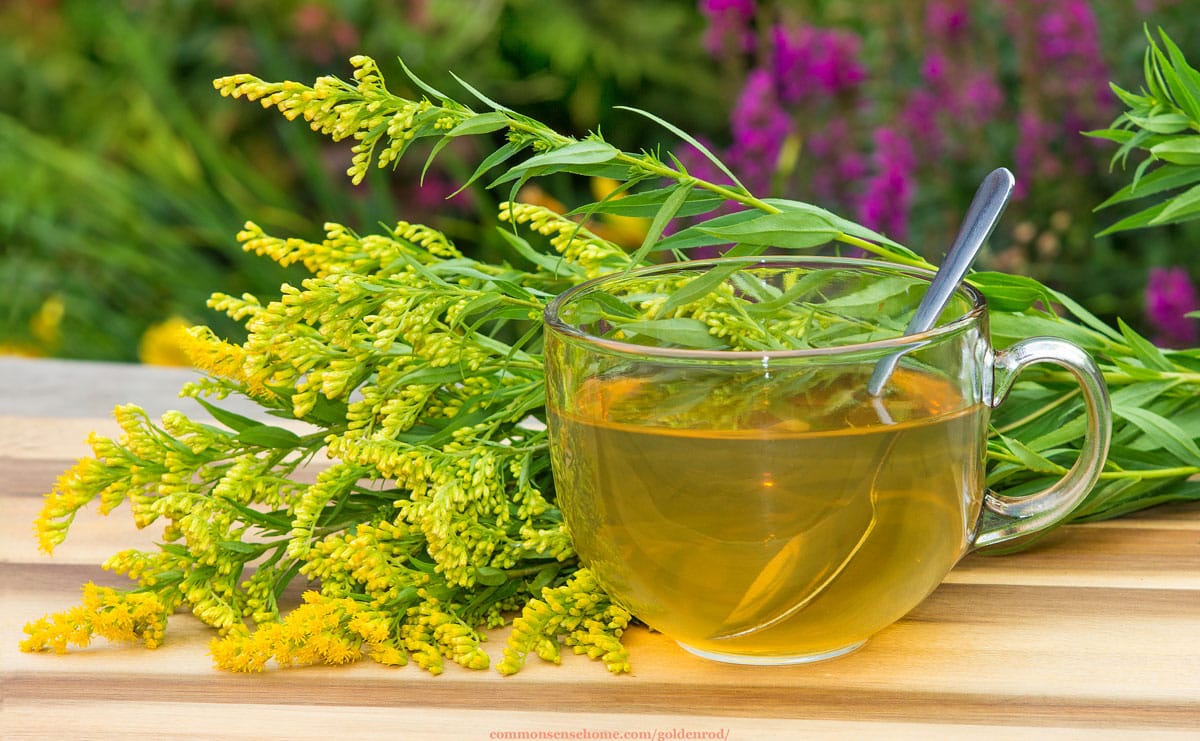
Elderflower and goldenrod are two traditional herbs for upper respiratory complaints. Elderflower is commonly used in teas to soothe irritated respiratory tissues, while goldenrod has traditionally been used when congestion and excess mucus are part of the problem.
Despite its reputation, goldenrod is generally not the cause of fall hay fever. Ragweed blooms around the same time and releases large amounts of windborne pollen, making it the more likely culprit. Nettle, elderflower, and goldenrod also work well together in herbal tea.
6. Eat for a Healthy Allergy Response
Instead of chasing individual supplements, start with nutrient-dense whole foods that support normal immune function and a balanced inflammatory response.
- Quercetin-Rich Foods – Quercetin is a plant flavonoid that may influence histamine release and inflammatory pathways. Good sources include onions, apples, berries, grapes, broccoli, leafy greens, and parsley.
- Vitamin C – Vitamin C supports immune function and participates in pathways involved in histamine metabolism. Good food sources include bell peppers, citrus, strawberries, broccoli, kiwi, and fresh fermented vegetables.
- Omega-3 Fats – Omega-3 fatty acids help support a balanced inflammatory response. Sources include sardines, salmon and other fatty fish, flaxseed, chia seeds, and walnuts.
- Herbs and Spices – Garlic, onions, ginger, turmeric, horseradish, hot peppers, and mustard provide a variety of antioxidant and anti-inflammatory plant compounds. Spicy foods may also temporarily loosen mucus and get your nose running—which can feel pretty good when you’re stuffed up.

7. Support Your Gut
The gut microbiome and immune system are closely connected. Some research suggests certain probiotic strains may improve nasal symptoms or quality of life in people with allergic rhinitis, although results vary widely.
Fermented foods are an easy way to introduce beneficial microbes and their metabolites into the diet. Try yogurt, kefir, sauerkraut, kimchi, or other fermented vegetables.
8. Stay Hydrated
It’s simple, but don’t overlook water. Staying hydrated helps keep mucus secretions thinner and irritated tissues moist. Water-rich fruits and vegetables, soups, broths, and herbal teas all contribute to fluid intake.
Warm nettle, elderflower, or ginger tea provides hydration along with other potentially helpful plant compounds. See Best Ways to Stay Hydrated Naturally for more ideas.


Other Questions About Natural Allergy Relief
There are a number of other recommendations that make the rounds for allergy relief. We’ll take a closer look.
What About Local Honey?
Local raw honey is one of the most popular home remedies for seasonal allergies. The theory is that consuming small amounts of local pollen may gradually make your immune system less reactive.
Most seasonal allergies are caused by wind-pollinated trees, grasses, and weeds, while bees tend to visit insect-pollinated plants. The pollen in honey therefore isn’t necessarily the pollen that’s making you sneeze.
That said, I have several friends who swear by it. Honey is still soothing for a scratchy throat and cough. If local honey seems to help you, there’s little reason not to enjoy it. Note – It’s generally recommended to avoid honey for children less than one year old.
Essential Oils for Seasonal Allergies
Peppermint, eucalyptus, and other aromatic plants may create a cooling sensation that makes breathing feel easier. Try an aromatic shower, or carefully diffused essential oils.
Essential oils don’t stop the underlying allergic reaction. Never put undiluted essential oils in your nose or add them to a neti pot. People with asthma or fragrance sensitivity (like me) may find that essential oils make symptoms worse.
Do You Need to Avoid Dairy or Other Foods?
Probably not, but it makes sense to pay attention to what you’re eating. Look for patterns when allergies flare up. For instance, I’ve found that certain processed foods trigger an immediate histamine reaction.
Some people with pollen allergies also experience oral allergy syndrome, where certain raw fruits, vegetables, or nuts cause itching or tingling in the mouth because their proteins resemble pollen proteins.
When Home Remedies Aren’t Enough
For severe or persistent allergies, testing can help determine whether pollen, dust mites, mold, pet dander, or another allergen is causing the problem. You might also want to try homeopathic allergy remedies, like Boiron AllergyCalm Tablets.
Allergy shots, or allergen immunotherapy, gradually expose the immune system to controlled amounts of specific allergens. Rather than simply controlling symptoms, immunotherapy attempts to change the body’s response to the allergen over time. Like any medication, they may have side effects.
When to Seek Medical Care
Seasonal allergies are uncomfortable, but severe allergic reactions are a different matter. Seek immediate medical attention for difficulty breathing, swelling of the tongue or throat, trouble swallowing, fainting, or other signs of anaphylaxis.
Talk to your healthcare provider if allergy symptoms are persistent, severe, or difficult to distinguish from asthma, infection, or another condition.
This article is for informational purposes only and is not intended to diagnose or treat illness. Natural products can cause allergic reactions and interact with medications. Check with your healthcare provider as appropriate, especially if you are pregnant, nursing, taking medications, or managing a chronic health condition.

This article is written by Laurie Neverman. Laurie is a lifelong learner with a passion for natural remedies and holistic healing. She’s successfully improved her eyesight and cleared her psoriasis.
I am curious about Remedy 15, ACV. My gut handles honey quite well, and I regularly take honey with ACV diluted with 6 to 8 oz. water. Lemon juice straight up would definitely irritate my stomach lining. Is the remedy you described effective diluted, or would that neutralize its effect?
Dilution shouldn’t be an issue, especially if it helps it sit easier in your stomach.
My husband experiences severe seasonal allergies every Spring and Fall,which really makes it difficult for him to minister to the church and deliver sermons…he has severe allergies to dyes and preservatives and prescription drugs have caused extra problems…we were informed about homeopathic medicines and a company Native Remedies…we purchased the AllergiClear-M and it has been an answer to our prayers…also we used Muscus-Clear in the Winter when he got a cold and was congested and couldn’t get rid of the mucus…they have been a true relief for us…don’t know if anyone else uses homeopathic medicines but this company is great
Thanks, Donna. I’ve used some homeopathic remedies, but not many.
This sounds bonkers but i promise it works perfectly ,if you dont want to wake up with the horrible hayfever headache every morning buy a strong mustard and about an hour before you go to bed apply a small amount to the skin over your upper and lower sinus being very carefull not to get it in your eyes ,they will water badly for a few seconds but will stop and the mustard will dry to a crust quite quickly ,go to bed as normal and i promise you will not wake up with a headache .
Hi,what about allergy from perfumes,strong sprays that irritates your eyes and start running,sneezing and dry coughing?
While inconvenient, many fragrances are toxic and can cause serious damage with long term or high exposure, so an allergic reaction is normal and healthy as your body attempts to get them out of your system as quickly as possible. I avoid synthetic fragrances like the plague.
The article “Dangers of Synthetic Scents Include Cancer, Asthma, Kidney Damage and More” notes:
An excessive reaction may be an indication that your immune system is on high alert due to other underlying issues, such as an autoimmune disease, asthma, high stress levels, or other factors. It’s impossible for me to say for sure, but it may be something that you want to look into in more detail. Sorry I don’t have a “magic bullet”, but there are many possible factors in play.
BEST THING FOR SEASONAL ALLERGIES? WASH YOUR HAIR EVERY DAY.. POLLEN
COLLECTS IN YOUR HAIR ~
I found the salt water gargle works well, it is also an inexpensive method of a regular mouth wash after the cold has gone to keep it at bay. Thanks.
Hi Laurie,
I’ve been lurking for several weeks. I know my comment on this matter is late but it’s important. You’ve got to be very careful with Reishi mushrooms. I worked for US Customs for decades and one of the drugs that we worked hard to keep out of the country was Sibutramine. It’s used as a weight loss pill or in weight loss tea or weight loss coffee. It’s main ingredient comes from the Reishi mushroom. Just because it grows naturally, does not mean it’s 100% good for you. The active ingredient in the Reishi and Sibutramine contraindicates with high blood pressure meds and statins and causes heart attacks. At least that’s the way it was explained to me by the FDA director that worked with our unit.
Thanks for the safety warning. I would hope that people would check dosing instructions and contraindications before dosing willy-nilly, but it certainly can’t hurt to have more warnings here.
I might cause a ruckus by saying this, but sugar actually helps allergies and–if not–allergy symptoms. I noticed that when I have the horrible, nightmarish, allergy, itchy throat that sugar gets rid of it! I also noticed peppermint candy seems to be great for allergy itchy throat and cough, but worthless against cold virus cough. What does peppermint candy have in it besides peppermint oil? Sugar and red dye. Just last night, I woke up in the middle of the night with that allergy itchy throat and cough. I got some candy and sucked on it and it was gone! It doesn’t matter what kind of candy you use, so it’s not the red dye, either.
No ruckus caused as long as people are polite in sharing their experience. Peppermint is commonly used for sore throat, and I personally do find it helpful for cold sore throats, but each person is different. Hard candies effectively produce a syrup as you suck on them, which could coat and soothe the throat area. So, yes, in a way it is the sugar, but the effect could be duplicated with other substances if sugar is being avoided.
I didn’t know about all these methods. I’ve known the gut would create a huge allergy issue if out of sync. The flora in our intestines are kinda in charge of what we get in to our bodies as they break it down.
What research is there on honey for allergies? I read this article, http://www.slate.com/articles/health_and_science/medical_examiner/2015/05/local_honey_for_allergies_pollen_in_honey_cannot_desensitize_the_immune.html
..which explains that bees collect nectar to make honey (with only trace amounts of pollen, which is what people are allergic to). Therefore by eating honey, we’re basically only consuming nectar which is pointless. Is that right?
Well, I’m not “an associate professor of allergy and immunology” and that article does make some good points. That said, I have seen anecdotal evidence in more than one person that the local honey has helped. Placebo effect? I have no idea. Other possible theories include that the consumption of raw local honey with pollen desensitizes the immune system to pollen in general (even though the pollen in the honey is not a match for allergenic pollen). In spite of the professor’s statement that most people are not allergic to “pretty flowers”, I see bees in the yard all the time visiting not so pretty flowers – even ragweed. Homeopathy folks would probably argue that the trace amounts are more effective than massive amounts, but I’m not expert on that field of study.
Still another possible option is that the honey, even though it’s consumed orally, acts to reduce inflammation and shrink swelling of the inflamed sinus tissues – like it draws excess fluid from wounds. You can read more on that in the post “Honey as Medicine” – https://commonsensehome.com/honey-as-medicine/
So basically, I’m not sure why it helps, but it does seem to, at least in some people. At the very least, it should do no harm to try it, but I haven’t found any conclusive study results.
One would be hard pressed to find someone that had an allergy sheet as extensive as mine once was. They started after many bouts of antibiotics for tonsillitis and the polio vaccine as a young child. I am now in my 50’s. A s a teenager I was tested for just about everything and came back positive for breathing. 🙁 Especially mold, dust and ragweed. BTW if you have a ragweed allergy never use echinacea for the flue season, as they are related and it will only hurt you more. I tried everything for decades – pharma and other remedies for years to no avail. 3 years ago I tried diatomaceous earth (the fresh water kind that I bought from earthworkshealth.com). Check out their human uses page if interested. After 6 months of slowly building up my dosage from a half teaspoon daily to 2 tablespoons per day I was literally cured. Obviously I was toxic in some way – what I do not know, but it worked. Warning – it can and will constipate as it cleans you out and I needed oatmeal, roughage and citrucel to do this. Now I take a slight teaspoon every few days and I can eat cantaloupes, bananas and avocados that each use to make my lips blister and swell and my stomach feel like I swallowed battery acid. Hope this helps someone else! I can now actually sleep with my windows open during ragweed season and laugh at it! 😀
PS I strongly believe in probiotics, Bragg vinegar and local honey too! They helped – but earth cured me.
That’s really interesting and an option that I haven’t heard of before. I’m glad that you found a solution that worked for you.
Reactions clearing up after a course of treatment with food grade diatomaceous earth can indicate the presence of parasites and the resulting metabolic wastes that sensitize us. Doing it slowly and gradually was a smart idea, especially with such a sensitive gut and that big pile of reactive substances. Nice result for such a simple therapy! Neither am I a certified practitioner, but a long time self treating , formerly extremely reactive person.
The neti pot has helped me tremendously, used with a saline solution (1 tea. bicarbonate of soda, 1 tablespoon kosher salt mixed in 1 qt. of distilled or purified/filtered water, add 15 drops of grapefruit seed extract (to combat bacterial growth) which will kill bacteria or viruses in nasal passages. I also use homeopathic nasal sprays, once in the morning and once at night before bed (irrigate first with the neti pot). No more discharge at night while trying to sleep, and no more giant wads of tissues in my pockets.
Doctors prescriptions would work for a few months and then I had to switch to another type or brand, all the while I was in a mental fog from the prescription. Good riddance!
I got water in my ear a few days ago and now my ear is like totally stopped up can hardly hear out of it…Today my ear is hurting. I tried holding my nose and popping them but it kinda hurts the ear ….I can feel/hear it like wanting to pop but it just wont…its not draining or anything. But it hurts and I cannot afford to go to doctor right now. What are some home remedies I can use to make the pain go away …and cure any inner ear infection I may have…also I feel the wax inside my ear has something with the water getting clogged in my ear. Please Help
I am not a medical professional and cannot give specific advice. You may find the Home Remedies for Earaches post useful.
Please try a drop of two of pure Neem Oil. I used the brand by Premier Research Labs and it totally eliminated my ear pain overnight. It’s an anti-inflammatory. Haven’t had any pain since!!
I do not recommend loading up on veggies and fruits to help with allergies. If you have common allergies to ragweed, grasses, alfalfa, etc, these foods are easily able to absorb these pollens resulting with you consuming the pollens that most affect you. Which is why people will eat fruit and veggies and assume they are allergic to them when really it is because they are consuming the pollens.
I have suffered with allergies for years , not being able to sleep because I couldn’t breathe, sneezing and choking so much it was miserable.,I’ve tried most al,of the above. Some may have helped some. But when I found raw local honey, it was the biggest blessing. I was even diagnosed with chronic bronchitis. It’s all gone now using fraw honey and raw apple cider vinegar. I still sneeze once in a while and a little mucus but 90 percent better
hi Donna how do you use the raw honey and raw apple cider vinegar for allergies?
How much raw honey and how much raw acv dosed how many times a day? I am desperate! Please help!
For honey:
Dosing recommendations range from teaspoons to tablespoons per day, once dose to three or more doses. Try different amounts and see what works for you.
For vinegar:
Mix 1 tablespoon apple cider vinegar, 1 tablespoon freshly squeezed lemon juice and 1/2 tablespoon raw honey. Drink three times a day.
Thank you! Will be giving this a try!
You must be very careful about the type of water you use with a Neti Pot. Some have gotten very ill. Please do research on the Internet before using.
Just added a note about this as a reminder with a link to more information.
Gretchen shared this remedy in an email:
Some people report that burning pure beeswax candles can help: http://tahomaclinicblog.com/beeswax-benefits/
It is easy to make your own, and it probably can’t hurt to try it. No bad side effects. 🙂
I know my seasonal allergy prone son seems more sensitive to indoor air pollution in general when he has seasonal allergy issues. Makes sense. His resistance may be down. So cutting down on the toxic personal care products and household cleaning products may help, too. (I think that is a good idea to do that anyway, personally, but in a truly allergic person reducing their toxic overload at times when they are down might make sense.)
hey thanks for the great info, I was feeling like death and pharmaceuticals never even worked for me, and this year homeopathic remedies haven’t helped either so I was desperate for a solution… I can’t tell which one of your tricks exactly worked because I did several of them, but the improvements are AMAZING, in just a day!! I realize this is a bit hardcore, but I was so desperate to get better that I made a mixture of cinnamon, turmeric, garlic powder, onion powder, cayenne pepper, dried ginger, and mustard powder and put a heaping tablespoon of the mixture in a glass of water and just drank it. Did that a few times a day and it seems to be what helped me! Also steaming is amazing for immediate relief 🙂 To go to sleep I actually tried putting a thin bed sheet over my head to prevent some of the pollen from getting to me and it seems to work great!
I’m glad you found some relief, whichever item or items were responsible.
Check out Donna’s Blog for other helpful info on your allergies – – – – culturedfoodlife.com/how-i-fixed-my-seasonal-allergies/
I remember that post! That’s a good one. Live culture foods have helped me, too.
you do your own stunts…..ROFL!!!! Good one!
I also have a short cameraman, thus the angle on the photo. 😉