
Growing Blueberries – Best Tips for the Home Garden

This post may contain affiliate links. Read my full disclosure here.


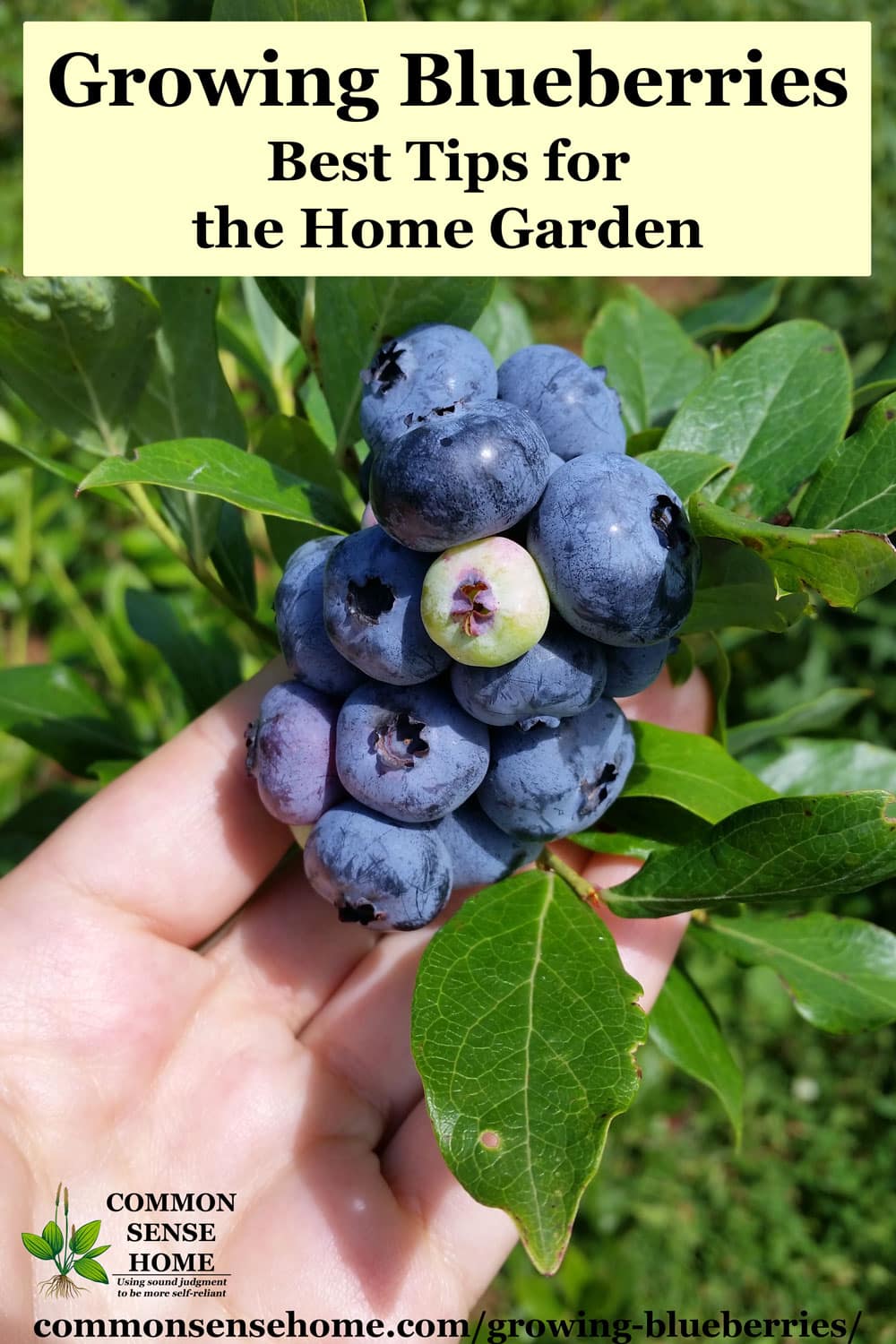
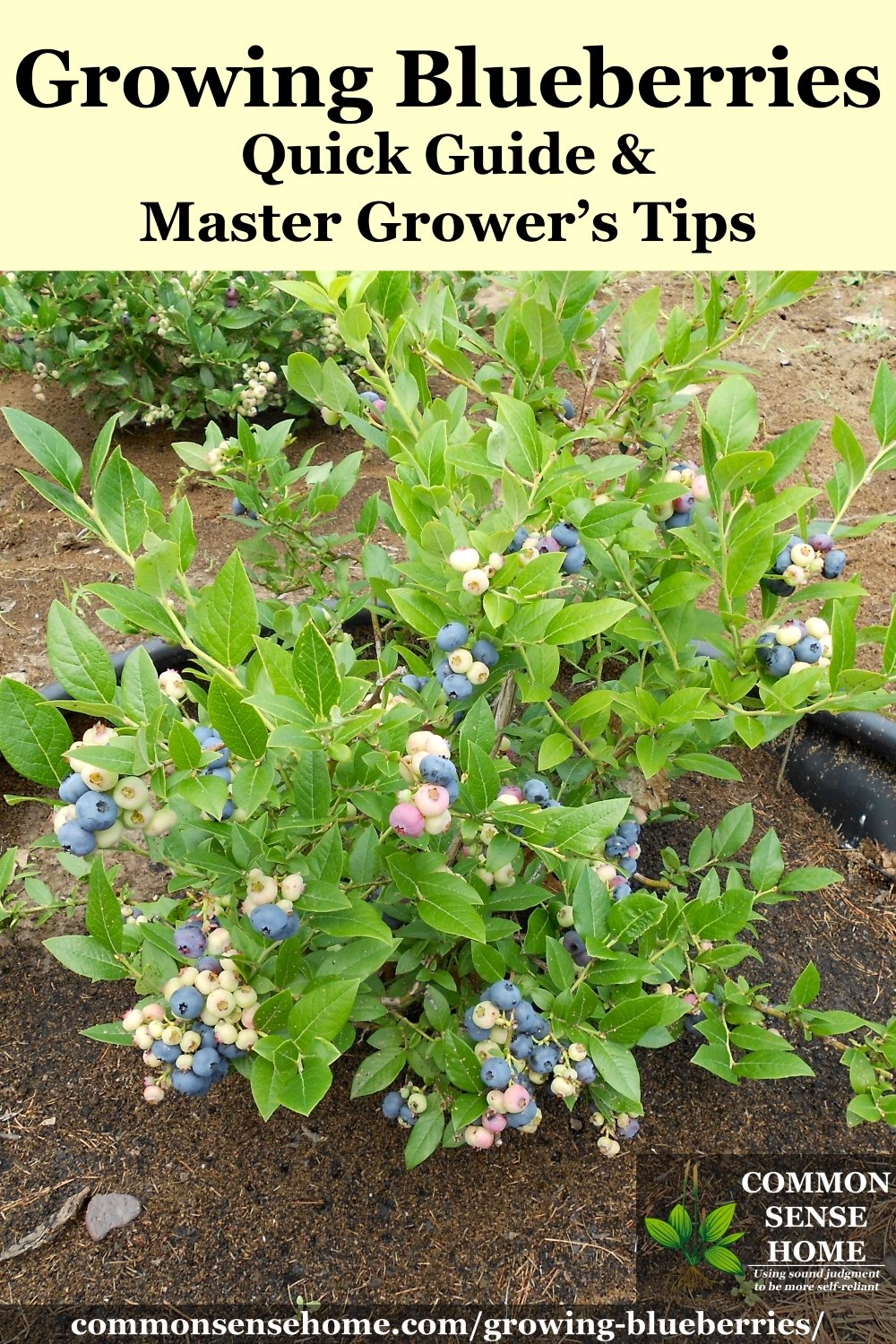
Learn how to grow blueberries in your home garden. We’ll take you step by step through planting, fertilizer and mulch, care and harvest.
We also touch on growing blueberries in containers, pruning and moving mature plants.
Would you like to save this?
Growing Blueberries – Quick Guide
Blueberries are fairly easy to grow, if you follow some basic rules.
- Blueberries grow in USDA hardiness zones 3 through 10.
- Blueberry soil should be rich in organic matter, with soil pH between 4 and 5.5 (acidic soil).
- Plant blueberry bushes in full sun for best production. Plants will tolerate late afternoon shade.
- Blueberries prefer well drained soil.
- While blueberries are self-pollinating, planting a second variety will increase fruit production
- Space blueberry plants 4-6’ apart for highbush, 2-4’ for low bush with 6-8’ between rows
- Use several inches of organic mulch to prevent weeds.
- Apply organic fertilizer in spring when plants are starting to bud.
- Prune off damaged or crossing branches in late winter.
- Blueberries need around an inch of water per week during the growing season.
- Protect plant from wild animals, if needed.
- Harvest regularly to prevent spoilage.
How to Grow Blueberries
Let’s tackle each of these steps for growing blueberries in more detail.
Where do blueberries grow?
You can grow blueberries in USDA Plant Hardiness Zones 3 through 10.
Local microclimate and soil is important, too, as we’ll discuss below. Watch your local weather, talk with other gardeners to see what varieties grow well in your area.
For more information, read: Plant Hardiness Zones and Microclimate.
What’s the Best Soil for Blueberry Plants?
Healthy soil = healthy plants. Remember, these bushes have the potential to provide many years of delicious berries, so they are worth the extra effort.
Blueberries grow best with an acid soil pH between 4 and 5.5, so do a soil test before you start.
The best soil for blueberry plants is soil rich in acidic, organic material, like you would find on forest floor or edge of the forest.
Add Organic Matter
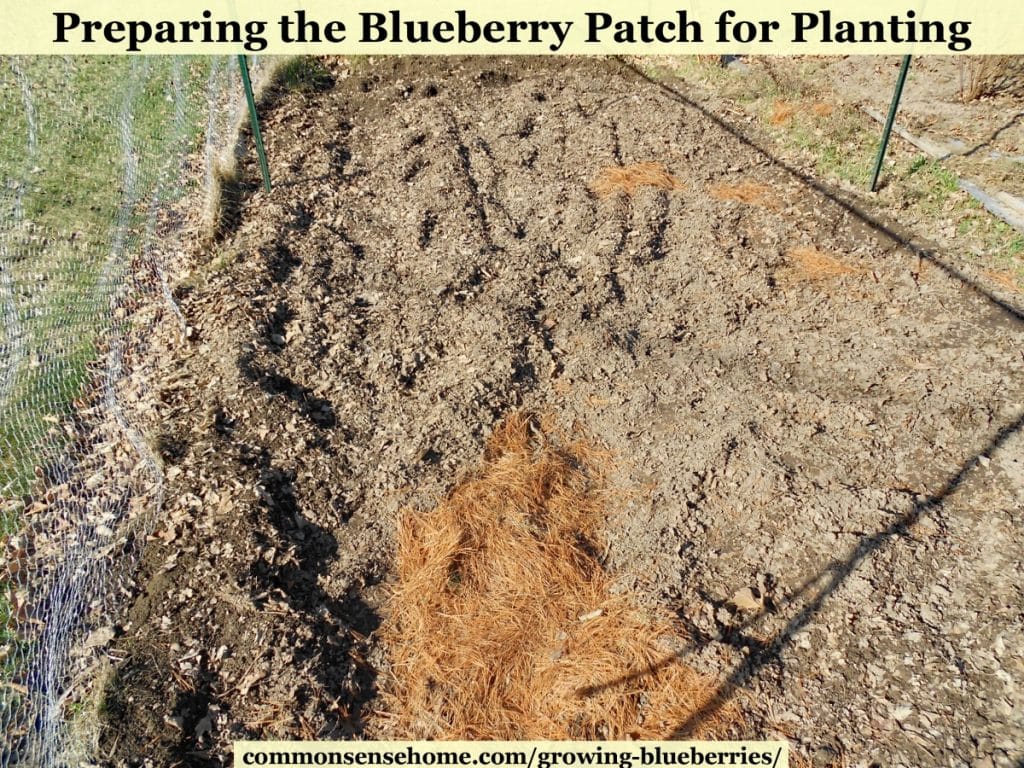
When you prepare your blueberry planting area, dig a generous amount of organic matter into your blueberry soil. Time and effort up front will make all the difference in plant performance.
Peat moss is commonly recommended, but pine needles, leaves and other tree fallout work just as well. If your soil is alkaline, you’ll either need to do a LOT of soil amending, or grow you blueberries in a container.
The first time I planted blueberries, I used pine sawdust to kill the weeds, then used the sawdust for mulch. It worked OK, but I think the sawdust tied up a lot of nitrogen in the soil as it broke down, which slowed plant growth.
When I extended my blueberry patch, I first smothered the grass in a 10’x24′ plot with black plastic during the growing season. In the fall, I tilled in a generous amount of leaves and black peat by-product from earthworm casting production.
Be Careful with Chemicals
Avoid large amounts of sulfur and chemical fertilizers, which disrupt soil health.
If you do add sulfur in quantity to lower pH, wait at least three months for it to break down before planting. (For instance, add sulfur in fall for planting in spring.)
Where to Plant Blueberry Bushes
As noted above, blueberry plants prefer slightly acidic soil rich in organic matter. They need full sun for best fruit production, but will tolerate some afternoon shade.
Avoid planting blueberries in ground that tends to have standing water or ground that dries out too quickly. Think “edge of forest”, not bog. If standing water is an issue, try raised beds.
Which Blueberry Variety is Right for Your Area?
Different blueberry varieties can be grown from Texas to Canada. Check with your local Cooperative Extension office, or ask neighbors who have had success in growing blueberries.
You can also check your favorite local garden center or online nursery for suggested blueberry varieties. Try to plant at least two different varieties so they can cross pollinate.
Basic blueberry types include:
- Lowbush Blueberry – Vaccinium anugustifolium – Cold tolerant, less productive than high bush blueberry varieties, can be used as an edible ground cover or food forest planting
- Northern Highbush Blueberry – Vaccinium corymbosum – For zones 4-7 (specific highbush blueberry varieties will tolerate colder temps, such as those I’m growing in zone 3). Grows 5-6’ tall.
- Southern Highbush Blueberry – Vaccinium corymbosum hybrids – For zones 7-10. Plants require little chilling, but are otherwise similar to their northern cousins.
- Rabbiteye Blueberry – Vaccinium ashei – Best for southern growers. For zones 7-8. Cold tolerant to around zero F. This blueberry variety can grow up to 20 feet if left unpruned, but best trimmed to manageable picking height.
- Saskatoon – Amelanchier alnifolia – Not a true blueberry, but extremely cold tolerant. Can be grown in the northern United States and Southern Canada. Does not require acidic soil.
Saskatoons are also known as serviceberry, shadbush and juneberry. Fruit flavor is somewhat bland, seeds are larger than blueberry seeds and have a mild almond flavor.
Plant Spacing
When growing blueberries, allow 6 to 8 feet between rows.
Space blueberry plants:
- 4 feet to 6 feet apart for highbush blueberries
- 24 inches to four feet apart for low bush blueberries
- 1 to 5 feet for saskatoon plants
Planting Blueberry Bushes
Plant container grown blueberry plants in your garden at the same depth they were growing in the pot. The same rule applies for bare root plants.
To remove a blueberry bush from its container, place your hand around the base of the blueberry plant with your palm facing towards the soil to support the root ball. Gently invert the pot to dump the blueberry bush out.
Check for roots that circled around inside the pot, and gently loosen and spread them out before you set your blueberry bush into the planting hole.
If planting a bareroot blueberry plant, gently spread the roots in the planting hole. Cover the roots of your plant and gently tamp down the soil.
Water the blueberry bush well to settle the soil around the roots, and cover soil with a layer of organic mulch.
When to Plant Blueberry Bushes
Bareroot blueberry plants should be planted in early spring, preferably while they are still dormant, to minimize transplant shock.
Container grown blueberry plants do well planted in spring, too, but can also be planted later in the season. It’s best to avoid planting in mid-summer, when high temps in the garden can stress plants. Areas with mild winters may do well planting container grown blueberries in fall.
Note for Plants Purchased via Mail
If you purchase blueberries from an online nursery, they may need to be acclimated to your area before planting.
Start with placing the containers in sheltered, shady spot outdoors, such as a porch. Keep them there for 3-4 hours the first day, bringing them inside at night. Add 1-2 hours of outside time each day, planting at the end of a week.
Avoid exposing your young blueberry plants to freezing temperatures when they have fresh baby leaves. If frost threatens after planting, use frost protection.
Locally grown container blueberries that have been sitting outside at a nursery shouldn’t need to be acclimated and can be planted directly in the garden.
Best Blueberry Mulch
Blueberries are a shallow rooted shrub and don’t compete well with grass, so they benefit from a good mulching.
Mulch helps keep the moisture level stable, and cust down on the amount of time spent watering.
I would say the best blueberry mulch is pine needles. They help maintain the correct pH, and add nutrients to the soil.
If you can’t get pine needles, bark or wood chips over wet newspaper would be my next choice.
The Best Blueberry Fertilizer
Fertilize blueberries with an acid fertilizer like ammonium sulfate or Down to Earth Acid Mix.
Use 2 ounces of ammonium sulfate 18 inches from the plant when you see blossoms. Increase by one ounce each year, up to 4 oz per plant per year.
If you are adding extra mulch at the same time, increase the amount of fertilizer by 1/2.
How to Fertilize Blueberries the Right Way
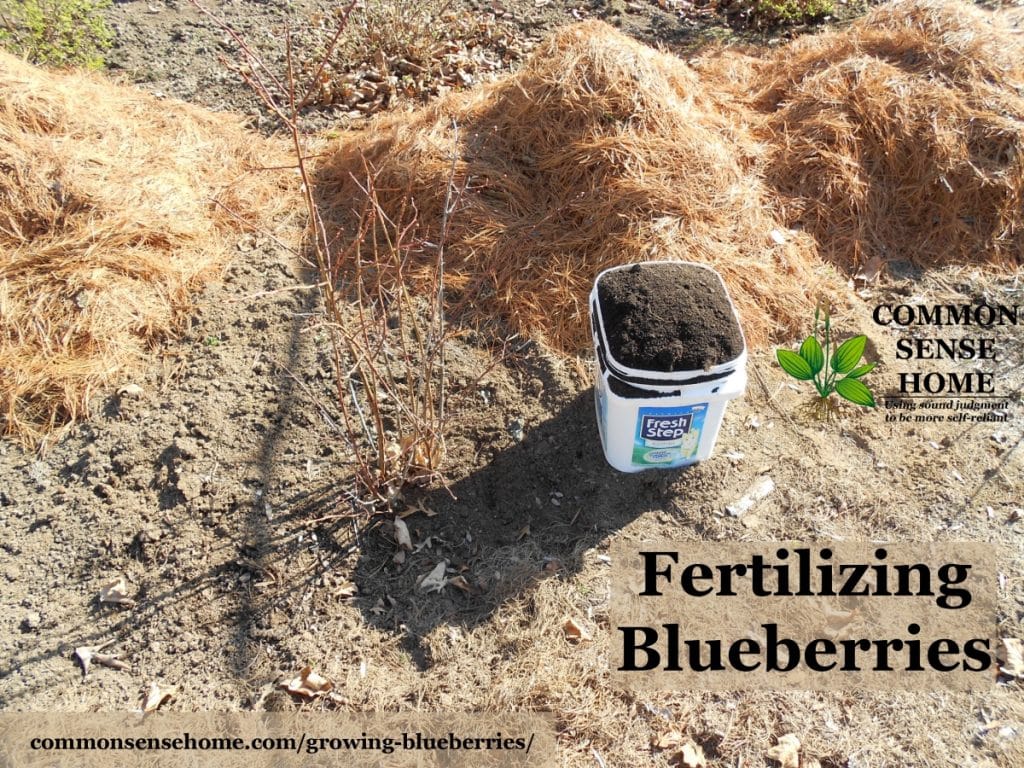
Along with acid fertilizer, blueberry plants love earthworm castings. When the blueberries are starting to bud, I fertilize my blueberry bushes with earthworm castings.
To apply castings, I pull back the mulch at the base of the blueberry bush, and spread an inch of two of worm castings. Then I move the mulch back into place around the blueberry plant.
(More info on organic fertilizers here.)
Watering Blueberries
Once you prep the soil, fertilizer and mulch, the main thing to watch during the growing season is watering.
Blueberries need around an inch of water per week, and water is extra important when the berries are growing. Without water, the berries wither instead of ripening.
Blueberry bushes set fruit next year on this year’s growth, so you want to make sure to care for your blueberry plants well throughout the season.
Protecting Blueberry Plants from Birds and Other Animals
The first problem I ran into with blueberries is that every wild animal eats them, and not just the berries.
First the deer came to browse and then the rabbits, and the first 6 plants I put in turned into 2 inch stubs.
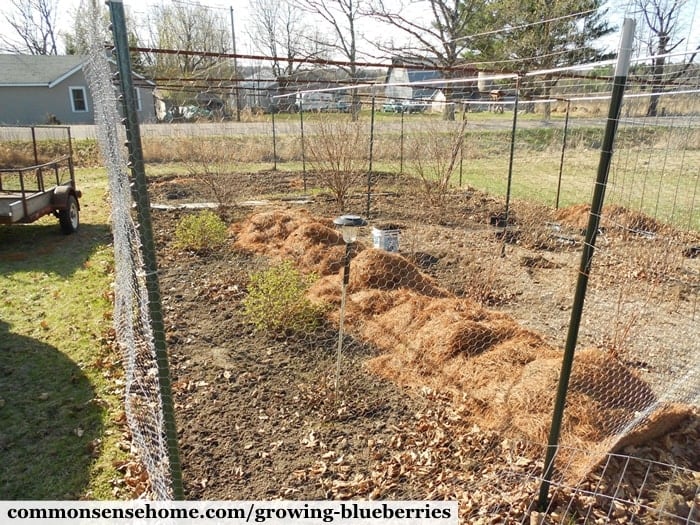
I fenced the next planting with 3 foot wire, but I still had problems with the deer jumping the fence, so last year I went to a 6 1/2 ft fence.
To keep the birds out, I built a frame work out of T post, chicken wire, tube steel and conduit, then ran wires to support plastic bird netting. This created safe haven for the plants to grow and berries to ripen pest free.
Having the netting elevated instead of just draped over the plants provides better protection and makes the plants easier to access for harvest and care.
When you price fencing materials they may seem expensive, but remember a blueberry planting can last 30 years if you manage it properly, so it will be worth it in the long term.
For more information on my set up, see “Blueberry Netting Tips – Protecting Blueberries from Birds (& Deer)“.
When to Pick Blueberries
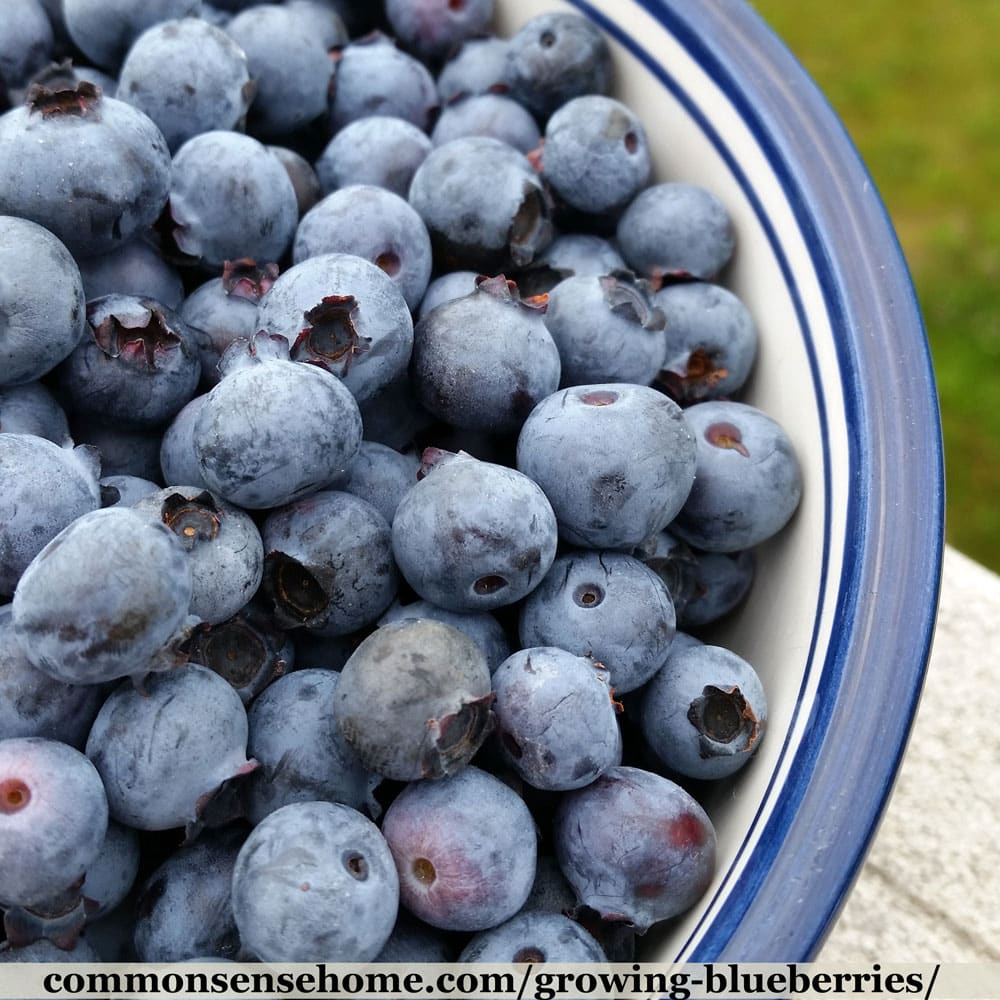
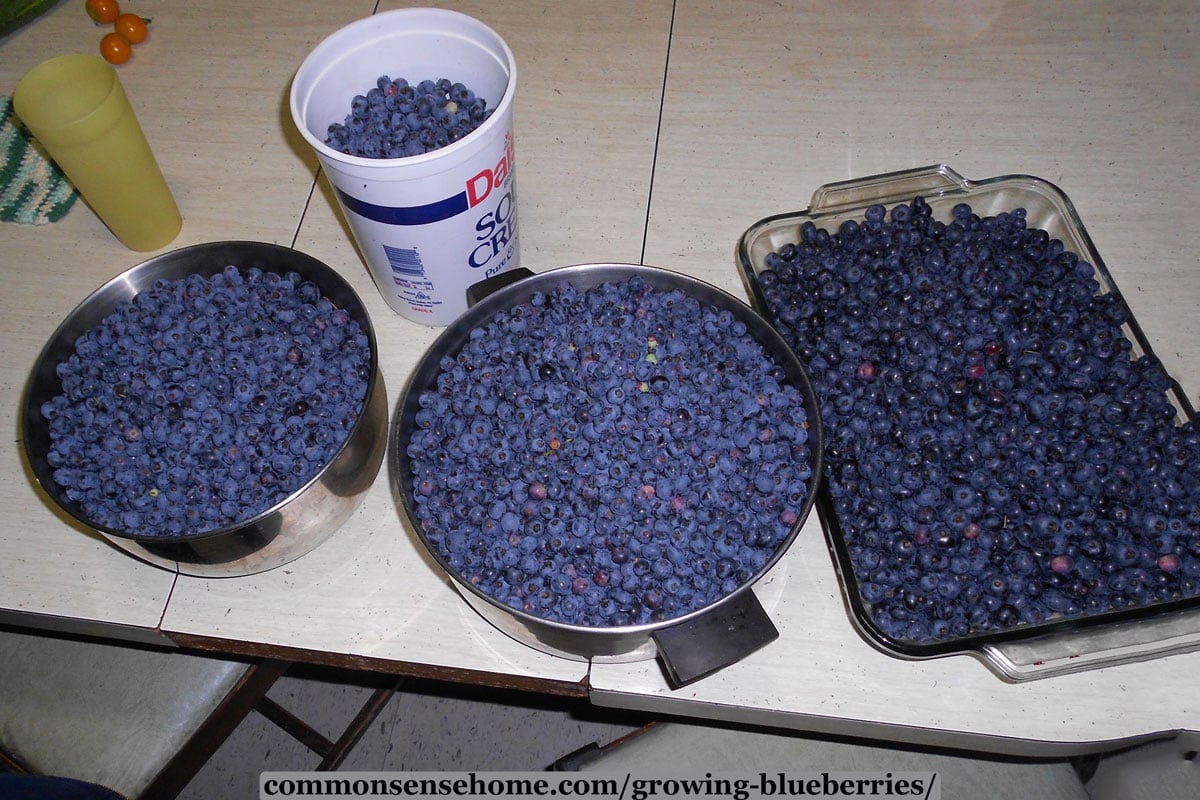
Pick blueberries when they are a deep blue color. It’s okay to pick them slightly underripe and let them ripen at room temperature inside.
Avoid letting overripe blueberries sit on the plant, as they can attract Drosophila fruit flies, especially in wet weather.
Blueberries will keep for several days at room temperature, or about a week in the refrigerator. Freeze or make blueberry jam for longer storage.

Growing Blueberries in Containers, Including Overwintering Instructions
For detailed blueberry container planting information, please see “Growing Blueberries in Containers“
Excerpt from the article:
Because containers do not provide adequate insulation from the cold, be sure to protect container-grown blueberries during the winter to prevent root damage.
In mid- to late October, bury containers in the ground at a site where snow is likely to accumulate and where plants will be protected from cold winter winds.
Mulch the soil surface with four to eight inches of straw in mid-November or cover the bushes with burlap. Prevent rabbit damage by placing chicken wire fencing or hardware cloth around the bushes.
During early to mid-spring, remove containers from the ground and place them in full sun. Alternatively, containers can be left buried in the soil as long as the containers have proper drainage holes and the site where the containers are buried is well drained and exposed to full sun.
How to Plant Blueberries in Pots
How to Prune Blueberries
Here’s a good post from Oregon State University Extension on proper pruning techniques for blueberries, “Prune blueberries yearly for more fruit“, which includes the following steps:
“Remove the low growth that would touch the ground when loaded with fruit. Cut out short, soft shoots that develop from the base of the plant late in the season.
Prune off canes and twigs damaged by winter injury, mechanical causes, diseases or insects. Cut out the unproductive canes: those that haven’t produced much new growth on one-year-old canes, which have buds and are dull in color.
If you have been pruning every year, it is best to remove the two oldest (most unproductive) canes each winter.
Prune to let light down into the plant center.
If your plants tend to overbear, with numerous small fruits rather than larger ones, thin the fruit buds by clipping back some of the small shoots carrying a heavy load of flower buds. Blueberry flower buds are near the tips of the past season’s growth and are large and plump, compared to the small scale-like “leaf” buds.”
How to Transplant Mature Blueberry Plants
Yes, you can transplant mature blueberry bushes.
It’s best done in late winter or early spring. “How to Transplant a Mature Blueberry Bush” is a pretty good guide, although I would try to give the sulfur a longer rest period before planting.
How to Clone Blueberries from Mature Plants
See “How to Graft or Clone Blueberries” for instructions on cloning your own blueberry plants.

This post is by Laurie Neverman’s brother, Richard Poplawski. Since his service in the Marines, Rich has been a mechanic, fabricator and “fix just about anything” guy for over 20 years.
He lives in northwest Wisconsin and maintains a large orchard and perennial plantings, as well as a vegetable garden. He loves spending time with his grandkids, introducing them to gardening or getting in some fishing with “Papa Rich”.
His posts on the site include:
- How to Grow the Best Raspberries You’ve Ever Tasted
- Car Won’t Start in the Cold? check Out these Troubleshooting Tips
- 5 Things You Need to Know Before You Buy a Wood Burning Stove
First published in 2012, last updated in 2020.
Do you have any suggestions as to how to keep the birds out of the blueberry bushes? We have a real battle every year. We have covered them with white gardening fabric, bird netting (which I hate because the birds get caught in it) and have gone as far as to build a PVC enclosure covered with plastic fencing and they STILL manage to get in. I don’t know what else to do…..
My brother has an enclosure covered with netting to keep out the birds and the deer. We hope to get some better photos and videos up this year, but it’s tough because he lives on the opposite side of the state.
What about maple leaves, fir needles, cedar needles, would they be good or not?
I don’t see why not, unless they are treated with something.
Great post about growing blueberries. I cannot wait to give it a go. The weather might be an issue where we are but will try and see if it works. If not will need to wait for better weather.
Get your kids a tool set and let them go wild and plant in the garden. Loved your post and thanks for the info about the different blueberry plant types. Will check them out at the nursery and see what they have available.
My “babies” are now 14 and 16, so they’re using full size tools. 🙂
I am from Philippines. Can I grow blueberries here in our country (Tropical area)?Where can I buy the seeds for planting?
I am from Philippines, how can I grow blueberries here?
Mariz, unfortunately, blueberries do not tolerate tropical weather, but I’m sure there are many other wonderful fruits you can grow.
I am curious as to how you are handling Spotted Wing Drosophila infestations? Here in the northeast the earliest blueberries are ok, but the later varieties become infested quickly is there a safe deterrent?
Rich’s plants are very vigorous and have not had any insect problems.
I’d consider doing everything I could to boost plant health, as healthy, vigorous plants tend to be less affected by pests and disease. Take a look at the blueberry plants in the video at the end of this post – https://commonsensehome.com/grow-tomatoes-organically/2/
Hi, I’m new to having blueberry bushes. When they started putting on their leaves this spring something started eating the them right away! I’m not finding a lot of information on the internet about what it could be. Do you possibly know a common pest for the blueberry bush? Thanks.
You can visit this blueberry insect pest guide to identify what may be munching on your plants – https://www.lsuagcenter.com/en/crops_livestock/crops/blueberries/pests/Insect+Guide.htm
I was wondering how one would winter over a potted blueberry bush. Our soil isn’t suitable, yet we would love to grow them.
I’ve added information to the post about overwintering, with a link to more information.
I planted two blueberry plants last year in half-barrels. There are no pine needles available in my area, so a got some discarded Christmas trees from my neighbors in January. My plants are loving the pine needle mulch.
Good creative problem solving. 🙂
Thank you so much for this post! Blueberries are on my planting list. I love them and buy so many. I really would like to grow my own. However, the spot I have is a bit shady, is that ok, or do blueberries require full sun?
Blueberry plants will fruit best with at least 6 hours of sun. They can grow in partial shade, but will not produce as well.
Thank you, I will have to look into it more. Thankfully we have not planted yet.
Would red cedar needles be to hot to use as a mulch for blueberries?
When you say too hot I’m not sure what you mean. Blueberries like fertile ground. If you mulch with leaves or needles it takes a while for them to break down and soil microbes will change the ph and bring it closer to neutral
I’ve heard cedar is toxic to blueberries — not sure if foliage or bark or chips are the problem. Curious, since originally the commercial blueberry was developed in New Jersey by (Mary?) White, where there are lots of cedars, including cedar swamps. My 2 year old blueberries are spindly and have a red blush on the leaves in mid spring. I will be modifying the irrigation this season — the pine needles and other nutrients don’t really reach the roots if my drip system is under the mulch! I’m in the northern California Sierras, 2600 ft elevation.
I was talking to my brother about this, and he notes that blueberries need a fair amount of nitrogen to thrive, so he highly recommends a foliar feed in early spring when they’ve leafed out, and some balanced granular fertilizer.
Searching online about cedar mulch, I found at least one site that claimed it was okay to use with established plants, and my experience back at our previous home bears this out. We used it all around our foundation plantings, and they thrived. It’s probably not optimal, but shouldn’t kill your plants.
Just wanted to chime in and say that I planted 3 bare root blueberry plants and one potted this year. I mixed into the dirt leaf compost and mulched with pine bark. Fertilized with jacks classic acid special and they were doing good. Last weekend I pulled the much back to expose the dirt and added two pounds of earthworm castings on top of the dirt around the base of the plant, covered back up with mulch and watered. Man let me tell you the blueberry plants just took off! They love the earthworm castings so much I am thinking of buying a few dozen eartworms and putting them under there. I doubt there is a better fertilizer for blueberries.
Worm castings are wonderful around the garden. I visited my brother, Richard, this past weekend, and his blueberries look amazing!
Thank you for this informative article. However, Please, don’t suggest using peat moss. It is not a renewable resource, it’s harvesting destroys old ecosystems. The alternatives you gave – pine needles, forest duff – are fine, but removing this from its habitat still disturbs wildlife quite a bit. How about integrating these? Using a forest edge that is within the community where you live – as a permaculture option. Or creating one! There are ways to start cultivating the conifers that will create the soil conditions over the years. Sure, it will take time. For the meatime, using containers is a great suggestion. You will be giving a gift to future generations, who will see the values of having a variety of habitat types all around, and can then learn from them.
Naturally, protecting the plants from being eaten away by wildlife is the biggest challenge, the same as here in Germany. In some places, large browsers can still be fenced out of “habitat-recovery zones”. Just a suggestion! All the best!
Rich gets most of his pine needles from people who clear them from their yards because they prefer to try and grow grass.
Humans, not wildlife, are at the top of the food chain and, as such, human needs come before those of wildlife. Unless you live a primitive lifestyle under a tree in the woods, your daily activities and the production of products you use disrupt wildlife more than raking up a few pine needles.
great post…. I am so happy that worm casting are good… I have some busy worms…and live with lots of pine trees around so that is a good reminder to….take care.
Hi, I have a blue berry plant in a container. It has produced a lot of fruit buds but they are not growing any bigger. Any information would be appreciated please.
Are the buds being pollinated? Does the plant have enough room, enough fertilizer, proper pH? Is it too hot or too cold? It takes time for fruit to grow, but these are things you can check to help it along.
I met a man on line that has many BB plants in containers.
He saids the fertilizer & water needs are different in containers & the plant should be repotted into a big pot every year or root pruned every 3-5 years like a bonsai tree.
You should have at least two plants.
I have great harvests from my blueberry bushes which are grown 100% organically with compost as the only fertilizer and soil amendment. I also do not remove any fallen leaves from the garden or landscape but rather allow them to remain in place to naturally replenish the soil and provide a host of environmental services.
Why recommend the use of synthetic fertilizers? Ammonium sulfate is not only unnecessary but harmful to the environment and public health. Synthetic fertilizers are particularly damaging to soil health in addition to contaminating ground water and storm water runoff. The toxic run-off or leaching of synthetic fertilizer is particularly grave in the Chesapeake Bay watershed causing dead zones in our national treasure, the largest estuary in the US.
I Have 3 blueberry bushes 4 years old . And the one in the middle is the only one that gets berries on . What can I do to get the other one to bloom,. Thanks.
if they are different types, they may just take a little longer, or there may be something causing lack of fruit set in your area.
Here are some more things to check.
From Michigan Gardener:
I enjoyed your comments to this question but I have another: due to rabbit damage over the snowy Wisconsin winter, we have no center stalk/trunks on our 3 young blueberry bushes. They sprouted many low branches/canes but no fruit from only a few flowers. Feedback?
If rabbit is not on the menu, try and fence the plants if possible, especially heading into winter. Deer will be happy to eat them, too, if you have any in the area.
Train the recovering growth to upright stems, building your framework for the bushes in the years ahead. Now’s a good time to fertilize, before it gets too close to fall/winter. New growth put on this year will be next year’s fruiting growth.
How’s your pH and general soil health? Healthy soil = healthy plants.
Are there enough pollinators in the area? Bumblebees and other native bees are better for blueberries, as they produce little nectar for honey bees.
What was the weather like at blossom time? Heavy rains or conditions that are too dry both interfere with fruit set.
I am real curious how you built your fencing and how it is working. It is hard to tell from the picture how the wires, tube steel and conduit are connected. I’ve been wanting to do something similar, but wondering how to tighten the high tensile strength wires so they do not sag with netting without pulling the T-post out. I put almost an acre of blueberry bushes in over the last two years but the birds eat almost all the berries before even ripening. Deer and rabbits are not my friends either. Any help would be appreciated? and could you post or send more pictures of the fence too maybe. Thanks for the great article and hope.
I’ll ask Rich to see if can explain a little better and get some more photos. I know the system has been working well for him.
I looked at how Rich did it using those 6 foot iron stakes, but I used a better method that makes it easier to enclose the site with chicken wire, I used PT 4 x 4’s.
Using 4 x 4’s you can staple chicken wire directly to the posts & not need to worry about the wire slipping down & off the metal stakes you see in Rich’s photo. However, the key to making 4 x 4 posts work in the most efficient manner possible is to first drive a 2 or 3 foot long metal stake into the ground at the one end of which has a 4 x 4 cup, you see these most commonly used to hold roadside mailboxes in place, they cost about $20 each at Home Depot.
Drive each post holder into the ground until the 4 x 4 cup just nicely sinks into the surface so that it rests firmly on the ground & won’t twist. You must use a post level to make sure your stake holder is being driven into the ground so that your post will be vertical, to do this place a 2-3 foot long 4 x 4 into the stakeholder cup so onto which you can use rubberbands to keep the post level in place as you pound on top of the short 4×4 to drive the stakeholder into the ground.
I placed my stake holders 10- 15 feet apart. I used 8 foot long 4 x4’s & simply dropped them into the stakeholders & secured them from accidentally lifting out of the stakeholders using galvanized screws threw the sides of the 4 x 4 stakeholder cups.
I have six perfectly vertical posts at the top of which I connected PT 2×4’s all around the perimeter. I then spanned across the 15′ width of the area using 15 foot long PT 2×4’s at 3′ intervals so that I could make lightweight screens to span the distance over the tops of the bushes to keep the blueberry vultures out.
I did this 20 years ago just after I built the house, could thing I was 20 years younger than I am now, I wouldn’t have had the stamina for it.
Thanks for sharing your experience. It’s not clearly visible in the photos, but there’s a frame attached to the posts – no slipping. Hopefully I can get another post up sometime this season that has better photos of the enclosure. Running a little behind right now.
I’ve been growing my own blueberry bushes for years. I just recently started growing them from seeds as opposed to buying them. I like to grow highbush and rabbiteye so I can harvest berries all year, makes for the perfect mixture.
Great article, I have about 200 wild high bush blueberry bushes. I love that every bush yas a different flavor. I was told to fertilize just before they flower and just after flower drop. Also learned blueberries are a 50/50 plant where the roots are the same size as the tops, to encourage growth the oldest shoots should be pruned to promote new growth. Love my blueberries…
Great article, thank you! I had great beginner’s luck with my first blueberry bush, but it died. I’ve since purchased 72 slips and I have about 40 plants going. I want to make sure they grow optimally. This sure helps! Thanks for the county extension links. I found and favorited mine.
Nice article ! We have a small planting of blueberrires and love them !!! They are my pride and joy. It is a wonderful feeling to be able to ‘share the bounty’ with family and friends.
I do have a question… When we did our First planting of blueberry bushes, we nade a novice mistake…The plants were so small that we planted them rather close together…i believe they are 4 feet apart , in rows 6 feet apart. Now, years later , they are difficult to work around. Can the bushes be thinned out by transplanting some ?? I absolutely hate the thought of just removing them, and want to try to save them. I realise they would get set-back for a couple of years…but it would be worth it to me.
Thank You for any suddestions, Marge Thornton
Yes, you can transplant mature blueberry bushes. It’s best done in late winter or early spring.
This is a pretty good guide, although I would try to give the sulfur a longer rest period before planting.
http://www.gardenguides.com/112707-transplant-mature-blueberry-bush.html
Question: Do you need to prune blueberry bushes?
Amanda – yes, after they get a little more growth. Rich’s are pretty small yet, so he’s only cleaned up damaged and crossing growth at this point. Here’s a good post from Ohio State University Extension on proper pruning techniques for blueberries – http://ohioline.osu.edu/hyg-fact/1000/1430.html.
The link for proper pruning doesn’t work. It says page cannot be found. Do you know of another?
Added a different link and info.
I have a three acre field (farmed 60 -80 years ago) that is mostly hay and grass, but have an abundance of wild low blueberry bushes especially thick around the forest edge but shooting in the rest of the field. Not clear how I would clear-prepare the grasses without removing the roots of the Blueberry. Any ideas welcome
Thanks
Scott
I’d probably start mulching to smother the grass.