
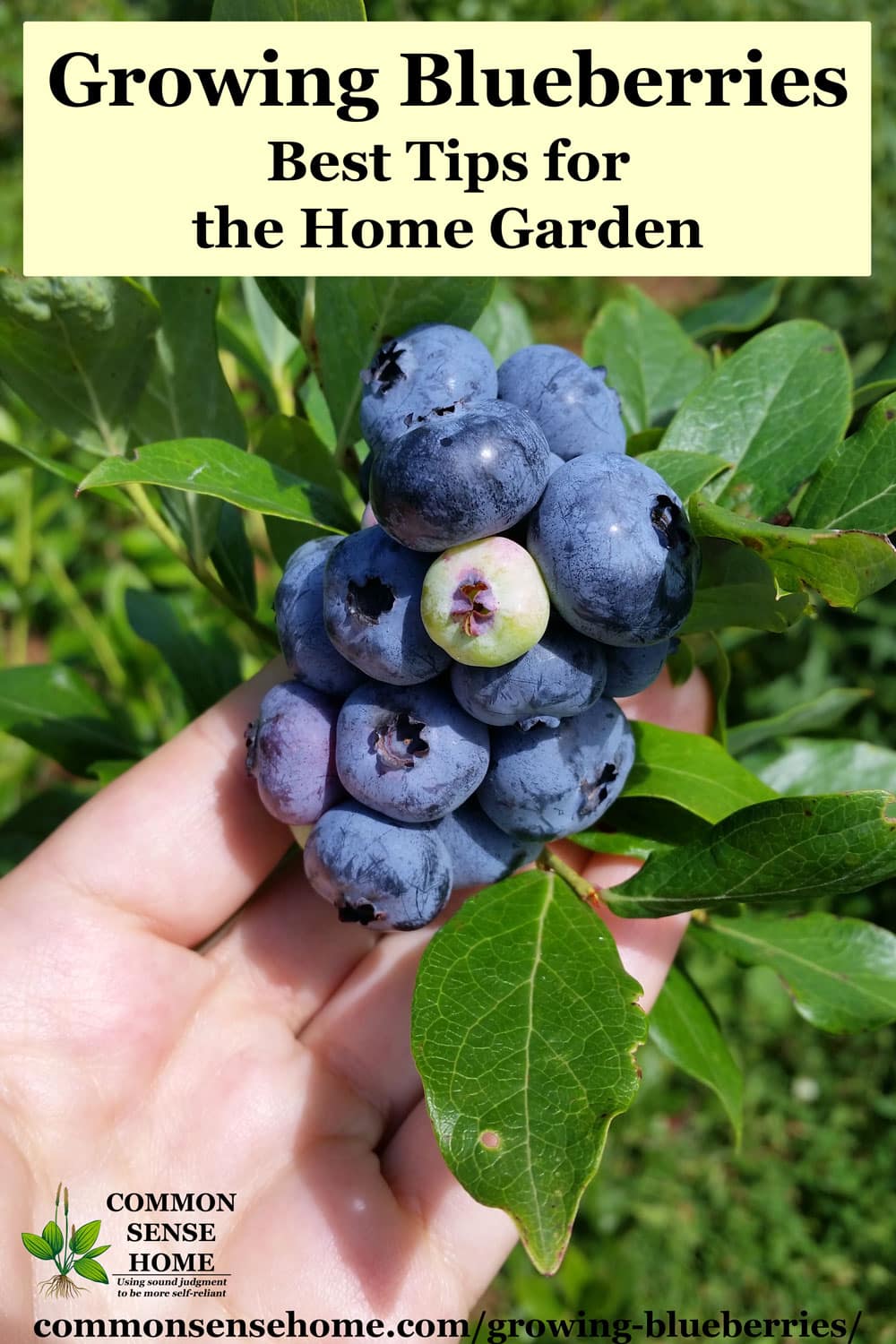
Growing Blueberries – Best Tips for the Home Garden

This post may contain affiliate links. Read my full disclosure here.



Learn how to grow blueberries in your home garden. We’ll take you step by step through planting, fertilizer and mulch, care and harvest.
We also touch on growing blueberries in containers, pruning and moving mature plants.
Would you like to save this?
Growing Blueberries – Quick Guide
Blueberries are fairly easy to grow, if you follow some basic rules.
- Blueberries grow in USDA hardiness zones 3 through 10.
- Blueberry soil should be rich in organic matter, with soil pH between 4 and 5.5 (acidic soil).
- Plant blueberry bushes in full sun for best production. Plants will tolerate late afternoon shade.
- Blueberries prefer well drained soil.
- While blueberries are self-pollinating, planting a second variety will increase fruit production
- Space blueberry plants 4-6’ apart for highbush, 2-4’ for low bush with 6-8’ between rows
- Use several inches of organic mulch to prevent weeds.
- Apply organic fertilizer in spring when plants are starting to bud.
- Prune off damaged or crossing branches in late winter.
- Blueberries need around an inch of water per week during the growing season.
- Protect plant from wild animals, if needed.
- Harvest regularly to prevent spoilage.
How to Grow Blueberries
Let’s tackle each of these steps for growing blueberries in more detail.
Where do blueberries grow?
You can grow blueberries in USDA Plant Hardiness Zones 3 through 10.
Local microclimate and soil is important, too, as we’ll discuss below. Watch your local weather, talk with other gardeners to see what varieties grow well in your area.
For more information, read: Plant Hardiness Zones and Microclimate.
What’s the Best Soil for Blueberry Plants?
Healthy soil = healthy plants. Remember, these bushes have the potential to provide many years of delicious berries, so they are worth the extra effort.
Blueberries grow best with an acid soil pH between 4 and 5.5, so do a soil test before you start.
The best soil for blueberry plants is soil rich in acidic, organic material, like you would find on forest floor or edge of the forest.
Add Organic Matter
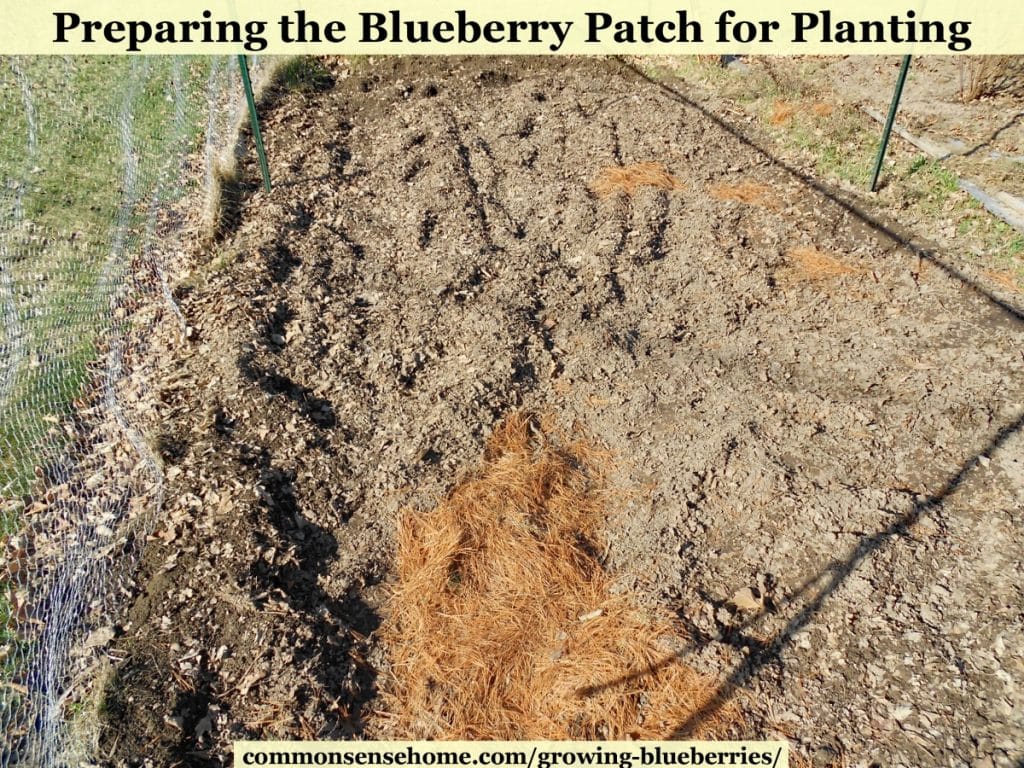
When you prepare your blueberry planting area, dig a generous amount of organic matter into your blueberry soil. Time and effort up front will make all the difference in plant performance.
Peat moss is commonly recommended, but pine needles, leaves and other tree fallout work just as well. If your soil is alkaline, you’ll either need to do a LOT of soil amending, or grow you blueberries in a container.
The first time I planted blueberries, I used pine sawdust to kill the weeds, then used the sawdust for mulch. It worked OK, but I think the sawdust tied up a lot of nitrogen in the soil as it broke down, which slowed plant growth.
When I extended my blueberry patch, I first smothered the grass in a 10’x24′ plot with black plastic during the growing season. In the fall, I tilled in a generous amount of leaves and black peat by-product from earthworm casting production.
Be Careful with Chemicals
Avoid large amounts of sulfur and chemical fertilizers, which disrupt soil health.
If you do add sulfur in quantity to lower pH, wait at least three months for it to break down before planting. (For instance, add sulfur in fall for planting in spring.)
Where to Plant Blueberry Bushes
As noted above, blueberry plants prefer slightly acidic soil rich in organic matter. They need full sun for best fruit production, but will tolerate some afternoon shade.
Avoid planting blueberries in ground that tends to have standing water or ground that dries out too quickly. Think “edge of forest”, not bog. If standing water is an issue, try raised beds.
Which Blueberry Variety is Right for Your Area?
Different blueberry varieties can be grown from Texas to Canada. Check with your local Cooperative Extension office, or ask neighbors who have had success in growing blueberries.
You can also check your favorite local garden center or online nursery for suggested blueberry varieties. Try to plant at least two different varieties so they can cross pollinate.
Basic blueberry types include:
- Lowbush Blueberry – Vaccinium anugustifolium – Cold tolerant, less productive than high bush blueberry varieties, can be used as an edible ground cover or food forest planting
- Northern Highbush Blueberry – Vaccinium corymbosum – For zones 4-7 (specific highbush blueberry varieties will tolerate colder temps, such as those I’m growing in zone 3). Grows 5-6’ tall.
- Southern Highbush Blueberry – Vaccinium corymbosum hybrids – For zones 7-10. Plants require little chilling, but are otherwise similar to their northern cousins.
- Rabbiteye Blueberry – Vaccinium ashei – Best for southern growers. For zones 7-8. Cold tolerant to around zero F. This blueberry variety can grow up to 20 feet if left unpruned, but best trimmed to manageable picking height.
- Saskatoon – Amelanchier alnifolia – Not a true blueberry, but extremely cold tolerant. Can be grown in the northern United States and Southern Canada. Does not require acidic soil.
Saskatoons are also known as serviceberry, shadbush and juneberry. Fruit flavor is somewhat bland, seeds are larger than blueberry seeds and have a mild almond flavor.
Plant Spacing
When growing blueberries, allow 6 to 8 feet between rows.
Space blueberry plants:
- 4 feet to 6 feet apart for highbush blueberries
- 24 inches to four feet apart for low bush blueberries
- 1 to 5 feet for saskatoon plants
Planting Blueberry Bushes
Plant container grown blueberry plants in your garden at the same depth they were growing in the pot. The same rule applies for bare root plants.
To remove a blueberry bush from its container, place your hand around the base of the blueberry plant with your palm facing towards the soil to support the root ball. Gently invert the pot to dump the blueberry bush out.
Check for roots that circled around inside the pot, and gently loosen and spread them out before you set your blueberry bush into the planting hole.
If planting a bareroot blueberry plant, gently spread the roots in the planting hole. Cover the roots of your plant and gently tamp down the soil.
Water the blueberry bush well to settle the soil around the roots, and cover soil with a layer of organic mulch.
When to Plant Blueberry Bushes
Bareroot blueberry plants should be planted in early spring, preferably while they are still dormant, to minimize transplant shock.
Container grown blueberry plants do well planted in spring, too, but can also be planted later in the season. It’s best to avoid planting in mid-summer, when high temps in the garden can stress plants. Areas with mild winters may do well planting container grown blueberries in fall.
Note for Plants Purchased via Mail
If you purchase blueberries from an online nursery, they may need to be acclimated to your area before planting.
Start with placing the containers in sheltered, shady spot outdoors, such as a porch. Keep them there for 3-4 hours the first day, bringing them inside at night. Add 1-2 hours of outside time each day, planting at the end of a week.
Avoid exposing your young blueberry plants to freezing temperatures when they have fresh baby leaves. If frost threatens after planting, use frost protection.
Locally grown container blueberries that have been sitting outside at a nursery shouldn’t need to be acclimated and can be planted directly in the garden.
Best Blueberry Mulch
Blueberries are a shallow rooted shrub and don’t compete well with grass, so they benefit from a good mulching.
Mulch helps keep the moisture level stable, and cust down on the amount of time spent watering.
I would say the best blueberry mulch is pine needles. They help maintain the correct pH, and add nutrients to the soil.
If you can’t get pine needles, bark or wood chips over wet newspaper would be my next choice.
The Best Blueberry Fertilizer
Fertilize blueberries with an acid fertilizer like ammonium sulfate or Down to Earth Acid Mix.
Use 2 ounces of ammonium sulfate 18 inches from the plant when you see blossoms. Increase by one ounce each year, up to 4 oz per plant per year.
If you are adding extra mulch at the same time, increase the amount of fertilizer by 1/2.
How to Fertilize Blueberries the Right Way
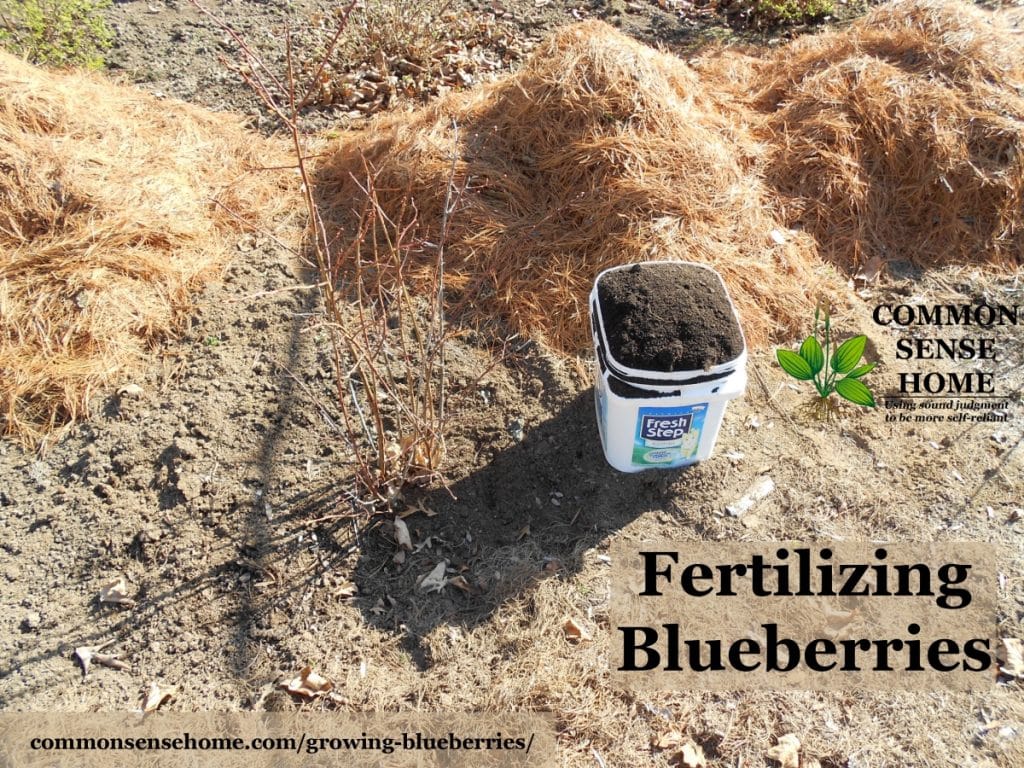
Along with acid fertilizer, blueberry plants love earthworm castings. When the blueberries are starting to bud, I fertilize my blueberry bushes with earthworm castings.
To apply castings, I pull back the mulch at the base of the blueberry bush, and spread an inch of two of worm castings. Then I move the mulch back into place around the blueberry plant.
(More info on organic fertilizers here.)
Watering Blueberries
Once you prep the soil, fertilizer and mulch, the main thing to watch during the growing season is watering.
Blueberries need around an inch of water per week, and water is extra important when the berries are growing. Without water, the berries wither instead of ripening.
Blueberry bushes set fruit next year on this year’s growth, so you want to make sure to care for your blueberry plants well throughout the season.
Protecting Blueberry Plants from Birds and Other Animals
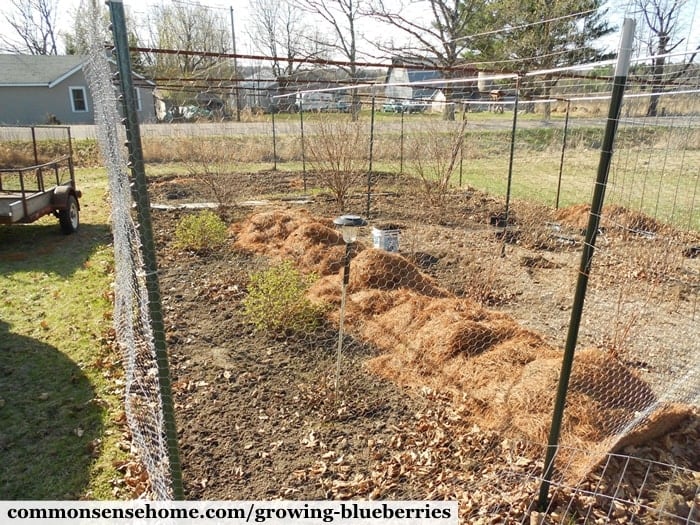
The first problem I ran into with blueberries is that every wild animal eats them, and not just the berries.
First the deer came to browse and then the rabbits, and the first 6 plants I put in turned into 2 inch stubs.
I fenced the next planting with 3 foot wire, but I still had problems with the deer jumping the fence, so last year I went to a 6 1/2 ft fence.
To keep the birds out, I built a frame work out of T post, chicken wire, tube steel and conduit, then ran wires to support plastic bird netting. This created safe haven for the plants to grow and berries to ripen pest free.
Having the netting elevated instead of just draped over the plants provides better protection and makes the plants easier to access for harvest and care.
When you price fencing materials they may seem expensive, but remember a blueberry planting can last 30 years if you manage it properly, so it will be worth it in the long term.
For more information on my set up, see “Blueberry Netting Tips – Protecting Blueberries from Birds (& Deer)“.
When to Pick Blueberries
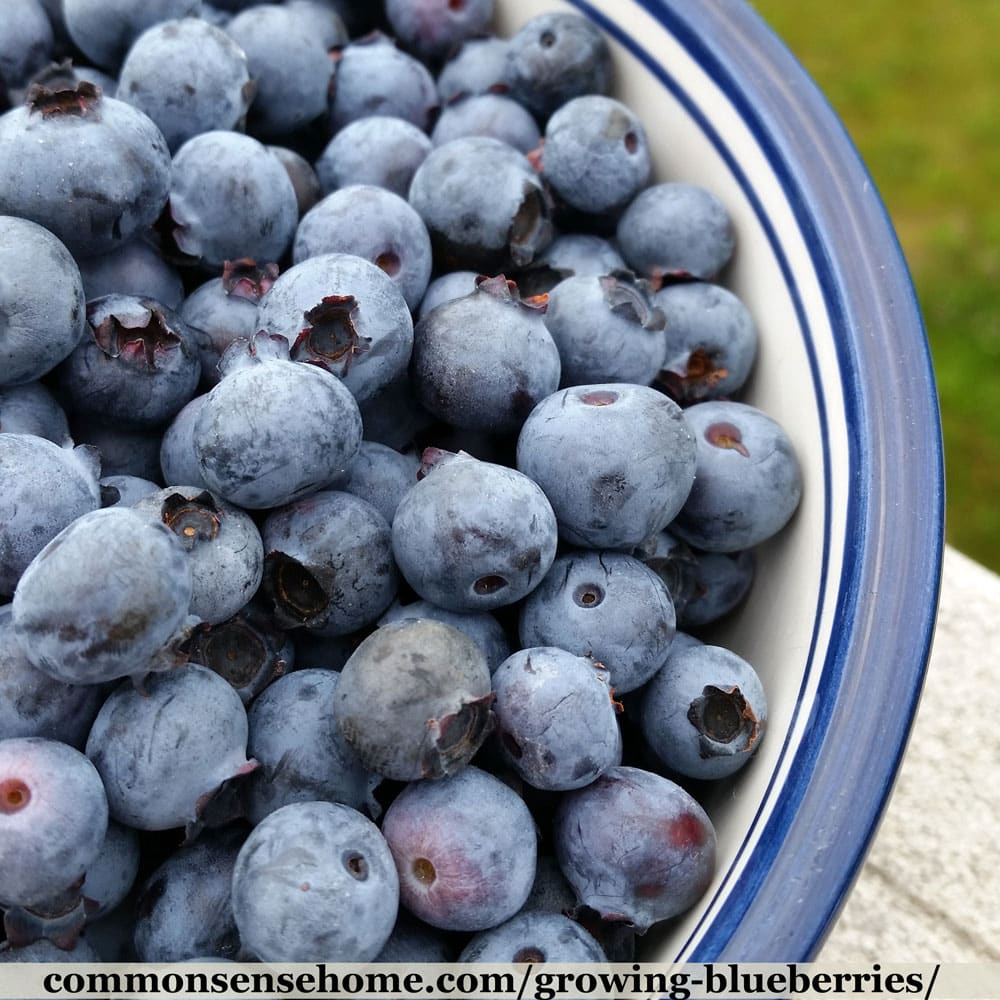
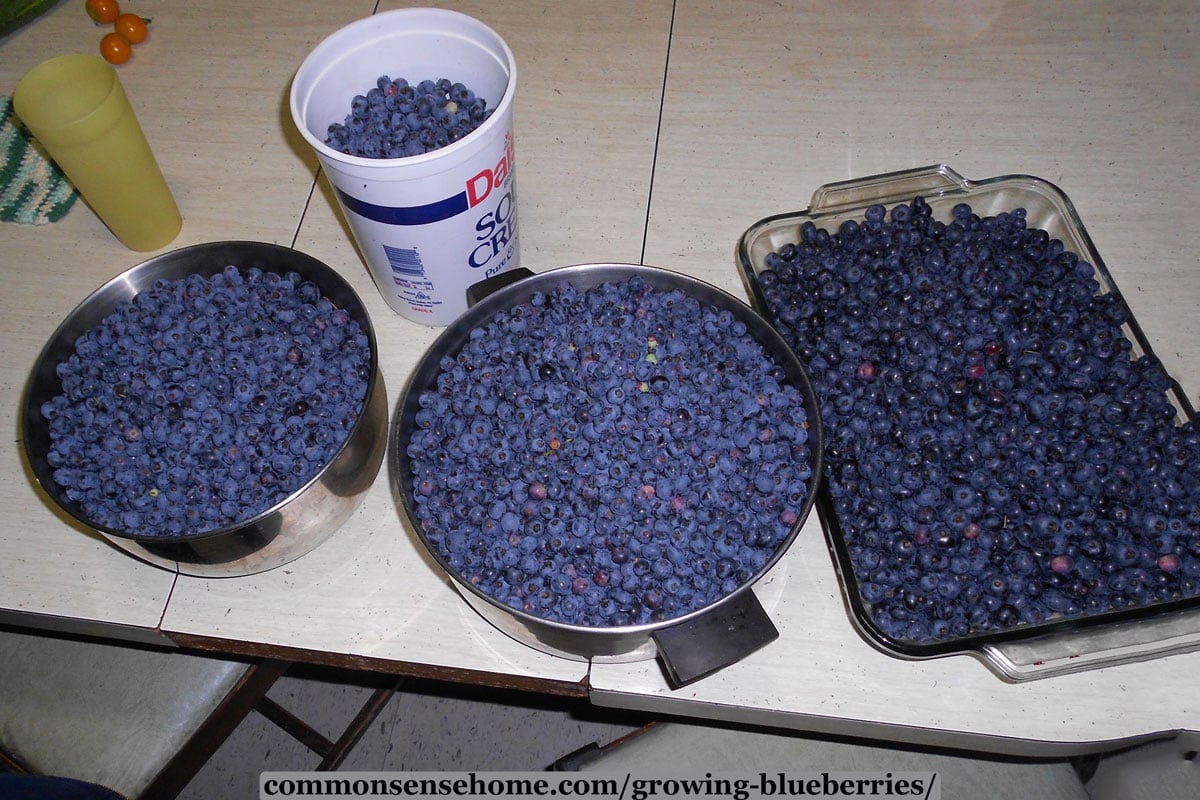
Pick blueberries when they are a deep blue color. It’s okay to pick them slightly underripe and let them ripen at room temperature inside.
Avoid letting overripe blueberries sit on the plant, as they can attract Drosophila fruit flies, especially in wet weather.
Blueberries will keep for several days at room temperature, or about a week in the refrigerator. Freeze or make blueberry jam for longer storage.

Growing Blueberries in Containers, Including Overwintering Instructions
For detailed blueberry container planting information, please see “Growing Blueberries in Containers“
Excerpt from the article:
Because containers do not provide adequate insulation from the cold, be sure to protect container-grown blueberries during the winter to prevent root damage.
In mid- to late October, bury containers in the ground at a site where snow is likely to accumulate and where plants will be protected from cold winter winds.
Mulch the soil surface with four to eight inches of straw in mid-November or cover the bushes with burlap. Prevent rabbit damage by placing chicken wire fencing or hardware cloth around the bushes.
During early to mid-spring, remove containers from the ground and place them in full sun. Alternatively, containers can be left buried in the soil as long as the containers have proper drainage holes and the site where the containers are buried is well drained and exposed to full sun.
How to Plant Blueberries in Pots
How to Prune Blueberries
Here’s a good post from Oregon State University Extension on proper pruning techniques for blueberries, “Prune blueberries yearly for more fruit“, which includes the following steps:
“Remove the low growth that would touch the ground when loaded with fruit. Cut out short, soft shoots that develop from the base of the plant late in the season.
Prune off canes and twigs damaged by winter injury, mechanical causes, diseases or insects. Cut out the unproductive canes: those that haven’t produced much new growth on one-year-old canes, which have buds and are dull in color.
If you have been pruning every year, it is best to remove the two oldest (most unproductive) canes each winter.
Prune to let light down into the plant center.
If your plants tend to overbear, with numerous small fruits rather than larger ones, thin the fruit buds by clipping back some of the small shoots carrying a heavy load of flower buds. Blueberry flower buds are near the tips of the past season’s growth and are large and plump, compared to the small scale-like “leaf” buds.”
How to Transplant Mature Blueberry Plants
Yes, you can transplant mature blueberry bushes.
It’s best done in late winter or early spring. “How to Transplant a Mature Blueberry Bush” is a pretty good guide, although I would try to give the sulfur a longer rest period before planting.
How to Clone Blueberries from Mature Plants
See “How to Graft or Clone Blueberries” for instructions on cloning your own blueberry plants.

This post is by Laurie Neverman’s brother, Richard Poplawski. Since his service in the Marines, Rich has been a mechanic, fabricator and “fix just about anything” guy for over 20 years.
He lives in northwest Wisconsin and maintains a large orchard and perennial plantings, as well as a vegetable garden. He loves spending time with his grandkids, introducing them to gardening or getting in some fishing with “Papa Rich”.
His posts on the site include:
- How to Grow the Best Raspberries You’ve Ever Tasted
- Car Won’t Start in the Cold? check Out these Troubleshooting Tips
- 5 Things You Need to Know Before You Buy a Wood Burning Stove
First published in 2012, last updated in 2020.
Good site, I haven’t read it all yet, but I knew I had to print it when I saw the picture of your berries… I figured I better listen to what you have to say
I have had good production of blueberries in the past in WA, but haven’t tried yet in MT… I will next year, and bought 21 plants at a deep year end discount which are now going in the garage until spring because I will have to add sulfur… I didn’t know about that breakdown, thanks for that
The following IS NOT spam… Just a great product, and while I’m getting help here, I figured I would pass along my experience… I AM NOT affiliated with the company at all, I am just a very happy customer, and you will be too…
One product I would like to promote is the fertilizer Sea Magic… It can be purchased online for about $8, and the packet makes 66 gallons of fertilizer… (One gallon concentrate)… I have used it on everything I plant, and had 6 foot tall, 4 foot wide cherry tomato plants in WA… As far as blueberries, the production was excellent, and I even witnessed a dying plant brought back to life overnight, and it grew 6 inches… (No greenhouse, but plants with Sea Magic grow much higher in them)
I know how that makes me sound like I’m from the looney bin, but it’s called Sea “Magic” for a reason… I had stevia plants grow over a foot in 2 days… Try it for the $8… I don’t see how you could lose… I didn’t mix anything with it, and I never use chemical fertilizers, period…
I set up two raised beds with soil from the sand and gravel joint, tomato plants from the same nursery, and used the same water on both beds… One with Sea Magic, one without (To test the claims of the company and the massive reviews you can find on the Burpee website)
The one without the Sea Magic did about 1/4 the production, about 1/10th the size… I remember getting Sea Magic from Park Seed, Burpee and Amazon, but Burpee has the extensive reviews…
Thanks for the recommendation. It looks like they sell it on amazon.com, too – Sea Magic Dry Soluble Seaweed Extract Fertilizer, Makes 66 Gallons
Hey Laurie, i will start to make a nursery, i have a question about the soil, I have soil with ph 6-7 , so i will make raised bad with mix of : Sphagnum moss & peat moss, pine needles, pine wood chips, pine sawdust.
But which version of Sphagnum moss i have to use ?
White Sphagnum Moss with PH 2,5-3,5
or
Brown Sphagnum moss with PH 3,5-4,5
I planning to mixture Sphagnum moss with the rest in consistence : 50/50 %
i think Pine moss and other pine think will have around 5,5 – 7 PH
so mixture with with White moss how will change the <>
and … have i add some Ammonium Sulfate in that mixture around 1 pound ? or Sulfur 🙂
Thanks 😉
I think either moss would do, and that your mixture should have some dirt or compost in addition to all the pine parts. What you’ve listed contains much carbon and very little nitrogen, and blueberries do require some nitrogen.
As for adding sulfur, with that mix I’m not sure it’s needed. How about mixing and testing the pH to see where you’re at before adding sulfur?
yep i will add soil from the pine wood, there have a lot of sand and dirt, but i’m not sure about the Sphagnum moss which one is better for blueberry 🙂 brown or white or both of them, mb will work well.
i got information to put some Ammonium Sulfate around of the bush , is it ok ?
and for sulfur i have to make test about the PH before using, but will be better to use it in new nursery 1 season before planting.
More detailed information on fertilizing blueberries and modifying pH – https://www.hort.purdue.edu/ext/HO-65.pdf
Should I start growing blueberries in pots in the early spring? I want to start a blueberry garden but don’t know when. Greatly Appreciated if someone could help!
In our area (upper Midwest), blueberries are generally started in spring.
Just planted container blueberries and am thinking of using a fine cedar sawdust to change the ph of my soil. Is cedar sawdust ok, or is it too acidic? I’ve been told that cedar sawdust may actually be poisonous to plants. What do you think?
Too much of any sawdust at once can bind up the nitrogen in the soil, stressing the plants. A surface dressing, or adding a little along with some aged manure or other nitrogen source would probably be okay.
I love blueberries But in my country is the fruit not cultivation
Hi Laurie,
When I was a kid, my mother would take me for a walk along railroad tracks not too far our home to pick blueberries. It was evident that the area near the tracks had been burned. Steam locomotives were long gone, as were the sparks from their boilers. It turned out that the railroad burned the rail beds to keep weed growth down. Unfortunately today, burning has been replaced with 2,4,5-T 2,4-D which kills the blueberries with the weeds.
It’s well noted that the “wild” blueberry fields that cover parts of Maine are torched to prune the bushes. There might be something to adding char into the soil … it makes condominiums for micro-organisms which improve the soil.
In more recent years, I’ve been seen spreading coffee grounds and corn screenings in areas where I want earthworms to set up house keeping. Not only do you get castings, but the living rototillers open the soil deeper than any mechanical device can go. While it’s said that blueberries are shallow rooted, the roots will grow deeper in better soil.
Most homesteaders can harvest abundant crops with a “plywood patch,” more specifically a four-foot by eight-foot growing area. Six blueberry plants, one at each corner with two in between, will provide lots of fruit. This smaller size can be fenced in with seven foot tall deer fence, so you get almost all of the blueberries.
Off to eat some previously frozen blueberries, turn my fingers blue and scare the neighbor’s kids.
Thanks for sharing your experience, Daryl. I know a number of plants thrive after fire, but didn’t know that some blueberries were included in that mix.
Hi Laurie:
I am a farmer in Nairobi Kenya. I have been trying to get planting material for blueberries, raspberries and cranberries to no avail. How can you help?
I’m not familiar with the import laws on plant material to Kenya, which would likely restrict what plant material you can bring in. I suspect that your climate may be too warm for the plants to grow, since they are typically found in more temperate locations. Have you tried checking with sales websites? I don’t personally sell or ship plants.
I am new to blueberries, I normally stick to my veggies but last fall my husband bought me a blueberry bush (not sure on the type) and I was wondering if they are a type of plant that need another bush to pollinate with to bear fruit? sorry if that’s a dumb question. im also wondering the same about the grape vine he just got me this week for our anniversary
Blueberries may or may not be self-pollinating, depending on the variety. For best fruit set, two or more plants are recommended. Most grapes are self-pollinating, but fruiting may again be better with two or more varieties.
My water has lots of alkaline in it. If I plant in acidity soil but then water with alkaline water will it effect the plant. How do I make my water so it doesn’t have so much alkalinity?
If your water is very alkaline, yes, it may negatively affect the plant. You’d have to use some sort of filter to remove some of the minerals that make it alkaline. Is collecting rain water an option? Rain water usually slightly acidic, and would be healthier for the plant.
You might try googling exact directions but I was directed to add a very small amount of vinegar to the water. Maybe some ph sticks and you could work up your own correct ph recipe to neutralize the alkalizing minerals.
Do blueberries need 2 be in full sun or part sun/shade
For best fruit set they should get at least 5 hours of sun.
Buys some rubber toy snakes and move them around your blue berries periodically. Birds will not be a problem. You can even tie one of the snakes into a particularly appetizing tree. It works great.
How Can I Get So Free Seed
I’m afraid I don’t understand the question.
This is super helpful! I’m pinning to come back to later! I originally found this post from Pinterest which led me to this site: http://dailyhealthhacker.com/grow-blueberries-home/. Maybe they scooped your post? 🙁
Hi Jennifer. Thanks for letting me know about the other site. I’m glad you took the time to visit here. 🙂 They’re part of a new generation of sites that refer to themselves as Curator Sites. They don’t create content, they simply reshare content from all over the internet. This allows them to focus their energy on massive amounts of social media and building big email lists. They then load their sites heavily with ads and sales pitches, and rake in the money with much less work than content creators. As long as they are polite about it and don’t reprint entire posts, I don’t have an issue with it.
I think growing blueberries will be cool! They have some nice health benefits. But I live in Massachusetts and we get some snow. Which blueberry species can withstand cold? Thanks 😀
As mentioned in the article, I’d check in with your local cooperative extension office for specific recommendations for your area.
Do you have any information on the sunlight needs of blueberry bushes? I have a garden that loses some hours of direct sun late in the season because of some tall Redwoods on our property that we need to have topped, but I’m not sure when that will happen. Thanks!
Blueberries will produce best in full sun, that is, at least 6 hours per day. They may get by with less, but full sun is preferred.
Hi Laurie,
I am building a greenhouse. We live in SW riverside county of California(Lake Elsinore). It can get over a hundred degrees some weeks in summer. The greenhouse will be shaded most of the day.
I don’t know yet what the temperature and humidity will be inside it.
Should I plant for fall through spring only?
I would love to grow all berries including blueberry.
Any suggestions on what to grow in the berry world?
I don’t have any personal experience gardening in such a warm location, but this article about Growing Berries in the Sacramento Region might be helpful to you. Some berries tolerate the heat much better than others.
Hi ,I live in Hawaii, planted a bluberry bush and lots of bluberries and their started to fall off. Too much water?, Too much Heat, soil wrong?
Mahalo, Carrie
My guess would be too much heat, but it’s hard to tell without more information. Soil should be damp, not too wet or too dry, and slightly acidic. If they set fruit and then dropped it, it would seem like basic growing conditions are okay, and then something changed, so heat would be the most obvious answer to me.
Hi Carrie,
When I lived on the big island, hilo side, I could not even get plumeria to thrive because of too much rain. So I set strips of plastic covering about half of the soil (like a non twisting pinwheel, or think sunburst, trunk in the center)under the dirt and graded the dirt away from my plants. It actually helped by shedding the large amount of rainfall away from the root system. I doubt that it’s too much heat as highs rarely reach 90f in Hawaii and I can grow them in 6b with highs well over 100 and over. Make sure you have plenty of organic material in the soil and that there are natural fertilizers in use. Much of the land was former sugar plantation and the soil is tapped out or darn near dead.
I agree with Beth, I grow in full sun in South Carolina, has got to high 90’s 7 some times over 100
Degree F. I never lost fruit from the heat in 20 years.
I do not have a problem with the rat family in my garden,but A friend did & we put wire cloth under the raised bed, that stop them all. The cloth was 1/4 inch square weld wire.
http://forums.gardenweb.com/discussions/1531448/how-to-get-rid-of-moles-voles-in-my-garden?n=120
… how much sun must a blueberry plant get, we live in a very hot and humid town in South Africa, and am scared that the heat will kill my plant, please help
thank you
Manuela
Manuela, I’m not sure what sort of gardening resources are available in your area, but perhaps you could ask at a gardening center or nursery whether some of the southern blueberries types would survive? I’m not sure about the rules for importing plant material, which would be another concern if they are not locally available for sale. Generally, blueberries do not tolerate extremely hot weather, but there may be some other plant that is just as wonderful that is native to your area. Sometimes it’s best to work with nature, instead of struggling against it.
Hi, I tried multiple times to grow blue berries where I live, Kansas, USA. All attempts failed. I followed all directions, but the problem was the directions say full sun. With highs over a hundred for more than 30 days a year and sometimes we get as high as 113F I came to realize they did not mean Kansas full sun. So I moved them to a spot with morning sun and afternoon shade and they did great. I hope this works for you.
I’m hoping to grow some blueberries this year. We have lots of fresh and composted cow manure. Is this acidic enuf? Would adding pine needles make it better?
I wouldn’t use the fresh manure directly, as it may burn the plants. Pine needles would be a good idea.
I have been growing a dwarf blueberry bush for 3 years now. Each spring it is LOADED with flowers that turn into berries. Yet I only get 5-10 berries off of it as something is getting them before we are. We even built a close hole wire cage around it last year, once the flowers were done, yet still no berries for me. Any idea as to what is getting the enjoyment of eating the berries? No birds, rabbits or deer can get to it. Bugs? Worms? What and what to do about it?
It’s really hard to say for sure unless you catch something in the act. Are you sure that it sets berries? Just trying to clarify. You see green berries getting bigger, but something eats them before they ripen, or you don’t see many berries at all? Do you fertilize? Good plant nutrition will help with fruit set and berry production.
I see the berries and watch them ripen. When I go to eat, I mean harvest, them the ripest berries are gone! Something is also chewing on some of the leaves but not as much as eating my berries. I am lucky if I get to eat 10 berries out of all it starts out with.
The pest that most comes to mind is birds for only making the ripe berries disappear. It’s really tough to tell without catching the bandit in the act. This article lists some other possible pests – http://www.ibiblio.org/london/agriculture/faqs/1/msg00000.html
Thanks for the link but it doesn’t really help. We know it isn’t birds as thelant was caged the entire time the berries were disappearing. We are wondering if there is something like bugs/worms in the soil that were eating the berries. Right now my plant is loaded with the beginnings of berries. We are thinking of covering it with cheesecloth this time and see if it works. Thanks for your time and help.
Good luck. It’s really hard to say without catching whatever it is in the act.
DJ, I have 2 blueberry plants (different varieties) that I’ve been trying to grow for about 4-5 years now (New England coast) and I have the same problem I’ve just about given up at this point… it’s easier to just walk into the woods and pick the wild blueberries! The only clue I’ve noticed is some webbing on the flowers sometimes so I wondered if it could be spider mites. My local garden shop says spider mites don’t affect blueberry plants. The whole thing is an utter mystery to me.
Mice or voles!
I would say mice or voles as well. They only need an opening the size of a pen to get through. They just squeeze their bodies through. I would guess they could even get through 1/4 inch hardware cloth.
Hello,
Critters- I’ve got 3 sizeable blubrry bushes 6-7ft tall and 3 newer ones that are waist high. To keep birds, squirrels, etc., out I use a white mosquito netting to cover the whole bush. It’s made cover tents and has a zipper that can open from near the top to the ground. It keeps a lot of critters out.
On the bottom there’s a place to add water to keep the netting on the ground but someone always manages to step on it causing a leak so I place rocks all around bottom. We use PVC to hold the netting up over the bushes, too. I’ve been buying the netting from Christmas Tree shops, tho there were none at the local store this year.
-Squirrels & others: I pour red pepper flakes around the perimeter about 8″ away. Plus it works for bird feeders when added to birdfood (the birds don’t eat it)
Netting’s not perfect but works well.
Thanks for sharing your system, Peggy.