
Warm & Golden Dandelion Wine Recipe (Old-Fashioned Wine Making)

This post may contain affiliate links. Read my full disclosure here.
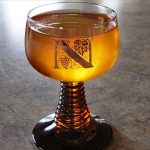
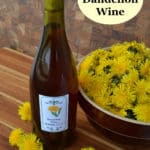
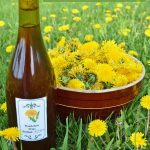
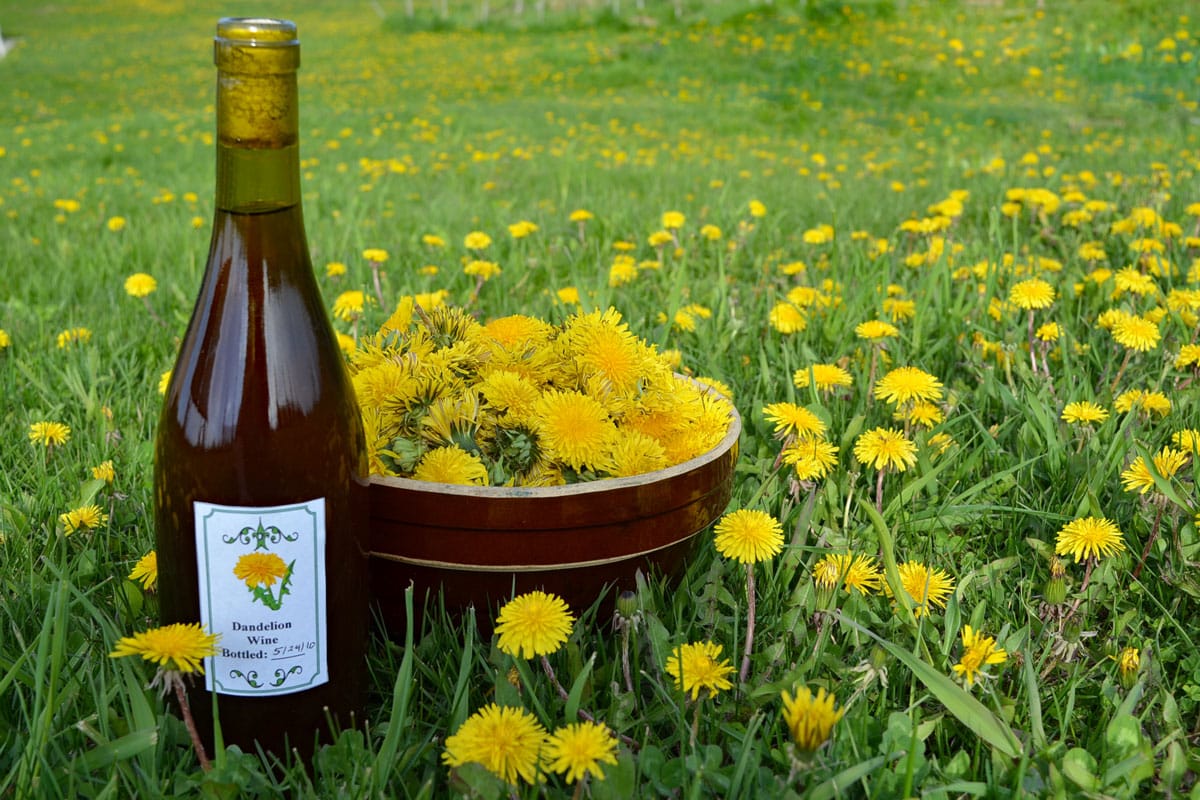
Wine out of dandelions? You bet! Making homemade dandelion wine is a longstanding family tradition. We don’t make it every year, but I do like to keep a few bottles on hand for company.
The taste of this dandelion wine is rich, golden and warming – more like a good brandy than a wine. I’ve had friends who don’t normally like wine comment that they do enjoy this “spring tonic”. This is a “country wine” made from simple ingredients with basic equipment.
Would you like to save this?
When we get dandelions, we get LOTS OF DANDELIONS! They are everywhere! (Boy photos are from 2010. They have grown quite a bit since then, but I kept these photos here for the happy memories.)
Dandelions are wonderful for bringing up nutrients and breaking through compacted soil. This area of the yard had a lot of compaction from soil being moved around, so the dandelions were working overtime.
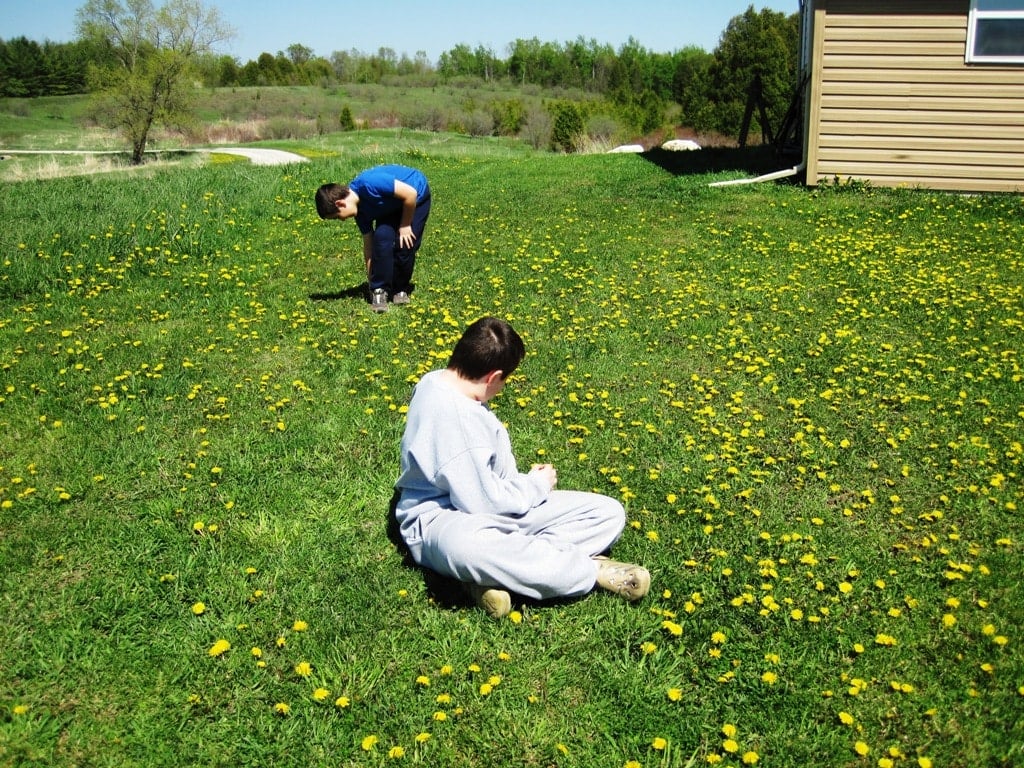
Table of Contents
Gathering the Flowers
Make sure your dandelion flowers are free of pesticides, herbicides and other contaminants. I usually don’t rinse the blossoms, though you can if they are dusty. They are sterilized during the first part of brewing. We gather bins of flower heads outside, and then bring them inside to remove the petals.
Don’t pick dandelion blossoms for wine or eating from an area used by pets for their “bathroom”. As I explained to a reader in the comments, I’m fairly sure goat pee will not wash off.
What part of the dandelion is dandelion wine made from?
For dandelion wine, use the yellow flower petals only. Leaving the petals attached to the green base of the flower will result in a bitter, unpleasant wine. My neighbor made this mistake when she tried to make dandelion wine, and she ended up throwing out the whole batch.
I use 3 quarts of loosely packed yellow dandelion petals (pictured below). Not 3 quarts of flower heads, 3 quarts of petals only.
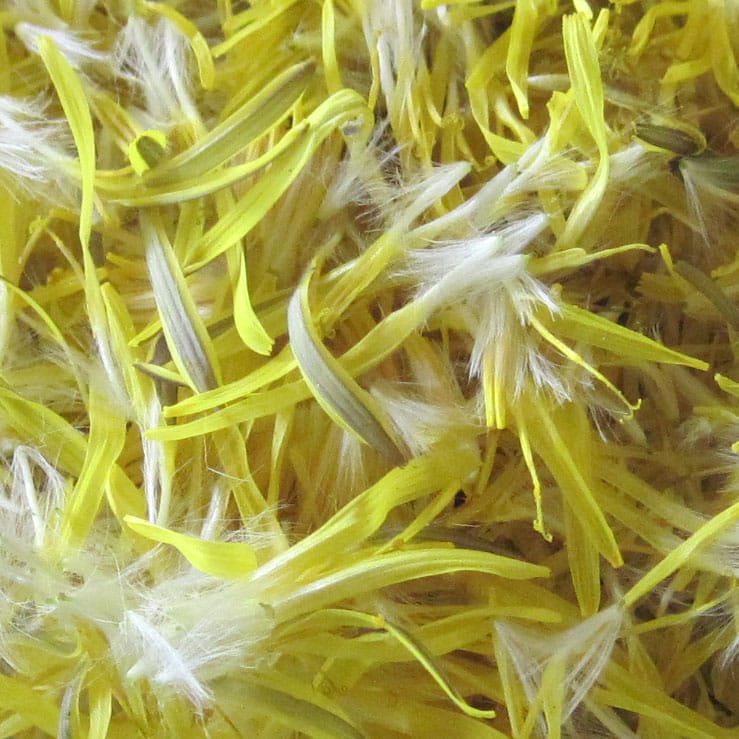
If you don’t have enough dandelion petals from one picking, freeze the petals until you have enough.
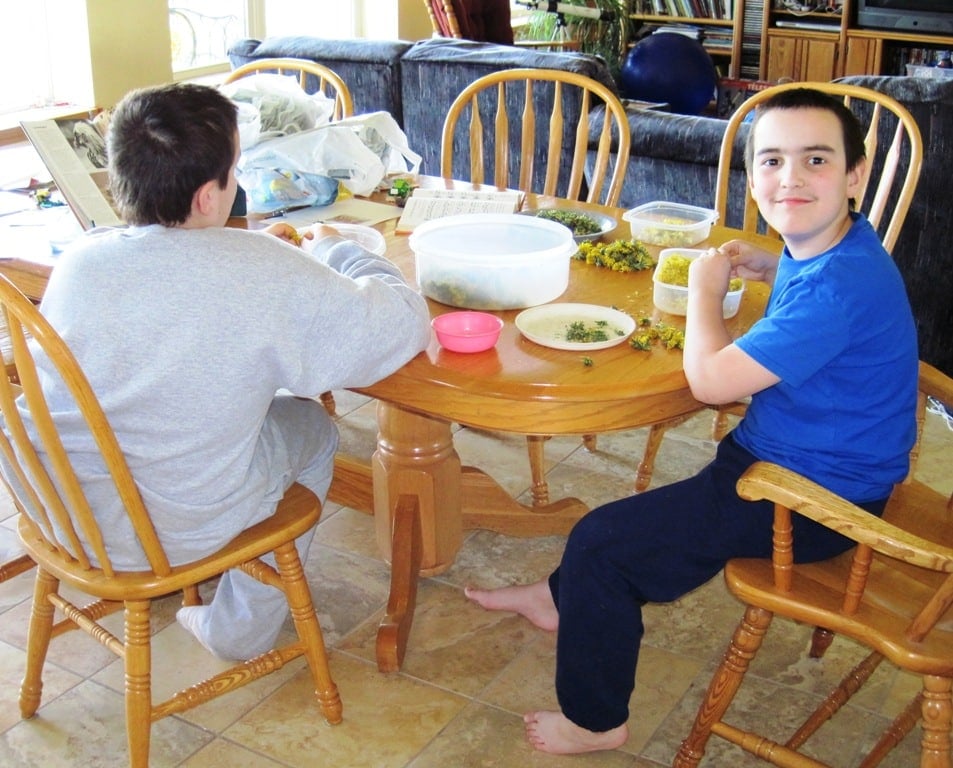
The boys and I sat down to a session of “second picking” to remove the yellow petals from the blossoms. You want to remove the petals as soon as possible after picking, as the flower heads close over time. Once they close, it’s tough to get the petals off.
If you are working alone, it may be best to pick some of the flowers needed, remove petals, then pick more flowers and repeat. That way, you won’t have trouble with the flower heads closing before you have time to clean them. It’ll also give you a chance to get up and stretch.
Making Homemade Dandelion Wine
“Dandelion wine, believed to be of Celtic origin, is regarded as one of the fine country wines of Europe. In the late 1800s and early 1900s, it was not proper for ladies to drink alcohol. However, dandelion flower wine was considered so therapeutic to the kidneys and digestive system that it was deemed medicinal even for the ladies.“
Adapted from Dandelion Medicine, in combination with my mother’s recipe.
Remember, all your fermentation vessels should be glass, ceramic, stainless steel or food grade plastic. Never ferment in aluminum or iron, as it can react with the wine.
I normally use my two gallon crock for one gallon of wine, since the fruits bubble up during fermentation. You can see in the photos below that a one gallon crock gets very full.
Ingredients
- 3 quarts dandelion petals, loosely packed
- 1 gallon water
- 2 oranges, with peel, preferably organic
- 1 lemon, with peel, preferably organic
- 3 pounds sugar
- 1 package champagne yeast or wine yeast (this yeast finishes at around 12-14% alcohol)
- 1 pound raisins, preferably organic
How to make dandelion wine – Directions
1) Collect the blossoms when they are fully open on a sunny day, after the morning dew clears. Remove green parts and measure out 3 quarts of loosely packed petals.
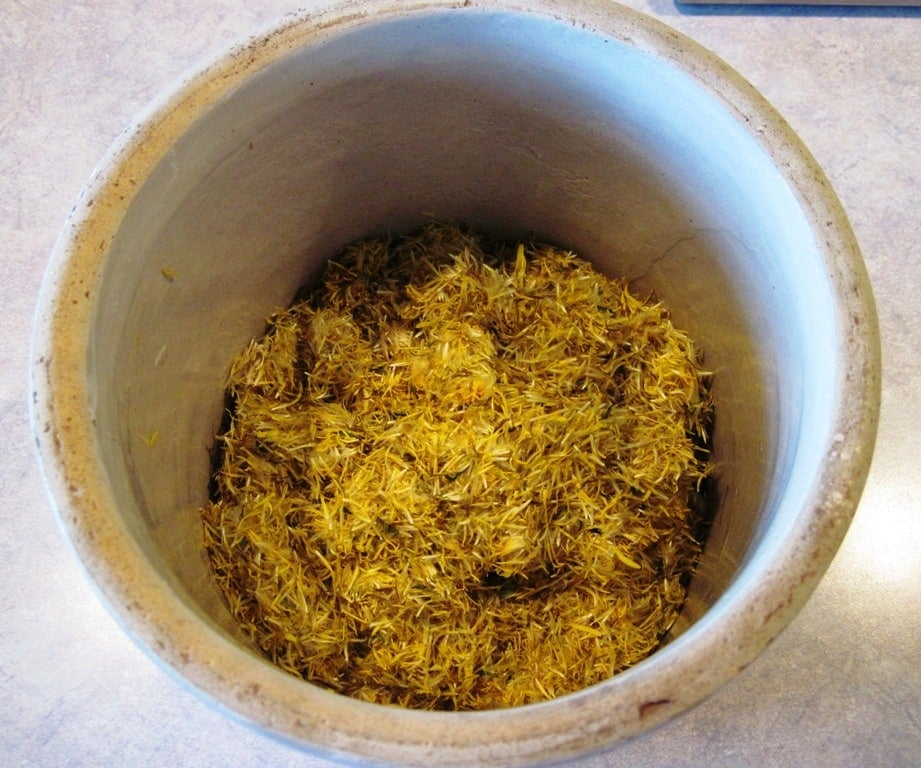
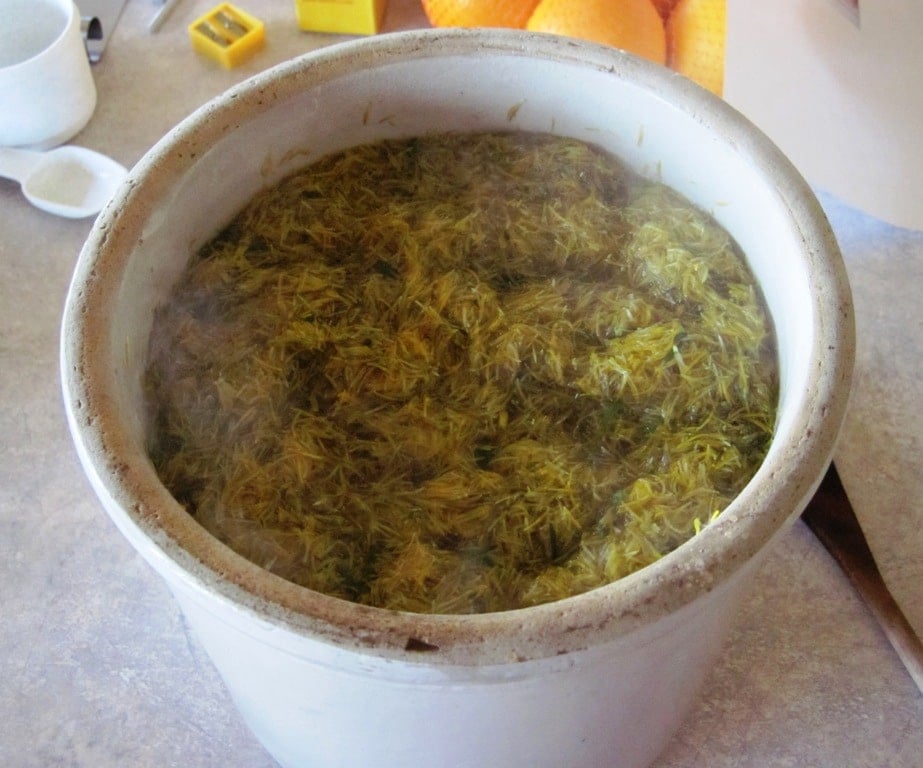
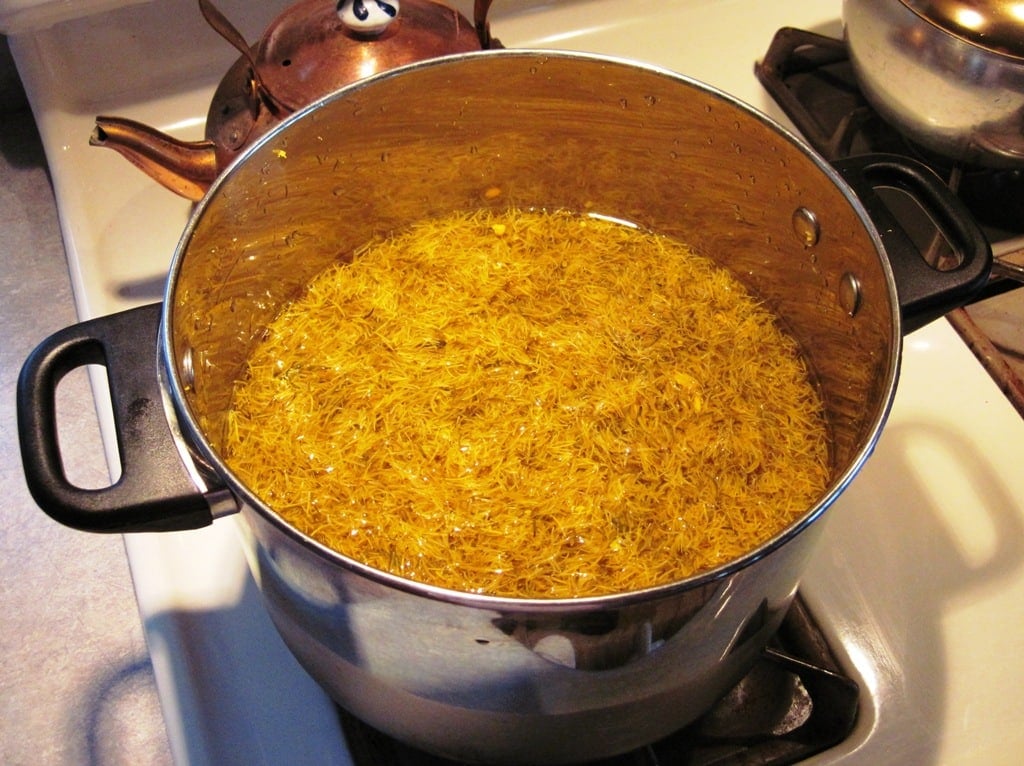
2) Bring the water to a boil and pour it over the flowers in a large pot or crock. Cover with a towel to keep dust out and let steep for three days. Stir daily to keep the petals submerged in your “dandelion petal tea”. They will develop a musty smell, which is normal.
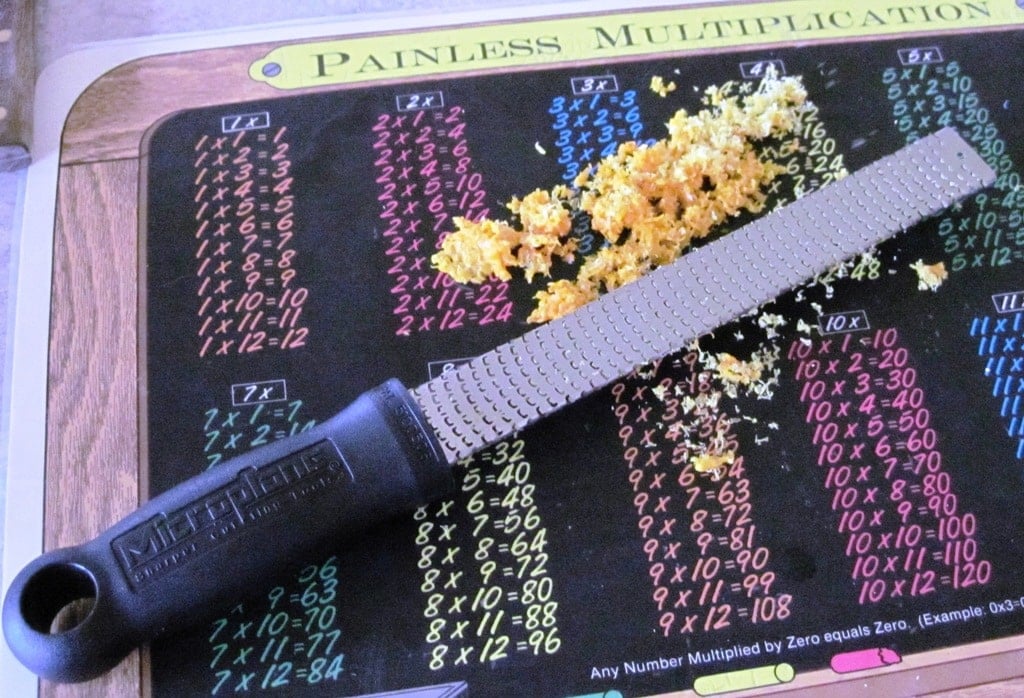
3) Prepare the oranges and the lemon. Zest about half of the rind and peel off the rest in thin strips. You want to minimize the amount of white pith added to the brew.
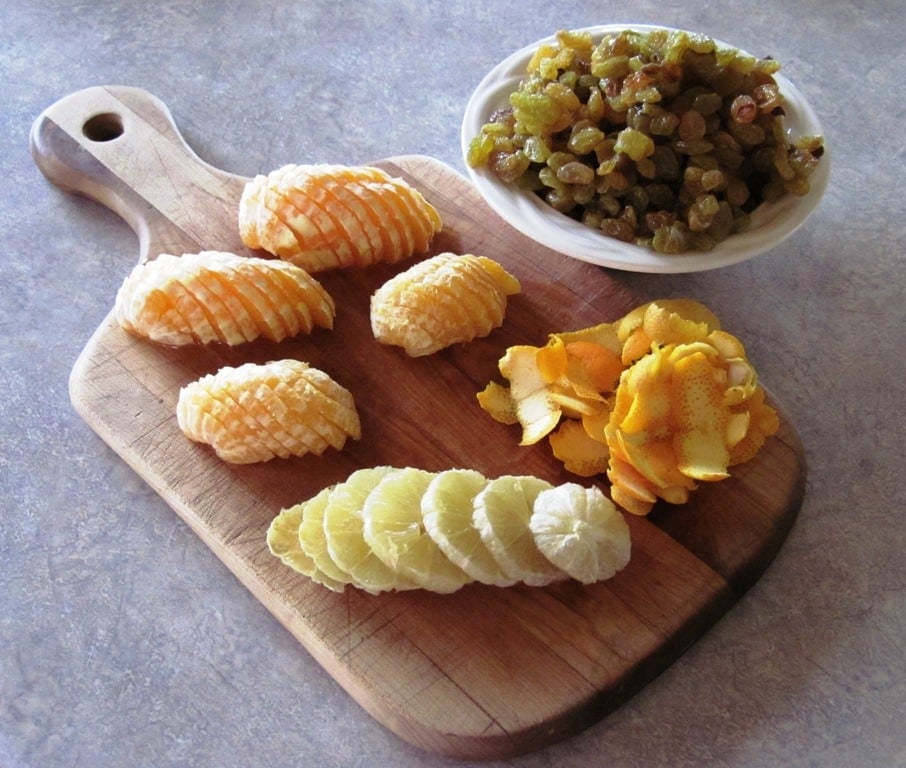
4) Clean most of the pith off the fruit and slice into thin rounds.
5) Add the lemon and orange zest to the flower-water mixture and bring to a boil. Remove from heat, strain out solids. Dissolve the sugar in the flower water. Allow to cool to room temperature.
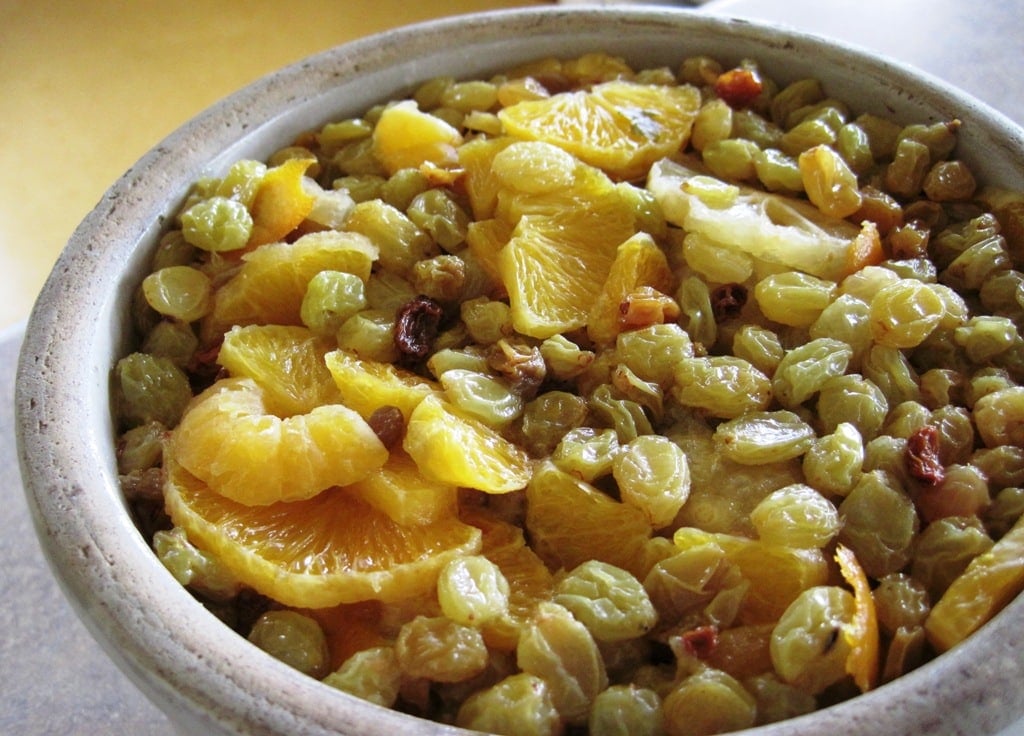
6) Add the yeast, raisins, and orange and lemon slices and rind strips to the liquid. Put everything into a crock (or wide mouth carboy with airlock) to ferment. I cover my crock with a clean cotton towel held down by a rubber band to keep dust and bugs out. (Not shown.)
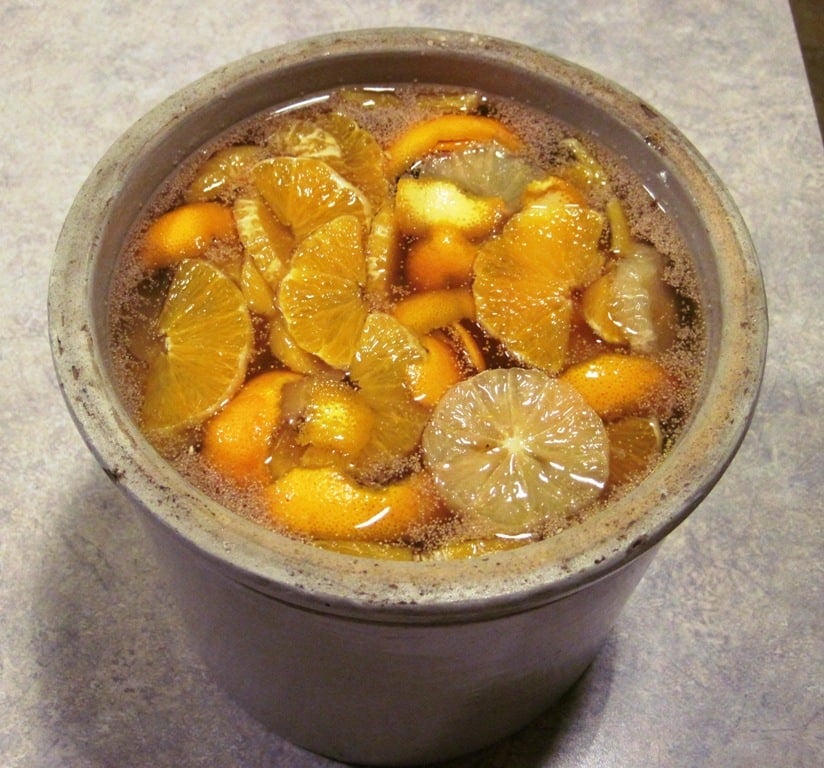
Stir daily with a wooden spoon or non-reactive stir stick. When the yeast gets active, the bubbles will lift the fruit up to the top of the wine. You want to stir so all the fruit gets pushed back under the surface and wet down daily.
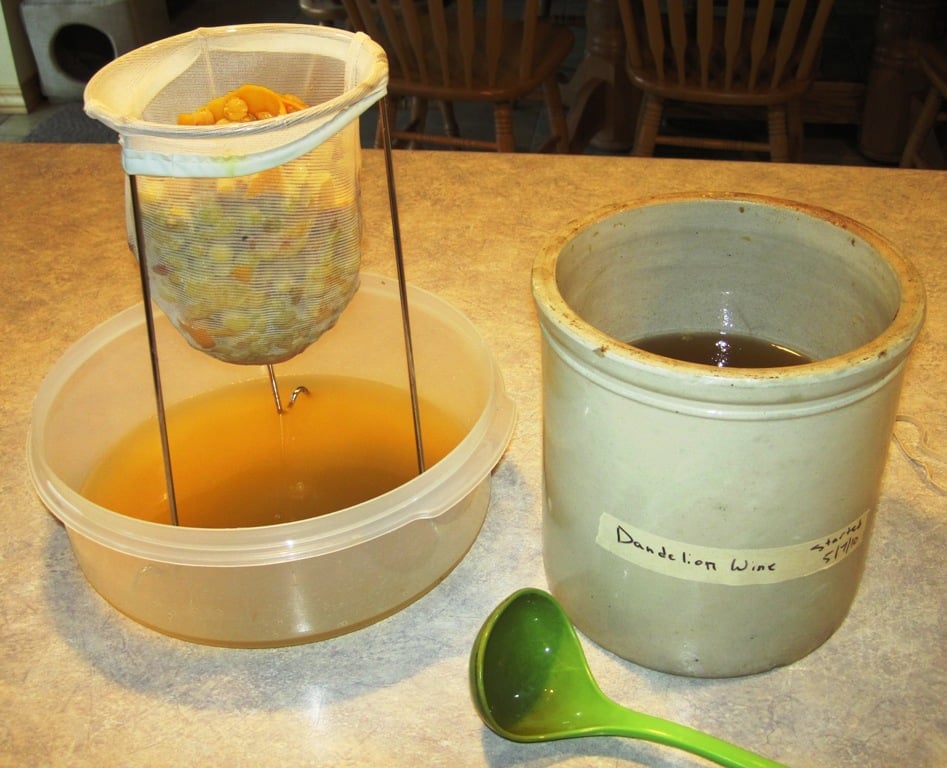
7) When the primary fermentation mixture stops bubbling (1 -2 weeks), fermentation is almost done. Strain the liquid through several layers of cheesecloth, a flour sack towel, or a jelly bag.
Bottling the Wine
You have two options for bottling your homemade dandelion wine. You can let it finish in bottles, or move to a carboy and then bottle.
To finish in bottles: After straining, move the young dandelion wine directly to clean bottles. Slip a deflated balloon over the top of each bottle to monitor for further fermentation. When the balloon remains deflated for 24 hours, fermentation is complete. You will probably need four or five 750 ml bottles.
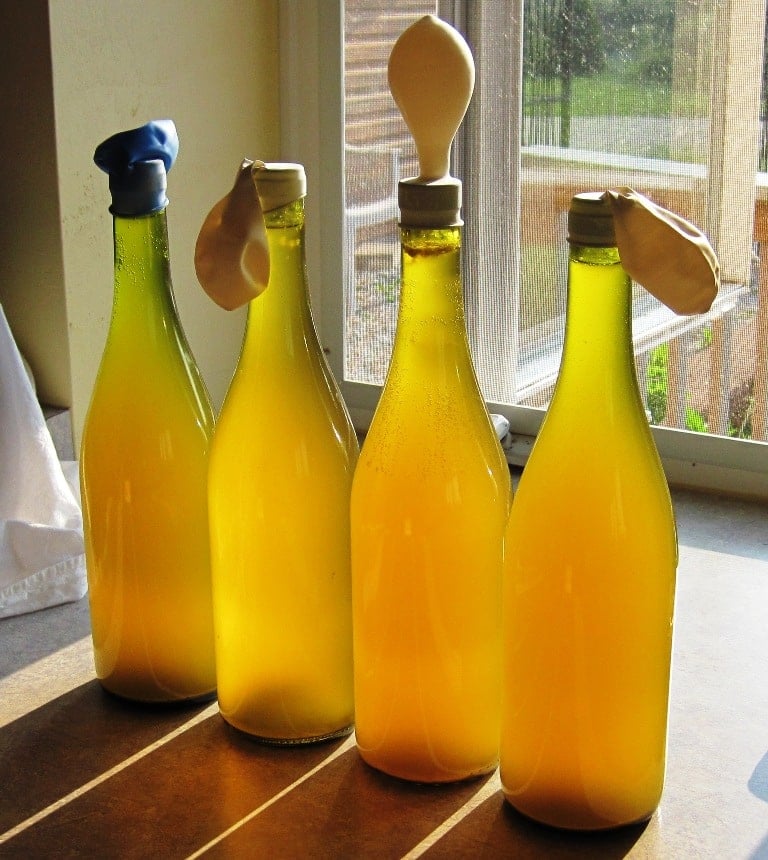
Cork the bottles and store in a cool, dark place for at least six months before drinking.
NOTE: Do not seal bottles tightly before they finish fermenting, and don’t put them somewhere warm. Otherwise, you’ll end up with exploding bottles, like my sister, Mary, when she stashed them in a closet. Apparently, it sounded like there were bombs going off or they were being shot at.
If you would like a clearer wine, transfer the strained dandelion wine into a one gallon carboy with airlock before the final bottling. Allow to ferment in the carboy for 2-3 months, and then rack into the bottles.
If you’d like to download a pdf of my wine labels, use this link: Printable Dandelion Wine Labels.
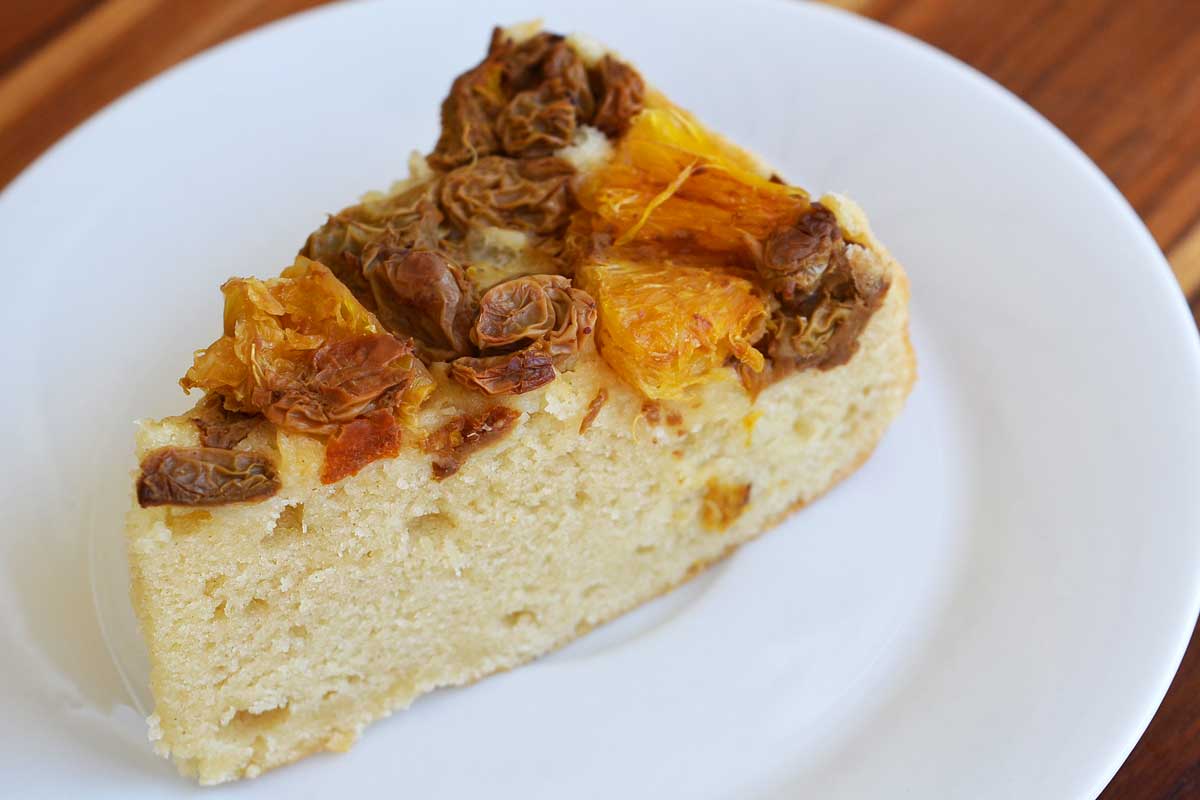
If you don’t want to send the wine fruit to the compost pile, try Dandelion Wine Fruitcake.
Recommended Materials for Making Dandelion Wine
- Wine Yeast – store extra yeast packs in the fridge or freezer. I normally use Lalvin Wine Yeast EC-1118.
- 2 Gallon Crock – 2 gallons gives you space for fermentation.
- Wine Bottles – It’s fine to wash and reuse old wine bottles. You will probably need five 750ml bottles.
- Corks – It’s best to use new corks. I like the #9 Straight Wine Corks.
- Wine Bottle Corker – This double lever model works like a charm.
- Gallon carboy with airlock – optional, for clearer wine.
Old-Fashioned Dandelion Wine Recipe
A smooth and hearty flower wine with citrus notes that will warm you from head to toe.
- Yield: 4–5 bottles 1x
Ingredients
- 3 quarts dandelion petals, loosely packed
- 1 gallon water
- 2 oranges, with peel, preferably organic
- 1 lemon, with peel, preferably organic
- 3 pounds sugar
- 1 package wine yeast
- 1 pound raisins, preferably organic
Instructions
- Collect the blossoms when they are fully open on a sunny day. Remove any green parts and measure out three quarts of petals.
- Bring the water to a boil and pour it over the flowers in a large pot or crock. Cover with a towel to keep dust out and let steep for three days. Stir daily to keep the petals submerged.
- Prepare the oranges and the lemon. Zest (finely grate) about half of the rind and peel the rest off in very thin strips. You want to minimize the amount of white pith added to the brew.
- Finish peeling the citrus, and slice them into thin rounds.
- Add the lemon and the orange zest to the flower-water mixture and bring to a boil. Remove from heat, strain out solids, then add the sugar, stirring until it is dissolved. Allow to cool to room temperature.
- Add the yeast, raisins, and orange and lemon slices and rind strips to the liquid. Put everything into a two gallon crock (or wide mouth carboy with airlock) to ferment. I cover my crock with a clean cotton towel held down by a rubber band. Stir daily with a wooden spoon or non-reactive stir stick.
- When the primary fermentation mixture stops bubbling (1 -2 weeks), fermentation is almost done. Strain the liquid through several layers of cheesecloth or a flour sack towel.
Bottling the Wine
You have two options for bottling your homemade dandelion wine. You can let it finish in bottles, or move to a carboy and then bottle.
To finish in bottles: After straining, move the young dandelion wine directly to clean bottles. YOu will probably need four or five 750 ml bottles. Slip a deflated balloon over the top of each bottle to monitor for further fermentation. When the balloon remains deflated for 24 hours, fermentation is complete.
Cork the bottles and store in a cool, dark place for at least six months before drinking.
If you would like a clearer wine, transfer the strained wine into a one gallon carboy with airlock before the final bottling. Allow to ferment in the carboy for 2-3 months, and then rack into the bottles.
Notes
Do not seal bottles tightly before they finish fermenting. Always store your wine in a cool location.
Is Dandelion Wine Alcoholic?
Yes. If you use wine yeast as recommended in the recipe, you should end up with around 12 to 14 percent alcohol.
If you’re feeling adventurous, you may be able to nurture wild yeast from the raisins to do the fermenting. Wild yeast brews will have a lower alcohol content, because wild yeast dies off if the alcohol levels get too high.
You can learn more about using wild yeasts in the book, “The Wildcrafting Brewer“.
Is Dandelion Wine Medicinal?
Nearly every part of dandelion is full of nutritional value, with vitamins and minerals packed in every part of the plant. Aside from its great taste in wine making, it also has been used throughout history for its medicinal properties.
For more information, check out this article on Dandelion Benefits.
To dig even deeper into this amazing plant, check out The Dandelion Workshop online course. It includes a printable guide and step-by-step videos for making a variety of dandelion recipes and remedies.

You may also enjoy:
- Harvesting and Using Dandelion Roots
- Low Sugar Dandelion Jelly Recipe
- Dandelion Fritter Recipe
- How to Make Dandelion Root Tea
- Get Rid of Dandelions Without Chemicals
I’ve also answered a lot of reader inquiries in the comments, so be sure to have a look if you have questions. If you don’t find your answer (or would like to share some wine making stories or observations), leave a comment below.

This article is written by Laurie Neverman. Laurie mixes her rural background and engineering training to create a unique and resilient homestead. She enjoys getting to know wild plants and using them for food and medicine. Her most unique experiment to date was quackgrass wine.
Originally published in 2010, last updated in 2026.
Hi! Do I need a stoneware crock for this, or will a stainless steel saucepan pan do the trick? Hoping to keep costs down so would rather use what I have already if possible!
Stainless steel or food grade plastic will get the job done, as long as they have enough capacity. They’re a reasonable option for trying out the process to see if you like the results and want to do it again. Just make sure to cover with a cloth during the first ferment to keep dusts and pest away.
Hello! Thank you for sharing!
I started collecting dandelion petals this weekend to follow this recipe. When you measure 3 quarts of petals, do you normally pack the flowers down or leave them fluffed when measuring? I plan to freeze my batches until I have enough to make my first batch, so I’m thinking I need to plan for variations in the petal amount unless this does not matter too much?
I use 3 quarts of loosely packed yellow dandelion petals.
In regards to the dandelion petals, are you removing each of the petals individually from the stem or are you just cutting the largest green part of the flower away leaving the flower head mostly intact? I recently picked dandelions to make dandelion jelly and the recipe called for petals only and it was a very tedious Job to complete just for 2 cups of pedals. I didn’t know if there is a shortcut to that very time consuming step.
I remove each of the petals from the base of the flower. It is time consuming. The technique I generally use is to split the flower open, and use my thumb to rub the petals free. I’ve seen some people say that they snip the petals off with scissors, but once I get a rhythm going, I think the way I do it is faster for me than using scissors.
As for saving time, the best option is to get help if possible. It’s a good opportunity to visit and chat while processing the flowers. Otherwise, you can process in batches and freeze the petals until you have enough.
I’m excited to try and make Dandelion Wine this year. Can I use a blend of dried fruits? Or should it be limited to just raisins?
Raisins are used in winemaking primarily to increase sugar content, enhance body, and add complex flavors. Since raisins are dried grapes, they have a concentrated amount of sugars and tannins, which contribute to the alcohol content and mouthfeel of the wine. They also introduce deeper flavors, such as caramel, and sometimes even nutty notes, depending on the type of raisin used.
You can substitute other dried fruits (e.g., figs, dates, apricots). These provide a concentrated sugar source, similar to raisins, but will change the flavor of the wine to some degree.
Hello, thank you so much for sharing this recipe! Just a few questions before I try this for the first time (it will be my first time fermenting anything):
1. Can I use an enamel-lined cast iron Dutch oven with a lid instead of a crock and towel?
2. If during step 6 I am using the carboy with airlock– can I keep it in there for the 2-3 months for a clearer wine or does it need moved around after 1-2 weeks regardless of container?
3. Does it matter what kind of wine yeast is used?
1 – As long as the finish is intact, that should work. You may want to set it on a platter in case it bubbles up and liquid escapes, or switch to covering it with a towel if the lid isn’t providing enough ventilation when it at its most active.
2 – After the initial ferment, you need to strain the liquid and remove the solids, no matter what sort of container it is in. If you are using a wide mouth carboy for the initial ferment, you could strain the fruit out, clean the carboy, and then put the wine back into the same carboy. Once the fruit is removed, the wine should rest/ferment in the carboy or bottles that are not tightly sealed for 2-3 months. You could let it sit in a carboy for up to 6 months before bottling.
3 – Different types of wine yeasts will provide slightly different flavor profiles and finished alcohol levels. I like Lalvin EC-1118 for this wine, which is linked in the article. It does have a high alcohol tolerance, around 18%. Lalvin 71B has a lower alcohol tolerance, around 14%. Wild yeast has a tolerance around 5%, so it provides a much less alcoholic wine. You can introduce wild yeast with raisins and fresh flower petals (not heated), but it will be slower to ferment and can be less reliable. The book “The Wildcrafting Brewer” explains various methods for using wild yeast. The book “The Complete Guide to Making Your Own Wine at Home” has a table of different types of wine yeasts and their properties in the appendix.
Back in the old days, I remember mom brewing with fresh bread cake yeast normally used for bread making. If you have sugar and yeast, it will ferment. The taste and alcohol levels with just vary.
Hi Laurie,
I didn’t hear back from my last response – maybe I had the wrong address. My dandelion wine has been bottled since May. I have tried it a few times and it’s really sweet! Will more time in the bottle take some of that sweetness away?
Cacie – look in the comments section. I replied on December 8, 2024, shortly after you asked the question. (My reply may have gotten caught in your spam filter.) The comment and reply are currently near the top of the comments section.
Hi,
My dandelion wine has been in a carlock jar since May 1st. It’s really sweet! Is there a way to lessen the sweetness? It has a great flavor tho!
Thanks,
Cacie
There are a few different options. You could wait and see how the flavor changes as it ages more, or dilute at serving time, say with some sparkling water or tonic water, or blend with a drier wine.
You can try adding some acid, like an tartaric acid, to balance the sweetness. You could ferment again with a different yeast that has a higher finished alcohol ratio, like EC-1118.
my dandelion mixture is still bubbling it’s been 2 weeks, I’m making 3 times the recipe. how long should it be for it to stop foaming?
Fermentation depends on living organisms (the yeast), so it will vary based on conditions. This is an old fashioned “country wine”, so the recipe is very forgiving. You can choose to keep an eye on the ferment, and strain once it becomes less active, however long that may be. Or, you can strain now and move it to a carboy with an airlock.
The one thing you don’t want to do if it is still very active is to strain and bottle immediately. It’s best to have the fermentation not active before you put the wine in bottles. You can “cheat” with the balloons, but it’s safer to wait until the wine is not so bubbly. The carboy ferment is a good intermediate step for a clearer wine and less sediment.
Thank you
My wine is already in a carboy, so I’ll just keep waiting for the bubbling to stop.
If for some reason you are in a hurry, you could add potassium sorbate crystals or metabisulphite to stop fermentation, but I prefer to avoid additives. (I know I react to sulfites, as I get headaches from commercial products that use them.)
Hi! We are having a blast trying out this recipe. One clarifying question- we moved the wine into a carboy with airlock for the second fermentation for 2 months. When we put it in bottles, do we wait another 6 months? Or is waiting 6 months only if you don’t put it in a carboy? Thanks!
At least six months total between carboy and bottles. Longer fermentation is fine with this recipe. I’ve had some bottles in storage over a decade and they are still good.
how many bottles does this recipe make. thank you
I normally get four bottles, but it may be possible to get five depending on evaporation, how juicy the fruit is, how much you can squeeze out of the fruit, etc.
Hi – I made the fruitcake from fruit from my dandelion wine and it was so good! I will definitely remember this for the next time.
My question is: I have the wine in a glass gallon carboy and it’s not full to the top (I followed the directions but the gallon is only halfway full). Will it still ferment if not full? It’s been sitting for almost a month now. How will I know it’s fermenting? I can’t wait to try it!
Well I’m glad someone tried that recipe! It always seem like a shame to me to compost the fruit, but it’s rather overwhelming to eat it straight.
hmmmm… you must have had more evaporation than I do. Ideally, you want the carboy filled to within a few inches of the top. The aim is to have the space above the wine fill with carbon dioxide. It will still ferment if not full, but having the top filled with CO2 adds more protection against spoilage/oxidation.
The wine is safe to taste at any time, so you can sample a sip to get an idea of where it’s at. If fermentation is still active, you may see some bubbles in the liquid of your carboy.
When the wine is young, the flavor will be more harsh. You can taste the booze, but it lacks the smooth finish that aging brings. This wine improves with age, unlike many fruit wines, which are best consumed young. I’d say it should age for six months minimum, but we usually wait a year, and have a few bottles that are over 10 years old that we save for special occasions.
Thank you for your quick response!
Would you recommend me transferring to a 1/2 gallon with airlock? I want to make sure I don’t create spoilage. I tried the wine after a month. It’s sweet but has a great flavor.
Thank you,
Cacie
If you have a half gallon container with airlock, that would be a good option.
When I transfer to the half gallon (it’s been a month), there’s sediment on the bottom of the gallon that I transferred from. Do I still need that sediment in my half gallon?
No, the sediment is called “lees”, and it’s dead yeast and other solids that have dropped out of the wine. Ideally, you want to siphon the wine off the top of the lees, leaving that sediment behind, so you get a clearer wine with less risk of “off” flavors.
Help! My petals are steeping but my wine yeast hasn’t arrived yet and am not sure it will by day 3…can I refrigerate them until my yeast comes?
I would probably either freeze the petal water, or go ahead with the next steps and let the natural yeast on the raisins start the ferment, and then add in the commercial yeast when it shows up.
Sun dried raisins have natural wild yeast on their surface. They can be used exclusively for a yeast source, but it will take longer for the yeast to multiply, and the fermentation will not be as vigorous as with a commercial yeast. I recommend using commercial yeast because it’s easy and reliable, and multiplies quickly to crowd out any potentially problematic microbes.
Hi, I tried this recipe. I strained it last week into a glass carboy but I noticed murky stuff on the bottom of the jar, assuming it is the yeast. Any idea? Should I strain it again? I put it through 2 cheese cloths. Thanks!
As the wine sits and ages, old yeast and other sediment will naturally accumulate at the bottom of the carboy (or bottles, if you opt to bottom immediately). These yeast dregs are called “lees” and are normal.
When you rack the wine at the 2-3 month mark, you siphon off the wine from the top of the carboy, aiming to leave the yeast sediment behind in the bottom. Racking is the process of moving wine from one container to another, generally aiming to separate wine from the sediment.
If you like, you can rack at 2-3 months, then again at 6 months before bottling, it’ll give you two opportunities to remove the lees.
Hi! It has finished fermenting in the crock, and I am ready to move it to a carboy. As far as the airlock, I assume I need to add water or a sanitizing solution to it? What do you recommend using to fill the airlock? Thanks!
HI Sofie.
I just use a clean airlock filled with reverse osmosis water. Some people use mineral oil because it won’t evaporate, or use water topped with mineral oil. You could also add some vodka in with the water to inhibit microbes.
Hi! Will a 3-week initial ferment “hurt” anything? Life keeps getting in the way but my brew is currently sitting with raisins and oranges still in it. The flowers were filtered after the steep phase. And I’ve stirred every day and seen no mold. So I’m feeling fairly confident! Also… I have one batch separated in 2 different containers. In one container the fruit sank to the bottom, in the other , some fruit is still sitting on top. Any idea why? The one with the sunk fruit just so happened to have a dish towel and rubber band as a lid.. the other container with the floating fruit has an air stopper.
As long as there’s no signs of spoilage, a three week ferment with fruit in place shouldn’t be a problem. I suspect that people making folk wines in years past weren’t terribly precise in timing.
With the floating vs non-floating fruit, I think it’s trapped gasses. I bet the container with the floating fruit has more CO2 trapped since it has a stopper, while the open crock with towel cover is probably fermenting a little faster and more gas is escaping. Faster fermentation means less gas currently being produced, because the ferment is starting to slow down.
Hello, So glad for this comment section. I have made dandelion wine but have always wondered about the smell. After three days one batch smells horrible. I have another batch going for 1 1/2 days that does not, it smells grassy. My question is about the horrible smell. Will this go away after 6 months of fermentation? I have tossed it before because when I tasted it ahead of time it tasted like that smell. Should I strain it before it gets that smell? I don’t want to ruin this batch and hope you will get back to me quickly. Thanks for all your help.
Hi Mary.
The three day smell is not pleasant, but shouldn’t go all the way to “horrible”. The flower petal liquid also isn’t particularly pleasant. Once the other ingredients get added in (and the flower petals are strained out), the mustiness become only one element of the whole. During the initial ferment with fruit, I refer to the flavor as “foxy”. It’s alcoholic, and will make the hair stand up on the back of your neck. After aging, the transformation is dramatic. It still has a kick, but it become smooth and full bodied, like a good brandy.
How warm is it in the area where you let your petal water sit? If your kitchen is warmer, the petals may be breaking down faster, so you may want to strain after 2 days instead of 3 days. I’m in Wisconsin, so my kitchen will typically be in the mid to low 70s F, maybe even the upper 60s.
I am so excited to give this a try! I do not have a carboy or a true fermenting crock, but I do have a spare dutch oven or the insert for a crockpot. Both of these come with lids but I’m thinking that I should probably stick with using a cloth cover because it’s important for the brew to get oxygen; is this correct? Any thoughts on whether the dutch oven or crock pot crock would be the better option? And one last question: rather than corking the bottles, do you think it would work to use swing top bottles?
Thanks for the help, and the delicious instructions. I can’t wait to get started!
Which of the two containers has more room, the Dutch oven or crockpot? I would use that, as the ferment will bubble up a bit when it’s most active.
Yes, it’s okay to use swing top bottles. The swing tops are usually more expensive than a corked wine bottle, and may slow down the aging process a bit because the wine can’t breathe through the top like it can with a cork.
can I use dried dandelions or do they need to be fresh?
I would recommend fresh or frozen. Once dried, the flavor profile will be a little different. You could make it with dried petals, but I don’t think it will have the potency.
You only want the yellow petals. I noticed that the sites I’ve seen selling dried flowers are selling the whole flower, not just petals, so keep that it mind if you try it.
Could I half this recipe straight down the middle or do any of the ingredients need to stay the same if I do half it?
Just use half of the ingredients. No other adjustments needed. The yeast packets are enough to make 5 gallons of wine, so if you want, you can measure the packet and subdivide it, using less than 1/2 of the packet.
the yeast doesn’t care about halving, but you need high sugar content to get the alcohol content estimation they provide. halfving the flower, water and sugar can work, but the closer you start to a proven recipe when home brewing the better.
Hello! Two questions:
In step six, for how many days do you leave the mix in the pot?
What temperatures do you ferment the wine at in the bottles?
Thanks
Hi Sophie.
It’ll need 1 to 2 weeks in the crock, depending on temperature. When it stop actively bubbling when you stir, it’s ready for the next step.
If I use the bottle ferment option, the bottles are in my kitchen on the counter. (I placed them in the window temporarily to make them easier to see against the bright background.)
I normally keep them out of direct sunlight on a different section of countertop. The kitchen temperature ranges from mid to low 60s at night if we’re having chilly weather to low to mid 70s if it’s warm and the oven is on. When it’s warmer, it ferments faster. When it’s cooler, the wine ferments more slowly. This is why the timing in the recipe is not exact.
Thanks for the detailed answers! My wine has been fermenting for nearly three weeks in its pot and is still bubbling when I stir. I am going away for 10 days soon, so was wondering if I should move on to the bottles and balloons step now, even though there is still some bubbling, or to just leave it in the pot covered for longer?
It’s up to you. I use one to two weeks as a starting point, but if it’s still bubbling, it’s fine to leave it in the crock a bit longer.
One thing to keep in mind is that the longer the fruit sits, the more it will break down, which will make the wine a bit cloudier. If you use a carboy, that cloudiness has time to settle out in the bottom of the carboy before bottling.
If you’re going straight to bottles, that sediment will be trapped in the bottle. It settles over time, but some people prefer a clearer wine with no sediment in the bottom. You can see a bit of the cloudiness in the top of the bottle that’s second from right in the balloon photo.
I didn’t see anything about adding a yeast nutrient, but I think I will so it doesn’t stall, 3 pounds of sugar is a lot and I will have to take a gravity reading before adding it all. just saying 😜 any thoughts or comments on this is greatly appreciated.
thanks
I never have added a yeast nutrient, and we’ve made several batches over the years. If you want to it shouldn’t hurt anything, but this is an old fashioned recipe. I’m quite sure my mom and grandmother never even heard of the term “yeast nutrient”.
can we use a plastic carboy, or does it have to be glass?
As long as the container is food safe, you’re fine. I prefer glass, but it’s not essential.
Hi there, I bottled this about a month ago without racking (oops) and now there’s lees in my bottles – now that I know this can cause exploding bottles, would you uncork and rack in case fermentation never stopped? What would you do to stop any renewed fermentation? Cold crash, pasteurize?
p.s. I tried the wine before bottling and it was already delicious!
The biggest issue with the lees being left in the bottle is typically that it doesn’t look nice (you get wine with chunks), and over time it can produce off flavors. (You get more yeasty/flat flavor instead of the bright, clear wine flavor.) It has to be pretty active for the wine to blow the cork or explode. If you did the balloon trick and the balloons weren’t inflating, it’s not likely to blow.
If you’re planning on drinking the wine young (6 months to a year), I probably wouldn’t mess with it. If you want to age it longer, you may want to take the time to rack it.
If you want to make sure the yeast is dead, you can add sulfites to kill the yeast, but I don’t because they give me headaches.