
Warm & Golden Dandelion Wine Recipe (Old-Fashioned Wine Making)

This post may contain affiliate links. Read my full disclosure here.
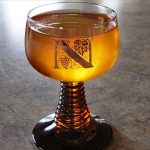
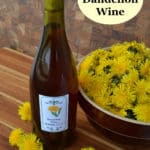
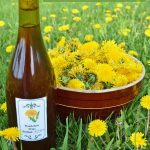
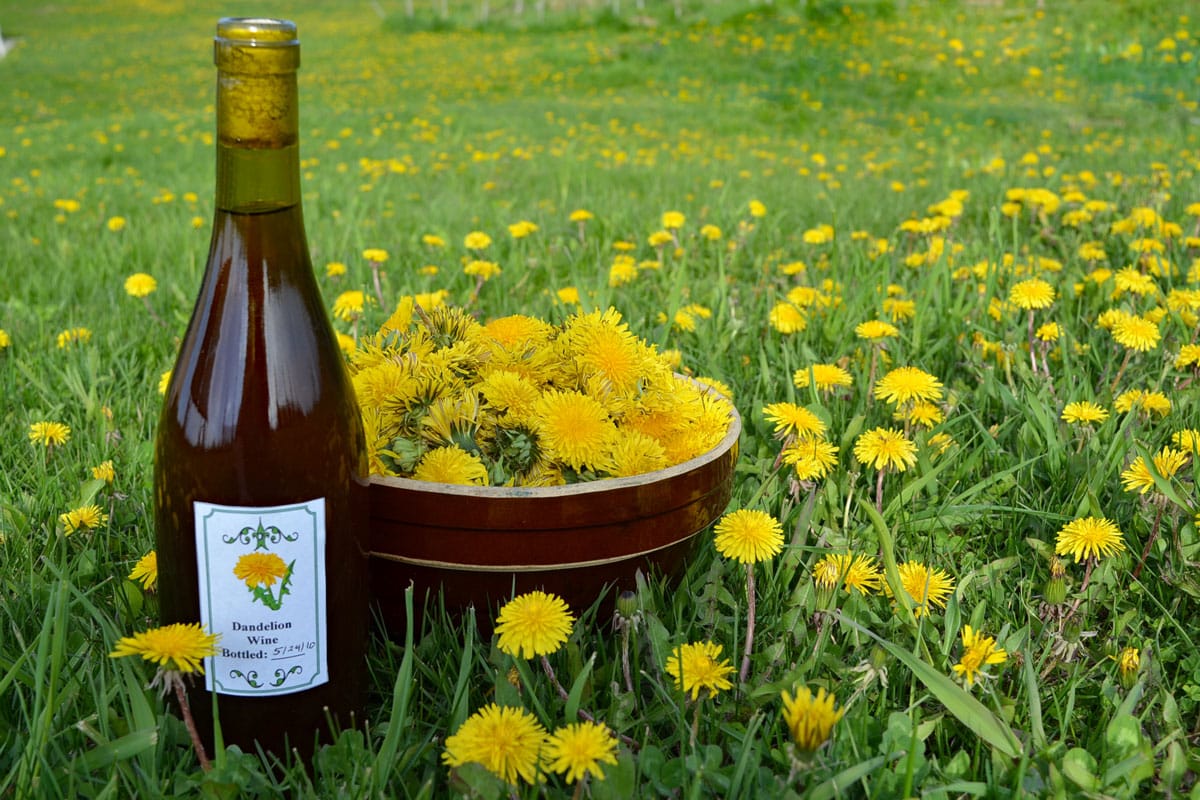
Wine out of dandelions? You bet! Making homemade dandelion wine is a longstanding family tradition. We don’t make it every year, but I do like to keep a few bottles on hand for company.
The taste of this dandelion wine is rich, golden and warming – more like a good brandy than a wine. I’ve had friends who don’t normally like wine comment that they do enjoy this “spring tonic”. This is a “country wine” made from simple ingredients with basic equipment.
Would you like to save this?
When we get dandelions, we get LOTS OF DANDELIONS! They are everywhere! (Boy photos are from 2010. They have grown quite a bit since then, but I kept these photos here for the happy memories.)
Dandelions are wonderful for bringing up nutrients and breaking through compacted soil. This area of the yard had a lot of compaction from soil being moved around, so the dandelions were working overtime.
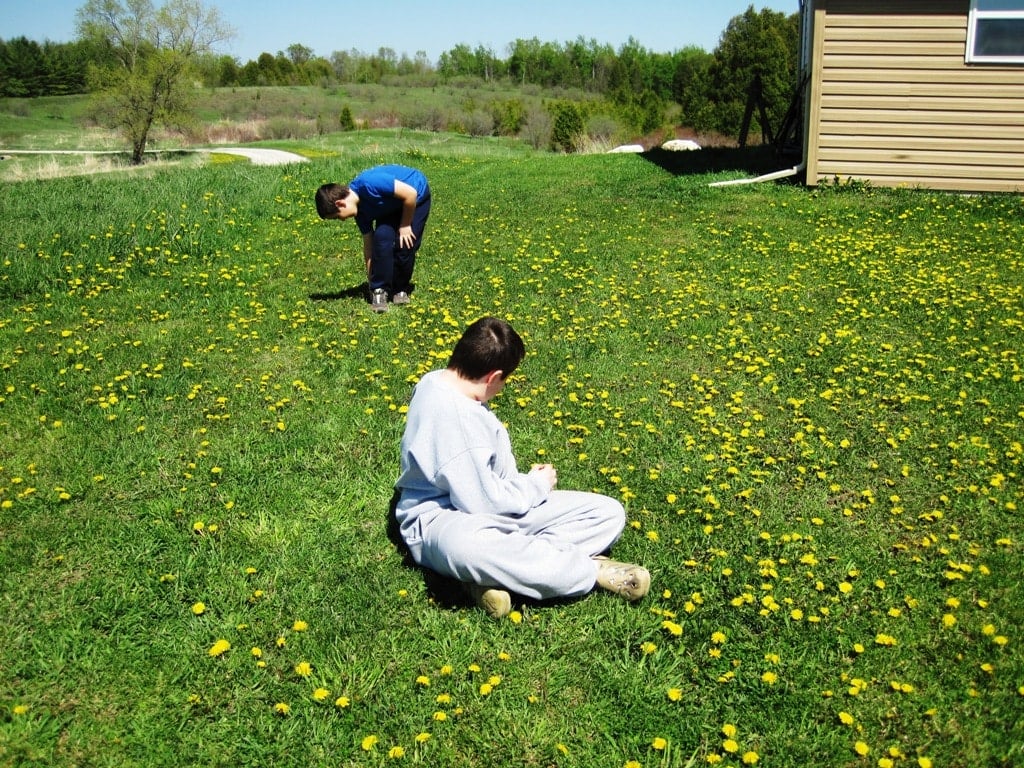
Table of Contents
Gathering the Flowers
Make sure your dandelion flowers are free of pesticides, herbicides and other contaminants. I usually don’t rinse the blossoms, though you can if they are dusty. They are sterilized during the first part of brewing. We gather bins of flower heads outside, and then bring them inside to remove the petals.
Don’t pick dandelion blossoms for wine or eating from an area used by pets for their “bathroom”. As I explained to a reader in the comments, I’m fairly sure goat pee will not wash off.
What part of the dandelion is dandelion wine made from?
For dandelion wine, use the yellow flower petals only. Leaving the petals attached to the green base of the flower will result in a bitter, unpleasant wine. My neighbor made this mistake when she tried to make dandelion wine, and she ended up throwing out the whole batch.
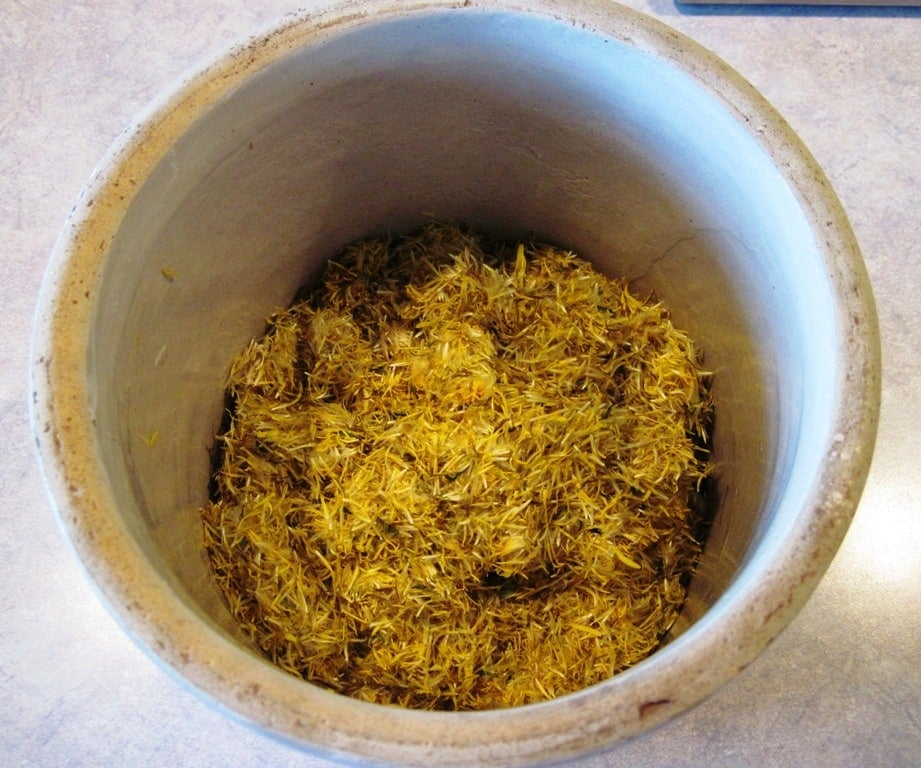
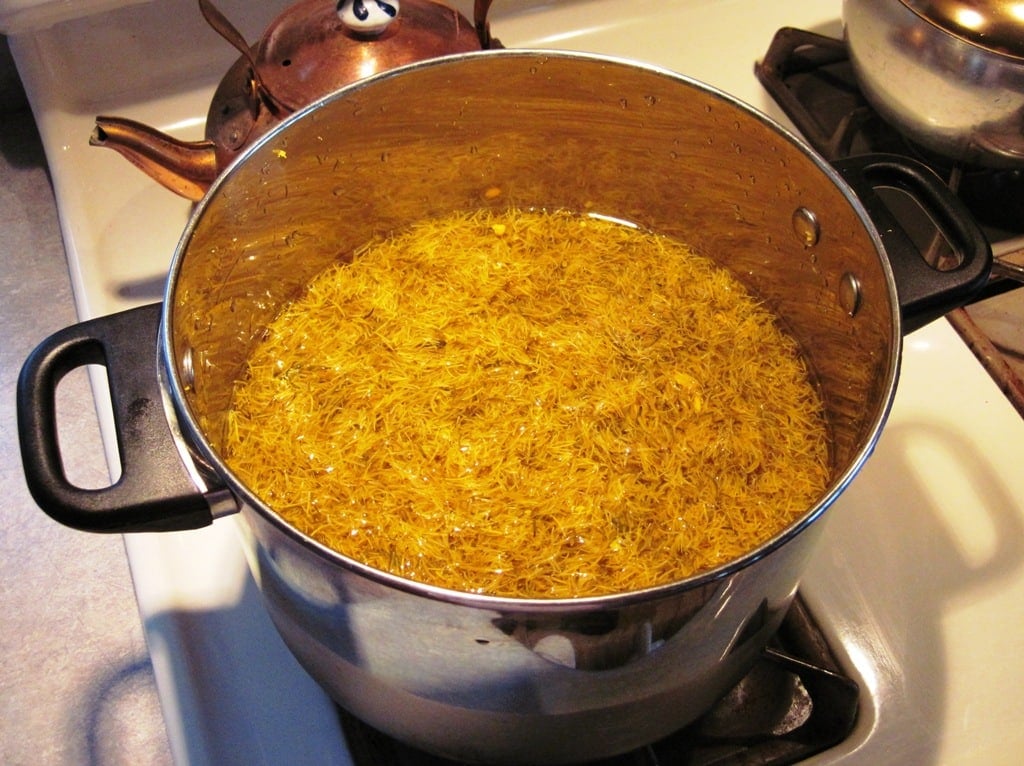
I use 3 quarts of loosely packed yellow dandelion petals (pictured below). Not 3 quarts of flower heads, 3 quarts of petals only.
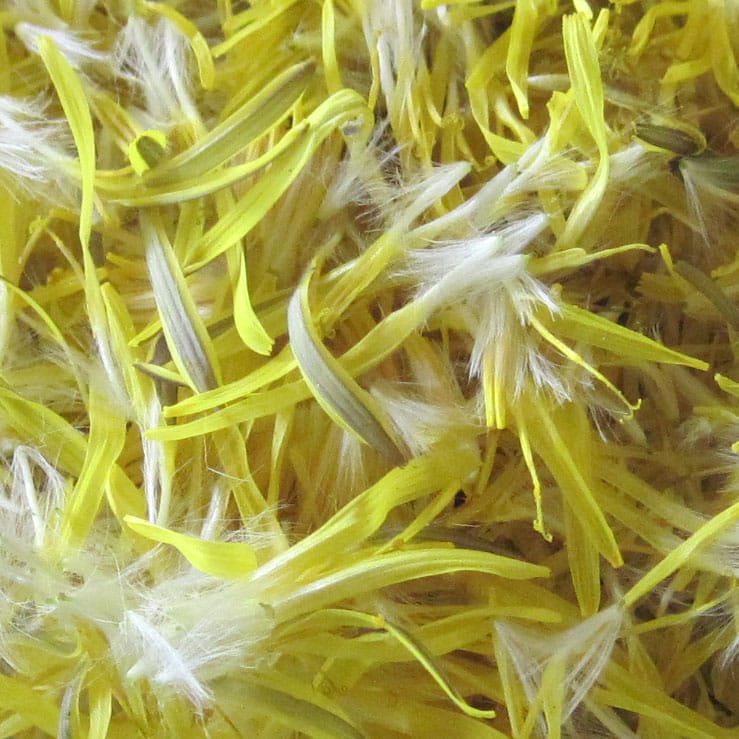
If you don’t have enough dandelion petals from one picking, freeze the petals until you have enough.
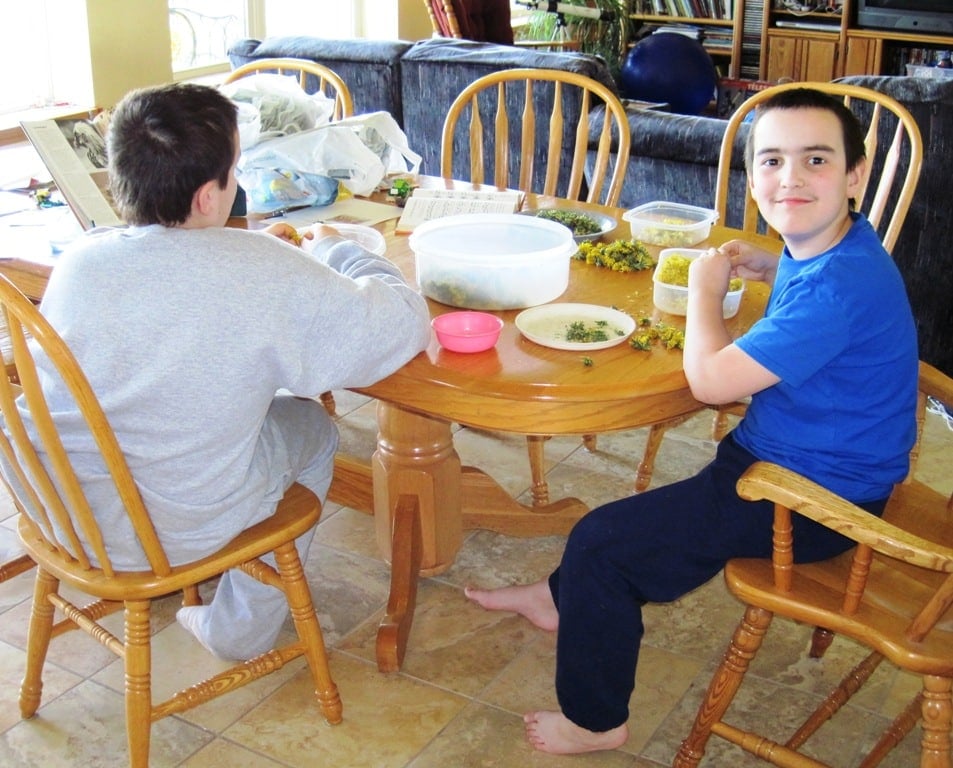
The boys and I sat down to a session of “second picking” to remove the yellow petals from the blossoms. You want to remove the petals as soon as possible after picking, as the flower heads close over time. Once they close, it’s tough to get the petals off.
If you are working alone, it may be best to pick some of the flowers needed, remove petals, then pick more flowers and repeat. That way, you won’t have trouble with the flower heads closing before you have time to clean them. It’ll also give you a chance to get up and stretch.
Making Homemade Dandelion Wine
“Dandelion wine, believed to be of Celtic origin, is regarded as one of the fine country wines of Europe. In the late 1800s and early 1900s, it was not proper for ladies to drink alcohol. However, dandelion flower wine was considered so therapeutic to the kidneys and digestive system that it was deemed medicinal even for the ladies.“
Adapted from Dandelion Medicine, in combination with my mother’s recipe.
Remember, all your fermentation vessels should be glass, ceramic, stainless steel or food grade plastic. Never ferment in aluminum or iron, as it can react with the wine.
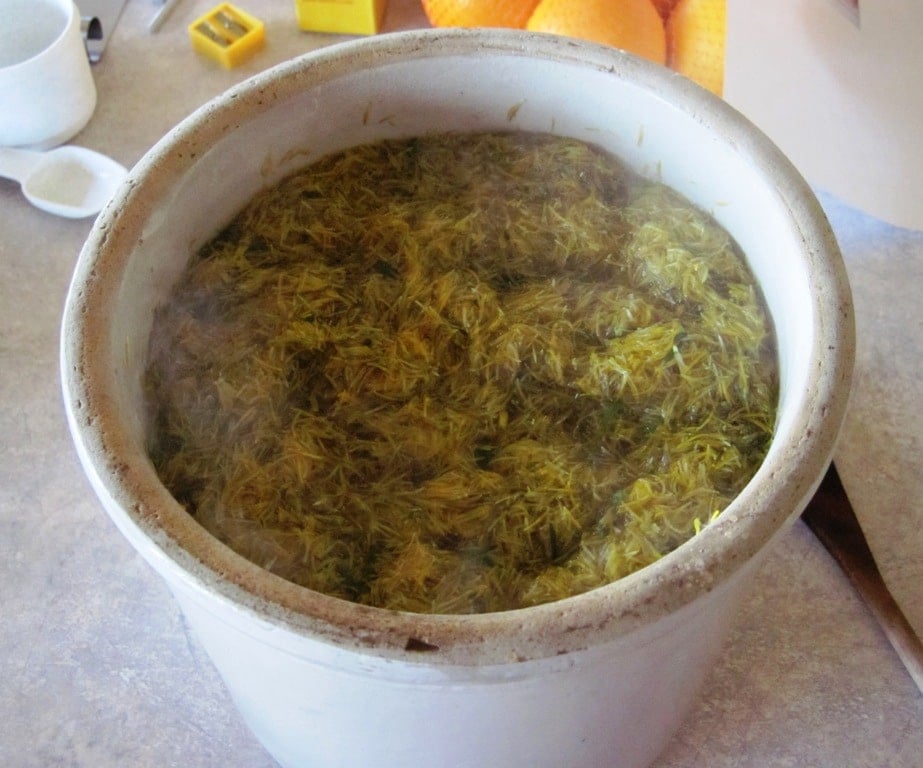
I normally use my two gallon crock for one gallon of wine, since the fruits bubble up during fermentation. You can see in the photos below that a one gallon crock gets very full.
Ingredients
- 3 quarts dandelion petals, loosely packed
- 1 gallon water
- 2 oranges, with peel, preferably organic
- 1 lemon, with peel, preferably organic
- 3 pounds sugar
- 1 package champagne yeast or wine yeast (this yeast finishes at around 12-14% alcohol)
- 1 pound raisins, preferably organic
How to make dandelion wine – Directions
1) Collect the blossoms when they are fully open on a sunny day, after the morning dew clears. Remove green parts and measure out 3 quarts of loosely packed petals.
2) Bring the water to a boil and pour it over the flowers in a large pot or crock. Cover with a towel to keep dust out and let steep for three days. Stir daily to keep the petals submerged in your “dandelion petal tea”. They will develop a musty smell, which is normal.
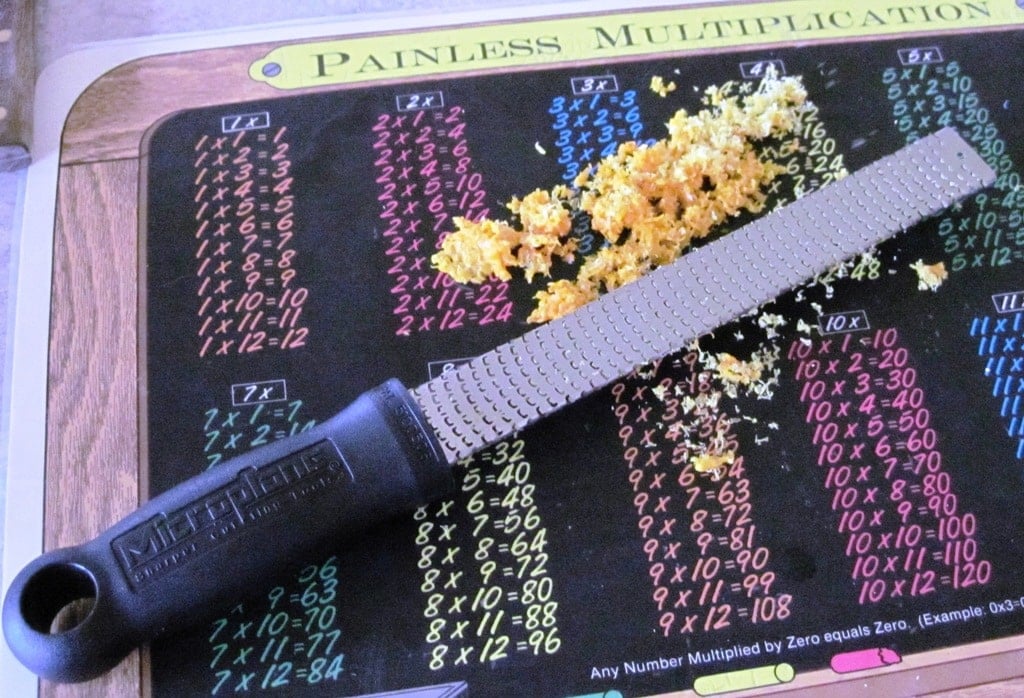
3) Prepare the oranges and the lemon. Zest about half of the rind and peel off the rest in thin strips. You want to minimize the amount of white pith added to the brew.
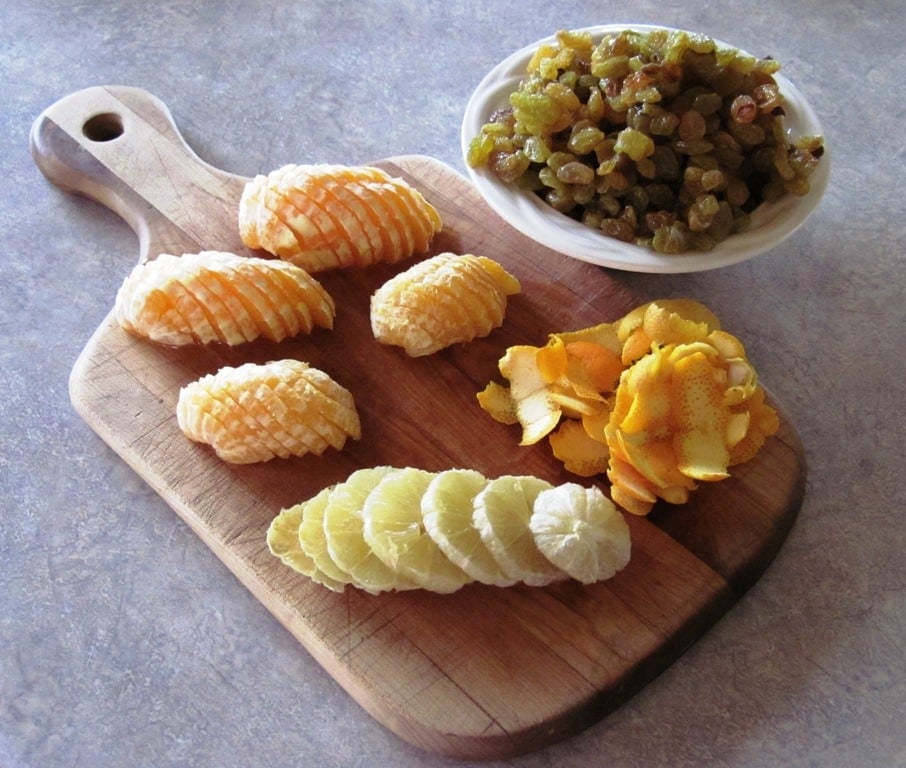
4) Clean most of the pith off the fruit and slice into thin rounds.
5) Add the lemon and orange zest to the flower-water mixture and bring to a boil. Remove from heat, strain out solids. Dissolve the sugar in the flower water. Allow to cool to room temperature.
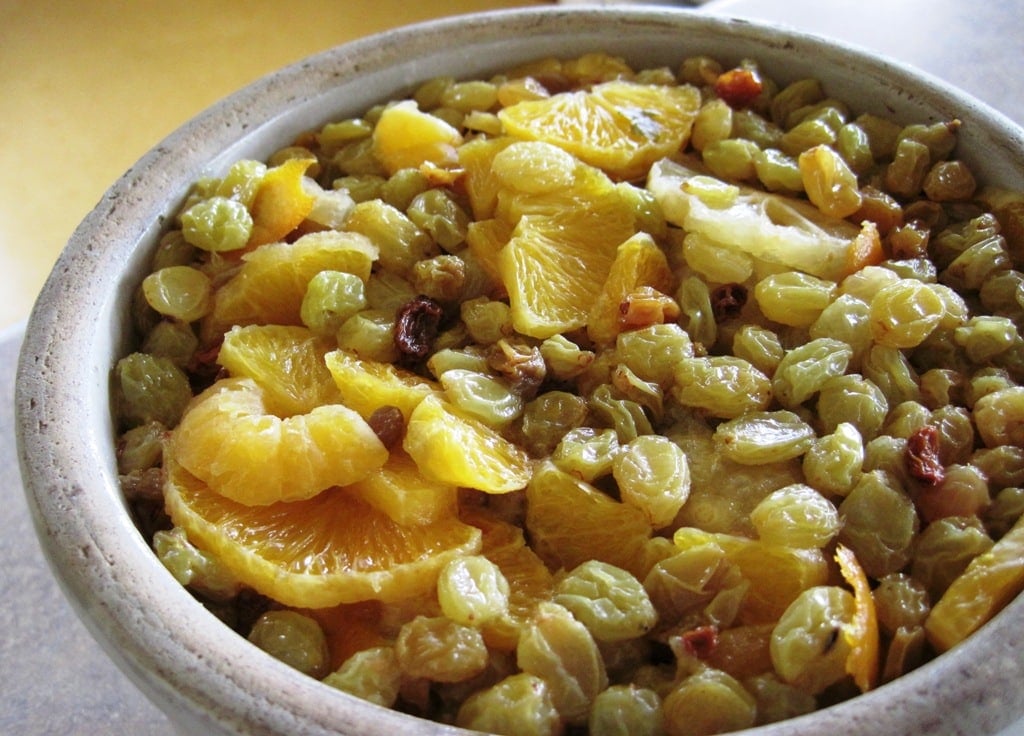
6) Add the yeast, raisins, and orange and lemon slices and rind strips to the liquid. Put everything into a crock (or wide mouth carboy with airlock) to ferment. I cover my crock with a clean cotton towel held down by a rubber band to keep dust and bugs out. (Not shown.)
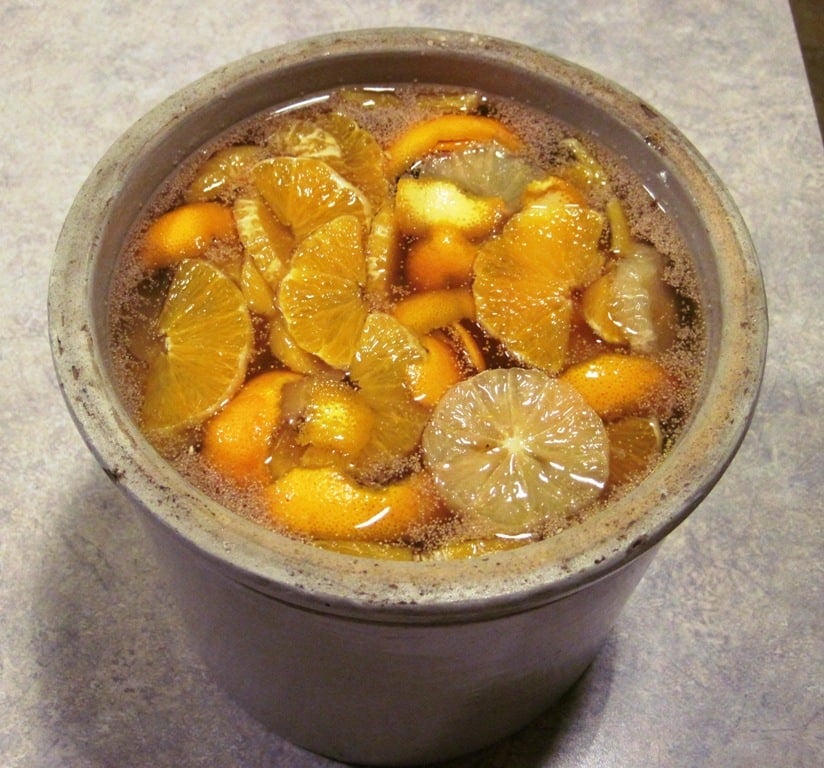
Stir daily with a wooden spoon or non-reactive stir stick. When the yeast gets active, the bubbles will lift the fruit up to the top of the wine. You want to stir so all the fruit gets pushed back under the surface and wet down daily.
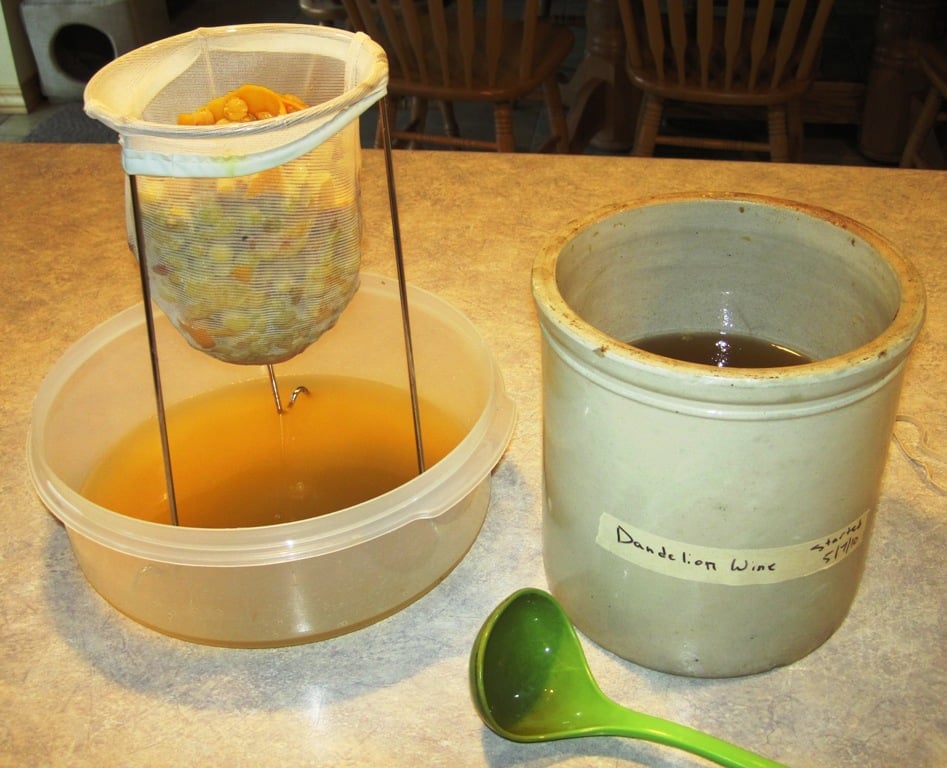
7) When the primary fermentation mixture stops bubbling (1 -2 weeks), fermentation is almost done. Strain the liquid through several layers of cheesecloth, a flour sack towel, or a jelly bag.
Bottling the Wine
You have two options for bottling your homemade dandelion wine. You can let it finish in bottles, or move to a carboy and then bottle.
To finish in bottles: After straining, move the young dandelion wine directly to clean bottles. Slip a deflated balloon over the top of each bottle to monitor for further fermentation. When the balloon remains deflated for 24 hours, fermentation is complete. You will probably need four or five 750 ml bottles.
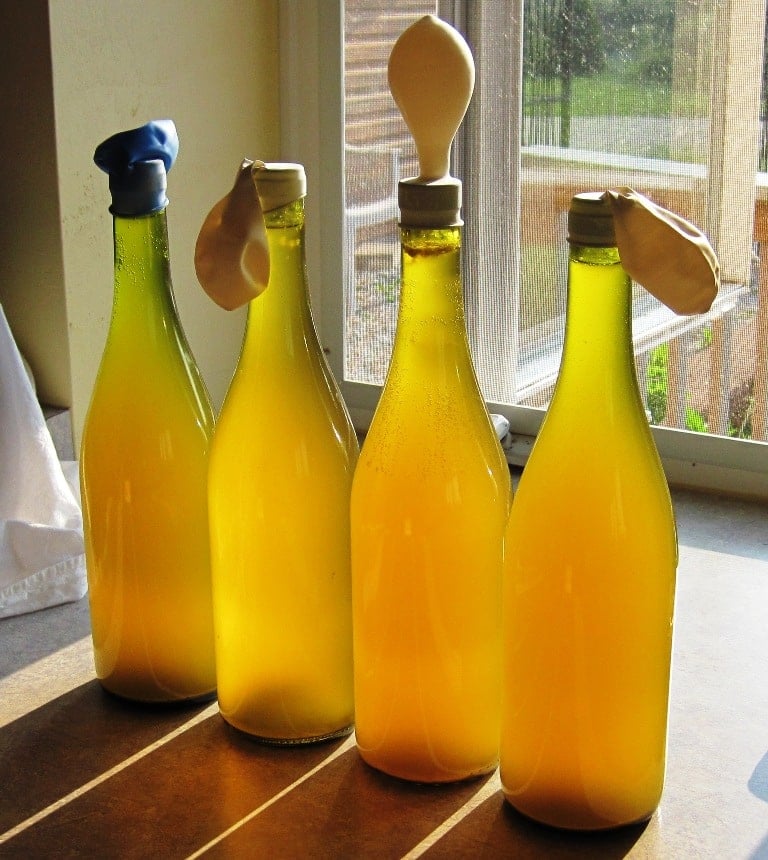
Cork the bottles and store in a cool, dark place for at least six months before drinking.
NOTE: Do not seal bottles tightly before they finish fermenting, and don’t put them somewhere warm. Otherwise, you’ll end up with exploding bottles, like my sister, Mary, when she stashed them in a closet. Apparently, it sounded like there were bombs going off or they were being shot at.
If you would like a clearer wine, transfer the strained dandelion wine into a one gallon carboy with airlock before the final bottling. Allow to ferment in the carboy for 2-3 months, and then rack into the bottles.
If you’d like to download a pdf of my wine labels, use this link: Printable Dandelion Wine Labels.
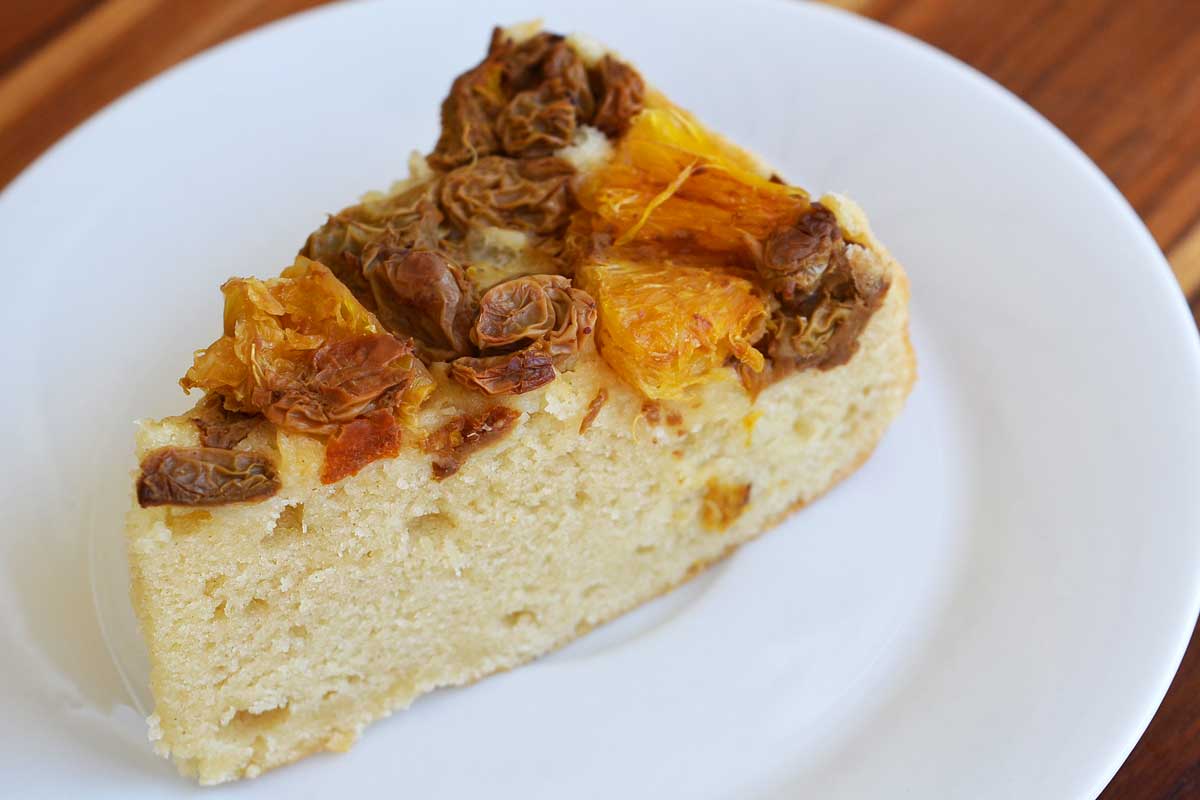
If you don’t want to send the wine fruit to the compost pile, try Dandelion Wine Fruitcake.
Recommended Materials for Making Dandelion Wine
- Wine Yeast – store extra yeast packs in the fridge or freezer. I normally use Lalvin Wine Yeast EC-1118.
- 2 Gallon Crock – 2 gallons gives you space for fermentation.
- Wine Bottles – It’s fine to wash and reuse old wine bottles. You will probably need five 750ml bottles.
- Corks – It’s best to use new corks. I like the #9 Straight Wine Corks.
- Wine Bottle Corker – This double lever model works like a charm.
- Gallon carboy with airlock – optional, for clearer wine.
Old-Fashioned Dandelion Wine Recipe
A smooth and hearty flower wine with citrus notes that will warm you from head to toe.
- Yield: 4–5 bottles 1x
Ingredients
- 3 quarts dandelion petals, loosely packed
- 1 gallon water
- 2 oranges, with peel, preferably organic
- 1 lemon, with peel, preferably organic
- 3 pounds sugar
- 1 package wine yeast
- 1 pound raisins, preferably organic
Instructions
- Collect the blossoms when they are fully open on a sunny day. Remove any green parts and measure out three quarts of petals.
- Bring the water to a boil and pour it over the flowers in a large pot or crock. Cover with a towel to keep dust out and let steep for three days. Stir daily to keep the petals submerged.
- Prepare the oranges and the lemon. Zest (finely grate) about half of the rind and peel the rest off in very thin strips. You want to minimize the amount of white pith added to the brew.
- Finish peeling the citrus, and slice them into thin rounds.
- Add the lemon and the orange zest to the flower-water mixture and bring to a boil. Remove from heat, strain out solids, then add the sugar, stirring until it is dissolved. Allow to cool to room temperature.
- Add the yeast, raisins, and orange and lemon slices and rind strips to the liquid. Put everything into a two gallon crock (or wide mouth carboy with airlock) to ferment. I cover my crock with a clean cotton towel held down by a rubber band. Stir daily with a wooden spoon or non-reactive stir stick.
- When the primary fermentation mixture stops bubbling (1 -2 weeks), fermentation is almost done. Strain the liquid through several layers of cheesecloth or a flour sack towel.
Bottling the Wine
You have two options for bottling your homemade dandelion wine. You can let it finish in bottles, or move to a carboy and then bottle.
To finish in bottles: After straining, move the young dandelion wine directly to clean bottles. YOu will probably need four or five 750 ml bottles. Slip a deflated balloon over the top of each bottle to monitor for further fermentation. When the balloon remains deflated for 24 hours, fermentation is complete.
Cork the bottles and store in a cool, dark place for at least six months before drinking.
If you would like a clearer wine, transfer the strained wine into a one gallon carboy with airlock before the final bottling. Allow to ferment in the carboy for 2-3 months, and then rack into the bottles.
Notes
Do not seal bottles tightly before they finish fermenting. Always store your wine in a cool location.
Is Dandelion Wine Alcoholic?
Yes. If you use wine yeast as recommended in the recipe, you should end up with around 12 to 14 percent alcohol.
If you’re feeling adventurous, you may be able to nurture wild yeast from the raisins to do the fermenting. Wild yeast brews will have a lower alcohol content, because wild yeast dies off if the alcohol levels get too high.
You can learn more about using wild yeasts in the book, “The Wildcrafting Brewer“.
Is Dandelion Wine Medicinal?
Nearly every part of dandelion is full of nutritional value, with vitamins and minerals packed in every part of the plant. Aside from its great taste in wine making, it also has been used throughout history for its medicinal properties.
For more information, check out this article on Dandelion Benefits.
To dig even deeper into this amazing plant, check out The Dandelion Workshop online course. It includes a printable guide and step-by-step videos for making a variety of dandelion recipes and remedies.

You may also enjoy:
- Harvesting and Using Dandelion Roots
- Low Sugar Dandelion Jelly Recipe
- Dandelion Fritter Recipe
- How to Make Dandelion Root Tea
- Get Rid of Dandelions Without Chemicals
I’ve also answered a lot of reader inquiries in the comments, so be sure to have a look if you have questions. If you don’t find your answer (or would like to share some wine making stories or observations), leave a comment below.

This article is written by Laurie Neverman. Laurie mixes her rural background and engineering training to create a unique and resilient homestead. She enjoys getting to know wild plants and using them for food and medicine. Her most unique experiment to date was quackgrass wine.
Originally published in 2010, last updated in 2026.
can I use honey instead of sugar?
Yes. Honey is a bit sweeter than sugar, so you may want to use around 2 1/2 pounds (about 3 1/3 cups) of honey. Reduce the water by about a cup. You may want to add 1 teaspoon yeast nutrient per gallon, as honey ferments more slowly than sugar.
I’ve picked and weighed 3 quarts of dandelion pedals twice and they only weigh 420 grams to 452 grams. That’s a lot less than 660 grams .
The metric conversion feature in the recipe card is an automatic function that doesn’t accurately convert unusual ingredients like flower petals. If you have roughly 3 quarts/3 liters of petals by volume, you’re good to go. It’s a cottage style wine, so it doesn’t need to be absolutely precise. It’s forgiving.
Impressive! Thanks for sharing this.
Hi there! First time making wine- super fun!
So I used a crock with a towel, and made about a gallon. I was tasting a small sip every week and it was very sweet. Now it is not sweet and almost tastes like booze. It is still bubbling though. It has been 5 weeks. My question is, should I let it keep fermenting? Or strain off the fruit now and go to the next step?
I bought a carboy so I have that if I need it. Can you put wine in a carboy if it’s still fermenting?
I would strain and move to the carboy. Fermentation rates vary, but by this point the fruit is breaking down, and leaving the fruit in longer will just make the wine cloudier. The flavor is infused in the brew. If you want you can try the fruit cake with the strained fruit, too.
The instructions aren’t completely clear. Do we put in the peel with the orange slices and raisins? It doesn’t say to in the instructions, but it shows them in the pictures on the cutting board and it appears to be in the pictures with the straining as well. It also seems like slicing the peel into small strips seems like a specific instruction if they’re not supposed to be included. Just hoping to clarify thanks!
I’ve updated the article so hopefully it is clearer. In my head, “orange and lemon slices” includes slices of the fruit and slice of the rind, so yes, those all go into the crock.
good morning, I am making this wine for the first time, my Polish uncle used to make this and has since passed away, I have a question I followed the directions and have decided to use the balloon method, I have 4 bottles that still have inflated balloons and one that is inflated a little how long does this process take with the balloons and is this normal its been two weeks after the initial 2 weeks in the crock, thank you.
The time to leave the balloons on the bottles will vary based on the conditions where you’re fermenting and the ingredients. Even though you’re using the recipe from the site, the fruits will have some differences in sugar content. It’s better to leave the balloons on (and corks out) a little longer than to cork too soon and risk the bottles blowing up. It may take a few more weeks until the fermentation slows down enough.
If you want, you can take the balloons off once a week and deflate them, and then put them back on, just to make sure that they’re not retaining a lot of CO2.
Another alternative is to add sulfites such as Campden tablets or sodium metabisulfite to stop fermentation. I don’t, because I react to sulfites.
Lovely recipe, thank you!
A couple of questions:
1. I have four bottles and a half – will it be a problem to have just half a bottle?
2. Is it normal for it to be bubbly still when I put it into the bottles (I skipped the carboy)
3. Is there a substitute for balloons? I don’t have any on hand. Is there just a time period where I can expect the fermentation to stop?
1. Yes, it’s a problem to have half a bottle because of oxidation. Excess air (oxygen) in the headspace reacts with the wine.
Oxygen exposure can lead to:
Spoilage from bacteria or wild yeasts.
Oxidized flavors — wine can taste flat, sour, or sherry-like.
Discoloration — white wines may turn brownish; reds may fade.
Loss of aroma and freshness.
The simplest option would be to top off with grape juice. This will continue to ferment for some time.
2. Ideally, you don’t want bubbles in the bottle. If it’s still bubbling when you put it in the bottles, it’s still actively fermenting. Those bubbles are carbon dioxide (CO2). If you try to cork it now, the bottles are likely to explode. That’s where the balloons come in. The balloons capture the CO2, keeping oxygen out of your wine, preventing oxidation (see #1), while at the same time allowing the gas to escape the bottles so they don’t explode.
3. The balloons work well, because it’s easy to visually monitor when fermentation slows. I recommend picking some up. You can loosely cork the bottles so that CO2 can still escape around the cork, but this doesn’t give you the clear visual cues.
There is no one set clear time for fermentation to stop because fermentation rates will vary with the conditions at the location of fermentation (warmer, colder, etc.) and minor differences in ingredients (sugar content of the specific fruit used, for example).
Hello, after steeping the dandelion flower petals for three days you’ve said a “musky” smell is normal. My dandelion tea smells to me like it has fermented (it smells a bit like vomit, to be honest) and it is bubbling a lot. There’s no mold, strange discoloration or anything like that. I know there can be a lot of wild yeast on dandelion flowers. Is it still okay to use?
As long as there’s no mold or strange discoloration, it should be okay. I know mine does not smell at all appealing after it sits. You boil it again with the zested citrus, so that will sterilize it. The commercial yeast is also very vigorous compared to wild yeast.
By chance do you live in a warmer area? If so, you may want to let the petal tea rest for only two days instead of three. My kitchen is not terribly warm yet this time of year, so I can’t compare potential fermentation rates for the petal tea in person, but I know heat does speed up the process dramatically.
Can you tell me how long the second fermentation should take? I will be moving in a couple of months and was hoping to have this in sealed jars before we move.
If it’s warmer where it’s fermenting, it’ll go a little faster, versus having the carboy in a cool location. So if you keep it in your kitchen versus a basement or unheated area, it should be safe to bottle just before you move.
Hello quick question first time making this I strained all the fruit and put them in bottles with the balloon but I’m noticing stuff at the bottom of the bottles should I strain the liquid out again and re bottle or is that normal
If you look closely at the bottles with balloons on in the photo, you’ll see that they are cloudy and some even have some floating bits at the top. This is normal if you go directly from the crock to bottles. There are little bits of dead yeast, pectin, and other fine debris referred to as “wine lees”. They will eventually settle, and do add more complex flavors to the wine. As long as there is some level of fermentation going on, yeast will keep dying off and settling, so rushing to strain and rebottle won’t completely clear the wine.
As noted in the extended description, if you would like a clearer wine, it’s best to use a carboy after the crock, and let the wine rest in the carboy for 2-3 months, and then rack off the wine from the carboy, leaving the lees behind. If you don’t have a carboy and don’t want to get one, and don’t want sediment in the bottles, you can let it age in the bottles for 2-3 months, and then strain and rebottle.
I’ve used a carboy, and I’ve bottled directly from the crock. With going directly from crock to bottles, there will be some lees in the bottles, but the flavor is still good.
Hi!
Was I supposed to do something other than stirring the dandelion petal mixture daily to make sure the petals were covered?
(What does it mean to ‘still daily’)?
It turned out smelling like cheese after 3 days.
Thanks.
“Still daily” means that I typed the wrong word and spell check didn’t catch it. You don’t need to do anything else other than stir to keep the petal submerged and cover it to keep the dust out.
The smell of the petal infusion after three days is musty and rather odd, but through the magic of fermentation (and adding some fruit to the mix), it truly does transform into something completely different (and tasty) over time.
I made this last year and it was a hit! Making a second batch this Spring.
Also– did there used to be a video of you going through the steps? I thought I watched one but don’t see it now.
Glad the recipe worked well for you. Yes, there was a video, and there still is a video, unfortunately now it’s being blocked by most browsers, which isn’t so helpful. If it’s possible for you to turn off ad blockers, it should be visible.
Hello-
I had a question on this part of the recipe-
7) When the primary fermentation mixture stops bubbling (1 -2 weeks), fermentation is almost done
I have my fruit mixture in a pot with a lid. I am waiting for my airlock to come in the mail and It is taking longer than I anticipated and the primary mixture has been sitting for a little or two weeks /stirred daily.
Can it sit too long in the pot before putting into gallon glass jug with airlock?
Will the mixture go bad or spoil with the fruit in it?
Any insight would be great!
Thanks
Kris
Short answer – it depends.
Longer answer – as the fruit sits in the liquid, it breaks down more. Then you end up getting more pectin and other flotsam in your wine, so it’s cloudier. This will settle out over time, and you can use pectin enzyme to speed up the process, but to keep things simple, you may want to strain out the fruit before it breaks down more.
If you have some sort of lid or cork for your gallon glass jug, but not an airlock, just put the lid or cork on loosely while you wait for your airlock to arrive. Straining out the fruit and moving the liquid to a narrow neck vessel will keep your wine clearer, and allow a protective layer of CO2 to form at the top of the vessel as the slow fermentation continues. Once your airlock arrives, put it in place on your carboy. No worries – just work with what you have.
Hi there, I’m wondering if the active dry yeast I use for baking bread would work instead of a specialty wine yeast. My husband made mead with my bread yeast and it seemed to work quite well …
Yes, it’s okay to use bread yeast, or even wild yeast. The finished alcohol content will be lower than most wine yeasts (around 6-8%), and the flavor will be a little bit different, but it will ferment.
Hi, thank you for sharing the wine recipe. I have been wanting to try making dandelion wines for years but seem to miss the season. This year, I am ready. My question is regarding using raisins, do you know if this only work with raisins? My reason for asking is a severe allergic reaction to raisins or grapes.
Thank you for reading my comment and for any suggestions you may have. Kindly, Theresa
Chopped dried apricots or prunes would provide a similar function to raisins, but alter the flavor profile more noticeably. Add 1–2 teaspoons of brewed black tea per gallon of wine to mimic tannin levels of raisins.
Hi, so I’ve been following this recipe but I just realised I strained and bottled the mix before it had fully finished bubbling – I read the 1-2 weeks so bottled it after 12 days but it was still bubbling quite a bit- will it still be okay? I’ve got the balloons over the tops and they’re inflating pretty quickly. Will it affect the final mix?
You’re likely to have more lees build up in the bottom of the bottles (from yeast die off), but as long as you don’t attempt to put the corks in while your balloons keep inflating, it should be fine.
What to do if you don’t have 3 quarts of finely packed dandelion blooms?? Can you make a smaller batch?? What’s would you recommend using instead of 3 quarts??
Yes, it’s fine to reduce the batch size. Cutting it in half would probably be easiest. You would only need a small amount of the yeast packet, since one package makes up to five gallons.
I only have 4 cups of loosely packed dandelion petals. I froze mine until now, to make a small batch. What I need to know is how much water, yeast and sugar to make 1 / 3 gallon. That’s what 4 cups is. I can’t break it down to compensate for the sugar, water and yeast. Could you please elaborate on my behalf?? Thank you 🙏 very much.
Making a third of a batch is messy math, but “close enough” should work.
5 1/4 cups water
1 small orange
1/2 lemon
1 pound sugar (2 1/4 cups)
1/2 teaspoon of wine yeast
1 pound of raisins (a generous 3/4 cup)
Thank you Lauri for the information, I was trying to do the math, but I couldn’t get the yeast and sugar amount correct. I thought I had enough dandelion to make a full batch, but I didn’t. From what I collected it looked I had more, so it must take you some time to get 3 quarts loosely packed. I’ll be better prepared for next year!! Thank you so very much!! I really enjoy your content and recipes!
It helps to have more sets of hands available for collecting blossoms and removing petals, as the recipe does require quite a few flowers.
Laurie, you said to stir the fermentation every day. I’ve heard before that if you let air in that it would slow or stop the fermentation?? I stirred mine this morning for the first time, and it fizzed up like crazy and after I put the lid back on, it took a little bit to start bubbly again. I’m doing mine in a glass carboy, you said up to 2 weeks. If I was to strain it after 2 weeks, should I keep stirring it?? I’m wanting it to get clearer after fermentation has completed the fermentation process.??
Daily stirring during the first ferment helps keep the fruit submerged so it doesn’t spoil. Once the fruit is out, you don’t need to stir anymore.
Extreme fizzing as a reaction to mixing is normal. It’ll keep fermenting just fine.
No stirring once the fruit is out. Allow the lees to settle to the bottom of the fermenting vessel. After it’s been fermenting for a couple of months without fruit, you can rack the wine off the lees, and then let it rest for a couple more months, and rack again before bottling to get a very clear wine.
this looks like a simple recipe.. my question is, instead of covering with a towel for first fermentation, can I use a bucket with an airlock? I appreciate any input . thank you
Absolutely! I use what I have, but do mention the option of a wide mouth carboy, which would be similar to a bucket with airlock. Even with the airlock, it’s still helpful to stir it daily, as the floating fruit will discolor.
If you wanted to make the recipe with wild yeast instead of commercial yeast, I’d recommend sticking with the towel covered crock.
Hello! First time making wine (of any kind) and feeling both excited and a little worried. 😊
Thank you for this lovely recipe!
I have a couple of questions. 1.How much/what quantity is in your package of wine yeast? Where I live they come in multiple quantities and I just want to make sure I get the quantity right.
2. How do you measure a quart? Is it by weight or by volume? I’m in Europe and once again, I want to make sure I get the quantities right. Thank you!
Hi Ioana.
The recipe is very forgiving, so slight changes in ingredients should still work fine.
For the wine yeast – use the type that has your preferred targeted alcohol level at finish. Use the amount (package size) that is recommended to match the volume of wine you want to make. The standard packets in the United States hold enough yeast to make up to 5 gallons, so one is more than adequate for a single batch.
Quart is a volume unit, equal to about 0.95 liters, so if you measure generous liters, your petal volume will be about the same. With a water volume of 4 quarts (1 gallon), that’s 3.8 liters. 1 pound of sugar = 0.45 kilograms of sugar.
Thank you so much Laurie! 🤍
That helps! I’ll be back to report.
You’re welcome! Have fun!
Your recipe is PERFECT! and this from a former organic chemist with ~33 yrs experience in new products, soil metabolism of pesticides and support for chemical manufacturing who now enjoys just about everything and happened upon your website when searching out of curiosity for dandilion wine.
By PERFECT I mean no chance that the normally careful person will not be able, using it, easily to follow and get good wine. My only question remaining is it seems 2B sparse on keeping the brewing safe from airborn bacteria/fungi. When I made beer [culminating in a fair imitation of my favorite, Guinness Stout tho a bit sour] I often failed apparently due to such contamination.
Thank you
Thank you for the compliment. I’ve tried to make it easy to follow, continually updating based on reader feedback.
What I’ve found (and feel free to jump in if you’ve found something different), is that using commercial wine yeast offers some innate protection from airborne microbes. The commercial yeast cultures are quite vigorous, and will normally outcompete the slower growing airborne microbes. Then, once the strong yeast culture gets established, the higher alcohol content makes the brew uninviting to other microbes.
If someone wants to use natural yeasts from the flower petals or raisins, then wild microbes can be more of an issue. Natural yeasts tend to be less vigorous, so unintended yeasts might join the party. To help with this, you can make a “wild yeast pre-brew”, cultivating the wild yeast and getting it more active before adding it to the wine. Wild yeasts also finish at a lower alcohol content (4-5% vs 10-14% with commercial yeasts).
I procrastinated and skipped the last step (siphoning the wine out of the yeast) .. its been 8 months. Its ruined isnt it? Or is it salvageable?
No worries. This is a country style wine, not a precise, fussy recipe. Go ahead and rack it and bottle it now, leaving the lees behind. It’ll be fine. Let it rest in the bottles to finish out the year and settle any yeast that accidentally gets moved to the bottles.
I think it gets better with age, but it’s fine to drink young, too, if you prefer. We opened up a bottle from 2013 this weekend and it was quite nice, though the cork had started to break down a bit with age.