
Wooden Cutting Boards and Bacteria – What You Need to Know

This post may contain affiliate links. Read my full disclosure here.
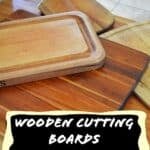
I’m sharing the science of wooden cutting boards and bacteria, plus other benefits of wood. I only use wood cutting boards in my kitchen. I never liked plastic cutting boards, and now studies are backing me up.
At our family catering business, the health department required us to use plastic cutting boards because “they were more sanitary”. Like so many well-intentioned government agencies, they were wrong.
We have a section of butcher block countertop, plus six other boards, including one passed down from my husband’s grandmother. (The top board in the image below.) With proper care, these boards can last a lifetime. You can’t say that about plastic boards.

Would you like to save this?
Table of Contents
- Wooden Cutting Boards and Bacteria
- Wood Versus Salmonella, Listeria and enterohemorrhagic Escherichia coli
- Survival of bacteria on wood and plastic particles
- Other Reasons to Choose Wood Cutting Boards Over Plastic, Glass or Ceramic Cutting Boards
- Basic Food Safety Applies No Matter Which Type of Cutting Board You Use
- More Food Safety Articles
Wooden Cutting Boards and Bacteria
In “Plastic and Wooden Cutting Boards” by Dean O. Cliver, they noted that “the U.S. Department of Agriculture told us they had no scientific evidence to support their recommendation that plastic, rather than wooden cutting boards be used in home kitchens”.
The problem is that while it may seem like plastic is non-porous and can’t absorb liquids, with use the surface becomes knife-scarred. This rough surface is exceptionally difficult to clean, even with bleach or running through the dishwasher.
Wood, by contrast, shows the ability to halt the growth of and kill bacteria applied to its surface. Both new and used wooden cutting boards maintain this ability equally well.
Wood Versus Salmonella, Listeria and enterohemorrhagic Escherichia coli
In a study conducted at the University of Wisconsin (also by Dr. Cliver), they tested bacteria known to produce food poisoning – Salmonella, Listeria and enterohemorrhagic Escherichia coli.
These bacteria were placed on cutting boards made from seven different species of trees and four types of plastic. All the wooden boards consistently outperformed the plastic.
The scientists found that three minutes after contaminating a board that 99.9 percent of the bacteria on wooden boards had died, while none of the bacteria died on plastic.
Bacterial numbers actually increased on plastic cutting boards held overnight at room temperature, but the scientists could not recover any bacteria from wooden boards treated the same way.
Dr. Cliver also discusses a case-control study of sporadic salmonellosis in “Plastic and Wooden Cutting Boards”:
(This study) revealed that those using wooden cutting boards in their home kitchens were less than half as likely as average to contract salmonellosis, those using synthetic (plastic or glass) cutting boards were about twice as likely as average to contract salmonellosis; and the effect of cleaning the board regularly after preparing meat on it was not statistically significant.
Basically, wood cutting boards kill bacteria.
Wood binds up water, which bacteria needs to grow. Wood also contains antimicrobial compounds. (Given that many plants can be used as natural antibiotics, this is not surprising.)
Old or new, wood cutting boards add an extra line of defense to your kitchen.
Bamboo also has anti-bacterial properties, but it contains silica, which can dull or chip knives. Bamboo may also warp or crack more readily than wood.


Survival of bacteria on wood and plastic particles
The study “Survival of bacteria on wood and plastic particles: Dependence on wood species and environmental conditions” compared bacteria growth (E. coli and E. faecium) in seven types sawdust and plastic (polyethylene chips).
They found that the sawdust reduced the bacteria count, with pine and oak performing the best.
From the abstract:
“The presented study shows that pine and oak exhibit substantially better hygienic performance than plastic and indicates an antibacterial effect caused by a combination of the hygroscopic properties of wood and the effect of wood extractives.”
They also discuss earlier studies, including one by Koch et al in 2002 comparing bacterial survival (Bacillus subtilis and Pseudomonas fluorescens) on wood, plastic and stainless steel, noting:
“A remarkably great difference in the survival of the bacteria on the surface of the samples was observed between wooden samples and plastic and steel. Oak showed the highest decrease rate in bacterial titre, followed by beech and ash. Bacteria survived longest on plastic followed by stainless steel.“
Other Reasons to Choose Wood Cutting Boards Over Plastic, Glass or Ceramic Cutting Boards
Additionally, wood cutting boards:
- Protect your knives and don’t dull them like ceramic, glass, or bamboo cutting boards.
- Are completely biodegradable and renewable. (See our Teakhaus review.)
- May support small business. Check out your local farmers markets and craft fairs for handmade products.
Duncan demonstrates how to oil cutting boards in the video below.
Not surprisingly, plastic cutting boards may be a significant source of microplastics in food. (See “Are Plastic Cutting Boards Safe?“) No one needs to be eating more plastic. Even if it doesn’t end up in your food, it’s washing down the drain into the water supply.
Basic Food Safety Applies No Matter Which Type of Cutting Board You Use
Wash hands frequently using a non-toxic soap and hot water. Do not use antibacterial products like triclosan. They breed tougher superbugs.
Avoid cross contamination. Keep meat away from produce, cooked food away from raw food, etc. Don’t grill and put the finished meat on the same plate you used for the raw meat.
For more detailed information, see How to Clean Wooden Cutting Boards and Wooden Cutting Board Care.
If you want to use bleach to sanitize your cutting board, add one tablespoon of bleach to one gallon of water. Soak your board for a few minutes, and then rinse well with clean water. I don’t do this for wooden cutting boards, but if you still have plastic boards, it may be helpful.
A better understanding of the interaction of wooden cutting boards and bacteria makes it clear why wood has been the material of choice for so long. Being more resilient is all about combining the best of old and new.
Did you know about the wood/bacteria interaction? Leave a comment below to share your thoughts.
More Food Safety Articles
Good food is critical to good health – but our food system is in trouble. We’ll help you to understand the risks and make better choices. Learn more at:
Bt Corn – What is it, and Why Should You Care About It?
Botulism – Tips for Safe Home Canning
Protect Yourself from Salmonella and E Coli Naturally

Laurie Neverman has her bachelor’s degree in mathematics and a master’s in mechanical engineering. She paid part of her way through college working at the family catering business, Irene’s Custom Cakes & Catering. Now she and her family grow and preserve most of their food on their Wisconsin homestead.
Originally posted in 2013, updated in 2024.
I would use it to cut all of the veggies that I use when cooking dinner.
Great article! We’re just now switching to wood cutting boards
Our small garden is growing in an over-turned dresser filled with dirt on the porch, as we rent and are not allowed to disturb to landscaping. If I won this cutting board, it would be used to prepare the lovely tomatoes, cucumbers and beans that are over-flowing our humble dresser garden!
I’ve always preferred wooden boards, they look better and have a much nicer feel.
If I won this it would definitely become my daily use board.
Gorgeous wood cutting boards! I love them…have been wishing for a good one like this! Great article, thank you!
This is a great article. I would love to use one of these quality boards everyday … and they are so beautiful I could leave them on my counter!
Wow, I always thought the plastic cutting boards would be less likely to harbor bacteria! I glad to see the studies show otherwise, as I much prefer a wood board. They are much nicer to work with and look much better. Time to replace my plastic ones with wood.
This would be nice to chop veggies for my salsas and sauces ????
I loved this article on the wood cutting boards. You have done a really nice job. I will be replacing my plastic cutting boards now. Thank you for the article.
I love wood cutting boards!
Interesting read, although I am kind of concerned about using mineral oil on my boards. I wouldn’t cook with mineral oil (I don’t even buy anything that contains it), so why would I use it on my board? Surely, there is another food-safe oil I can use?
Some people do use coconut oil, which is shelf stable for longer than most other oils, but eventually it, too, will go rancid. The mineral oil, if you’re using it properly, should be absorbed by the wood, not by your food.
I have always used a wood board as has my parents to save the table from damage as well as prolong the life of the knifes edge . .yet winning or purchaseing a new high quality one will be great with the small on i’m using has seen iys better days mostly due to using it on the stove as a trivit for hot pots ,and getting it damaged , of course I can imagine its age being at least 3 generations
These are so beautiful and I’m guessing the give away is over but I’ll just say we only use wood cutting boards in our kitchen. To make some feel better we do have one marked chicken and it is the one that is used when raw meat products must be cut. Just makes less worry for one person in our family who can’t stand the thought of the same board being used for fruit a different time 🙂
I am learning to use my new dehydrator so I’ve been cutting up lots of fruits and veggies to dry! I need a new cutting board so I entered the contest. : )
I would put the John Boos cutting board to good use in preparing my families favorite meals. It will also give me great comfort to know that using their handmade wood cutting board is safe and will not harm my family. I try my best to make what I can homemade and what better way to add to the tradition.
Great info on cutting boards! Thank you.
I’ve been trying for 2 or 3 years to figure out the best type to use.
All of ours are so old and used and need to be replaced.
We use them daily to prepare meals.
Since my husband often gets the first part of preparing-slicing, dicing or chopping as I get home from work much later in the evening he uses the cutting boards probably even more than I do.
It was great to read this blog and threads. Thank you.
I’m a vegetarian so I’m always using a cutting board for cutting up veggies and fruits. It would be nice to have such a nice one to use.
beautiful board – would love to win one. 🙂 it would likely be a daily use board, since we do a lot of cooking at home, and that seems like a lovely, practical size.
I would use this cutting board for when we have family cookouts–my adult son likes to cook meat on a smoker/grill.
Thanks for the information. This is completely counter intuitive so I never would have guessed wood is better than plastic. But your explanation makes sense.
I’d use it for my veggies. I use a separate board for meat, but it sounds like I’m going to have to invest in a wood board…