
Wooden Cutting Boards and Bacteria – What You Need to Know

This post may contain affiliate links. Read my full disclosure here.
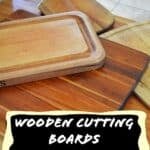
I’m sharing the science of wooden cutting boards and bacteria, plus other benefits of wood. I only use wood cutting boards in my kitchen. I never liked plastic cutting boards, and now studies are backing me up.
At our family catering business, the health department required us to use plastic cutting boards because “they were more sanitary”. Like so many well-intentioned government agencies, they were wrong.
We have a section of butcher block countertop, plus six other boards, including one passed down from my husband’s grandmother. (The top board in the image below.) With proper care, these boards can last a lifetime. You can’t say that about plastic boards.

Would you like to save this?
Table of Contents
- Wooden Cutting Boards and Bacteria
- Wood Versus Salmonella, Listeria and enterohemorrhagic Escherichia coli
- Survival of bacteria on wood and plastic particles
- Other Reasons to Choose Wood Cutting Boards Over Plastic, Glass or Ceramic Cutting Boards
- Basic Food Safety Applies No Matter Which Type of Cutting Board You Use
- More Food Safety Articles
Wooden Cutting Boards and Bacteria
In “Plastic and Wooden Cutting Boards” by Dean O. Cliver, they noted that “the U.S. Department of Agriculture told us they had no scientific evidence to support their recommendation that plastic, rather than wooden cutting boards be used in home kitchens”.
The problem is that while it may seem like plastic is non-porous and can’t absorb liquids, with use the surface becomes knife-scarred. This rough surface is exceptionally difficult to clean, even with bleach or running through the dishwasher.
Wood, by contrast, shows the ability to halt the growth of and kill bacteria applied to its surface. Both new and used wooden cutting boards maintain this ability equally well.
Wood Versus Salmonella, Listeria and enterohemorrhagic Escherichia coli
In a study conducted at the University of Wisconsin (also by Dr. Cliver), they tested bacteria known to produce food poisoning – Salmonella, Listeria and enterohemorrhagic Escherichia coli.
These bacteria were placed on cutting boards made from seven different species of trees and four types of plastic. All the wooden boards consistently outperformed the plastic.
The scientists found that three minutes after contaminating a board that 99.9 percent of the bacteria on wooden boards had died, while none of the bacteria died on plastic.
Bacterial numbers actually increased on plastic cutting boards held overnight at room temperature, but the scientists could not recover any bacteria from wooden boards treated the same way.
Dr. Cliver also discusses a case-control study of sporadic salmonellosis in “Plastic and Wooden Cutting Boards”:
(This study) revealed that those using wooden cutting boards in their home kitchens were less than half as likely as average to contract salmonellosis, those using synthetic (plastic or glass) cutting boards were about twice as likely as average to contract salmonellosis; and the effect of cleaning the board regularly after preparing meat on it was not statistically significant.
Basically, wood cutting boards kill bacteria.
Wood binds up water, which bacteria needs to grow. Wood also contains antimicrobial compounds. (Given that many plants can be used as natural antibiotics, this is not surprising.)
Old or new, wood cutting boards add an extra line of defense to your kitchen.
Bamboo also has anti-bacterial properties, but it contains silica, which can dull or chip knives. Bamboo may also warp or crack more readily than wood.


Survival of bacteria on wood and plastic particles
The study “Survival of bacteria on wood and plastic particles: Dependence on wood species and environmental conditions” compared bacteria growth (E. coli and E. faecium) in seven types sawdust and plastic (polyethylene chips).
They found that the sawdust reduced the bacteria count, with pine and oak performing the best.
From the abstract:
“The presented study shows that pine and oak exhibit substantially better hygienic performance than plastic and indicates an antibacterial effect caused by a combination of the hygroscopic properties of wood and the effect of wood extractives.”
They also discuss earlier studies, including one by Koch et al in 2002 comparing bacterial survival (Bacillus subtilis and Pseudomonas fluorescens) on wood, plastic and stainless steel, noting:
“A remarkably great difference in the survival of the bacteria on the surface of the samples was observed between wooden samples and plastic and steel. Oak showed the highest decrease rate in bacterial titre, followed by beech and ash. Bacteria survived longest on plastic followed by stainless steel.“
Other Reasons to Choose Wood Cutting Boards Over Plastic, Glass or Ceramic Cutting Boards
Additionally, wood cutting boards:
- Protect your knives and don’t dull them like ceramic, glass, or bamboo cutting boards.
- Are completely biodegradable and renewable. (See our Teakhaus review.)
- May support small business. Check out your local farmers markets and craft fairs for handmade products.
Duncan demonstrates how to oil cutting boards in the video below.
Not surprisingly, plastic cutting boards may be a significant source of microplastics in food. (See “Are Plastic Cutting Boards Safe?“) No one needs to be eating more plastic. Even if it doesn’t end up in your food, it’s washing down the drain into the water supply.
Basic Food Safety Applies No Matter Which Type of Cutting Board You Use
Wash hands frequently using a non-toxic soap and hot water. Do not use antibacterial products like triclosan. They breed tougher superbugs.
Avoid cross contamination. Keep meat away from produce, cooked food away from raw food, etc. Don’t grill and put the finished meat on the same plate you used for the raw meat.
For more detailed information, see How to Clean Wooden Cutting Boards and Wooden Cutting Board Care.
If you want to use bleach to sanitize your cutting board, add one tablespoon of bleach to one gallon of water. Soak your board for a few minutes, and then rinse well with clean water. I don’t do this for wooden cutting boards, but if you still have plastic boards, it may be helpful.
A better understanding of the interaction of wooden cutting boards and bacteria makes it clear why wood has been the material of choice for so long. Being more resilient is all about combining the best of old and new.
Did you know about the wood/bacteria interaction? Leave a comment below to share your thoughts.
More Food Safety Articles
Good food is critical to good health – but our food system is in trouble. We’ll help you to understand the risks and make better choices. Learn more at:
Bt Corn – What is it, and Why Should You Care About It?
Botulism – Tips for Safe Home Canning
Protect Yourself from Salmonella and E Coli Naturally

Laurie Neverman has her bachelor’s degree in mathematics and a master’s in mechanical engineering. She paid part of her way through college working at the family catering business, Irene’s Custom Cakes & Catering. Now she and her family grow and preserve most of their food on their Wisconsin homestead.
Originally posted in 2013, updated in 2024.
This board looks almost to beautiful to cut on! I however could use a second board for fresh fruit. Currently my wooden board smells of onions, making the fruit taste bad!
Thank you!
I would use the cutting board in preparation of breakfast, lunch and dinner as the cook for our guest services small business. I love natural wood and hate plastic. Thanks.
Oiling to board ruins the antimicrobial nature of the wood board. Wood is hygroscopic and pulls the bacteria inside it where it is trapped and dies. If the pores in the wood are filled with oil then the board is basically a plastic board because all the bacteria will sit on the surface.
If you were to wax the board, then yes, that would seal the surface. Oiling does not completely seal all the pores. If you note, the one referenced study looked at people who used cutting boards in their homes, with no specific guidelines as to how those boards were maintained, i.e., the subjects were not using un-oiled boards only.
Hello!
I run an Etsy store and we’ve recently started selling wooden cutting boards, would it be alright to reference your article in our listings as a reference for proper care of wooden cutting boards? I just feel like it would be an amazing resource for our customers, I didn’t know if it would be considered improper, or if you would be okay with the idea.
Links back to the site are always welcome.
Boards with the end grain facing up are by far the best as knives will not cut the wood fibers.
The actual paper is located here: http://www.ingentaconnect.com/content/iafp/jfp/1994/00000057/00000001/art00003
And the abstract states “Recoveries from wooden blocks were generally less than those from plastic blocks, regardless of new or used status; differences increased with holding time.” NOT that there were no bacteria left on the wood. Please be more careful when reporting study results, and provide a link to the actual peer-reviewed article.
Thank you for providing a link to the abstract. I was unable to locate it at the time the post was written, because the study is 10 years old. For those who are interested, the abstract specifically states:
“Abstract:
The microbiology of plastic and wooden cutting boards was studied, regarding cross-contamination of foods in home kitchens. New and used plastic (four polymers plus hard rubber) and wood(nine hardwoods) cutting boards were cut into 5-cm squares(“blocks”). Escherichia coli (two nonpathogenic strains plus type OI57:H7), Listeria innocua, L. monocytogenes, or Salmonella typhimurium was applied to the 25-cm2 block surface in nutrient broth or chicken juice and recovered by soaking the surface in nutrient broth or pressing the block onto nutrient agar, within 3-10 min or up to ca. 12 h later. Bacteria inoculated onto plastic blocks were readily recovered for minutes to hours and would multiply if held overnight. Recoveries from wooden blocks were generally less than those from plastic blocks, regardless of new or used status; differences increased with holding time. Clean wood blocks usually absorbed the inoculum completely within 3-10 min. If these fluids contained 103-104 CFU of bacteria likely to come from raw meat or poultry, the bacteria generally could not be recovered after entering the wood. If ≥106 CFU were applied, bacteria might be recovered from wood after 12 h at room temperature and high humidity, but numbers were reduced by at least 98%, and often more than 99.9%. Mineral oil treatment of the wood surface had little effect on the microbiological findings. These results do not support the often-heard assertion that plastic cutting boards are more sanitary than wood.” (emphasis mine)
Never in the article did I state that wood killed all bacteria, only that wood did kill bacteria, while plastic bred more bacteria.
Actually, you did in essence say that wood killed all bacteria. You said:
“….could not recover ANY bacteria from wooden boards treated the same way.” Doesn’t this indicate that ALL bacteria were killed on the wooden boards?
Jim
As a former laboratory technician I can tell you that “could not recover any bacteria” does not mean that ALL were killed. Microscopic examination may well have found live bacteria that could not be recovered by a swab test.
I have a wooden cutting board, walnut or maple, from 1978 and it still has no splinters knife marks! Always wash with hot soapy water and wipe or drip dry. Am going to be replacing all my plastic cutting boards with wood even though they have the convenience of going into the dishwasher. Tried a glass one once and it was way too slippery! Glad to know my wooden board is indeed the best choice! Thanks for the expertise.
My favorite cutting board used to belong to my grandmother. When properly cred for, they can last a very long time. 🙂
I’ve known about the antibacterial properties of wood cutting boards for many years. One more advantage that should never be overlooked: your knife will slip on glass and plastic, but not on wood, making wood much safer to cut on. This also results in less stress on your hands and arms because you don’t have to struggle to control the knife. Ask me how I know!!
I agree! Wood is just easier to cut on.
Is it possible to season a wooden chopping board with duck fat?
I wouldn’t recommend it, simply because the duck fat will get rancid fairly quickly.
My grandfather was a butcher, way back when… He had a little meat market, in a little town in NH. His butcher block was , of course, wood. The floor was covered in wood shavings. I remember raking the bits of meat and fat that fell to the floor out of the shavings. These were replaced periodically. He scraped the top of the butcher block every night with a metal scraper. His store was inspected by the state yearly. The old ways are best! Now I walk by the door to the meatroom at a supermarket and am assaulted by the smell of bleach…
Gail, my name is also Gail and my grandfather and father had a little meat market. They did the same things that you mentioned. Thank you for the memories.
Can you treat wood cutting boards w/ coconut oil?
While coconut oil is very shelf stable, it eventually does become rancid. I’d personally stick with one of the blends specifically mixed to avoid rancidity.
I have plastic boards. I don’t cross contaminate. I would like to get board, but the last board I got was indeed a low/poor quality one from walmart and it got marked up pretty quickly and I wondered about splinters getting into the food. Does no soaking, sharp knives, and oiling all reduce a chopped up/sliced up board? What else can be done to reduce the incidence of splinters? And how long do you think a medium/fair quality board should last you? Thanks!
I don’t regularly shop at Walmart, because I ran into quality issue (especially with kitchen items) in the past. (I went to use a potato peeler I bought there, and it stuck in the potato and broke off the first time I tried to use it.) I have one mid-quality board that I bought at Shopko, and I’ve had it at least ten years. I made a pig-shaped cutting board back in junior high shop class, and that’s around 30 years old and still in good condition. The only board I’ve had splintering issues with was one that was made of softwood, not hardwood. Otherwise the pig baord, the mid range board, a second hand board from my MIL (the one with the handle in the photo), the butcher block counter – no splintering issues. A hardwood cutting board treated with modest care should last a lifetime (or longer).
No affiliation, but I use wonderful burled maple cutting boards made from pieces of “imperfect” maple. They are beautiful, and because the grain is random, they are less prone to splitting and cracking. I gave one to my niece as a wedding gift, telling her that marriage is like this cutting board, imperfect but beautiful, and with proper care, will last a lifetime. http://www.maplemagic.com/Gallery/Pictures.htm
Maple is a good quality hardwood for cutting boards. 🙂
You can also get your wooden board clean and free from bactaries by scrubbing it with salt, let i set for 20 minutes and then rinse!
I’ve seen that recommended in a number of places, and salt does inhibit bacteria, but isn’t that hard on your boards?
No. The combination of Salt and Bleach on wood, placed in the sun(or not) for 30 minutes is also used to” lighten” the wood ever so slightly. After an afternoon of cutting meats for my freezer I use salt and Blue Dawn to clean, then rinse well.
Would you reccommend seperate boards for meat and veggies then? Any thougjts on picking iut a good wood board??
As I mention in the post, Don’t cross contaminate. Keep meat away from produce, cooked food away from raw food, etc. Don’t grill and put the finished meat on the same plate you used for the raw meat.
As for picking out a good board, you can often find ones that are made locally at craft fairs or thrift sales, especially during the holidays. Otherwise, look for a good, sturdy hardwood board. I like the ones with a drop channel around the outside edge to catch any runoff. I’ll be hosting a cutting board giveaway sometime in the upcoming weeks. I was contacted by a company that makes the boards and liked the post.
I use a cutting board with the “juice channel” for meats and the other side which has no channel for fruits and veggies. I do dice hard boiled eggs on the meat side just to be safe.
I have long heard the fact that wood cutting boards are better for you than plastic. I thought though, that I had also heard that it was only true with untreated wood boards. Once you oil the boards the bacteria doesn’t necessarily die off like with an untreated board. I am curious if the research you site tested oiled or untreated boards? I would much rather start treating my boards as it would help them last longer. However, I don’t want a board that is unhealthy and doesn’t kill the germs like the untreated do. Do you have any info to help clear this up?
Thanks!
Although it’s not clear from the information provided about Dr. Cliver’s research whether the wood tested was treated or untreated, it seems logical that any treatment would only affect the surface of the board, not the subsurface. The surface can still be washed, and the subsurface is where the antibacterial activity is more pronounced. Also, there is evidence that bamboo maintains its antibacterial properties even when processed into fabric, and this is a far more dramatic change of state than creating a cutting board and applying oil. I cannot say with 100% certainty that the antimicrobial activity is unaffected by treating the wood, but it would seem logical to me that it would still exist. I do treat my cutting boards.
Unfortunately, Dr. Cliver passed away in 2011 and is not available for comment. http://www.secfac.wisc.edu/senate/2011/1003/2284%28mem_res%29.pdf
We all need to read the instruction book. Leviticus 15:12 tells us that we only have to rinse wooden vessels but break earthenware vessels and bury them. God put naturally occurring toxins in the wood that kills bacteria. This info has been around for 4500 years.
That Good Book covers everything from A–>Z 🙂
I had the same thought and therefore do not treat my cutting board. I thought of buying some petre dishes to test what grows on my plain washed boards vs oiled board.
Unfortunately, without some sort of surface treatment, most cutting boards will crack and split, especially with heavy use.
Fantastic post! Seems counter intuitive but I have read this before too. Glad I know the best practices for washing my boards! Thanks!
I get plastics harboring bacteria, but glass? I’m not sure I understand why glass would be inferior to wood, since it is not porous or easily scratched like plastic and wood. Did you find anything to explain this?
I didn’t find anything specifically noting bacterial issues with glass, although it is not naturally antimicrobial like wood and bamboo. I have seen some comments that indicated a concern with minute glass slivers flaking off (some people beat the heck out of their boards). Also, glass is likely to dull your knives more quickly, and would create a more slippery surface when wet so that food could slide around and be a little tougher to cut. If proper kitchen sanitation rules are followed, surfaces are regularly cleaned and you don’t get rough with your glass boards, they should be fine.
glass boards are not good for your knives
I do know that glass boards are awful for your knives. And glass can scratch, or chip — those tiny areas are just as problematic as on plastic.
Interesting article. We only use wood here one of which my brother made us. So very cool. I always used wood since they look better and of course aren’t plastic. Though I never gave it too much thought we’re vegetarian so I did wonder if meat needed to be on plastic I’m glad you wrote this article. I’ve shared it on NZ Ecochick’s facebook page. Mx
When properly cared for, wood cutting boards can also last just about forever, too. Very eco-friendly. Thanks for sharing.
Wow! I never would have thought! I actually use the Natural by Epicurean (it’s made of a wood-fiber laminate) and I LOVE it! It says that it prohibits bacteria…I wonder if it works as well as a regular wooden cutting board?
-andi