
Water Kefir Versus Kombucha – Which one is better?

This post may contain affiliate links. Read my full disclosure here.
Would you like to save this?
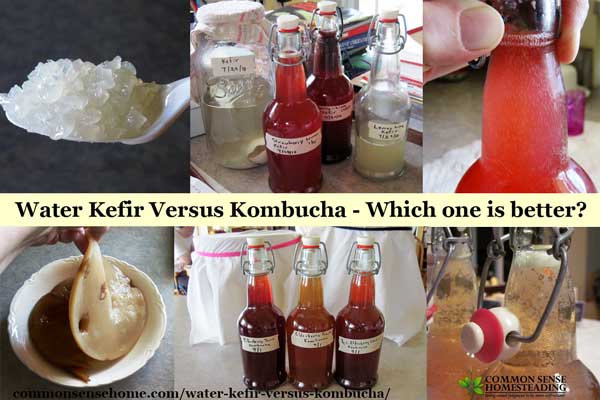
Water kefir verus kombucha, which is better?
This is a question I’ve heard a number of times. My kids like the flavor of water kefir soda better than kombucha tea, but I generally prefer the kombucha myself, and my husband will drink either, depending on the flavor.
Water kefir is quicker to brew than kombucha tea – unless you do a continuous ferment, in which case you can draw off kombucha every day. Some people find water kefir is more consistent, my kombucha tends to be more consistent. Some people feel guilty about excess scobys, I have been able to give most of mine away, or I simply compost them. A few I’ve used to treat skin ailments, such as my son’s cradle cap. (Read The SCOBY Cure.) (DON’T FLUSH YOUR SCOBY! It may just be able to grow in your septic system and cause big problems.)
So, other than personal preference, what is the real difference between water kefir and kombucha? Both start with a base of sweetened liquid (kombucha with sweetened tea, water kefir with sweetened water). I did a lot of hunting, and what follows are some of the best explanations I found on the Net. First up, kombucha.
What is Kombucha?
Kombucha is also known as Kombuchal, Gerbstoffe, Combucha, Kum-Cha, Fungus japonicas, Fungojapon, Indo-Japanese tea fungus, Pichia fermentans, Cembuya orientalis, Combuchu, Tschambucco, Volga spring, Mo-Gu, Champignon de longue vie, Tea Kvas, Teakwass, Kwassan, Kargasok, Kocha kinoko, Tibetian mushroom and more.
From the forums at Wild Fermentation:
The bacterial component of a kombucha culture usually consists of several species, but will almost always contain Gluconacetobacter xylinus, which ferments the alcohols produced by the yeast(s) into acetic acid. This increases the acidity while limiting the alcoholic content of kombucha. G. xylinum is responsible for most or all of the physical structure of a kombucha mother, and has been shown to produce microbial cellulose.
From the Happy Herbalist (which I highly recommend – tons of great information):
The classification of kombucha vinegar according to Traditional Chinese Medicine is Sour, Bitter and Warm, and milder than alcohol which is Hot (alcohol contributes to phlegm and stagnation). TCM uses vinegar (kombucha) to break stagnation and to move the blood and Qi. Thus improving circulation and contributing to the general feeling of well-being.
As a Pro-biotic: Acidic kombucha, pH 2-3.5 aids the Stomach (both in the TCM and western sense) in the breakdown and digestion of food ingested. Beneficial bacteria and yeasts, that comprise the Live K-T or Pressed Extract (as opposed to pasteurized, neutralized, alcoholic or dead kombucha) compete with and help remove (suppress) harmful bacteria, yeast, parasites. … Then due to the synergism of the stomach acids and kombucha (Acid and Alkaline meets Yin and Yang, Herman Aihara ISBN 0-918860-44-x), kombucha transforms into an alkaline forming substance. Now the transformed Alkaline kombucha pH 7+, aids the Spleen (function in TCM), intestines, gall bladder and pancreas (function in western speak) in metabolizing and distributing that digest throughout the body. Thus IMHO, kombucha truly holistically balances and harmonizes the body.
And finally, from the Heal Thyself Forums:
Kombucha also has the effect of increasing detoxification in the liver. This is beneficial, unless pregnant or nursing, or excess mercury stores. You also need your detox pathways to be open first for effective detox.
So, kombucha acts as an immediate digestive tonic, much like apple cider vinegar. It colonizes the guts with friendly bacteria and yeasts. It detoxifies the liver, and generally cleans and rejuvenates the digestive system as a whole.
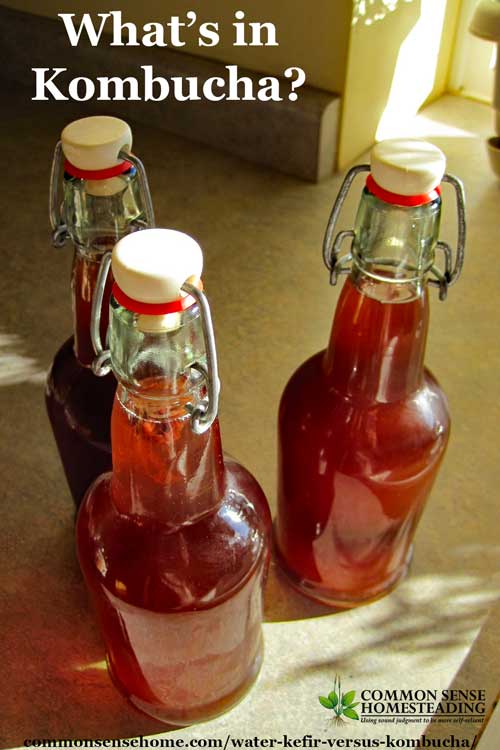
What’s in Kombucha?
The Happy Herbalist contains links to a number of kombucha studies at http://www.happyherbalist.com/analysis_of_kombucha.htm. On this page, they state that the typical composition of kombucha may include:
Bacterium gluconicum
Bacterium xylinum
Acetobacter xylinum
Acetobacter xylinoides
Acetobacter Ketogenum
Saccharomycodes ludwigii
Saccharomycodes apiculatus
Schizosaccharomyces pombe
Zygosaccharomyes
Saccharomyces cerevisiae
Acetic acid
Acetoacetic acid
Benzoic acid
propenyl ester
Benzonitrile
Butanoic acid
Caffeine
Citric acid
Cyanocobalamin
Decanoic acid
Ethyl Acetate
Fructose
d-Gluconic acid
Glucose
Hexanoic acid
Itaconic acid
2-Keto-gluconic acid
5-Keto-gluconic acid
2-Keto-3-deoxy-gluconic Lactic acid
Niacinamide
Nicotinic acid
Pantothenic acid
Phenethyl Alcohol
Phenol, 4-ethyl
6-Phospho gluconate
Propionic acid
Octanoic acid
Oxalic acid
Riboflavin
d-Saccharic acid
(Glucaric acid)
Succinic acid
Thiamin
plus 40 other acid esters in trace amounts.
Cultures for Health Kombucha Discussion
Cultures for Health highlights key kombucha elements in their Q &A section:
Not all kombucha cultures will contain the exact same strains, but generally, these are some that you might expect:
Acetobacter: This is an aerobic (requiring oxygen) bacteria strain that produces acetic acid and gluconic acid. It is always found in kombucha. Acetobacter strains also build the scoby mushroom. Acetobacter xylinoides and acetobacter ketogenum are two strains that you might find in kombucha.
Saccharomyces: This includes a number of yeast strains that produce alcohol, and are the most common types of yeast found in kombucha. They can be aerobic or anaerobic (requires an oxygen-free environment). They include Saccharomycodes ludwigii, Saccharomycodes apiculatus, Schizosaccharomyces pombe, Zygosaccharomyes, and Saccharomyces cerevisiae.
Brettanomyces: Another type of yeast strain, either aerobic or anaerobic, that are commonly found in kombucha and produce alcohol or acetic acid.
Lactobacillus: A type of aerobic bacteria that is sometimes, but not always, found in kombucha. It produces lactic acid and slime.
Pediococcus: These anaerobic bacteria produce lactic acid and slime. They are sometimes, but not always, found in kombucha.
Gluconacetobacter kombuchae is an anaerobic bacteria that is unique to kombucha. It feeds on nitrogen that is found in tea, and produces acetic acid and gluconic acid as well as building the scoby mushroom.
Zygosaccharomyces kombuchaensis is a yeast strain that is unique to kombucha. It produces alcohol and carbonation as well as contributing to the mushroom body.
Kombucha also contains a variety of other nutrients, particularly various acids and esters that give the drink its characteristic tang and fizz. Included in these components is gluconic acid, which is the primary difference between the makeup of kombucha and the makeup of apple cider vinegar!

Now, water kefir:
What is Water Kefir?
Water Kefir is also known as Japanese Water Crystals, sugary-kefir grain (SKG), Sugary Fungus, Tibicos, Ginger Beer Plant, California Bees, Water Kefir Grains, tibetan mushroom grains, snow lotus, water crystals, tibi, Kephir, Paris, Kephir, kefir fungus, kefir d’aqua, and more.
From Yemoos Nourishing Cultures:
(Water kefir) is loaded with valuable enzymes, easily digestible sugars, beneficial acids, vitamins and minerals. Water kefir is also generally suitable for some diabetics (though personal discretion is advised). It also is a nice option if you are trying to avoid the caffeine present in kombucha, but still seeking a probiotic drink. Water kefir supplies your body with billions of healthy bacteria and yeast strains. Some store-bought probiotic foods or supplements can help, but they are not as potent, and do not contain the beneficial yeasts usually (just bacteria).
Within your body there are already billions of bacteria and yeast. Your internal microflora support proper digestion, synthesis of vitamins and minerals, and your immune system by warding off foreign and harmful bacteria, yeast and viruses. It has thus long been known to promote and aid in digestion and overall health. Some studies show it may be anti-mutagenic and help manage free radicals in the body. Folic acid (and B vitamins) increases as the length of the ferment increases. Some people let the strained kefir sit on the counter or the fridge another day to increase the folic acid and B vitamin content before drinking (this will increase the acidity too).
Kefir may also help reduce blood pressure and cholesterol. As with most things we’ve personally found, food and health is too difficult to reduce to facts and statistics. While kefir is not a magic bullet for health (what is) we believe kefir has a myriad of possible health benefits, and those will be individual for everyone. Some feel it helps them digest better, others get colds and viruses less often, some get more energy, and some people feel nothing much in particular, but enjoy the taste and value of it over store-bought yogurt, kombucha or kefir.
From Heal Thyself
Pat at Heal Thyself includes more information and a word of caution (she leans to the kefir side of the discussion):
Kombucha has Saccharomyces boulardii which displaces and replaces candida albicans in the gut. Candida binds mercury to keep it out of circulation. When you kill off candida in the gut, stored mercury is released back into circulation to redeposit into other organs and the brain.
Kefir does not do this similarly. Some people get GI symptoms if they start kefir too much too fast due to the microbial shift in the gut. Kefir has many beneficial microbials. You only need 1 tablespoon to equate to a whole bottle of probiotics.
So, water kefir is loaded with probiotics that colonize the entire digestive tract, doesn’t contain caffeine (although if you use continuous brewing, caffeine in kombucha can be significantly reduced), may help with free radicals and boost the immune system. It doesn’t produce a significant detox effect.
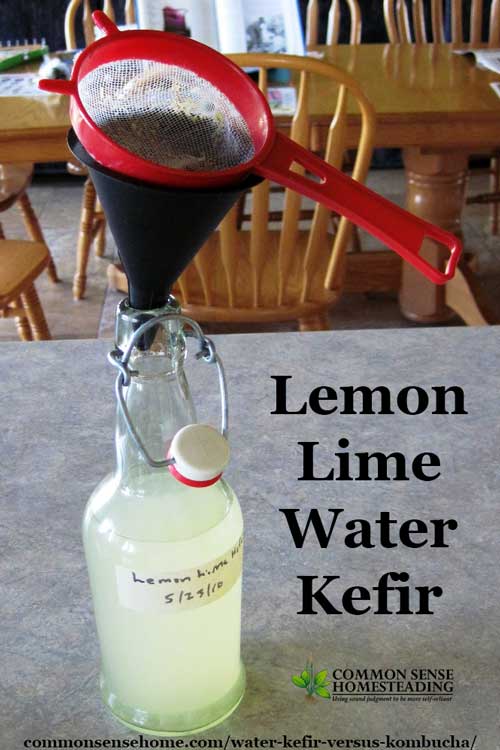
What’s in Water Kefir?
So what do you find in a typical glass of water kefir or kombucha?
Cultures for Health lists the following bacteria and yeasts as potentially occurring in water kefir:
Bacteria
Species Lactobacillus
L. acidophilus
L. alactosus
L. brevis
L. bulgaricus
L. casei subsp. casei
L. casei subsp. pseudoplantarum
L. casei subsp. rhamnosus
L. casei subsp. tolerans
L. coryneformis subsp. torquens
L. fructosus
L. hilgardii
L. homohiochi
L. plantarum
L. psuedoplantarum
L. reuterietc
L. yamanashiensis
Species Streptococcus
S. agalactiae
Sr. bovis
S. cremeris
S. faecalis
S. lactis
S. mutans
S. pneumoniae
S. pyogenes
S. salivarius
S. sanguinis
S. suis
S. viridans
Species Pediococcus
P. damnosus
Species Leuconostoc
L. mesenteroides
Species Bacillus
B. subtilis
B. graveolus
Yeast
Species Saccharomyces
S. bayanus
S. boullardii
S. cerevisiae
S. florentinus
S. pretoriensis
S. uvarum
Species Kloeckera
K. apiculata
Species Hansenula
H. yalbensis
Species Candida
C. gueretana
C. lamica
C. valida
Species Torulopsis
T. insconspicna
Basically, when you compare water kefir versus kombucha, it seems to me that water kefir acts primarily as a wide spectrum probiotic, whereas kombucha acts as a digestive aid, a probiotic and detoxifier.
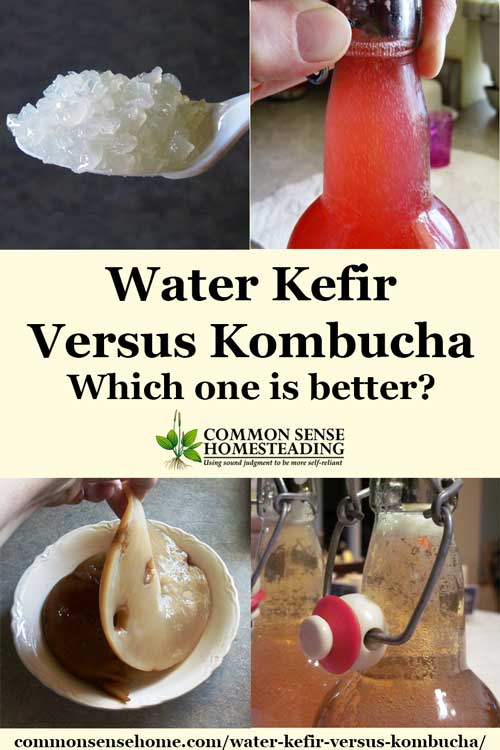
Water Kefir Versus Kombucha – Which one do I prefer?
I think both are valuable, but if I only had to choose one I would probably stick to kombucha. Both of them simply help your body to do what it needs to do – they are not miracle cures. Some sites warn not to use both, so keep that in mind. It’s best to start with small doses until you body acclimates to the new inhabitants. I think it gets down to individual taste preference, and individual body chemistry. I encourage you to try both if you have the opportunity and see which works better for you.
Note: If you are dealing with candida overgrowth, note that ferments may contain candida species. Ferments may make some sensitive individuals worse, and some individuals better. Pay attention to how your body responds and adjust accordingly. Please check with your healthcare provider if you are on prescription medications, as fermented foods may affect how your medication is absorbed.
You may also enjoy:
- Healthy Homebrew – Kombucha – How to brew kombucha
- Kombucha Q and A and More Flavoring Ideas – More flavoring ideas and all the Q and A from the comments in a more readable format
- How to Make Coffee Kombucha – Using coffee instead of tea to brew kombucha
- Holiday Kombucha Flavors– Ideas for holiday flavor blends such as pumpkin spice and cranberry collins
- How to Brew and Flavor Water Kefir
- The Dark Side of Water Kefir – Root Beer Water Kefir
Originally posted in 2011, updated in 2017.
Thank you, Trish. Be patient with your body and give it time to heal, and I hope you'll experience some positive changes. I firmly believe that consuming live culture foods has improved my health. I don't go a day without them any more.
Great article. I've just bought some water crystals and am trying to learn all I can. I've been prescribed powerful probiotics but this looks much more affordable and helpful. Thank you very much.
Greg – I considered coconut oil (and tried a mix with some coconut oil in it), but CO has natural antibacterial properties. I ended up with fur growing so I had to toss the salve. (I think I started with scoby, coconut oil, olive oil and almond oil.)
I wish I had access to raw Jersey milk! It seems crazy to live in the dairy state and not be able to buy raw milk. Kombucha is really easy to do. I'm sure you'll have no trouble once you get a scoby and tackle it.
I am late to this dance, but have you tried coconut oil (solid at room temperature) as a base for the skin cream?
Thank you for this comparison. I am soon to be making water kefir but have been making milk kefir from raw Jersey milk for quite some time, now. I have also been using commercial kombucha in combination with it. I am looking forward to brewing my own kombucha, but haven't made the leap yet.
Veronica – yes. The bacteria and yeast permeate the liquid. I know for sure that kombucha left in a warm space will spontaneously grow a new scoby (I've seen it). Not sure where baby kefir grains come from initially, but I do know that my kefir without grains is very much alive. I have ended up with a fountain effect while opening bottles that built up too much carbon dioxide from the live brew inside.
Thanks for the comparison! I have kefir at the moment… I have a question about kefir though- if you remove the kefir grains, are you still ingesting bacteria and yeast?
Veronica
Hannah – nice of you to stop by. Did you know that yours was one of the first kombucha blogs I visited? I just bottled a couple of batches of kombucha yesterday. I'm trying out a new flavor – prune. 🙂 Just in one bottle.
Great post! I really enjoyed your comparison. I think in the end, it comes down to individual taste and needs. I too prefer the longer brewing cycle and the endless variety of flavors that I create. So much fun!!
Amy – most of my salve recipes use beeswax, but of course that requires heating. Alas, no raw cream available. I ground up some scoby in oil, but it's really messy.
Jane – thanks! Glad you found it useful. There's a TON of info out there, but I hadn't seen a one to one comparison elsewhere. Where do you teach?
What about mixing the kombucha with kefir to make a cream.
I’d probably just use milk kefir alone if I was going to go that route. It’s possible to have too much of a good thing.
HI Laurie,
Your explanation was wonderful! I am going to use your post in a class I am teaching!
Thanks
Jane Casey
I would suggest coconut oil but it's antibacterial and antifungal, so that sort of defeats the purpose. 🙂 Maybe cultured raw cream? Obviously the mixture would need to be made fresh and used right away, but there could be a synergistic effect…
On another note, great post! I would think including both in the diet would be helpful to get a variety of probiotics. I'm enjoying some kombucha now… love it!
I did indeed scoby his head. 🙂 Any thoughts on a base for scoby cream?
Scobied his head did you!!!!! I can imagine that was quite a sight. Last summer when I had lots of excess scoby's I fed them to the 2 pigs since everyone around here that was interested in brewing had gotten scoby's from me and had their own abundance and were getting others themselves to start.
Blog transfer began….will go live once all the quirks are out and some are beyond my comprehension. Son will work on it this weekend.
I have shared excess SCOBYs with my neighbor’s chickens, the producers of our delicious eggs, and the chickens rush to consume them. I like to think they deliver benefits to our breakfast that way.
Plus, watching chickens chase around with scoby strips is hilarious! I know people dry them and use them for doggy chews, too.
🙂 I guess I should have explained that earlier. If you look at the bottom picture – that is a scoby or SCOBY (Symbiotic Colony of Bacteria and Yeast) AKA kombucha mother, kombucha mushroom. It's the "starter" you use to brew kombucha.
Thanks for the info, Laurie. I guess I will have to ask what a Scoby is?
g&g- There's a huge variation in kombucha flavors depending on the age of the brew and the ingredients used. It's s a lot like wine. Some of mine has tasted much like apple cider vinegar, other batches have been much more mellow. Keep sampling and I'm guessing at some point you may find a flavor you like (or get a scoby and brew to order).
Pamela – I guess I'll have to another post on that one at some point. Last winter, my son got very thick, waxy dandruff. I read up on likely causes (skin bacteria imbalance being one of them). I "scoby'd" his head for about 15 minutes before he took his shower at night. Worked like a charm. He still gets a few flakes now and then, but nothing like he had before. I want to try and make it into a skin cream to try for eczema-type conditions, but am not sure on the base to use. I also tried applying a scoby to my bursitis hip, but that was really messy and didn't seem to have any effect.
Good luck on getting all the posts transferred without mishap. Lots of work! We're not snowed in, but it's REALLY cold.
I use kombucha as a hair rinse once a week and have had no more flakes 🙂
Very nice! I used a scoby to cure my son’s cradle cap. Good stuff!
Great post Laurie!
Do tell how have you used Scoby's to treat skin ailments. What type of ailments and how did you apply the scoby?
Waiting on my son to transfer my posts, etc. to site….keep checking each day. Suppose happen this week? Can't wait!
Pam…….all snowed in here.
Thanks for all this information on both items! I just ran into a Kombucha beverage at my local health food store a couple weeks ago. While that one lacked in the taste department, I'm preparing to explore around. New territory here! Thanks again.
Yes, I ferment both water and milk kefir. I choose water kefir to do the comparison because it is more similar to kombucha, but the health uses should be similar.
Hello! I was wondering if you thought drinking Kefir would help with digestive problems and/or constipation?
Depending on what the problem is, it might, or it may make constipation worse if your water is high in calcium. You may find the post “Things We’re Embarrassed to Talk About – What’s a Healthy Bowel Movement?” useful.
my sister claims kombucha is a marvel for constipation, and she’s an old hippy with really good food habits who’s read a ton and tried all kinds of natural remedies…she is delighted to have started culturing kombucha. I on the other hand have almost never been constipated, but I love the taste of both and drink a lot of both kombucha and water kefir, well-fermented so there’s not much sugar left. Hope this helps!
I drink all three but milk kefir has made a decided difference in my regularity.
Great information Laurie.
In Sweden it is common to drink kefir milk, have you ever tried that?