
Vegetable Dehydrating – How to Dry Vegetables for Storage

This post may contain affiliate links. Read my full disclosure here.
Vegetable dehydrating is an easy way to store vegetables for long term use. During harvest season, my dehydrators live on my kitchen counter. Herbs, greens, fruits, veggies – everything gets dried and neatly tucked away for use year round. This post covers basic instructions for vegetable dehydrating to help you dry vegetables safely at home.
Would you like to save this?
Vegetable Dehydrating – Why Dry Veggies for Food Storage?
- Space Saving – Because vegetables have so much water, they shrink dramatically during dehydrating. If you’re tight on storage space, dehydrating is a great fit.
- No electricity required for storage – Once processed, dehydrated vegetables require no refrigeration or freezing.
- Lightweight – Since most of the water is gone, dried vegetables are lightweight, making them handy for camping or emergency preps.
- Minimal equipment required – I like commercial dehydration machines, especially in our humid climate, but folks also dry successfully with solar dehydrators or homemade drying racks. This non-electric 3 tray covered drying rack can be hung near a wood stove or other well-ventilated area for dehydrating.
Note: If using solar or air drying, drying times will likely be longer than those specified below. Turn food daily, protect from bugs and maintain good air circulation until food tests dry. For guidelines on drying foods using an oven, see “Home Food Drying – 6 Things You Need to Know to Dehydrate Food at Home“.
Recommended Vegetable Drying Tools
Solar Drying – The Sun Oven can be used as a food dehydrator as well as an oven.
See a more extensive list of kitchen tools for dehydrating in the post “Home Food Drying – 6 Things You Need to Know to Dehydrate Food at Home“.
For a full dehydrating course, please visit Traditional Cooking School. In this course you’ll learn how to quickly and easily dehydrate your own traditional foods for long-term storage, summer-fresh flavors, good health and freedom from energy dependence whether you’re on the camping trail or in your own kitchen… The Dehydrating eBook & Video Package (retail $64 – sale $20) contains: the Dehydrating eBook, 5 Dehydrating Master Class Videos, Lacto-Fermented Beverages eBooklet, and bonus printable worksheets!

Prepping Your Veggies for Drying
For dehydrating vegetables, set your electric dehydrator to 140°F (60°C). Remember, thinly sliced veggies will dry faster, and if you get all the pieces roughly the same size, they will dry in roughly the same amount of time.
Most vegetables should undergo a pretreatment, such as blanching or dipping, before dehydrating. Why? They dry faster and last longer. If I’m going to spend weeks growing beautiful veggies, I can take a few more minutes to dry them correctly.
Blanching is briefly precooking food in boiling water or steam. It stops enzymatic reactions within the foods, which slows down decomposition. Blanching shortens drying time (skins are softer so water gets out easier) and kills many spoilage organisms.
Steps for steam blanching (fruit and vegetables):
Adapted from Virginia Cooperative Extension.
- Use a steamer or a deep pot with a tight-fitting lid that contains a wire basket or could fit a colander or sieve so steam can circulate around the vegetables.
- Add several inches of water to the steamer or pot and bring to a rolling boil.
- Loosely place vegetables into the basket, no more than 2 inches deep.
- Place basket into pot (vegetables should not make contact with water).
- Cover and steam until vegetables for the recommended time (Table 2).
- Remove basket or colander and place in cold water to stop cooking.
- Drain and place vegetables on drying tray.
Steps for water blanching (vegetables only):
- Use a blancher or a deep pot with a tight-fitting lid.
- Fill the pot two-thirds full with water, cover, and bring to a rolling boil.
- Place vegetables into a wire basket and submerge them into the boiling water for the recommended time (see table below).
- Remove vegetables and place in cold water to stop cooking.
- Drain and place vegetables on drying tray.
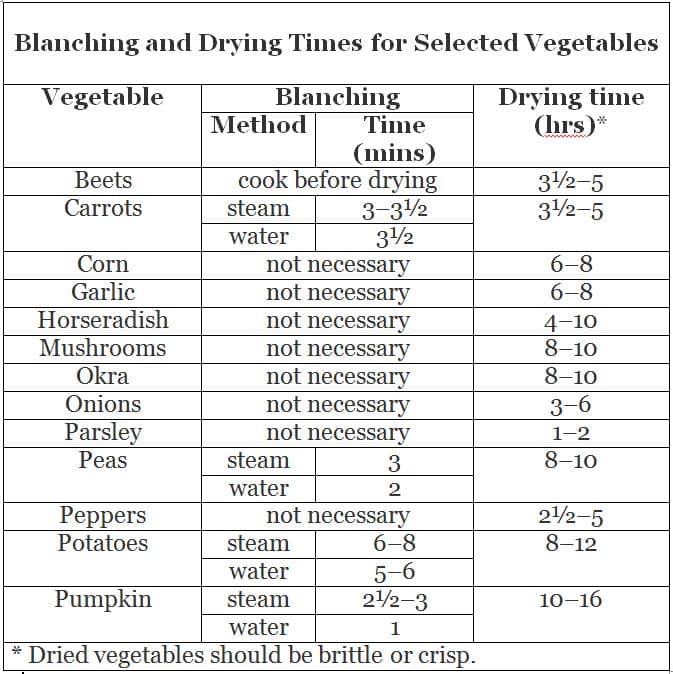
Download the Printable PDF version of the chart here
Note: Although not listed in the chart, I do blanch all cabbage family crops (broccoli, cabbage, cauliflower, kale, etc.) for 2 minutes in a boiling water bath.
How do I Know my Vegetables are Done Dehydrating?
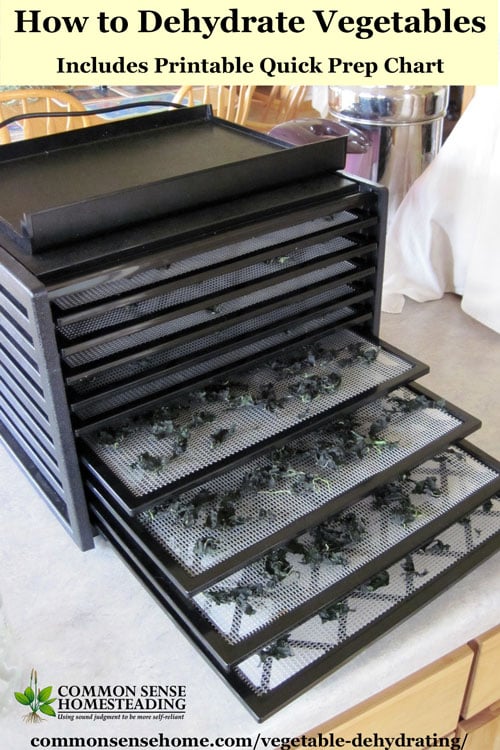
Up to 90% or more of the moisture is removed from vegetables when they are fully dry. They should snap/break cleanly, and be brittle. This may take longer than listed times, depending on the humidity levels.
Quick dryness check: Put your dehydrated vegetables in a mason jar, put a lid on and wait for a day. There should be no condensation on the underside of the lid. If you see condensation, put them back in the dehydrator. You might also want to cut any thicker chunks into smaller pieces.
If you want to be extra sure, you can buy a hygrometer that fits on top of a mason jar like a lid, the Hygrolid. My preferred storage method for dehydrated vegetables is vacuum sealed in mason jars. You can also use plastic zipper bags for short term storage, or Mylar pouches with oxygen absorbers for longer storage. However you store your dehydrated vegetables, keep them away from moisture as much as possible.
You may also find useful:
- Dehydrator Versus Freeze Dryer – What’s the Difference?
- Summer Squash Gummy Candies sweetened with fruit juice
- Homemade Fruit Leather – Works with a Variety of Fruits
Originally posted in 2014, updated in 2022.
please
can you provide details of safe water percentage for vegetables storage.
Moisture levels should be 10% or less of the original water in the vegetable. This can be tested as suggested in the post.
My family says I suffer from OCD…OBSESSIVE COMPULSIVE DEHYDRATING LOLOL…I dehydrate almost everything….somethings I would not waste my time/electricity doing again….but all in all….I try everything…also have a vac sealer but love to store alot of my bounty in 1/2 gallon mason canning jars….they are pretty…I do however, dry about 50 pounds of onions every year….use them alot and give away some…..not alot…of my dehydrated foods…favorites: PEEPS after the holidays when they are cheap…drying them actually changes the “DNA” of the peep….as does marshmallows…mini ones of course…strangest favorite? SPAM…alot of different flavors…cut in thin sticks…grand kids beg for them!
I had not considered dehydrating spam, but given the high salt content I imagine it would be rather like jerky.
Every year I dehydrate half of my garden and can the other half. The Excalibur is the Ritz compared to a motel by comparison.
For serious dehydrating, the Excalibur is a my personal favorite.
I would start with my most used dehydrated items that I currently buy: Onions, Carrots, Celery, chopped beef. This would save me tons of money each year!
what would I start with….. I would start with Whatever is in season!
I would dehydrate herbs, locally bought fruits and some kale,,, for now. Thank you!
It would be a tremendous blessing to our household to win this dehydrator!
It’s an item that we could never afford for ourselves and the harvest season is upon us.
God bless
I would first start dehydrate our herbs and spices.
Always wanted to try to dehydrate foods. This would be great for my huge garden to experiment on veg combinations with dried meats and fruits. Keeping my fingers crossed.
I would make some jerky and then go on from there. The sky is the limit. (or is it?)
Everything for snacks for my family !
I would love to be able to dehydrate the pears from our trees. They are loaded this year.
I would love to dry herbs, pineapple, and apples.
I would love to learn how to dehydrate the apples we will be picking from our two trees soon!
We love making cinnamon-sugar dried apples! They’re so good! Cinnamon-Sugar Apples
I can make yogurt, sprouted grains, toast nuts, make jerky, fruit leather, and so many other wonderful things!
I raise almost all of our own food, & a GOOD dehydrator would make my life so much easier than using the 2 cheapo, small ones we have, doing just a little at a time. 🙂
I would use it to save my life. I am diabetic and meds aren’t working for me so I decided, after watching several movies like Vegucated, that I would go on a raw food diet in hopes of getting my diabetes under control.
I would dry tomatoes, pepper , jerky and maybe some apples.
I would try drying tomatoes, I have a friend that dries even the cherry tomato cut in half, she says they are wonderful! But being that Monday the 18th is my 65 birthday and I’m recovering from a total knee transplant, I’ll end up with my 87 yr old mom and I having BLT’s made with a Cherokee Purple Heirloom tomato that I have been waiting to pick, the second of the year, but have at least 15 more on the vine and babies hiding under the leaves. My old Presto dehydrator bit the dust last year, I’ve been asking for a new one, this is way out of my budget, so I hope I’m lucky!!
I want to stew some okra, strain it, dehydrate it, and powder it to use as thickener in cooking! I just learned about it and am dying to try it. Thanks for the opportunity!