
Home Canned Tomato Soup – Easy Recipe for Canning Tomato Soup

This post may contain affiliate links. Read my full disclosure here.
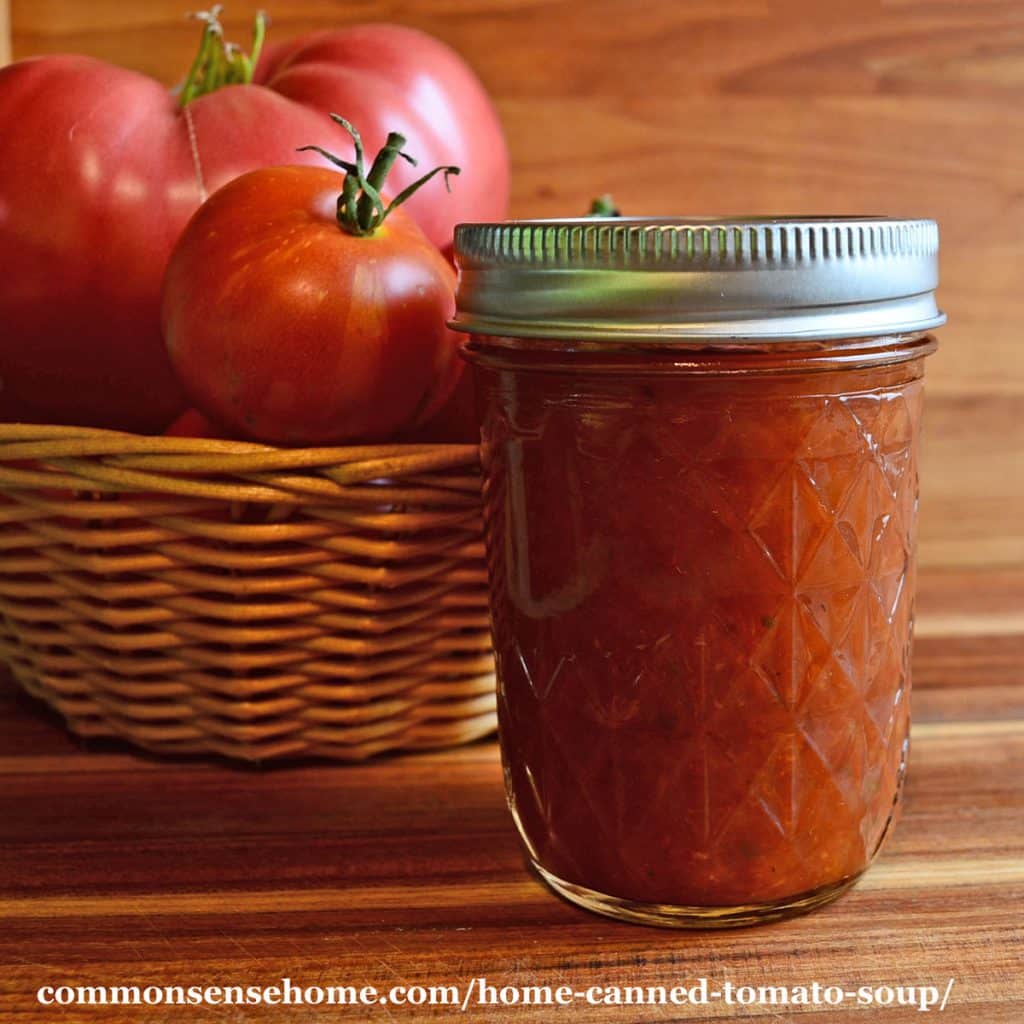
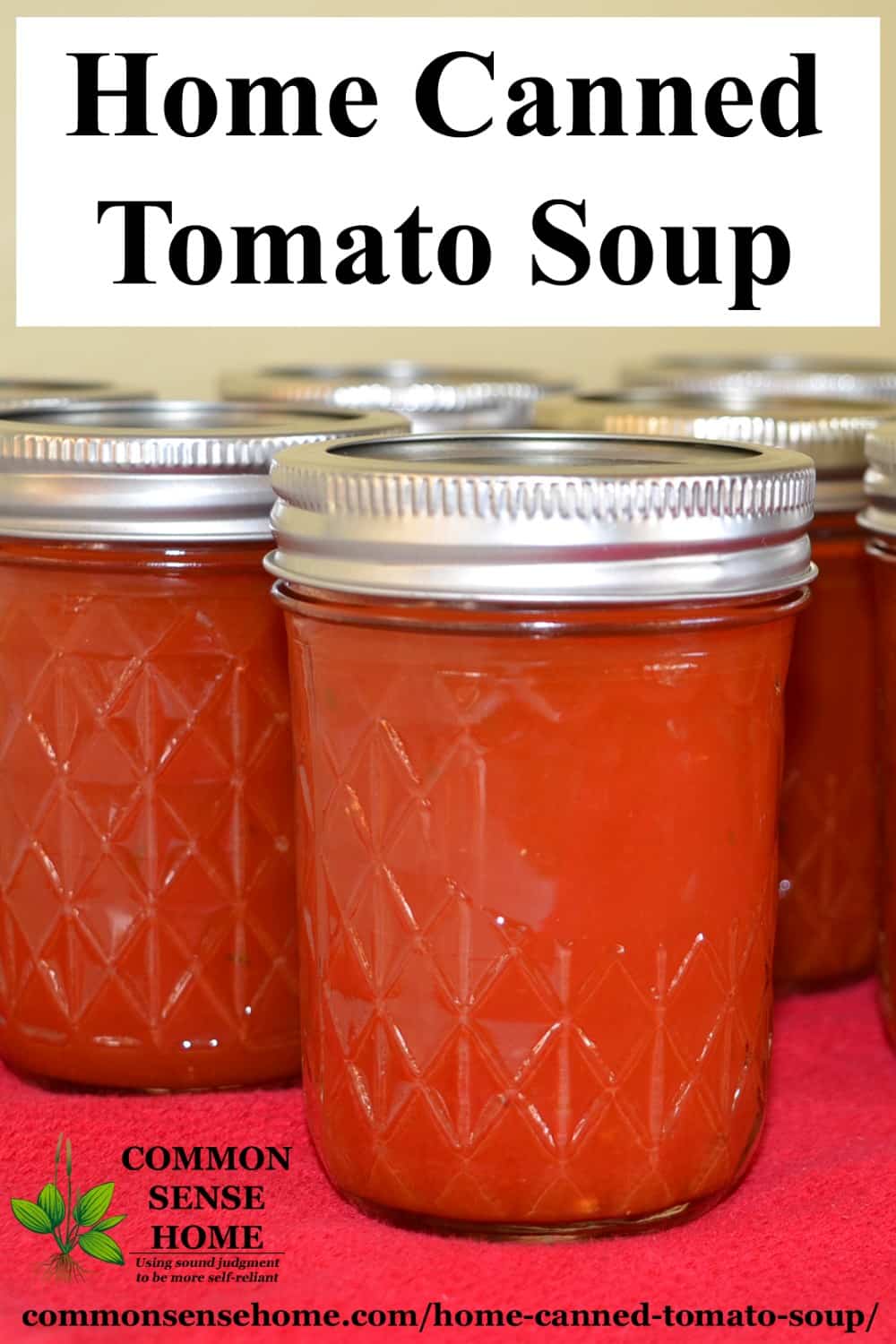
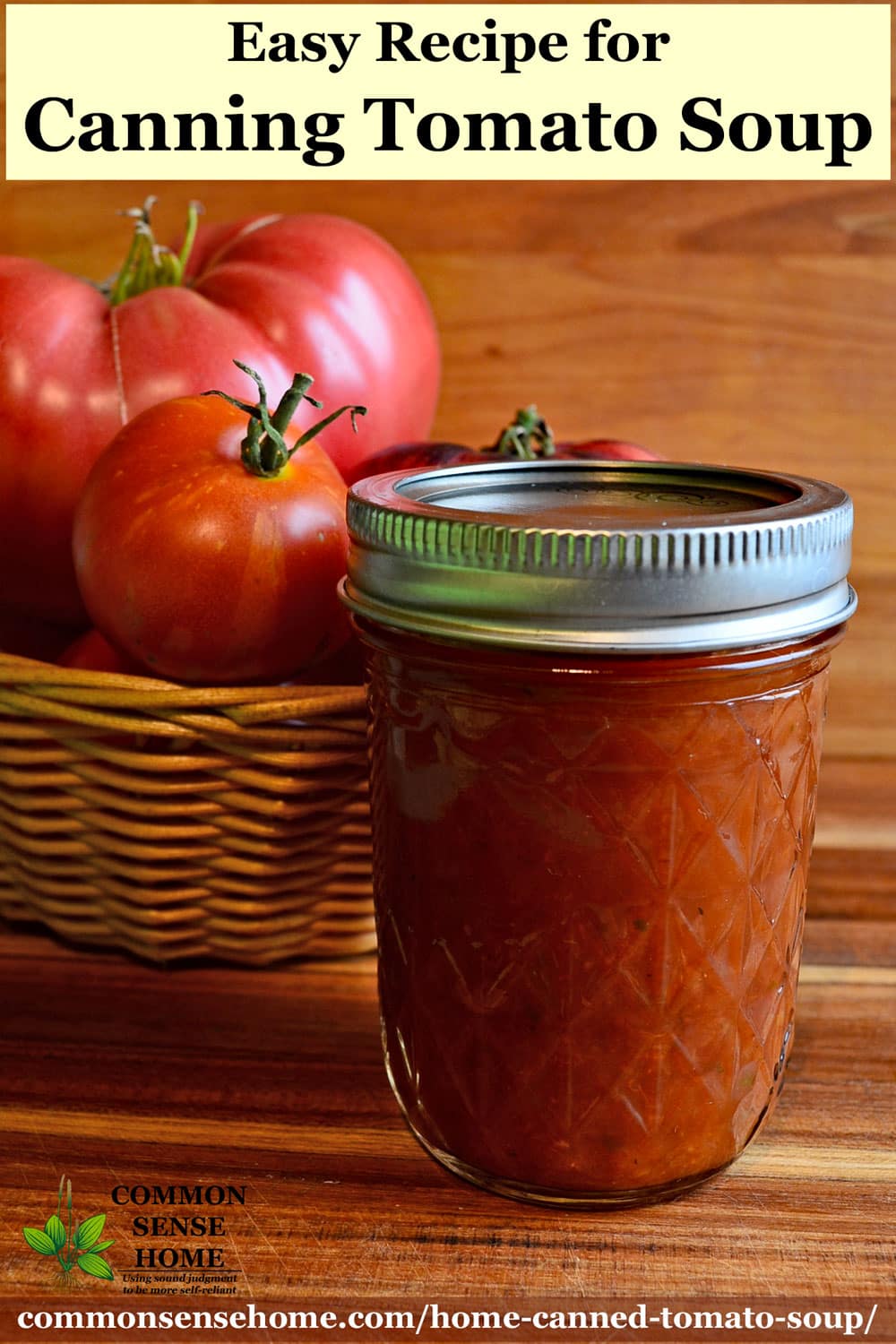
Canning tomato soup is a great way to use up extra tomatoes. We like to can our tomato soup in 1 cup mason jars, which are perfect for a quick lunch option.
Would you like to save this?
I’ve tried a few home canned tomato soup recipes over the years, but none of them were quite what I wanted for my family. All we wanted was a simple tomato soup, something like Campbells or Amy’s, but using our own home grown tomatoes, veggies and herbs for fresher flavor.
This year we finally have a winner. This tomato soup recipe is slightly thickened/concentrated, so it takes up less storage space. When ready to serve, you can add your choice of water, broth or milk.
This tomato soup recipe must be pressure canned or frozen for safe storage, due to the low acid ingredients. (Read more about safe canning and botulism here.)
Process it in pint or half pint jars, not quarts, to insure even heating (because of the thickening).
If you’re using paste tomatoes, the tomato soup will be thicker than if you use juicier tomatoes. Yesterday I made a batch with mostly cherry tomatoes and any other tomatoes I could find in the garden, and after thickening it was pretty much like regular soup, so I reduced the salt and canned it in pint jars instead of half pint jars.
Note: Need help getting your tomatoes to ripen? Check here for tips. Problems with blossom end rot? See this post for help. This recipe was adapted from Canning Homemade.
Easy Tomato Soup Recipe for Canning
Ingredients
- 8 lbs ripe tomatoes, unpeeled, quartered
- 1 cup celery, diced
- 2 cups onion, diced
- 1 cup fresh parsley
- 6 bay leaves
- 3/4 cup Clear Gel or E-Z Gel
- 1/2 teaspoon black pepper
- 2 1/2 Tablespoons salt (optional)
- 1/4 cup sugar (optional)
Directions
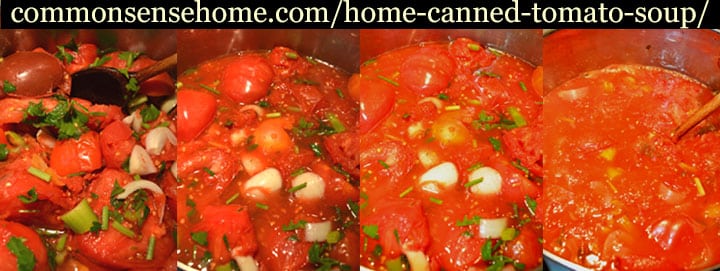
Place tomatoes, celery, onion, parsley and bay leaves in a large stainless steel pot. Cook gently, uncovered, until tender, stirring as needed. I aim to reduce the volume roughly by half, or until it starts to thicken.
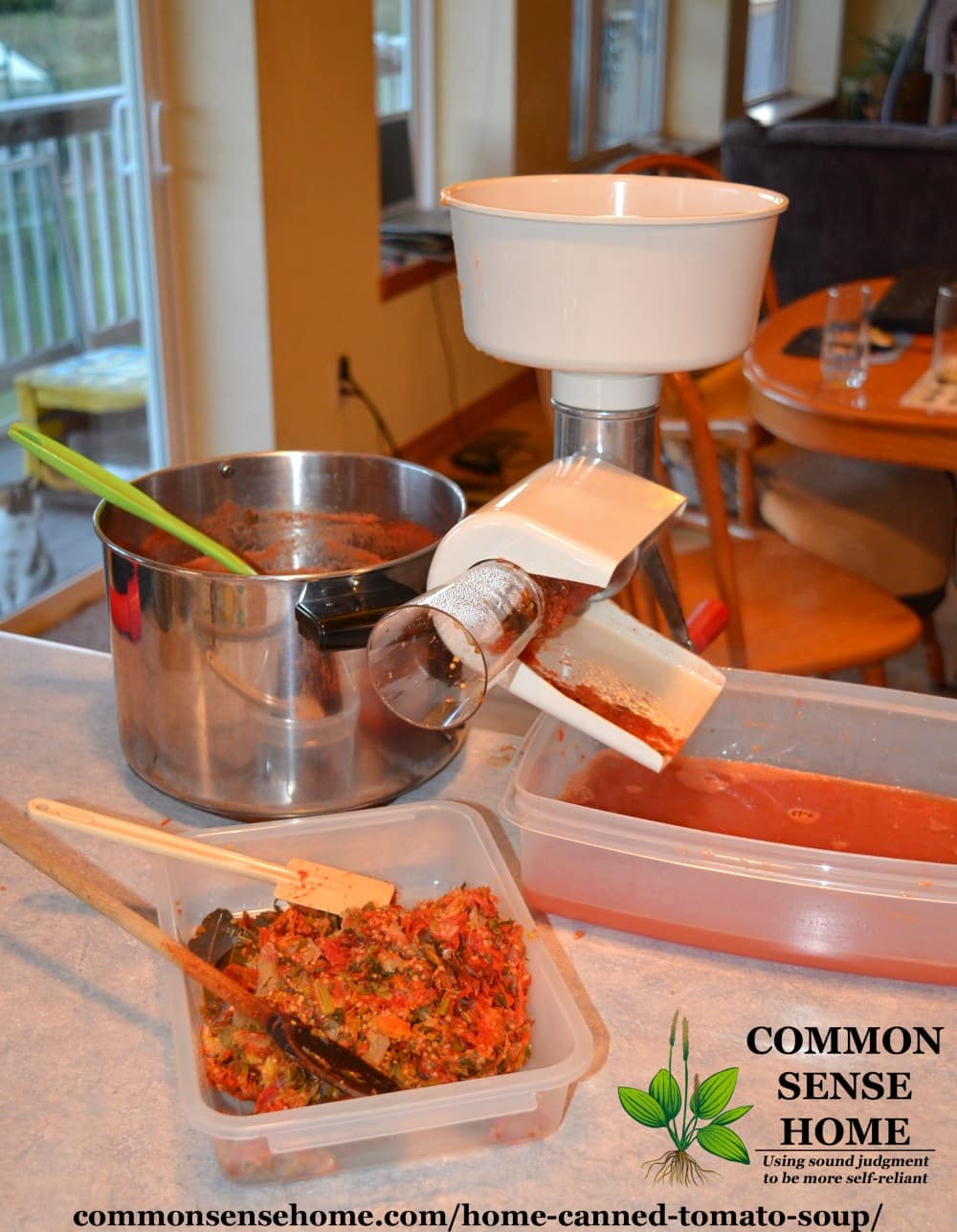
Press through a food strainer or sieve into a large stainless steel or enameled cast iron saucepan. Set aside 2 cups of puree to cool.
Whisk together Clear Gel (E-Z Gel) and cooled tomato puree to form a slurry.
Bring the tomato soup back to a boil and stir in the Clear Gel (E-Z Gel) slurry. Continue to boil for two minutes, until it thickens. Add salt, pepper and sugar (if desired). Soup will not resemble commercial soup concentrate. Instead, it will look like a slightly too thick tomato soup.
Ladle into pint or half pint jars and fill to 1” headspace. Wipe rims and seat two piece caps.
Process in pressure canner at 10 pounds of pressure for weighted gauge and 11 pounds for dial gauge, for 25 minutes for pints or half pints. Do not use quarts for this recipe.
When ready to serve the canned tomato soup, just heat with equal amount of liquid such as milk, water or chicken broth.
Makes around 4 pints.
What is Clear Gel? What is E-Z Gel? Do I Need to Use these for Canning Tomato Soup?
Clear Gel and E-Z Gel are gluten free, non-GMO cornstarch products that can be directly added to any liquid, hot or cold, for instant thickness. They hold up to freezing, canning and refrigerating without weeping, thinning, or breaking down.
Do you need to use Clear Gel or E-Z Gel? Yes and no.
If you are canning tomato soup and want to thicken it safely before canning, Clear Gel and E-Z Gel are the safest, most reliable ways to do it.
Some grocery stores are starting to carry these products, or you can buy Clear Gel online here. You can get E-Z Gel here. Clear Gel is usually easier to find, but I prefer the smell and texture of E-Z Gel.
If you don’t want to thicken before canning, just skip the Clear Gel and use corn starch or flour or homemade veggie powder to thicken after canning, if desired.
My friend, Tami, also uses this canned tomato soup recipe in casseroles or other recipes that call for tomato juice.
Print Friendly Recipe
PrintEasy Tomato Soup Recipe for Canning
This home canned tomato soup recipe is easy to make and kid friendly. The soup is condensed, so it takes up less storage space in the pantry. If you don’t have a pressure canner, you can also freeze the soup.
- Prep Time: 20 minutes
- Cook Time: 4 hours
- Total Time: 4 hours 20 minutes
- Yield: 4 pints 1x
- Category: Soup
- Method: Canning
- Cuisine: American
Ingredients
- 8 lbs ripe tomatoes, unpeeled, quartered
- 1 cup celery, diced
- 2 cups onion, diced
- 1 cup fresh parsley
- 6 bay leaves
- 3/4 cup Clear Gel or E-Z Gel
- 1/2 teaspoon black pepper
- 2 1/2 Tablespoons salt (optional)
- 1/4 cup sugar (optional)
Instructions
Place tomatoes, celery, onion, parsley and bay leaves in a large stainless steel pot. Cook gently, uncovered, until tender, stirring as needed. I aim to reduce the volume roughly by half, or until it starts to thicken.
Press through a food strainer or sieve into a large stainless steel or enameled cast iron saucepan. Set aside 2 cups of puree to cool.
Whisk together Clear Gel (E-Z Gel) and cooled tomato puree to form a slurry.
Bring soup back to a boil and stir in the Clear Gel slurry. Continue to boil for two minutes, until it thickens. Add salt, pepper and sugar (if desired). Soup will not resemble commercial soup concentrate. Instead, it will look like a slightly too thick tomato soup.
Ladle into pint or half pint jars and fill to 1” headspace. Wipe rims and seat two piece caps.
Process in pressure canner at 10 pounds of pressure for weighted gauge and 11 pounds for dial gauge, for 25 minutes for pints or half pints. Do not use quarts for this recipe.
When ready to serve the canned tomato soup, just heat with equal amount of liquid such as milk, water or chicken broth.
Makes around 4 pints.
Nutrition
- Serving Size: 1 cup
Recommended products:
- Norpro Strainer & Sauce Maker
- Clear Gel
- 23-Quart Pressure Canner
- Presto Cooking/Canning Rack for Pressure Canner
- Ball Mason 8oz Quilted Jelly Jars with Lids and Bands, Set of 12
You may also find these articles useful:
- Spaghetti Sauce Recipe for Canning Made with Fresh Tomatoes
- Home Canned Salsa Recipe – Plus 10 Tips for Safe Salsa Canning
- Homemade Ketchup – Canned or Lactofermented
- Pickled Cherry Tomatoes for Canning, Plus More Cherry Tomato Ideas
- How to Can Tomatoes in a Canner or Large Pot
Stacking Jars in the Pressure Canning
This year the boys and I did so much canning that I tried something I hadn’t done before – double decker canning in the pressure canner. If you have a taller pressure canner, it may be safe for you to can two layers of jars at once. You should check your owner’s manual to be sure.
I have a 23-Quart Pressure Canner and also picked up a 16 quart canner on sale this year for smaller jobs. My owner’s manual said it was safe to stack one layer of jars right on top of the other, but I prefer to use an additional rack between layers. (You can order an extra rack here.)
Canning two batches of tomato soup at once was a huge time saver. I’m so glad I finally gave stacking a try!
How’s your harvesting and preserving coming along? (Or maybe it’s planting season where you’re at?) It’s always fun to learn from different folks around the country and world.
Originally published in 2015, last updated 2018.
Please send me instructions that relate to qts of juice. I need be able to multiply and measure qts of juice not pounds of tomatoes…… I love this recipe but I’m guessing. So far I’ve used 80 oz for the 8 pounds. Please advise
I have no idea how many quarts of juice you would need, given that the amount of juice yielded would depend on the tomatoes. I found a juicing site that estimated a juice yield of 8 to 10 oz. per lb. of tomato, so if you like you can do the math and use that as an estimate.
Why do you say that you can’t use quart jars for this recipe? I have a pressure canner and feel that if I just increase the canning time, all should be well. What are your thoughts?
I don’t recommend using quart jars because I don’t have a way to test it. In the Ball Blue Book, they have a spiced tomato soup recipe which is thickened with an assortment of vegetables, and they only give the processing time for pints. I made that recipe first before I switched to the current recipe. The thickness of both products is similar, and there are no chunks, so a similar processing time should be effective. I don’t have a tested reference for quart size for this recipe.
The National Center for Home Food Preservation has soup guidelines, but not for a basic tomato soup. Their general soup recipe includes meat, vegetables and seasoning making up no more than half the contents of the jar, with the rest being unthickened liquid. For the mix of solid chunks and liquid, they bump processing time all the way up to 60 minutes for pints and 75 minutes for quarts.
In their Spaghetti Sauce without Meat recipe, they process quarts for 25 minutes, so it should be safe – BUT – the thickening is the wild card. If your soup looks more like thick soup and can move freely in the jar, then heat transfer should work well. If you’ve cooked it down fairly thick, and then added the UltraGel to make it really thick, that will slow down heat transfer. If you want quarts and don’t want to worry about how thick is too thick, skip the UltraGel and can away.
What is meant by ‘two piece caps’? Sorry, but I’m also relatively new to canning I am going to try this recipe, though! Thanks.
Are you familiar with canning lids, with the ring and the flat round piece that stays on the mason jar? That’s what I’m referring to.
can I add citric acid, just to be sure its safe?
Citric acid can be added and won’t dramatically change the flavor.
Thanks so much for you response. I am making a batch today, I am new to canning and am trying to make sure I do everything right. This recipe looks fantastic!
You’re welcome.
I have frozen tomatoes. When they are thawed they are quite soft. Any recommendations on the first step of boiling them to make them soft?
The tomatoes should be simmered gently and stirred regularly, not boiled, to avoid scorching to the bottom of the pan. Cooking will soften the tomatoes.
Can I just seed my tomatoes and follow the recipe but NOT put this through a food strainer and can
it that way? still using the pressure canner and times listed.
As long as you don’t mind tomato skins in your soup, that should be fine.
HI Laurie, great blog, love your recipes!! I can’t wait to try this soup.
Thank you, Alison, and welcome.
Can I just puree it all and sieve to get seeds out then cook it and why can’t this be hot water bathed? I do with my salsa and spaghetti sauce.
You can do whatever you like, but I won’t recommend it. Only items with a pH of 4.6 or lower can be safely water bath canned, and with the added veggies, odds are that the pH will be above 4.6.
I made a double recipe but ended up with 12 pints instead of the 8 I was expecting. I used coconut milk when making a jar to eat and it was very good but I will cut back on salt the next time.
Thanks for sharing your experience.
Living in Phoenix, AZ, I rarely have a bumper crop of tomatoes like when I lived in Illinois. Can I use canned tomatoes? If so, how much?
I haven’t tried canned tomatoes, but I’d aim for roughly the same weight as fresh tomatoes.
Would it matter if I squeezed the tomatoes before cooking I have a 5 gallon bucket of juice and want to try something new this sounds good
Are you thinking that you’d like to squeeze off some excess juice to cut down the cooking time? That should work just fine.
My family loves this recipe. Thanks!!
So glad that you like it, and thanks for taking time to let me know.
I have a similar recipe for tomato, basil bisque that I make. I take the tomatoes and vegetables that are cooked until they are very mushy, cool them, run them through the blender to puree, then run them through my Squeezo. Very little waste when I do this. I have never tried to can it. Still freezing it in meal size portions.
Thank you for the link to this post (Instagram). I can’t wait to try this! Tomato soup is one of my fave no-fuss soups!
It’s not fancy, just simple and good. The boys really enjoy it. They ate what didn’t fit in the canner with the first double batch I prepped this season right away for lunch.
Hi, I’m sorry but I don’t know what the gel is that you mention. This sounds so good and the salt being optional is great for our low salt diet. I really want to make this
As explained in the post in the section “What is Ultra Gel?”, Ultra Gel is a GMO free modified corn starch that is used to thicken the soup. Some grocery stores are starting to carry it, or you can click here to buy it online.
Tomatoe vines on hog panels! What a great idea! We have stakes but don’t use them and this year is wet and may be drowned today. I grown cucumbers and pole beans on panels and even tried cantalope.
Next year it will be tomatoes. Thanks for the tip.
Instead of throwing away all that goodness, couldn’t you put in a blender? It seem like it would thicken a lot easier. But Iv’e never made it before so I don’t know. I still get jokes made about certain things I’ve tried before. 🙂
Some people blender their tomatoes for sauce or soup. I did it – once. The seeds made it so bitter it was inedible – but I do have a very sensitive palate. Other people do it and claim to like it. Everyone has different tastes. If you give it a go, try a small batch first.
When you blended it all instead, did you still pressure can it the same amount of time and pounds of pressure? I am wanting to try both ways, but really think I would like a bit of “chunk” in mine! Thanks 🙂
As long as it’s not crazy thick, leaving it “chunky tomato style” should be just fine.
Can i use corn starch in replacement
It’s not generally recommended anymore because it is more likely to clump and heat unevenly, but you could try a batch and see how it turns out if you don’t want to order the UltraGel.
I am fairly new to canning and the info I’ve sought out at my local extension office warns me about using recipes that are not tried and true (like Ball Blue Book recipes are) due to the safety component. What is your opinion on that? There are so many delicious looking canning recipes out there but I also don’t want to put my family’s health in jeopardy. The extension lady said I could freeze these recipes but I’m looking for things that are shelf-stable for space reasons. Thanks in advance, I love your blog!
In general, I’d say your local extension office is spot on. There are a lot of recipes out there that are not safe. That said, as long as you follow safety guidelines, there is a little flexibility. For instance, this soup is a non-chunky liquid, so it should heat evenly, not leaving any cold spots in the jar because of unevenly sized or dense components. My canning time is based on a very similar recipe in the Ball Blue Book, and uses a pressure canner, so that should safely account for an unknown acidity level.
For detailed information on the chemistry that makes canning safe, I’d highly recommend The Natural Canning Resource Book – https://commonsensehome.com/the-natural-canning-resource-book-book-review/
Hi
I used a vegetable strainer to strain everything except the bay leaves then I boil it for abou twenty min then add the clear gel mixture and bring it back to a boil then process the soup
Can you use a steamer canner or hot water canner instead of the pressure cooker?
No, this recipe should be pressure canned or frozen for safe storage due to the large amount of low acid ingredients.
Thank you so much for the concentrated recipe! As someone who is into nutrition and don’t want any artificial ingredients, I have been trying to make my own “concentrated” tomato soup for the last couple of years now. My first batch was just two years ago, I just followed the recipe in my old Kerr canning book, which is NOT concentrated. Last year I tried reducing my tomatoes down and followed the same recipe (it does taste good) but still was not the “concentrated” form I was looking for. We love home made Dorothy Lynch salad dressing which calls for one can of Tomato Soup. For the dressing I replaced the sugar with honey and use Extra Virgin Olive Oil to make it healthy but my soup recipe was making this too thin. I’m anxious to try this recipe!!!
I was going to ask what variety of tomato to use… Roma or regular tomatoes… because they all vary so much in water and taste but I think each person may have their own preference. My personal preference is Roma’s. I love Martino’s for sauce, they are small and have great flavor and the vines reach about 3-4′ tall and heavy producers. I also tried Amish Paste which are larger Roma’s with vines reaching 6′. These broke down quickly also in cooking. I wasn’t able to buy Martino’s this year and bought San Marzano’s. The tomatoes are twice the size with vines reaching 6′ on my hog panel fence. I just started harvesting and can’t compare how they cook up yet. I’ll probably just cold pack them. The Martino’s broke down quickly and would not hold up to canned diced so I’ll see how these do for diced tomatoes. Also, some tomatoes are more acidic than others and they don’t all taste the same, so you’re only going to get out what you put in as far as quality taste.
I haven’t grown Romas in years, so I can’t speak for the taste with those. The first three batches I made were mostly paste tomatoes – Opalka, San Marzano, Amish Paste. The consistency was thicker and the flavor was smoother and more mellow – good with and without the added sugar. (I tried with and without sugar and salt.)
The last two batches I made I used an assortment of heirlooms, including many cherry tomatoes – garden peach, green zebra, peacevine, yellow pear, pearly pink, black cherry, mortgage lifter and a few others. We’re had a ton of rain lately, and the tomatoes were really juicy. Even with thickening, the soup was still not “thick”, just less thin. Because of the acidity of the cherry tomatoes, I really felt the sugar was a good counter balance on the flavor. As I mentioned in the post, I cut the salt down and bottled it to use “as is”.
All the different variations were good, but the batches with almost all paste tomatoes were most similar in flavor to commercial products, as one would expect.
Have you ever tried Beef steak tomatoes for this recipe? If so, how did they work?
I’ve never tried it with Beefsteak tomatoes only, because I usually mix whatever types I have on hand, but I’m sure they would work just fine.
Tomatoes and no garlic? Blashpemy, LOL….sounds tasty even so…
You can always have garlic bread on the side, or garlic croutons. 😉
Very excited to try this soup! I’m wondering why your not adding a little lemon juice for safe canning?
I find that lemon juice significantly affects the flavor in a way my family doesn’t enjoy. Because it’s pressure canned, additional acid is not needed.
Thanks for the recipe and all the hints. Really enjoyed the information very informative thanks again.
You’re welcome, Gail. Making up another double batch again today.
Holy cow! i just made this and alas there wasn’t room in the caner for that last jar. I was forced to add some milk and eat it. My son and i will never but that National Brand again. this is fabulous!
I was thinking about adding some garlic, but the first time i make something i like to stick to the original recipe. Maybe next time.
I do have one question (as i sit sipping this yummyness). i ran this through a Roma mill and the chickens were very happy to get the leavings so there is no waste. but i wonder how it would be if it were all scrambled in a ninja or vitamix to retain the part the chickens got. any thoughts?
D’oh i just realized you’d already answered this question….. my bad.
Can you can the soup without putting it through the sieve
Yes, you may can it without straining, but I would recommend at least pureeing or making sure to use small chunks so that it heats evenly.
I’m about to make this recipe and I intend to just use my hand blender for 1 batch as I like a chunkier soup option.
I’ve made the chunkier version before with different recipes. This recipe sounds delicious!
Some have dehydrated the peels and then ground in a coffee grinder to use as flavoring