
Harvesting and Using Dandelion Roots for Food & Medicine

This post may contain affiliate links. Read my full disclosure here.

Dandelion roots have long history of use as food and medicine. I’ll share the best time to dig dandelion roots, tips for preserving them, and how to use them. Who doesn’t like free food and medicine?
Note: Never harvest dandelion roots from lawns or other areas treated with herbicides or pesticides. The roots accumulate anything sprayed on the soil.
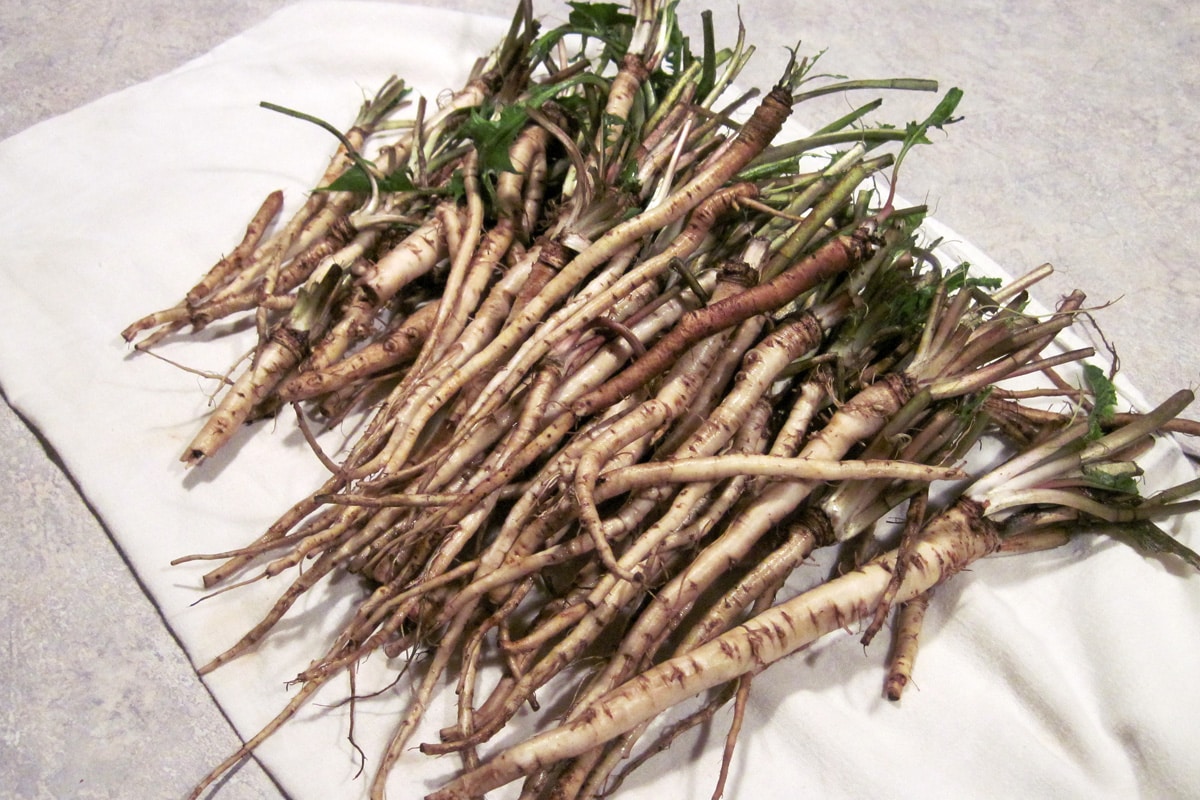
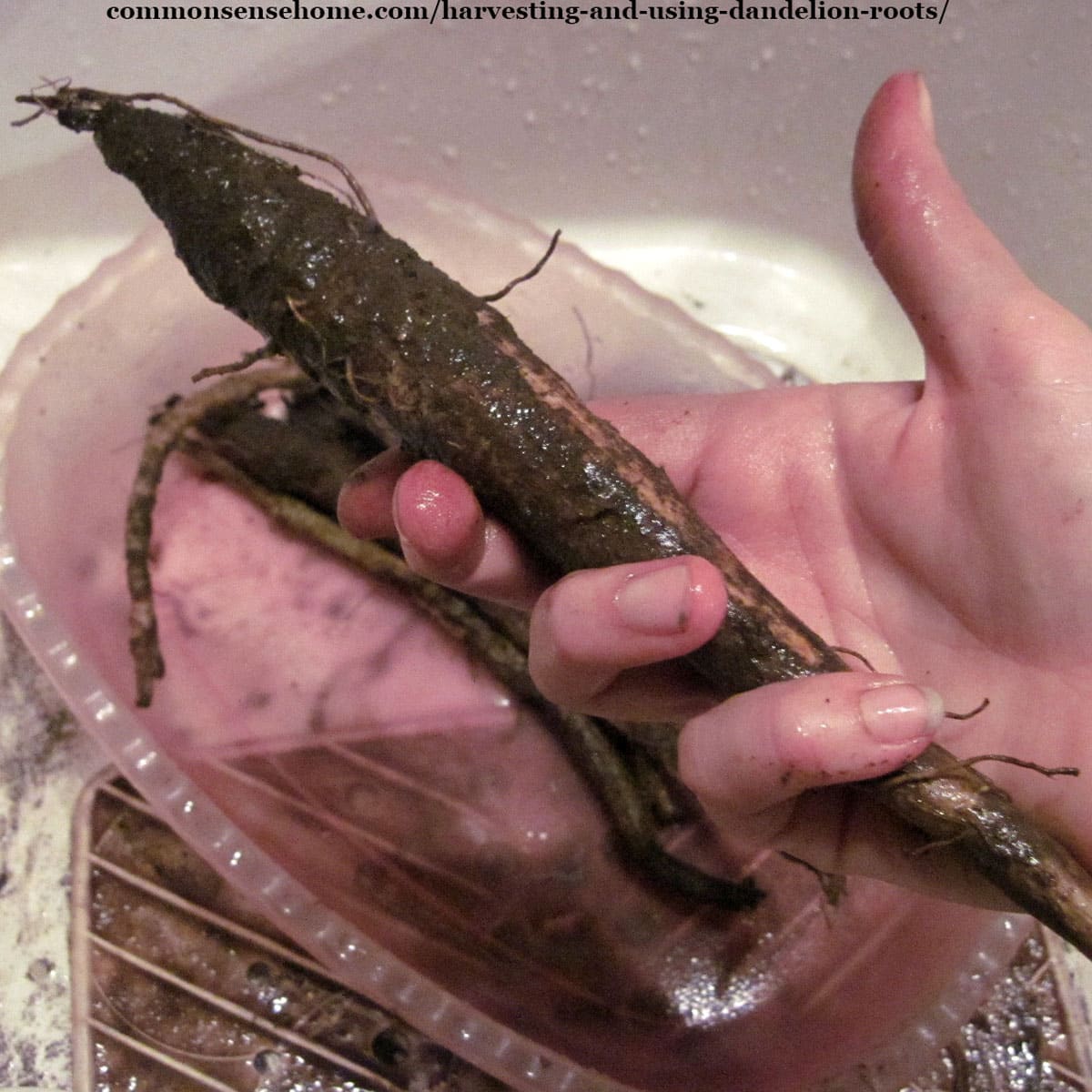
I dug up this pile of dandelion roots while harvesting other fall root vegetables from the garden.
Would you like to save this?
Table of contents
When Should I Harvest Dandelion Roots?
Harvest dandelion roots from late fall through early spring, when the plant is dormant and has stored up energy in the root. (Spring dandelion greens are less bitter, if you are using the whole plant.)
For medicinal use, most sources say fall harvest is best. In fall, the levels of inulin (insoluble fiber) are higher and the fructose levels are lower.
The freezing of winter converts the inulin to fructose, which makes spring roots more palatable for eating. Spring roots are less bitter and chewy – just make sure you dig them before the plants start to blossom. Spring roots are also higher in taraxacin, which stimulates bile production.
What’s the Best Way to Harvest Dandelion Roots?
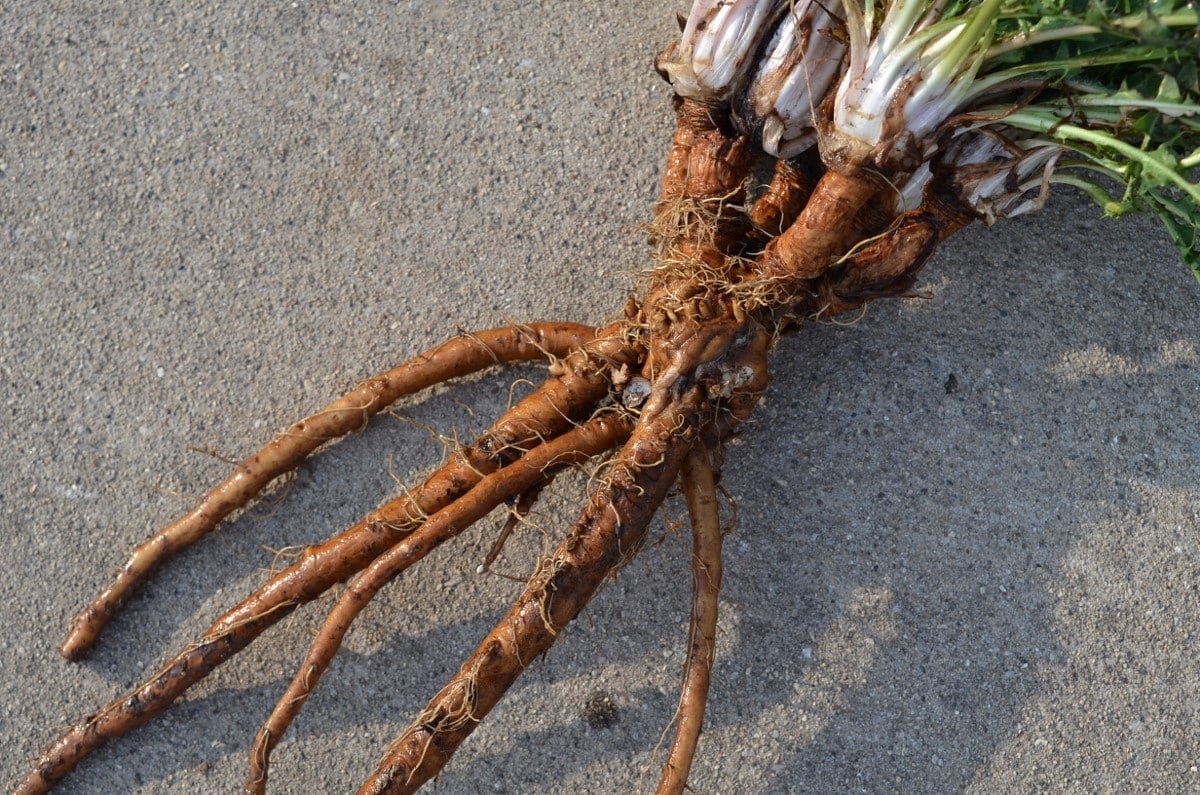
To dig roots, use a dandelion digger or a sturdy fork. Try to damage the root as little as possible so you don’t lose much sap, which is where the medicinal properties lie. Deep, rich soil produces the thickest, easiest to harvest roots.
I always let a few dandelions go in the garden, as they are great for reaching deep into the soil to bring up nutrients.
Select large, vigorous plants – small, spindly plants have small roots that are not really worth harvesting. Sometimes you find larger roots with dark cores. These are older plants, and the roots will be tough. They’re still fine for making dandelion root tea and medicinal use.
You can chop and freeze the roots to use later, but the most common storage method is dehydrating. Rehydrate your dried roots in soups, or use them for teas or tinctures.
How to Dry Dandelion Roots
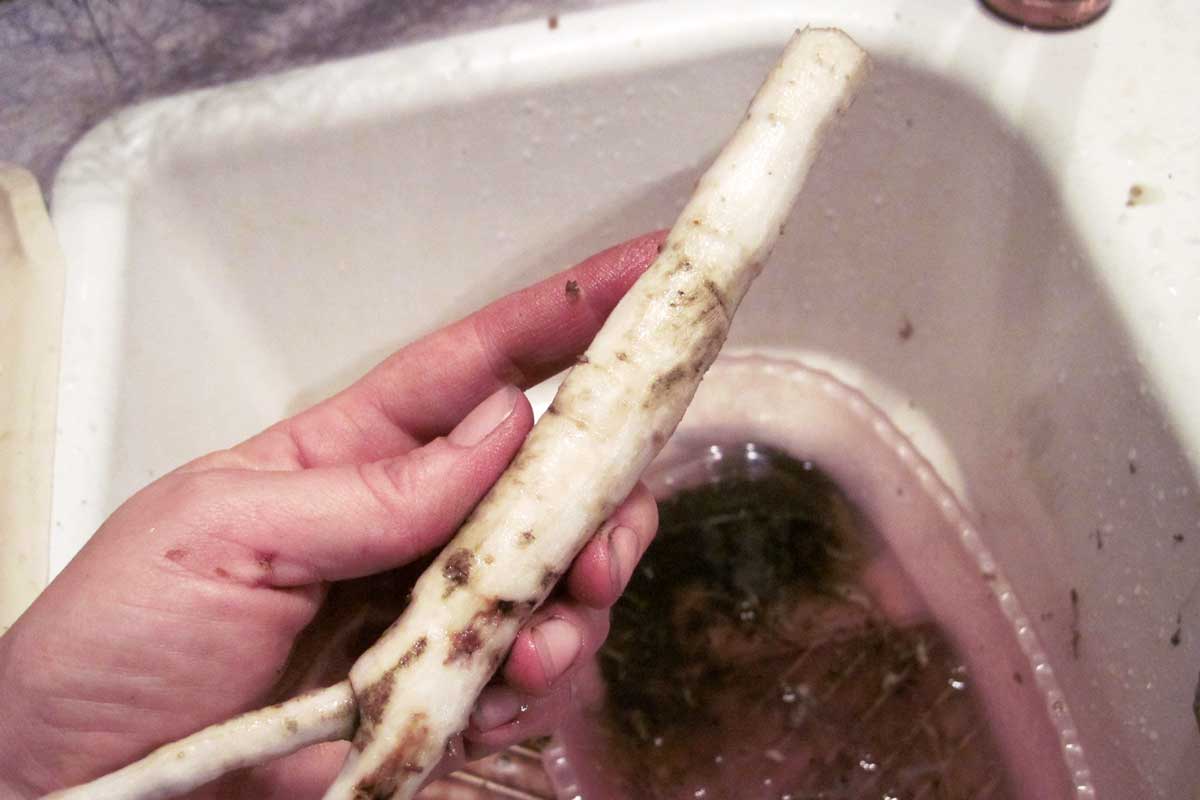
Begin by scrubbing roots well with a vegetable brush, or peeling larger roots.
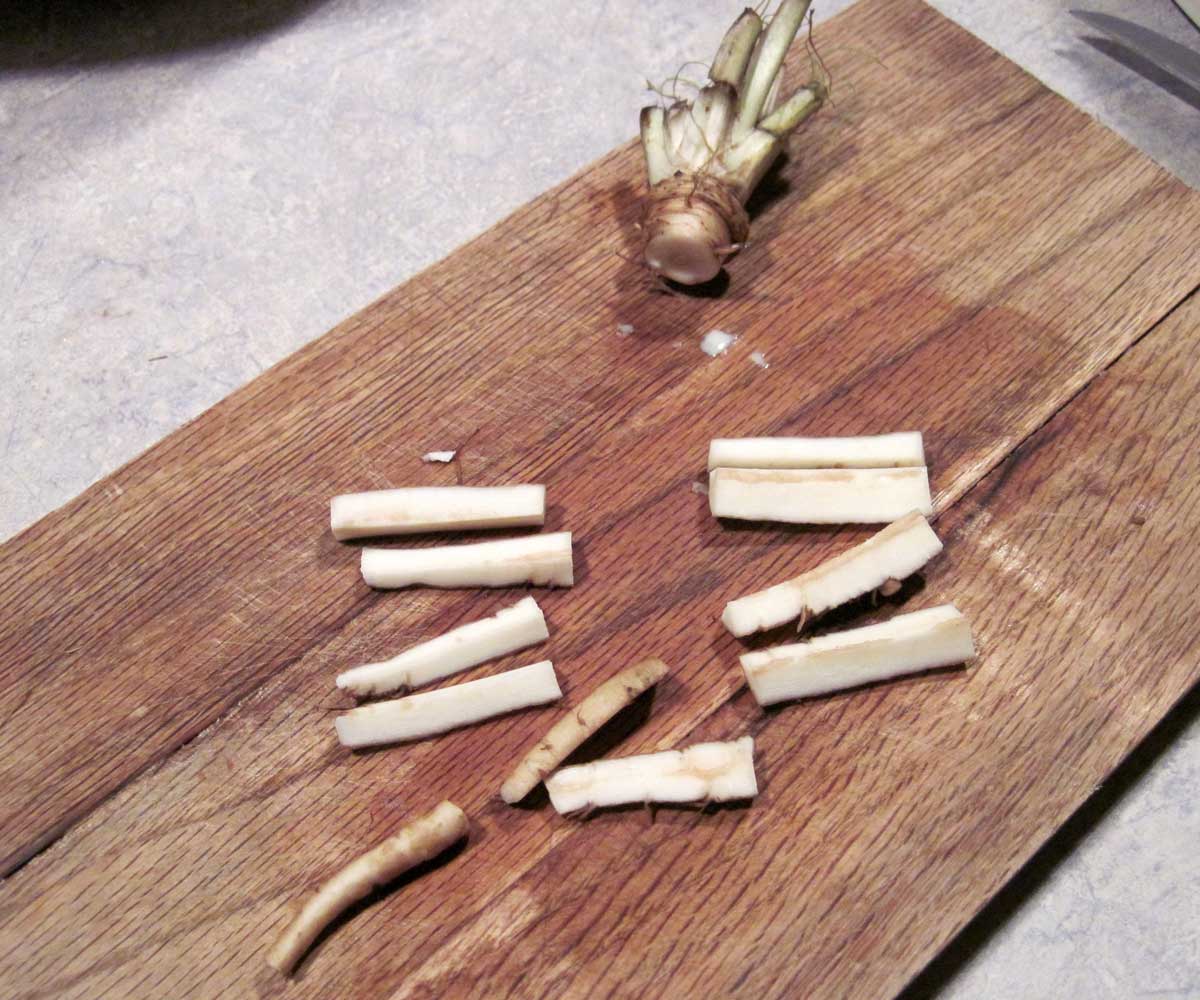
Slice thick roots lengthwise into strips of uniform thickness to decrease drying time and encourage uniform drying.
Spread the chopped roots in a single layer on dehydrator sheets. Dry the roots at 95°F (35°C) until brittle.
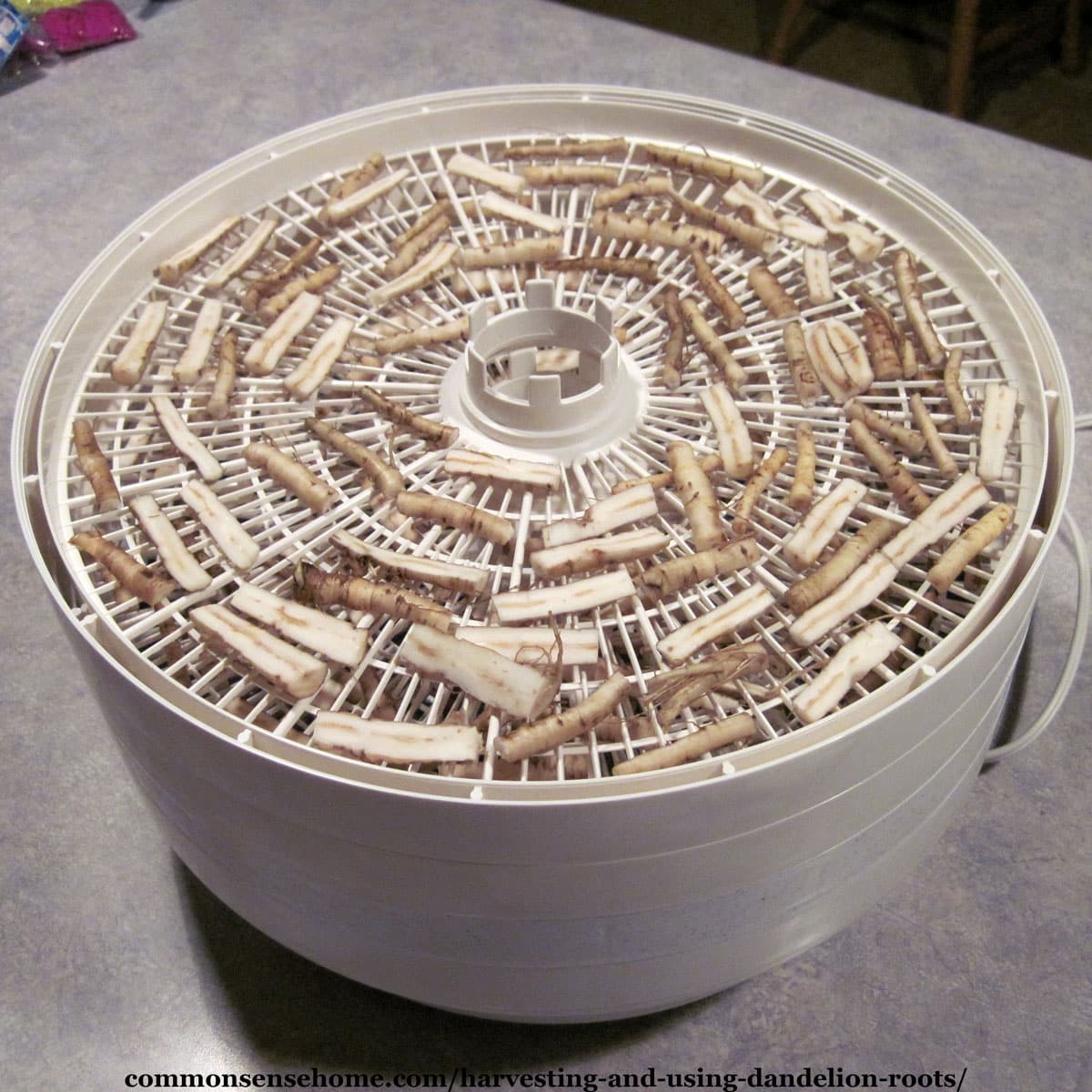
If you don’t have a dehydrator, spread the root pieces in a single layer and place in a dry location with good air flow. Air dry for 3 to 14 days (until brittle). Dried roots will keep for a year or more.
Don’t have time to dig or a clean spot to harvest?
You can buy clean and prepped roots, teas, and extracts online, ready to use, including:

How to Cook Dandelion Root
If you don’t mind a little bitterness, dandelion roots are safe to eat raw. The flavor is mildest in late winter/early spring. Katrina Blair notes in “The Wild Wisdom of Weeds” that she makes dandelion relish with ground roots, apple cider vinegar, and honey. You can also add the shredded roots to homemade sauerkraut.
Peel roots from older plants before cooking. Younger roots are fine with a good scrub. You can treat them like other root vegetables, though some people may notice the bitterness. My crew is used to the stronger flavors of wild plants.
Cut the cleaned roots into uniform pieces, and toss with a bit of oil and salt. Spread on a baking sheet. Bake the roots at 375℉ (190℃) for about 30 minutes, until fork tender.
Boil roots for about 10 minutes with a pinch of baking soda in the water. Change the water and boil for 10 minutes more to reduce bitterness. Eat the cooked roots warm or chilled. The inulin in the roots acts as a prebiotic, promoting the growth of beneficial bacteria in the colon.
If you like bold flavors, simply chop the root and add it to soups or stews. The Wild Wisdom of Weeds includes a simple dandelion root stew recipe, with the following ingredients:
- 1 cup fresh dandelion roots, shredded
- 2 tablespoons sweet white miso
- 1 avocado, diced
- 1/2 cup scallions, diced
- 1 cup fresh yellow squash, shredded
- 6 cups water
- 1 tablespoon fresh garden herbs, minced
Add all ingredients to a pan and heat through, stirring to blend well. Note that the raw or lightly cooked roots may produce flatulence for some, due to the inulin content.
Medicinal Uses
Dandelion root has been used to treat everything from arthritis to hangovers. In traditional medicine, dandelion (Taraxacum officinale) root is used many ways, including as a:
- Liver ally and diuretic
- General tonic
- Anti-inflammatory
- Digestive stimulant
- Deobstruent (clears and opens ducts)
- Sedative
Most scientific studies have been in vitro or animal studies. Dandelion root extracts show promise against cancerous cells, type 2 diabetes, liver damage, and more. As a diuretic, dandelion clears excess fluid, lowering blood pressure.
In “A comprehensive review of the benefits of Taraxacum officinale on human health” the authors review 54 studies. They found that the most commonly reported effects of dandelion were hepatoprotective, antioxidant and anticancer activities.
To extract the medicinal compounds from the roots, use a decoction or tincture. Decoctions are water based, while tinctures are generally alcohol based. A decoction is essentially a strong tea.
Make a Dandelion Root Decoction
To make a decoction, place one ounce of dried roots or two ounces fresh roots (by weight) in a pan with one pint of water. Bring to a boil, cover, and simmer for 20 minutes. Strain and compost the spent roots.
See How to Make Dandelion Tea for recipe variations, including roasted root tea and healing tea blends for specific ailments.
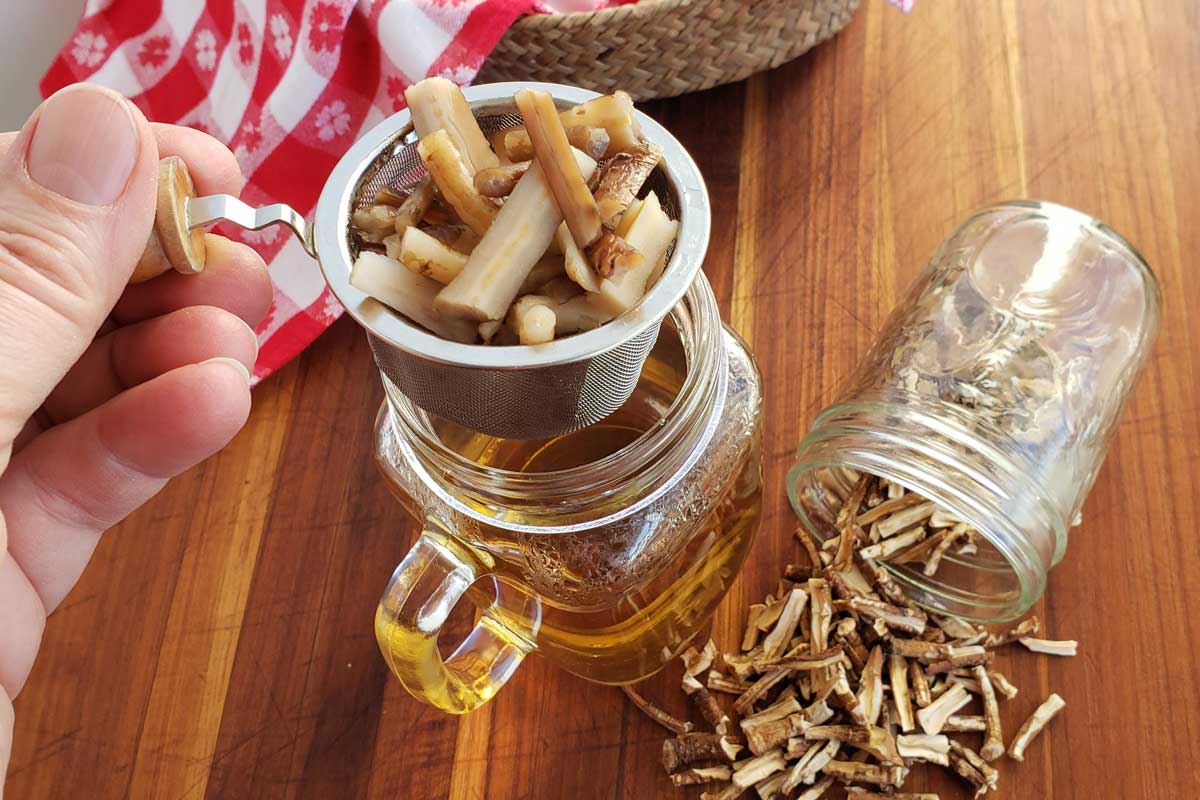
Make a Dandelion Root Tincture
To make a tincture, place dandelion root in a jar and cover with 80 proof (40%) vodka. Cover tightly and allow to steep 4-6 weeks, shaking daily.
Strain out plant material and store in a dark glass bottle. Label and date.
Side Effects and Allergic Reactions
While rare, dandelion sap can cause contact dermatitis in sensitive individuals. As a diuretic, it may flush medicines out of your body faster. If you are allergic to plants in the daisy family, you may react to dandelion.
Do not use dandelion root if you have irritable stomach or bowel, or if you have an acute inflammation. (source)
If you suspect you have gallstones larger than 1.5 millimeters, avoid using dandelion root. You might accidentally flush the stones into the bile ductwork. There they can get stuck and cause a lot of pain.
Note: Always talk to a healthcare professional before taking any herbal medicine if you are on prescription medications. This article is not intended to treat, cure, or prevent illness, or replace professional medical advice.
More Information on Dandelions and Using Wild Plants
Wild plants are a wonderful resource for those who seek healthy, nourishing food with abundant nutrition. The flavors can be strong, but I find that the more I eat, the more I crave them. I hope you’ll give this humble weed a chance in your garden and your kitchen.
Don’t forget to check out the other Wildcrafting posts, including:
- Benefits of Dandelion
- How to Make Dandelion Wine
- Easy Dandelion Fritters
- Dandelion Flower Jelly
- How to Get Rid of Dandelion Without Chemicals

This article is written by Laurie Neverman. Laurie is a lifelong learner with a passion for natural remedies and holistic healing. She’s successfully improved her eyesight and cleared her psoriasis.
Can you tell me should dandelion root extract be dark? Should it have a smell?
Thanks
Lina Alford
There will be some odor (kind of earthy) and the color will darken. Exactly how dark it gets depends on how much root is used and the specific root.
What’s the difference medicinally between a dandelion root decoration and the dandelion root coffee?
The decoction normally uses raw or dehydrated roots, slow simmered, which allows more of the compounds from the root to infuse in the water. The roasting process for coffee may cook off some of the volatile compounds, and coffee is not typically slow simmered, so there’s less time to transfer compounds into the water.
Is that first picture really a dandelion root? Where on earth did you find one that big? That’s amazing :O I’d love to have seen the plant it was attached to.
I leave a few plants in my garden to mature and dig them up in the fall when I’ve harvesting other root vegetables.
I’m growing dandelions in a pot. Saved a single plant that was growing in a rose bush pot and transplanted it into its own pot. After a short time of stress (wilty leaves and such), constant watering revived it and its VERY healthy now. Popping out so many blooms/cotton balls, I’m sure my whole back yard will be full of dandelions… and it’s all gravel! :-D.
I’m growing them for the roots mainly, but would like to know how you get the dandelions to produce those long slender leaves (like you see in stores) and not just turn into a squat green plant (like you see most in yards). It was tall and slender in the rose pot, but turned into a squat green thing in its own pot. Hmm.
You’ve hit upon your own answer – those long, slender leaves result from conditions where the plant is crowded into a smaller space but other plants competing for the same space. In the yard or a pot by itself, it spreads nice, fat leaves above the grass and pot. When it has to compete with other plants (like the rose, or other close planted dandelions), the greens stretch up instead of spreading out.
Want a wonderful, natural, free side dish or appetizer? Since I was a young girl my dad would pay us .25 cents a bowl for dandelion heads. Mom would batter them like chicken and deep fat fry them. I have done this since I was old enough to cook I’m 50 now. My neighbors always know if I am out picking flowers in m pajamas I’m fixen to fry dandelions lol. My sons on a Saturday morning would hear, smell or have radar not sure would come busting out of their rooms and get excited for dandelions!! One sure way to get them up early!!! Its as natural for them as having French fries. They remind me of mushrooms and my sons love them with ranch dressing!
Great article, Laurie. Thank you for writing such an informative piece and updating through the years. While harvesting potatoes at our CSA, my son brought me a huge root and asked what it was. Realizing it was dandelion I decided to start collecting the roots to bring home. They have now sat for two weeks uncleaned. Would anything have been lost during this time or can they still be processed as if fresh? To date I have only consumed the leaves and flowers or purchased dandelion “tea”.
Ideally it’s best to process them as soon as possible after digging. If the green are still attached, the roots will do their best to keep the greens alive, sending up nutrients out of the root. If the greens have been clipped, the roots are likely in better shape, but they will be wilted and much more difficult to clean. Might as well try working with them if you have time. Nothing to lose.
Hi Laurie,
Great article! For those of us in the north with snow in the winter, should we harvest roots in the fall as well? Right now we have lots of dandelions blooming. I’d like to pick the heads to infuse. Is this a good time to do that? Should I be leaving the roots alone? I’d like to try making the ‘coffee’.
I often dig dandelion roots in fall when I’m harvesting other root vegetables. Roots are best harvested in fall or early spring before blossom time for maximum nutritional/medicinal value, but if you want to experiment with dandelion coffee now for the heck of it, we both know there will be more later to harvest at the “right” times. Pick the blossoms when they show up and use promptly, as blossom season is come and gone in a flash.
Hi, i’ve just gathered a load of dandelion roots to make powder. The flowers are in full bloom (may 4th) will these be ok to ingest?
Thanks
It won’t hurt you to eat them, i.e., they don’t suddenly become toxic. When the plant flowers, it pulls energy and nutrients out of the root. This may the root tough, with less nutrients and lower medicinal quality.
I make a powder all the time. Keep it in the fridge. Use it to clean out my liver and kidneys, I dehydrate, put in blender and make a powder. can use it for tea. Or just take a little on a teaspoon with water. Great stufff!!!!
I love the little sun ball flowers of the spring. I eat the flowers raw in salad make fritters and infuse into olive oil for breast massage oil. The greens I add to salads or even grab and mouth full straight off the plant and chew while working in the yard. The roots are dried and made into a nice brew. But into a coffee? Or tea? Not so. Coffee is an actual plant not just a drink and tea is an actual plant just as dandelion is an actual plant. Really wish bloggers would get this right. So I have a nice cup of hot dandelion while hubby has a nice cup of hot coffee. Never have eaten the root tho. Think in will try this out. We don’t get to many bumblebees bees but plenty of little bees and this year we got amazing amounts of hummingbird moths all over our dandys and it was an amazing sight! Nice article.
While coffee and tea are indeed specific plant species, the terms “coffee” and “tea” are now regularly used to describe beverages with similar flavor profiles, whether or not the original plants are involved. It’s not a mistake, it’s a common usage of the terms.
Hi, Great reading. I’ve just made my first litre of tincture (Dandelion virgin) I will leave it for 100days and then strain out. I was wondering if it would be useful to also use dried root ground to a powder in a coffee grinder to fill capsules with or would it be a waste of time because no heat will have been applied? Does it have to be heated to be effective?
As I understand it, heat or alcohol do help to make the nutrients and compounds more available, but given the large number of dandelion root capsules available for purchase, odds are you’re still getting something out of the powdered root.
Unless you have another blog, you copied this article Word for Word from another person who published the same article in 2014. Is that you or is this just copied?
I’d like to know who I supposedly copied it from, given that I originally wrote the post back in 2012, and updated it again in 2014 and 2017. That’s my counter top, my window, my cutting board (if you look really closely, you’ll see that it’s unusually narrow because one of the sections of wood broke off), my pink plastic bowl in the top photo that was given to me as a Christmas fruit basket from my sister, and most of all, my dandelion roots. Maybe you read a copied post previously?
I’m talking content not photos. I was searhing a key term yesterday and happened upon your blog as it was first in Google results. I then went back to look at some of the other articles and noticed there was another post from 2014 from another blog that had the exact same wording. After reading your reply I highlighted one paragraph of your post and pressed “look up” on my phone. There are currently three other blogs that use this exact same wording. So somebody copied somebody. Perhaps they all copied your article from 2012? If so it’s good to know that you are still first in Google results….and this article is great btw! Apparently enough to be reprinted by others.
Can you let me know what search terms you used or where you found the content? I don’t allow reprints, so someone is illegally stealing my content.
I dig dandelions in the late autumn and fall to make dandelion coffee. I put the roots on a wire mesh and wash them clean with a domestic power washer. It will remove all the soil and debris from the roots, but use the fan instead of the jet as the jet may peel the skin off the roots. Slice them in a food processor. spread the slices on aluminium foil and put in the oven at about 100 deg. C until crisp. Remove half and continue to roast the other half at a higher temperature until chocolate brown colour.
Mix this half with the other, light coloured half which will contain more medical qualities and grind the lot in a coffee grinder and store in a glass jar. To make a cup of coffee boil a cupful of water in a small pot and add about one teaspoonful of the coffee and continue to boil for about half a minute or so. Strain into a cup, and add milk and sugar if you like. Have as many cups of this coffee-like drink as you like as it is very good for liver, kidneys stomach, and much more.
Thanks, Don.
I was wondering just how much dehydrated roots to take on a daily basis. I usually take about a teaspoon, more or less a couple of times a day. I usually do this for a couple of days, go a week or more. Am I taking enough? Thanks for any information you can help me with…. linda
If you have a specific health condition that you are trying to address with dandelion, you should work directly with a trained herbalist to determine the proper dosage, or try adjusting your dosage incrementally and see how you feel.
hi,
Thank you for the great information. In our area of California, there is a ton of what we call dandelions, their leaves are fuzzy, not thorny, just a bit more leathery than the classic dandelion described in many herb books, is it still ok to harvest for flowers and roots?
It would be best to get a confirmed identification before using the plant. You should be able to take a sample into your local cooperative extension office for an ID.
Hi, I’m interested in using dandelion root to help treat my daughters leukemia. It sounds like many people make teas and I’m wondering if cooking the root destroys any of the medicinal properties? Also I read somewhere that the dried root can be pulverized and put into water to drink. Any thought?
Roots tend to have constituents that can only be extracted using heat. It would be safest if you worked directly with a local herbalist so they could help you develop a full treatment protocol.
What is the difference between dandelions who’s leaves are smooth and dandelions that appear to have really thorny leaves and less flowers?
Those probably aren’t dandelions.
Pick the tiny dandelion buds while still firmly closed and toss them into your soups. They are quite tasty.
When dandelion leaves get too large and start to turn bitter, simply cover the plant with a piece of cardboard or something to keep the sun off for around 4 days. When the leaves turn a pale greenish-yellow, you will find them quite tender and sweeter again without the bitterness.
You can pick newer leaves all season for salads without doing the blanching with a cover trick….
Simply by picking out the newer leaves while leaving the whole plant, it will encourage the plant to keep putting up new leaves.
I tried Dandelion tea for the first time this morning and my blood pressure dropped from 153/89 to 136/69 in about an hour. Instead of composting the leaves and roots I ate them with my Ramen noodles and egg. I’m hooked; no more aspirin for me. Will dry plenty for winter months.
Wow – that’s a pretty amazing result.
That’s what I wanted to know! I did a search for “can you eat rehydrated dandelion leaves” since I bought a huge bag of dried leaves from Frontier. I have eaten fresh leaves that were steamed or sautéed. I just didn’t know whether you could eat the reconstituted version. Other places say make tea and compost the used leaves.
My search landed me on this webpage which obviously didn’t address the query, but it looks like this comment answers it. Thank you.
This post was focused on the roots, but it’s absolutely safe for you to eat rehydrated dandelion leaves, just like any other edible green. The texture isn’t like fresh greens, but if you use them like Roy as a “mix in” to other dishes, they work just fine.
Can you eat Dandelion roots raw? I’m not much of a cook….
You can, but they don’t taste very good. They are quite bitter. Some people shred them and ferment them with cabbage in sauerkraut, too. Of course, if you really like bitter food, you could try and grate some and sprinkle them on a salad.
We usually put dandelion roots in our morning smoothie. Tastes fine to us. I’ve been trying to make sure it’s OK to eat the roots raw, but until now have never been able to find the answer. I assume if there were any problem (other than some people not liking taste of raw dandelion root), u would mention it?
I’ve never seen anything saying you shouldn’t eat them raw, other than for flavor. I’ve tried them raw with no ill effects.
Hi Laurie,
Good day to you.
Please advise me with my questions below. Thank you.
May i know, what is the average numbers of flower in a single dandelion ?
What can we do with he flowers ? Are there any ways to preserve them ?
Cheers!
You can dry the flower petals and leaves for later use. Flowers can also be infused in oil to make a dandelion salve base, or used to make dandelion wine.
Oh – and the number of flowers varies by the size of the plant and growing conditions. There is no “average” that I am aware of.
Thanks for sharing such great information! What are your thoughts on using dandelion infused oils using the flowers? Would using the roots be more effective? What applications would you suggest? Please reply and Thank you so much!
Different parts of the plant store up more of certain compounds, but the entire plant is useful and edible (maybe not so tasty at times, but edible). I know the flower infused oil/salve has been used to treat sore muscles, dry skin, arthritis and joint pain relief and more.