
Homemade Ground Beef Jerky Recipe (For Dehydrator or Oven)

This post may contain affiliate links. Read my full disclosure here.

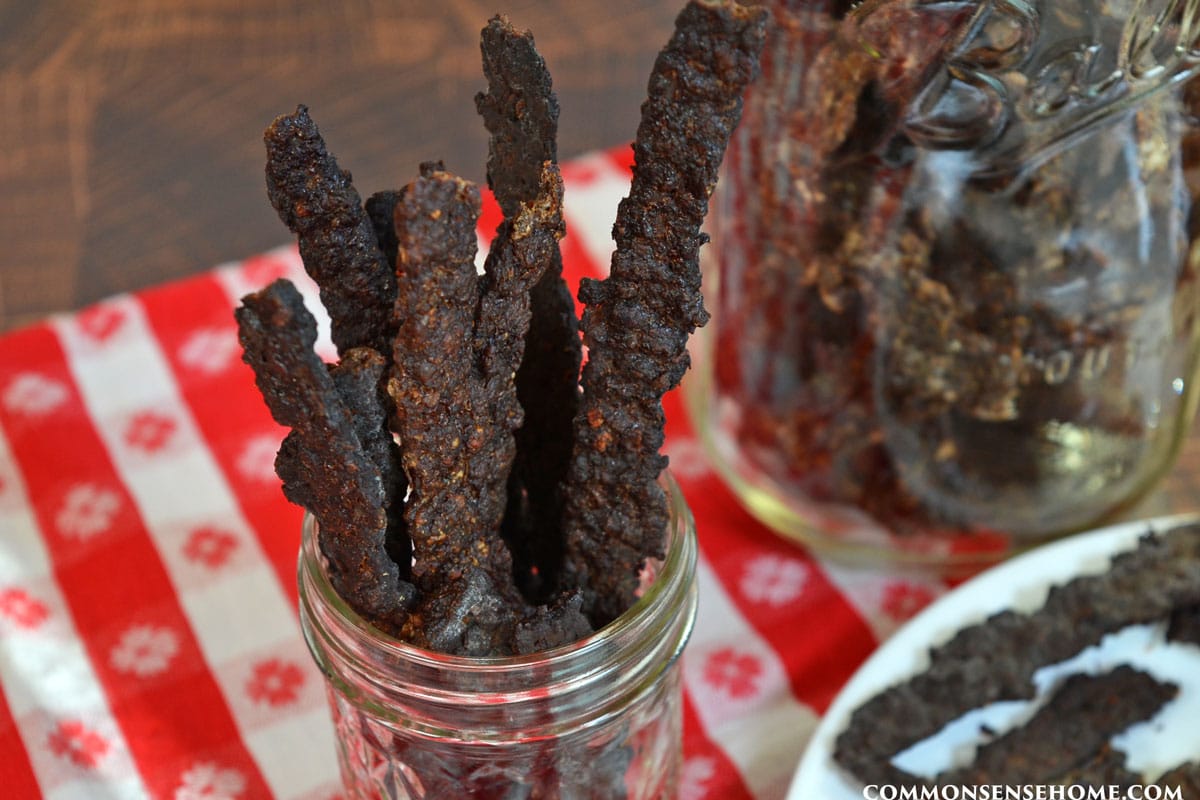
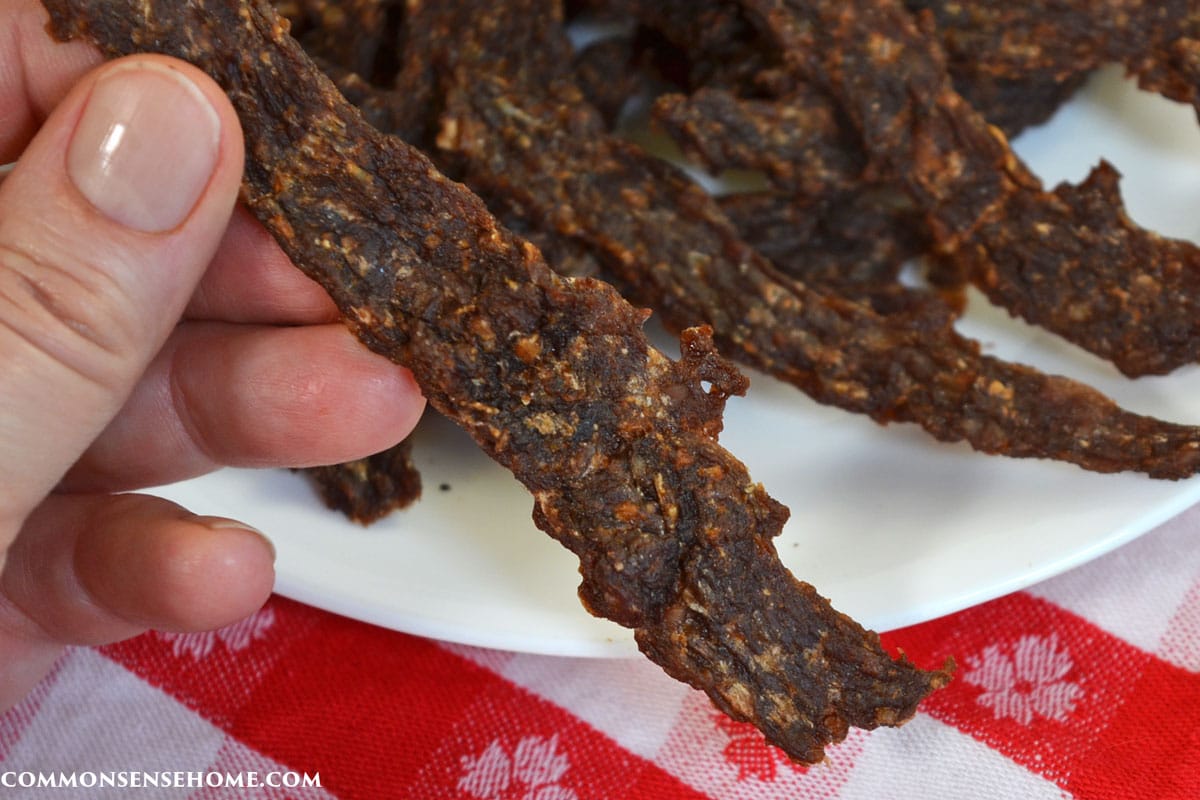
Ground beef jerky is easy to make and less expensive than store-bought jerky. You can make it with a dehydrator or dry it in the oven. Use your choice of ground meat – lean beef or venison – whichever you have available.
Would you like to save this?
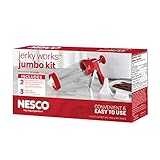
My jerky gun came with seasoning and cure packets. Unfortunately, these were full of ingredients I’m trying to avoid in commercial jerkies (MSG, hydrolyzed soy protein, nitrates, etc.). (Those little packets are expensive, too, if you purchase them separately.)
This recipe uses soy sauce and sea salt for preserving instead of curing salt. It doesn’t contain nitrites or nitrates.
Do you need a jerky gun to make jerky with ground beef? Nope! You can make jerky without a dehydrator or a jerky gun, but the jerky gun is handy and entertaining.
We have a basic Nesco jerky gun. For those who want to make big batches of jerky, try the LEM jerky cannon.
Why Use Ground Beef for Homemade Jerky Instead of Beef Strips?
I prefer ground beef jerky for three main reasons:
- It’s cheaper. I can get ground beef or venison much cheaper than a roast.
- It’s easier to make. Working the jerky gun or rolling the meat out thinly goes quickly. Wrestling to cut strips out of a piece of meat with bone and connective tissue intact is tough.
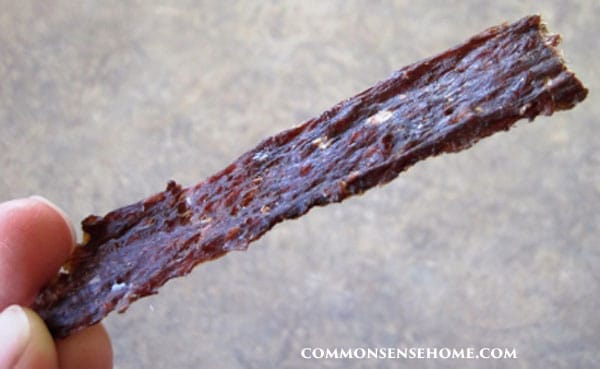
- It’s easier to chew. Eating a piece of regular muscle jerky can sometimes be like chewing on an old shoe, especially when there’s a lot of connective tissue. Ground beef jerky has the meaty, salty jerky taste we love, without getting stuck in your teeth.
This recipe is adapted from Mary Bell’s Complete Dehydrator Cookbook – “All American Marinated Beef Jerky”. Mary makes hers with beef strips, but it worked well as a ground beef jerky recipe, too.
How to Reduce Sodium in Beef Jerky
For the soy sauce, I prefer grain free organic tamari. Most US non-organic soy is genetically modified, and may have glyphosate residue. Non-organic wheat may be sprayed with glyphosate prior to harvest.
I use San-J, which has 940 mg of sodium per tablespoon. In comparison, La Choy has 1330 mg. A tablespoon of regular table salt has 6976 mg of sodium(2325 mg per teaspoon).
If you use a saltier soy sauce, it’s easy to overdo the salt in the recipe. Stick with a soy sauce that has less sodium. If you want to skip the teaspoon of sea salt, store the finished jerky in the fridge or freezer. Salt is a preservative.
If your finished jerky is still too salty, you can soak it for 15-20 minutes to remove surface salt, then dry it again. Store the de-salted jerky in the refrigerator or freezer. Another option is to use the salty jerky for flavoring another dish, so the saltiness is diluted.
Homemade Ground Beef Jerky Recipe
Ingredients
- 1/2 cup soy sauce
- 1 teaspoon liquid smoke
- 1/2 teaspoon onion powder
- 1/2 teaspoon garlic powder or 1 teaspoon minced garlic
- 1 teaspoon sea salt
- 1 pound lean ground beef or venison, at least 93% lean
Directions
In a glass bowl, combine all ingredients and let sit (refrigerated) for at least two hours. I mixed this up at bedtime and let it sit until after lunch the next day, and it wasn’t too strong.
Load the mixture in the jerky gun and use the gun to load your dehydrator trays. I do recommend using the mesh inserts or fruit leather trays for your dehydrator. This mixture is fairly soft because of the liquid ingredients, which makes it easier to fire through the gun.
If you don’t have a jerky gun, use a rolling pin to roll the mixture out very thinly (1/8 inch thick). Score lines to form long strips of jerky.
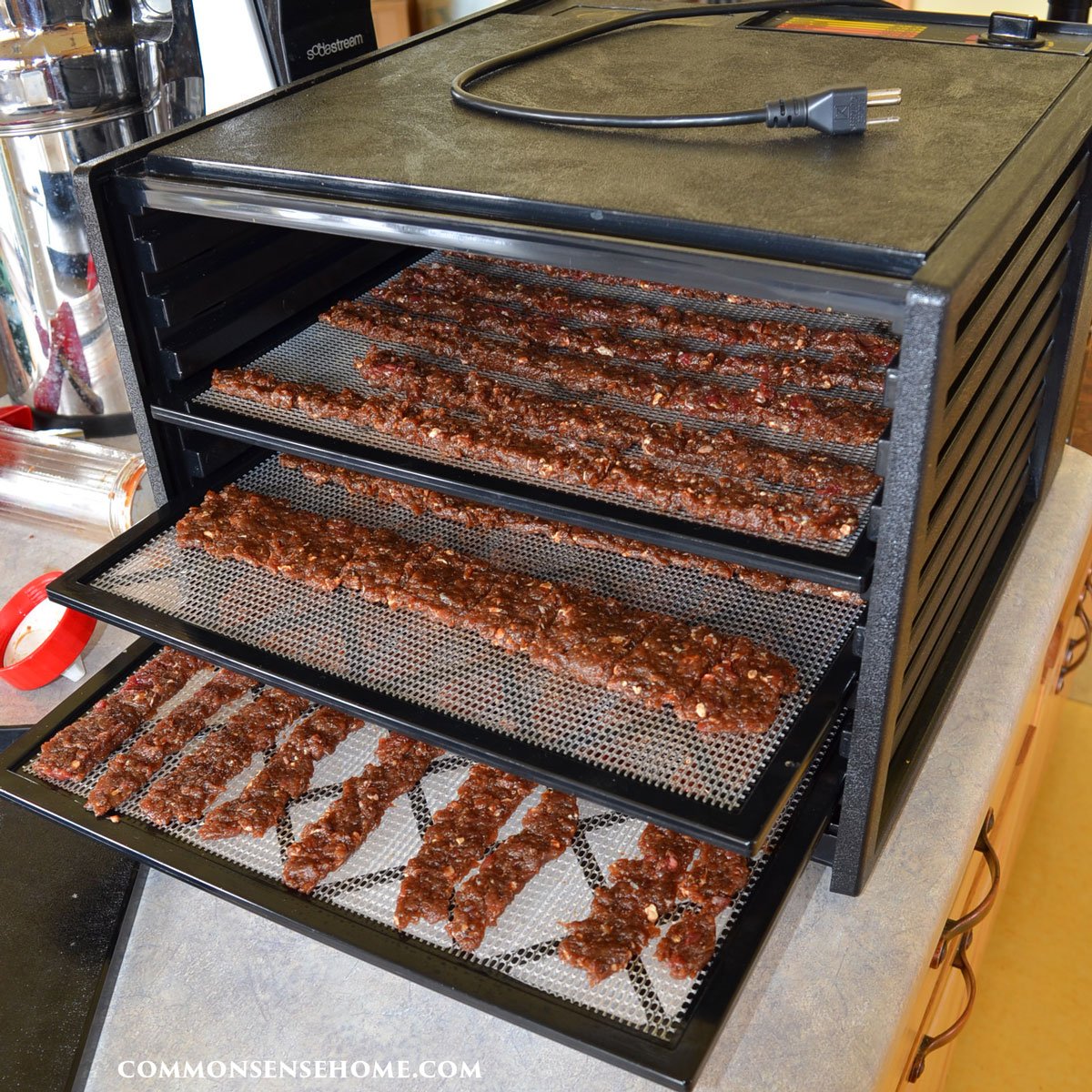
Dry at 145° – 165°F (63° – 74° C) for 4 to 12 hours. The jerky should be hard but still flexible and contain no pockets of moisture. For extra safety, heat finished jerky in a 275° F (135° C) oven for 10 minutes.
Jerky will last in an airtight container at room temperature for 1 – 2 months. For longer storage, place in an airtight container in the refrigerator or freezer. Vacuum sealing extends shelf life.
How Much Homemade Jerky Do You Get from One Pound of Raw Meat?
The weight of the jerky decreases by about two-thirds during the drying time. So for every pound of raw meat you use, you’ll get around one-third pound of finished homemade jerky.
How Can I Be Sure My Jerky is Safe to Eat?
The University of Wisconsin suggests the following two options for safe jerky making at home:
- Dry meat at 145° – 155°F for at least 4 hours followed by heating in a preheated 275°F oven for 10 minutes. Drying meat at a temperature below 145°F produces a product that looks done before it is heated enough to destroy pathogens, and before it has lost enough moisture to be shelf-stable.
Only a few dehydrators currently on the market will maintain the necessary temperature of 145° – 155°F. The Gardenmaster by Nesco/American Harvest and the Excalibur are two such units.
Each of these units has a large heating element, strong air flow, and adjustable temperature setting. Dry for at least 4 hours (6 hours is preferable) and remove jerky from the dehydrator.
Place dried strips on a baking sheet, close together but not touching or overlapping. Heat in a pre-heated 275°F oven for 10 minutes to an internal temperature of 160°F. Strips thicker than ¼” (when raw) may require longer to reach 160°F.
In our research, strips removed from the oven were sizzling hot. Remove oven-heated samples from the oven, cool to room temperature, and package. Always include the post‐drying oven‐heating treatment as a safety precaution.
- Steam or roast meat strips in marinade to an internal temperature of 160°F before drying. Heat poultry to 165°F (internal temperature) before drying. The USDA Meat and Poultry Hotline currently recommends this method for making safe jerky.
The pre‐heating step assures that any bacteria present will be destroyed before drying. This allows a lower dehydrator temperature (130° to 140°F) to be used. After boiling, dehydrate meat for 4 to 6 hours. No post-dehydration oven-heating is necessary.
Since it can be impossible to accurately measure the internal temperature of a thin strip of meat, consumers can boil meat in marinade (or water) for 5 minutes before drying. Unfortunately, this USDA recommended method produces a dried, crumbly product. It would be judged inferior by Wisconsin standards for chewy, flexible jerky.
Holding meat above 145°F for over an hour pasteurizes the meat. Pathogens start dying at temperatures above 130°F, but the lower the temp, the longer they take to kill.
We get our beef or venison from a single animal, so I use the dehydrator above 145°F and call it good. If you had ground beef from unknown animals, I’d suggest some time in the oven to finish it.
Do I Need a Dehydrator to Make Jerky?
It’s possible to make jerky without a dehydrator. Here’s how to make jerky in the oven.
Roll out the jerky on a piece of parchment paper and place it on a baking sheet (or use a jerky gun). Dry the homemade jerky at your oven’s lowest temperature with the door slightly open for 2 hours. Our oven’s minimum temperature is 170°F (77°C).
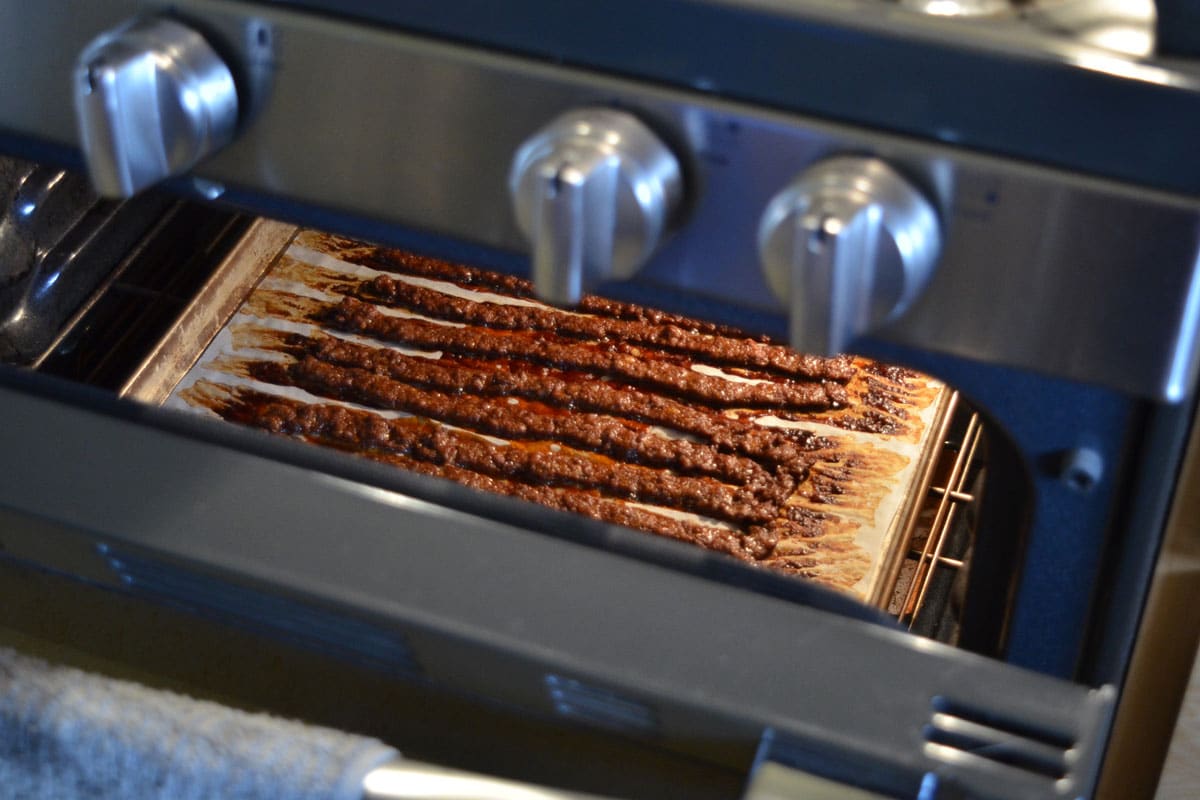
Flip the jerky and rotate the baking sheet. Bake for 1-2 hours more, until jerky is dry but flexible. Oven drying jerky shrinks it up faster and plumper, and creates more of a salty crust.
Using the Excalibur Dehydrator and Jerky Gun
With the Excalibur dehydrator, a batch of jerky is done in about 4-6 hours, depending on the humidity level. Drying overnight gets the jerky a little too dry for my taste. It’s still good, but a little too crumbly.
The last time we made jerky, my eldest mixed up the jerky marinade and meat the evening before drying. My youngest loaded up the Excalibur the next morning.
Make sure to pack the ground meat tightly into the tube to avoid air pockets. The jerky gun shoots strips about an inch wide when you use the “double barrel” attachment. The gun also has option of a single wide strip or a tube shape.
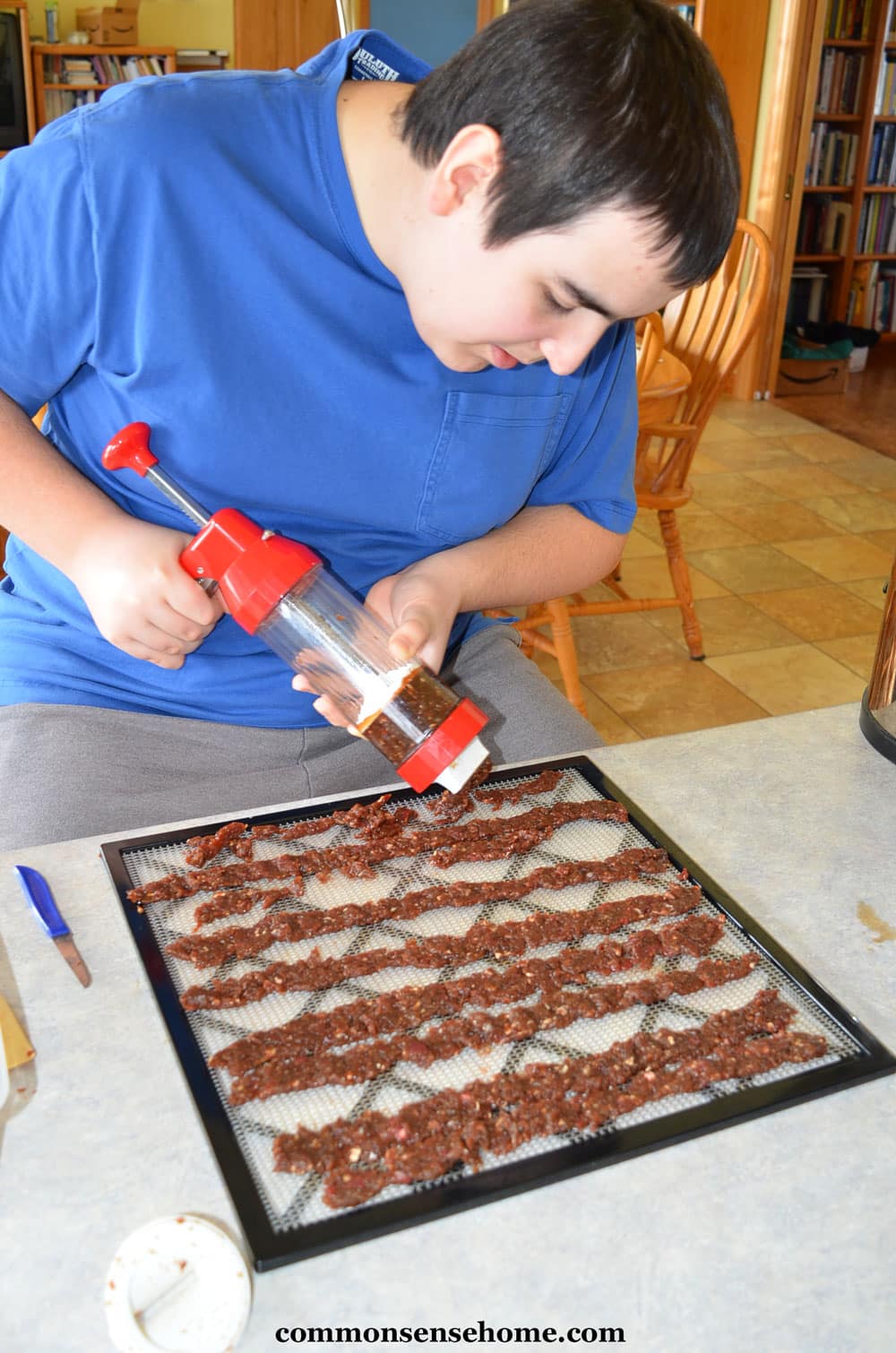
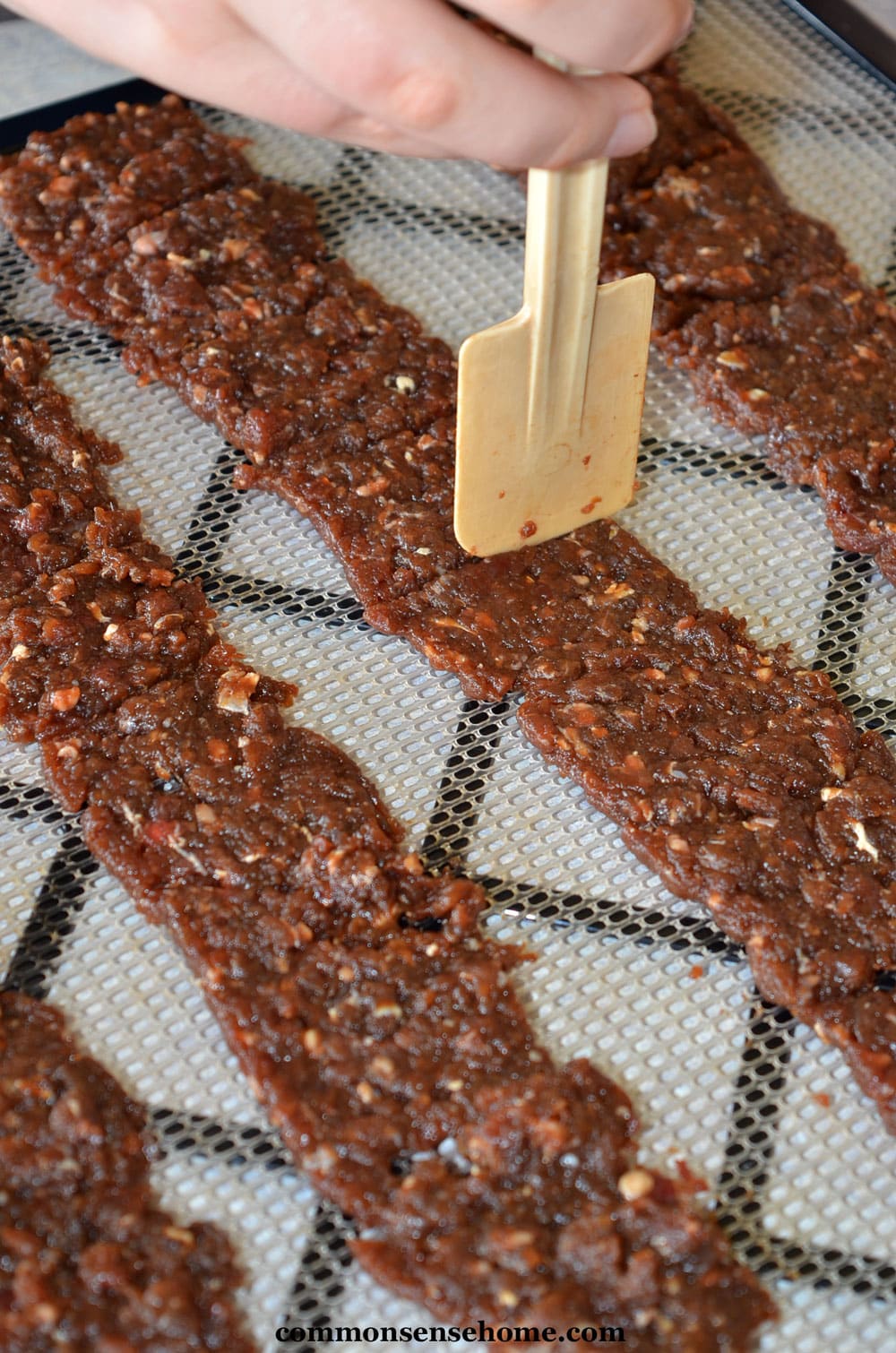
We made wide strips and scored them with a thin spatula. This makes them easier to break apart once dry. (You can use this same scoring technique for jerky made with a rolling pin.)
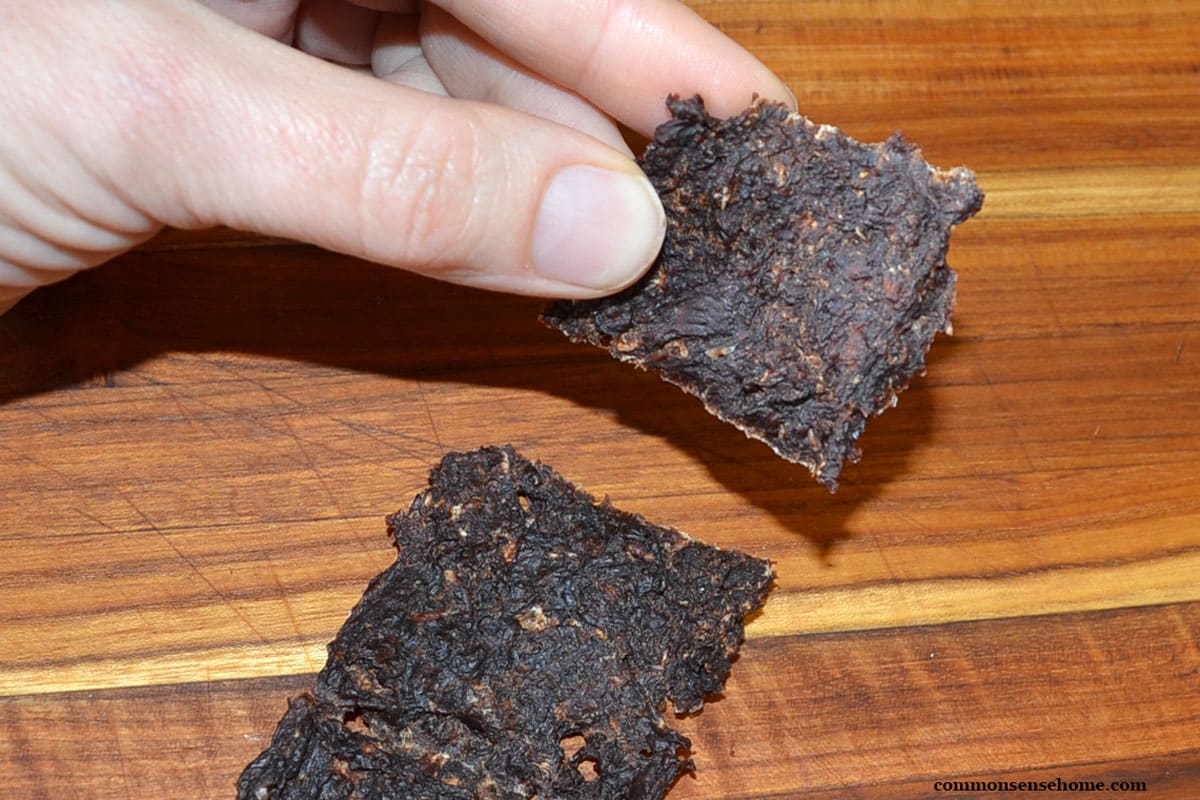
This has become one of my favorite snack foods since we’ve been working to reduce our carbohydrate and grain intake. It’s relatively quick and easy to make, and the gun was pretty inexpensive.

Homemade Jerky without Soy Sauce (Gluten Free, Soy Free Option)
For those who avoid soy and/or gluten, substitute liquid coconut aminos for the soy sauce. Coconut aminos have a similar flavor profile, and are gluten free and soy free.
Beef Jerky Recipe with Ground Beef

Easy and economical jerky recipe that’s great for lean beef or venison.
- Prep Time: 10 minutes
- Drying Time: 4 hours
- Total Time: 4 hours 10 minutes
Ingredients
- 1/2 cup soy sauce
- 1 teaspoon liquid smoke
- 1/2 teaspoon onion powder
- 1/2 teaspoon garlic powder or 1 teaspoon minced garlic
- 1 teaspoon sea salt
- 1 pound lean ground beef or venison, at least 93% lean
Instructions
- In a glass bowl, combine all ingredients and let sit (refrigerated) for at least two hours. I mixed this up at bedtime and let it sit until after lunch the next day, and it wasn’t too strong.
- Load the mixture in the jerky gun and use the gun to load your dehydrator trays. I do recommend using the mesh inserts or fruit leather trays for your dehydrator. This mixture is fairly soft because of the added liquid, which makes it easier to fire through the gun.
- If you don’t have a jerky gun, roll the mixture out very thinly (1/8 inch thick) and score lines where you would like the pieces to break apart.
- Dry at 145° – 165° F (63° – 74° C) for 4 to 12 hours, until jerky is hard but still flexible and contains no pockets of moisture. For extra safety, heat finished jerky in a 275° F (135° C) oven for 10 minutes.
For oven drying:
Roll out the jerky on a piece of parchment paper and place it on a baking sheet (or use a jerky gun). Dry the homemade jerky at your oven’s lowest temperature with the door slightly open for 2 hours. Our oven’s minimum temperature is 170°F (77°C).
Flip the jerky and rotate the baking sheet. Bake for 1-2 hours more, until jerky is dry but flexible. Oven drying jerky shrinks it up faster and plumper, and creates more of a salty crust.
Notes
Jerky will last in an airtight container at room temperature for 1 – 2 months. For longer storage, place in an airtight container in the refrigerator or freezer. Vacuum sealing extends shelf life.
Do you have a favorite jerky recipe? Have you tried making jerky with ground beef? Has anyone tried making jerky out of organ meats? I’d love to hear from you.
Recommended Dehydrators
- Nesco Gardenmaster Dehydrator
- 9 Tray Excalibur Dehydrator – This is the unit we have.
More Snack Recipes
More Food Storage
Home Food Drying – 6 Things you Need to Know
Food to Stock Up On (For Daily Use or Emergencies)
Dehydrator vs Freeze Dryer – What’s the Difference?

This article is written by Laurie Neverman. Laurie grew up in the kitchen, learning baking and home cooking from her momma. At age 15, she and her mom and two sisters created Irene’s Custom Cakes & Catering, which was her summer job through most of high school and college.
Last updated in 2024.
I have been making jerky for 40 years. For the past 25 I have used ground meat. I used to roll it out with a rolling pin between two pieces of waxed paper and then turn the sheets of meat unto the dehydrator trays. Now I have the Cabelas jerky shooter and dehydrator. Both of those items have made my jerky making much easier. I hit the lucky button the day I found the barely used dehydrator at an auction. In fact I have some jerky in there right now.
I love auctions and thrift stores! You just never know what you’re going to find.
I have been looking for months for a good HEALTHY jerky recipe and have yet to find one. I was hoping yours would be I am afraid to say you are a bit contradictory in your recipe. You say you do not want to use commercial because of the MSG and the nitrates and yet you put soy sauce (8500 mg) and then add a t. of sea salt (6000 mg) and then you double it which gives you almost 30000 mg of salt! The recommended intake is between 1500 and 2500 and of course the less amount is the best. Out of 2# of meat you get 20 pieces of jerky that equals your recommended daily intake. With eating other foods you could allow yourself maybe a bite of jerky a day. And I do not think you need much salt since you are dehydrating as opposed to letting it sit and dry out.
If you don’t want that much salt, don’t use that much salt, but if you’re going to reduce the salt, make sure to eat the jerky sooner rather than later, and keep it refrigerated. Looking in another jerky recipe book (specifically, “Jerky: Make your own delicious jerky and jerky dishes using beef, venison, fish or fowl” by A. D. Livingston), the salt levels in the recipes are very similar – or even higher. “2 lbs meat, 1/2 cup soy sauce, 1 tablespoon salt” in the Sesame Seed Jerky. “2 lbs meat, 1/2 cup soy sauce, 1 tablespoon salt” in the Hawaiian Jerky – and so on. Not all of the cure is absorbed by the meat. I view jerky as an occasional treat, not a food I’m going to snack on all day. The low salt recipe in in the Livingston jerky book is 2 pounds lean red meat, 1 cup low-salt soy sauce, 1/4 cup liquid smoke and freshly ground black pepper.
How do you precook the jerky to 160 before dehydrating??
I don’t. I only use local, single source meat from healthy animals from people I trust, and I’ve never had an issue with any forborne illness using the 145 temp. Mary Ellen mentions that she takes hers up to 160 in the oven after dehydrating.
Have you ever tried Bragg’s Liquid Aminos instead of soy sauce?
No, I haven’t. The salt in the soy sauce acts as a preservative, so any time you reduce the salt, you increase the risk of spoilage. If you would like to try it, I’d recommend the 165 temp for sure.
145° is not high enough. My Dad use to make hamburger jerky with my dehydrator. He froze the package to make it last. I was the first to try it. I ended up with a very bad case of Ecoli. Turns out the meat was contaminated and 145 isn’t high enough temp to kill the bad bacteria. Now I take my jerky out of the dehydrator and finish it off in my Convection oven. That allows it to get high enough 170 to 175°. It took me a long time to try jerky again.
The USDA recommends precooking to 160 before drying to minimize e coli risks. http://www.fsis.usda.gov/wps/wcm/connect/32da4779-ba5e-4d7b-ad5a-2ad8a13aad1e/Jerky_and_Food_Safety.pdf?MOD=AJPERES
This is probably a very good idea if you are using meat that has more potential exposure to pathogens. I’ve always followed the dehydrator instructions, which use the 145 temp, but this would add an extra layer of protection.
Instead of the Tamari and spices, try “Dale’s Steak Seasoning”. If you can’t find it locally, Amazon has it. It’s essentially concentrated soy sauce with garlic and other spices mixed in. I recommend the low sodium version. The Kroger’s house brand is just as good for a cheaper option.
I’ve been making jerky for several weeks now. Based on all my research, it sure seems like you need some sort of curing agent in the jerky to be safe and that little amount of sea salt or even regular salt won’t do it. My recipe is almost identical to yours, except I use Morton’s Tenderquick (salt, sodium nitrate) and use no regular salt in the recipe and it comes out perfect and not nearly as salty.
Using an additional preservative such as sodium nitrate will increase shelf life/stability at room temperature. The salt acts as a preservative by binding up free water in the meat, which, in addition to the drying process itself, binds up free water, making the meat inhospitable to bacteria growth. Introducing healthy bacteria, as Wardeh does in The Complete Idiot’s Guide to Fermenting Foods, is another way to extend shelf life by crowding out bad bacteria with good bacteria. I’m sure you’ve seen historical references where meat was dried completely untreated, or smoked, but not salted or cured. Each element acts to add another layer of shelf stability. You are correct that the recipe in the post will keep best in the fridge or freezer for longer storage because of this, and that less salt may be used if another preservative is introduced.
I have Mary Bell’s “Just Jerky”. I can definitely understand what you mean. We usually consume a batch of jerky within a few days anyway.
Does the jerky need to be heated to a particular degree for safety purposes or does the salt content and drying take care of these concerns? Thanks
Free water is necessary for bacteria growth, and as you have correctly identified, the dehydrating process removes that water and the salt binds up free water that may be left. This doesn’t completely eliminate the risk of spoilage, but it does slow down the bacteria responsible for spoilage. Historically, of course, meat was air dried or smoked – no exact temperature controls.
Does anyone have a recipe for Teriyaki Beef Jerky for ground beef? I have seen lots for sliced beef but none for ground beef. I usually use the packet mixes but want to make my own spice blend and would really to try Teriyaki. Thanks for your help
You can usually use the beef strip recipes for ground beef, if there’s one you like.
Hello, this looks great! Thanks :-). How lean is lean. Does it have to be lean? The pasture raised ground beef is my only option and I don’t want to buy extra lean from the supermarket. If it’s not lean, what will happen to the jersey?
Pastured beef or venison is perfect. Too much fat makes the jerky spoil faster.
I am going to try ground turkey tomorrow with this recipe. I was looking on line for the seasoning packets and ran across this site. Must be my lucky night. Thanks for Posting.
If you eat a significant amount of jerky, DIY seasoning mix should save you a bundle. Thanks for taking time to leave a comment.
I was wondering, do you have to use a meat cure such as Morton’s tender quick salt? Or does it keep O.K. without it? I to don’t want the MSG and all the “junk” in the pre mixed seasonings. Thanks for your help.
I just use natural sea salt in this recipe. Salt binds up free water, which helps prevent spoilage. To extend shelf life the jerky can be refrigerated or frozen. if you like. Because it doesn’t have all the bizarre preservatives, it will not have the shelf life of commercial products.
Really REALLY salty. Half the salt and it would still be salty. Good seasoning flavor…. But Drink with lots of water. Thanks for the jumping point because we didnt know what to do as we are first timers.
Marinating for a shorter period of time will reduce the saltiness, and different ingredient brands will also affect the flavor dramatically, especially the salt and soy sauce used. The salt acts as a preservative, binding free water in the meat and extending shelf life, so be aware of this if you reduce the salt in the recipe.
I never add salt to any jerky recipe, can’t tolerate the taste But what I have found that works well when using tahini and soy, I dilute 1/2 tsp honey in soy sauce. Has really good flavor and doesn’t make it sweeter.
Thanks for the post! Love the picture of you with the jerky gun 😉 I recently purchased a dehydrator and planning on making jerky with ground beef and wondered if the jerky gun was REALLY necessary. I see now that it is, and will be purchasing one soon. All the Best!
It’s not absolutely necessary, but it does make the process a whole lot easier – and fun!
Oh my. If I show this to my “men” you know what I’ll be doing soon…..
We need to make up another batch, as I am all out. The youngest is growing again, and man, is he eating!
THANK YOU for posting a recipe using real food and not the seasoned packets for jerky! I have the same jerky gun and have been wanting to use up some ground venison in our freezer but I didn’t want to use the msg laden packets and wasn’t sure what spices, etc. to use to make my own marinade. Now I know! 🙂 I love reading your blog, and pin stuff from it all the time! Thanks for another awesome post. 🙂
You’re welcome. Those jerky packets are awful, aren’t they? Plus, they’re really expensive. This is so much nicer. The jerky cookbooks at the bottom of the post have a lot of great ideas, but this is still a favorite of ours.
I recently had pork liver in Thai larb and I didn’t even recognize it at first. Even after the waiter told me what it was, it didn’t taste very livery. I wonder if one could make a beef larb jerky? Mix of ground beef and liver with the larb flavorings (lime juice, fish sauce, mint, cilantro) during the marination process. Could be a fun experiment!
If you try it, please post the recipe and link here. I’d love to see how it turns out.
Whollly Salt bat man… we used premium tamari and 1/2 the salt that the recipe called for and it is way to salty… I need to try now to rectify 4 pounds of way tosalty jerky… Maybe it was the premium tamari but I have never had a problem subing it before… Any ideas??
I don’t know of any way to “unsalt” jerky, unfortunately. About the only thing I could suggest is pairing it with a bland food that could use some salt. I use San-J organic tamari. I’m sure there’s a difference in salt content in various brands.
I almost always buy low sodium soy. More soy taste, less salt.
I also quadrupled the batch size and ended up with 4 lb of super-salty jerky. I think it was a combination of the soy sauce plus salt. I was very disappointed because I made this jerky for a backpacking trip, and it was one of our main food sources. We had no choice but to eat it. It actually burned my tongue from so much salt! I found that over the course of a few days, it did mellow out a bit. However, I would recommend seriously reducing the salt or soy sauce.
I’m curious – what brand of soy sauce did you use? There’s quite a range of salt content in different soy sauce brands. San-J, the type I prefer, is less salty than some more common commercial brands. Also, a shorter time in the marinade will give a less salty end product.
Looks good.
Mark's Never Fail Jerky
1/4 cup soy sauce
1/8 cup worcestershire sauce
1/8 cup red wine
1 tbs molasses
1 tbs liquid smoke
1 tbs brown sugar
1 tbs hot sauce (optional)
1 tsp cayenne (optional)
1 pound lean ground beef or thin sliced eye of round
You shouldn’t use alcohol when dehydrating meat.
It’s amazing how much difference that molasses makes. And adds a little iron to the diet!