
Grandma Called it Medicine Leaf – Plantain Weed Remedies

This post may contain affiliate links. Read my full disclosure here.
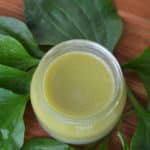
Plantain weed is good medicine, from seed to root. In this article, I’ll share how I came to know plantain, and how to use the fresh leaves and dried leaves for natural remedies such as salve and tea.
Would you like to save this?
Table of Contents
Plantain Weed – Grandma’s “Medicine Leaf”

When I was a little girl, my father’s mother, Catherine, and I were very close. Mom was awfully busy trying to raise six kids and run a farm by herself, so I spent a lot of time with grandma (I’m the baby of the family).
Grandma had ever-bearing strawberries that she would pick as soon as they showed a blush of red, so the birds didn’t get them. There were always hollyhocks and poppies, the yellow transparent apple tree, lilacs, roses and a small vegetable garden.
Grandma and I would dance and sing on the front lawn, and every Saturday night we had a “date” watching HeeHaw.
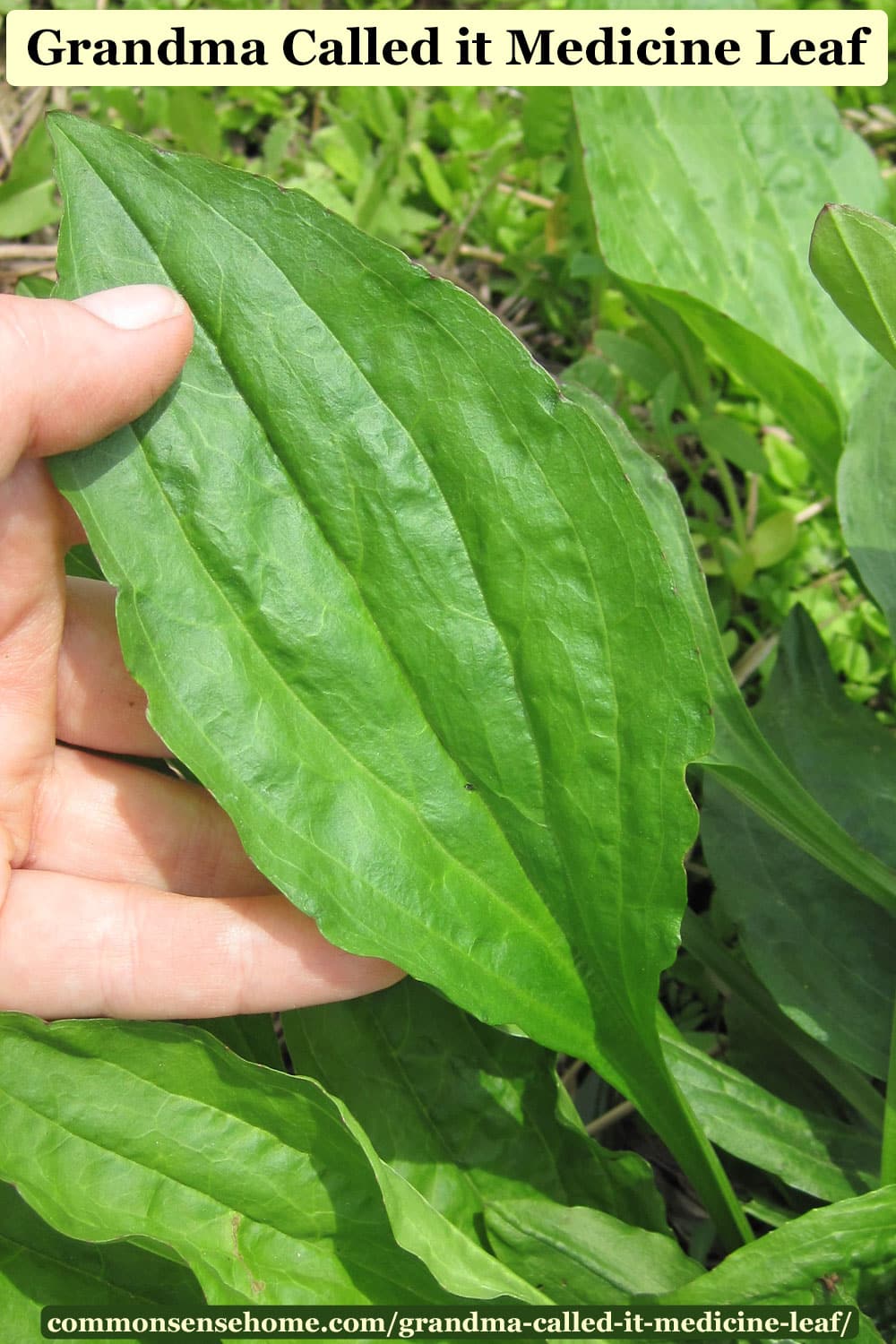
I remember grandma pointing to a broad leaf plant in the yard and calling it “medicine leaf”. She told me the Native Americans use to use it for medicine, but we never used it ourselves.
A New Look at Old Medicine
Fast forward about 30 years. I started hanging out with the grandmother of some boys in our local homeschool group, and she showed me how to use plantain leaf to make an infused oil.
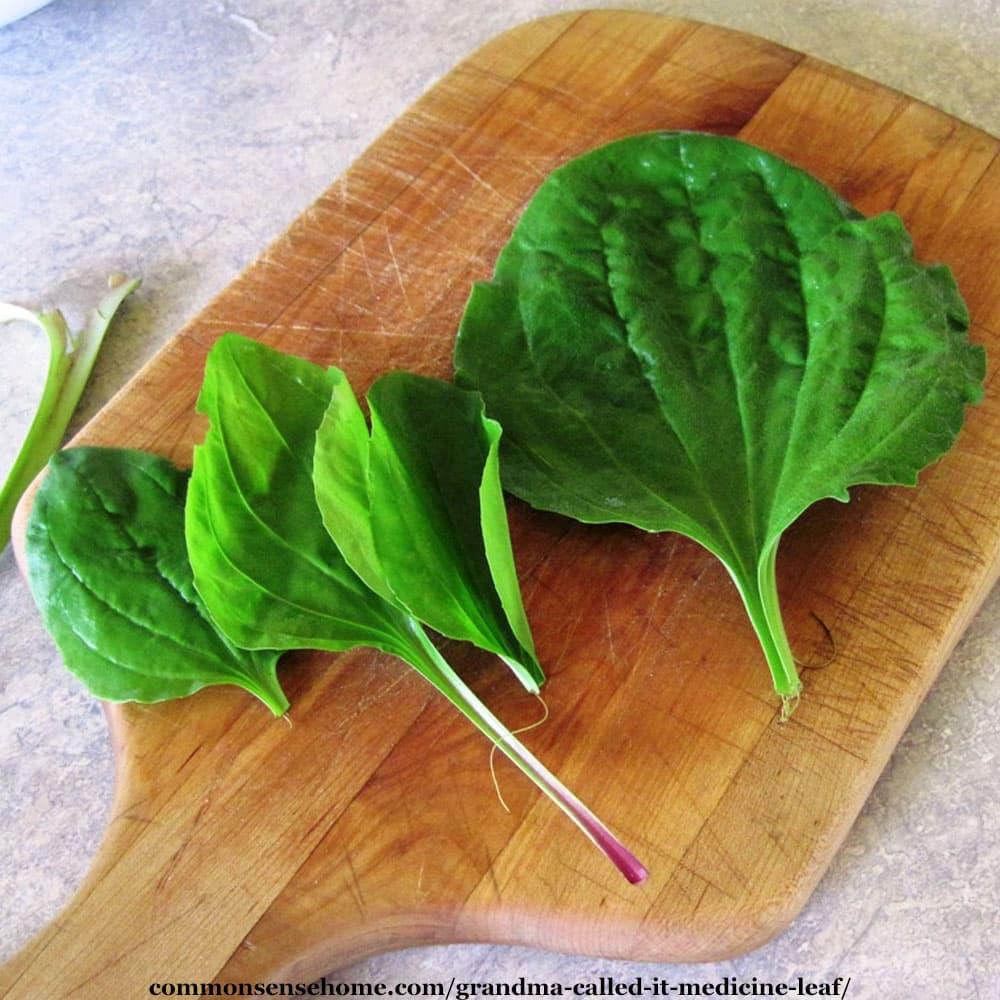
It turns out grandma’s “weed” was actually broadleaf plantain (Plantago major), and it’s close to miraculous for treating bug bites, stings and many other ailments.
Using plantain weed opened the door to my curiosity about the use of many common weeds. It truly changed my life, and that’s why I chose it for the logo of the website.
Now I look at wild plants with fresh eyes. (Many of them were carefully carried by settlers as food and medicine.) It’s a great feeling to know that I can find simple remedies almost anywhere.
I’m not the only one taking notice of plantain. The 2018 study “Plantago major in Traditional Persian Medicine and modern phytotherapy” looks at a wide range of medicinal uses of plantain, including treatment of:
- epilepsy
- eye disease
- toothaches and other oral health problems
- earaches
- pulmonary disorders
- gastrointestinal trouble
- liver disease
- urinary tract issues
- skin diseases
Note: For more detailed information on how to to identify plantain and food uses of plantain, see “Broadleaf Plantain – The “Weed” You Won’t Want to Be Without – Weekly Weeder #14“.
How to Use Fresh Plantain Leaf to Treat Insect Bites, Stings and Other Skin Irritation
The first time I put plantain weed to the test was for treating a wasp sting.
I was at my Great Uncle’s house scrubbing egg off a plate with a metal scouring pad, when “the pad” stabbed me. I set the scrubber down and out crawls a large black wasp. (Bill told me after the fact that, “Oh yes, he had seen some of those around.” I guess it didn’t like being used to scrub plates.
My finger started swelling and burning. I ran cold water on the sting, and yelled for my son to run outside and grab some plantain. He came back in a matter of minutes with a nice, healthy leaf, and into my mouth it goes. Chew, chew, chew – spit it out – onto the bite.
The worst of the pain subsided within minutes. I wrapped the green blob onto my finger with a band-aid and left it there for the rest of the afternoon and evening. (Plantain tastes very green, in case you’re wondering.)
Here’s what the sting looked like at the end of the day:
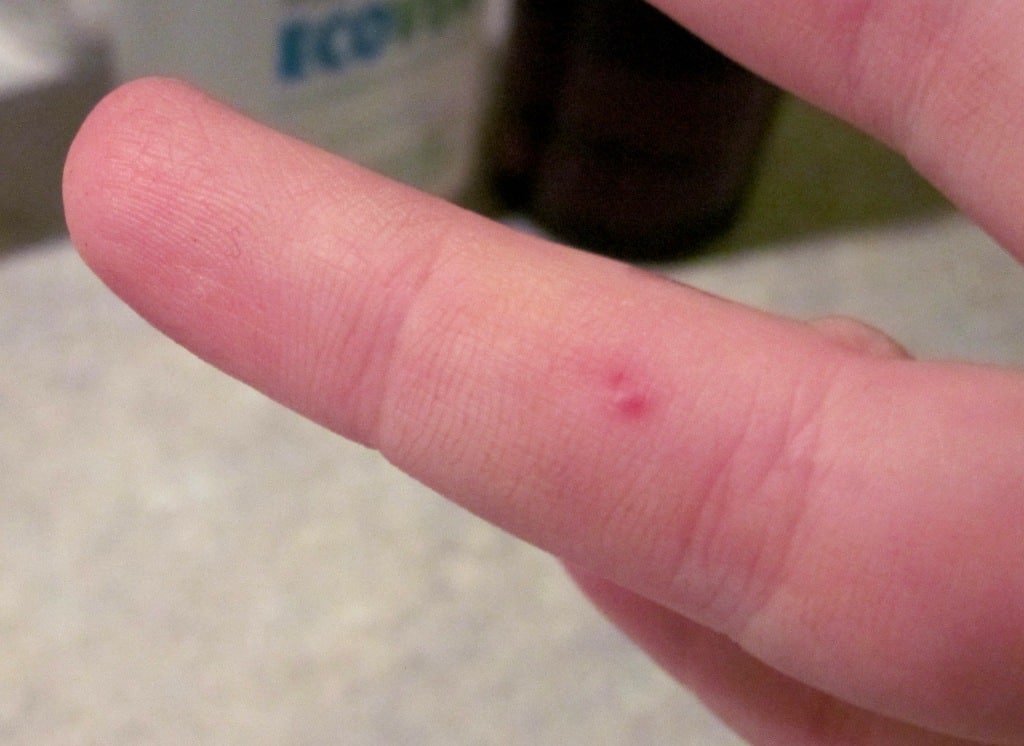
Note: insect damage is very clear, but there is no sign of inflammation or swelling (no welt). There was no pain at all the following day. The last time I was stung, the welt lasted for several days. This was so much better.
To use Plantain Leaves for Bites and Stings
- Find a clean leaf
- Chew or otherwise mash it to release juices
- Apply to affected area until pain/itching subsides
A plantain poultice also helps to heal cuts and incisions.
Plantain Weed for Slivers
Plantain has a natural drawing and anti-inflammatory action. This helps to reduce swelling, but it also helps to draw out slivers.
Simply crush or chew your plantain leaf, place it over the area with the sliver, bandage and leave overnight. In the morning the sliver should easily pop out.
You can use fresh plantain juice to treat poison ivy, sunburn and other skin irritations, but infused oil or salve is easier to apply.
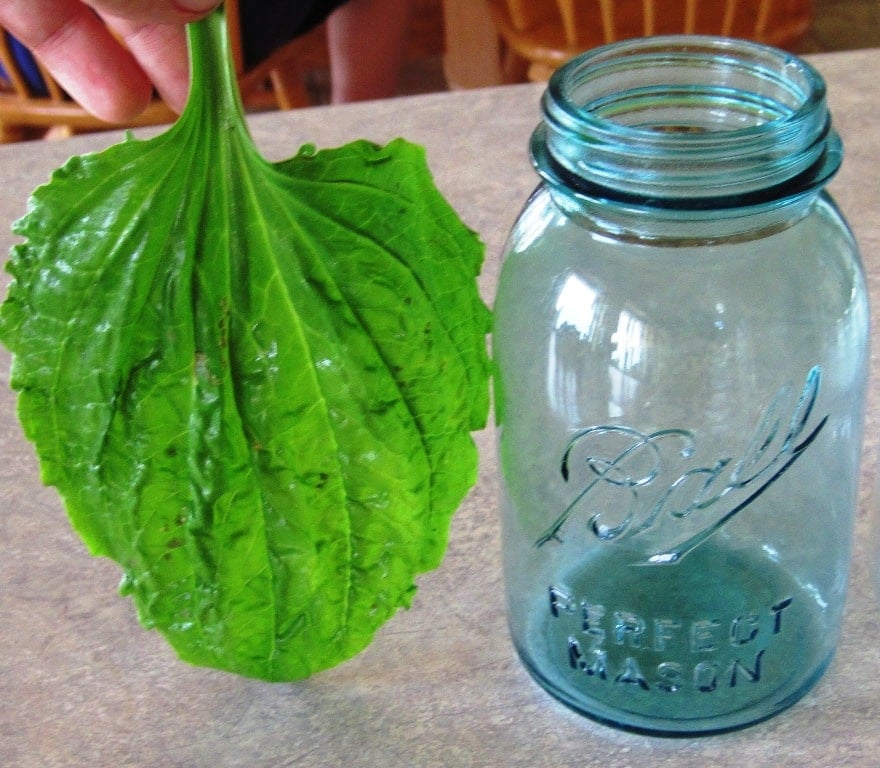
I visited my brother recently and he had some enormous plantain weed leaves. (My brother now lives in grandma’s old house.) Some of the leaves were nearly the size of a sheet of paper. Here’s one of them next to a quart Mason jar for comparison.
How to Make Plantain Infused Oil
Gather Plantain Leaves
First, gather up a bunch of plantain leaves. Minor damage is fine, but avoid mold or other signs of spoilage. Pick enough leaves to fill your container of choice. (Small jars work well.)
Wash and Prep Leaves
Wash the leaves and dry thoroughly. (I run mine through the salad spinner and pat dry with a towel.) You want these as dry as possible to help prevent mold in your infusion.
Finely chop the leaves and pack them into your jar until full. Cover leaves with olive oil or fractionated coconut oil. Poke/stir with a chopstick or other implement to remove air bubbles. Place lid on jar, label and date.
Infuse the Oil
I keep the jar in a sunny window for at least two weeks (usually four to six weeks), stirring daily to make sure the leaves stay below the oil. After several days it will start to smell like pepperoni – this is normal.
Sunlight exposure during this stage helps to prevent mold, but you don’t want the oil to get extremely hot.
Decant and Pack for Storage
Decant the oil (strain out the plant material) in four to six weeks. I use my jelly bag strainer. The oil is now ready to use.
For longer storage, allow the decanted oil to settle for a few days, then bottle the finished oil in dark jars. You may get sediment or water in the bottom as the oil settles – try to keep this out of your finished product by pouring off the oil carefully.
Seal the bottles, label, and store in a cool, dry, dark place.
Using Plantain Infused Oil
My first test of plantain oil came after an evening in the garden with a voracious cloud of mosquitoes. I rubbed catnip on my exposed skin, but they bit right through my shorts!
I must have had at least 20 bites on my tush. Oh man, did it itch! I took a quick shower and coated all my bites with some plantain oil. Again, within a matter of minutes, the pain and itching subsided.
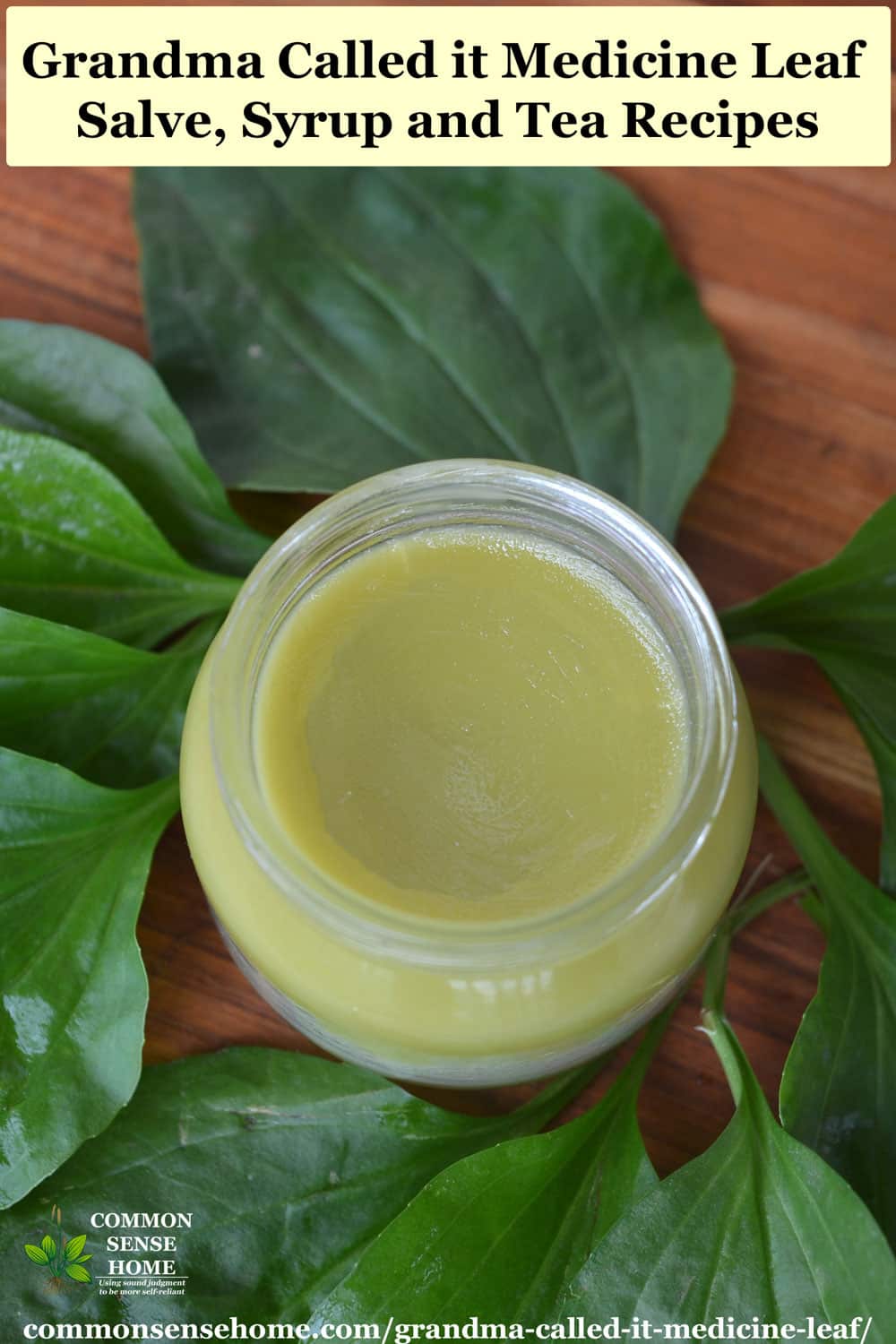
Simple Plantain Weed Salve
Plantain infused oil is great for covering larger areas, but plantain salve is nice for spot treating bites, stings or hemorrhoids.
Use 1 tablespoon of finely chopped beeswax for every ounce of plantain infused oil. Stir the oil and wax together over low heat until the oil is melted.
For more details, see “How to Make a Salve with Infused Oils“.
Plantain Leaf Tea
For internal use, try plantain leaf herbal tea.
Place one heaping teaspoon of crumbled dried leaves or one to two fresh leaves in a mug. Cover with boiling water and infuse for ten minutes. Strain and drink, adding a little honey for sweetness, if desired.
Drink a mug of plantain tea three times per day to help clear out colds and soothe digestion.
Plantain Juice with Honey
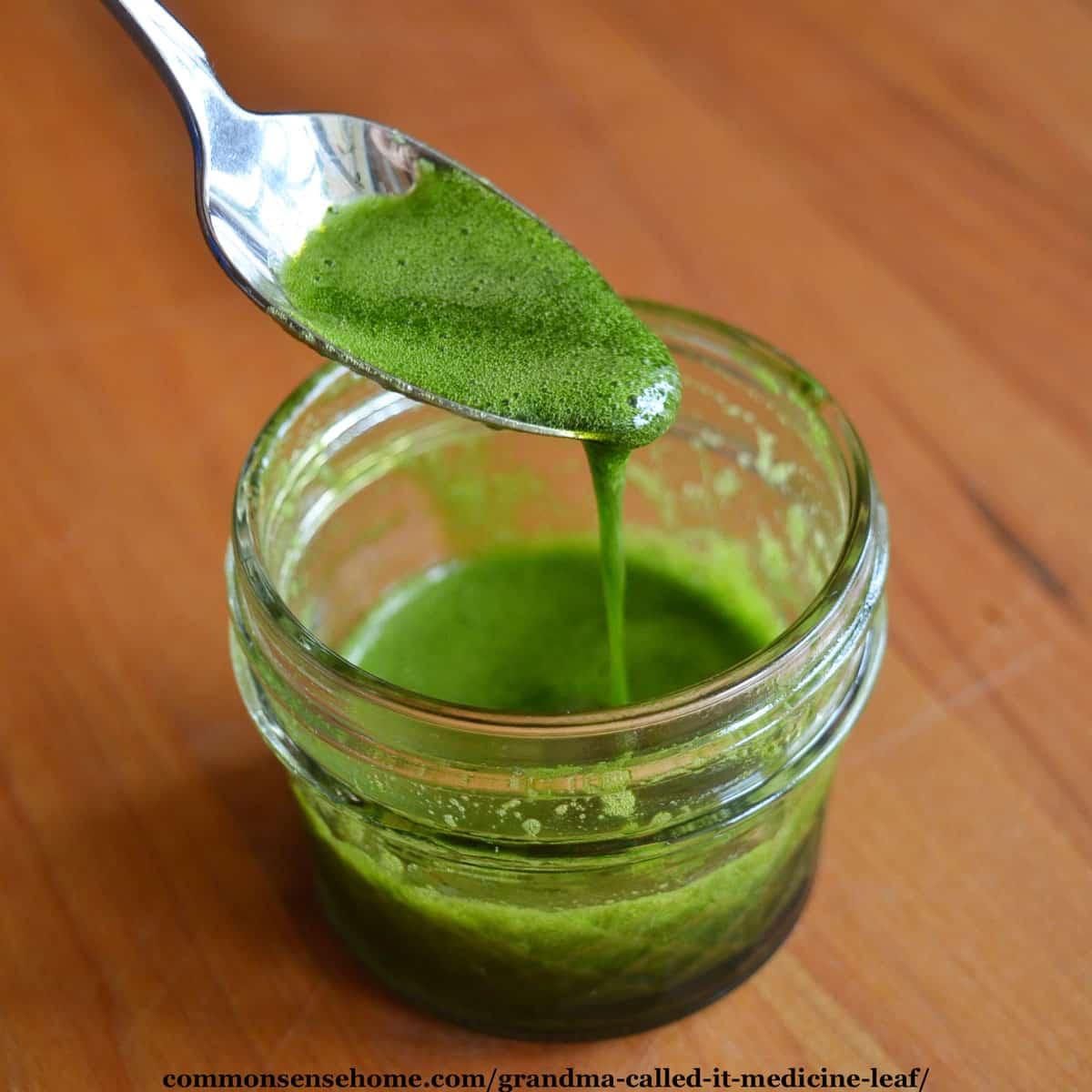
This plantain weed remedy is recommended in Backyard Medicine for coughs and stomach ulcers. It can also be used externally for ulcers and other sores. (Honey also has a long history of medicinal use.)
Juice fresh plantain leaves and mix the juice with an equal amount of honey. Pour into sterilized bottles and keep in a cool location.
Dose: 1 teaspoon as needed for coughs, 1 tablespoon three times daily for stomach ulcers.
Note: Ribwort plantain (Plantago lanceolata) works best for juicing, but any plantain variety has similar medicinal properties.
Dig deeper into the wonders of plantain in The Wild Apothecary series – volume 1.
Get Plantain Products and Seeds Online
Want someone else to prep the oil for you, or don’t have plantain readily available?
You can get plantain infused oil, plantain seeds, dried plantain leaf, powdered plantain, plantain extract, and plantain infused lip balm.
Have you used plantain? Do you have a favorite recipe or tip to share? I’d love to hear from you.
You may also enjoy:
- 15 Ways to Naturally Reduce Cholesterol
- Easy Homemade Cough Drops for Treatment of Sore Throats and Coughs
- Natural Remedies for Colds and Flu to Help You Feel Better Faster
Originally posted in 2010, updated in 2019.
Thank you for the great post! I make the salve and like you said it is great for burns, cuts, bee stings etc. My 93 year old mother has the shingles I put some salve on her today, seemed to help with the pain. I left the plantain salve with the nursing home and they are going to apply it. If it does relieve the pain we need to get the word out! My mother is getting percocet at the moment to manage the pain…..NOT GOOD! I will let you know if it helps.
I hope it helps. Saying a prayer for her.
Plantain is also a strong anti-cancer herb, especially for hard to treat glandular cancers (ovarian, pancreatic). It is well suited for cancers where hormones are a concern. This is controversial and some say yes or no on both sides, but some herbs are considered estrogenic and are avoided by some for that reason. Plantain is a good replacement in those formulas instead of red clover, for example, which is estrogenic. Plantain can be added to other formulas such as Essiac to customize it for particular cancers. Follow your instincts, muscle test, or use the pendulum to decide if this is the herb to add for your cancer.
Thank you, Pati. Historically, there have been dozens of uses for plantain, so I tried to highlight some of the most common. Thank you for sharing your experience.
I have very small leaf plantain in my yard but wanted the large leaf one. I found some a two hours drive and brought it home. It took several tries as a pet rabbit would eat it to a nub. Now I have a bed of it growing.
We have fire ants here in the south. Their bites hurt and leave pus-filled bumps that are painful! A quick chew of a leaf and applied to the spot guarantees no reaction. It’s amazing.
My grands have a bad reaction to mosquito bites leaving large welts. A little plantain infused oil calms the spots in 45 minutes or less.
Needless to say, I baby my plantain bed!
Whenever we have people out for tours, I always point out the plantain and how to use it. It’s one of the best treatments for bites and stings.
My Mother always called this back door leaf. I had a sister that got boils and my Mother would put the leaf on it. We used it for bug bites and bee stings too. Have you ever heard it called this?
No, that’s one name I haven’t heard, but it makes sense given that plantain thrives in compacted soil – like soil near a doorway. It’s also been called “white man’s foot”, because Europeans brought it with as they traveled throughout the Americas.
I appreciate the information in this post. Now knowing how effective Plantain can be in so many cases, I will be making Plantain oil soon and then learn how to make a salve. Some years ago I had a most impressive experience with Plantain.
I had been working in the yard clearing poison ivy for several days. Getting into my vehicle one day, a spider bit my arm. Thinking no further of it, I went about my business. Later in the evening, I felt an itch developing which did not react to the poison ivy lotion I had. The itch on my arm grew in intensity and spread until it took up most of the lower section of my arm. It took a while before I realized this was not poison ivy. It was the result of the spider bite.
I had a Polish natural health-oriented friend whose mother operated a health center in Poland. My friend went out to her yard, picked Plantain leaves and mashed them with the back of a spoon. She applied Calendula Ointment to the mashed leaves and held all in place with a large gauze and bandages. I was instructed to do the same several times per day. The situation on my arm of yellow and green infected tissue began to clear and healed within the week.
The health complications I soon encountered from that spider bite took years of attention. If I had saved the spider we could have made a homeopathic remedy from the spider toxins, but I had not thought of it. I’m sure a Plantain salve would be much the same in effectiveness as the Calendula ointment. I think of this often as I see Plantain growing all around where I live.
Thank you for sharing your experience. Roxy. I’m glad the plantain helped, but sorry you had to go through so much pain.
I really like your site. I went to a talk where a natural healer mentioned you can stop a brown recluse spider bite from festering and spreading if you take activated charcoal and mix it with the pulverized plantain leaves. She said it healed the bite without even a scar. I wonder if you can use those two ingredients with olive oil to make a salve. I was bitten by a large spider while i slept. I wish I had some sort of poultice and used it. There were three large deep wounds in my leg. They took forever to heal. Years later, I still can see the scares. I didn’t think about that talk until I found your site. This site is a keeper.
Thank you, Kathy. I’m glad you enjoy the site. Plantain is a wonderful plant. It works so well to relive pain and draw out inflammation. You’ll probably enjoy the Weekly Weeder series if you haven’t checked it out yet – https://commonsensehome.com/wildcraftingweekly-weeder/
I didn’t read all the posts, so if someone has already suggested this, I apologize for the redundancy. On making a salve: Have you tried mixing some of the infused oil with some beeswax? I made an olive oil and beeswax salve years ago — still have some of it — it’s not plantain, but it’s the only thing that works on certain skin issues. I made mine with essential oils, but I don’t see why you couldn’t use plantain-infused oil.
I don’t know in what form you get your beeswax — it comes in pellets and sticks. A stick is about 1/3 cup when melted. I would use 1/3 cup of beeswax with 1/2 cup of the infused oil, and see if you like the consistency. You can always ADD infused oil, if it’s too stiff, but you can’t take it out if it’s too thin.
Hope this helps.
There’s a link in the post to another post showing step by step how to make salve from infused oil with beeswax.
Yup, me, too! I was working outside yesterday and got some raspberry juice on my hands. Rather than go inside to wash, I rubbed it off on some damp grass. Unfortunately I rudely did not check to see if that patch was already occupied or not, and a few seconds later felt a hot little sting starting in my finger. Plantain is all over my property. I grabbed a leaf, chewed and held it over the spot for instant and complete relief. This reminded me that I better clip up my batch of plantain leaf and get it in some olive oil. While laying and rolling up my washed and dried leaves, I noticed a couple had some tiny, white fuzzy spots. I’m careful about ingesting molds, and must have clipped from a patch that had started to get a little powdery mildew. This often appears in my garden, some years earlier than other.s. Until new the weather has been changeable, but it has been clear and breezy often enough that the mildew season had held off until the temperatures began to drop at night and fog set in. Tough and potent as they are, plantain seems especially vulnerable to mildew, perhaps because it grows low to the ground. There is still plenty around. In fact, seedlings are still appearing. These are the ones I like best in salad, since they have yet to become fibrous.
I’ve noticed that susceptibility to mildew, too- and also need to make up a fresh batch before the season is done. I’ve been using fresh leaves, so it’s easy to forget to make a stash for later.
Laurie,
After making the plantain oil, how long of a shelf life does it have? Does it lose it’s potency over time?
Thanks,
Rob
I keep a batch from one season to the next. It does become less potent over time, although I don’t have a way to measure how much and how quickly. I would replace it each year, more rapidly if stored at a warmer temperature.
Love your post Laurie! I am from Sarnia, Ontario Canada and need to find more of this type of info in my area. ????
Glad you enjoyed the post, Wilma. I’ll be working my way through updating all the old Weekly Weeder posts, so I expect you’ll find more wild plants that look familiar in those posts, too.
Thank you for posting so many helpful things on your site. I am a beekeeper, and started growing plantain. I always have a difficult time with stings. Silly me I got stung a few times and decided to try plantain on two of the stings, ignoring a third, small one. The two I treated went away quickly, while the third bothered me for days. What a huge difference it was.
Glad that you enjoy the site, and that the plantain helped your stings. It’s a wonderful plant.
My husband forgot to get my anti seizure medication one time before a 10 day vacation . I picked up old book on herbs and it said to use 1/8 tsp in a tea once a day to prevent seizures. I can not go without my medicine for more than 3 days without a seizure. I don’t have one the whole 10 days. Now if I get just convince my doctor.
My 6 year old got stung by a wasp inside my parent’s house. I put a baking soda paste on it immediately, then went outside to find a leaf. I bruised it with the handle of a knife, sqeezed the juice onto her sting with the baking soda. A few minutes later, replaced the baking soda/plantain juice with the mashed leaves. An hour later, no pain or swelling, only a tiny pink dot where she was stung.
Thanks for sharing your story. This plant is so widespread, it’s really a shame that more people don’t know how well it works.
As a beekeeper, thank you for knowing the difference between a wasp and a bee. It’s one of my pet peeves when a person automatically assumes they were stung “by a bee” instead of a wasp, hornet, or yellow jacket.
I know and appreciate my winged companions, and have generally found bees to be much more docile than wasps and hornets. Overall, I rarely get bit or stung without provoking any of them.
I went for a walk yesterday in a nearby forest preserve and I spotted a lot of wild plantain. The leaves were big and looked very healthy. I’m going to go back there today and gather some for my own plantain infused oil. Thanks for this recipe!
Wow, nice to see everyone sharing. I am First Nations from BC Canada. My family has been using this Plantain/leaf/frogs leaf/medicine leaf for generations. We use this as olive oil and as a salve. There are lots of natural medicines you can make from devils club, willow, comfrey, buds of the cotton wood tree and dandelions.
So many wild plants are useful for food and medicine, if one only knows how to use them.
Great post. I will start keeping my eye out for plantain in my walks. Wondering if you know if there is a best time of year, or best stage of the plant’s life, to pick it for most effectiveness?
Most sites I’ve seen say you can harvest at any time. I’ve found not difference using young or old leaves fresh for medicine. Both work equally well.
love the information however you spell diarrhea ( frequent and fluid bowel movements), and hemorrhage ( a profuse discharge of blood), and hemorrhoid ( a painful varicose vein in the anal sphincter)
Thank you for your attention to detail when reading the post. I’m well aware of the American form of the words that you noted, however, the passage where they are used is a quote from another herbal site. In other countries, the words are spelled differently. For instance, a hemorrhoids blogger notes that:
Can you post a picture of the actual plant? I might find it in my yard too. Thanks!
As noted at the bottom of the post, additional images and more information on the plant can be found at: https://commonsensehome.com/weekly-weeder-14-common-plantain/
Hi every one ,
is plantaine good enough for Cataract in eyes?
if not what could be the alternative of surgery?
thanks very much for tking the time to read.
🙂
Herby
I have not heard of plantain being used for cataracts. I don’t know of an herbal alternative to surgery at this time.