
Grandma Called it Medicine Leaf – Plantain Weed Remedies

This post may contain affiliate links. Read my full disclosure here.
Plantain weed is good medicine, from seed to root. In this article, I’ll share how I came to know plantain, and how to use the fresh leaves and dried leaves for natural remedies such as salve and tea.
Would you like to save this?
Table of Contents
Plantain Weed – Grandma’s “Medicine Leaf”

When I was a little girl, my father’s mother, Catherine, and I were very close. Mom was awfully busy trying to raise six kids and run a farm by herself, so I spent a lot of time with grandma (I’m the baby of the family).
Grandma had ever-bearing strawberries that she would pick as soon as they showed a blush of red, so the birds didn’t get them. There were always hollyhocks and poppies, the yellow transparent apple tree, lilacs, roses and a small vegetable garden.
Grandma and I would dance and sing on the front lawn, and every Saturday night we had a “date” watching HeeHaw.
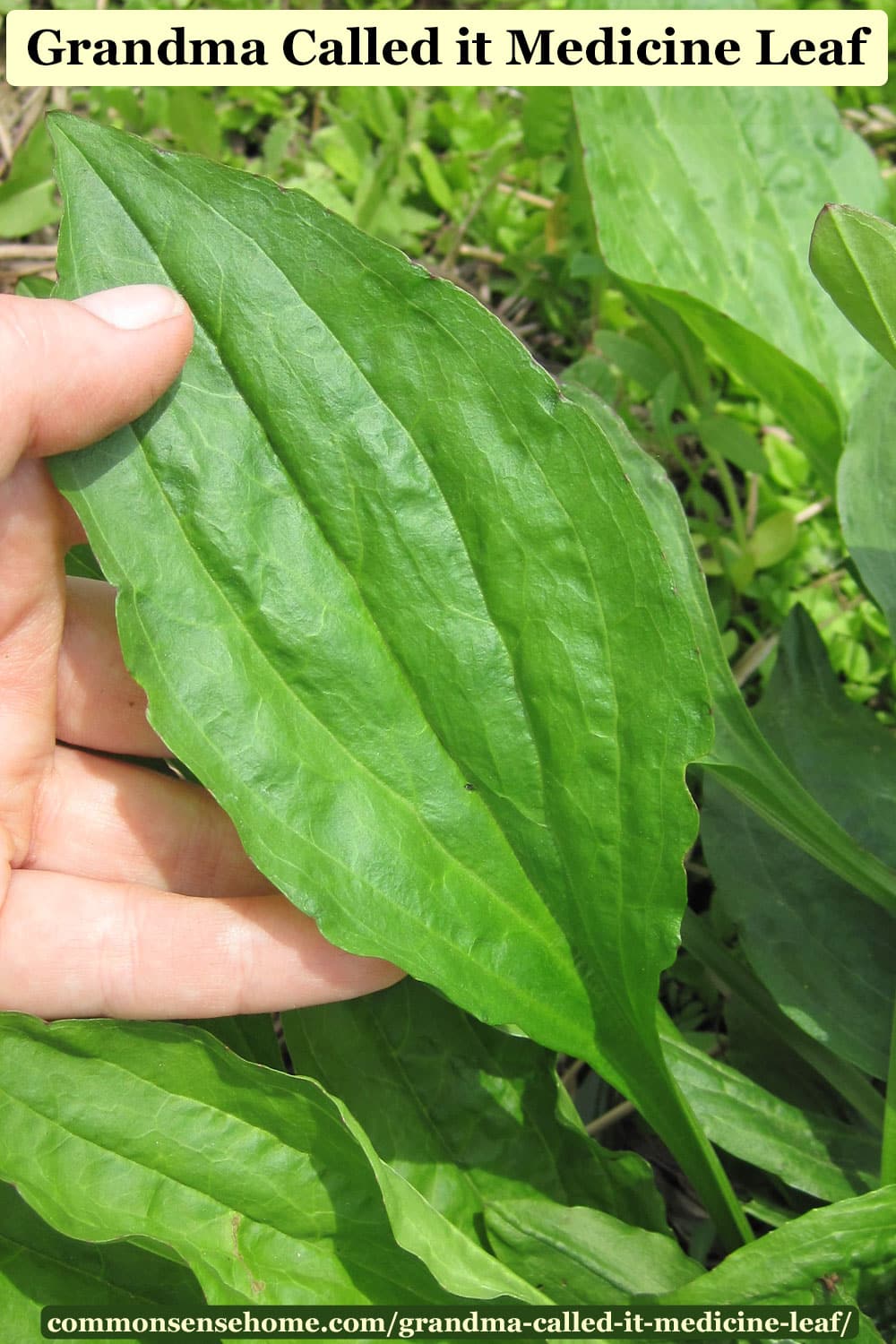
I remember grandma pointing to a broad leaf plant in the yard and calling it “medicine leaf”. She told me the Native Americans use to use it for medicine, but we never used it ourselves.
A New Look at Old Medicine
Fast forward about 30 years. I started hanging out with the grandmother of some boys in our local homeschool group, and she showed me how to use plantain leaf to make an infused oil.
It turns out grandma’s “weed” was actually broadleaf plantain (Plantago major), and it’s close to miraculous for treating bug bites, stings and many other ailments.
Using plantain weed opened the door to my curiosity about the use of many common weeds. It truly changed my life, and that’s why I chose it for the logo of the website.
Now I look at wild plants with fresh eyes. (Many of them were carefully carried by settlers as food and medicine.) It’s a great feeling to know that I can find simple remedies almost anywhere.
I’m not the only one taking notice of plantain. The 2018 study “Plantago major in Traditional Persian Medicine and modern phytotherapy” looks at a wide range of medicinal uses of plantain, including treatment of:
- epilepsy
- eye disease
- toothaches and other oral health problems
- earaches
- pulmonary disorders
- gastrointestinal trouble
- liver disease
- urinary tract issues
- skin diseases
Note: For more detailed information on how to to identify plantain and food uses of plantain, see “Broadleaf Plantain – The “Weed” You Won’t Want to Be Without – Weekly Weeder #14“.
How to Use Fresh Plantain Leaf to Treat Insect Bites, Stings and Other Skin Irritation
The first time I put plantain weed to the test was for treating a wasp sting.
I was at my Great Uncle’s house scrubbing egg off a plate with a metal scouring pad, when “the pad” stabbed me. I set the scrubber down and out crawls a large black wasp. (Bill told me after the fact that, “Oh yes, he had seen some of those around.” I guess it didn’t like being used to scrub plates.
My finger started swelling and burning. I ran cold water on the sting, and yelled for my son to run outside and grab some plantain. He came back in a matter of minutes with a nice, healthy leaf, and into my mouth it goes. Chew, chew, chew – spit it out – onto the bite.
The worst of the pain subsided within minutes. I wrapped the green blob onto my finger with a band-aid and left it there for the rest of the afternoon and evening. (Plantain tastes very green, in case you’re wondering.)
Here’s what the sting looked like at the end of the day:
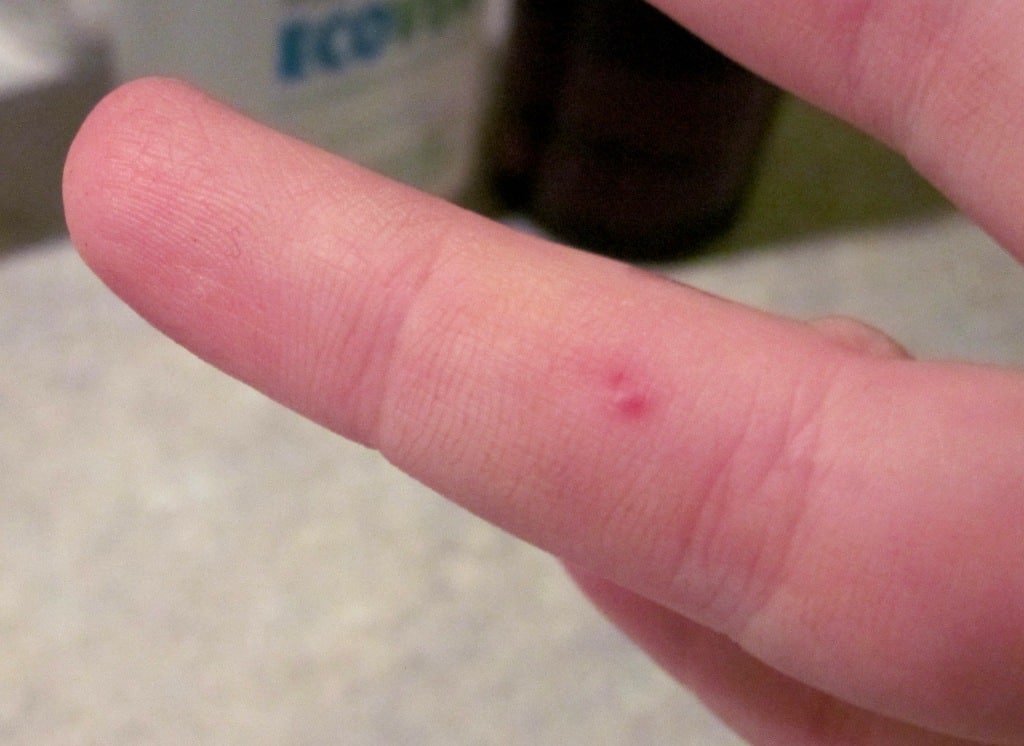
Note: insect damage is very clear, but there is no sign of inflammation or swelling (no welt). There was no pain at all the following day. The last time I was stung, the welt lasted for several days. This was so much better.
To use Plantain Leaves for Bites and Stings
- Find a clean leaf
- Chew or otherwise mash it to release juices
- Apply to affected area until pain/itching subsides
A plantain poultice also helps to heal cuts and incisions.
Plantain Weed for Slivers
Plantain has a natural drawing and anti-inflammatory action. This helps to reduce swelling, but it also helps to draw out slivers.
Simply crush or chew your plantain leaf, place it over the area with the sliver, bandage and leave overnight. In the morning the sliver should easily pop out.
You can use fresh plantain juice to treat poison ivy, sunburn and other skin irritations, but infused oil or salve is easier to apply.
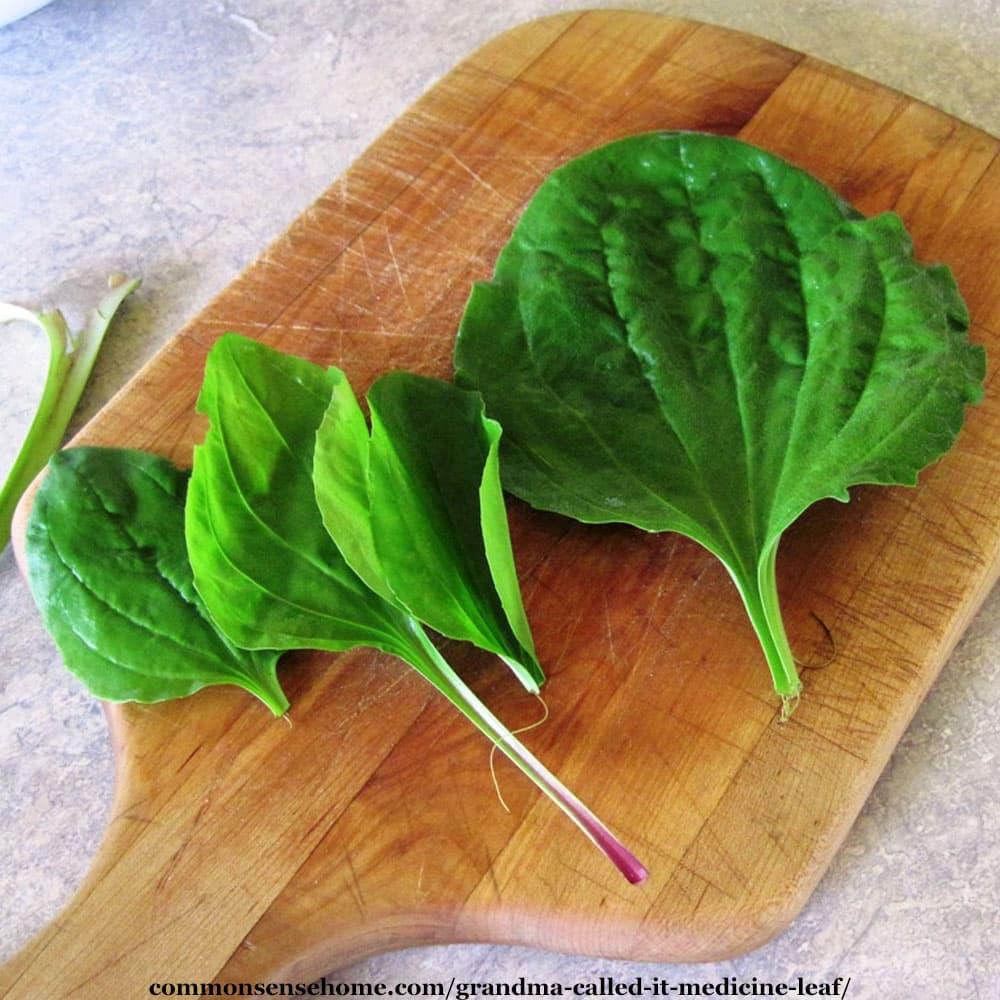
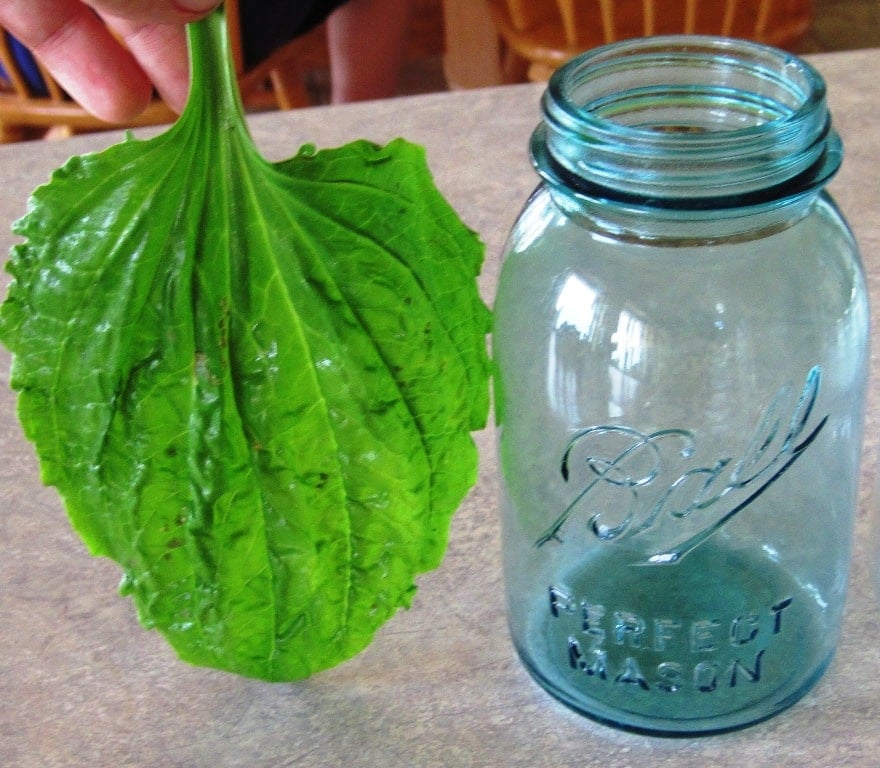
I visited my brother recently and he had some enormous plantain weed leaves. (My brother now lives in grandma’s old house.) Some of the leaves were nearly the size of a sheet of paper. Here’s one of them next to a quart Mason jar for comparison.
How to Make Plantain Infused Oil
Gather Plantain Leaves
First, gather up a bunch of plantain leaves. Minor damage is fine, but avoid mold or other signs of spoilage. Pick enough leaves to fill your container of choice. (Small jars work well.)
Wash and Prep Leaves
Wash the leaves and dry thoroughly. (I run mine through the salad spinner and pat dry with a towel.) You want these as dry as possible to help prevent mold in your infusion.
Finely chop the leaves and pack them into your jar until full. Cover leaves with olive oil or fractionated coconut oil. Poke/stir with a chopstick or other implement to remove air bubbles. Place lid on jar, label and date.
Infuse the Oil
I keep the jar in a sunny window for at least two weeks (usually four to six weeks), stirring daily to make sure the leaves stay below the oil. After several days it will start to smell like pepperoni – this is normal.
Sunlight exposure during this stage helps to prevent mold, but you don’t want the oil to get extremely hot.
Decant and Pack for Storage
Decant the oil (strain out the plant material) in four to six weeks. I use my jelly bag strainer. The oil is now ready to use.
For longer storage, allow the decanted oil to settle for a few days, then bottle the finished oil in dark jars. You may get sediment or water in the bottom as the oil settles – try to keep this out of your finished product by pouring off the oil carefully.
Seal the bottles, label, and store in a cool, dry, dark place.
Using Plantain Infused Oil
My first test of plantain oil came after an evening in the garden with a voracious cloud of mosquitoes. I rubbed catnip on my exposed skin, but they bit right through my shorts!
I must have had at least 20 bites on my tush. Oh man, did it itch! I took a quick shower and coated all my bites with some plantain oil. Again, within a matter of minutes, the pain and itching subsided.
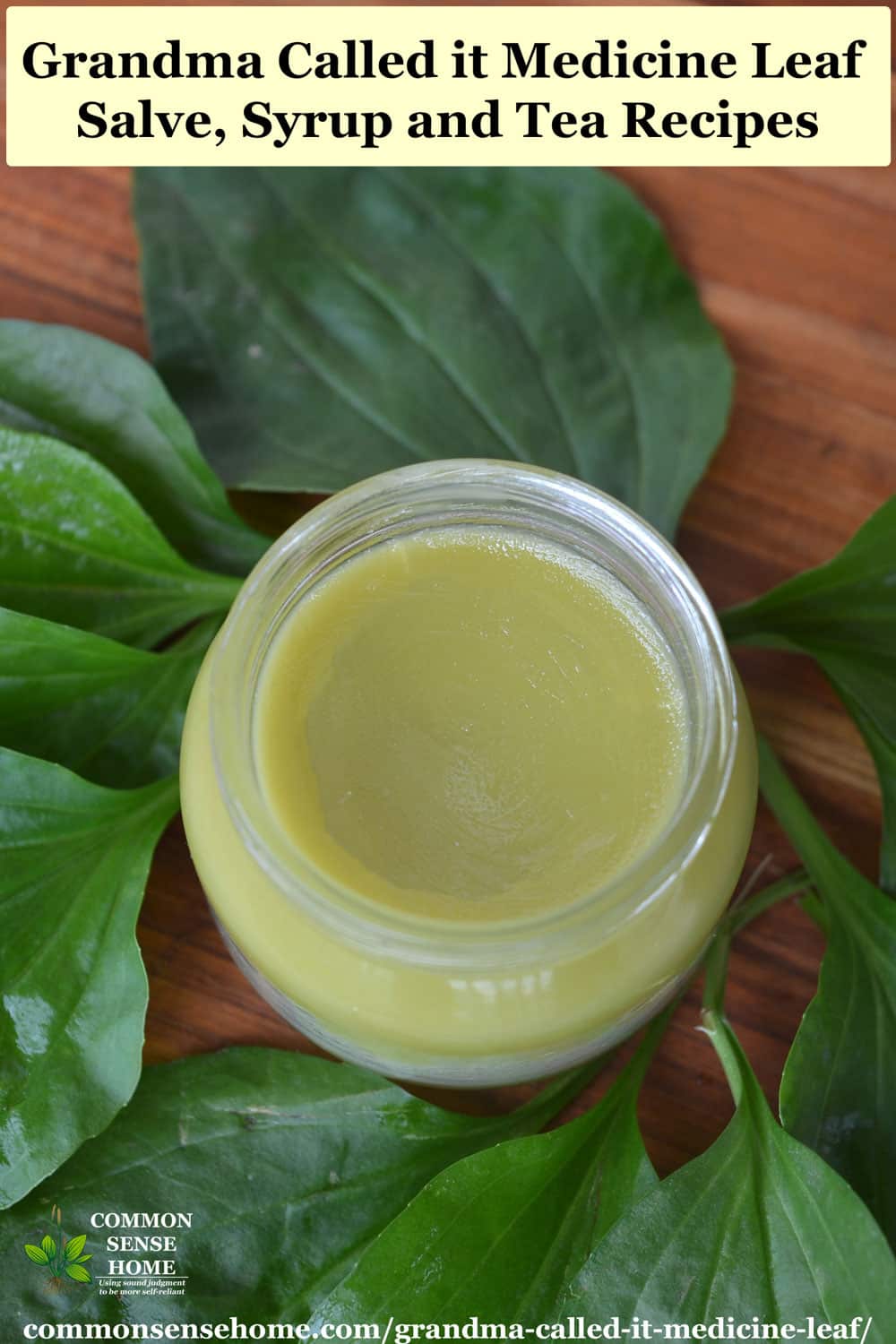
Simple Plantain Weed Salve
Plantain infused oil is great for covering larger areas, but plantain salve is nice for spot treating bites, stings or hemorrhoids.
Use 1 tablespoon of finely chopped beeswax for every ounce of plantain infused oil. Stir the oil and wax together over low heat until the oil is melted.
For more details, see “How to Make a Salve with Infused Oils“.
Plantain Leaf Tea
For internal use, try plantain leaf herbal tea.
Place one heaping teaspoon of crumbled dried leaves or one to two fresh leaves in a mug. Cover with boiling water and infuse for ten minutes. Strain and drink, adding a little honey for sweetness, if desired.
Drink a mug of plantain tea three times per day to help clear out colds and soothe digestion.
Plantain Juice with Honey
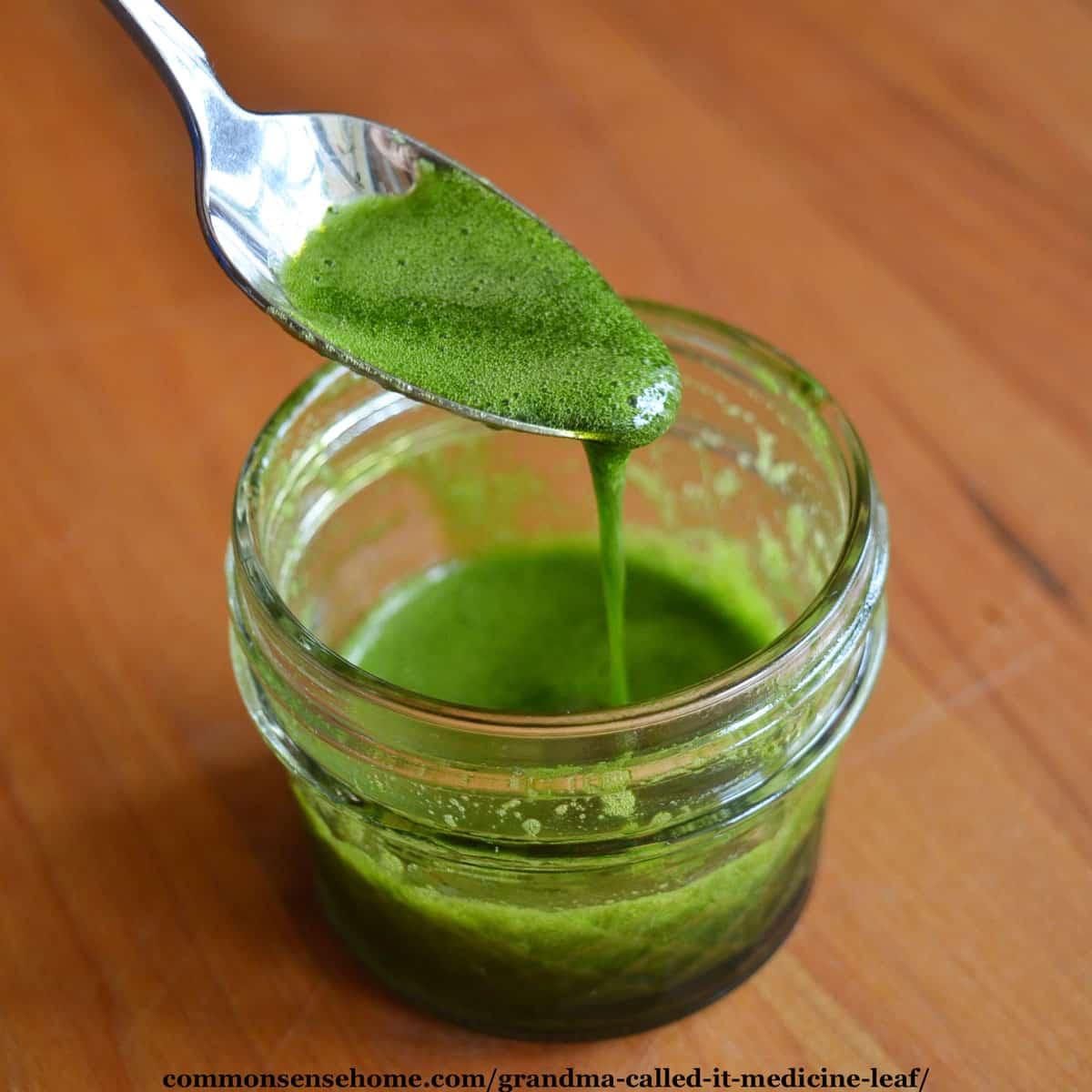
This plantain weed remedy is recommended in Backyard Medicine for coughs and stomach ulcers. It can also be used externally for ulcers and other sores. (Honey also has a long history of medicinal use.)
Juice fresh plantain leaves and mix the juice with an equal amount of honey. Pour into sterilized bottles and keep in a cool location.
Dose: 1 teaspoon as needed for coughs, 1 tablespoon three times daily for stomach ulcers.
Note: Ribwort plantain (Plantago lanceolata) works best for juicing, but any plantain variety has similar medicinal properties.
Dig deeper into the wonders of plantain in The Wild Apothecary series – volume 1.
Get Plantain Products and Seeds Online
Want someone else to prep the oil for you, or don’t have plantain readily available?
You can get plantain infused oil, plantain seeds, dried plantain leaf, powdered plantain, plantain extract, and plantain infused lip balm.
Have you used plantain? Do you have a favorite recipe or tip to share? I’d love to hear from you.
You may also enjoy:
- 15 Ways to Naturally Reduce Cholesterol
- Easy Homemade Cough Drops for Treatment of Sore Throats and Coughs
- Natural Remedies for Colds and Flu to Help You Feel Better Faster
Originally posted in 2010, updated in 2019.
I’ve used the plantain poultice on mosquito bites and it works almost instantly! Often I would get welts from the mosquito bites, but not when I’m able to put some plantain on it right away.
I also made my first plantain salve this summer. Haven’t had a lot of need to use it yet, but I’m ready!
The one thing I want to try for next summer is to see how I can incorporate more into my diet. It grows all over and I would like to use it more.
My family made fun of me ‘picking weeds’ and making everything homemade until we got into a patch of chiggers and poison ivy. Out came the plantain salve I had stored in the cabinet. Chigger relief was almost immediate with redness and swelling gone by morning. Poison ivy disappeared in 4 days. Made believers out of them! Always keep it handy and it is the first thing they use now. I also have a comfrey plant and must give one word of caution, become familiar with the adverse properties of the plant. It can cause liver problems if over used. Glad to find this sight wonderful posts on stuff I use and am learning more about every day.
That’s usually the easiest way to convert someone – just let them see the plants in action. 🙂
As I understand it, you would have to use quite a bit of comfrey to cause problems, but it’s always good to exercise caution when using any medicinal plant.
Hi, I have only ever noticed thin leaf plantain in my area, (although I’m probably just not paying enough attention for broad leaf) there is some growing in my yard/driveway right now. Does the thin leaf variety have the same medicinal properties?
Yes, the narrow leaf plantain has similar properties, and is preferred for medicinal use.
The property we bought had a garden patch from a several times past owner. The soil is is variable, but it is obvious where the general boundaries are because of the medicinal herbs that toughed out years of drought and neglect. Common/Broad-leafed plantain has spread all over the property, but the narrow-leafed, which I have seen referred to as Chinese plantain, was in just a little patch, and I left it alone to multiply on its own. It appeared in a new lasagna bed, and while “guiding” it into a more convenient location I noticed that in addition to cheery little spikes of florets, it spreads under surface by a root that sprouts shoots at intervals, much like many of the field plants on our property. I am going to make a small batch of this to compare with my broad leafed plantain infusion.
I’m having fun doing my plantain shaking dance every morning. I spent a little time compulsively trying to get those little air bubbles out and discovered a quick technique. The finale for each performance is now about 30 seconds of vortexing the bottle. I rest the bottom of the jar on the palm of my right hand and rapidly rotate the top counterclockwise with my left. It looks like the top is spinning in one direction and the bottom is rocking in the other. The bubbles head right to the top in seconds. I tried doing it the opposite way, and found that the lid started to unscrew itself–bad move with that much oil to spill! I haven’t ever read this in oil infusion instructions. If you try it, Laurie, I’d love to know if it works with other herbs, and with herbs that are prepared differently than with slicing them into chiffonade. It occurs to me that my comfrey is big enough now to make a good sized batch. I have yarrow and nettle, but those did not grow as profusely this year, not sure I want to cut them back any more than I have to feed them to my chickens.
Narrowleaf plantain is generally considered to have slightly superior healing properties. I’ve never heard specific shaking directions. I simply use a chopstick to stir.
Has anyone used plantain for internal issues such as peptic ulcers, irritable bowel syndrome,asthma or sinusitis? A friend of mine her daughter who is 17 has ulcers and possibly irritable bowel syndrome I’m looking for something natural that will help her.
Thanks
I’m sure that people have, but it would be best to consult with a trained herbalist for more serious issues.
Mine has been sitting for longer thank 4-6 weeks. Is that okay or should I throw it out?
As long as there is no mold or rotten smell, you’re fine. The steeping time is just a rough estimate, not an exact science.
Hi,
I just love love love plantain.i am so happy with it…it has cured many different things for me and my kids. I decided to also make the oil, done the same way as mentioned above and it really works. I made it about 3 months ago,it’s strained of course,and only now noticing sediment at the bottom of jar and when I tipped it I can see floaties! :/ is it still ok? Do I just strain again and will be ok? Or is it bad? Doesn’t smell bad,just sediment. Please let me know…thankyou so much.
I think as long as the smell isn’t “off”, you can strain and it will be just fine.
I use plantain for bee stings and bug bites. I just scrunch it up to expose the juices and then rub hard on the itchy area. It works wonders for me. Very fast. I also have taped it to my bee stings with a bandaid. That was effective to eliminate the pain and let me keep working in the yard.
Glad that it worked well for you, too. I wish I had known how to use it years ago.
Glad to see someone forging a safer life. Good post.
Why use only the ones the bugs have not bitten? If the bugs will chomp on it – the plant is better for humans and the bug chomp can be cut out.
Can also use Sweet almond oil, olive oil – grapeseed oil is antioxidant and astringent – good for skin preparations such as this (making this oil does not require heating on the stove so there is no drawback to using grapeseed oil here; all oils, particularly medicinal oils should be kept from the light and stored in dark brown glass bottles.)
Sesame oil and coconut oil are antibacterial (coconut oil must be melted – I would add the melted coconut oil to the extract oil made with sesame oil).
Keep the oil in the dark while making and storing – light defeats the efficacy of your product.
You can strain with fine mesh screening – remove the ring and disk, replace the disk with the mesh, screw the ring on – turn it upside down (if you can prop it securely), set it upside down in the canning funnel and let it drain all day/overnight – store in glass bottle (preferably dark brown) with pump for dispensing.
To “protect and preserve” add rosemary leaves and a little tea tree oil.
A comment I have often seen in discussions about the merits of organic gardening is that a healthy plant will get less bothered by bugs than one that is stressed or grown in stressed soil, which is what eventually results when using chemical fertilizers. So if a wild plant is being nibbled on by bugs, it may be stressed or deficient in some way in nutrients that are an important aspect of the therapeutic qualities of the herb. Plantain is a double blessing in that it grows well in different kinds of soil and in a fairly wide range of conditions. It also seems to germinate through most my growing season, so the immature leaves, which taste less intense can often be found at the same time as more mature leaves. Young leaves will have more tender fibers that extend from the stem up through the leaf, something else that makes them more palatable. A wide border of it makes an effective living mulch that seems to discourage more invasive weeds from getting into my raised beds as well as helping to hold moisture. I’m so mosquito-phobic/allergic that I cover up pretty thoroughly before going into the garden. This article is giving me a great deal more confidence in grabbing for a leaf when bit, and I am going to start a jar of the oil tomorrow. One of my first great gardening mistakes in the Midwest was squatting to do some weeding wearing knit pants. Twenty bites sounds about right, and it was in the area of maximum stretch across my butt. Sitting down for the next week was an unforgettable lesson in dressing properly for the garden. Wish I’d know about my treasured friend plantain then.
It’s on the to do list to start a fresh batch this week. I have a ton of plantain volunteers in our attached greenhouse, which makes them nice and easy to pick.
There are conflicting trains of thought on the bug eaten versus not bug eaten plants. One, as you said Sandy, is that a chewed plant is stressed in some way, making it less than optimally healthy, which is why it gets chewed.
The folks that promote using the chewed leaves are generally in the camp that favors the argument that plants will change their chemistry to fight off the bug attack, boosting the level of antioxidants and other active compounds in the leaves, making chewed leaves a better choice for medicine making.
Another factor in play is the bug saliva or feces. Often I don’t wash the leaves, especially if there has been rain recently. Saliva and feces contain bacteria that will speed decomposition, which of course is not what we’re looking for in an oil that we want to preserve.
Addressing Vicki’s earlier comment, when using fresh plant material, sunlight exposure while the plant is in the oil helps prevent mold. This is generally not an issue with dried plant material, which can be infused in the dark or gently on the stovetop. Once the fresh plant material is removed, risk of spoilage decreases.
Can I use Grapeseed oil instead of Olive oil?
I personally wouldn’t use grapeseed oil because it readily oxidizes when exposed to heat and light. You can read more at Smokin’ Hot or Unsafe? Is cooking with grape seed oil a good idea?
Do you think coconut oil would work because they say that in itself has wonderful healing qualities to it. The two together might be 1+1=3 ???
Solid coconut oil would be tricky to slow infuse, but you could do the stove top infusion method. I use coconut oil regularly for salves and skin care and like it. If I need a liquid at room temp oil, I use fractionated coconut oil.
hi laurie, amazingly true article. thanku for sharing established knowledge from an incredible source. many organic plantains on my farm, and surrounding 3,000 acres of deciduous forest for wildcrafting. plantains hold remarkable food properties as well as topical body care applications. gem
So, I live in Haiti…does this apply to the plantain plant leaves we have here as well? Because they are alllll over the place and that would be nice to know if they provided the same medicinal qualities…thanks for the education!! God bless you!
Sarah
Not sure what species of plantain you have, but most have similar medicinal properties.
I would compare pictures. The plantain leaf I am familiar with here in NC is definitely not the same as the plantains that I had in the Dominican Republic. Our plantains do not bear fruit and are considered a weed in the grass.
Plantain as in your green banana (love them fried) is not the same plant. This always a problem with using plant common names. This band-aid leaf is Plantago major, yours is Musa paradisiaca. These might grow there too, I’ve seen them in Florida, we used to “shoot” the seed head things at each other as kids. Check out more pictures, its a small weedy plant with fat leaves (some kinds have narrow leaves) and spriggy separate seed heads on long stems.
Love to use Plantain ever since I learned its uses from a Native American woman. I use the fresh leaves – unchewed as a styptic and have had luck with the dried as well. Have had terrible cuts on the farm that looked like they needed stitches but I wrapped them tight with plantain and they healed beautifully. Just recently I made a rookie mistake with a sharp knife and am I glad I died some Plantain this summer. Put it on the cut and within a minute stopped the bleeding. A miracle plant as far as I’m concerned!
Thanks for sharing your experience, Margaret. I know it’s one “weed” that I look forward to seeing every year.
Hmm i have a problem and that is plants i see and pictures never seem to match for me . What i need is someone around here to walk with me and tell me names of things . I know some andi do tons of research and i make tinetures for myself as i find it more benefitful for myself . I do eat wild garlic /chives . onion , dandelion ,etc ihave read many leaves are good including strawberry leaves [ how about that ] now i see black berry leaves ok too . I learned night shades like tomatoe leaves not supposed to eat i have but not supposed to . so i wish i could find someone near me who can help me learn more of whats what . Likei also eat rose petals good for me i save the buds and i learn daily on different things that one can eat from the plants God blessed us with . Want to learn more an more as this way one never goes with out food since so many wild foods one can consume . I am thankful that Homestead posted your site on FB . star
It is great to have someone who is knowledgeable to learn from if possible. You may be able to connect with someone through Wild Ones – http://www.wildones.org/
Try contacting your local USDA extension office and ask someone to come look, walk and talk with you for plant identification. Not all areas have staffing to do so, but will allow you to bring a plant in and identify it for you at no charge. Telephone contact numbers are under the federal office numbers or county government section in most telephone books.
Hi Laurie,
My son had poison ivy on his knuckle, leg, neck, etc…etc. I had read on your blog about plantain major and how it works wonders for skin irritations. I’m new to herbal usage (and so was he) but decided to give it a shot. I picked a bunch and gave it him telling him it was a miracle herb for ivy. After a few days of no relief from the itching using OTC meds, he gave the plantain major a try. Overnight the blisters subsided and the spreading stopped.
Thanks for the great blog topic.
Dave
Glad that it worked well for you. Jewelweed is another great plant for skin irritation – https://commonsensehome.com/jewelweed/
my wife will have poison ivy every spring, its in her blood, plantain is the best to stop the itch..will not prevent the itch but will stop the itching within minutes..just crush it up real good and rub it on, works everytime for her and others that i have used it on..plantain is the first herb that i go to for any skin irritations.. have seen it bring temporary relieve to those with shingles..
Glad to hear it helps with poison ivy, too. It’s my favorite “go to” herb for skin irritations as well.
Wondering if you can freeze the leaves for future use
I haven’t done it -I usually use the salve when fresh is not available – but his herb lady says that you can freeze it effectively- http://www.aloe-vera-and-handy-herbs.com/plantain.html
we have froze the leaves and used them throughout the year…works wonders on wounds that wont heal.
Good to note. I keep the oil and salve year round, but there are some instances where the leaves would work better.
Has anyone used plantain for blackfly/gnat bites? It’s a weeks worth of itching every time I get bitten by these miserable bugs.
Yes. We don’t have them here (thankfully), but I’ve been bitten at a friend’s place. Plantain doesn’t knock out the bite completely, but significantly reduces the itch and speeds healing.
Yes! I have been making plantain oil and salve for a year now and I tried it on my Turkey gnat bites I got at the beginning of this week. It stopped the itch right away and the bites are already healing. Like you, those bites have always lasted a week or more in the past and I even developed cellulitis once. This discovery has been a real life saver for me. I make enough to share with friends and relatives and have made a batch to take to our local free store for the unhoused and they are asking for more!
That’s great! Thank you for sharing your experience. to my knowledge, we don’t have turkey gnats around here, so it’s helpful to hear from other locations.
Such a vivid post on this versatile plant. Grandparents are great. You can’t replace them. But you can write down their wisdom for later generations to learn from. Thanks for doing that.
risa bear – that's interesting! Thankfully, we haven't had the opportunity to try is on arrow wounds, but I could understand how it would work.
We keep some, dried — but never get around to using that — there's almost always some in the yard when we need it. It was called "soldier weed" in our family and they said it used to be applied to punctures such as arrow wounds (!!) Dunno about that but seems to help with things like blackberry scratches.
That remindet me of the “Schwertsalbe” (sword salve in direct translation) as my great grandma used to say. Not that I remember her saying it as she died when I was 4. Thats a salve made from Tagetes/Marigolds. Apparently it was used in the middle ages to treat sword wounds.
I saved tons of seeds last year. Grows really easily and provides tons of seeds and is a good companion plant to many vegetables as well as attractive for bees.
That’s interesting! Thankfully no sword wounds around here lately. 🙂
I just made salve from this year's oil. So nice to have it available for easy application, and I agree about it growign right where it's needed.