
Warm & Golden Dandelion Wine Recipe (Old-Fashioned Wine Making)

This post may contain affiliate links. Read my full disclosure here.
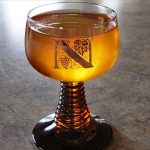
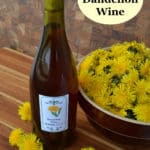
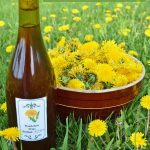
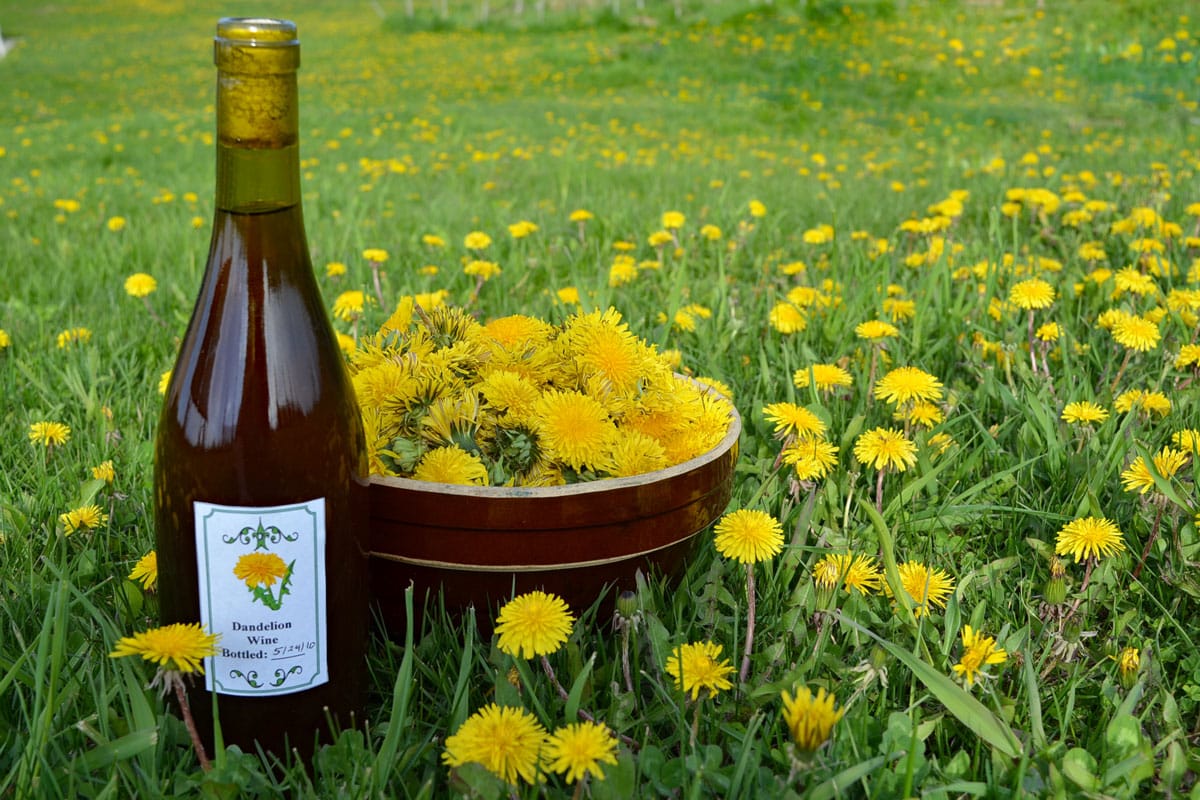
Wine out of dandelions? You bet! Making homemade dandelion wine is a longstanding family tradition. We don’t make it every year, but I do like to keep a few bottles on hand for company.
The taste of this dandelion wine is rich, golden and warming – more like a good brandy than a wine. I’ve had friends who don’t normally like wine comment that they do enjoy this “spring tonic”. This is a “country wine” made from simple ingredients with basic equipment.
Would you like to save this?
When we get dandelions, we get LOTS OF DANDELIONS! They are everywhere! (Boy photos are from 2010. They have grown quite a bit since then, but I kept these photos here for the happy memories.)
Dandelions are wonderful for bringing up nutrients and breaking through compacted soil. This area of the yard had a lot of compaction from soil being moved around, so the dandelions were working overtime.
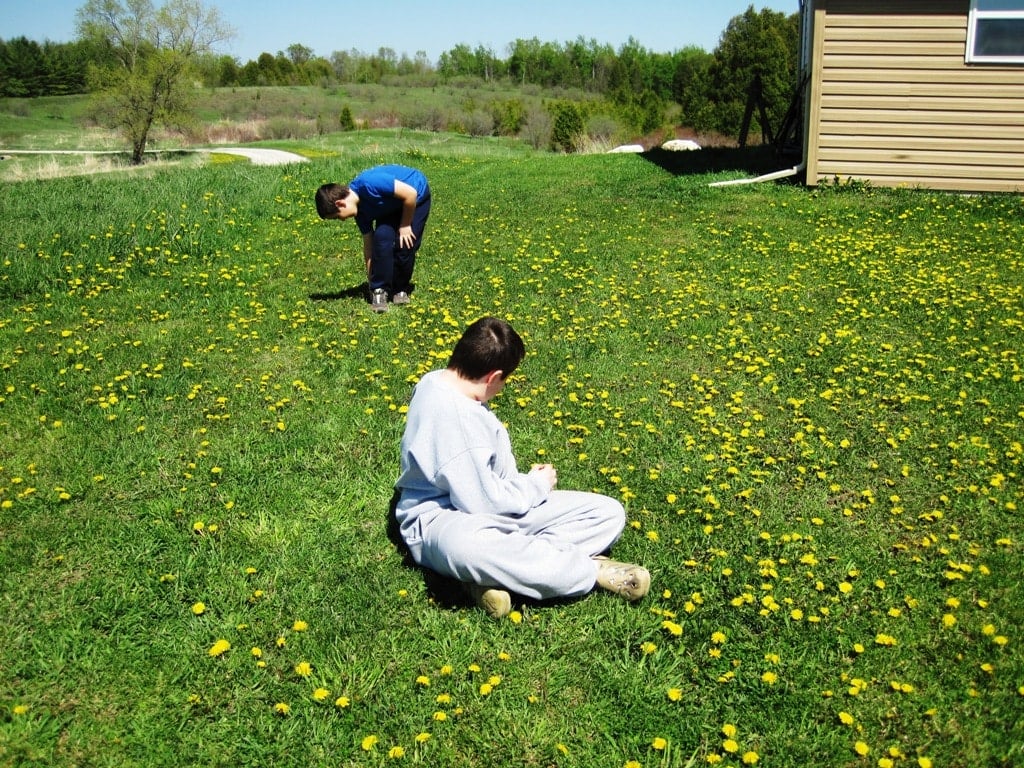
Table of Contents
Gathering the Flowers
Make sure your dandelion flowers are free of pesticides, herbicides and other contaminants. I usually don’t rinse the blossoms, though you can if they are dusty. They are sterilized during the first part of brewing. We gather bins of flower heads outside, and then bring them inside to remove the petals.
Don’t pick dandelion blossoms for wine or eating from an area used by pets for their “bathroom”. As I explained to a reader in the comments, I’m fairly sure goat pee will not wash off.
What part of the dandelion is dandelion wine made from?
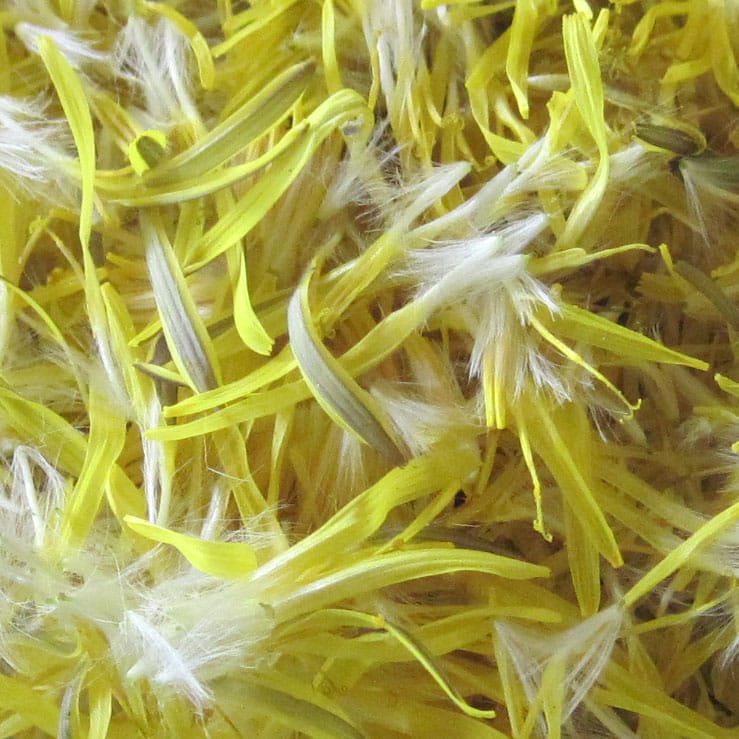
For dandelion wine, use the yellow flower petals only. Leaving the petals attached to the green base of the flower will result in a bitter, unpleasant wine. My neighbor made this mistake when she tried to make dandelion wine, and she ended up throwing out the whole batch.
I use 3 quarts of loosely packed yellow dandelion petals (pictured below). Not 3 quarts of flower heads, 3 quarts of petals only.
If you don’t have enough dandelion petals from one picking, freeze the petals until you have enough.
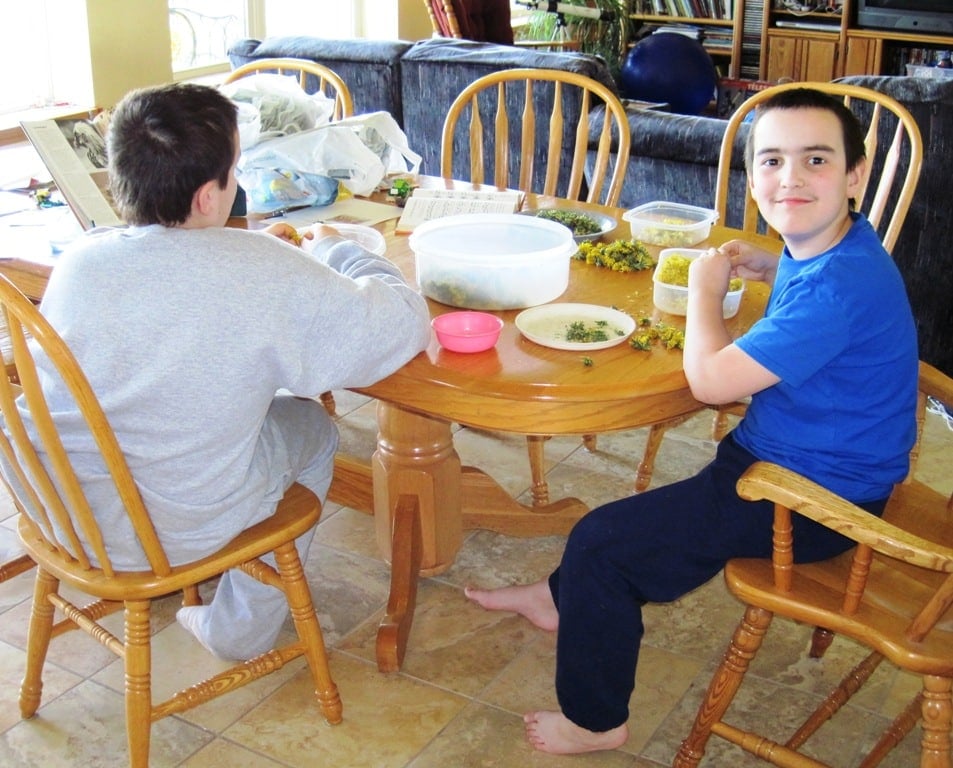
The boys and I sat down to a session of “second picking” to remove the yellow petals from the blossoms. You want to remove the petals as soon as possible after picking, as the flower heads close over time. Once they close, it’s tough to get the petals off.
If you are working alone, it may be best to pick some of the flowers needed, remove petals, then pick more flowers and repeat. That way, you won’t have trouble with the flower heads closing before you have time to clean them. It’ll also give you a chance to get up and stretch.
Making Homemade Dandelion Wine
“Dandelion wine, believed to be of Celtic origin, is regarded as one of the fine country wines of Europe. In the late 1800s and early 1900s, it was not proper for ladies to drink alcohol. However, dandelion flower wine was considered so therapeutic to the kidneys and digestive system that it was deemed medicinal even for the ladies.“
Adapted from Dandelion Medicine, in combination with my mother’s recipe.
Remember, all your fermentation vessels should be glass, ceramic, stainless steel or food grade plastic. Never ferment in aluminum or iron, as it can react with the wine.
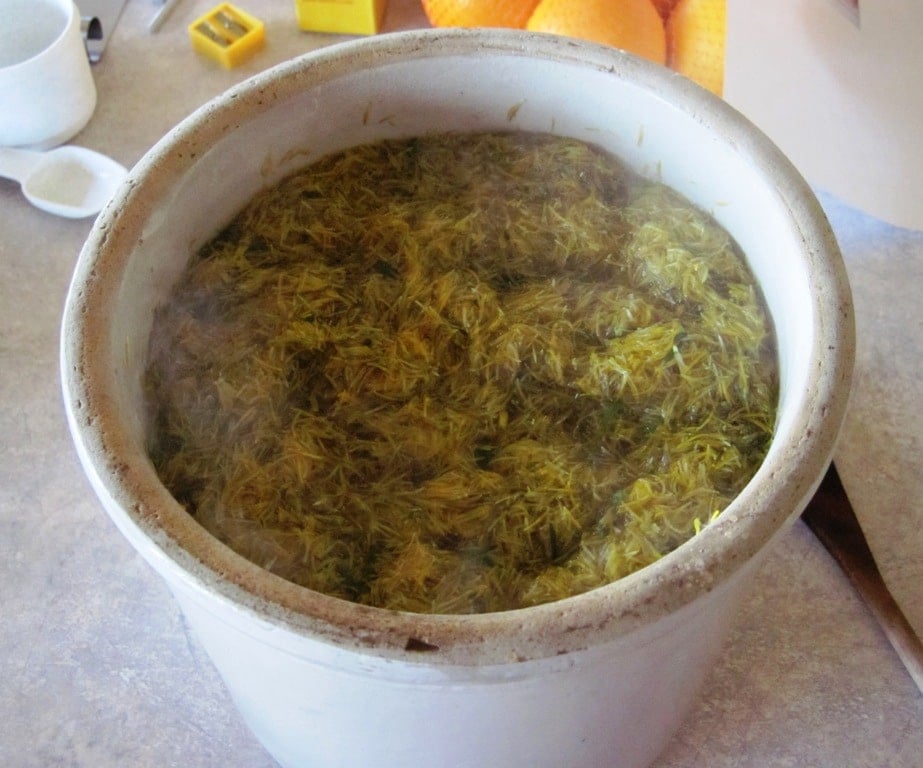
I normally use my two gallon crock for one gallon of wine, since the fruits bubble up during fermentation. You can see in the photos below that a one gallon crock gets very full.
Ingredients
- 3 quarts dandelion petals, loosely packed
- 1 gallon water
- 2 oranges, with peel, preferably organic
- 1 lemon, with peel, preferably organic
- 3 pounds sugar
- 1 package champagne yeast or wine yeast (this yeast finishes at around 12-14% alcohol)
- 1 pound raisins, preferably organic
How to make dandelion wine – Directions
1) Collect the blossoms when they are fully open on a sunny day, after the morning dew clears. Remove green parts and measure out 3 quarts of loosely packed petals.
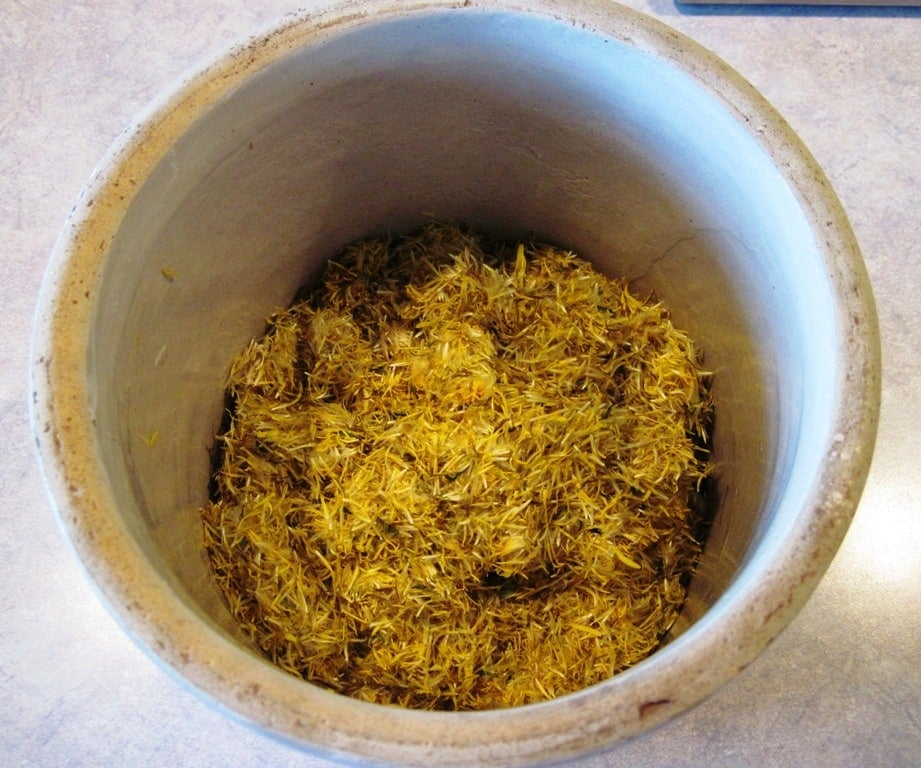
2) Bring the water to a boil and pour it over the flowers in a large pot or crock. Cover with a towel to keep dust out and let steep for three days. Stir daily to keep the petals submerged in your “dandelion petal tea”. They will develop a musty smell, which is normal.
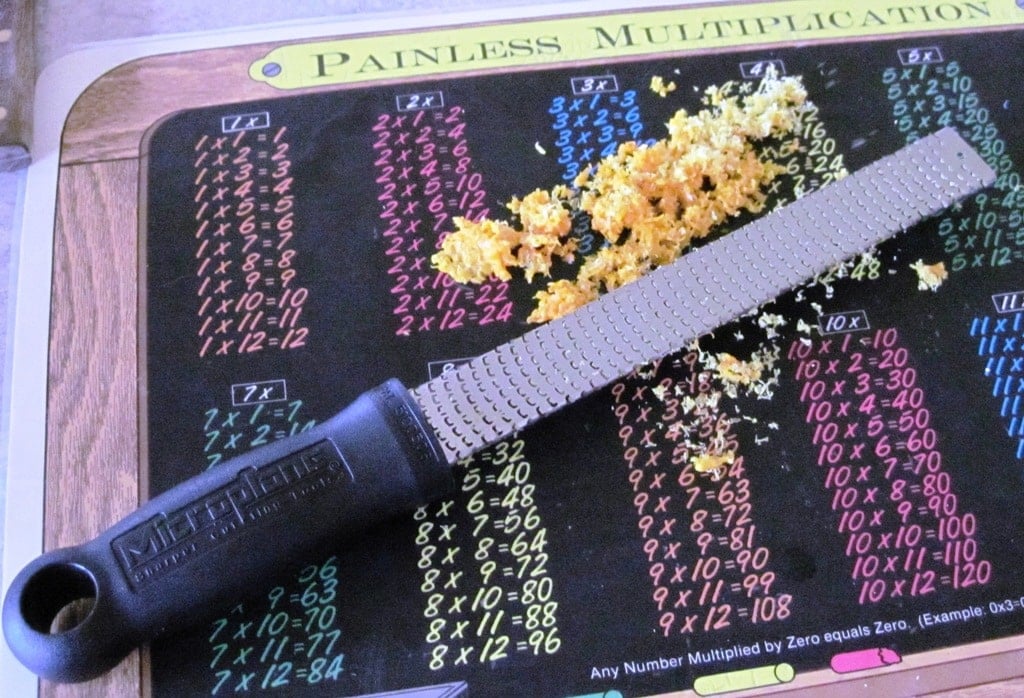
3) Prepare the oranges and the lemon. Zest about half of the rind and peel off the rest in thin strips. You want to minimize the amount of white pith added to the brew.
4) Clean most of the pith off the fruit and slice into thin rounds.
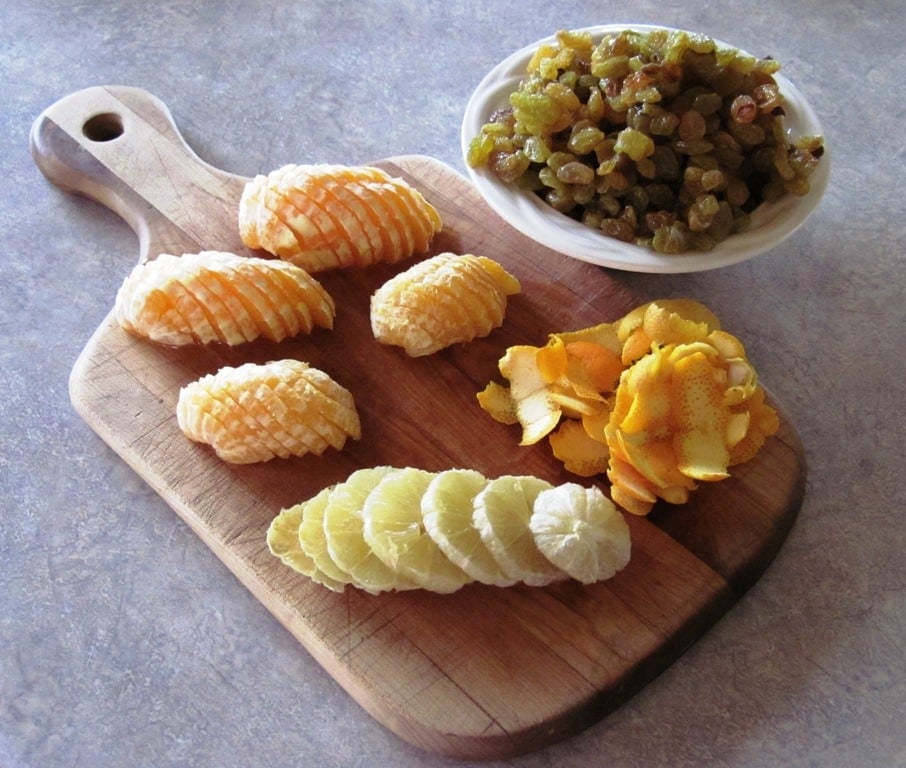
5) Add the lemon and orange zest to the flower-water mixture and bring to a boil. Remove from heat, strain out solids. Dissolve the sugar in the flower water. Allow to cool to room temperature.
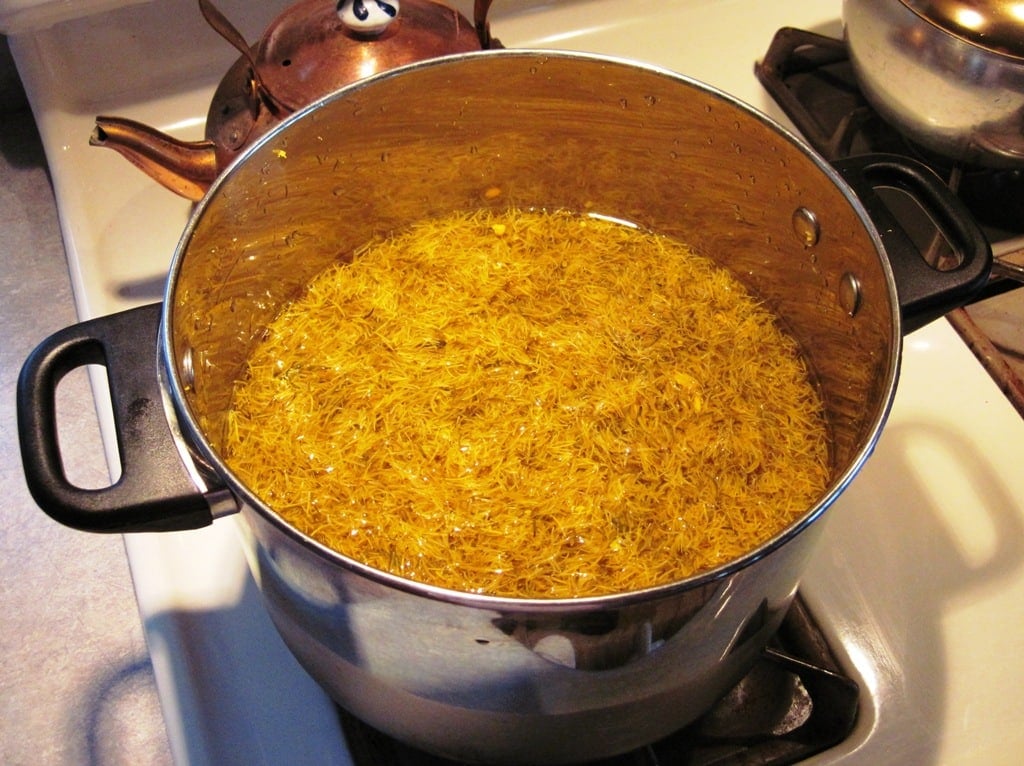
6) Add the yeast, raisins, and orange and lemon slices and rind strips to the liquid. Put everything into a crock (or wide mouth carboy with airlock) to ferment. I cover my crock with a clean cotton towel held down by a rubber band to keep dust and bugs out. (Not shown.)
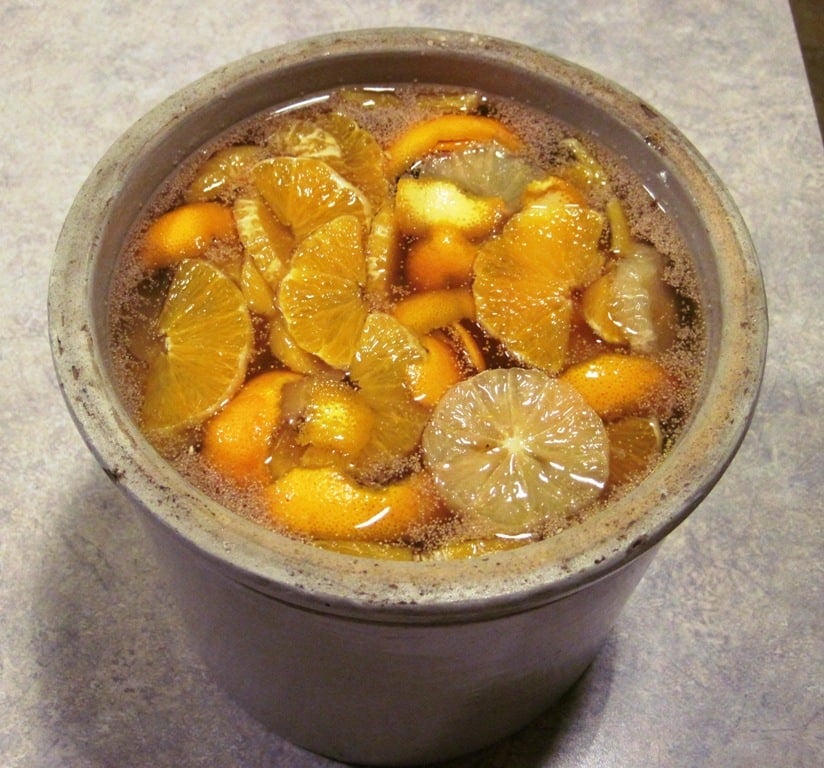
Stir daily with a wooden spoon or non-reactive stir stick. When the yeast gets active, the bubbles will lift the fruit up to the top of the wine. You want to stir so all the fruit gets pushed back under the surface and wet down daily.
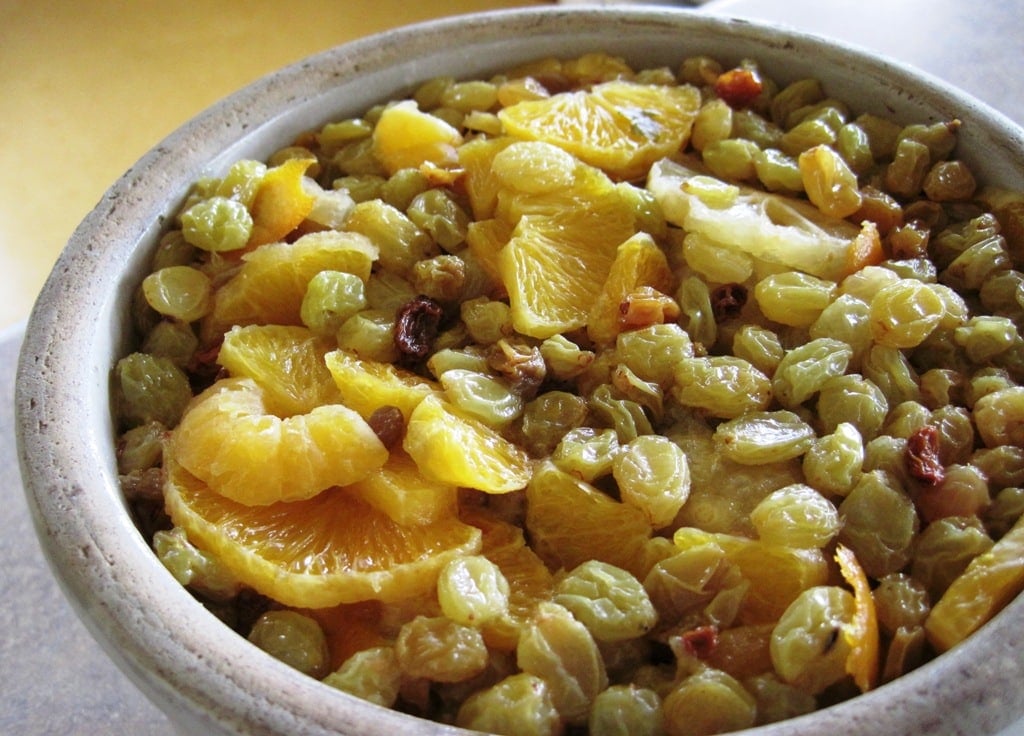
7) When the primary fermentation mixture stops bubbling (1 -2 weeks), fermentation is almost done. Strain the liquid through several layers of cheesecloth, a flour sack towel, or a jelly bag.
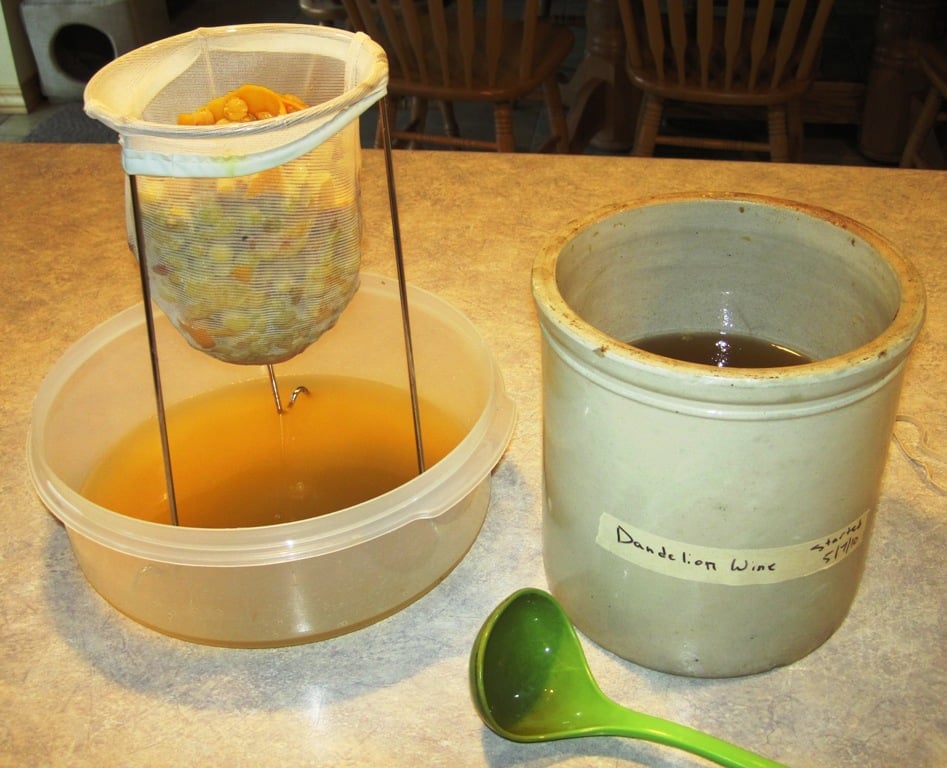
Bottling the Wine
You have two options for bottling your homemade dandelion wine. You can let it finish in bottles, or move to a carboy and then bottle.
To finish in bottles: After straining, move the young dandelion wine directly to clean bottles. Slip a deflated balloon over the top of each bottle to monitor for further fermentation. When the balloon remains deflated for 24 hours, fermentation is complete. You will probably need four or five 750 ml bottles.
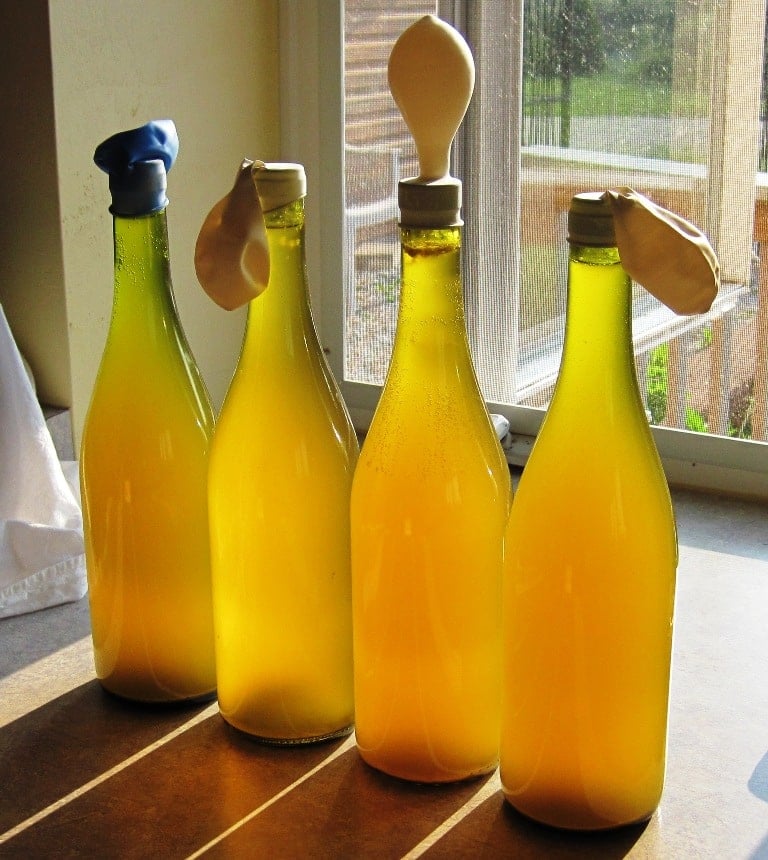
Cork the bottles and store in a cool, dark place for at least six months before drinking.
NOTE: Do not seal bottles tightly before they finish fermenting, and don’t put them somewhere warm. Otherwise, you’ll end up with exploding bottles, like my sister, Mary, when she stashed them in a closet. Apparently, it sounded like there were bombs going off or they were being shot at.
If you would like a clearer wine, transfer the strained dandelion wine into a one gallon carboy with airlock before the final bottling. Allow to ferment in the carboy for 2-3 months, and then rack into the bottles.
If you’d like to download a pdf of my wine labels, use this link: Printable Dandelion Wine Labels.
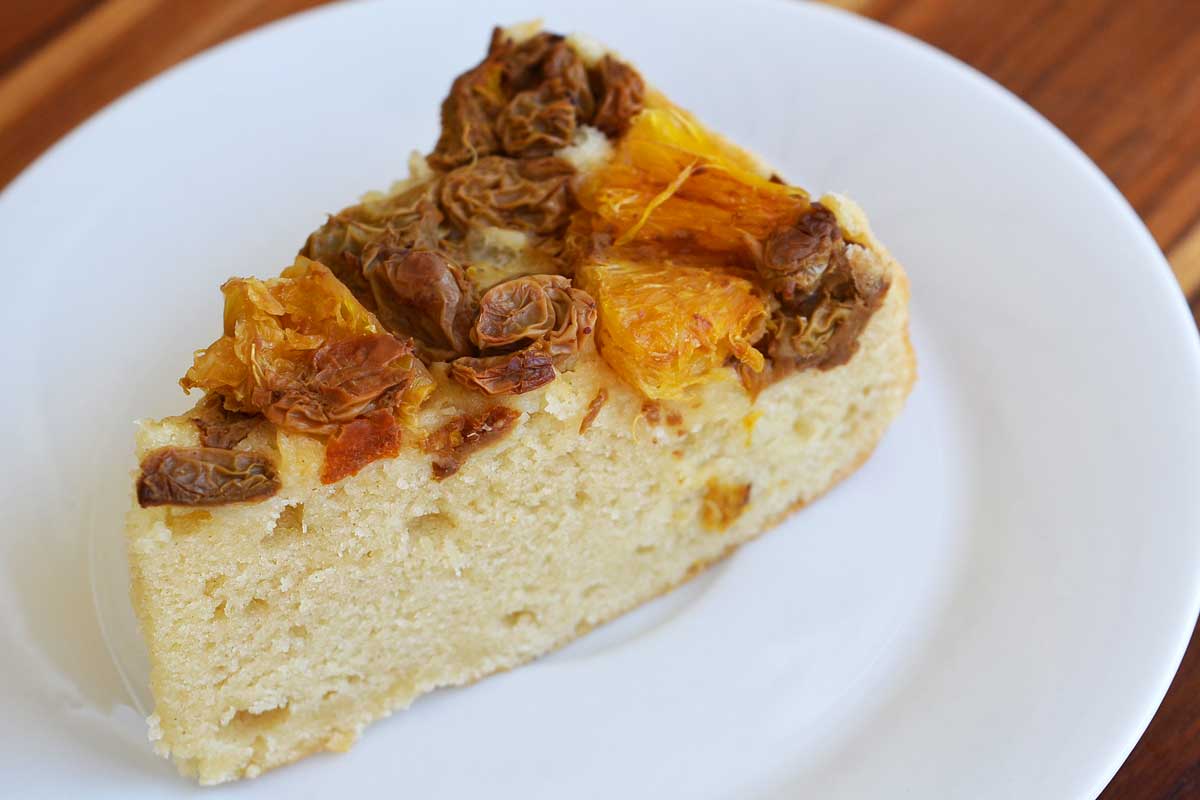
If you don’t want to send the wine fruit to the compost pile, try Dandelion Wine Fruitcake.
Recommended Materials for Making Dandelion Wine
- Wine Yeast – store extra yeast packs in the fridge or freezer. I normally use Lalvin Wine Yeast EC-1118.
- 2 Gallon Crock – 2 gallons gives you space for fermentation.
- Wine Bottles – It’s fine to wash and reuse old wine bottles. You will probably need five 750ml bottles.
- Corks – It’s best to use new corks. I like the #9 Straight Wine Corks.
- Wine Bottle Corker – This double lever model works like a charm.
- Gallon carboy with airlock – optional, for clearer wine.
Old-Fashioned Dandelion Wine Recipe
A smooth and hearty flower wine with citrus notes that will warm you from head to toe.
- Yield: 4–5 bottles 1x
Ingredients
- 3 quarts dandelion petals, loosely packed
- 1 gallon water
- 2 oranges, with peel, preferably organic
- 1 lemon, with peel, preferably organic
- 3 pounds sugar
- 1 package wine yeast
- 1 pound raisins, preferably organic
Instructions
- Collect the blossoms when they are fully open on a sunny day. Remove any green parts and measure out three quarts of petals.
- Bring the water to a boil and pour it over the flowers in a large pot or crock. Cover with a towel to keep dust out and let steep for three days. Stir daily to keep the petals submerged.
- Prepare the oranges and the lemon. Zest (finely grate) about half of the rind and peel the rest off in very thin strips. You want to minimize the amount of white pith added to the brew.
- Finish peeling the citrus, and slice them into thin rounds.
- Add the lemon and the orange zest to the flower-water mixture and bring to a boil. Remove from heat, strain out solids, then add the sugar, stirring until it is dissolved. Allow to cool to room temperature.
- Add the yeast, raisins, and orange and lemon slices and rind strips to the liquid. Put everything into a two gallon crock (or wide mouth carboy with airlock) to ferment. I cover my crock with a clean cotton towel held down by a rubber band. Stir daily with a wooden spoon or non-reactive stir stick.
- When the primary fermentation mixture stops bubbling (1 -2 weeks), fermentation is almost done. Strain the liquid through several layers of cheesecloth or a flour sack towel.
Bottling the Wine
You have two options for bottling your homemade dandelion wine. You can let it finish in bottles, or move to a carboy and then bottle.
To finish in bottles: After straining, move the young dandelion wine directly to clean bottles. YOu will probably need four or five 750 ml bottles. Slip a deflated balloon over the top of each bottle to monitor for further fermentation. When the balloon remains deflated for 24 hours, fermentation is complete.
Cork the bottles and store in a cool, dark place for at least six months before drinking.
If you would like a clearer wine, transfer the strained wine into a one gallon carboy with airlock before the final bottling. Allow to ferment in the carboy for 2-3 months, and then rack into the bottles.
Notes
Do not seal bottles tightly before they finish fermenting. Always store your wine in a cool location.
Is Dandelion Wine Alcoholic?
Yes. If you use wine yeast as recommended in the recipe, you should end up with around 12 to 14 percent alcohol.
If you’re feeling adventurous, you may be able to nurture wild yeast from the raisins to do the fermenting. Wild yeast brews will have a lower alcohol content, because wild yeast dies off if the alcohol levels get too high.
You can learn more about using wild yeasts in the book, “The Wildcrafting Brewer“.
Is Dandelion Wine Medicinal?
Nearly every part of dandelion is full of nutritional value, with vitamins and minerals packed in every part of the plant. Aside from its great taste in wine making, it also has been used throughout history for its medicinal properties.
For more information, check out this article on Dandelion Benefits.
To dig even deeper into this amazing plant, check out The Dandelion Workshop online course. It includes a printable guide and step-by-step videos for making a variety of dandelion recipes and remedies.

You may also enjoy:
- Harvesting and Using Dandelion Roots
- Low Sugar Dandelion Jelly Recipe
- Dandelion Fritter Recipe
- How to Make Dandelion Root Tea
- Get Rid of Dandelions Without Chemicals
I’ve also answered a lot of reader inquiries in the comments, so be sure to have a look if you have questions. If you don’t find your answer (or would like to share some wine making stories or observations), leave a comment below.

This article is written by Laurie Neverman. Laurie mixes her rural background and engineering training to create a unique and resilient homestead. She enjoys getting to know wild plants and using them for food and medicine. Her most unique experiment to date was quackgrass wine.
Originally published in 2010, last updated in 2026.
I was brought up by wine making parents and so the process comes easy. The hacks I’ve come to rely on have proven their value and I would love to pass them on.
Freezing the product intended for your wine making takes the urgency out the whole adventure. It kills or puts to rest lingering bacteria and also ruptures the cells of your bounty so the fermentation can fully and quickly get its job done leaving bacteria less chance to invade, wake up or bloom then spoil your elixir to be with the poop they excrete.
A sanitized pr of pantyhose can hold a lot of stuff. And they serve to separate the leaves from the young wine juice after fermentation is complete.
Addition of lemons or raisins is all about balancing the pH of your wine so your nose and tongue can pick up the flavors and send those signals to your brain. That in turn releases endorphins to bring you joy, which imprints a memory that also can bring you joy and of course the drive to do it all again. So trust the recipe. Do everything it says.
Lastly I’ve learned that every wine has a medicinal property if used in moderation. Respect its purpose and it will enrich your life 10 fold. Cheers!
My daughter and I made it – We got four bottles out of the recipe. Thank you so much, Laurie for your wonderful (and specific) instructions. It turned out perfectly and is absolutely delicious!!! We will definitely make it again next year.
I’m glad it worked out well for you, and thanks for taking time to let me know.
I live in Hot Springs, Arkansas, known to the Natives as Manataka, and considered by many over the centuries to be a magical place. It is in a way this nation’s oldest national park, set aside by US Congress as Hot Springs Reservation in 1832, forty years before Yellowstone was designated the first national park. Hot Springs Reservation became Hot Springs National Park in 1921. So what’s so great about some little Podunk town in the middle of nowhere that it should be set aside for future generations to enjoy forever? There are two reasons Hot Springs, Arkansas is world famous: pretty rocks and hot water. We have some of the largest, highest quality quartz crystals in the world, and the hot springs for which the city and park are named are reputed to possess healing properties. The Natives referred to it as medicine water. I call it magic water. This is the water I am going to use with your recipe to brew up a batch of dandelion wine. I will be back next year to tell you how it turns out! 🙂
I’ll be waiting to hear about it. Water is life.
My Grandmother used to make Dandelion wine when we lived on the family farm. She would go out into the fields and pick her flowers in galvanized pails. She would bring them home and start plucking all the petals off the greens. She said that was very important to do. The only yeast we had at that time was the cake yeast. I don’t know how much she used but it always fermented. One important ingredient was the raisins, never forget to use that. She also added another fruit, I don’t think is was lemons but maybe just oranges with no zesting. She would stir her brew she made in large crocks, 3 times a day; once in the morning before milking the cows then at noon and again around 5 o’clock after the cows were milked again. Grandma play the organ for church services on Sundays and the Pastor would always come over to the house on Saturdays to go over the service with her for the following day. Grandma would always bring out a small pitcher of her homemade wine and they would sip on a few small glasses during this time. The wine smelled so good and was so clear. I still have the small wine glasses but was not sure of the recipe she used. Thank you for sharing this recipe from years gone bye.
Cake yeast was more common in days past. Nowadays it’s become hard to find. If you can find it and want to substitute, all you need is a small amount per batch, just to get the fermentation started.
The raisins add body and balance to the wine.
Having crocks fermenting in the kitchen makes it feel like home to me.
We made this recipe 2 summers ago and it was fantastic! Started the process again, but noticed some mold spores on top of the dandelions/water mixture which I did skim off but I’m wondering if I should bother with adding the fruit/boiling now. Granted, the mixture sat for longer than 3 days due to my mom brain forgetting about it. Any advice is appreciated. I’m assuming it must be thrown out.
If mold shows up, I don’t trust it and would toss it.
Hi! I am currently finishing up the fermentation in the crock and getting ready to bottle the wine. If I continue to ferment it with the carboy for the 2-3 months, do I still have to use the balloon and ferment for another 6 months in the bottles or will it be ready after the initial 2-3 months? Also I only have a 5 gallon carboy for the 1 gallon of wine I am working with. Is it necessary for the wine to fill the carboy? Thank you so much!
Hi Julia.
If you go from crock to carboy, go ahead and let it stay in the carboy until fermentation has settled, then skip the balloons on the bottles. The time you need for fermentation to wrap up will vary with conditions, but 4-6 months in the carboy should eliminate exploding bottle risks.
With the carboy – it’s best to have a carboy that fits the batch size. With a one gallon batch of wine in a one gallon carboy, the neck of the carboy fills up with CO2 from fermentation. Between that and the airlock, your wine is largely protected from wild microbes that might product spoilage. With one gallon of wine in a five gallon carboy, not so much.
Just started the first fermentation! Super excited – a little late to the pandemic home brew craze but last year I could only find Cats Ear.
Also for everyone complaining about the flower petal picking part – use kitchen shears to snip off the top part – this gets rid of the white part trying to seed and you only get a wee bit of the green parts!! So much faster 🙂 though might have gotten a few ants in it. Also I’m using my instant pot which was sterilized beforehand and has its own gas valve. Was also joking with the roommates about using condoms instead of balloons as they are more sterile. Thanks for the recipe!
What are your thoughts about using dandelions from a lawn that may have been treated with lan care products (Scott’s, etc.)in the last couple years? Okay to use in the following season, or should there be a year or two wait?
For organic certification, three years is required, but practically speaking, there shouldn’t be much, if any, residue left after a year.
Question: I just finished steeping my flower petals for three days as instructed. It smells…odd. There was definitely some gas under the petals (I covered the pot with a lid). It smells kind of like an aged cheese. Is this bad? What is it supposed to smell like?
It does normally smell somewhat odd, with some mild fermentation going on, so aged cheese is probably okay.
Thank you for the recipe! A few questions if you don’t mind.. my petals were picked 12 hours before they went on the stovetop to soak for 2 days. Should that cause any issues with mold? Also, how do you sterilize your bowls, wooden utensils , crock, jars/ bottles and funnel? What if the funnel is plastic?
Ideally, it’s better to have less lag time between picking and steeping, but the boiling water should kill off mold spores.
I don’t hardcore sterilize anything, I just wash the equipment. This is an old fashioned folk wine style recipe for home use, not commercial scale production. Heck, if you’re feeling adventurous, you can even do variations where you cultivate the natural yeast on the flower petals and fruit to kick off the ferment. Commercial yeast is more reliable. The fermentation process acidifies the mix, preventing the growth of harmful microbes.
There are sanitizer products sold by brewing supply places (and online) that are touted for cleaning all equipment. We have chemical sensitivities in our household, so I avoid them. I don’t want to even have the potential of ingesting something designed to kill all microbes, since our body functions rely on healthy microbes.
I read on the back of the yeast package that for best results to dissolve in warm water and let rest for 20 minutes before using. Do you do that or is it just not necessary for this wine? Also, I’m using organic mandarin oranges, the only organic oranges I could find. They’re really large to be mandarin. Do you think they’ll be ok to use? I went ahead and gave the recipe 5 stars because I’m trusting my wine is going to be fabulous. I’ll let you know! Thanks! Sharon
If your yeast suggests a soak in warm water for beset results, go ahead and roll with that. Gentle heat gets the yeast going more quickly. My kitchen is normally warm enough that it starts fermenting readily.
The orange zest adds flavor, so it’ll be a little different using canned oranges instead of fresh oranges, but where there is sweetness, there is fermentation. It’s all good.
I started making my wine back on April 8th. It is now September 1st and the balloons are STILL inflated. What did I do wrong? Should I remove the balloons, strain the wines and re bottle with another balloon?
Take off the balloons and let the trapped CO2 out and put them back on. See if they reinflate again. If they do reinflate, you may need to rack you wine into new bottles because there is too much active yeast in the lees. By this point the yeast should have eaten itself to death (consumed all the sugars), so I’m not entirely sure what’s going on, unless the balloons are thick and not leaking the CO2 out.
So I essentially made hooch! lol I should have removed the balloons months ago. That’s okay. This was my first time trying to make wine. Now I have learned from my mistake. Thanks for the advice. I will definitely try again.
Cork and let it age and it will mellow out over time. The recipe packs a kick even under normal conditions.
Hello! During fermentation in a large crock covered with a towel, my liquid reduced to about half (I live in a dry climate) – I’m wondering if I can add water or something? I’m transferring to bottles now – or maybe just one! 🙂
Normally I only add a small amount of water or maybe grape juice to top off a carboy that’s not quite full. I’ve never run into that much liquid drop. It would probably be safest to bottle “as is”, and only add a small amount of water to top of a bottle, if needed, and then cut the wine with some seltzer or similar, if needed, when serving.
Given the dryness of you climate, it would probably be better to try future ferments in a wide mouth carboy with airlock.
How long can dandelion petals be frozen before use?
I would aim to use them within a month (gathered during one spring), not hold them from one year to the next. I haven’t seen a hard and fast recommendation, but they are delicate, so I don’t recommend long term storage.
Currently in the process of making my first batch, thanks for the awesome recipe! I have two questions.
First; roughly how long should it take for the balloons to drop? The let the wine ferment for 2 full weeks before removing the fruit and putting it into bottles.
Second; while I was straining my wine through cheesecloth and a funnel, a raisin fell into the bottle without my knowing it. Do you think it will be alright, or should I try to remove the raisin from the wine bottle?
Thanks in advance for your help. This blog was super helpful.
It’s tough to put a firm timeline on when the wine will stop fermenting, as it varies significantly with conditions. I’d expect them to settle in a few weeks, but sometimes they stay active longer. If you want to be extra safe, you can move the wine to a carboy with an airlock for 3-6 months before bottling.
I’d try to get the raisin out, as it will keep the fermentation going longer and make your wine murky, but if you’re not fussy about your brew, it could stay.
For folk who don’t make wine this comment might not be so very useful but a basic $10 hydrometer with a cylinder is a very good way to test when fermentation has ended. If you add about 2.5 lbs of sugar to the liquid the specific gravity of that liquid is going to be about 1.100 and that suggests a potential amount of alcohol the yeast can produce to be about 13% alcohol by volume (ABV). If you monitor the drop in specific gravity (AKA density) it should fall to close to (or even below )1.000. That will mean that there is virtually no more sugar left in solution for the yeast to ferment and if the density remains rock solid stable for three readings over abut a week or two then you can say that the yeast has stopped fermentation. Hydrometers can be bought online and local home brew stores sell this tool. (it is a calibrated glass tube that is weighted and floats in liquid and the more dense a liquid the higher the tube floats and the less dense the liquid the lower the tube floats.
Thanks, Bernard.
What is the different between a water lock & air lock? And the difference between an airlock and a carboy. I’m not sure about the instructions and if I need both airlock and carboy.
A water lock is a mechanism that raises and lowers water levels in a river or other waterway so that ships can move through said waterway.
An airlock uses water to block and trap gasses. In the case of wine making, it traps carbon dioxide at the top of the carboy, and prevents the surrounding air from entering the carboy.
An airlock is the little dohicky you still in the top of the container to keep the air out and the carbon dioxide in.
A carboy is the container that you use to hold the liquid, so yes, you need and airlock and a carboy. If you don’t have an airlock, you could put a large balloon over the top of carboy/gallon jug. You want to trap the carbon dioxide emitted by the fermentation on top of the wine to prevent spoilage, and keep the room air out.
Turned out wonderful I did replace orange peel for an orange (didn’t have one) also made it with wild yeast
I’ve seen several people asking about carboy head space. You’ll want about 2-3 inches in a regular carboy and 1-2 inches in a wide-mouth carboy. A handy way of decreasing the head space without diluting your wine is to boil/sterilize a bunch of glass marbles, let cool (so they don’t hurt your yeast), and then add them to the carboy until you’re at your desired head space!
I’m just starting my primary fermentation today on 2 gallons, and I’m picking/freezing petals daily to make another 2 gallons once I move these from crock to carboy. Thanks for the recipe and tips!
Is there any way to check and make sure that the marbles don’t have lead or other contaminants? I ask because I got some decorative glass “rocks” to put in a bird bath, and they were specifically labeled that they should not be in contact with food.
A lot of the brewing websites have them for sale, pointing out they are pure glass with no ink/lead. 3 pounds will run you about $15 and displace about a liter of liquid (Should be more than enough for 1-2 gallons). So a little upfront cost, but they’ll last a lifetime!
Thanks!
I just found this online. In the early 1970’s I made a very similar recipe of Dandelion Wine from a 1948 Culinary Arts Institute Cookbook. It was potent and very delicious. My dad said, don’t let the kids drink any of this, it’ll kill them, it’s so strong! I guess it turned out more like whiskey or vodka….. We had a house fire a few months later, and I think the alcohol content in the stored bottles fueled the fire :>)
When we were kids, mom let us eat the fermented fruit. 🙂
Hello! Giving the dandelion wine a shot! 🙂 I picked about 7 cups & I still went ahead with making the recipe anyway. The petals are on day 1 of the three day steeping. I wonder how this will effect the turnout though??
Do you ever add sulfites?
I don’t, because I have a mild reaction to them. Between the alcohol content and the lack of sugars as the brew ages, the yeast does die off over time. If you wanted to use them to speed the process up, you could.
Thank you!
You’re welcome.
The recipe calls for 3 quarts of petals. Just to be clear, that is 3 quarts of CLEANED petals, right? Most other recipes call for about 1 quart per gallon, which would be about 3 quarts of flower heads before cleaning. Thank you for clarifying.
I normally use about 3 quarts of the cleaned petals because I like more dandelion in my dandelion wine and we have so many, but as you mentioned, there’s a wide variation in recipes, so precise amounts are not critical.