
Warm & Golden Dandelion Wine Recipe (Old-Fashioned Wine Making)

This post may contain affiliate links. Read my full disclosure here.
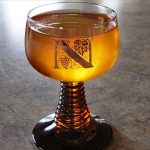
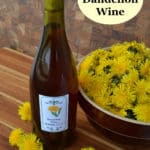
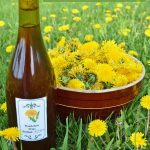
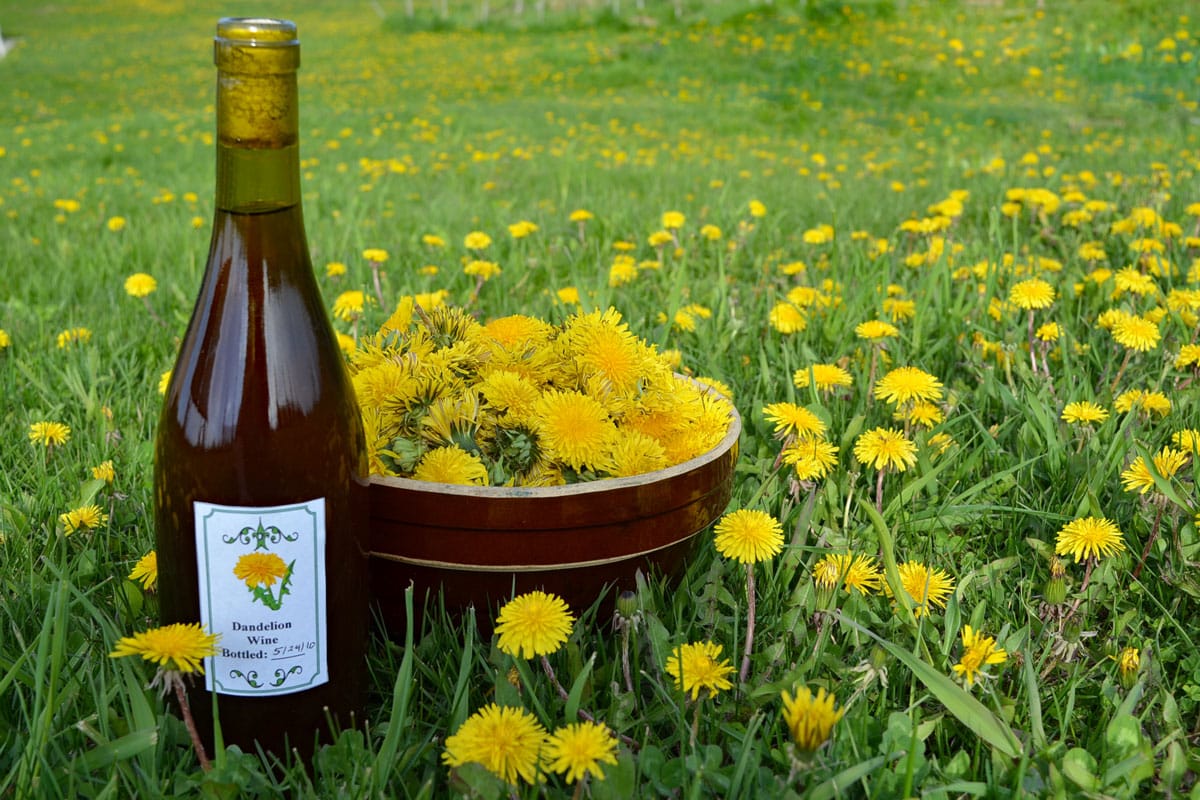
Wine out of dandelions? You bet! Making homemade dandelion wine is a longstanding family tradition. We don’t make it every year, but I do like to keep a few bottles on hand for company.
The taste of this dandelion wine is rich, golden and warming – more like a good brandy than a wine. I’ve had friends who don’t normally like wine comment that they do enjoy this “spring tonic”. This is a “country wine” made from simple ingredients with basic equipment.
Would you like to save this?
When we get dandelions, we get LOTS OF DANDELIONS! They are everywhere! (Boy photos are from 2010. They have grown quite a bit since then, but I kept these photos here for the happy memories.)
Dandelions are wonderful for bringing up nutrients and breaking through compacted soil. This area of the yard had a lot of compaction from soil being moved around, so the dandelions were working overtime.
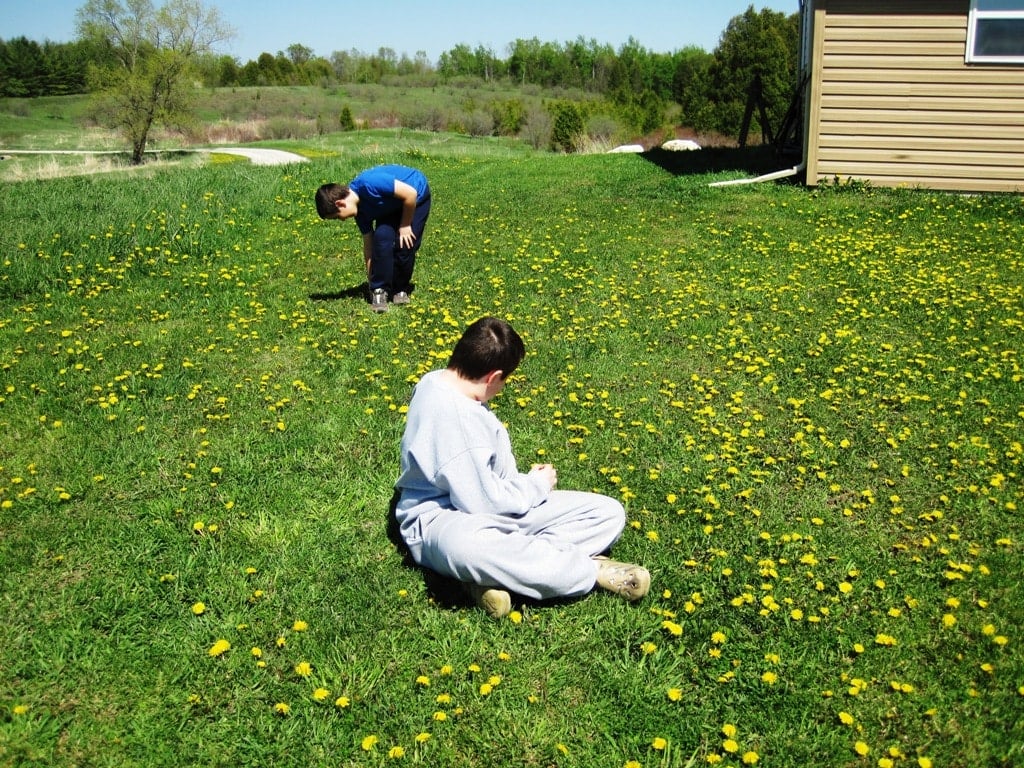
Table of Contents
Gathering the Flowers
Make sure your dandelion flowers are free of pesticides, herbicides and other contaminants. I usually don’t rinse the blossoms, though you can if they are dusty. They are sterilized during the first part of brewing. We gather bins of flower heads outside, and then bring them inside to remove the petals.
Don’t pick dandelion blossoms for wine or eating from an area used by pets for their “bathroom”. As I explained to a reader in the comments, I’m fairly sure goat pee will not wash off.
What part of the dandelion is dandelion wine made from?
For dandelion wine, use the yellow flower petals only. Leaving the petals attached to the green base of the flower will result in a bitter, unpleasant wine. My neighbor made this mistake when she tried to make dandelion wine, and she ended up throwing out the whole batch.
I use 3 quarts of loosely packed yellow dandelion petals (pictured below). Not 3 quarts of flower heads, 3 quarts of petals only.
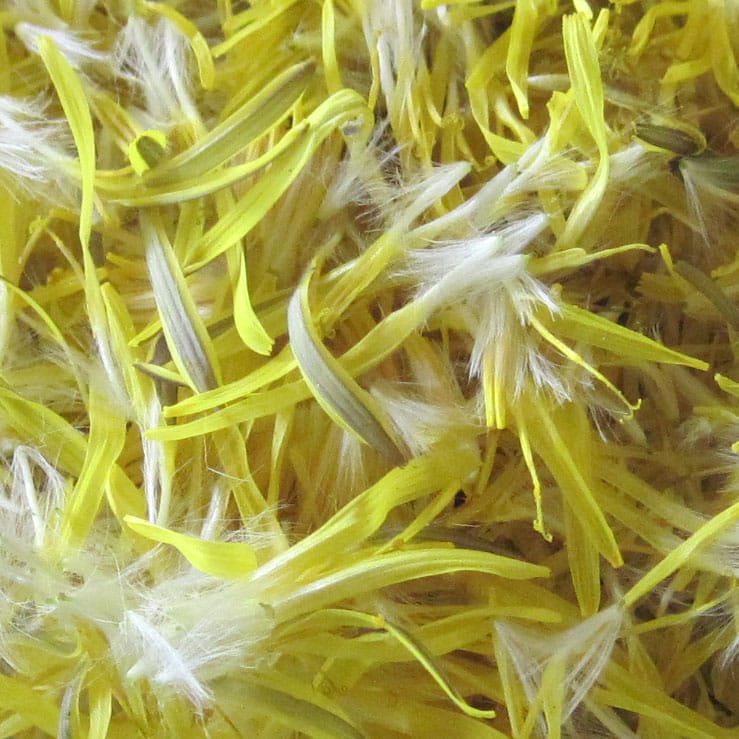
If you don’t have enough dandelion petals from one picking, freeze the petals until you have enough.
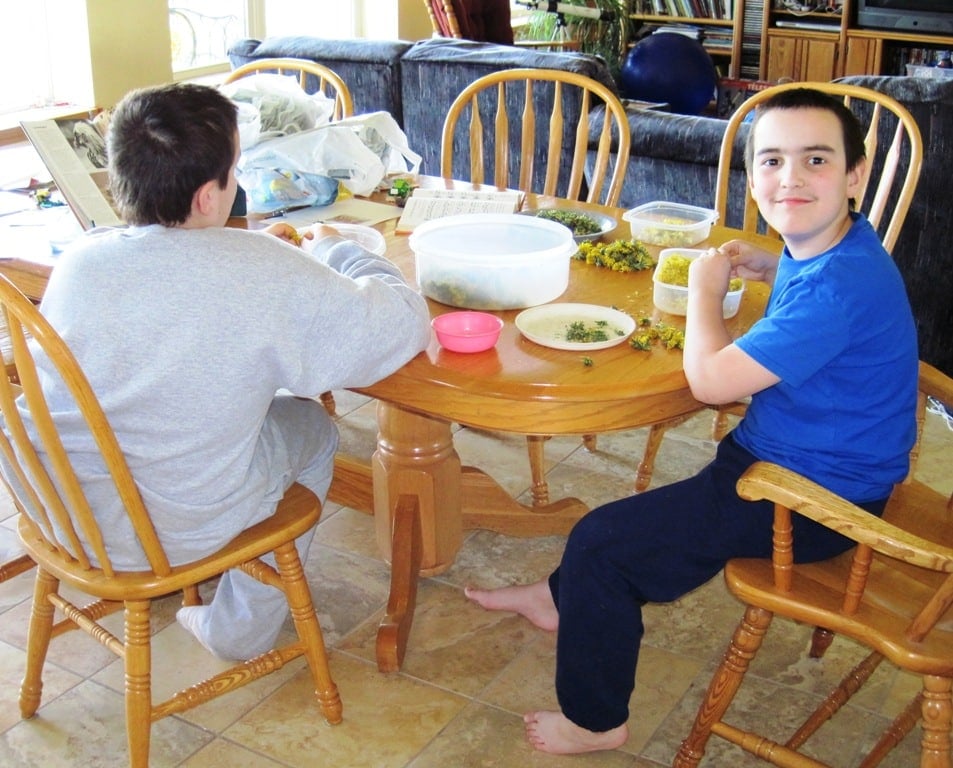
The boys and I sat down to a session of “second picking” to remove the yellow petals from the blossoms. You want to remove the petals as soon as possible after picking, as the flower heads close over time. Once they close, it’s tough to get the petals off.
If you are working alone, it may be best to pick some of the flowers needed, remove petals, then pick more flowers and repeat. That way, you won’t have trouble with the flower heads closing before you have time to clean them. It’ll also give you a chance to get up and stretch.
Making Homemade Dandelion Wine
“Dandelion wine, believed to be of Celtic origin, is regarded as one of the fine country wines of Europe. In the late 1800s and early 1900s, it was not proper for ladies to drink alcohol. However, dandelion flower wine was considered so therapeutic to the kidneys and digestive system that it was deemed medicinal even for the ladies.“
Adapted from Dandelion Medicine, in combination with my mother’s recipe.
Remember, all your fermentation vessels should be glass, ceramic, stainless steel or food grade plastic. Never ferment in aluminum or iron, as it can react with the wine.
I normally use my two gallon crock for one gallon of wine, since the fruits bubble up during fermentation. You can see in the photos below that a one gallon crock gets very full.
Ingredients
- 3 quarts dandelion petals, loosely packed
- 1 gallon water
- 2 oranges, with peel, preferably organic
- 1 lemon, with peel, preferably organic
- 3 pounds sugar
- 1 package champagne yeast or wine yeast (this yeast finishes at around 12-14% alcohol)
- 1 pound raisins, preferably organic
How to make dandelion wine – Directions
1) Collect the blossoms when they are fully open on a sunny day, after the morning dew clears. Remove green parts and measure out 3 quarts of loosely packed petals.
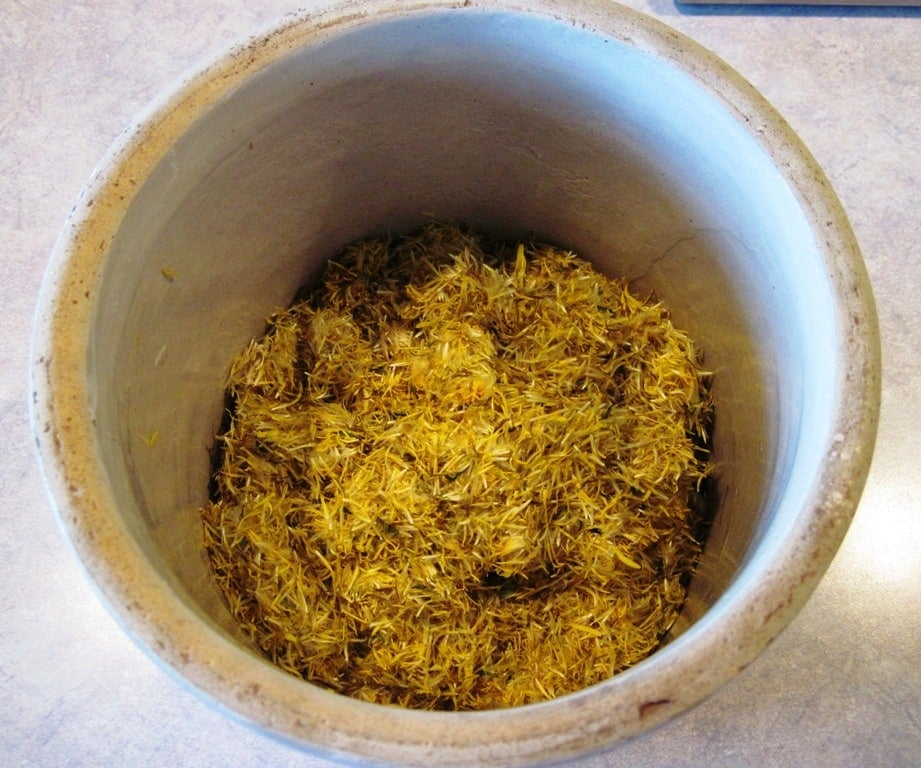
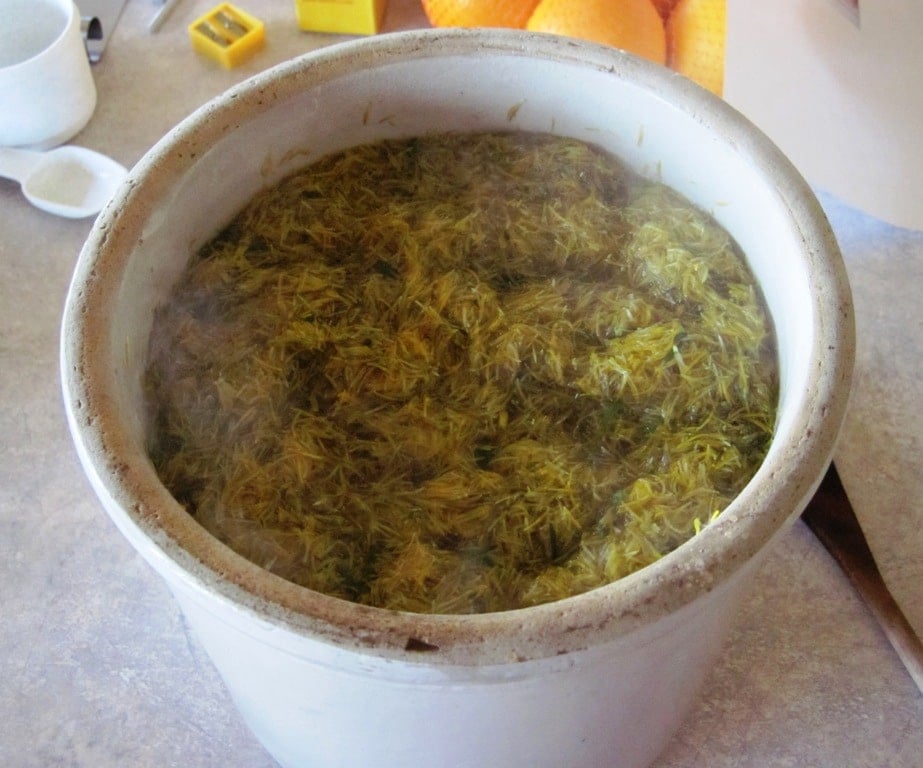
2) Bring the water to a boil and pour it over the flowers in a large pot or crock. Cover with a towel to keep dust out and let steep for three days. Stir daily to keep the petals submerged in your “dandelion petal tea”. They will develop a musty smell, which is normal.
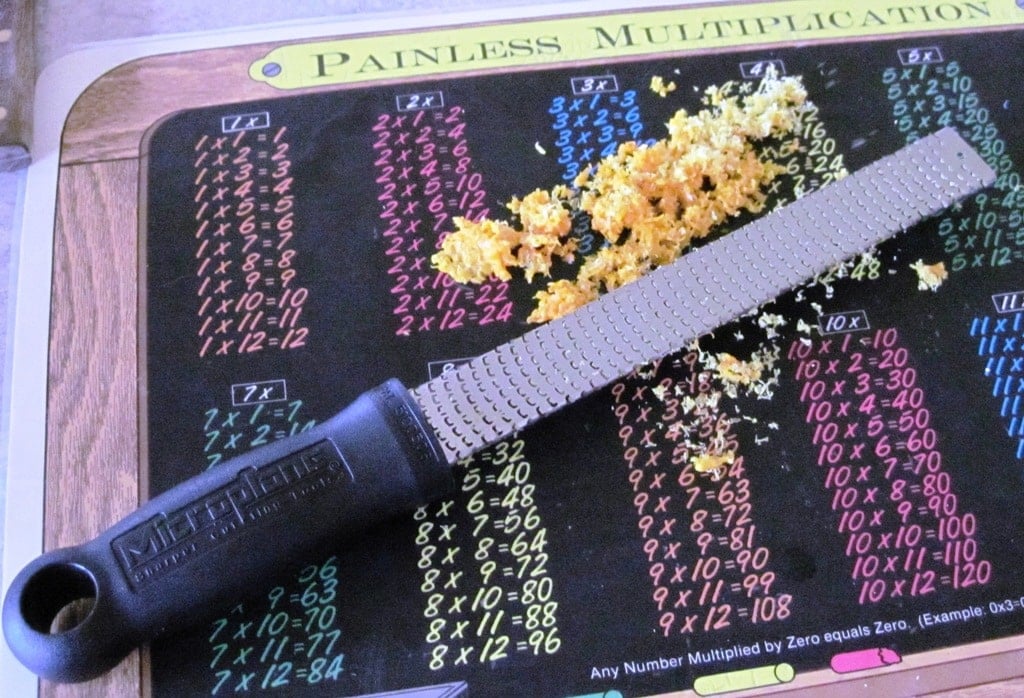
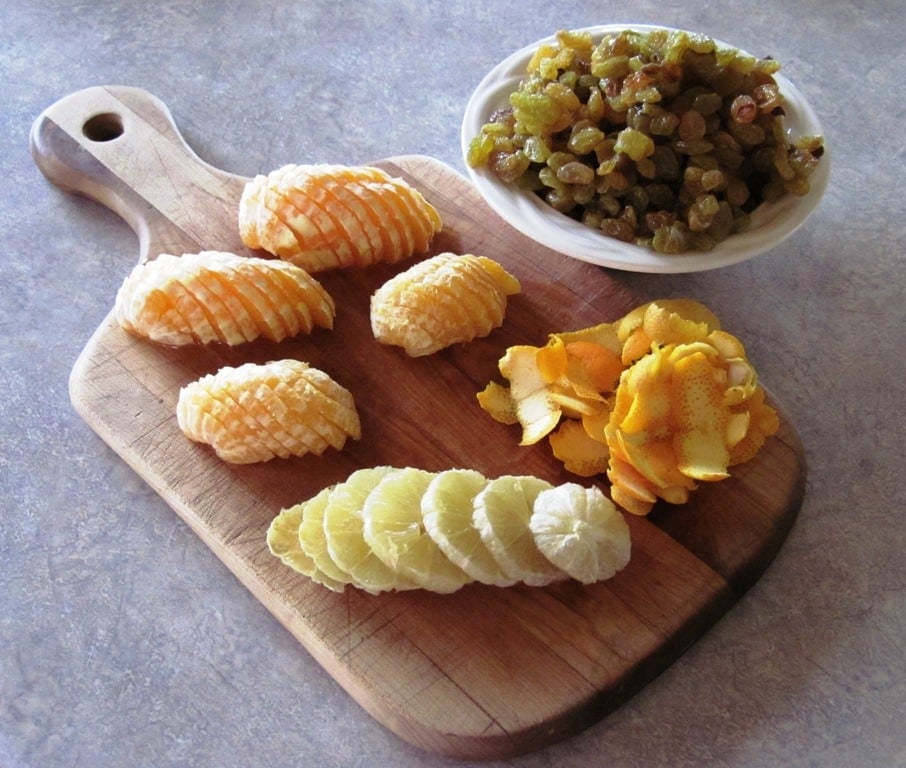
3) Prepare the oranges and the lemon. Zest about half of the rind and peel off the rest in thin strips. You want to minimize the amount of white pith added to the brew.
4) Clean most of the pith off the fruit and slice into thin rounds.
5) Add the lemon and orange zest to the flower-water mixture and bring to a boil. Remove from heat, strain out solids. Dissolve the sugar in the flower water. Allow to cool to room temperature.
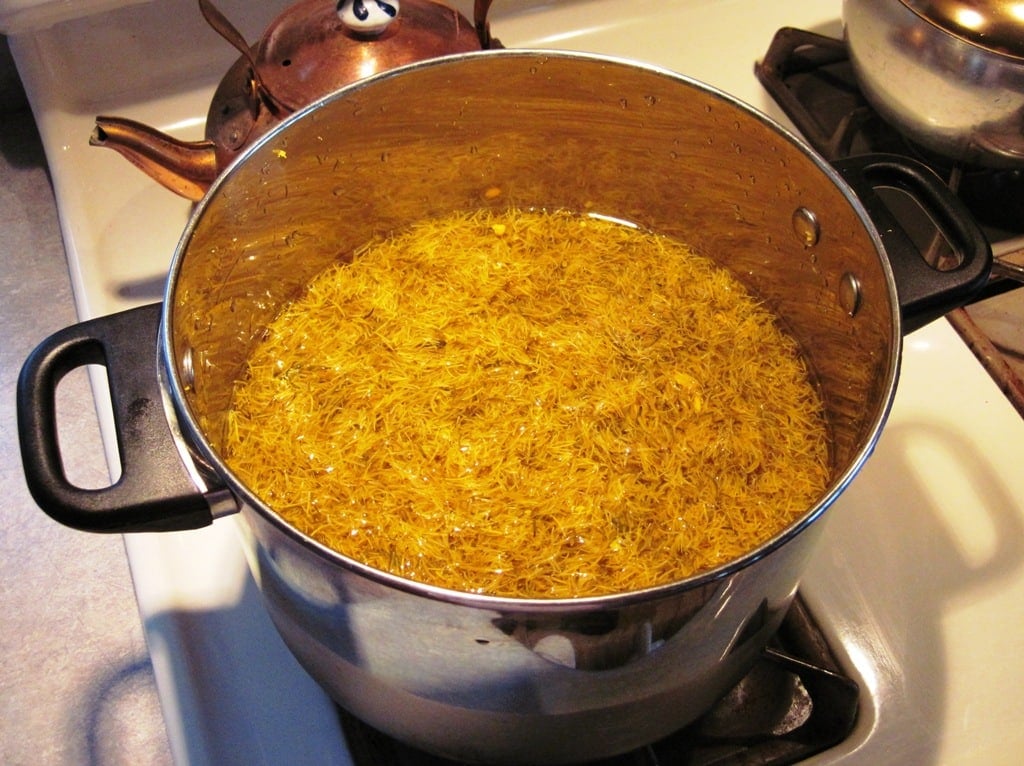
6) Add the yeast, raisins, and orange and lemon slices and rind strips to the liquid. Put everything into a crock (or wide mouth carboy with airlock) to ferment. I cover my crock with a clean cotton towel held down by a rubber band to keep dust and bugs out. (Not shown.)
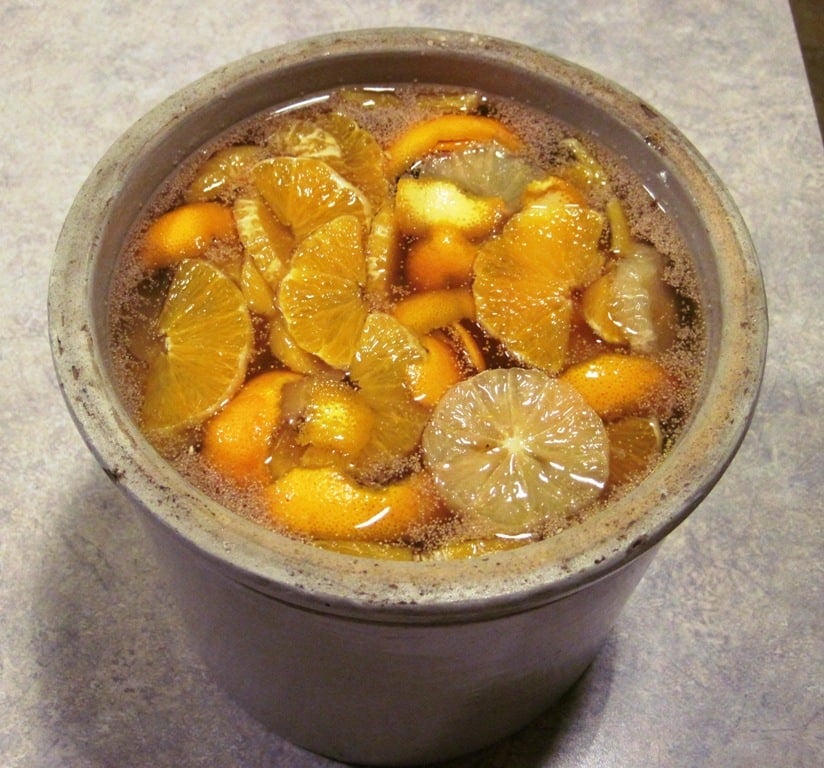
Stir daily with a wooden spoon or non-reactive stir stick. When the yeast gets active, the bubbles will lift the fruit up to the top of the wine. You want to stir so all the fruit gets pushed back under the surface and wet down daily.
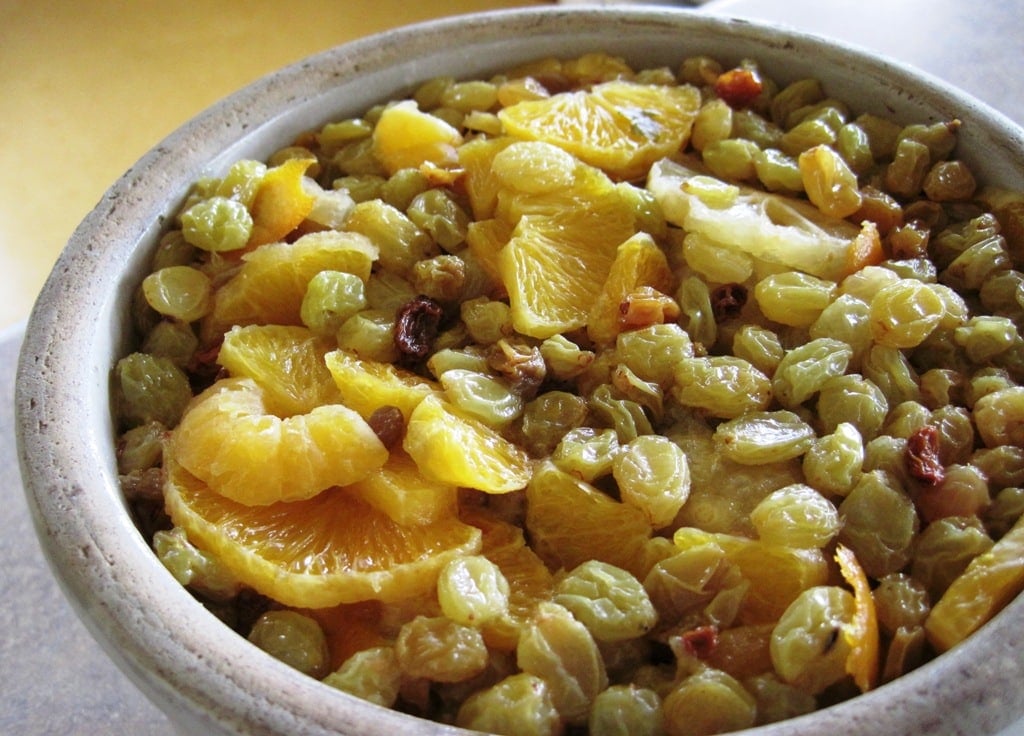
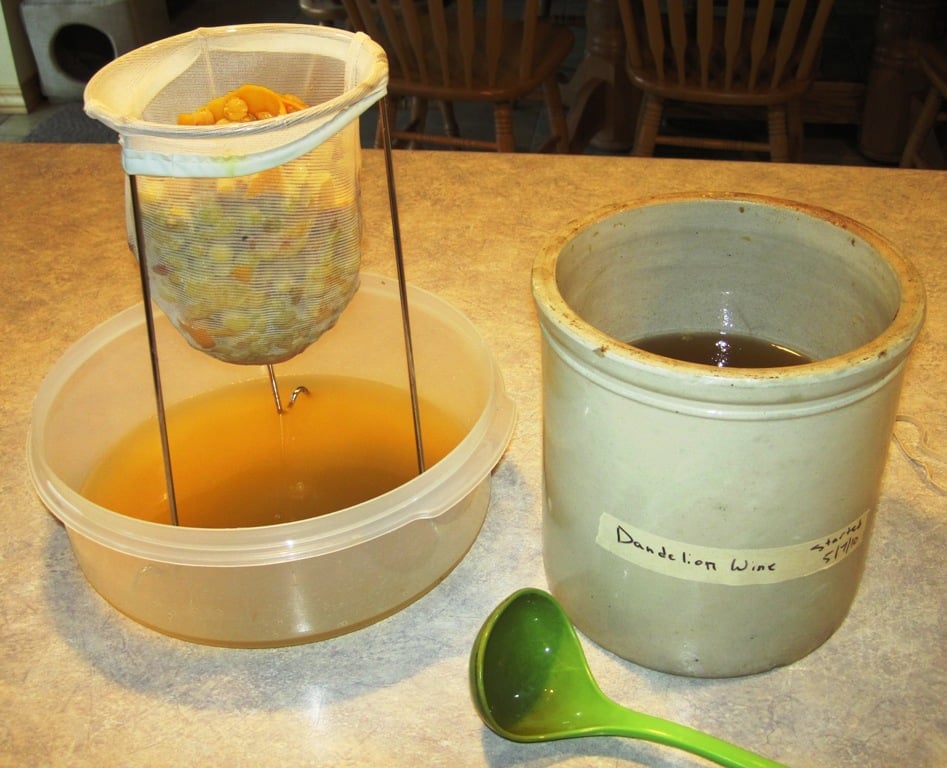
7) When the primary fermentation mixture stops bubbling (1 -2 weeks), fermentation is almost done. Strain the liquid through several layers of cheesecloth, a flour sack towel, or a jelly bag.
Bottling the Wine
You have two options for bottling your homemade dandelion wine. You can let it finish in bottles, or move to a carboy and then bottle.
To finish in bottles: After straining, move the young dandelion wine directly to clean bottles. Slip a deflated balloon over the top of each bottle to monitor for further fermentation. When the balloon remains deflated for 24 hours, fermentation is complete. You will probably need four or five 750 ml bottles.
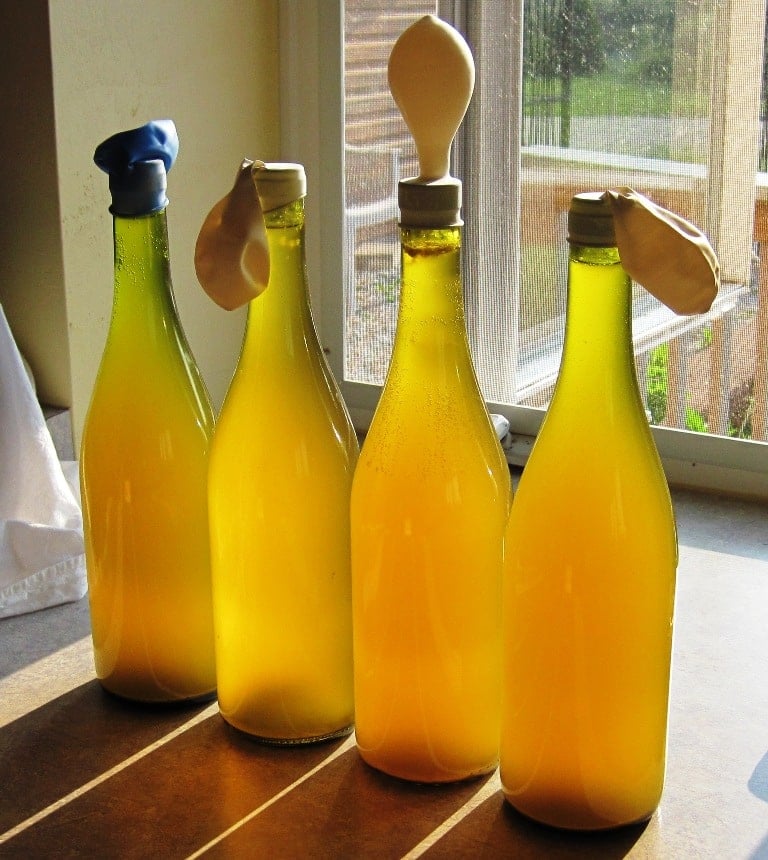
Cork the bottles and store in a cool, dark place for at least six months before drinking.
NOTE: Do not seal bottles tightly before they finish fermenting, and don’t put them somewhere warm. Otherwise, you’ll end up with exploding bottles, like my sister, Mary, when she stashed them in a closet. Apparently, it sounded like there were bombs going off or they were being shot at.
If you would like a clearer wine, transfer the strained dandelion wine into a one gallon carboy with airlock before the final bottling. Allow to ferment in the carboy for 2-3 months, and then rack into the bottles.
If you’d like to download a pdf of my wine labels, use this link: Printable Dandelion Wine Labels.
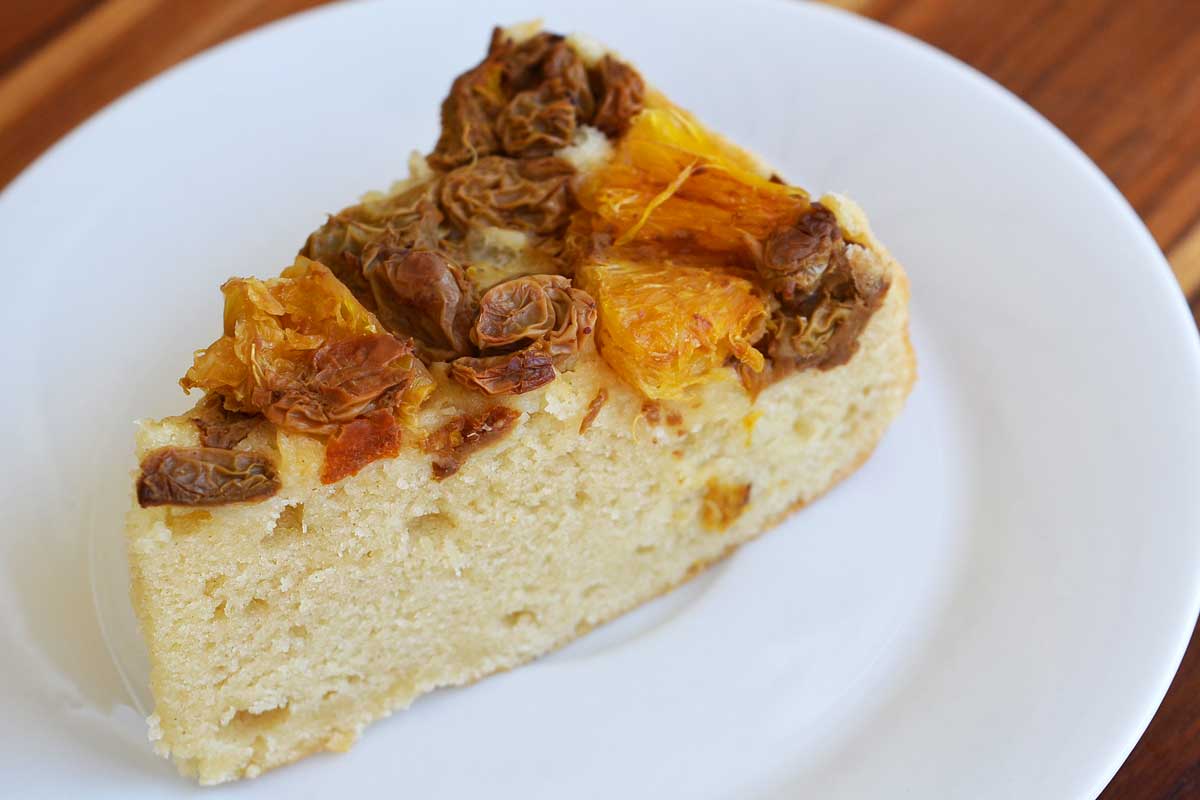
If you don’t want to send the wine fruit to the compost pile, try Dandelion Wine Fruitcake.
Recommended Materials for Making Dandelion Wine
- Wine Yeast – store extra yeast packs in the fridge or freezer. I normally use Lalvin Wine Yeast EC-1118.
- 2 Gallon Crock – 2 gallons gives you space for fermentation.
- Wine Bottles – It’s fine to wash and reuse old wine bottles. You will probably need five 750ml bottles.
- Corks – It’s best to use new corks. I like the #9 Straight Wine Corks.
- Wine Bottle Corker – This double lever model works like a charm.
- Gallon carboy with airlock – optional, for clearer wine.
Old-Fashioned Dandelion Wine Recipe
A smooth and hearty flower wine with citrus notes that will warm you from head to toe.
- Yield: 4–5 bottles 1x
Ingredients
- 3 quarts dandelion petals, loosely packed
- 1 gallon water
- 2 oranges, with peel, preferably organic
- 1 lemon, with peel, preferably organic
- 3 pounds sugar
- 1 package wine yeast
- 1 pound raisins, preferably organic
Instructions
- Collect the blossoms when they are fully open on a sunny day. Remove any green parts and measure out three quarts of petals.
- Bring the water to a boil and pour it over the flowers in a large pot or crock. Cover with a towel to keep dust out and let steep for three days. Stir daily to keep the petals submerged.
- Prepare the oranges and the lemon. Zest (finely grate) about half of the rind and peel the rest off in very thin strips. You want to minimize the amount of white pith added to the brew.
- Finish peeling the citrus, and slice them into thin rounds.
- Add the lemon and the orange zest to the flower-water mixture and bring to a boil. Remove from heat, strain out solids, then add the sugar, stirring until it is dissolved. Allow to cool to room temperature.
- Add the yeast, raisins, and orange and lemon slices and rind strips to the liquid. Put everything into a two gallon crock (or wide mouth carboy with airlock) to ferment. I cover my crock with a clean cotton towel held down by a rubber band. Stir daily with a wooden spoon or non-reactive stir stick.
- When the primary fermentation mixture stops bubbling (1 -2 weeks), fermentation is almost done. Strain the liquid through several layers of cheesecloth or a flour sack towel.
Bottling the Wine
You have two options for bottling your homemade dandelion wine. You can let it finish in bottles, or move to a carboy and then bottle.
To finish in bottles: After straining, move the young dandelion wine directly to clean bottles. YOu will probably need four or five 750 ml bottles. Slip a deflated balloon over the top of each bottle to monitor for further fermentation. When the balloon remains deflated for 24 hours, fermentation is complete.
Cork the bottles and store in a cool, dark place for at least six months before drinking.
If you would like a clearer wine, transfer the strained wine into a one gallon carboy with airlock before the final bottling. Allow to ferment in the carboy for 2-3 months, and then rack into the bottles.
Notes
Do not seal bottles tightly before they finish fermenting. Always store your wine in a cool location.
Is Dandelion Wine Alcoholic?
Yes. If you use wine yeast as recommended in the recipe, you should end up with around 12 to 14 percent alcohol.
If you’re feeling adventurous, you may be able to nurture wild yeast from the raisins to do the fermenting. Wild yeast brews will have a lower alcohol content, because wild yeast dies off if the alcohol levels get too high.
You can learn more about using wild yeasts in the book, “The Wildcrafting Brewer“.
Is Dandelion Wine Medicinal?
Nearly every part of dandelion is full of nutritional value, with vitamins and minerals packed in every part of the plant. Aside from its great taste in wine making, it also has been used throughout history for its medicinal properties.
For more information, check out this article on Dandelion Benefits.
To dig even deeper into this amazing plant, check out The Dandelion Workshop online course. It includes a printable guide and step-by-step videos for making a variety of dandelion recipes and remedies.

You may also enjoy:
- Harvesting and Using Dandelion Roots
- Low Sugar Dandelion Jelly Recipe
- Dandelion Fritter Recipe
- How to Make Dandelion Root Tea
- Get Rid of Dandelions Without Chemicals
I’ve also answered a lot of reader inquiries in the comments, so be sure to have a look if you have questions. If you don’t find your answer (or would like to share some wine making stories or observations), leave a comment below.

This article is written by Laurie Neverman. Laurie mixes her rural background and engineering training to create a unique and resilient homestead. She enjoys getting to know wild plants and using them for food and medicine. Her most unique experiment to date was quackgrass wine.
Originally published in 2010, last updated in 2026.
Hi, wicked excited to try this, I’ve been intrigued with the concept since reading Dandelion Wine by Ray Bradbury as a kid. One problem, I live in a neighborhood that gets a lot of dandelions but also has many stray cats and unsupervised dogs. Is there a good way to clean the flowers to make sure they aren’t covered in… business? Obviously I wouldn’t pick any out of a pile, but I can’t imagine any amount would do anything nice. Thanks!
Cat tend to prefer to do their business in mulch or garden beds where they can bury it, or mark an object (in the case the fellows). Depending on the dog, droppings should be obvious, but pee spots might not be. Many dogs do have the favorite spots that they like to mark, so you can tell by damaged foliage, but it’s not always obvious.
The flowers tend to stay up above ground level and so should avoid the worst of the fallout, but any washing that’s thorough enough to completely remove urine and feces will probably wash all flavor out of the dandelions. The petals do get sterilized by the boiling water poured over them, so if you’re comfortable with “close enough”…
Our ducks free range in the yard, but their droppings tend to be quite obvious, so we visually avoid the poop and call it close enough.
Hello, it appears as though most things are covered especially with all the questions and answers, great job on it all. I’d like to ask whether in a separate saucepan with a little extra water I can whizz up and boil the raisins, oranges and lemon flesh so that I can get all the contents straight into my air-locked container (demijohn x2)? They have only a small opening at the top but I could still funnel in a viscous mixture as opposed to solids. I realise not to add the yeast until cooled. In fact, is it possible to not strain anything till later, (post initial fermenting)? Thank you kindly.
General rule of thumb – if there’s sugar and yeast, it will ferment. Flavor will change a bit with different handling, but Mother Nature likes to make hooch.
If you prefer to do the initial ferment in an airlocked container that’s fine, as long as you can clean it out well after you’re done brewing. I personally like to stir daily, but many do not, especially those who are concerned with wild yeast getting in the brew.
Can I take this a step further and make dandelion vinegar. Any idea what I would need to do next? Thanks.
Seems like a lot of work, but you could leave the container open for the final ferment instead of bottling or using an airlock, and it would eventually turn to vinegar. It would be much faster to take apple cider vinegar and infuse the blossoms in it for a few weeks, and then strain.
Bees love dandilions. We need bees more than we need to steal their flowers for wine.
You may want to do a little more research before you start pontificating online.
First off, people protect resources that they use. If more people learn to appreciate and use dandelions, then they’ll stop spraying all those toxic herbicides all over their lawns to kill the dandelions and there will be more dandelions for humans and all the pollinators.
Secondly, picking the flowers encourages more flower production – making more food for the bees. The goal of the plant is to reproduce by setting seed. If it can do that with one set of flowers, it has no reason to keep creating more flowers. By picking some flowers, we encourage it to keep flowering over a longer period of time – making more food for the bees.
I’m going to be hard pressed to find enough flowers but determined to make! Can you let me know how many regular wine bottle sized bottles this recipe results in? It’s difficult to start without knowing!
You should end up with four or five bottles. There may be some variation in the fruit size and moisture levels, and some evaporation loss from the crock in the first stage of fermentation.
thank you so much for letting me know! If you think anyone (seems a lot of people talk about having an abundance of dandilion) still have any they would pick and sell – not sure if there are any strange restrictions on sending flowers or if freshness would be compromised, etc. I’d love to be able to buy them instead of the hunting and pecking (picking!) I’ll be doing here in northern California! No idea if there’s a way to facilitate? I saw someone mention facebook so I presume you have a page. If you think there’s a way for me to find someone for my scheme, please advise!
There are a couple of issues with shipping dandelion flowers. First off, this is best made with fresh flower petals. Those fresh flower petals are best picked off of their bases ASAP once they’ve been picked. Even after a few hours, they close and start to wilt, and turn into a sticky mess. After two or three days (shipping time), they turn white and try to go to seed.
Second, picking the petals from the base is very labor intensive. I don’t think anyone is willing to pay for the time involved in picking and drying enough petals for a batch of wine. For most who do it, it’s a hobby that they enjoy, so they’re willing to spend the time on it.
I didn’t mean to have someone else pick the petals from the base but it sounds like even shipping the flowers won’t work so I’ll collect here! Thank you again for your help.
Yep, they are a fleeting beauty. Good luck!
1 gallon will fill 5 wine bottles.
I followed your recipe, was getting ready for the next step: adding zest of orange and lemon.. I looked in my crock.. and my dandelion pedal water has molded 🙁 Is it because its humid/ hot in my house?
I waited 3 full days? Should I instead have processed on the 3rd day?
I’m bummed.. I’ll have to pick more dandelions and try again.. before my lemon and oranges are gone..
It’s hard to say for sure what caused the problem. Was your crock well cleaned? Was your water boiling? Were your petals fairly clean? Do you generally have mold issues in the house? Any of these could cause a problem.
I usually process strain and add the lemons and oranges on the third day, but if it’s extremely hot and humid in your home, straining and adding fruit after two days may be better, to get the yeasts in and start the fermenting sooner.
Just wanted to say thanks for this recipe!
I was randomly browsing reddit a few days ago and someone had put up a picture of a pulled up dandelion and complaining about them cluttering up his lawn, a few of the comments were upset that it was not going to be used for cooking, I had no idea dandelion had any culinary uses!
After searching for dandelion recipes I ended up here and have been following your instructions and I’ve been having a lot of fun so far making it! I am not used to U.S measurements so I ended up picking about twice as many dandelions that I needed, oops. We are having wonderful weather for the last month or so anyway, so it was not exactly horrible wandering around collecting them. I just finished added the yeast and my wine is currently bubbling away in the kitchen, so it seems it is going well so far, really looking forward to the next stage in a few weeks when i get to bottle it up and spend the next 6 months being super excited about how it will turn out, should be ready just in time for Christmas, perfect!
You’ve also sparked my wine-making curiosity now, I am already coming up with ideas for the next wine I will try to make, I am thinking of something with licorice and blueberries could be nice, those are 2 popular ingredients here in Finland.
If you’re excited about experimenting with different flavors while fermenting, you may enjoy the books listed in this post -https://commonsensehome.com/wild-yeast-brewing/
“Wild Wine Making”, another book just published by Storey Publishing, is another good resource for unusual wine recipes.
I was wondering if fermentation needs to take place in a cool place? Or does it need a warm room? Also, should the fermentation take place in a dark/dimly lit room, or will it be fine in a normally lit room? Thanks!
Primary fermentation can take place at normal room temp, from around 65 to 75F. Warmer temps will speed it up, cooler temps will slow it down. Secondary fermentation and aging (after bottling, or if aging in a carboy) is better in a cooler location. We age ours in the basement or root cellar.
I recommend fermenting and storing out of direct sunlight. I keep the crock covered with a flour sack towel, same thing with carboys if I have them on the kitchen counter. For aging in the basement, I cover with a light towel, too, just to keep the dust off. For long term wine storage, a cool, dark location is best. Think classic wine cellar conditions.
While steepping the flower petals, do they need to be in the refrigerator or just on onthe counter?
On the counter is fine. The water has been boiled, so you should have a fairly sterile environment.
Thanks, my first try don’t ant to ruin it. Also do you add any Potassium Meta bisulfate to eliminate any wild yeast? Everyone has different ideas, sometimes confusing.
If you use commercial yeast it tends to outgrow the wild yeast. It’s much more aggressive, and can take the alcohol count higher than wild yeast before dying off.
Making this recipe again Thanks so much for posting it. Picked dandelions and picked off the yellow flower stems to have 3 quarts Everyone that got it for Christmas wants it again. Yesterday it rained after I picked so watched movies and picked stems off
Glad you enjoyed it. Watching movies is a good way to help the time pass more quickly if you’re cleaning the blossoms alone.
What the fucks a Quart?!
A quart is a a unit of capacity equal to a quarter of a gallon or two pints, equivalent in the US to approximately 0.94 liter and in Britain to approximately 1.13 liters. It’s also known as 4 cups or 32 fluid ounces.
Take freshly harvested dandelion flowers when they are still wide open. Pick the yellow petals off. Stuff them in a measuring cup that holds a quart (or quart jar, until measuring device is well filled with lightly packed petals. Repeat three times.
OK I am sorry if this is ridiculous, but…are the petals firmly packed or loose? Because that would make a lot of difference. I’m not having fun pulling the petals out LOL
Firmly packed is preferred. I highly recommend bribing someone to help you if possible.
Oy. Thanks…it’s hard work! Dogs aren’t cooperating!
I have a 3gal jug, will all the extra air make a difference since this is a 1 gal recipe or do I need to get a smaller jug? Also I have lalvin, which I know you use the whole pk. I also have red star it says 1 pk for 5 gallons, do I follow your recipe or yeast pk, and cut it down for a gallon? Thank you so much
For the first active ferment, it’s not a problem to use a larger jug, as the fermentation will be very active. When you move on to final bottling, or if you’d like to do your first round of aging in your jug after the active ferment has settled down, it would be better to minimize headspace.
Whoops – almost forget the yeast question. You can go ahead and use the whole pack for ease of use. It’ll just be really frisky.
Will this work with the smaller dandelions?
I don’t know what you mean by smaller dandelions? Are you talking about the same species, with smaller flowers? If so, those will work.
I am going to try this recipe, but instead of sugar I am going to use caramelized honey and make a bochet.
I noticed you share the last name of a good friend of mine, Julie. She’s not much of a drinker, though. I’d appreciate hearing how it works out if you think of it when it’s ready.
I have just finished putting everything into my Anvil steel fermenter. Donyou recommend opening it up every day and stirring until it’s done? Also, how do we know when the wine fermentation is done? Once it’s done I’d like to out it into bottles and cork them off. As I understand, once corked off they will still ferment some over time- is this correct?
I stir daily while there is fruit in the ferment.
If you age in a carboy or other fermenter for 6 months or so before final bottling, fermentation should be largely complete.
Hello! Love this recipe! It’s been a joy taking on this challenge! There were a couple of parts of the instructions I wanted some clarity on. When you said strain the solids in step 5, you’re talking about the dandelion petals right? And did you throw them away after that? I wasn’t sure if they were supposed to be saved and put back in the crock. And how long is it supposed to cool before you add the citrus slices, yeast, and raisins? And should it be cool to the touch, not warm at all, before adding the remaining ingredients? Also, when I added the wine yeast it didn’t really react/bubble. Should that be a bad sign or is it suppose to take a bit before it bubbles? Sorry that’s a lot but I appreciate you taking the time to read this.
Thanks for sharing the recipe!
Hi Jamie.
I added zest to the petals in step 4, so I strained the zest and the petals out. They go into the compost.
“Cool” should be cool enough that you don’t kill your yeast. Between body temp and room temp is an easy safe range.
It won’t start bubbling immediately, but should be active by the next day.
I was wondering if I can use organic, raw sugar for all three pounds in the dandelion recipe? Thanks
Sure, of course!
I am so glad I Googled “dandelion wine” and found your post! My Grandma’s recipe is NOT complete – and I would never have attempted making this without your help! 🙂 We used to sit on a board that lay across the just-ending fermenting concoction for the promise of a shot-glass full of this wine. Best ever memories of childhood!!
I have the same trouble with some of the family cookbooks. Things were skipped in the recipes because it was assumed that everyone making it knew the other parts. Good luck with your wine!
Hello, my dandelion wine has greasy globules floating on top. What can I do, please?
Could you provide more information? I don’t know what you mean by “greasy globules”, or what top the said globules are floating on. At no point should the recipe be greasy, although during the initial ferment of the petals the surface may look a little slimy.
After you cover the dandelions with the boiling water do you just let them stew for 3 days, and then add all the rest of the ingredients? Or do you add them at the same time you start stewing the flowers?
The dandelion petals sit on their own for three days. Think really strong dandelion petal tea.