
Warm & Golden Dandelion Wine Recipe (Old-Fashioned Wine Making)

This post may contain affiliate links. Read my full disclosure here.
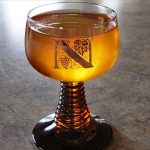
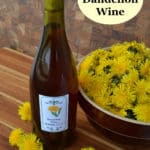
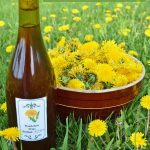
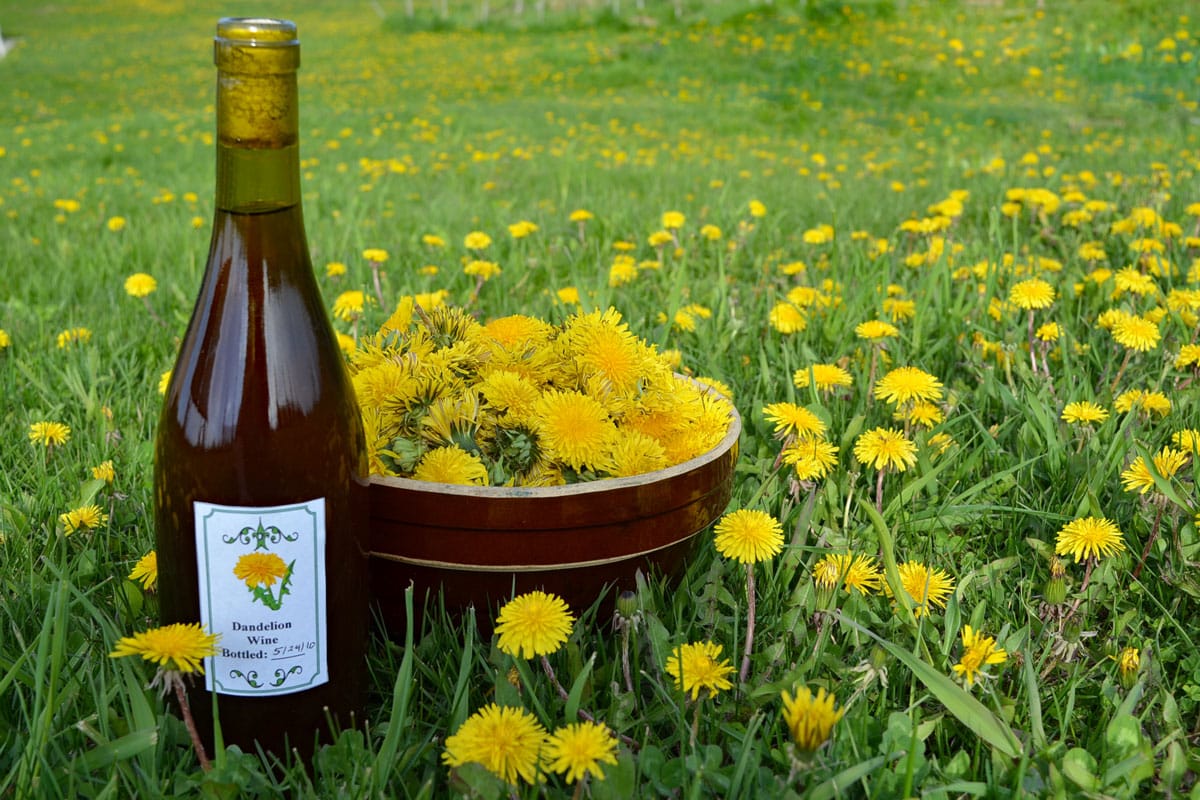
Wine out of dandelions? You bet! Making homemade dandelion wine is a longstanding family tradition. We don’t make it every year, but I do like to keep a few bottles on hand for company.
The taste of this dandelion wine is rich, golden and warming – more like a good brandy than a wine. I’ve had friends who don’t normally like wine comment that they do enjoy this “spring tonic”. This is a “country wine” made from simple ingredients with basic equipment.
Would you like to save this?
When we get dandelions, we get LOTS OF DANDELIONS! They are everywhere! (Boy photos are from 2010. They have grown quite a bit since then, but I kept these photos here for the happy memories.)
Dandelions are wonderful for bringing up nutrients and breaking through compacted soil. This area of the yard had a lot of compaction from soil being moved around, so the dandelions were working overtime.
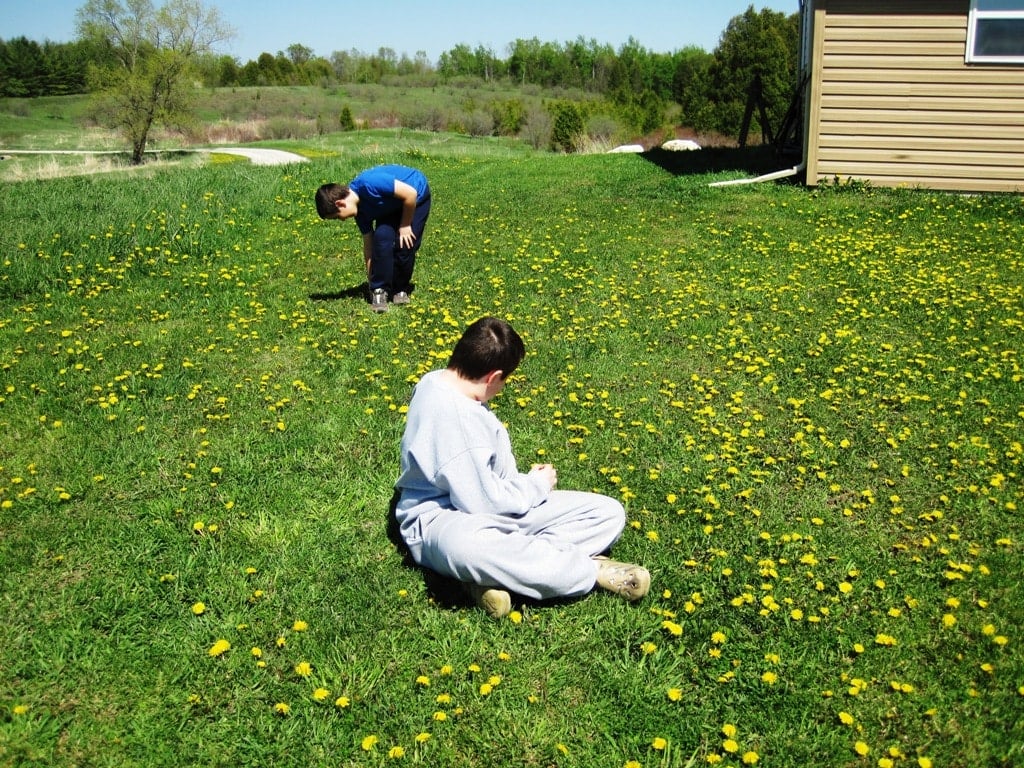
Table of Contents
Gathering the Flowers
Make sure your dandelion flowers are free of pesticides, herbicides and other contaminants. I usually don’t rinse the blossoms, though you can if they are dusty. They are sterilized during the first part of brewing. We gather bins of flower heads outside, and then bring them inside to remove the petals.
Don’t pick dandelion blossoms for wine or eating from an area used by pets for their “bathroom”. As I explained to a reader in the comments, I’m fairly sure goat pee will not wash off.
What part of the dandelion is dandelion wine made from?
For dandelion wine, use the yellow flower petals only. Leaving the petals attached to the green base of the flower will result in a bitter, unpleasant wine. My neighbor made this mistake when she tried to make dandelion wine, and she ended up throwing out the whole batch.
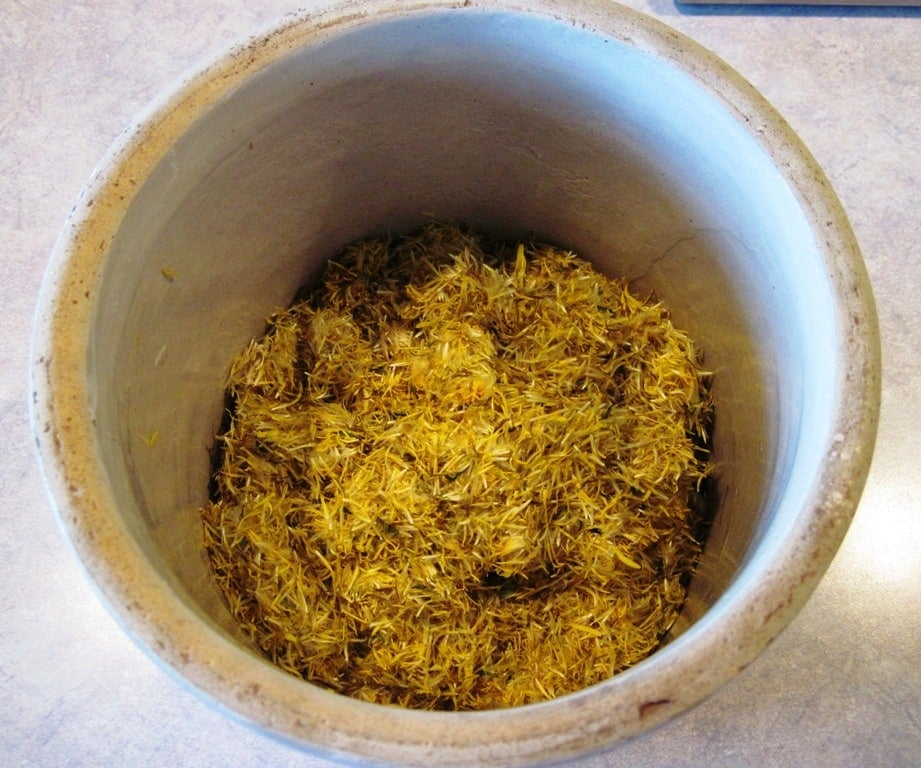
I use 3 quarts of loosely packed yellow dandelion petals (pictured below). Not 3 quarts of flower heads, 3 quarts of petals only.
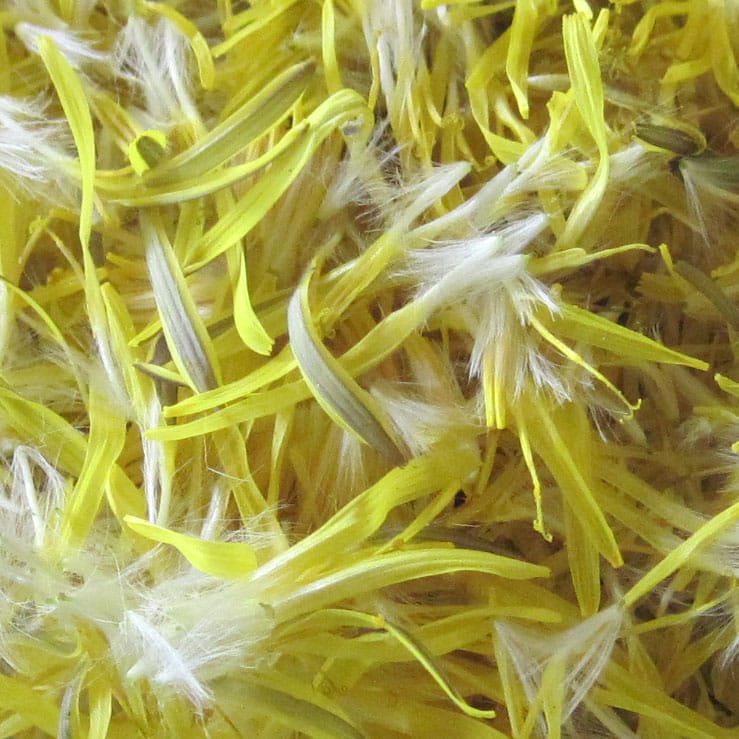
If you don’t have enough dandelion petals from one picking, freeze the petals until you have enough.
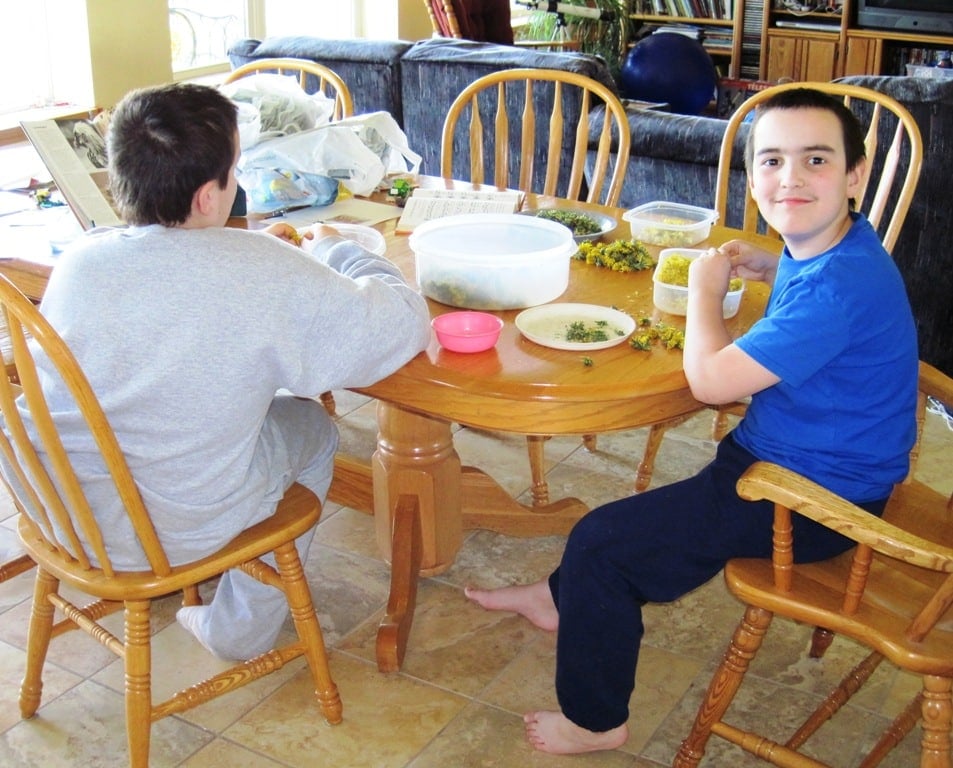
The boys and I sat down to a session of “second picking” to remove the yellow petals from the blossoms. You want to remove the petals as soon as possible after picking, as the flower heads close over time. Once they close, it’s tough to get the petals off.
If you are working alone, it may be best to pick some of the flowers needed, remove petals, then pick more flowers and repeat. That way, you won’t have trouble with the flower heads closing before you have time to clean them. It’ll also give you a chance to get up and stretch.
Making Homemade Dandelion Wine
“Dandelion wine, believed to be of Celtic origin, is regarded as one of the fine country wines of Europe. In the late 1800s and early 1900s, it was not proper for ladies to drink alcohol. However, dandelion flower wine was considered so therapeutic to the kidneys and digestive system that it was deemed medicinal even for the ladies.“
Adapted from Dandelion Medicine, in combination with my mother’s recipe.
Remember, all your fermentation vessels should be glass, ceramic, stainless steel or food grade plastic. Never ferment in aluminum or iron, as it can react with the wine.
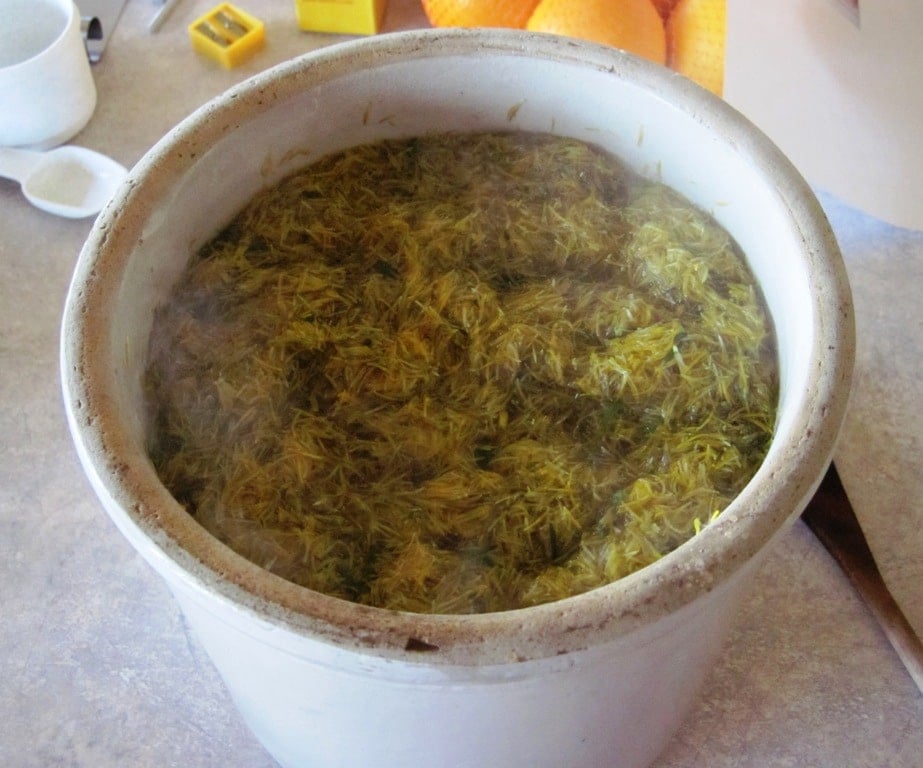
I normally use my two gallon crock for one gallon of wine, since the fruits bubble up during fermentation. You can see in the photos below that a one gallon crock gets very full.
Ingredients
- 3 quarts dandelion petals, loosely packed
- 1 gallon water
- 2 oranges, with peel, preferably organic
- 1 lemon, with peel, preferably organic
- 3 pounds sugar
- 1 package champagne yeast or wine yeast (this yeast finishes at around 12-14% alcohol)
- 1 pound raisins, preferably organic
How to make dandelion wine – Directions
1) Collect the blossoms when they are fully open on a sunny day, after the morning dew clears. Remove green parts and measure out 3 quarts of loosely packed petals.
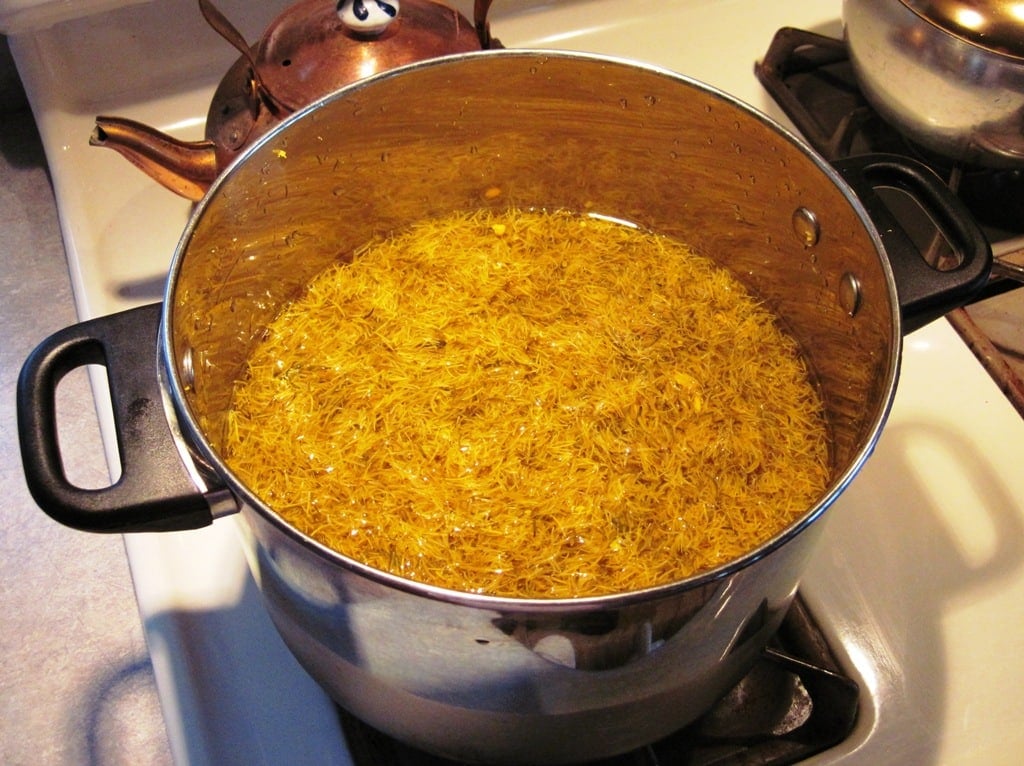
2) Bring the water to a boil and pour it over the flowers in a large pot or crock. Cover with a towel to keep dust out and let steep for three days. Stir daily to keep the petals submerged in your “dandelion petal tea”. They will develop a musty smell, which is normal.
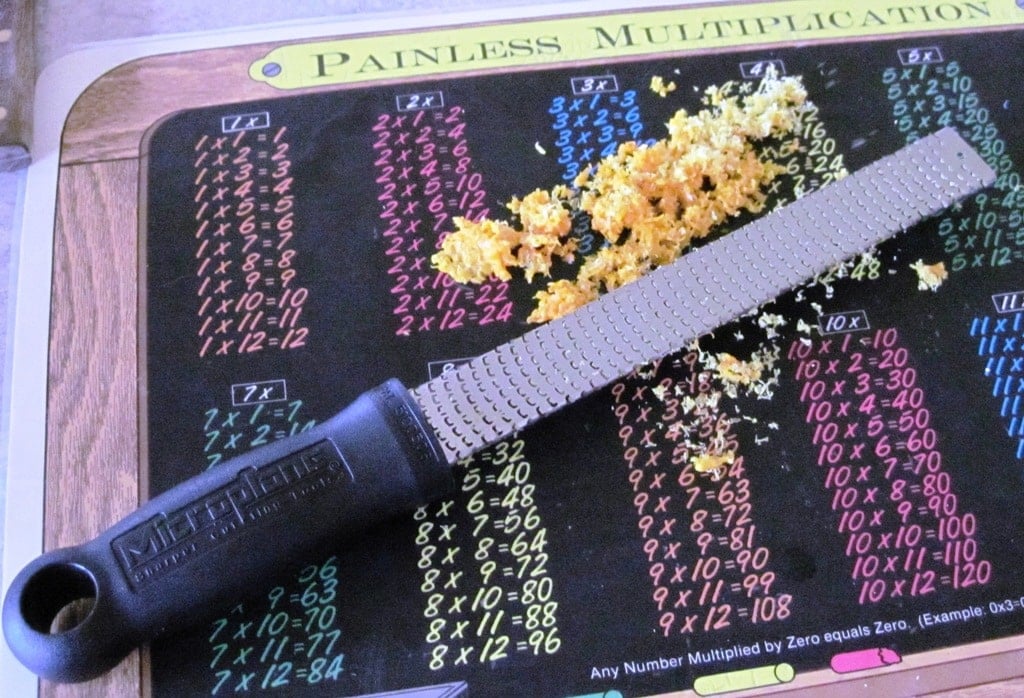
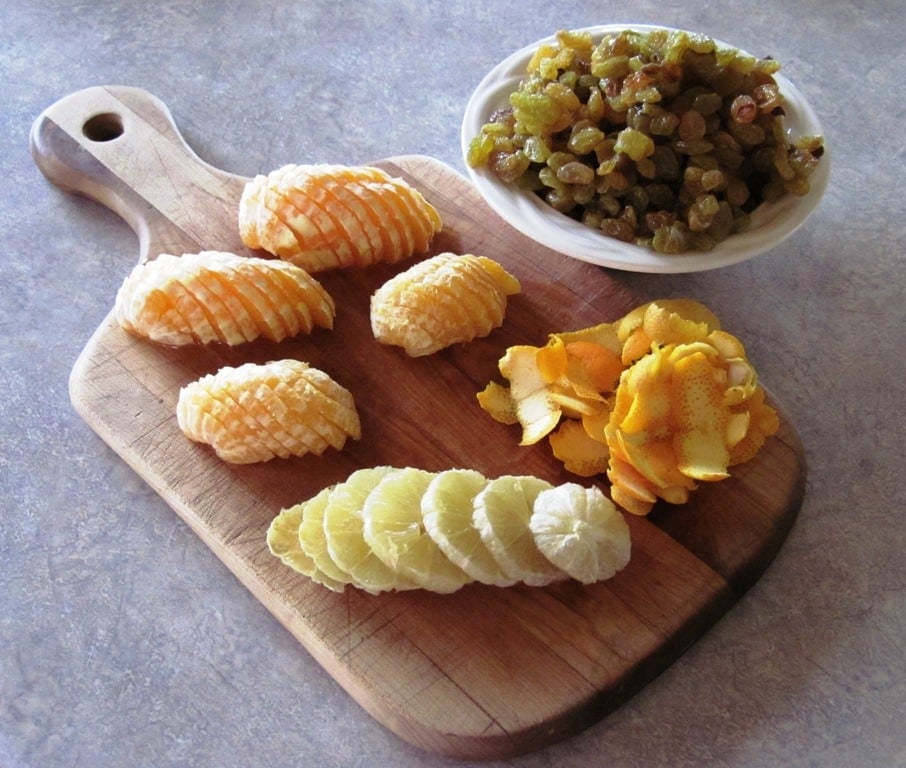
3) Prepare the oranges and the lemon. Zest about half of the rind and peel off the rest in thin strips. You want to minimize the amount of white pith added to the brew.
4) Clean most of the pith off the fruit and slice into thin rounds.
5) Add the lemon and orange zest to the flower-water mixture and bring to a boil. Remove from heat, strain out solids. Dissolve the sugar in the flower water. Allow to cool to room temperature.
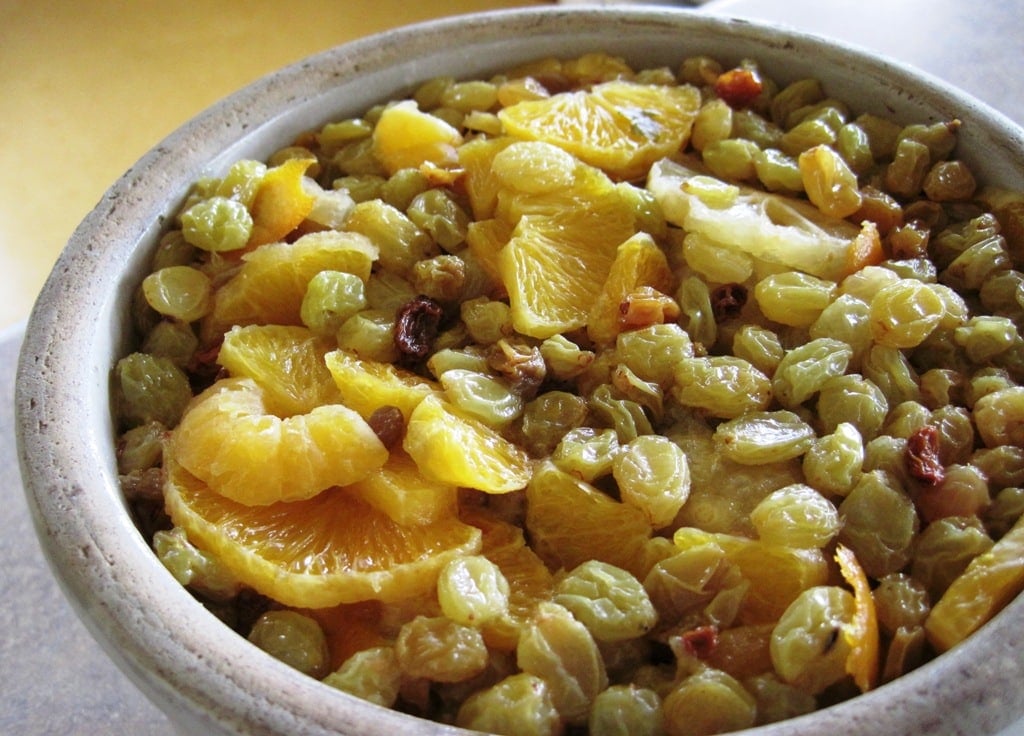
6) Add the yeast, raisins, and orange and lemon slices and rind strips to the liquid. Put everything into a crock (or wide mouth carboy with airlock) to ferment. I cover my crock with a clean cotton towel held down by a rubber band to keep dust and bugs out. (Not shown.)
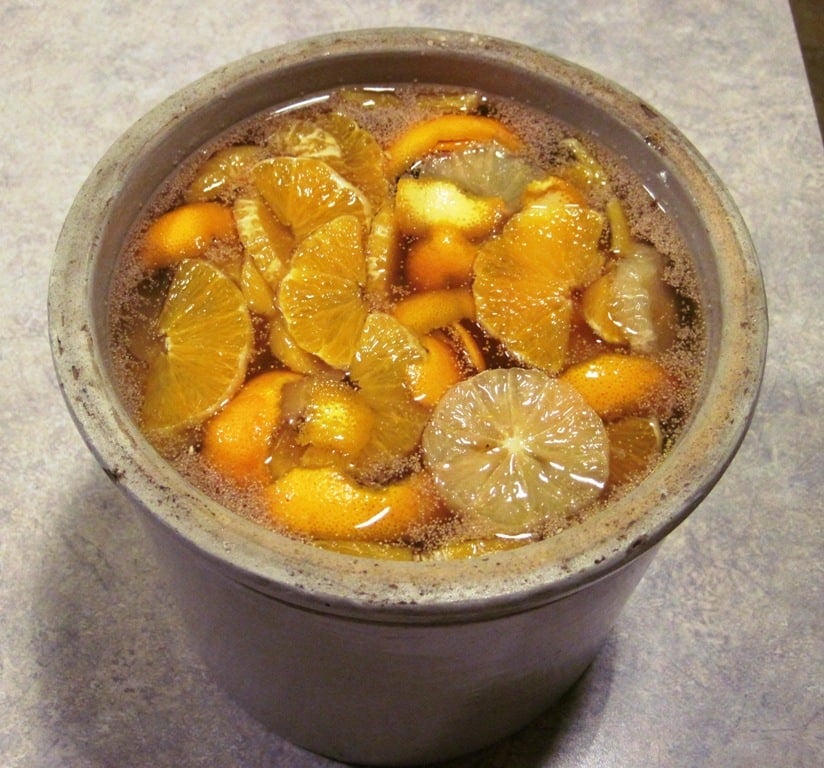
Stir daily with a wooden spoon or non-reactive stir stick. When the yeast gets active, the bubbles will lift the fruit up to the top of the wine. You want to stir so all the fruit gets pushed back under the surface and wet down daily.
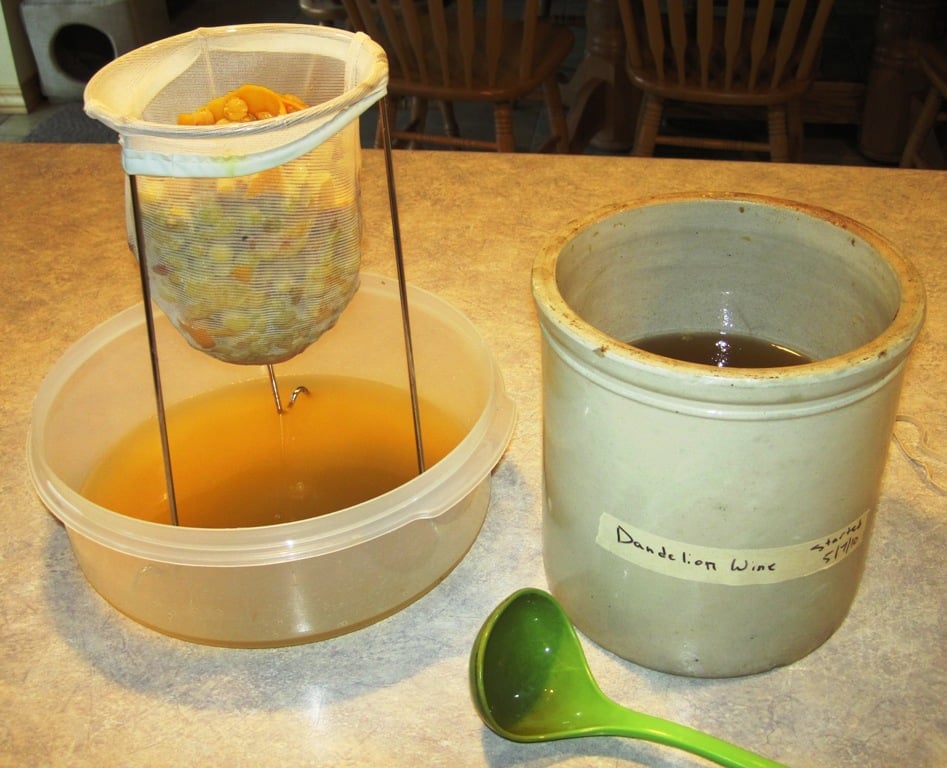
7) When the primary fermentation mixture stops bubbling (1 -2 weeks), fermentation is almost done. Strain the liquid through several layers of cheesecloth, a flour sack towel, or a jelly bag.
Bottling the Wine
You have two options for bottling your homemade dandelion wine. You can let it finish in bottles, or move to a carboy and then bottle.
To finish in bottles: After straining, move the young dandelion wine directly to clean bottles. Slip a deflated balloon over the top of each bottle to monitor for further fermentation. When the balloon remains deflated for 24 hours, fermentation is complete. You will probably need four or five 750 ml bottles.
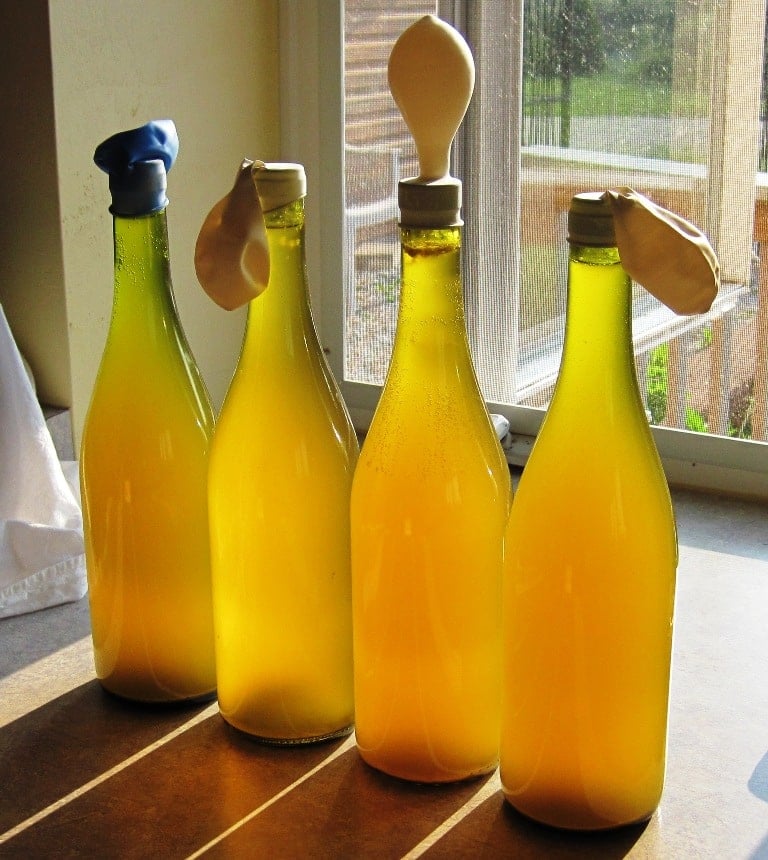
Cork the bottles and store in a cool, dark place for at least six months before drinking.
NOTE: Do not seal bottles tightly before they finish fermenting, and don’t put them somewhere warm. Otherwise, you’ll end up with exploding bottles, like my sister, Mary, when she stashed them in a closet. Apparently, it sounded like there were bombs going off or they were being shot at.
If you would like a clearer wine, transfer the strained dandelion wine into a one gallon carboy with airlock before the final bottling. Allow to ferment in the carboy for 2-3 months, and then rack into the bottles.
If you’d like to download a pdf of my wine labels, use this link: Printable Dandelion Wine Labels.
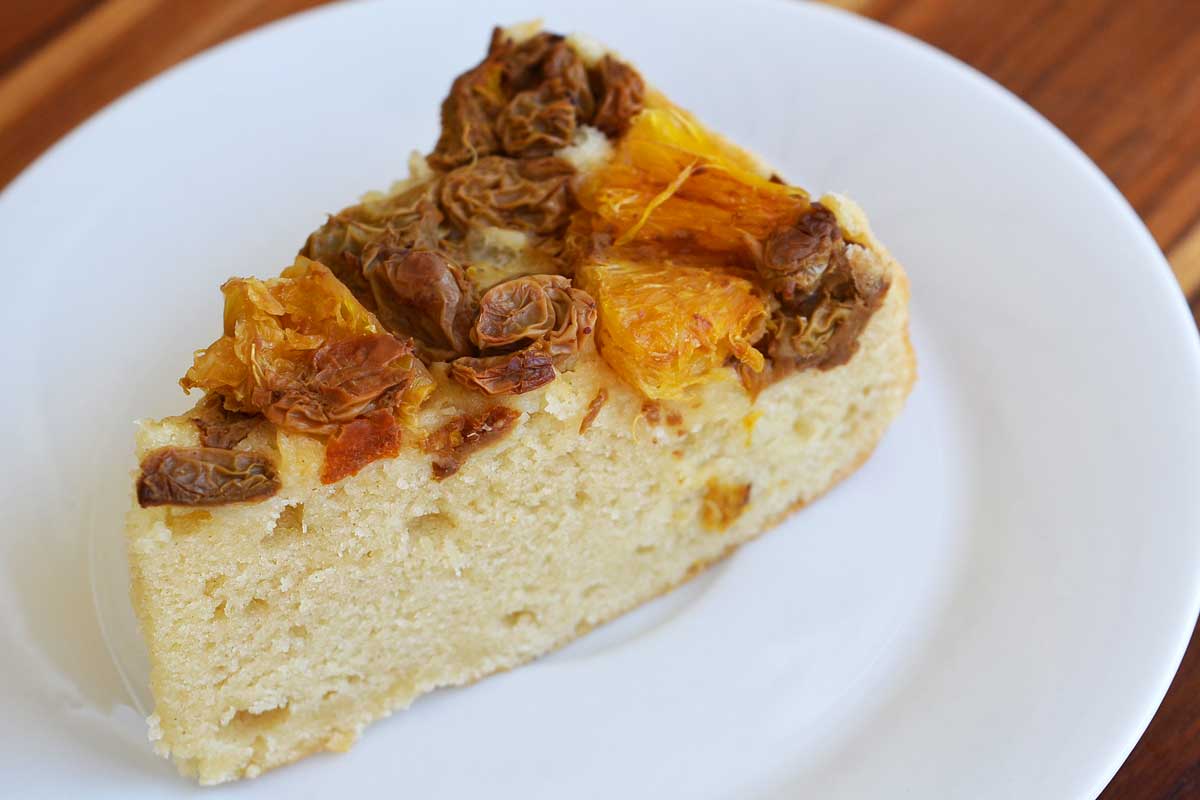
If you don’t want to send the wine fruit to the compost pile, try Dandelion Wine Fruitcake.
Recommended Materials for Making Dandelion Wine
- Wine Yeast – store extra yeast packs in the fridge or freezer. I normally use Lalvin Wine Yeast EC-1118.
- 2 Gallon Crock – 2 gallons gives you space for fermentation.
- Wine Bottles – It’s fine to wash and reuse old wine bottles. You will probably need five 750ml bottles.
- Corks – It’s best to use new corks. I like the #9 Straight Wine Corks.
- Wine Bottle Corker – This double lever model works like a charm.
- Gallon carboy with airlock – optional, for clearer wine.
Old-Fashioned Dandelion Wine Recipe
A smooth and hearty flower wine with citrus notes that will warm you from head to toe.
- Yield: 4–5 bottles 1x
Ingredients
- 3 quarts dandelion petals, loosely packed
- 1 gallon water
- 2 oranges, with peel, preferably organic
- 1 lemon, with peel, preferably organic
- 3 pounds sugar
- 1 package wine yeast
- 1 pound raisins, preferably organic
Instructions
- Collect the blossoms when they are fully open on a sunny day. Remove any green parts and measure out three quarts of petals.
- Bring the water to a boil and pour it over the flowers in a large pot or crock. Cover with a towel to keep dust out and let steep for three days. Stir daily to keep the petals submerged.
- Prepare the oranges and the lemon. Zest (finely grate) about half of the rind and peel the rest off in very thin strips. You want to minimize the amount of white pith added to the brew.
- Finish peeling the citrus, and slice them into thin rounds.
- Add the lemon and the orange zest to the flower-water mixture and bring to a boil. Remove from heat, strain out solids, then add the sugar, stirring until it is dissolved. Allow to cool to room temperature.
- Add the yeast, raisins, and orange and lemon slices and rind strips to the liquid. Put everything into a two gallon crock (or wide mouth carboy with airlock) to ferment. I cover my crock with a clean cotton towel held down by a rubber band. Stir daily with a wooden spoon or non-reactive stir stick.
- When the primary fermentation mixture stops bubbling (1 -2 weeks), fermentation is almost done. Strain the liquid through several layers of cheesecloth or a flour sack towel.
Bottling the Wine
You have two options for bottling your homemade dandelion wine. You can let it finish in bottles, or move to a carboy and then bottle.
To finish in bottles: After straining, move the young dandelion wine directly to clean bottles. YOu will probably need four or five 750 ml bottles. Slip a deflated balloon over the top of each bottle to monitor for further fermentation. When the balloon remains deflated for 24 hours, fermentation is complete.
Cork the bottles and store in a cool, dark place for at least six months before drinking.
If you would like a clearer wine, transfer the strained wine into a one gallon carboy with airlock before the final bottling. Allow to ferment in the carboy for 2-3 months, and then rack into the bottles.
Notes
Do not seal bottles tightly before they finish fermenting. Always store your wine in a cool location.
Is Dandelion Wine Alcoholic?
Yes. If you use wine yeast as recommended in the recipe, you should end up with around 12 to 14 percent alcohol.
If you’re feeling adventurous, you may be able to nurture wild yeast from the raisins to do the fermenting. Wild yeast brews will have a lower alcohol content, because wild yeast dies off if the alcohol levels get too high.
You can learn more about using wild yeasts in the book, “The Wildcrafting Brewer“.
Is Dandelion Wine Medicinal?
Nearly every part of dandelion is full of nutritional value, with vitamins and minerals packed in every part of the plant. Aside from its great taste in wine making, it also has been used throughout history for its medicinal properties.
For more information, check out this article on Dandelion Benefits.
To dig even deeper into this amazing plant, check out The Dandelion Workshop online course. It includes a printable guide and step-by-step videos for making a variety of dandelion recipes and remedies.

You may also enjoy:
- Harvesting and Using Dandelion Roots
- Low Sugar Dandelion Jelly Recipe
- Dandelion Fritter Recipe
- How to Make Dandelion Root Tea
- Get Rid of Dandelions Without Chemicals
I’ve also answered a lot of reader inquiries in the comments, so be sure to have a look if you have questions. If you don’t find your answer (or would like to share some wine making stories or observations), leave a comment below.

This article is written by Laurie Neverman. Laurie mixes her rural background and engineering training to create a unique and resilient homestead. She enjoys getting to know wild plants and using them for food and medicine. Her most unique experiment to date was quackgrass wine.
Originally published in 2010, last updated in 2026.
Thank you for the great article and all the comments.
I’m wondering if you can bottle in smaller bottles.
What about empty 500ml plastic bottles?
If corking.. does that mean you have to buy a special corker?
So many answers and still so many questions!
I’m personally not a fan of long term storage in plastic, but I suppose if it’s food grade you could probably do it. If corker, a corker works best, although I have seen corks forced in with a rubber mallet. (I don’t recommend this.) Smaller bottles would be fine as long as you can find a way to seal them.
I accidentally used 4 pounds of sugar instead of 3! Will this completely ruin my wine, or will it just be little sweeter. I feel really stupid for this mistake =(
I’ve never tried it, but I don’t think it will ruin it, just change the flavor profile.
Hi, I have used you this recipe for dandelion wine. It has been fermenting in a crockpot for nearly two weeks, it is still bubbling a little so not yet finished. i am going away for a week from tomorrow, will it be ok to leave for this amount of time in crockpot until I get home? Thank you in advance
It should be fine. By chance do you have a gallon carboy with airlock? You could strain before you leave and shift it in there to bubble. Alternatively, you could bottle and use the balloon trick – just make sure there’s plenty of room in the balloons.
Thank you for your reply. I don’t have a carboy unfortunately as this is my first time at making this wine. I think I will bottle & use the balloon trick. Thank you again. Marilyn
You’re welcome, and good luck!
I ordered raisins from Amazon and they will not arrive for several days, but today is the day I am supposed to add them and the citrus. Can I add them when they arrive? Or do without?
The raisins help to balance the flavor of the wine and improve fermentation, so I wouldn’t skip them. I normally prep all my ingredients in advance, so I haven’t tried this, but I would proceed with the rest of the recipe and mix the raisins in as soon as they are available.
I harvested my dandelions. I’ve removed the stems and leaves. Is it ok to save the dandelions in a ziplock bag and store in the refrigerator or freezer until I have enough to make full fill my recipe?
If you need to store the petals, keep them frozen, not refrigerated. The quality will be much better.
My neighbors all think I am some kind of nut because I am always picking dandelions. the stares I get are funny.
Maybe they need to be introduced to dandelion wine? 🙂
So I have spent the day picking and plucking dandelion, tedious but oddly relaxing. Now that I have them steeping I came back and read through the comments. My stars I am seeing so many variations. Im sure you’ve been asked enough but I want to confirm yet again if I may. I plucked a 3 quart saucepan full of nothing but yellow petals. So I measured after plucking. Is this your preference? Or should I add more water to the steeping? Sorry I know its a popular question. Thank you for this recipe my hubby sent it to me so I figure I may have it done for him by Christmas, goodness knows the dandelions are aplenty here in Ohio (broken mower on 4 acres means fount this recipe just in time)!!
lol – 4 acres could be a lot of dandelions. I prefer 3 quarts of nothing but the yellow petals. Cover those with the gallon of boiling water for steeping. Make sense?
They are everywhere, 3 quarts didn’t put a dent in them lol. Thats what I did! Thank you so much!! We are very excited to taste it 🙂
lol – it’s funny. You start picking, and it seems like it would be a lot to pick, but it’s not. Even in our yard I can never tell where we’ve picked. Plenty for us and the bees and butterflies, too.
Hi, this is my first time making wine. I’ve got my petals steeping in a crock now. I’ve got a one gallon crock so it is full to the brim. How much will the liquid expand when I add the yeast. Do I need to move it to a larger stockpot for fermenting so it doesn’t run over?
If you’re full to brim before yeast is added, yes, a larger container would be a very good idea. Anything non-reactive (like a stockpot, as you mentioned), will be fine. Just keep it covered to keep the critters and dust out.
Thanks. We’re fermenting now and the fruit is sitting on top the bubbles, should I stir it back into the liquid? Or is it like bread and you dont want to disturb it while the yeast is working?
The original recipe didn’t mention one way or another, but I typically give my homemade wines a stir each day and check on their progress.
My bottles have been sitting with the balloons on top for a week! Is that long normal? It appeared to be done bubbling when I bottled them and they ferented for two full weeks before that. Also, one bottle was done right away, another bottle was done a few days ago, one bottle inflates the balloon every few hours. Is it normal for it to vary so much from bottle to bottle? It seems like they would all be the same!
Some of the commercial yeast strains can be pretty vigorous, so that’s not terribly unusual. As for the variation from jar to jar, that is a little stranger, but if the wine was settled and pulled off in layers to the bottles, some will have more particulates than others, and more yeast fuel.
Working on making this right now. Curious about the 6 quarts of blossoms and measurements. Which if I figure correctly is about 12 cups of blossoms. My question: Is the measurement of blossoms to be packed such as brown sugar or loose such as chocolate chips?
The petals, being petals, don’t tend to pack quite like either brown sugar or chocolate chips. 🙂 I aim for a fairly snug packing of 3 quarts. It’s a country wine, so measurements may be less than precise and still end up with a drinkable product.
Nice recipe, Lorie, and especially valuable hint about throwing out the flower base.
I suspect that the wine yeast will be the most expensive part of the setup.
Does it matter which sort of yeast do you use? Have you ever tried to make this wine without boiling dandelions, using just “wild” yeast that live on the petals to do fermentation on their own?
Why I’m asking is because usually yeast race used affects wine flavor very much, and I suspect that taking just ANY (probably inappropriate) yeast race might bring some disharmony to wine flavor.
I tried my first wild yeast mead (honey wine) last year and ended up making vinegar. Wild yeasts, although traditional and potentially bumping up medicinal qualities in the brews, can be a little tricky. It’s easy for them to become dominated by vinegar yeasts. The commercial yeasts are bred to hold their own and crowd out the competition.
Thanks for quick reply.
Hmm… Honey wine is called “mead” in English? Didn’t know that. Looks suspiciously similar to the ancient russian name of the similar drink – “мёд”(myod), which also generally means “honey” in modern Russian.
Interesting 🙂
If wild yeasts might suffice, then I’ll probably try them anyway to see how will they perform in comparison to the commercial ones. I also plan to do some part of my wine using spring birch juice instead of water to bring additional forest note.
If vinegar fermentation is an issue, I like one good way to avoid it – fill a fermenter almost up to the top and put a water seal or some kind of bubbler on top of it (to avoid air intake), then place the fermenter into the cold cellar.
Then cork the wine up firmly in a bottle, and keep in cold.
So, you always use exactly the same Lalvin EC1118 every time?
There aren’t that many suppliers here in Russia, and it easily might be unavailable. So I wanted to have some possible replacement.
I guess any yeast suitable for white wine will be OK, right?
As I understand it, terms similar to “mead” are common in many cultures around the world. The book I read last year (Make Mead Like a Viking) that inspired me to give wild yeast a try had some interesting history and folklore.
To catch the wild yeasts, at least from most recipes that I have seen, the initial ferment should be done in an open crock covered with cloth to keep bugs out. The wine start should be stirred vigorously daily with the sugar and fruit added.
The initial soak of the dandelion petals basically makes a strong dandelion tea (infusion) to add to the fruit and sugar wine base. The author of Make Mead Like a Viking suggests somewhere warm outside, if it is available. I used my greenhouse, which at that time had the doors open for ventilation, but was still protected from the wind. (The doors are half doors, so can be partially closed to keep animals out.) After about 3 days of stirring, I had very nice bubbling – and should have brought it inside. I left it another day and the temperature spiked. The smell changed from fruity to vinegar very abruptly.
Without the open crock ferment, no wild yeasts.
Once the vigorous fermentation of the initial ferment is done, switching to an airlocked carboy in a cool location for aging would be good.
I use any wine yeast that’s available, as I’m not concerned about replicating an exact flavor. I believe grandma used bread yeast, and the old book “How to Make Wine in Your Own Kitchen” (1963) includes a number of recipes with a slice of bread or small amount of wheat biscuit cereal paired with bread yeast for fermenting.
Thanks a lot for such an exhaustive description.
Indeed, there’s not that much info on this topic around.
Working with wild yeasts is as much art as science – and there’s no money to be made promoting wild yeasts over selling commercial yeasts and all the equipment that goes with current wine making trends. Fruits and sugars ferment, and people have been using that basic fact for a very long time. As long as one doesn’t mind results that might be a little “foxy” at times, there’s no reason not to experiment. At worst, you’re likely to end up with a strange vinegar.
You can get a 10 pack of Montrachet wine yeast on Amazon for $6.34. You only need one pack per batch, so it’s 63 cents worth of yeast.
The most expensive part of this is the pound of raisins per gallon of wine.
Thanks for the info.
Despite that I’m not from Crimea, I believe Amazon charges some fairly good additional fee per shipment to Russia, so it’s much less expensive and much faster to me to buy from our local supplier.
Getting ready to try your recipe and I’m so excited! a couple of questions, though: I have looked at what others have to say about wine-making in general and I’m wondering if I need to add sulfites to the recipe? Same for yeast nutrient. One article that I read says that most recipes don’t call for these 2 items because a person should know that these are needed for every recipe. Thanks for your help!
This is a “country wine” – what you see is what you get. I don’t use sulfites or yeast nutrient with this one, just the recipe as stated. I’ve never had a problem with spoilage or the yeast taking off and working it’s mojo. The additives can help produce a more consistent wine, but people have been fermenting things for a very long time without them.
Ok, I’ve been looking up raisins by the pound…and they’re kinda expensive. Is there something special about raisins, or will any fruit/berry do?
Raisins add body to the wine, increasing it’s viscosity and causing the flavors of the wine to linger on the tongue. They also add a caramel element to the flavoring, which balances the acidity of the citrus. I haven’t experimented with other fruits, so I don’t know what the flavor of a substitution would be like.
I completely agree, Laurie. What do you do with the deliciously plump raisins afterwards? Seems a shame to throw them away!. I was thinking of a moist fruit loaf. Any ideas?
Thanks for reminding me! I wrote a post last year and forgot to link it – dandelion wine fruitcake, made with the fruit leftover from winemaking.
it’s so interesting and amazing !
I’m going to try to get into winemaking this summer: dandelion, salmonberry and blueberry (and whatever else I can pick around my area). I have some 5 gallon carboys for it. I’m guessing that I can just multiply all of the amounts by 5, since your recipe is for 1 gallon of wine, but would I use 5 packets of yeast or is 1 packet good enough for any size?
Yes, just upscale the recipe for most ingredients. The packets of yeast I’ve used say that they are good for up to 5 gallons of product, so odds are you won’t need extra packets of yeast for 5 gallons of wine.
Hi there! I’m about to be buying bottles to make this recipe: approximately how much does one batch (as per these instructions) make?
TIA!
I usually end up with around five bottles of wine.
I just go to a bar down the street and ask if I can have their empty wine bottles. They don’t recycle glass in my area, so I get them for free. Most places give back like 15c for bottles, so offer them a quarter or something. New bottles are like $2 each.
When the dandelion plants are growing in the spring, but before they set buds, cover them with upended nursery container pots (with holes). They will continue to grow for a few more weeks,
but this trick seems to make the leaves less bitter when used in salads or cooking like spinach…
Like blanching endive. Makes sense.
I have a question about fermentation vessels, crocks or pots. I just picked up a 20qt porcelain enamel stock pot from Meijer for great price, even came w a canning rack. Can I use that for fermentation of this or other wines? If not, I’ve seen stone crocks at Ace hardware for a good price but wondering if I can use the stock pot as multipurpose.
Also can one use vinegar for sanitation of the carboy?
TIA,
Lydia
If you’re only going to do an occasional batch of country wine, the stock pot will probably work just fine. If you think you’ll be doing winemaking on a more regular basis, a carboy is probably a worthwhile investment. I use my crocks for wine and other ferments, and don’t worry about precise flavor profiles, so crocks make sense for me.
I wouldn’t recommend vinegar for sterilization, as that might lead to introducing vinegar producing bacteria into your wine – so you’d end up with vinegar instead of wine. Either invest in the commercial cleaners (they’re not very pricey and a little goes a long way), or simply wash as well as possible with regular dish soap and hot water. Rinse well, and let things dry in a sunny window for a little more sterilization via the UV rays. (Not recommended for plastic, as this will speed breakdown.) Folks in the past used to ferment many different brews without the tech and sterilization we have available now.
I feel compelled to share some of my experience with brewing alcohols.
The one thing you’ve really left out is sterilization.
Not properly sterilizing all implements is a recipe for disaster. Bad bacteria can very easily get into your brew and overtake your yeast, or at least sour the flavor of your finish product. Star San is a no-rinse sterilizer that you only need to let set on a surface for a few minutes – basically fill your cooking vessel with it and water, and put all your tools in it for 5 minutes.
Also, you should really be using an airtight carboy with a one-way valve for fermenting. Again, it’s very easy for bacteria to creep in.
Finally, with fresh fruit, it’s good to make sure the flesh isn’t damaged – a previous wound that may be healed over would compromise the fruit, and again, sanitize the outside.
If people are inclined to invest in a more sanitary and controlled brewing setup, that’s great. It’ll give more consistent results. If one wanted to do commercial brewing, it would be required, along with a myriad of other sanitation rules. That said, folks have brewed all manner of ferments for millennia without the benefit of modern tools and sanitizers. My mom and my grandmother used to brew up a recipe very similar to this, and I’m quite sure they never owned an airlock or used no-rinse sterilizer. They still brewed up a fine assortment of country wines that were enjoyed by friends and family alike. As for only using perfect fruit…there’s a fine tradition of fermenting bumped and bruised fruit that wasn’t suitable for other storage methods. I wouldn’t use anything rotten, but mushy bits have some of the best flavor.
Thank you for sharing this recipe, I can’t wait to try making it this spring! What I would love to do is to give out small bottles of dandelion wine as favors for guests at my wedding this coming fall. My plan is to make a large quantity (~ 10 – 15 gallons) and bottle in small bottles (~ 250 – 375 ml). Rather than allow any remaining fermentation to occur in the bottles (requiring the monitoring of attached balloons), do you think it would work if I transfer to large sterilized carboys after the initial fermentation & straining, and left it for a few months to allow for plenty of time to fully ferment before bottling?
Absolutely! The balloon bottle thing is entertaining, but a proper carboy with airlock will definitely do the job – plus an additional racking will help clear the sediment, so they look nicer for wedding guests.
Hi, I have a question.
I made some dandelion wine this summer. I did take the greens of the petals (what an extraordinary amount of work, by the way :)) I have just decanted it, and it is very sharp and bitter. I made it last year with great success. I think that I might have put too much yeast in. Is there anyway I can salvage it, or do I chalk it up to a learning curve? Would it be insane to add some simple sugar to it? What type of yeast do you use?
I’ve been using the wine yeast linked in the post – or whatever I pick up at the local home brew store, depending on the year. I highly recommend getting help to pluck petals, if you can talk anyone else into it.
Although the wine can be consumed at 6 months, the flavor mellows with age and becomes much less foxy and harsh. My 6 year old bottles are more like a good brandy. If you hate the flavor, there’s no harm in attempting to add some simple syrup. I’d probably try doctoring some and leaving some “as is”, and taste again in 6 months to a year.
Thanks. That is what I will try. I will let you know next summer. For this winter, I think I will mix it with some of my raspberry cordial. 🙂
Sounds like a plan. 🙂
Thank you for this wonderful recipie! We made a batch this sommer. I wanted to give them as Christmas presents but now I am a little concerned. I do have sediments – no problem. But I also have strings/cloudiness. It took weeks for the fermenting to stop. Looks loke my Kombucha. Is this okay?
I tried a sip and it tasted like port wine/Sherry. I like it. Made me sing “Jeramia was a bullfrog – joy to the world! Joy to you and me!”
Some cloudiness is not unusual, especially if you didn’t rack more than once. As a “country wine”, there was nothing added to help precipitate out the yeast beasties, so multiple rounds of racking would be the best route to a clear wine – which I normally don’t do. The yeast dregs are loaded with B vitamins. Hopefully your gift recipients won’t mind. If you do want it clearer, you could dump all the bottles into a larger container, let it settle for a day, and then rack more carefully.