
Everything You Need to Know About the 18650 Battery

This post may contain affiliate links. Read my full disclosure here.
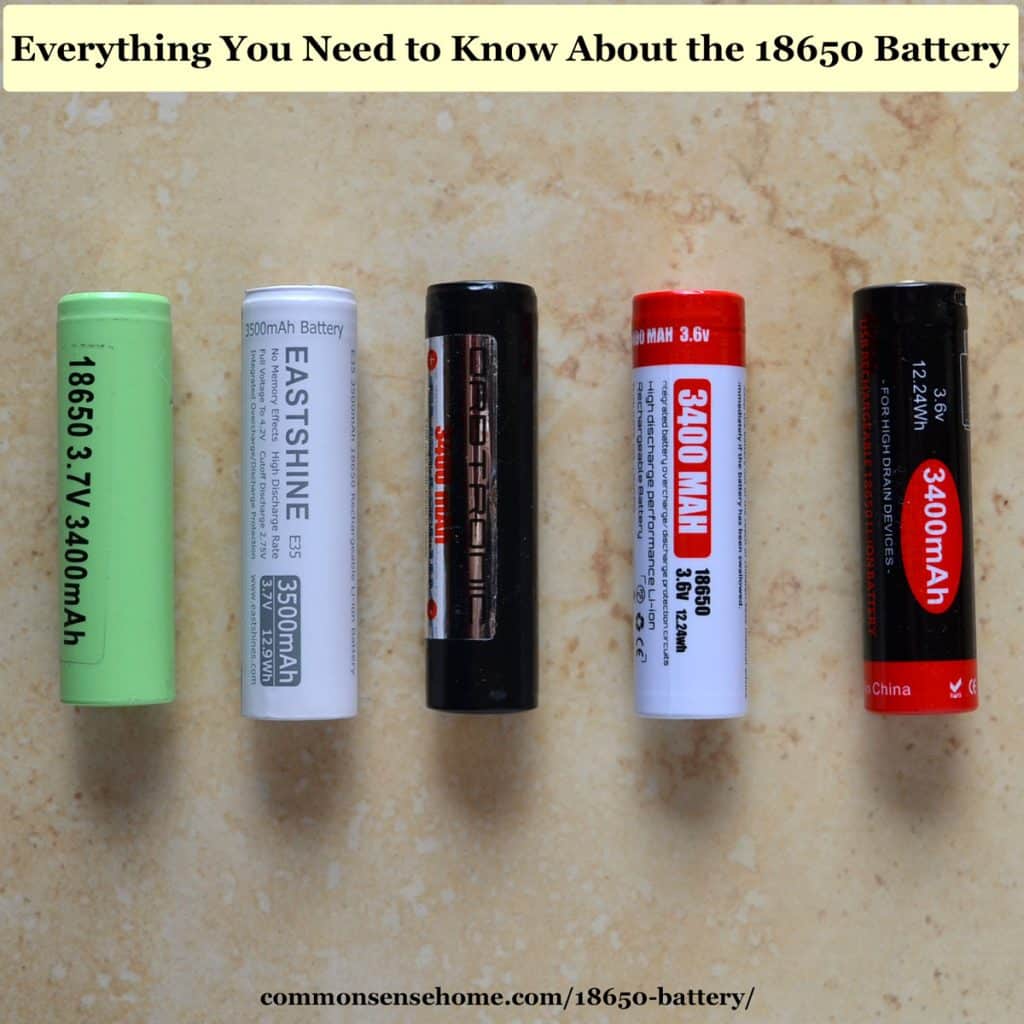
This article tells you everything you need to know about 18650 batteries. We’ll talk about different types, features, charging, lifespans, and our recommendations for batteries and chargers.
Would you like to save this?
Table of contents
- What is an 18650?
- Various Battery Sizes
- Comparing 18650s to Other Common Batteries
- 18650 Terminology
- Protected vs Unprotected 18650 Batteries?
- How much power does an 18650 have?
- How many times can you recharge an 18650 or other battery?
- How frequently should I recharge my 18650?
- How do I know my 18650 is Dying?
- How can I measure the quality of an 18650 if I am unsure of the age of a battery?
- 18650 Battery Chemistry
- What are 18650 batteries used for?
- Which is the Best 18650 Battery?
- 18650 Battery Charger
- 18650 Flashlight
- Related Posts
What is an 18650?
An 18650 is a lithium ion rechargeable battery. Their proper name is “18650 cell”. The 18650 cell has voltage of 3.7v and has between 1800mAh and 3500mAh (mili-amp-hours).
18650s may have a voltage range between 2.5 volts and 4.2 volts, or a charging voltage of 4.2 volts, but the nominal voltage of a standard 18650 is 3.7 volts.
There are two types; protected and unprotected. We absolutely recommend protected cell 18650 batteries. Protected cells include a protection circuit that stops the cell from being overcharged.
Unprotected cells can be overcharged and burst and potentially cause a fire unless there are specific electronics to protect the battery. The popular LG HG2 and INR and Samsung 25r and 35e are UNPROTECTED batteries, only use them in a device designed to use unprotected 18650s.
We also recommend you stick with high quality “brand name” 18650s. Many knock off, no-name brands lie about high mAh (capacity).
The average 18650 battery charge time is about 4 hours. Charge time can vary with amperage and voltage of the charger and the battery type.
Recommended 18650 Batteries
| Battery Make and Type All are 3.7v Lithium Ion (Li-ion) | Max Milliamp hours | Notes *Shop around for best price* |
| Orbtronic 18650 Protected #ORB3500P | 3500 mAh | Only available direct from vendor good price |
| Olight ORB-186C35 Protected #ORB-186C35 | 3500 mAh | Ok price |
| Nitecore 18650 NL1835R Protected #NL1835R | 3500 mAh | Good for travel, expensive. Has micro-USB charger port so it can charge itself with a cable/usb port |
| Panasonic NCR18650BD Button Protected #NCR18650-BD | 3180mAh | Less expensive PROTECTED and good for high drain devices. |
| Panasonic NCR 18650 3400mAh NOT PROTECTED #NCR18650B-3400 | 3400 mAh | Less expensive but is NOT PROTECTED. Use carefully. |
| Panasonic NCR18650BE NOT PROTECTED #NCR18650BE-3200 | 3200 mAh | Less expensive but is NOT PROTECTED. Use carefully. |
More info on the 21700: Everything You Need to Know About the 21700 Battery
Various Battery Sizes
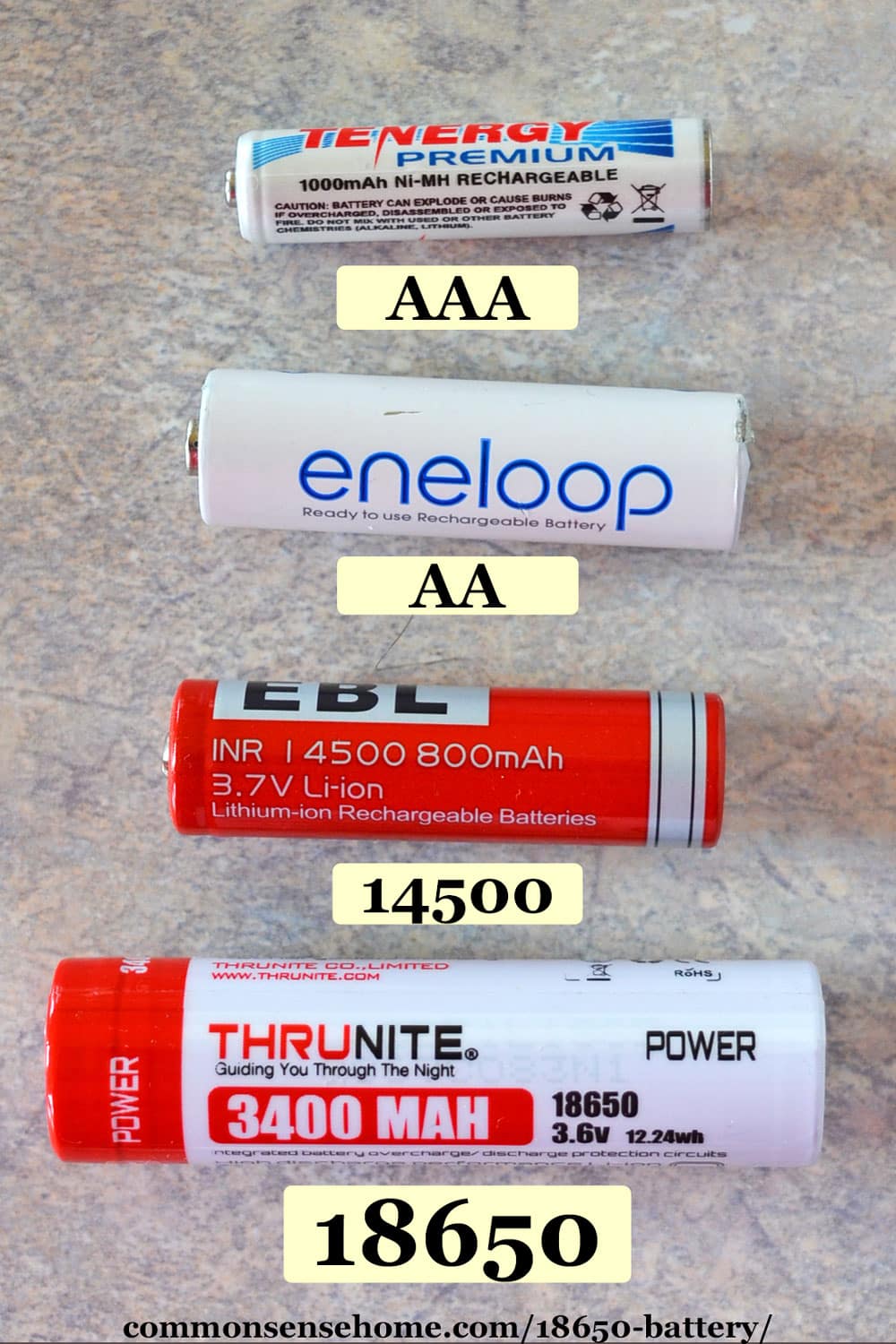
The following is a picture showing various battery sizes. The 18650 is 1170 cubic mm, the 14500 and AA are 700 cubic mm, the AAA is 467 cubic mm.
Note the 14500’s cannot be used in all AA devices unless they support both 3.7 and 1.5 volt batteries. The 21700 at 1550 cubic mm, is larger than the 18650 battery – the 21700 and 18650 is not interchangeable.
Comparing 18650s to Other Common Batteries
| Battery Make and Type | Rechargeable | Voltage | Max Milliamp hours | Watt hours | Length & Diameter |
| Nitecore 21700 (not an 18650 included for comparison) | YES | 3.7v | 5000 mAh | 18.5 | L: 74mm (2.92 in) D: 21.4mm (0.84 in) |
| Orbtronic 18650 Protected Battery | YES | 3.7v | 3500 mAh | 12.5 | L: 65mm (2.55 in) D: 18mm (1. in) |
| XTAR Li-ion 14500 (not an 18650 included for comparison) | YES | 3.7v | 800 mAh | 2.9 | L: 50 mm (1.96 in) D: 14 mm (0.55 in) |
| Energizer Lithium AA (not an 18650 included for comparison) | NO | 1.5v | 3000 mAh |
4.5 | L: 50.5 mm (1.99 in) D: 14.5 mm (0.57 in) |
| Eneloop Pro AA (not an 18650 included for comparison) | YES | 1.2v | 2550 mAh |
3.0 | |
| Energizer Lithium AAA (not an 18650 included for comparison) | NO | 1.5v | 1000 mAh |
1.5 | L: 44.5 mm (1.75 in) D: 10.5 mm (0.41 in) |
| Eneloop Pro AAA (not an 18650 included for comparison) | YES | 1.5v | 950 mAh |
1.4 | |
| 12v car battery (included for comparison) | YES | 12v | 40,000 mAh |
480 |
18650 Terminology
A battery might say protected mode 3.7v 18650 3000 mAh low self discharge for high drain devices. What does that all these features mean?
- “protected mode” means it has an overcharge and overdraw circuit protection built in (more info below).
- “3.7v” – is the optimal or peak voltage. It will drop as you use the battery.
- “3000 mAh” measures the amp hours the battery can provide. A higher number is better. The highest realistically available on an 18650 today is about 4000 mAh, anything higher than that is marketing hype.
- “Low self discharge” is a good thing. That means it will hold a charge in storage. The less it loses in storage the more charge will be left for you to run your flashlight or other device.
- “for high drain devices” – the battery is optimized for high drain devices. These are devices that use a lot of power very fast, such as RC toy car.
Protected vs Unprotected 18650 Batteries?
Protected 18650 batteries have an electronic circuit. The circuit is embedded in the cell packaging (battery casing) that protects the cell from “over charge”, heat or “over discharge”, over current and short circuit. A 18650 protected battery is safer than an 18650 unprotected battery (less likely to overheat, burst or start on fire).
Unprotected 18650 batteries are cheaper, but we do not recommend their use. Unprotected batteries should only be used where the load/draw and charging is externally monitored and controlled. The protected batteries normally have a “button top”, but check the specifications to make sure. Generally 18650 flat top batteries do not include the protection circuit.
If any 18650 battery is damaged or looks corroded or appears to be leaking, get rid of it at a battery recycling center. Be safe.
See “Battery Recycling – How to Recycle Different Battery Types and Corroded Batteries Safely“.
How much power does an 18650 have?
A 3.7v a 3400mAh 18650 stores about 2 aH to max of 3.5 aH. It can store about 10 to 13 watt hours. A small air conditioning unit that can cool about 9000 BTU uses about 1100 watts per hour. So it would take more than 110 of the 18650 batteries to run the air conditioner for 1 hour.
In comparison you would need three 12v 40 amp car batteries. But 110 18650s are smaller than three car batteries.
How many times can you recharge an 18650 or other battery?
Recharge cycles vary and are limited. Think of it like a bucket. The trick is that the bucket also gets filled with a tiny bit of other junk over time, so there is less room. As the battery is reused (recharged), the battery degrades due to oxidation and electro-chemical degradation.
This happens to any rechargeable battery such as an 18650, 21700, 26650, 14500, AA, AAA or even a car battery. They can only be recharged a limited number of times.
You want to select rechargeable batteries that can be recharged many times. We specifically recommend 18650’s because they have the ability to be recharged 300 to as many as 2000 times.
How frequently should I recharge my 18650?
The way you recharge your battery impacts the life of the battery. If you can measure it, you want to deplete from 3.7v down it to about 3v before you recharge. If you are not sure, use the device until it indicates a battery needs to be replaced. For a flashlight, run it till the light is dim or goes out.
A good charger will tell you the voltage of the battery so you can eventually get a sense of the life of the battery in various devices. If you recharge too frequently you “use up” the life without a return.
Some people don’t let it dip below 3.3v (or even higher). Each brand and model of 18650 has different maximum cycles. So this is really a process of matching your device and usage to the life cycle of the battery.
Be aware that an 18650 battery that drops below 2.5v may “lock” the device so it can’t be used. The “lock” function happens in devices such as vaping devices.
How do I know my 18650 is Dying?
Here is a list of 7 ways you can tell if you need to get rid of an 18650 (or other rechargeable battery). Look through these to determine if your 18560 is nearing the end of its life and needs to be retired:
- The battery will lose a charge on the shelf must faster than normal. It loses it’s charge after a couple of days or even worse overnight.
- The battery gets hot when charging or discharging, warmer than normal.
- You have used the battery frequently over 2 to 3 years.
- The battery can hold less than 80% of its original capacity.
- Recharge time gets abnormally long.
- If there is ANY cracking or deformation in the battery.
These are the 6 signs your 18650 is dead and it is time to get a new one. If you ignore these warning signs you risk fire or even having the battery explode while being recharged.
How can I measure the quality of an 18650 if I am unsure of the age of a battery?
A trick is to buy one or two similar 18650s and mark them “new” with a Sharpe (or label them A, B, C, etc). Then use them and compare their voltage and discharge rates with the questionable 18650s.
Basically you are comparing good vs unknown this way.
You can also gauge temperature this way. Charge both the new and unknown one to see how hot the new one is compared to the one you are unsure of.
18650 Battery Chemistry
There are a number of different chemical combinations for 18650 batteries. We recommend that you focus on protected mode, the chemistry can change and isn’t always reported. Many simply say Li-ION (meaning Lithium Ion).
There are actually a number of Li-Ion batteries. Here are some of the current “types”. Depending on your device type one might be better than the others.
- LiFePO4 which is Lithium iron phosphate
- also known as IFR or LFP or Li-phosphate
- LiMn2O4 which is Lithium manganese oxide
- also known as IMR or LMO or Li-manganese (high amp draw)
- LiNiMnCoO2 which is Lithium manganese nickel
- also known as INR or NMC (high amp draw)
- LiNiCoAlO2 which is Lithium nickel cobalt aluminum oxide
- also known as NCA or Li-aluminum
- LiNiCoO2 which is Lithium nickel cobalt oxide
- also known as NCO
- LiCoO2 which is Lithium cobalt oxide
- also known as ICR LCO Li-cobalt
What are 18650 batteries used for?
Flashlights, electronics, laptops, vaping and even some electric vehicles use 18650s. The Tesla uses 7180 of these batteries. Many high lumen flashlights such as the Thrunite TC15 v3 (best buy) or Fenix PD36 TAC (mo43 durable) use the 18650 or the even larger 21700 flashlights like the Nitecore P20iX a 4000 lumen flashlight.
Laptops and other electronic devices use one or more 18650’s and have recharging electronics built in. 18650’s are also used in vaping (smoking) devices.
18650s are are generally Lithium Ion batteries. If you are familiar with electronics you can change out some battery packs manually, but be careful – using the wrong type of 18650 or using it incorrectly can cause a fire.
Which is the Best 18650 Battery?
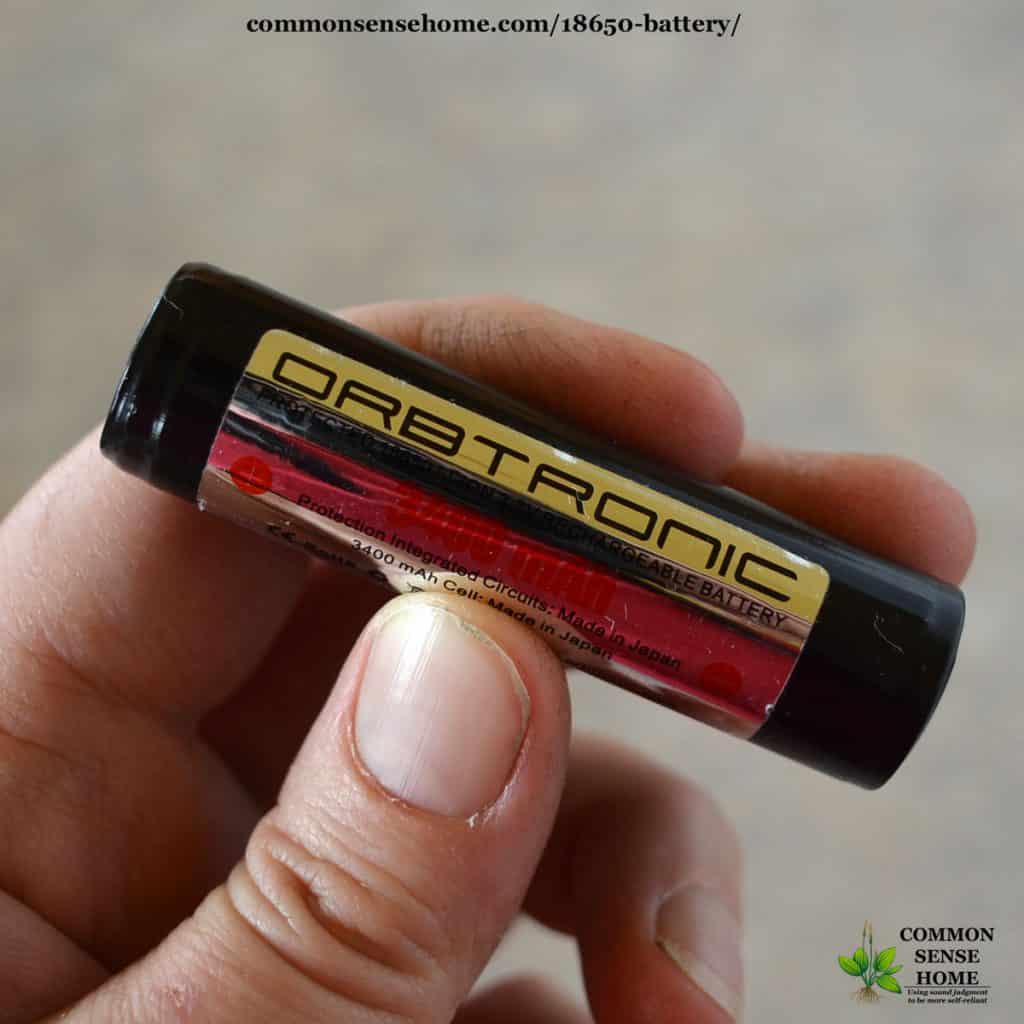
Overall best 18650 battery – The Orbtronic 18650 battery. This is an 18650 3.7v 3500mAh Protected cell. This is a high drain battery. We like it but it is expensive.
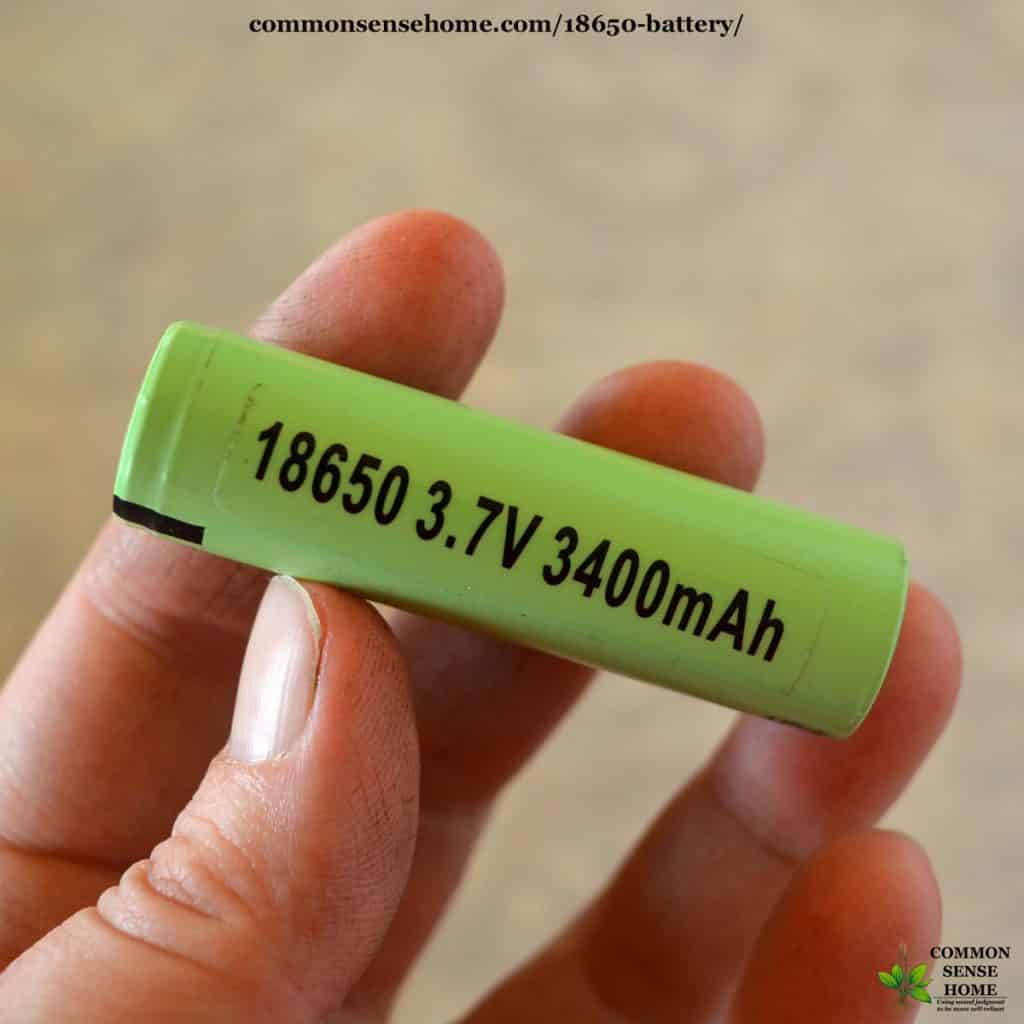
Best low cost 18650 battery – The Olight ORB-186P26 18650 2600mAh 3. The Panasonic 18650 is an 18650 3.7v 2600mAh Protected cell. This battery is less expensive and slightly lower amp hours than the Orbtronic. Also, this lower cost protected 18650 battery is still more expensive than the unprotected ones.
What is the best travel 18650 battery?
Nitecore NL1834R available directly from Nitecore. This is an 18650 3.7v 3400mAh protected cells with a built-in micro-USB charger. It is a few dollars more, but it allows you to charge it on the go and not have to carry a dedicated charger. The unit we have has slightly different packaging.
The cheapest decent one is the Titanium Innovations 18650 at 2600mAh. It won’t last as long as the 3400 mAh Nitecore but is 1/2 the price.
What 18650 Brands are Best?
The Orbtronic, Olight, Samsung, LG, Panasonic, Surefire, ThruNite and Nitecore are good reliable 18650 rechargeable cells. Be sure to buy them from a reputable source such as BatteryJunction or direct from the manufacturer. Note: Amazon stopped selling 18650s.
We don’t use the lower voltage and amperage 18650s, because they have lower amp hours and low peak wattage and lower sustained wattage.
We are willing to pay a few more dollars for the longer life, higher capacity and better quality.
18650 Battery Charger
18650 batteries are rechargeable, so you will need a good charger. We use two different 18650 chargers.
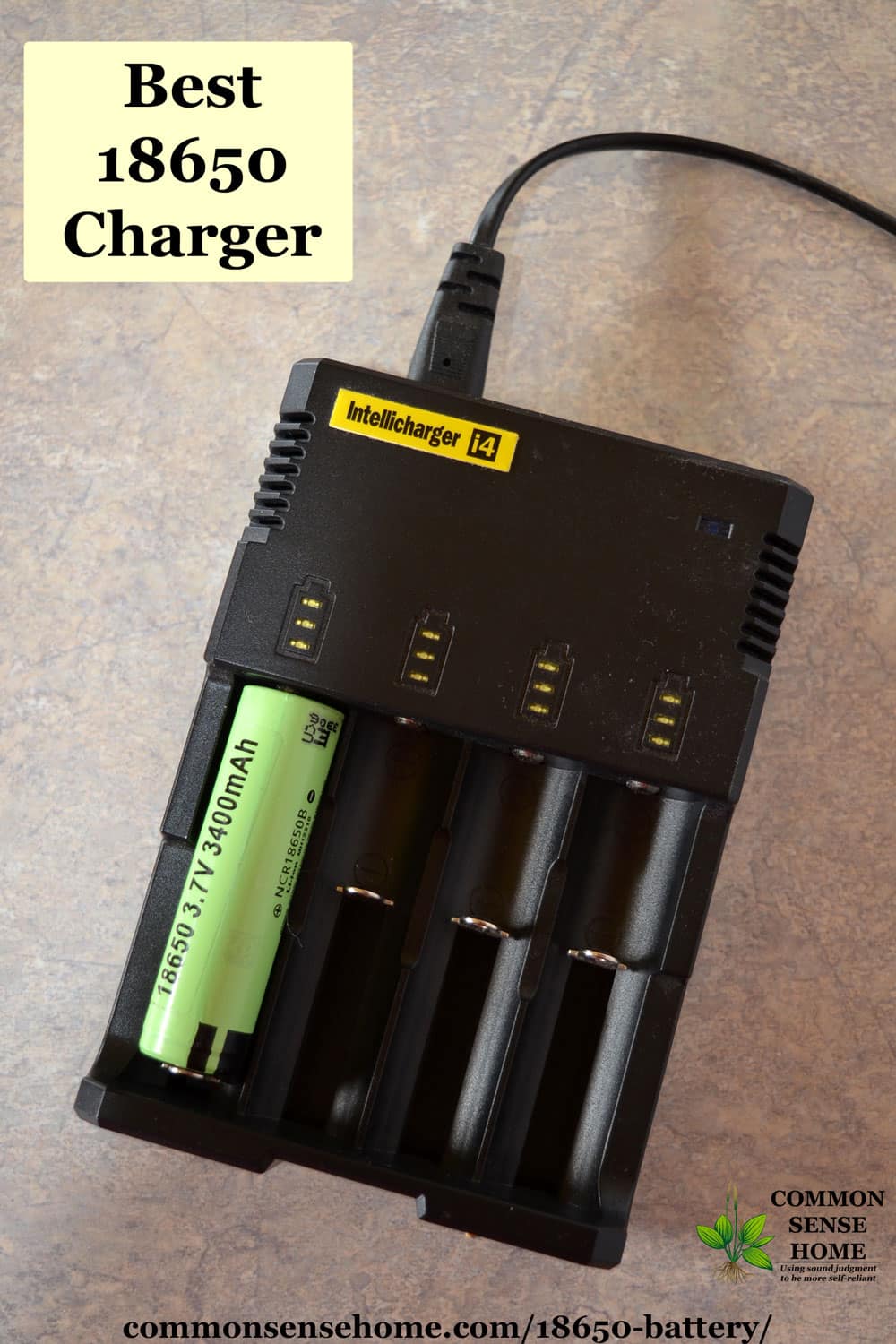
The best 18650 battery charger is the Nitecore UMS4 Battery Charger because it can charge pretty much anything.
Specifically, it supports: lithium ion 26650, 22650, 21700, 18650, 17670, 18490, 17500, 18350, 16340 (the 16340 is also known as RCR123), 14500, 10440 and Ni-MH and Ni-Cd AA, AAA, AAAA, C rechargeable batteries. This is our favorite charger for the 18650s.
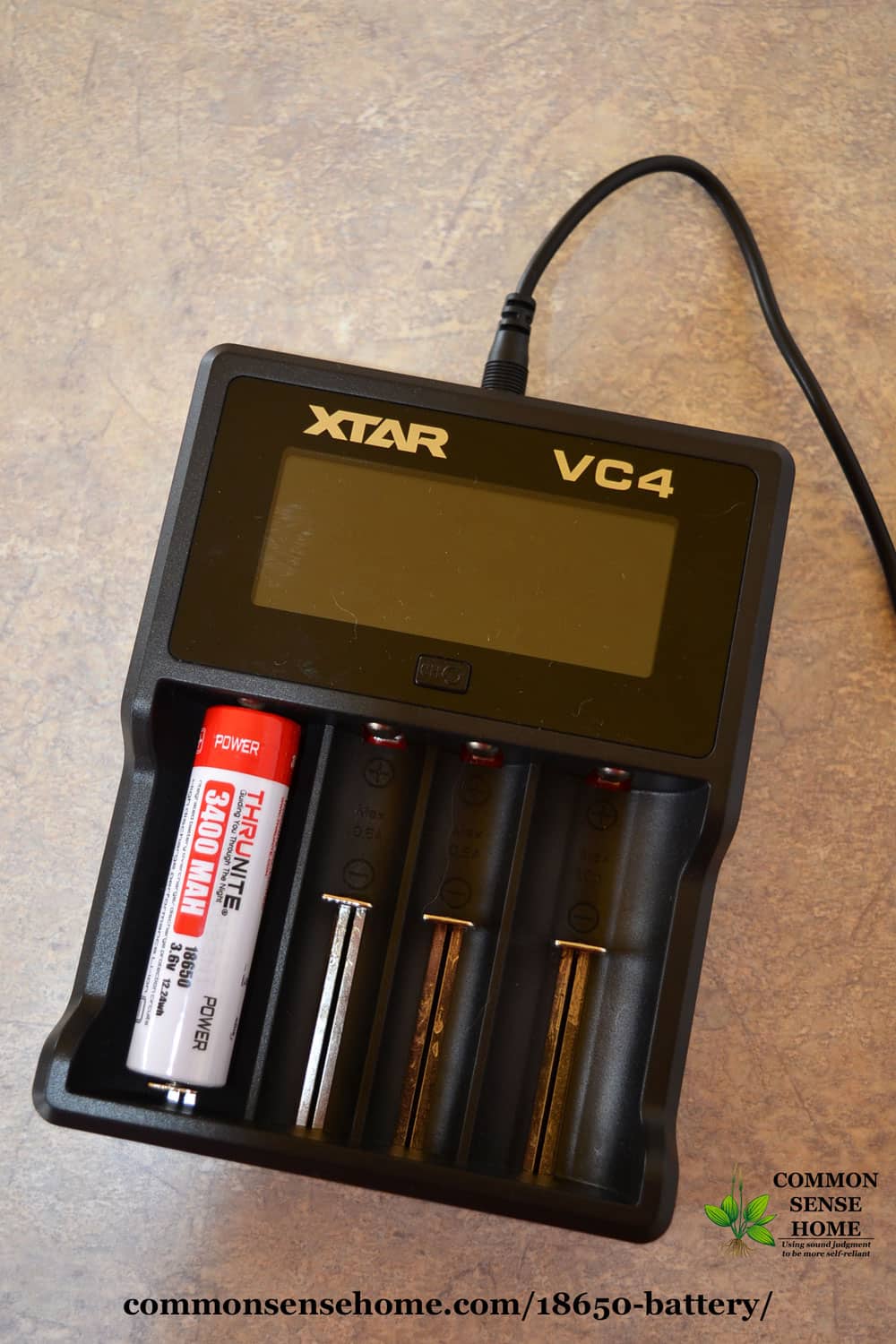
Our runner up and “best buy” is the XTAR X4 Charger. It is a USB powered 18650 charger. It charges the batteries with any USB power source. This unit is dependent on the power source, and is a bit more expensive.
It has an LCD display for charging status. A 2amp interface yields slower charge speeds. Even the 5amp is slow because it charges at .5 amps. We have used the XTAR and Nitecore with a Nektek solar panel that has a 2amp USB interface and it has worked well.
18650 Flashlight
The best mid priced 18650 flashlight is the Thrunite TC15 2403 lumen flashlight. It is about 1/2 the price of the PD36 and but a bit less bright. It is a GREAT buy (we have the older TN12 in emergency kits). We suggest two of these instead of one of the Fenix.
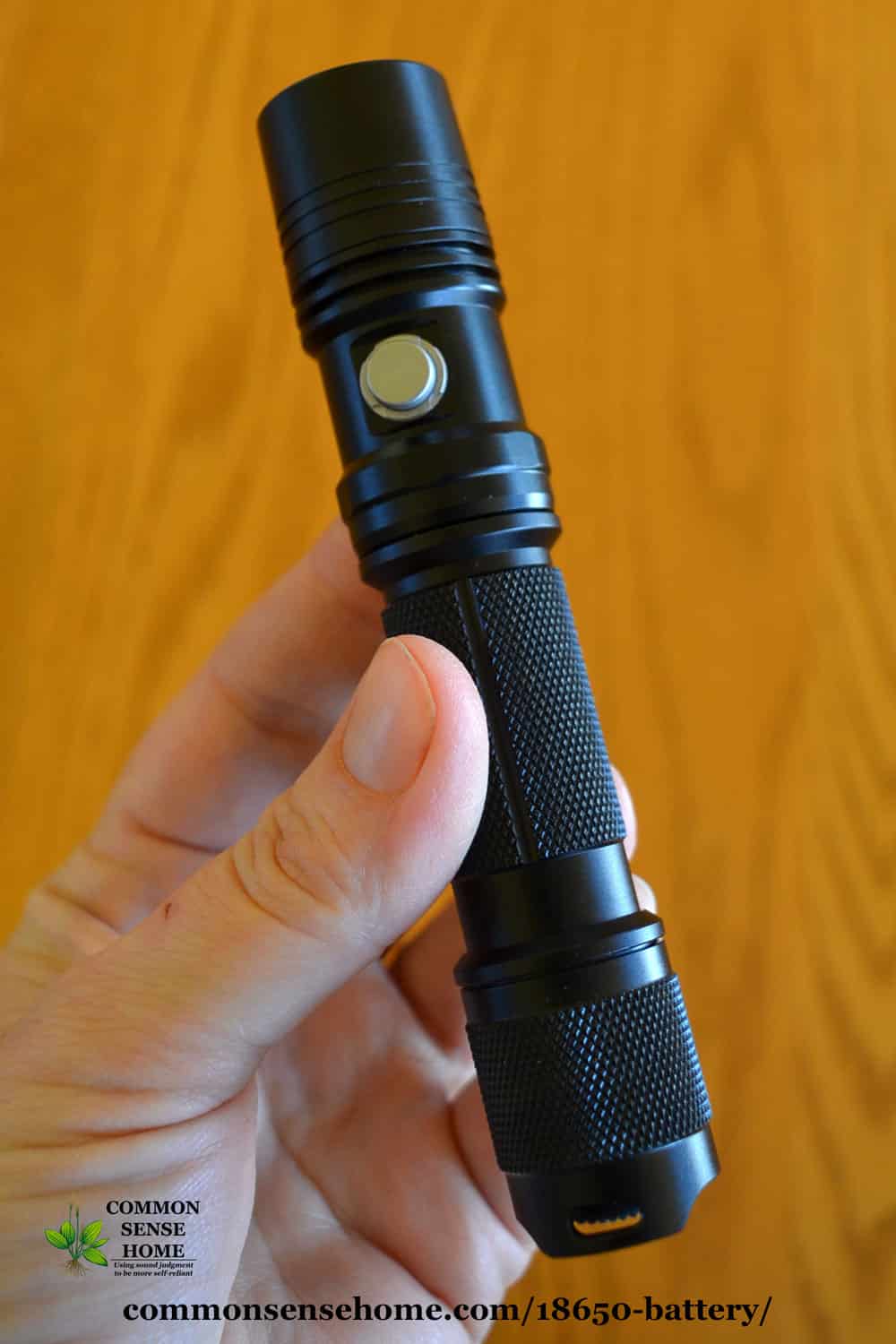
It has the following modes: Strobe (975 lumens for 226 minutes), Turbo (975 lumens for 126 minutes), High (652 lumens for 199minutes), Medium (266 lumens for 9.7 hrs), Low (19 lumens/177 hrs) and Firefly(0.29 lumens for 62 days) and it can charge itself with a USB power source. It is waterproof (IPX8) and has a max throw of 223m (764ft).
The toughest 18650 flashlight is the Fenix PD36 TAC. It is not cheap but it is durable and very bright, and has a pocket clip. The light level is 1000 lumens, and it is water resistant to IPX8. This is a “duty” quality flashlight.
The PD36 TAC offers five different brightness levels and strobe:
- Turbo: 3000 lumen – 1 hr 30 min
- High: 1000 lumen – 3 hr 15 min
- Medium: 350 Lumen (8hr 24min)
- Low 150 lumen – 18 hr 45 min
- Eco: 30 lumen – 160 hr
- STROBE (about 3hrs 2000 lumen)
It has a 300 yard or 274 meter throw.
Both the Fenix PD36 or the less expensive ThruNite TC15 are great LED Flashlights that use the powerful 18650 battery.
Related Posts

This post was written by August Neverman IV. August has a strong background in emergency preparedness. He served on several emergency preparedness teams during his tenure at Brown County WI Government, the Medical College of Wisconsin, HSHS, a 13-hospital system and emergency response training during his time with the Air Force and Air National Guard. Learn more about August.
Thanks for sharing this article. It is very comprehensive by covering almost all questions that we could think of.
Although I work with 18650 lithium batts every week, use them for a ton of different things, convert devices to their use or boost a device’s capacity, have learned much about them over the years. So when I read your stuff it was truly enjoyed info. This is mostly because you validated much of what I learned on my own (& through experience +/-), but most especially by how you explained things in a humanistic manner, even with examples for anyone to grasp. This makes it simple but most importantly it was ‘easy reading’, meaning your choice of words was like reading a good book.
That is not to say I didn’t learn anything new, you bet I did. Thanks kindly. That being said, I do not wish offer negativity to these comments here, rather a request or mild suggestion.
When you gave info on the various lithium batt. types, (though some were not noted), I would have said ‘you hit the nail right on the head’ with all your explanations… if you would have generally rated them as to quality/durability/lifespan.
Regardless, I personally give you all a huge thanks for giving everyone the ‘real goods’ on lithium and 18650 batts as well.
What we’ve found with battery testing (we did test a bunch of rechargeables head to head) was that battery life varies, so it’s not straightforward to rank them. Some hold up better for high power loads. Some last longer for small loads. Some hold their charge well in a drawer while others don’t. August still has a bunch of rating posts in draft because he’s trying to figure out a useful way to display the somewhat wonky results.
Apparently, I have lost my ability to find a specific battery for my husband’s solar, windup System: emergency radio. Here ar voltagee the specs. for the battery pack. It takes 2 of these:
Lithium-ion battery pack
Model:XTT 18650 2000mAh Material System: Temary Lithium
Normal voltage 3.7V Charging cut-off voltage: 4.2V
Specs. 18650-2000mAh-7.4Wh (ofcourse0 MADE IN CHINA TCT200302B004
I suspect that pretty much any 18650 can go in it. The question is it protected or not? To be safe I would use a protected mode 18650. Ones to consider Panasonic NCR 18650BD 3180mAh Protected, or Panasonic NCR 18650B Protected or the Samsung 35E Protected Button Top 3500mAh
Note the extra capacity might mess things up but i doubt it. Most likely it will just run longer. Those should be readily available, really any “Protected Mode” 18650 battery from: Panasonic, Sanyo (NCR), LG, Orbtronic, Samsung, Olight, Fenix, Tenergy or Klarus. Acebeam and JetBeam seem popular but I have never used those. If you want absolutely safe the Samsung 20R (2000mAh) should be pretty much a 1 for 1 match.
Hi, Bart here. Great work. I’m just going to make some simple comments regarding my experiences with the use of 18650 cells, regarding replacement or converting or upgrading.
I do apologize for repeating things already mentioned in the past by others oe yourself, as did not read every post in total.
1. If you start mixing ma or mah ratings together in the same device… you will have issues fairly soon, if not right away. As an example: the weakest link in the chain breaks 1st.
2. If you mix new with used, same behavior: weakest link scenario.
3. If you do replace, upsize storage cap., or upgrade to 18650’s from some other power, items #1 & 2 apply.
4. Always pre-measure each battery’s voltage inv=dividually BEFORE including in device.
– If all same (talking new ones here) within a minor fraction of a volt: fine, else possibly problematic in future.
– If using used batts, same thing, voltage must be individually within minor fraction of 1 volt.
5. Do the voltage check per cell 1st, but then ALWAYS pre-charge each new or used batt. INDIVIDUALLY before doing anything. Charge all to exact same voltage (eg: 3.70).
6. This may be a ‘pain in the butt’ due to eagerness or time issues, BUT it does pay off in the long run (have learned this more than once).
– Wait 1 week and re-check voltage of each batt.: if any vary more than 00.08 vdc (eg: 3.70 vs 3.62 or less) aprox., then question that batt.
7. After full assy. of multiple cells for a device, obviously check total, but you can still check each cell while even in the ‘package’, by probing each one at + & -, to see if any change in voltages.
8. Run the device for extended time and then IMMEDIATELY (within seconds actually) do a voltage check on each cell as noted in #7. If any cell has a marked voltage drop vs others in the package, it’s the weakest link scenario.
9. Any device that has a declared voltage (eg: 12vdc) is very very using less to actually operate, likely anywhere from 5, 6, 9 vdc. But additionally where rated as, eg: 12 vdc, the actual input to the device from it’s inherent power supply is always slightly greater than 12 vdc exact.
10. If some says their device is powering down way to early from lack of power, it’s likely:
– low ma/mah supply in total or in 1 or more INDIVIDUAL cells vs the others.
– low voltage in 1 or more INDIVIDUAL cells vs the other cells.
– miscalculated total load requirement of device.
– improper charging
– just a bad cell or cells.
– type or quality of conns. to each cell.
11. In EVERY negative experience of mine with 18650, one thing was more than evident:
CHECK VOLTAGE ON EVERY CELL BEFORE AFTER, pre-charge each cell before assy / CHECK VOLTAGE BEFORE AFTER / WHEN DONE (and after load test) – each cell.
Those are my rules, they work for me, simply because just 1 (one) crappy cell can crap out the entire pack of 1 to 50 or more. How do they say it… “you can pay for it now, or you will pay for it later”, or is 10 mins. now or 10 hrs later.
Have a great day and a better tomorrow pal.
Do they make a flat top 3.7 volt LiFeP04 in a 18650 form factor? I want something safe since it goes in a toy. Or maybe an Alkaline non rechargable 3.7 volt flat top?
Yes there are LIFPO4 batteries. You can find them on Amazon and at a few other online battery stores. In comparison, a Li-ION 18650 should weigh roughly 45g to 48g and the LiFePo4 are about 41g so slightly lighter but also about 40% less capacity, compared to a 3500mAh Li-Ion 18650. I still recommend the boring Li-Ion 18650s.
I have several battery question:
I have a 4-cell UV flashlight from some Chinese manufacturer (I have no idea who made this). They connected all the UV LEDs in parallel, and built-in a constant voltage converter to convert the battery voltage to a voltage that can power the LEDs. Unfortunately, since the LEDs were wired in parallel, 3 of them burned out, and the 4th wasn’t in very good shape.
I rebuilt the LED portion by replacing the LEDs with a modern UV LED chip, mounted on a small MCPCB and drove each LED with a 1.4A driver board. That works fine.
My issue is with the batteries. There are 4 ICR 18650 button-top batteries (3.7V @ 2200mAh) connected in parallel. The flashlight has some sort of built-in charging circuit driven from a small USB charger. There is a charge indicator on the flashlight that glows green when the batteries are fully charged. This thing charges them, but seems to take a while.
Anyway, I fully charged the batteries and left it away from the charger for about 2 weeks, expecting the batteries to hold a charge. After this time, the batteries were dead and the flashlight wouldn’t light.
I have several questions:
1) I am concerned that the batteries didn’t hold a charge for very long. Are there other batteries that would hold a charge for a longer time?
2) Should I be using protected cells? Should I wire a 3A micro fuse in series with each battery?
3) Should I even charge these batteries in this flashlight, or get an external charger and change the flashlight switch to run the driver boards directly from the batteries (bypassing the internal charging circuit). The driver boards have a current-source buck converter on them.
I am now fairly nervous to charge this flashlight, not knowing if I am going to cause a fire.
Thank you for your help.
Steve
Q1) I am concerned that the batteries didn’t hold a charge for very long. Are there other batteries that would hold a charge for a longer time?
A) 18650s are fairly consistent with the variance being mAh. A higher mAh battery will last longer (all other things being equal).
Q2) Should I be using protected cells? Should I wire a 3A micro fuse in series with each battery?
A) Sorry, I can’t answer that. I generally go for the protected mode battery to avoid problems. However, some devices are specifically designed to use non-protected batteries. You need to confirm with the device manufacturer to confirm.
Q3) Should I even charge these batteries in this flashlight, or get an external charger and change the flashlight switch to run the driver boards directly from the batteries (bypassing the internal charging circuit). The driver boards have a current-source buck converter on them.
A) Again your expertise on the specific device is higher than mine. As a general rule I use an external charger (that can test mAh and IR/Internal Resistance. That way I know my 18650s are all roughly same mAh/capacity – especially in multi-battery devices. I have spare 18650s so I can grab fresh ones and then charge/test at my leisure.
General comments: For anything in parallel you want the batteries to be quite similar. Lets say you have four 18650s in parallel – then you want all four to be 3500mAh (or whatever amperage you pick)- don’t mix 2200s and 3500s. I currently have no multi-18650 parallel devices and only had a laptop that used a series of 3, which again I made sure were all the same “profile” (mAh and IR) – but don’t have that laptop any more. For flashlights and other devices with internal chargers – I still use an external moderate to high end charger because it lets me analyze the 18650s (so I dont use a battery that is labeled 2200mAh that is actually 1100mAh and then get surprised with low runtime).
Keep us posted on your success.
I have built an 18650 battery pack with a 3s BMS module, what would be the best way to charge this pack and when would I know when it is fully charged? Thanks.
Maybe the documentation for the 3S module would help? Also note the process/procedures/measures could vary if the batteries are protected vs unprotected mode and how many you have in series or parallel. Sounds like an interesting project but I dont really have any other advice.
The 18650 I am looking for has a concentric ring PC board on one end so that both terminals are available at that one end. Is there a name for this type of connection? I know that it is not “flat top”. Can a regular battery be modified? I could forward a photo if that would help. Thank you for your help.
You would need to compare the voltage and amperage requirements for the device to make sure you are actually dealing with an 18650 if it is not standard. Further, you would need to confirm that there were no embedded electronics, ie. the button-top is an example of an overcharge protection circuit, and there could be something like that added to perform other functions. Worst case if the device is dead, you could just try a standard 18650 but you might fry the device and/or battery doing that, so I cannot recommend that.
Even with a picture I could not make a good suggestion, sorry. Best of luck.
Hi August,
I have a Philips Fc6168 portable hand held vacuum cleaner.
The batteries are 18650 and seem to last with no discharge at 4.1 volts.
There are 5 in series making it about 20 volts. The spec says its an 18 volt unit.
My problem is that the motor draws over 6 amps when running.
It is now running for only about 1 minute.
I am guessing the cells are now getting too old to use ??
Does the 6 amp I measure mean that each cell ( all 5 of them) must be 6000mah units ?
Does such a cell exist, as all reference I see about these cells is 3.7 volt and 2500 mah ??
And I see 6000 mah units on the net, but they are 2 sets of 3500mah units ?
Many Thanks
Leo Murray
I cant be sure. The problem could be any number of things including shorts, bad charging. 18650s go up to around 3500mah NOT 6000. So 5 would be between 15000mah or 15amps to 17500mah 17.5amps. The amp hours is runtime ie capacity/power. For parallel/serial that can change also.
The easiest suggestion is replacing them exactly as they are, with fresh 18650s that is probably your best bet (assuming that isnt crazy complicated).
An amazingly complete article on the 18650 battery and it’s on a website that does not specialize in tech… Amazing!
Glad you found it useful. We’re not primarily tech, but do research areas where it overlaps with household applications.
Dear Sir, Thank you very much for all the information provided. I have still one question: Is an 18650 Li-Ion battery recommended for a stanby application like a small UPS? You can look at it like an unending charging cycle… What could be the life span expectancy in such an application?
Thanking you in advance, HB
Yes many UPS’s use 18650s or 21700 batteries, in packs. That is why an 18650 is called a “cell”. They will discharge and recharge 500 to 1000 times depending on the cell.
If you discharge “less” and recover, then it could be even more. Say the battery is rated for 500 discharges if you discharge only 50% it would likely last about 900 to 1000 recharges. Battery life is “devil in the details”, based on actual load, temperature, charging cycle, materials if there are any bad cells in the pack. How good the electronics are to control the charge – etc etc.
Under normal use if the battery pack supports 500 recharges that means the UPS could handle 500 “events” where it needed to recharge. A caveat is that if there is minor draw over time (brownouts, brief blackouts) all would count as events so that will need to be included in the calculation of “events”.
Hi August!
I have read some of your comments and I find it very interesting. thanks for the clarity of the explanations! 🙂
I’m contacting you because I have a doubt and I think your experience can help me: Here’s my question: I have 18650 cells, 3.7V 2200mAh with specs: standard dicharge current = 0.5C; max continuous discharge current = 5C; cutt-off voltage= 2.75V.
Here is the part in datasheet that intrigues me:
5.6.2 Cycle Life 循环性能
The rest time is 10min after using 0.5C charge. Then the cell will be discharged to 2.75V using 5 C, The rest time is 20min after discharging. The test shall be terminated when discharging capacity ≤80% of initial capacity in three consecutive cycles. Temperature of standard charge and discharge is 25±2. Cycle time≥ 800 times
The manufacturer says that discharging the cell up to 2.75V (cutt-off voltage) with 5C (11A!!), the cell will have 800 cycles of life? Is that possible?
Many thanks for the all the help you can give me!
You are at the edge of my expertise. I can say life cycle is normally about 300 to 500. It is theoretically possible to do more. Some better AA batteries can approach or slightly exceed 1000 recharges. I would follow their recommendation regardless (if possible).
Hi August,
I am trying to find a charger for a 2600 mah sony 18650 batteries. Unfortunately I cant find anything that specifically states it is compatible. I have a cheap XTAR charger for it that randomly doesn’t charge the batteries at all. Any suggestions?
All 18650 batteries can be charged with a decent 18650 charger, UNLESS the battery is junk. I have an XTAR and have consistently charged 18650s from numerous providers.
Try the charger with other 18650s if it consistently works on other batteries you may have a bad cell. If the charger is random on all batteries, you need to get a new charger. They do die randomly. I recently had a really good AA/AAA charger die after 15 years.
Best of luck.