
Everything You Need to Know About the 18650 Battery

This post may contain affiliate links. Read my full disclosure here.
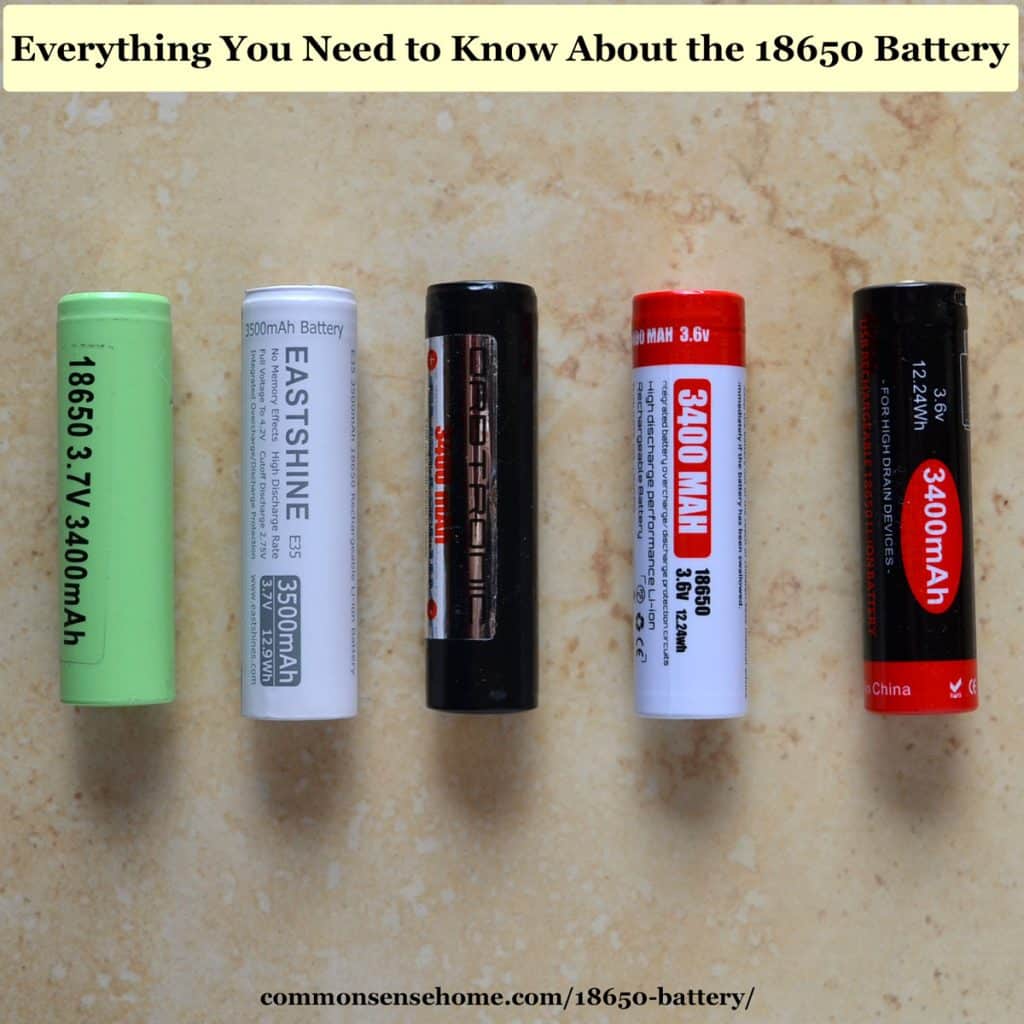
This article tells you everything you need to know about 18650 batteries. We’ll talk about different types, features, charging, lifespans, and our recommendations for batteries and chargers.
Would you like to save this?
Table of contents
- What is an 18650?
- Various Battery Sizes
- Comparing 18650s to Other Common Batteries
- 18650 Terminology
- Protected vs Unprotected 18650 Batteries?
- How much power does an 18650 have?
- How many times can you recharge an 18650 or other battery?
- How frequently should I recharge my 18650?
- How do I know my 18650 is Dying?
- How can I measure the quality of an 18650 if I am unsure of the age of a battery?
- 18650 Battery Chemistry
- What are 18650 batteries used for?
- Which is the Best 18650 Battery?
- 18650 Battery Charger
- 18650 Flashlight
- Related Posts
What is an 18650?
An 18650 is a lithium ion rechargeable battery. Their proper name is “18650 cell”. The 18650 cell has voltage of 3.7v and has between 1800mAh and 3500mAh (mili-amp-hours).
18650s may have a voltage range between 2.5 volts and 4.2 volts, or a charging voltage of 4.2 volts, but the nominal voltage of a standard 18650 is 3.7 volts.
There are two types; protected and unprotected. We absolutely recommend protected cell 18650 batteries. Protected cells include a protection circuit that stops the cell from being overcharged.
Unprotected cells can be overcharged and burst and potentially cause a fire unless there are specific electronics to protect the battery. The popular LG HG2 and INR and Samsung 25r and 35e are UNPROTECTED batteries, only use them in a device designed to use unprotected 18650s.
We also recommend you stick with high quality “brand name” 18650s. Many knock off, no-name brands lie about high mAh (capacity).
The average 18650 battery charge time is about 4 hours. Charge time can vary with amperage and voltage of the charger and the battery type.
Recommended 18650 Batteries
| Battery Make and Type All are 3.7v Lithium Ion (Li-ion) | Max Milliamp hours | Notes *Shop around for best price* |
| Orbtronic 18650 Protected #ORB3500P | 3500 mAh | Only available direct from vendor good price |
| Olight ORB-186C35 Protected #ORB-186C35 | 3500 mAh | Ok price |
| Nitecore 18650 NL1835R Protected #NL1835R | 3500 mAh | Good for travel, expensive. Has micro-USB charger port so it can charge itself with a cable/usb port |
| Panasonic NCR18650BD Button Protected #NCR18650-BD | 3180mAh | Less expensive PROTECTED and good for high drain devices. |
| Panasonic NCR 18650 3400mAh NOT PROTECTED #NCR18650B-3400 | 3400 mAh | Less expensive but is NOT PROTECTED. Use carefully. |
| Panasonic NCR18650BE NOT PROTECTED #NCR18650BE-3200 | 3200 mAh | Less expensive but is NOT PROTECTED. Use carefully. |
More info on the 21700: Everything You Need to Know About the 21700 Battery
Various Battery Sizes
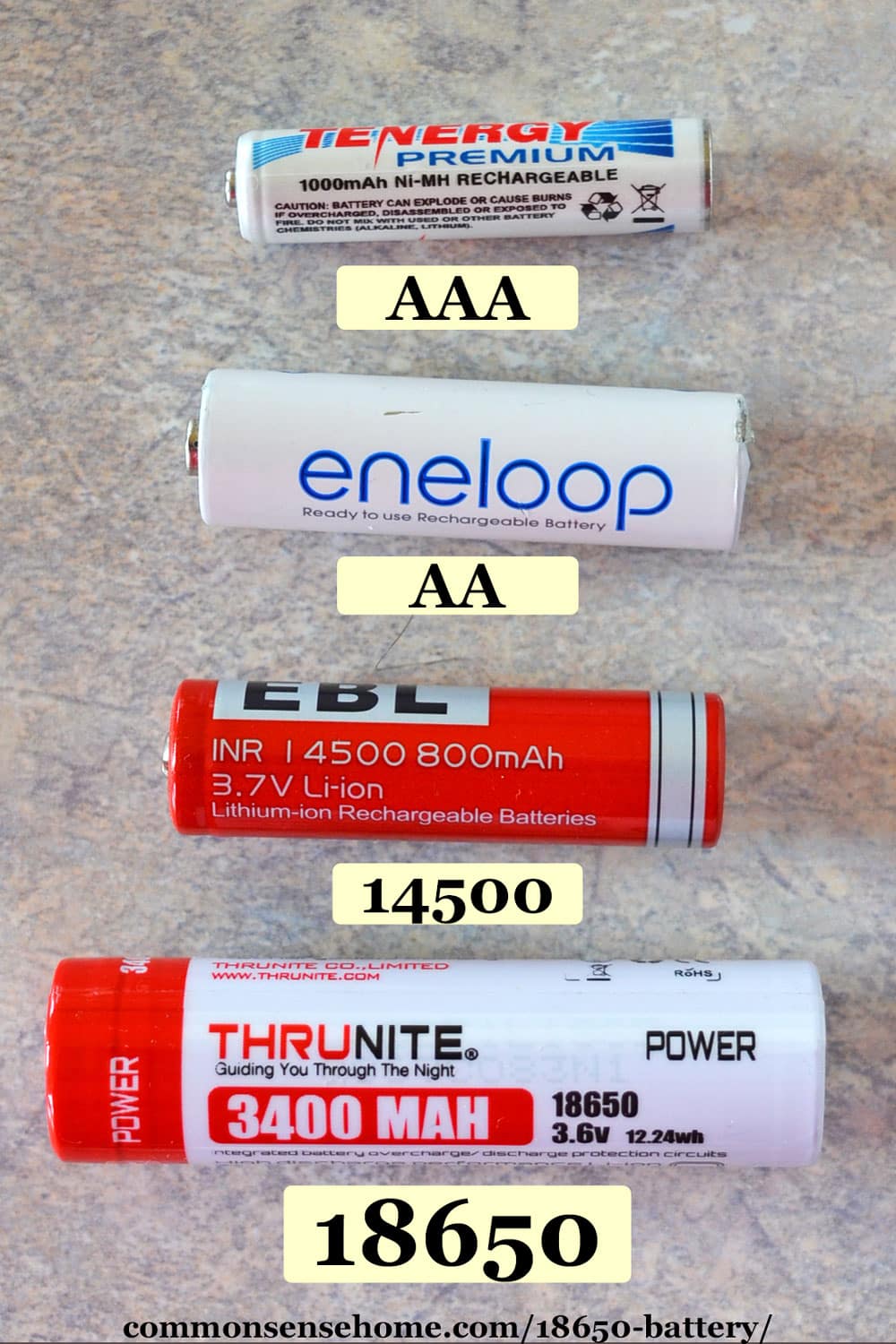
The following is a picture showing various battery sizes. The 18650 is 1170 cubic mm, the 14500 and AA are 700 cubic mm, the AAA is 467 cubic mm.
Note the 14500’s cannot be used in all AA devices unless they support both 3.7 and 1.5 volt batteries. The 21700 at 1550 cubic mm, is larger than the 18650 battery – the 21700 and 18650 is not interchangeable.
Comparing 18650s to Other Common Batteries
| Battery Make and Type | Rechargeable | Voltage | Max Milliamp hours | Watt hours | Length & Diameter |
| Nitecore 21700 (not an 18650 included for comparison) | YES | 3.7v | 5000 mAh | 18.5 | L: 74mm (2.92 in) D: 21.4mm (0.84 in) |
| Orbtronic 18650 Protected Battery | YES | 3.7v | 3500 mAh | 12.5 | L: 65mm (2.55 in) D: 18mm (1. in) |
| XTAR Li-ion 14500 (not an 18650 included for comparison) | YES | 3.7v | 800 mAh | 2.9 | L: 50 mm (1.96 in) D: 14 mm (0.55 in) |
| Energizer Lithium AA (not an 18650 included for comparison) | NO | 1.5v | 3000 mAh |
4.5 | L: 50.5 mm (1.99 in) D: 14.5 mm (0.57 in) |
| Eneloop Pro AA (not an 18650 included for comparison) | YES | 1.2v | 2550 mAh |
3.0 | |
| Energizer Lithium AAA (not an 18650 included for comparison) | NO | 1.5v | 1000 mAh |
1.5 | L: 44.5 mm (1.75 in) D: 10.5 mm (0.41 in) |
| Eneloop Pro AAA (not an 18650 included for comparison) | YES | 1.5v | 950 mAh |
1.4 | |
| 12v car battery (included for comparison) | YES | 12v | 40,000 mAh |
480 |
18650 Terminology
A battery might say protected mode 3.7v 18650 3000 mAh low self discharge for high drain devices. What does that all these features mean?
- “protected mode” means it has an overcharge and overdraw circuit protection built in (more info below).
- “3.7v” – is the optimal or peak voltage. It will drop as you use the battery.
- “3000 mAh” measures the amp hours the battery can provide. A higher number is better. The highest realistically available on an 18650 today is about 4000 mAh, anything higher than that is marketing hype.
- “Low self discharge” is a good thing. That means it will hold a charge in storage. The less it loses in storage the more charge will be left for you to run your flashlight or other device.
- “for high drain devices” – the battery is optimized for high drain devices. These are devices that use a lot of power very fast, such as RC toy car.
Protected vs Unprotected 18650 Batteries?
Protected 18650 batteries have an electronic circuit. The circuit is embedded in the cell packaging (battery casing) that protects the cell from “over charge”, heat or “over discharge”, over current and short circuit. A 18650 protected battery is safer than an 18650 unprotected battery (less likely to overheat, burst or start on fire).
Unprotected 18650 batteries are cheaper, but we do not recommend their use. Unprotected batteries should only be used where the load/draw and charging is externally monitored and controlled. The protected batteries normally have a “button top”, but check the specifications to make sure. Generally 18650 flat top batteries do not include the protection circuit.
If any 18650 battery is damaged or looks corroded or appears to be leaking, get rid of it at a battery recycling center. Be safe.
See “Battery Recycling – How to Recycle Different Battery Types and Corroded Batteries Safely“.
How much power does an 18650 have?
A 3.7v a 3400mAh 18650 stores about 2 aH to max of 3.5 aH. It can store about 10 to 13 watt hours. A small air conditioning unit that can cool about 9000 BTU uses about 1100 watts per hour. So it would take more than 110 of the 18650 batteries to run the air conditioner for 1 hour.
In comparison you would need three 12v 40 amp car batteries. But 110 18650s are smaller than three car batteries.
How many times can you recharge an 18650 or other battery?
Recharge cycles vary and are limited. Think of it like a bucket. The trick is that the bucket also gets filled with a tiny bit of other junk over time, so there is less room. As the battery is reused (recharged), the battery degrades due to oxidation and electro-chemical degradation.
This happens to any rechargeable battery such as an 18650, 21700, 26650, 14500, AA, AAA or even a car battery. They can only be recharged a limited number of times.
You want to select rechargeable batteries that can be recharged many times. We specifically recommend 18650’s because they have the ability to be recharged 300 to as many as 2000 times.
How frequently should I recharge my 18650?
The way you recharge your battery impacts the life of the battery. If you can measure it, you want to deplete from 3.7v down it to about 3v before you recharge. If you are not sure, use the device until it indicates a battery needs to be replaced. For a flashlight, run it till the light is dim or goes out.
A good charger will tell you the voltage of the battery so you can eventually get a sense of the life of the battery in various devices. If you recharge too frequently you “use up” the life without a return.
Some people don’t let it dip below 3.3v (or even higher). Each brand and model of 18650 has different maximum cycles. So this is really a process of matching your device and usage to the life cycle of the battery.
Be aware that an 18650 battery that drops below 2.5v may “lock” the device so it can’t be used. The “lock” function happens in devices such as vaping devices.
How do I know my 18650 is Dying?
Here is a list of 7 ways you can tell if you need to get rid of an 18650 (or other rechargeable battery). Look through these to determine if your 18560 is nearing the end of its life and needs to be retired:
- The battery will lose a charge on the shelf must faster than normal. It loses it’s charge after a couple of days or even worse overnight.
- The battery gets hot when charging or discharging, warmer than normal.
- You have used the battery frequently over 2 to 3 years.
- The battery can hold less than 80% of its original capacity.
- Recharge time gets abnormally long.
- If there is ANY cracking or deformation in the battery.
These are the 6 signs your 18650 is dead and it is time to get a new one. If you ignore these warning signs you risk fire or even having the battery explode while being recharged.
How can I measure the quality of an 18650 if I am unsure of the age of a battery?
A trick is to buy one or two similar 18650s and mark them “new” with a Sharpe (or label them A, B, C, etc). Then use them and compare their voltage and discharge rates with the questionable 18650s.
Basically you are comparing good vs unknown this way.
You can also gauge temperature this way. Charge both the new and unknown one to see how hot the new one is compared to the one you are unsure of.
18650 Battery Chemistry
There are a number of different chemical combinations for 18650 batteries. We recommend that you focus on protected mode, the chemistry can change and isn’t always reported. Many simply say Li-ION (meaning Lithium Ion).
There are actually a number of Li-Ion batteries. Here are some of the current “types”. Depending on your device type one might be better than the others.
- LiFePO4 which is Lithium iron phosphate
- also known as IFR or LFP or Li-phosphate
- LiMn2O4 which is Lithium manganese oxide
- also known as IMR or LMO or Li-manganese (high amp draw)
- LiNiMnCoO2 which is Lithium manganese nickel
- also known as INR or NMC (high amp draw)
- LiNiCoAlO2 which is Lithium nickel cobalt aluminum oxide
- also known as NCA or Li-aluminum
- LiNiCoO2 which is Lithium nickel cobalt oxide
- also known as NCO
- LiCoO2 which is Lithium cobalt oxide
- also known as ICR LCO Li-cobalt
What are 18650 batteries used for?
Flashlights, electronics, laptops, vaping and even some electric vehicles use 18650s. The Tesla uses 7180 of these batteries. Many high lumen flashlights such as the Thrunite TC15 v3 (best buy) or Fenix PD36 TAC (mo43 durable) use the 18650 or the even larger 21700 flashlights like the Nitecore P20iX a 4000 lumen flashlight.
Laptops and other electronic devices use one or more 18650’s and have recharging electronics built in. 18650’s are also used in vaping (smoking) devices.
18650s are are generally Lithium Ion batteries. If you are familiar with electronics you can change out some battery packs manually, but be careful – using the wrong type of 18650 or using it incorrectly can cause a fire.
Which is the Best 18650 Battery?
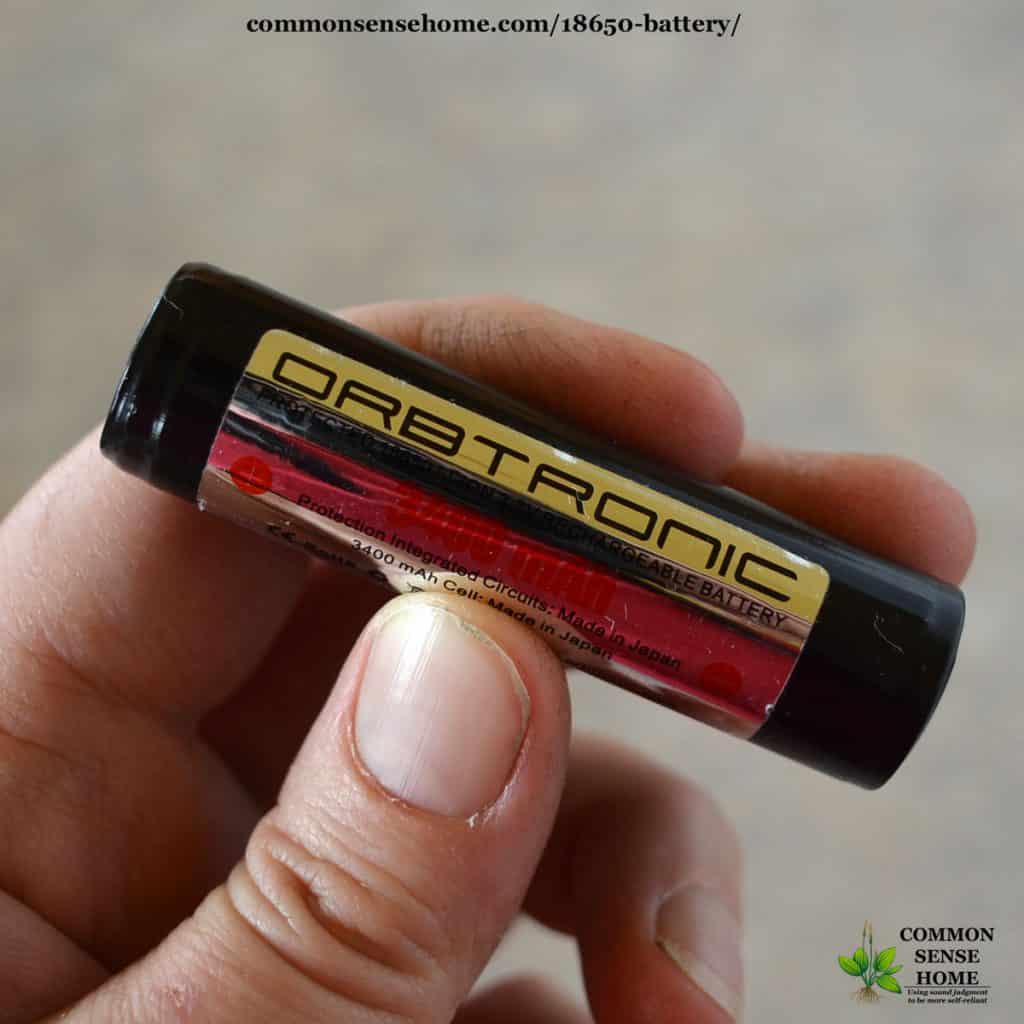
Overall best 18650 battery – The Orbtronic 18650 battery. This is an 18650 3.7v 3500mAh Protected cell. This is a high drain battery. We like it but it is expensive.
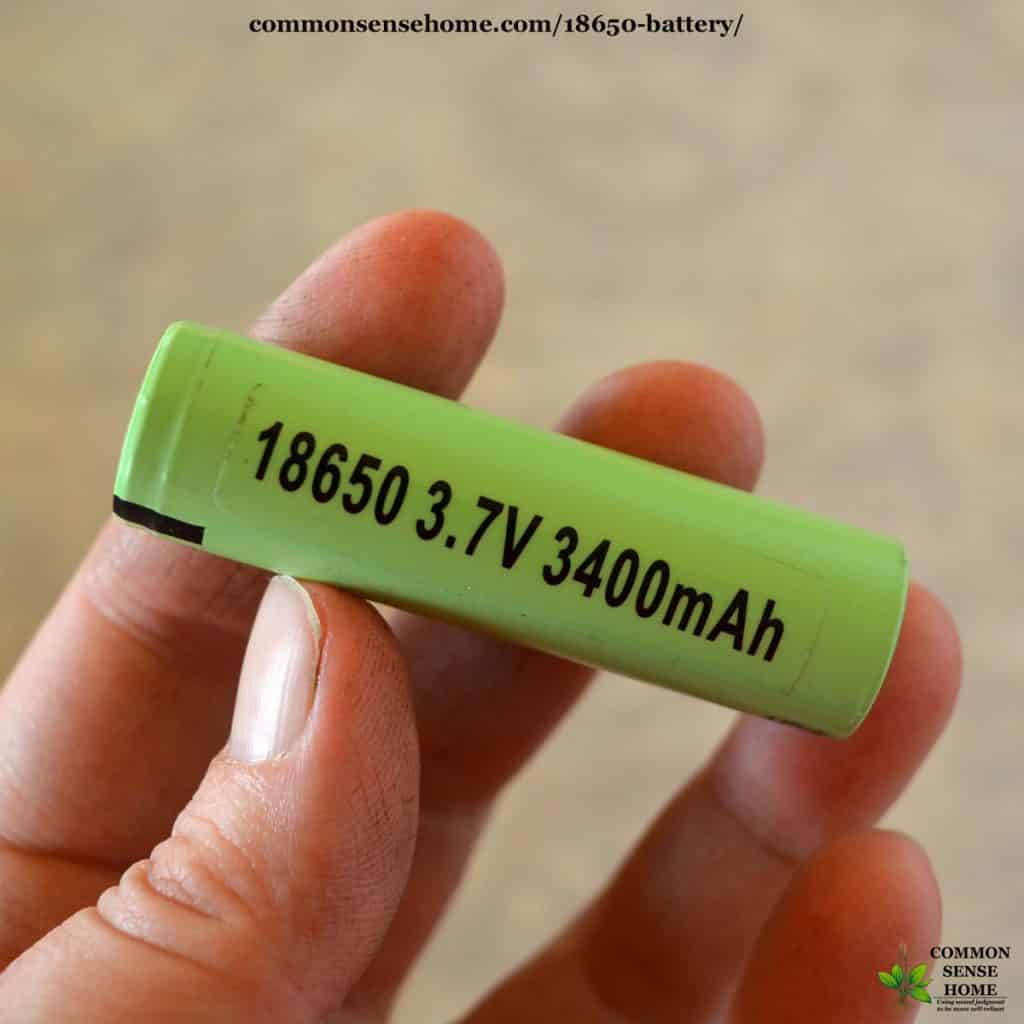
Best low cost 18650 battery – The Olight ORB-186P26 18650 2600mAh 3. The Panasonic 18650 is an 18650 3.7v 2600mAh Protected cell. This battery is less expensive and slightly lower amp hours than the Orbtronic. Also, this lower cost protected 18650 battery is still more expensive than the unprotected ones.
What is the best travel 18650 battery?
Nitecore NL1834R available directly from Nitecore. This is an 18650 3.7v 3400mAh protected cells with a built-in micro-USB charger. It is a few dollars more, but it allows you to charge it on the go and not have to carry a dedicated charger. The unit we have has slightly different packaging.
The cheapest decent one is the Titanium Innovations 18650 at 2600mAh. It won’t last as long as the 3400 mAh Nitecore but is 1/2 the price.
What 18650 Brands are Best?
The Orbtronic, Olight, Samsung, LG, Panasonic, Surefire, ThruNite and Nitecore are good reliable 18650 rechargeable cells. Be sure to buy them from a reputable source such as BatteryJunction or direct from the manufacturer. Note: Amazon stopped selling 18650s.
We don’t use the lower voltage and amperage 18650s, because they have lower amp hours and low peak wattage and lower sustained wattage.
We are willing to pay a few more dollars for the longer life, higher capacity and better quality.
18650 Battery Charger
18650 batteries are rechargeable, so you will need a good charger. We use two different 18650 chargers.
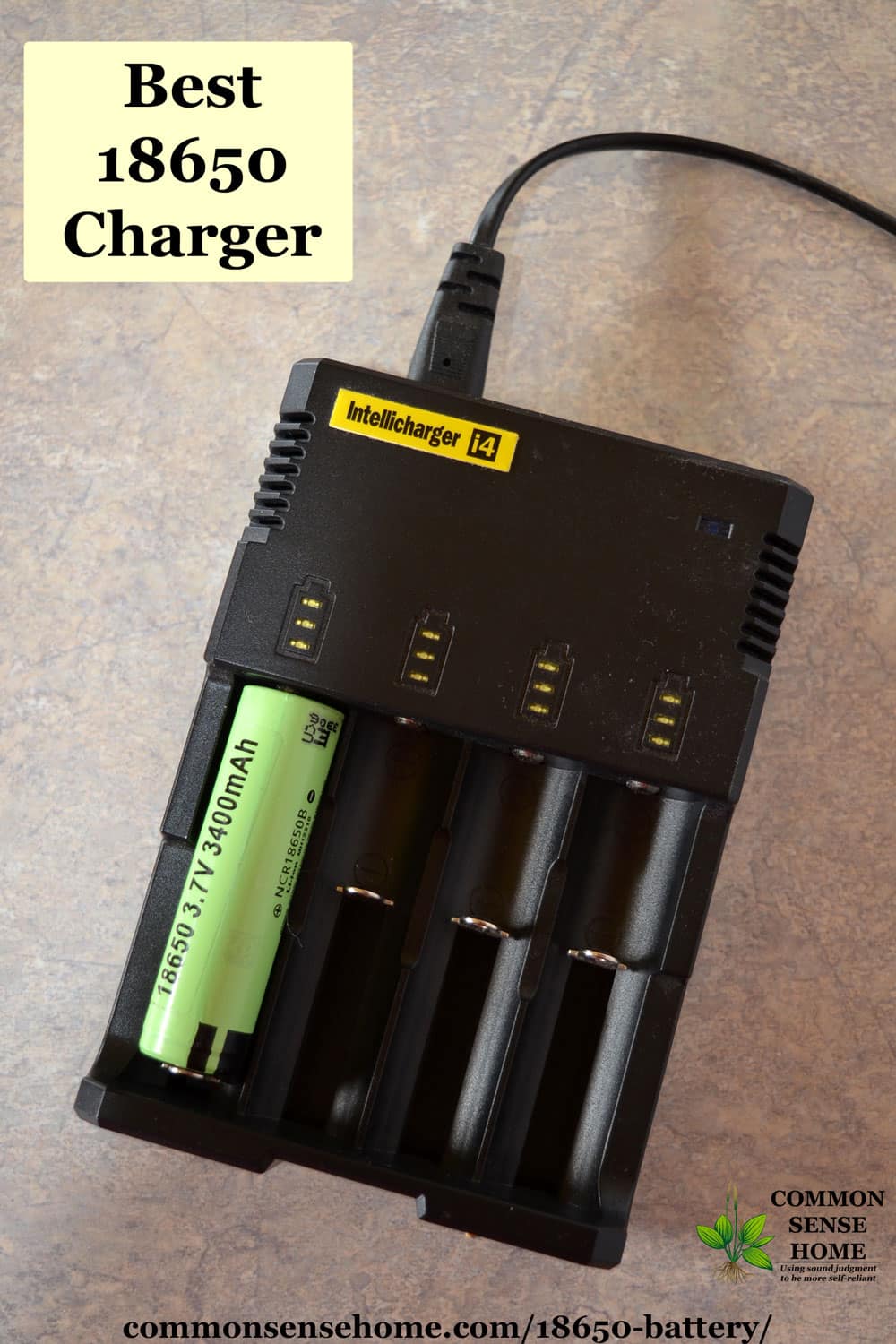
The best 18650 battery charger is the Nitecore UMS4 Battery Charger because it can charge pretty much anything.
Specifically, it supports: lithium ion 26650, 22650, 21700, 18650, 17670, 18490, 17500, 18350, 16340 (the 16340 is also known as RCR123), 14500, 10440 and Ni-MH and Ni-Cd AA, AAA, AAAA, C rechargeable batteries. This is our favorite charger for the 18650s.
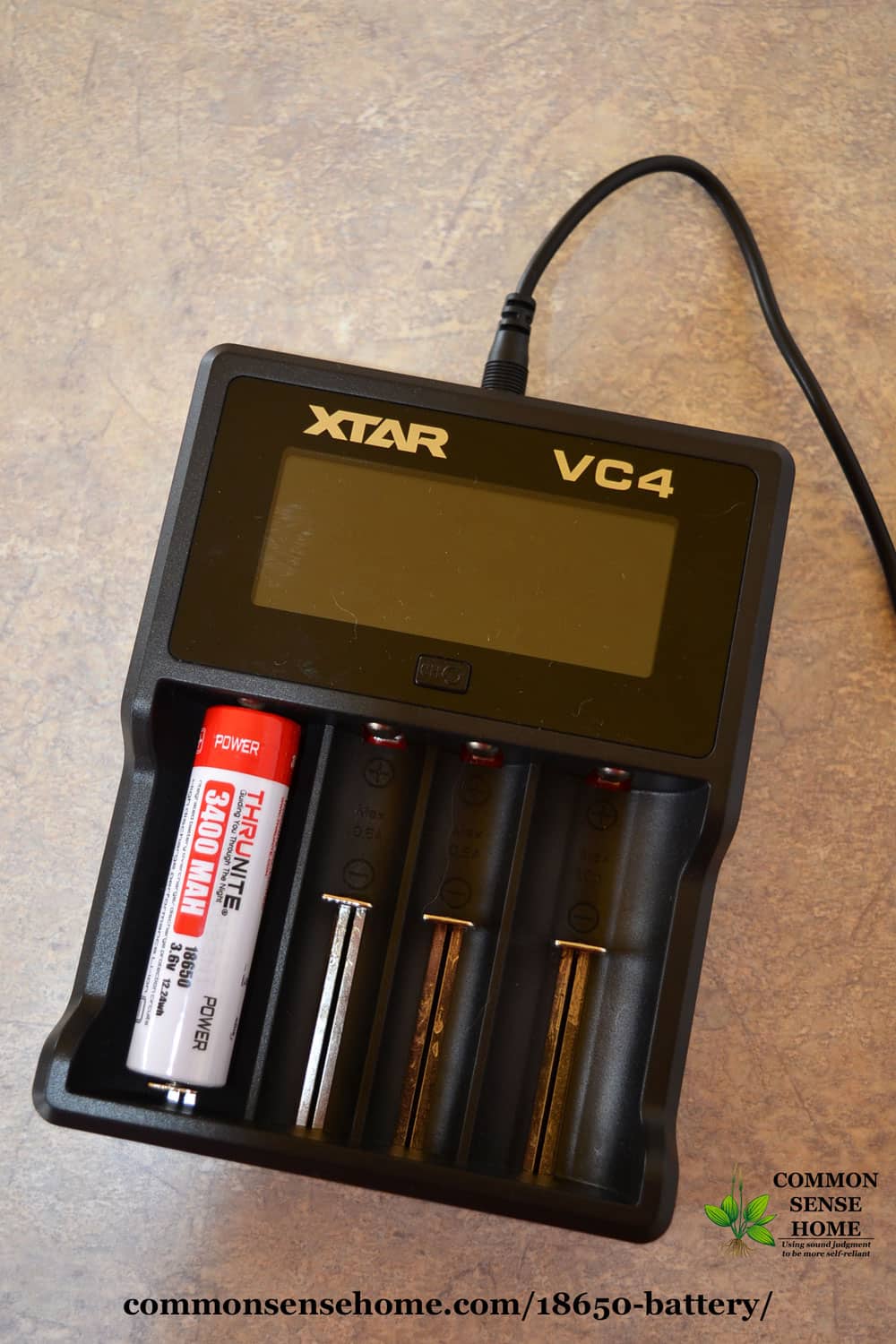
Our runner up and “best buy” is the XTAR X4 Charger. It is a USB powered 18650 charger. It charges the batteries with any USB power source. This unit is dependent on the power source, and is a bit more expensive.
It has an LCD display for charging status. A 2amp interface yields slower charge speeds. Even the 5amp is slow because it charges at .5 amps. We have used the XTAR and Nitecore with a Nektek solar panel that has a 2amp USB interface and it has worked well.
18650 Flashlight
The best mid priced 18650 flashlight is the Thrunite TC15 2403 lumen flashlight. It is about 1/2 the price of the PD36 and but a bit less bright. It is a GREAT buy (we have the older TN12 in emergency kits). We suggest two of these instead of one of the Fenix.
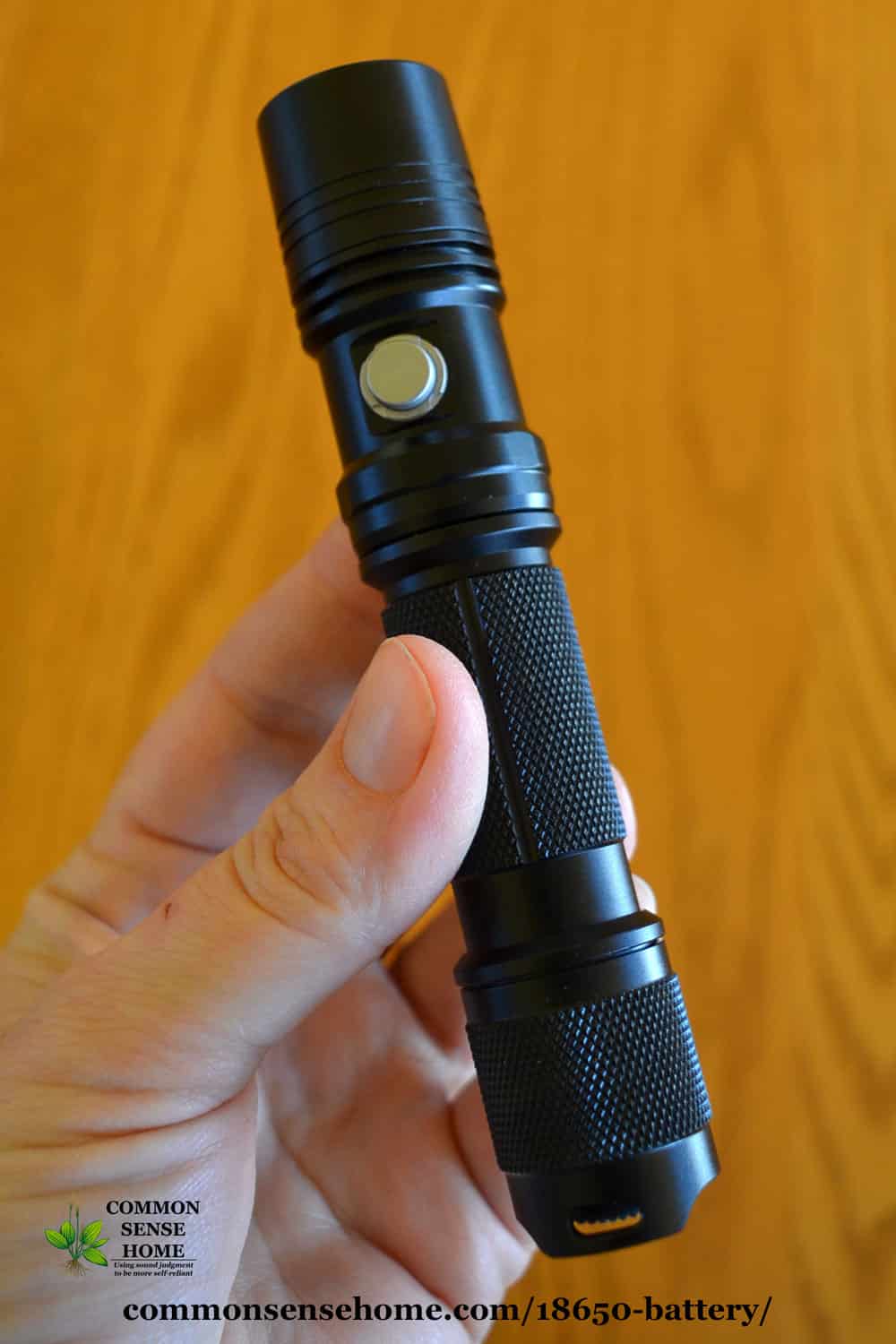
It has the following modes: Strobe (975 lumens for 226 minutes), Turbo (975 lumens for 126 minutes), High (652 lumens for 199minutes), Medium (266 lumens for 9.7 hrs), Low (19 lumens/177 hrs) and Firefly(0.29 lumens for 62 days) and it can charge itself with a USB power source. It is waterproof (IPX8) and has a max throw of 223m (764ft).
The toughest 18650 flashlight is the Fenix PD36 TAC. It is not cheap but it is durable and very bright, and has a pocket clip. The light level is 1000 lumens, and it is water resistant to IPX8. This is a “duty” quality flashlight.
The PD36 TAC offers five different brightness levels and strobe:
- Turbo: 3000 lumen – 1 hr 30 min
- High: 1000 lumen – 3 hr 15 min
- Medium: 350 Lumen (8hr 24min)
- Low 150 lumen – 18 hr 45 min
- Eco: 30 lumen – 160 hr
- STROBE (about 3hrs 2000 lumen)
It has a 300 yard or 274 meter throw.
Both the Fenix PD36 or the less expensive ThruNite TC15 are great LED Flashlights that use the powerful 18650 battery.
Related Posts

This post was written by August Neverman IV. August has a strong background in emergency preparedness. He served on several emergency preparedness teams during his tenure at Brown County WI Government, the Medical College of Wisconsin, HSHS, a 13-hospital system and emergency response training during his time with the Air Force and Air National Guard. Learn more about August.
I have a Black & Decker “Gyro” screwdriver and the battery, 18650, is dead. The way this battery is installed in the screwdriver is with soldered connections. Unfortunately, I cannot find a 18650 with soldered wires or connections so, my question is, can I solder a wire to each end of the protected-18650 battery? At Battery+ I was told they would explode if I did. Thanks.
If you overheat the battery while soldering, it will indeed explode.
It’s possible, but dangerous, even for those with experience.
Have bought a cheap solar sensor light – directions were to charge for 3 days before using – winter here and not much sun where the panel is – it has basically gone flat after 3 nights with not that much use – the batteries are labelled ICR 18650 but are only 1500mAh – no name batteries with flat ends – would it be ok to replace the batteries with higher mAh ( the specs also say to charge for 5 days when storing – I am wondering if the batteries are from way back as the model of the light has been around for a while)
Thanks for a great resource
August is up to his eyeballs at work, so I’ll jump in.
Given that the light’s not working, it would seem that you have nothing to lose. That said, I’m sure battery swapping would void any warranty. Ideally, I’d contact the manufacturer and ask them directly, but I know that’s not always possible.
Good morning. Wonder if you might help. I have a set of 18650 batteries in a Dremel tool I would like to replace. The battery data is
LGCH118650
F1511026510
HE311C2H1
Not sure what this data means. Where would you recommend I look to buy these? I’ve watched the videos, understand will need to solder. Any ideas?
Thanks much
the LGCH118650 appears to be a custom non-USA pack (German I think). If you can solder, it looks like you could use any good 18650s (probably protected mode). I am unsure what the F1511026510 code is or the HE311C2H1 code means (no luck searching). I cannot guarantee standard 18650s would work but probably about a 80% chance.
The batteries are attached to a board. Not sure if that board protects the batteries or if it has more to do with the function of the tool.
An you suggest a manufacturer and website to buy these batteries?
and what is the best place to buy?
Thanks
Amazon doesn’t have them recently. The Panasonic 18650s are all good.
Place to buy- https://www.batteryjunction.com/18650.html#/?Section=18650&search_return=all&Catalogprotectedbattery=Yes
I have NO idea on the electronics piece, you would need to tinker to find out voltage/amperage etc. and likely do some soldering.
Best of luck!
Hi. I have just bought an RC car which came with a 7.4v 1500mah 25c battery. I bought 2 spares off ebay but both last about a minute before the cars lvc kicks in and the car dies. The original battery lasts around 5-6 minutes. I would like to build a battery with known good parts (eg samsung 18650’s). I know how to build the pack with all the necessary wiring etc but my question is can I put in a higher capacity battery like – Samsung 25R 18650 x2? The Samsung battery is not protected but I have a balance charger and the car has LVC in it.
99% chance you can use a 18650 with a higher mAh. Going from a 1500 to 3000 should roughly double the runtime. Note a number of RC cars and especially drones use LiPO variants which are much lighter, those are NOT 18650 batteries. Good luck and let us know if the math matches reality.
For RC Lingo, you are running a 2s battery (s=series, and there are two 3.7v cells ran in series inside an RC 2s battery). 18650 or L-ion type lithium batteries aren’t often used because they do better with a steady draw, to where Lithium Polymer (Lipo pack) battery, can handle the rapid and sporadic high voltage draw associated with RC cars and drones. Not sure what kind of RC car you have but you want to pay attention to that “c” number, which relates to how well the battery handles rapid/burst voltage, 25c is pretty low. and could cause what’s called “voltage sag” like when your car sputters low on gas. If you’re just cruising around the park, not a big deal, but if you’re off road and going fast, you’re going to want closer to 50-75c at least. Racing drone pilots won’t use anything under 100c.
Like August stated, weight is an issue too, but not as much for land vehicles as drones. Milliamps (mah) is the biggest factor, the more mah, the heavier, but the longer run time. A good analogy I once heard, the voltage is like how powerful your car engine is, and mah is the gas and size of your gas tank, the bigger the tank, the longer you can drive, but the heavier your car is.
Make sure you know the voltage rating of your vehicle and it’s parts too. if it’s 12.6v, then you could move up to a 3s battery, often they are rated by “s” type, like 1-3s capable. Remember a 2s lipo pack will have 7.4v labeled on it, because when at storage level and the way they are shipped, is appx 3.7v per cell, fully charged it will be 8.4v, when not using a Lipo pack, they should ALWAYS be stored in a safe place at storage level to get the most cycles (longest life) out of them. Most decent chargers have a setting to put a Lipo pack at storage level. Always charge/discharge in a safe place, NEVER unattended, preferably using an ammo box or other “lipo bunker” (type that in youtube, tons of videos), Lipo packs don’t have a hard casing as 18650s and L-ion type batteries, meaning they can puff or have a cell let loose, causing thermal runoff and very bad things to happen. August is not joking about their energy potential, I’m a retired firefighter, and I’ve had a couple let loose on me over the years, they are no joke. Be safe, hope this helps.
Thanks for sharing your experience, Jack.
I have a flashlight with 18650 ( 1200 mah ) battery. The battery suppose to give 2 – 3 hours backup as per flashlight specification. But i observed after 40 minutes, the light started getting dimm and if i switch of flashlight for an hours and turn it on again, it starts with bright ( as expected ) then with in 1 or 2 minutes the light get dimm again. Is it due to battery capacity degradation ? Or something wrong with battery ?
The easiest test is get a different fresh 18650. A 1200mah seems low, a 2500mah or 3500mah battery is going to give you longer runtime. Note: The 18650’s are not readily available on Amazon right now, but they are available at Battery Junction.
My suspicion is that it is up to 3 hours with a fully charged high mah 18650.
I think it would be wise to add something about the difference in rated nominal capacity vs rated discharge current. As a general rule , the more of one you want, the more of the other you have to sacrifice. Which will vary depending on your device. Examples:
Samsung 20S (unprotected) has a rated capacity of only 2000mAh but has a rated discharge current of 30A.
A Panasonic NCR18650B (unprotected) has a rated capacity of 3350mAh but rated discharge current is 4.87A.
Using these examples above, depending on your particular needs, you can actually get more life and performance from the Samsung 20S if you had a particularly high drain device. This is, of course, not including the protected cells which generally have a cut-off around 5-10A depending on the model. They change the chemistry depending on the current vs capacity need. Choosing the wrong one can cause bad life, performance, excessive heat, and in the worst cases, thermal runaway. Also, you have to beware of brands that advertise a “burst” or “pulse” current. These manufacturers rarely state what exactly the “pulse” conditions they used to get that rating so it could be way over rated. Usually “max continuous current” is what the more reputable companies use and is the safest one to use. Finally, https://www.imrbatteries.com/ is a very good place (not affiliated with them in any way besides being a repeat customer) to get cells from. The shipping is always fast , they have genuine Samsung, Panasonic, Nitecore, Sony, Sanyo, brands (others too), and they include free cases with every battery. They also give detailed specs in an easy to read format for every cell. You should check them out.
Agreed, we have it in the lower notes, but I will note it. Draw and actual amperage vary with charge, temperature, load and charge level (and of course between batteries). Also since amazon doesn’t seem to carry them we also like Battery Junction (and we dont get any money from them either).
I purchased a 6 cell lithium ion battery pack with no markings except 21.6V 28,100 ah. The individual cells inside are generic and have zero markings on them. I do not think is is physically possible to create such a battery pack using 6 18650 batteries and some protection circuitry. Any opinions out there? They are chinese and the vendor says the spec is correct and challenged me to prove him wrong. Of course, I tore it apart and its extremely low quality, high internal resistance cells inside.
Wait! Found this… m4potofu
2 years ago
· edited 2 years ago
that this battery is protected ?
It’s not, cells from original manufacturers ( i.e. lg, sanyo, panasonic, samsung, sony) are not protected and have a lenght of 65mm, protection circuits are added by other compagnies (sometimes flashlight compagnies) such as redilast, keepower, eagletac, nitecore… , they are always longer generally 68~69mm, also a bit thicker and more expensive.
Like kamil4 says you need a relatively high drain cell for this flashlight, like ~>8A to have headroom and more longevity (because less heat generated), no need to go super high like >15A, as you have a trade of with capacity.
From the website you have linked you have this one for example : KeepPower 3500mAh Sanyo NCR18650GA based on the Sanyo GA and is rated a 10A continuous discharge current.
Protected v. unprotected recommended brand. Can you assist me in finding a flat top, protected, reliable 18650 for a Zebralight H600c Mk IV 18650 XHP50.2 4000K High CRI Headlamp for my hubby who wants to thru-hike the AT. Zebralight website has Sanyo NCR18650GA 3500mAh 10A, but it’s unprotected. Too many no-name brands on Amazon! I’m scared of the unprotected name brands. Ty Obi Wan, you’re my only hope.
If all the models we link to on Amazon are sold out (like they are right now). Battery Junction has a good stock of protected mode. Just make sure you pick one that is rated well and meets your mAh https://www.batteryjunction.com/search-results.html?keywords=protected+18650&x=0&y=0
I hope this helps I believe you are correct you have a 4S2P that will give you from 2P double the current of each battery and the 4S will give you 4 times the Voltage.
Hello,
Could you comment about batteries in series versus batteries in parallel to change the output voltage and the capacity?
I have a custom design LED display and I need to replace the battery pack. (I purchased the LED display from a supplier in China.) Looking at the battery I can see one row of 8 cells. And I know they are 18650 cells with 3.7V per cell.
I also know that the voltage output is 14.8V. I think each cell capacity is 2200 mAh.
Even though the pack is 1 row of 8 cells, they can’t all be in series, correct? If that were the case, the output voltage would be 29.6V? Is it possible that the wiring of the cells is 4S2P?
If that were the case, the voltage would be correct, (4×3.7V) and the capacity would be 2200 x 2 = 4,400 mAh.
But the supplier is giving me 14.8V 2,200 mAh and that’s it. I think they are wrong, but I’m not sure how to confirm.
Let me know your thoughts. Thank you.
My brain is distracted this morning, but I hit up clear thinking friends, and here’s the verdict:
“Voltage is correct for 2 paths of 4 cells = 14.8 volts. mAh will be 4400 mAh (2200 x 2).They should be able to load the battery pack to 4400mA for one hour … 2200 mA would take 2 hours to deplete the batteries.”
Hello Laurie,
Thank you for your reply and for the help of your colleagues.
This partly answers my question.
I’m also trying to figure out the “configuration” of my battery pack.
I need to know if it is 8S or 4S2P.
From “the looks of it”, there are 8 cells in a row. (I wish I could upload a pic.)
But there must be “2 paths of 4 cells” = 14.8V. That’s my guess, because that would equate to the correct voltage.
I’m not sure how much current the LED display draws when it is fully illuminated. (I was hoping to calculate it… or measure it.) There are 217 individual LEDs on the display. I’m assuming it is much less than 4.4A.
I guess my most basic question is: Can a battery pack of 18650’s that are physically 8S actually be wired to be 4S2P? (Do you know of any batter suppliers that would do this?)
I’m basically trying to reverse-engineer what I have so I know what to order. The supplier that I got the display from doesn’t seem to have the technical background. (And I’m just a novice myself…)
Let me know your thoughts. (You guys are GREAT… by the way!) Thank you!
Hey Ron.
I think my electric wiring guys are busy elsewhere, as I put out another inquiry but got no replies this time. Hopefully someone else will jump in.
Ron, some input from the crew:
“If the 8×3.7V batteries are connected in series (8 batteries in a row), they would produce 29.6V, and the capacity of the battery bank would be 2.2Ah. However, to produce 14.8 V, a Voltage Divider (for example) would need to be added to the circuit. A voltage divider adds resistance to the circuit thus reducing the voltage. I don’t think that a Voltage Divider decreases the Ah or capacity of the batteries, but it would decrease the available current.”
I am so very confused with all the different types of batteries. I have purchased a video doorbell without first looking at the batteries needed.my mistake! It asks for the18650 which makes this purchase very expensive needing 3 batteries & charger. Can any rechargeable of the proper size do the job? I realize the benefits to the 18650 but would like to try the item first without a large investment to see if the item is worth keeping.
Unfortunately, you can’t use just any battery that fits as a substitute for the 18650s.
Hi Following our discussion I found this website to identify my battery and thought you may find it of interest.
https://secondlifestorage.com/index.php?pages/cell-database/
I was able to download the spec for my battery and you were right.
Steve
Thanks for taking time to come back and share what you found, Steve.
Hi I just bought a SucbaPro 850 R dive light it says to use TENERGY 18650 2600 mAh Li-ion 3.7v PROTECTED batteries.
my question is can I use higher mAh numbered batteries to have them last longer or just get what it suggests.
Is Tenergy a good brand name or do you reccomend something else.
Thank you.
Tenergy is a good brand (we have a number of them), and higher mAh numbered should be fine – as long as it wouldn’t void any warranty. If you are using within a warranty period, it’s probably best to stick with recommended specs.
Hi Great article. Can you advise I have a battery with LDGBHE41865 cells I want to recondition. Is this the same as 18650 cells? Also the battery is 2S24P configuration so do I have to isolate each cell to test for failed cells as I guess the faulty cells will be lifted up be good cells.?
Regards Steve
Please contact the manufacturer for advice. I suspect that you may be dealing with 18650s, as they are commonly bundled for use in rechargeable devices, but we are not a battery service company.
Ok thanks for getting back to me
Sorry I don’t have more specific info.
Also not all 18650 batteries are 3.7 volts I some that are 4.2 volts!
18650s may have a voltage range between 2.5 volts and 4.2 volts, or a charging voltage of 4.2 volts, but the nominal voltage of a standard 18650 is 3.7 volts.
Hello . You sure have a lot of info about 18650 batteries here …Thanks …it’s interesting but the more I read the more unsure I am about whay I “Know” …Learning about ebike batteries as mine appears to have died … Do I go with the $300 one on Amazon https://www.amazon.com/dp/B07W521C9C/?coliid=I33HAT6JPQK97I&colid=GSPEKEXZA4VR&psc=1&ref_=lv_ov_lig_dp_it or the $600 one from the Bike dealer …My dead one came from the dealer …Lasted 3 years Supposto be a Panasonic but upon opening it up it’s LGEBMG 11865 2850 MAH …Good or bad I don’t know ..so much to learn ..discharge rates ..charge rates . I think I may have been charging mine to often dealer says after every trip I was doing it every 5 trips or 30 miles when the yellow battery indicator just started showing …Anyhow would you go with the expensive battery or the cheaper one …Thanks so much
You should buy the replacement battery from the e-bike company or at least buy a pack they approve.
I am not familiar with eBikes. If you try replacing the individual batteries (ie taking the existing unit apart) You could confirm if the 18650’s still can be charged that way. Take them out and charge them individually to see – using a flashlight to test battery life. But even putting new batteries into a pack could be tricky as the casing is likely sealed, and if the batteries are custom or have specific voltage/amperage profile you could cause serious problems.
So I recommend sticking with buying one form the bike manufacturer. There could be custom voltage/amperage controls and/or electronics that could cause damage to the bike. I suspect the bike is far more than $300. If you tinker, your are tinkering at your own risk.
Best of luck.
you don’t explain the different types of 18650 batteries something you should have talked about I have 2 types of 18650 batteries. I have a BMR 18650 battery and a IMP 18650 battery
Thanks for the feedback, I added a section to the post about the 18650 chemistry variants.
Great article thanks. Quick question, if I replaced old cells in a battery pack (there are 12) I’d need to unsolder the positive and negative terminals. As these connections would no longer be seeing any voltage would this automatically trigger the low voltage protection circuit?
If it does how would I reboot it? I thought maybe I could temporarily connect a voltage duri g the swap out to prevent the safety circuit cutting in?
Thanks
I talked to August (he’s swamped at work), and he said that you’re likely to trigger the low voltage protection, but he hasn’t personally attempted anything quite like this.
I’m buying a protected 18650 battery for a solar charging light in my garage. I only need one, but the S&H is the same as the price of one battery. If I order 2 or 3 and don’t need them for 2-4 years, will they still be good or am I better off just buying the one now and deal with it.
After doing some digging, it looks like most people are not having any issues with 18650 batteries that have been stored a few years.
The article “Proper 18650 Battery Storage” suggests a charge of roughly 40% for best storage life.
Thanks so much for your help and the great article!
You’re welcome.