
Spaghetti Sauce for Canning (Use Fresh or Frozen Tomatoes)

This post may contain affiliate links. Read my full disclosure here.

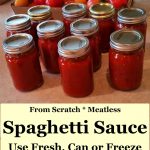
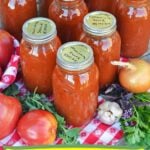
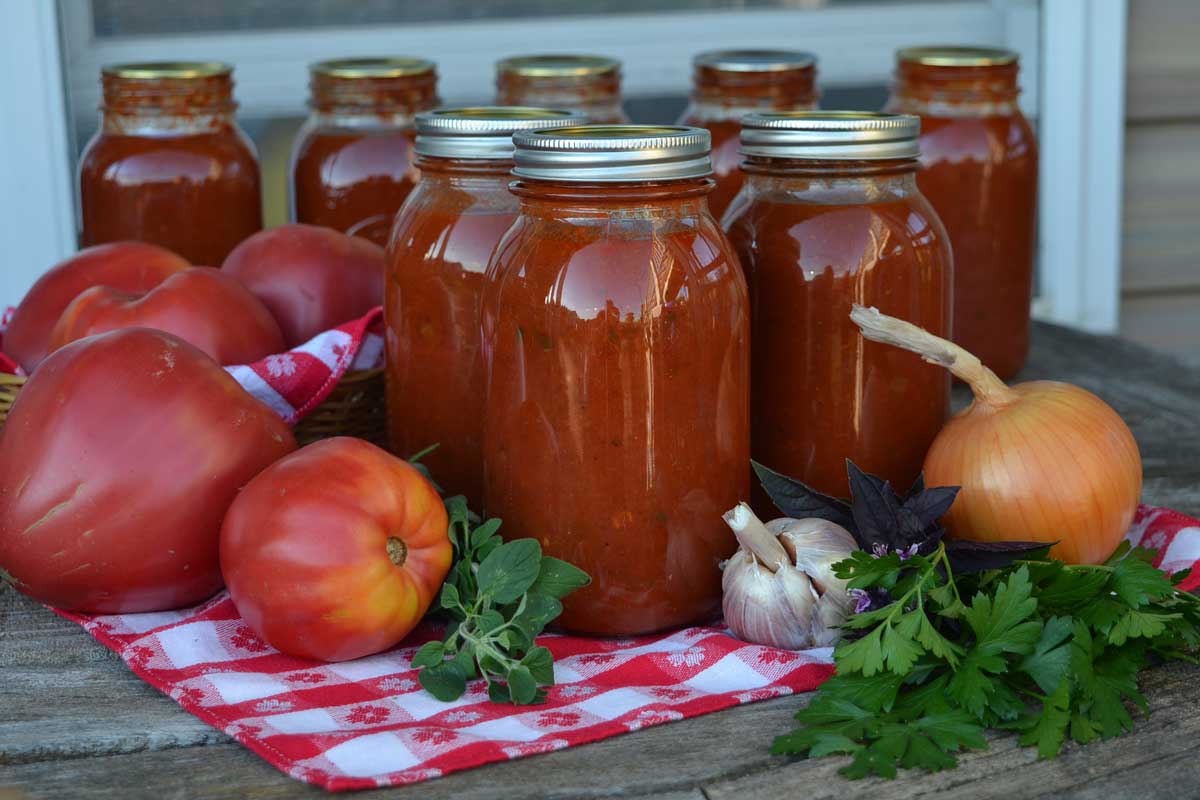
My husband came in from outside the first time I was canning spaghetti sauce, smiled and said the house smelled like an Italian restaurant – a good Italian restaurant. I had to agree.
This sauce takes a while to cook, but the end result is delicious! It’s great for pasta sauce, pizza or topping spaghetti squash. Gluten free and meatless (you can add meat just before serving if you like). We take you through the recipe step by step with photos, plus share tips for working with frozen tomatoes.
Would you like to save this?
This homemade spaghetti sauce is one of my favorite ways to turn the tomato harvest into ready-to-use meals for the pantry. It takes some time to cook down, but most of that time is hands-off — and there’s something deeply satisfying about lining the pantry shelves with jars of sauce made from your own tomatoes.
We use it for spaghetti, pizza, lasagna, and spaghetti squash. You can make it with fresh or frozen tomatoes, and I’ll walk you through the process step by step.
I start a batch in the morning, and slow cook it while I’m working on other things in the kitchen, like prepping the rest of the ingredients and canning equipment. Paste tomatoes yield a thicker sauce with less cooking, but you can use any tomatoes that you have available.
Table of Contents
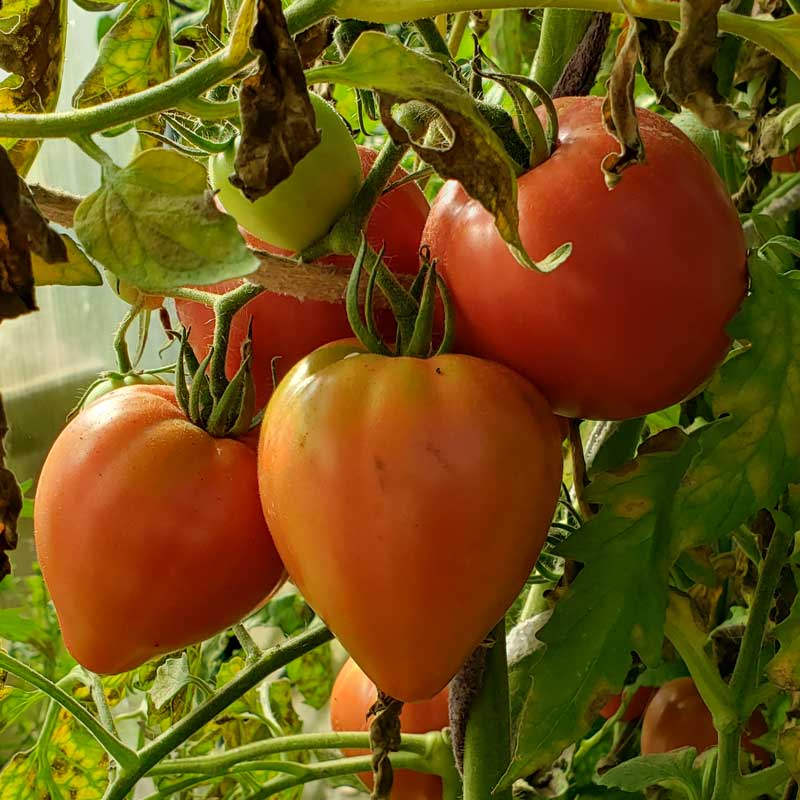
Got more tomatoes than you can handle?
Not every tomato needs to become spaghetti sauce. Depending on your harvest and your time, you can:
- Can whole or chopped tomatoes
- Make salsa
- Make tomato soup
- Freeze tomatoes for later processing
- Dehydrate tomatoes
Before You Start
This recipe is based on 30 pounds of whole tomatoes before cooking and straining. I don’t recommend trying to convert an unknown quantity of prepared tomato juice or purée back into pounds of fresh tomatoes, because tomato varieties and preparation methods produce very different amounts of liquid.
You’ll need:
- About 30 pounds tomatoes
- A food mill or tomato strainer
- A large heavy-bottomed pot or roaster
- A pressure canner
- About 8 -10 pint jars (yield will depend on how meaty your tomatoes are and how much you cook down the sauce)
Don’t have 30 pounds ripe at once? Freeze ripe tomatoes as they become available and make the sauce when you’ve accumulated enough. (See below.)
Spaghetti Sauce Recipe for Canning with Fresh Tomatoes – Step By Step Instructions
(Scroll down to bottom of post for print friendly version of recipe.)
My favorite canning spaghetti sauce recipe is adapted from The Encyclopedia of Country Living by Carla Emery. This recipe is very close to the “Spaghetti sauce without Meat” recipe listed on the National Center for Home Food Preservation website, so you know it’s a safe canning recipe.
Salt and pepper can be adjusted to taste, or substitute Italian seasoning for the oregano. It’s okay to substitute an equal amount of fresh basil for some of the celery, green peppers or mushrooms.
You can cut this spaghetti sauce recipe in half or to a fourth. Just keep the processing time the same, or freeze the marinara sauce in freezer bags or freezer safe containers instead of canning.
When we’re ready to serve the spaghetti sauce, we open a jar and heat it up, or brown some ground beef or Italian sausage and add the sauce to the skillet.
Ingredients
- 30 pounds tomatoes
- 1/4 cup butter or olive oil
- 1 cup chopped onions
- 5 minced garlic cloves
- 2 tablespoons salt
- 1 cup chopped celery or green pepper
- 1 pound sliced mushrooms (optional)
- 2 teaspoons black pepper
- 2 tablespoons oregano flakes
- 1/4 cup minced parsley
- 1/4 cup brown sugar or unrefined cane sugar
Directions
Wash 30 pounds of tomatoes. Remove cores and quarter tomatoes.
Cook 20 minutes, uncovered, in large pan or pans to soften tomatoes. I cook mine at medium high heat in an assortment of heavy bottom stainless steel pots. I have also used a Nesco roaster and a slow cooker.
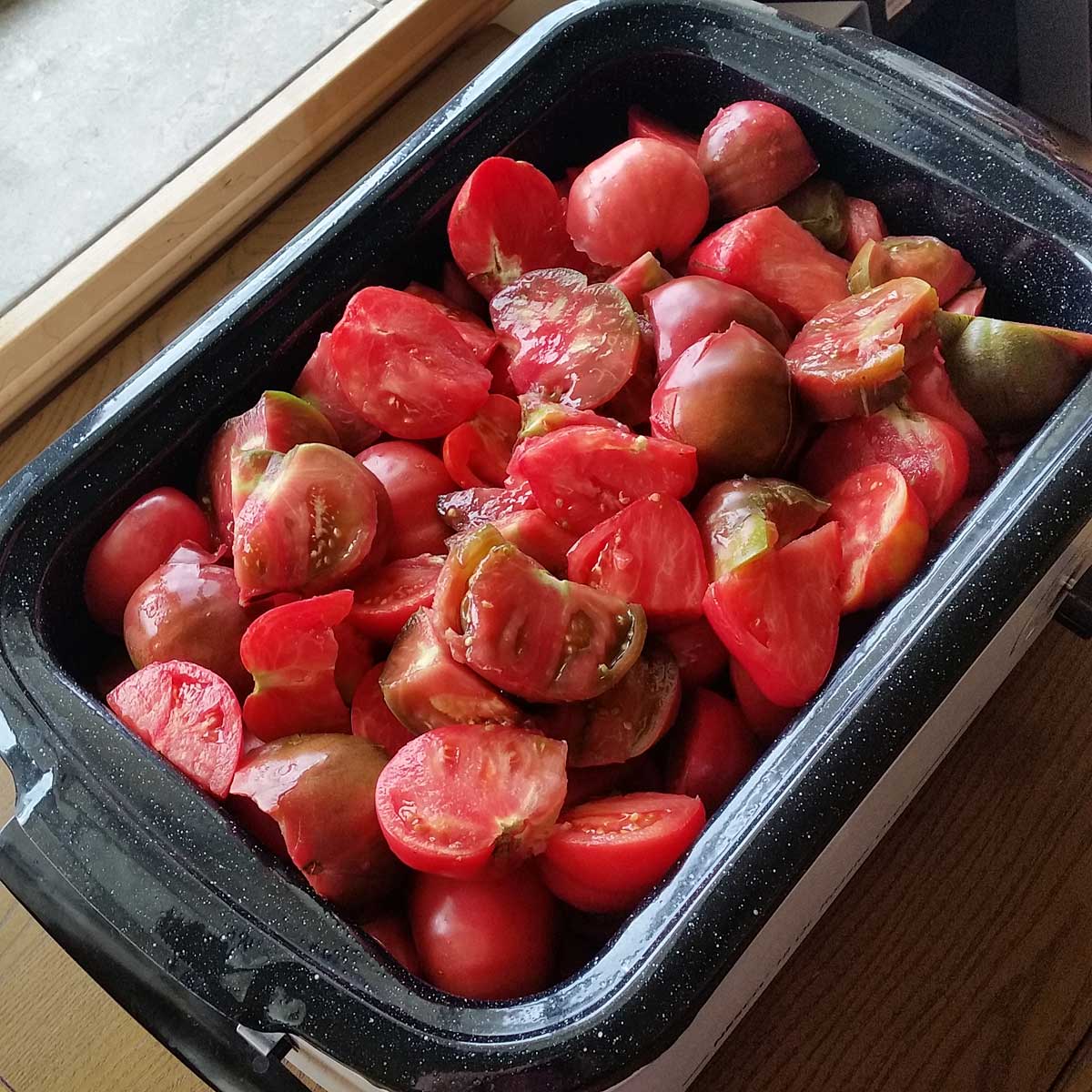
Thick bottom pans prevent accidental scorching, frequent stirring is recommended. Don’t use aluminum – it will react with the acid in the tomatoes. When I cook on the stove top, I start with four pans and cook the sauce down to one 8 quart stockpot.
Put tomatoes through a food strainer or food mill. I have a Back to Basics food strainer that works beautifully. (The Back to Basics strainer isn’t available anymore, but this Norpro strainer is similar.) We feed the seeds and skins to the chickens, or you can put them in the compost.
Years ago I used a chinois strainer. I still use it for small batches, but for large batches the food strainer can’t be beat. It’s so much faster! KitchenAid also makes a strainer attachment for their mixers.

Cook down the strained tomatoes to reduce volume and make a thicker sauce. We start with four pots and end up with one. This is the base of your spaghetti sauce.

While the tomato sauce is cooking, you can do the rest of the prep work, like chopping the rest of your veggies, filling the canner, and getting the lids and jars ready.
My pressure canner uses three quarts of water, to which I add one tablespoon of white vinegar to reduce hard water build up on the jars. I wash my jars in the dishwasher and keep them hot until I’m ready to fill.
I keep my lids in hot water in a one quart saucepan (do not boil lids), and use kitchen tongs for lifting them out of the water. The latest generation of canning lids from Ball do not require preheating, but I have a stock of lids that I am still working through.
To Finish the Sauce
Sauté in 1/4 cup butter or olive oil until tender: onions, garlic, celery or green pepper, and mushrooms. Combine sautéed vegetables and strained tomatoes. Add salt, black pepper, oregano, parsley and sugar.
Bring to a boil. Stir frequently to avoid burning. Reduce heat to simmer, keep hot while waiting to process.
Canning the Spaghetti Sauce
If this is your first pressure-canning project, start with my Home Canning Basics guide. It explains jars, lids, headspace, processing, storage, and the basic safety rules before you tackle your first batch.
Fill jars, leaving 1 inch headspace. Adjust lids. Process in a pressure canner 20 minutes for pints, 25 minutes for quarts.
If using a weighted-gauge canner, set at 10 pounds pressure at 0-1,000 feet above sea level; set at 15 pounds pressure at higher altitudes.
If using a dial-gauge canner; set at:
- 11 pounds pressure at 0-2000 feet above sea level
- 12 pounds at 2,001-4,000 feet
- 13 pounds at 4,001-6,000 feet
- 14 pounds at 6.001-8,000 feet
- 15 pounds above 8,000 feet
Allow canner to cool and release pressure. Remove jars and set on towel on counter. Let rest until cool, or overnight.
Remove rings, wipe any spills. Date and label and store in a cool, dry location, out of direct sunlight. Best used within 1-2 years.
Yields around eight pints of home canned spaghetti sauce.
What About Canning Spaghetti Sauce Without a Pressure Canner?
You need to use a pressure canner for canning this spaghetti sauce recipe, since it contains low acid ingredients like oil and onions. Freezing spaghetti sauce is a good option if you don’t have a pressure canner.
To use a water bath canner, the food you’re canning must have a pH of 4.6 or lower.
The homemade spaghetti sauce recipes with lemon juice added to make them safe for water bath canning taste like lemons to me, not tomatoes. I’ve tried them, but I can’t recommend them.
Citric acid lowers acidity without changing the flavor of the sauce, but there’s still the issue of the oil. Use the freezer instead.
How long does home canned spaghetti sauce last?
The flavor and nutrient levels in your home canned spaghetti sauce are best when used within one to two years. If you store the sauce in the freezer, try to use it within six months.
We’ve used a few home canned items at five years of age, but the flavor is not as good.
Never use a canned product with a broken seal, bulging lid or other obvious signs of damage or spoilage.
How do you thicken homemade spaghetti sauce for canning?
Low, slow cooking is my default option to thicken the sauce and concentrate the flavor of the tomatoes.
Other options include:
- Weigh and freeze the tomatoes, and then allow them to thaw in a colander to remove excess liquid before proceeding with the recipe.
- Can the sauce when it is somewhat thin, and then add tomato powder or dehydrated tomato puree to thicken when you heat the sauce for serving. I use this option when I make sauce out of cherry tomatoes or other very juicy tomatoes instead of paste tomatoes.
Some people grind up the skins and seeds to thicken the sauce. For our tastes, this made the sauce so bitter that we couldn’t eat it.
If You Don’t Have Enough Ripe Tomatoes from One Picking
If you don’t have enough ripe tomatoes at one time for canning spaghetti sauce, you can store tomatoes that are very ripe or damaged into the freezer, until you have enough for the recipe.
Our ripe, undamaged tomatoes will easily keep for a week or more at room temperature. Cracked or otherwise damaged tomatoes will only last a day or two before spoiling and/or attracting fruit flies. They should be processed within 24 hours, if possible.
I usually core the tomatoes and half or quarter them (depending on the size) before freezing. If possible, I pack them in bags of 5 pounds each, so it’s easy to grab the right amount for recipes. I weigh the bags and mark the amount on the outside with a waterproof marker.
When I am planning on canning spaghetti sauce the next day, I place the bag of frozen tomatoes in the sink overnight to thaw. In the morning, you can pour off some of the clear juice so that they cook down quicker. This clear liquid is good to drink, especially chilled. Use the weight of the tomatoes before the juice is poured off to calculate amounts for the sauce.
If you have fruit that’s refusing to ripen, check out “4 Reasons your Tomatoes Aren’t Ripening – And What You can Do About it“. If you have tomato blossoms, but no fruit, we have help for that, too.
Why Remove the Seeds and Skin?
We remove the seeds and skin in part because we like the taste better. Ground seeds can add bitterness to the sauce. That said, there’s another reason we prefer to remove them — lectins.
Lectins are proteins that bind to carbohydrates and serve a variety of functions in plants, including roles in plant defense. They can resist digestion, and some lectins, particularly when consumed in significant amounts or inadequately prepared foods, can irritate the digestive tract.
Some people are also more sensitive to lectin-containing foods than others. Removing the skins and seeds gives us a smoother, better-tasting sauce and reduces some of the compounds concentrated in those portions of the tomato.
PrintCanned Spaghetti Sauce Recipe – Fresh or Frozen Tomatoes
Never buy spaghetti sauce from the store again.This homemade canning spaghetti sauce recipe is slow cooked and loaded with flavor. May also be used fresh or frozen if you don’t have a pressure canner.
- Prep Time: 5 hours
- Cook Time: 20 minutes
- Total Time: 5 hours 20 minutes
- Yield: 8 pints 1x
- Category: Sauce
- Method: Canning
- Cuisine: American-Italian
Ingredients
- 30 pounds tomatoes
- 1/4 cup butter or olive oil
- 1 cup chopped onions
- 5 minced garlic cloves
- 2 tablespoons salt
- 1 cup chopped celery or green pepper
- 1 pound sliced mushrooms (optional)
- 2 teaspoons black pepper
- 2 tablespoons dried oregano flakes
- 1/4 cup minced parsley
- 1/4 cup brown sugar or unrefined cane sugar
Instructions
- Wash 30 pounds of tomatoes. Remove cores and quarter tomatoes. Boil 20 minutes, uncovered, in large pan (or pans).
- Put through food strainer or food mill. Cook down tomatoes to reduce volume and make a thicker sauce. Reduce volume by 1/2 to 2/3rds.
- While the sauce is cooking, finish the remaining prep work, like chopping your veggies and getting the lids and jars ready. Prepare pressure canner according to manufacturer’s instructions.
To Finish the Sauce
- Saute in 1/4 cup butter or olive oil until tender: onions, garlic, celery or green pepper, and mushrooms.
- Combine sauteed vegetables and tomatoes.
- Add salt, black pepper, oregano, parsley and sugar.
- Bring to a boil. Stir frequently to avoid burning. Reduce heat to simmer, keep hot while waiting to process.
- Fill jars, leaving 1 inch headspace. Adjust lids.
- Process in a pressure canner 20 minutes for pints, 25 minutes for quarts. If using a weighted-gauge canner, set at 10 pounds pressure at 0-1,000 feet above sea level; set at 15 pounds pressure at higher altitudes. If using a dial-gauge canner; set at 11 pounds pressure at 0-2000 feet above sea level; 12 pounds at 2,001-4,000 feet; 13 pounds at 4,001-6,000 feet; 14 pounds at 6.001-8,000 feet; or 15 pounds above 8,000 feet.
- Allow canner to cool and release pressure. Remove jars and set on towel on counter. Let rest until cool, or overnight. Remove rings, wipe any spills. Date and label and store in a cool, dry location, out of direct sunlight. Best used within 1-2 years.
Nutrition
- Serving Size: 1 cup
One Batch at a Time Builds a Pantry
Thirty pounds of tomatoes may not look like “preparedness.” It looks like tomatoes all over the kitchen, dirty pots, and a pressure canner hissing on the stove.
But eight jars of spaghetti sauce are eight future meals that don’t depend on a trip to the grocery store.
That’s how we’ve always approached food storage — not by trying to stock everything at once, but by preserving what we grow, buying extra when foods are abundant and affordable, and gradually building a pantry filled with foods we’ll actually eat.

This article is written by Laurie Neverman, author of Common Sense Preparedness. Laurie grew up in the kitchen, learning baking and home cooking from her momma. At age 15, she and her mom and two sisters created Irene’s Custom Cakes & Catering. This was her summer job through most of high school and college.
Originally published in 2009, last updated in 2026.
Hi, sounds wonderful! I can my tomatoes only. Any way you can break your reciepe down for a pint of tomatoes?
Thanks!
It’d be an awful lot of work to fire up the canner for a pint of anything, but you could divide all the measurements roughly be 12 if you just wanted to make it to eat right away.
Do you think you could use canned tomatoes if you don’t have enough from the garden? If so how much?
I measure all the tomatoes by weight, so I’d do the same with canned tomatoes.
Will a food strainer thing for the kitchen aid work as well?
Anything that will get the seeds out should do the trick.
http://foodpreservation.about.com/od/Canning/a/How-To-Can-Tomatoes.htm
I think this sorta explains what I was asking. todays tomatoes are different than yester-years.
btw, thanku kindly for ur website and facebook. u are a very remarkable woman 🙂
Yes, that agrees with my understanding. Better safe than sorry, as we deal with nastier bugs than they did in the past.
Thank you for your words of encouragement. Some days it’s tough to find the energy to tackle it all. The kind words help keep me motivated.
hi there, question-
back in the day canning tomatoes was just tomatoes,.salt, sugar and we used basil. all fresh and in water bath. no vinegar, lemon juice or citric acid. a recent glance at ball book spaghetti sauce recipe online and a number of other on line recipes say to use either one of those w the recipe it gives. more research and we read todays genetically modified tomatoes need citric acid, vinegar or lemon juice for canning. whats ur experience on this?
thanks 🙂
As far as I know, there are not currently any genetically modified tomatoes on the market – however – most modern hybrids are lower in acidity than traditional heirloom varieties. With the addition of herbs and/or other vegetables, this could place your tomato based sauce into the low acid range, making it a candidate for botulism or other food borne illness. Thus, the addition of lemon or vinegar to most current tomato sauce recipes.
Laurie, I just went over the entire recipe but I cannot find the recipe for the salsa, did I miss it? Can you share (email) it with me and the stewed tomatoes? Thank you
The link to the salsa is in the text right about the photo of finished jars, but I’ll make it to see because if you can’t see it, other can’t, either. Here’s the link to the salsa recipe: https://commonsensehome.com/home-canned-salsa/
For the stewed tomatoes, I followed the Blue Book directions. Peel the tomatoes and put them in a large pot. Heat to quite warm ( no need to boil, you just don’t want to put cold food in hot jars). Add 1 tablespoon lemon juice to each pine, 2 tablespoons to each quart jar. This makes sure that the tomatoes are acidic enough to safely can, as many modern varieties are less acidic. Pack tomatoes into hot jars. Poke are press down with a wooden spoon or chopstick to make sure the air is out. Leave 1/2 inch headspace. Add 1/2 teaspoon salt per pint, 1 teaspoon salt per quart. (Optional). Put on lids and process pints and quarts 1 hour and 25 minutes in a boiling water bath or 25 minutes at 10 pounds pressure in a pressure canner.
I made the spaghetti sauce today and it is delicious!!!!!
Yay! I’m still waiting for my tomatoes to ripen this year. It’s been such a cool spring and summer.
So glad I found this recipe! I plan to make some spaghetti sauce tomorrow (already have a “killer” recipe for salsa 🙂 Thank you!
You’re welcome. Still waiting patiently for my tomatoes to ripen this season. The cool summer has everything behind.
Can you leave out the sugar? I never put sugar in my spaghetti sauce.
I usually avoid adjusting canning recipes, but since this is pressure canned for a long period of time, I think it should be okay.
Can the tomato sauce be processed in a hor water bath canner?
Water bath canning is not recommended for this sauce because the additional ingredients (other than tomatoes) raise the pH of the final product to a level where water bath canning is considered unsafe.
Good for you! 🙂
Looks good. Just got done canning 15 pints spaghetti sauce today.
Glenn, believe it or not, I'm not a huge fan of basil. I use it pretty sparingly in the kitchen. You could probably sub it in for the mushrooms or any of the other non-acidic ingredients.
As for the tomato ratio and safety issues, the quote was from the original recipe. What I believe she wanted to avoid was people overloading the sauce with other ingredients and losing the acidity of the tomatoes. You're only driving off excess water, not really changing the proportions, when you cook the tomatoes down, with or without the other veggies. Either should increase the acidity of the end product. If one was to add an extremely high proportion of non-acidic ingredients, you could potentially create a low-acid environment that would be much more prone to spoilage. I don't think tweaking a bit this way or that would be a problem, but some people go overboard. If it's really a concern one could use a pH test on the final product before canning and add some lemon juice or vinegar to lower the acidity if needed.
lower the ph,increase the acidity
I thought you could base your canning times and pressure on the lowest acid ingredient in the recipe and maintain a safe product. More onions you would base the times and pressures on canning onions, etc
While basing processing times on the lowest acid ingredient may by effective, other factors may be at work, like thickness of product. Given the wide range of skill levels of people using recipes on the site, I try to keep things as simple as possible.
Just took a class, add 2 tbsp of lemon juice to each jar, raises PH and you will never taste it
Personally, I most assuredly do taste it, and think it tastes terrible, which is why I’ve switched to non-GMO citric acid for plain tomato sauce. If you or anyone else decides to add lemon juice to this recipe, please do a pH test before attempting water bath canning.
You can taste the lemon. I did diced tomatoes a few years ago this way. It was gross.
What, no Basil in your pasta sauce? 🙂
I keep looking back at this recipe, and after making a couple of batches of tomato sauce (not this recipe unfortunately as we just don't have that many tomatoes in our little garden) I wonder about the food ratios; you mention that "It is not safe to increase the proportion of onions, peppers, celery or mushrooms in this recipe if you are planning to can the sauce …" but you reduce the amount of tomatoes considerably during the entire process. Is this what you expect of the volume of tomatoes to vegetables?
I'm down to my last can. It's time while there are still some tomatoes left.
Michelle, some of my favorite paste varieties are Amish Paste, Opalka and Purple Russian. For me, one or more of these three will produce large, meaty fruit and lots of them no matter what the weather conditions. My favorite seed sources are on the sidebar. It takes time to do this, but the technique is easy and the flavor is outstanding.
I do not have the answer but I have my tom already throught food processor, so how much do I need for 30 lbs of tomatoes
I really don’t know. I always measure by starting tomato weight. Before I cook them down, there are around 21 quarts of quartered tomatoes, but I’ve never attempted to use a food processor, or measure them mid-processing.
Laurie, I am loving your posts! Just the inspiration I am needing! Those tomatoes look fabulous and I can just smell the sauce. I am growing more tomatoes next year. *Ü*
So here’s my question for you. I don’t currently have a pressure canner. And I’ve made tomato sauce before with the lemon juice and it didn’t personally bother me. If I were to add the lemon juice to each jar would it be safe to can this in a water bath? I know you don’t like the lemon flavor but from a safety standpoint what are your thoughts?
I can’t recommend that because it would be difficult to ensure uniform acidity in the jar. It would be safer to freeze the sauce. If you want to try it and pH test the sauce, that’s up to you.
Most days it smells pretty good, I must admit. That's one of my favorite parts of cooking and one of my favorite things to come home to after a day in town. :^)
I bet your house smells heavenly! You really are my idol in all the canning goodness!
lisa
Do you not use lemon juice or citric acid? I thought you always have to with high acid foods like tomatoes. Thanks!
This recipe is pressure canned, so you don’t need to add extra acid.
Thanks so much. I have been looking for a while for a pressure canned tomato recipe that does not require adding acid. The reason often given is that no one has bothered to test tomatoes pressure canned and there is no money to do that, so just follow the water bath recipes. This makes no sense, as I can do green beans and other foods with much lower acid than tomatoes without a problem in the pressure canner.
I also like the explanation for removing seeds. All the recipes say to remove them, but never say why. Bitterness was not something I ever thought of.
The seeds also raise the pH slightly, but with pressure canning that’s not an issue.
This recipe is adapted from the one on the National Center for Home Food Preservation website (same ingredients, more detailed instructions), so it has been tested.
Can you use a hot water bath on this ?
This recipe is not safe for water bath canning.
Why is this not safe for water bathing?
Because there are low acid ingredients added so the pH may not be 4.6 of lower.
If you were to test the pH and confirm that it is below 4.6 on each batch, it could be water bath canned.
Good tutorials on both the spaget sauce and salsa! I've been making and freezing "raw" tomatoe soup and sauce – sure glad those 'maters made it before the frost nailed the garden!
My question is if I could core the tomatoes and get the seeds out that way and than puree them in a food processor?
It’s a lot easier to cook them up and then run them through a food strainer, food mill or chinois than to hand remove the seeds, but if you really wanted to, you could blanch the tomatoes to remove the skins, core them and seed them and then cook them down and run them through a food processor. Alternatively, you could core them, seed them and skip blanching, and just grind up the peels, too. Some people even skip removing the seeds – but I find them quite bitter and unpleasant when pureed.
I’ve been doing the same as you Laurie for quite a few years now, it is the best way the sauce comes out smoother and better flavor. Keep up the good canning