
No Can Dill Pickles – Just Stick Them in a Jar!

This post may contain affiliate links. Read my full disclosure here.
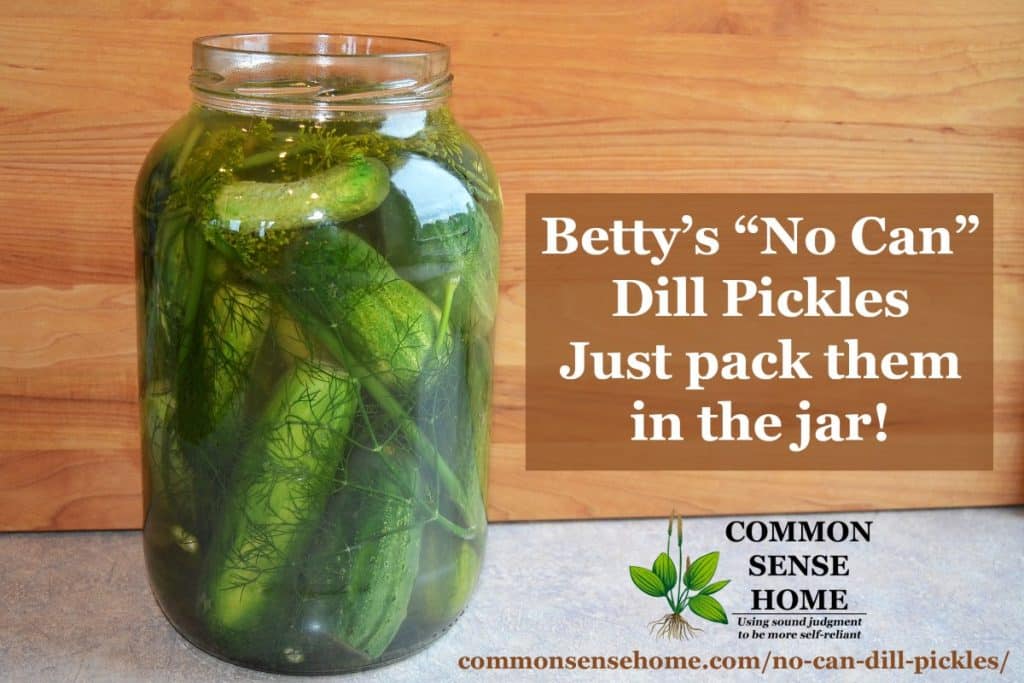
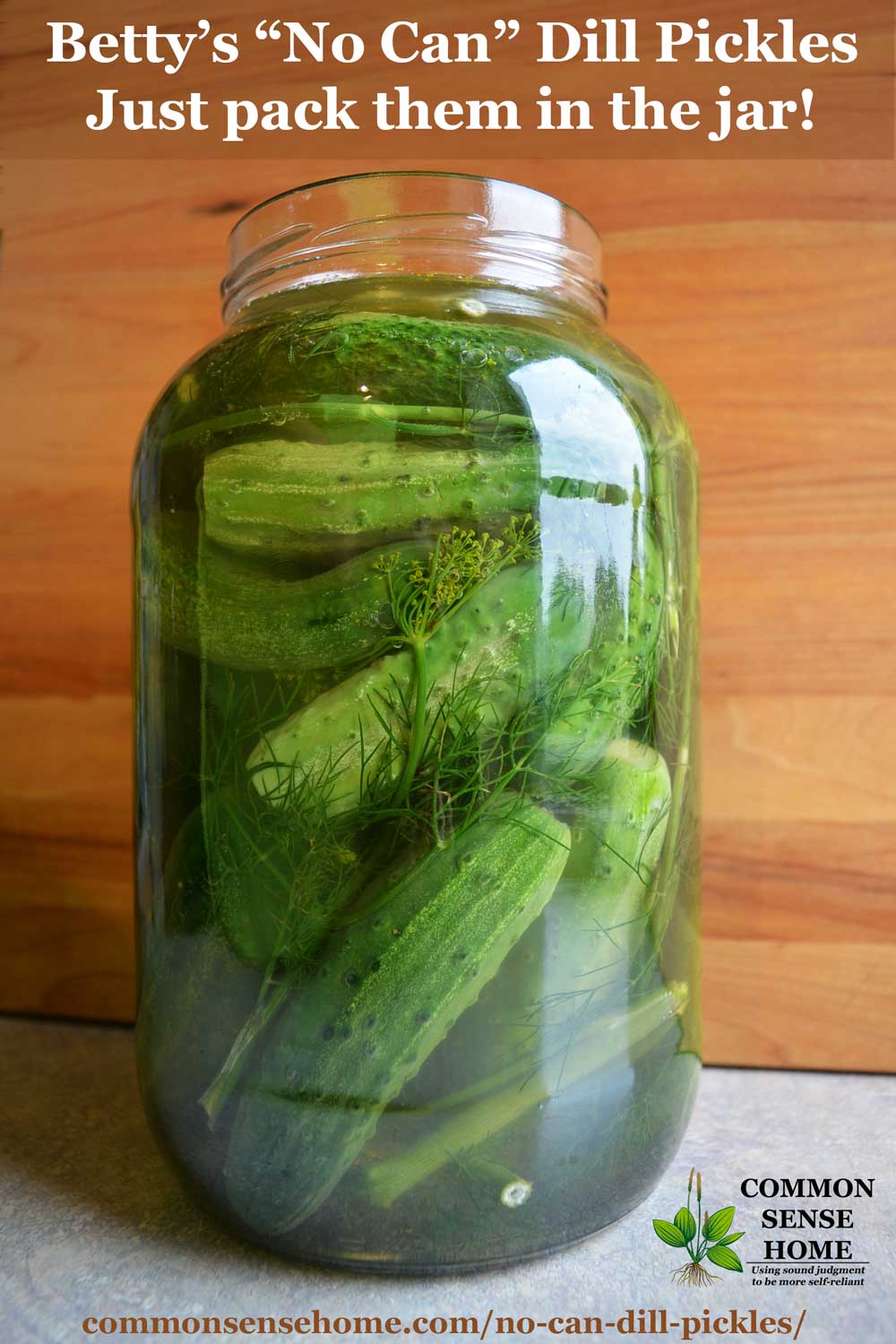
This recipe is from my neighbor Betty. Betty and I have swapped a lot of produce and recipes over the years (she’s also my son’s piano teacher and has become like a grandmother to him). Betty makes a simple old-fashioned brined dill pickle that doesn’t require canning, and couldn’t be easier to make.
Would you like to save this?
My early attempts at dill pickles were not very successful. I followed the FDA guidelines from the Ball Blue Book of Preserving, and ended up with tasty pickles with absolutely no crunch.
I love my Blue Book, but these were not the pickles I was looking for. As I understand it, many commercial manufacturers add alum (aluminum potassium sulfate) to give their pickles crunch.
Needless to say, I wasn’t going that direction. These no can dill pickles bring the crunch without the aluminum.
Betty’s No Can Dill Pickles
Ingredients
- 9 cups water
- 1 ½ cup vinegar
- 1/3 cup salt (Do not use salt with iodine, it will give the pickles a brown tint, Real Salt also gives a slight brown tint, canning salt works best)
- ½ cup sugar
- Dill, 2-3 stalks
- 2-4 inch long cucumbers, enough to fill a gallon jar
Directions
Combine the water, vinegar, salt and sugar and boil one minute. Cool slightly.
Wash the cucumbers and cut off about 1/16”from each end. This gets rid of some enzymes that would soften the pickles, and allows better penetration of the brine. Pack the cucumbers in a one gallon jar with the dill.
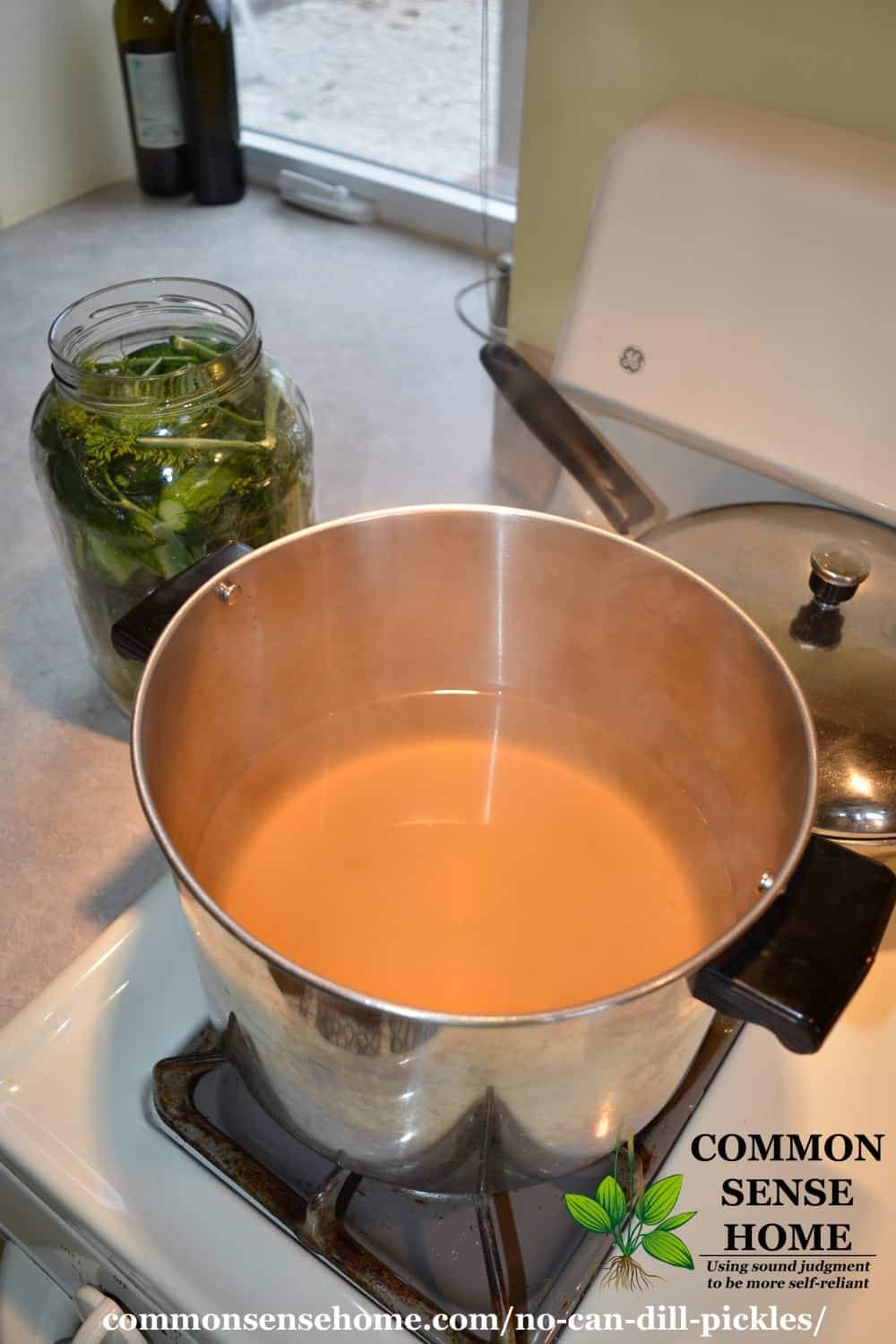
Note: I like to curl up some of the dill in the top of the jar to pin down the cucumbers and make sure they all stay submerged in the brine.
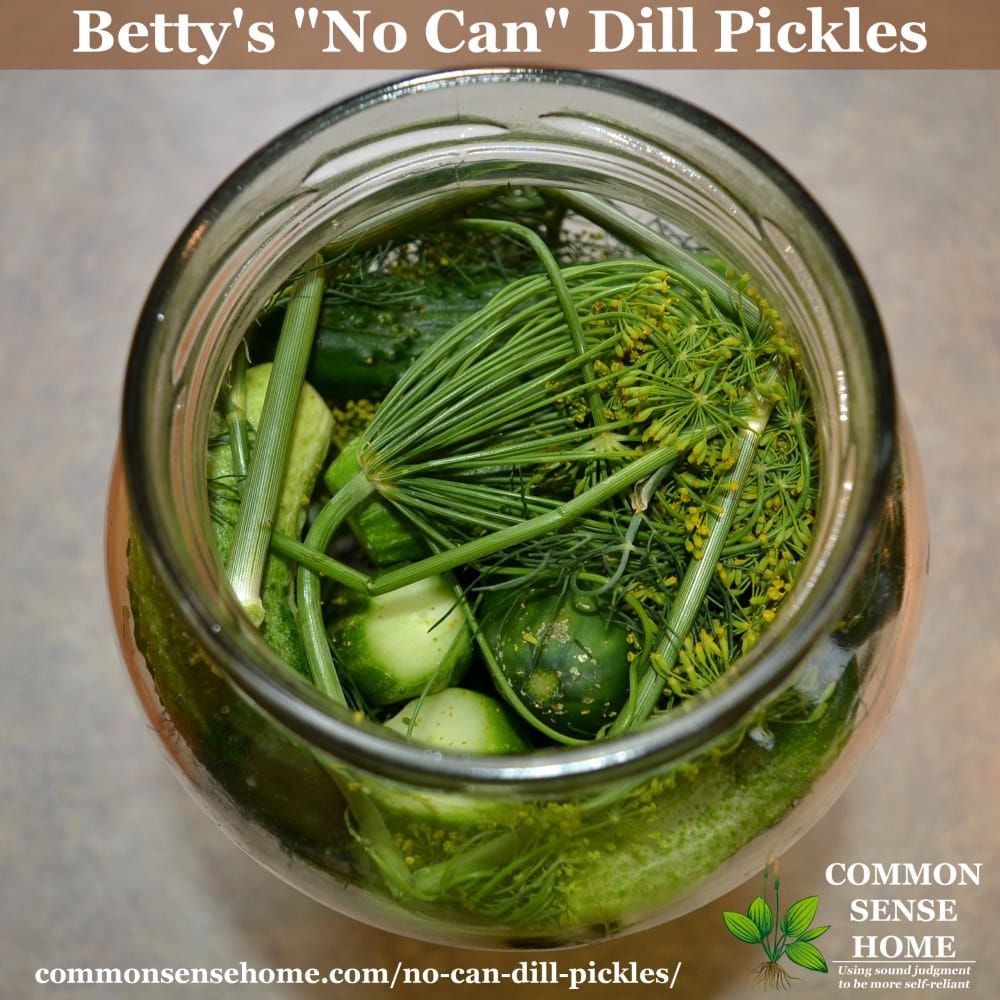
Pour the warm brine over the cucumbers. Let stand, loosely covered, at room temperature for three days. (Drape a towel over the jar opening or let lid sit on loosely.) I rubber band everything, especially in fruit fly season.
You could also use something like the Picklemeister Glass Fermenter Jar, which in addition to being fun to say, comes with its own airlock built right into the lid.
Cover and store in refrigerator. They are ready to eat after the three days but the flavor improves after a week or two in the refrigerator.
That’s it! No canning, no heat processing of any sort. These pickles stay fresh and crisp tasty for months. We’ve enjoyed them at Christmastime.
If you don’t have a lot of small cucumbers, you could cut the recipe in half, or make up a full batch of brine but process pickles by the quart and hold the reserve brine in the fridge for a couple of weeks. Delicious!
Thanks, Betty. I love my country neighbors!
If you don’t have fresh dill
Fresh dill is preferred, but if you don’t have any available, you can substitute 4-6 tablespoons of dill seed. (Adjust as needed depending on your flavor preferences.)
PrintEasiest Ever, No Canning Required Dill Pickles
Super easy no-canning required dill pickles. No canning required, store in the fridge for months.
- Prep Time: 15
- Total Time: 15 minutes
- Yield: 1 1x
Ingredients
- 9 cups water
- 1 1/2 cup vinegar
- 1/3 cup canning salt
- 1/2 cup sugar
- Dill, 2-3 stalks
- 2–4 inch long cucumbers, enough to fill a gallon jar
Instructions
- Combine the water, vinegar, salt and sugar and boil one minute. Cool slightly.
- Wash the cucumbers and cut off about 1/16”from each end. This gets rid of some enzymes that would soften the pickles, and allows better penetration of the brine. Pack the cucumbers in a one gallon jar with the dill.
- Pour the warm brine over the cucumbers. Let stand, loosely covered, at room temperature for three days. (Drape a towel over the jar opening or let lid sit on loosely.) I rubber band everything, especially in fruit fly season.
- Cover and store in refrigerator. They are ready to eat after the three days but the flavor improves after a week or two in the refrigerator.
Notes
- I like to curl up some of the dill in the top of the jar to pin down the cucumbers and make sure they all stay submerged in the brine.
- Fresh dill is preferred, but if you don’t have any available, you can substitute 4-6 tablespoons of dill seed.
You may also enjoy:
- Pickle Relish Sweetened With Honey
- Home Canned Salsa Recipe – Plus 10 Tips for Canning Salsa Safely
- Pickled Dilly Beans with Garlic and Cayenne Pepper
- Creamy Cucumber Salad with Sour Cream Dressing
Originally published in 2010, updated 2016.
Can u substitute dill seed for fresh dill?
Yes, if needed. Try 2-3 tablespoons of dill seed per gallon.
I’m curious how salty these are. So many I have tried that people have made are what I call “salt bombs”! I have only made canned pickles and 24 hr refrigerator pickles so I’m not familiar with this type and salt ratios to know how salty they are…interested in trying!
Pickles by nature do tend to be salty, as the salt helps to draw the water out of the cucumber to preserve it. Maybe try a half batch first to see if you like the flavor?
can you put them in refrigerator after one day?
I suppose, and if your house is really hot it would accelerate the pickling process so that would be a reason to do it. Under normal conditions, you want to leave them out a little longer so the flavor is stronger.
my house stays about 72 degrees year round, just saw an earlier post about mold forming and it worried me about leaving them out three days…..what does it hurt by putting them in the fridge right away?? does it affect anything with the taste?
I have not tried putting the cucumbers directly in the refrigerator, but I believe it would likely slow down the pickling process. If you want to put the pickles straight into the refrigerator, I would definitely leave them in for at least two weeks to allow the flavor to develop.
Can this recipe be done with green tomatoes, has anyone else tried this
Sorry, I’ve only used cucumbers.
I tried the no cook dill pickles and i curled up dill on top of the pickles. Some of the dill wasn’t under the brine and it molded. Will my pickles be ok? I took the molded dill out and spooned the little bit of scum off the top but one jar it turned the brine cloudy. I used 6% vinegar and kosher canning salt and I boiled it then cooled it. I also forgot about them and they sat out an extra day maybe 2. What did I do wrong? So i dont mess up next time. I have them in frig now we did like them very much so i hope the ones i have are safe to eat.
Don’t leave it out so long on the counter. If the cucumbers are still in the brine, they should be okay.
Thanks for the recipe!
Worth noting that I added carrots with the pickles and it was good, but they only lasted 5 days total before they were gone.
Also, did not leave them out and put them straight in the fridge because I misread the recipe. I’m wondering what the leaving them out is for, if it’s flavor or something else?
Canning is a total time sink, but this is just right. Am now wondering what I can pickle using this recipe during the fall and winter.
The time on the counter helps them break down a bit and soak in the brine before stabilizing them in cold storage. It develops the flavors more.
Hi Laurie,
Hmmmmm… I made another batch, except with green beens. I actually put them right in the fridge for a week, and then left them out for a few days.
They definitely were fermenting. The liquid turned cloudy, a white sediment settled at the bottom, and the liquid (and my beans) became carbonated. And they were awesome.
Great recipe and all but I think we should be more explicit about the purpose of those three days and say “we are gonna ferment the pickles.”
For the record, I came up with a doozy of a recipe here for asian fusion dill pickles:
5-7 garlic cloves
2-3 inches lemongrass
15 peppercorns
10 coriander seeds
15 tiny pieces dried galangal
1 hot pepper
All the dill + Betty’s recipe
The thing is, it’s not a full blown ferment. It’s a vinegar pickle, which is a different beast. My pickles don’t get fizzy. I have not done a detailed study of vinegar pickling, but I know that the pickling solution draws the moisture out of the veggie. The bacteria that cause spoilage like things warms and moist. So we draw out the moisture, then we drop the temps.
Such an easy sounding recipe, and many great remarks! I’m trying this today, the weather outside is hot and humid and will hit high 90’s…I keep the house around a comparatively cool 80. Should they still sit out for three days, or should that time be strongly shortened?
Thanks!
I would think you’d still want at least two days, even with the higher temps.
Thank you. I am new to the homesteading movement. I so love your emails. Have learned so much from them thank you
You’re welcome, and I’m glad you enjoy the emails and site.
Do you have to use whole cucumbers. Or can you use slices of cucumbers?
Whole cucumbers tend to stay more crisp, but I have used slices to fill a jar.
I can not hardly wait to try these. Sound delicious and easy.bthans so much. Love your emails keep them coming.
Enjoy!
Hi. We live on dill pickles and pickled beets. But since I make over 150 jars of each a year (not counting peaches, pears, stews, meats, fish, soups, etc to the tune of about 1500 jars a year. My husband buried a sea can for me as a root cellar because I feed 13+ people off my canning and preserving), water bathing just took to much time. And like you I want my pickles to be crunchy. First thing I learned is that pickles need to be water bathed at 180 degrees… no change.. and they will stay crisp. So get your water bath to 180 and leave the lid off.. and you won’t have soggy pickles. That solves the crunchy part.
For me it doesn’t solve the time constraint. And then I started to pay attention to the elderly. In three countries I might add. Germany, Canada and the USA. Many learned to preserve at the apron of their grammas. So I paid attention. I started hearing that I didn’t have to water bath my pickles or beets.. and of course I was intrigued. The instructions I received were simple. Heat your jars, heat your seals, boil your liquid. Assemble all of it quickly, toss on your lid and tighten the ring… flip upside down and leave for 24 hours. My pickles all sealed. And because everything was still boiling my pickles were still bubbling away over an hour later.. much like a water bath. Like everything this is a personal choice. I decided that this many generations of elderly have survived so I’m willing to follow their lead. I feel everyone has to make the decision on what they feel comfortable with. But I thought I’d throw this into the mix too. I think we’re on the right track when we take control of our food and food supply. Happy canning everyone.
What you’re describing is now referred to as the inversion method, and is no longer recommended due to the potential for food to get in the seal during inversion and the possibility of air being retained in the jar headspace, leading to a false seal.
That said, if a person were inclined to use inversion canning, pickled recipes would be some of the safest types of recipes to use it on, given the high acidity and salt levels of the pickled produce. Both acidity and salt inhibit bacterial growth.
Thanks for sharing your experience.
I’m bookmarking this recipe! I’m growing cucumbers and dill this summer with the express purpose of making dill pickles. What kind of vinegar do you use?
My neighbor used white vinegar, but I prefer cider vinegar.
I have to wonder how pickles used to be made so they could be kept in a barrel in the old country store, and people would simply grab out one to eat when they bought it. That was long before there was refrigeration, or canned/jarred pickles sold on the shelf, and how could they possibly have known the percent of acid in their brine? I wonder how big the barrel was, too! Might have to do some research with my Mennonite relatives and friends…. I’m not Mennonite, but my mother’s mother’s mother was, and it seems wherever I go, I find distant cousins! I have a half-dozen Mennonite cookbooks that were written, compiled or contributed-to by various relatives. … Thank goodness for Google! I searched for how to make pickles in a barrel and came up with THIS wonderful site, with very complete directions, for lacto-fermented pickles made in big crocks – and I HAVE some in storage! I think they’re coming out this summer so I can try this!
If you’re making these pickles in a glass gallon jar, any small glass plate or dish that would fit through the opening and submerge the produce in the brine should work as a weight. Just make sure the item has been sterilized first. If necessary, a sterilized glass canning jar full of water could be set on top of the plate or dish to further weigh it down.
Remember, people have been making pickles for hundreds of years, and they didn’t have all the fancy stuff we do, or the scientific knowledge about bacteria, yeasts, molds, etc. – yet they mostly survived the experience and kept pickling! I think we tend to make processes like this too complicated. And who really cares what the FDA “approves of,” anyway?! I love finding new uses for stuff that carries the dreaded warning – “Federal mandates require use only in accordance with label directions.” Mankind has thrived on discovering new uses for all kinds of familiar things!
Since you’re already walking on the wild side, I’d also note that our ancestors didn’t sterilize everything, either. Of course, we’re now dealing with some nasty pathogens that they didn’t have to contend with, so I do try to keep everything clean and follow common sense guidelines. That said, I do still use some traditional recipes as well – as long as the chemistry and biology of them make sense.
Bacteria and mold don’t thrive in an acidic environment. Salt and sugar also inhibit bacteria growth by binding up free water (bacteria needs that water, too). I imagine the early recipes came from trial and error, working with local supplies. If it didn’t spoil, you knew you got it right. If your brine is properly acidic, a clean weight should suffice.
Mom used to make pickles in a big 15 gallon crock, too, but I’ve long since lost the recipe. Big batch preserving like that was a lot more common when there were big farm families to feed with no freezers or refrigerators. I’d hazard to guess that those open barrels people grabbed pickles out of were filled with bacteria, at least around the edge outside of the brine. Folks still lived to tell the tale. 🙂
I’m with you. Sometimes new isn’t better. Nor does it necessarily make sense. I believe a lot of changes are more lawsuit based than fact based. Personally I think we should listen and at least consider how those before us survived. I mean we’re all here?! With way less options available to them. They must have done something right. JMHO
We have a lawsuit crazy culture, but much of the produce now in grocery stores has a high risk of more aggressive pathogens. One bad lot of anything can get spread across the country, coming with listeria, e coli or other nasty critters. With garden or local produce, most times those risks are reduced. Healthy bacteria are essential to human health (our bodies normally have around 10 bacteria cells for every human cell), so waging war on bacteria is like waging war on ourselves. I hope over time the focus continues to shift towards nurturing good bacteria instead, while following basic safety guidelines like not mixing raw veggies and raw meat unless they’re going to be cooked.
Do you have a recipe for kimchi? Thanks.
No, that’s something we haven’t tackled yet, but maybe this fall when more cabbage comes in.
I’ve made my mom’s refrigerator recipe for decades, and she made them (in Luck, Wisconsin) for decades before that. She added a pinch of alum, which gives it a nice, loud crunch.
Mom used to used alum, too, but I generally avoid it due to concerns with ingesting aluminum.
Ferment one quart at a time. With fermented foods you get a wide variety of probiotics which make up 80% of your immune system!!!
Fermented Garlic Dill Pickle Recipe
http://www.healthnutnation.com/2014/08/18/garlic-dill-pickle-recipe/
Once the three days is done and I close the jar, must they go in the fridge? Can I store them on a shelf and if so how do I seal the jar?
They can’t go in the pantry unless your pantry is below 40F. This recipe is for refrigerator pickles, not canned picked. They are not shelf stable at room temp. My friend, Sharon, has a dill pickle recipe for canning on her website – http://www.simplycanning.com/dill-pickle-recipe.html
Thank you for your very informative and interesting newsletter! My mom did a lot of canning as i was growing up in Crivitz and then Marinette. Can’t wait to try these pickles. Is there such a method of “crock pickles”? I overheard some ladies discussing them, but wasn’t able to qerry them.
I’m new to your site and wonder if you have a formula for making sauerkraut, preferably not too “puckery”. Mom made her own in a crock, in the basement. One night we were rudely awakened when the plate blew off the crock. I don’t remember what she did wrong since I was only 10 years old.
Thanks for your fun to read newsletter.
Cate
Hi Cate. You grew up not too far from here. The trick to proper kraut pucker is simply aging it until it reaches the flavor that you like. I make mine in a crock, too – https://commonsensehome.com/how-to-make-sauerkraut/
Cate, you are making me home sick. I grew up in Marinette 🙂 Excited to try these pickles. My usual recipe has far more vinegar. Did you make these? Like these? Thanks.
I’m excited to try this recipe, would it work with a reg. Cucumber ? or does it have to be small cukes?
You could use larger cukes and cut them into slices, but the whole small cukes stay crisper.
I just printed your recipe off and can’t wait to try it next season! One question can you use homemade apple cider vinegar (mine I just finished fermenting for 4 wks has one in it). Just curious!
You could use homemade vinegar if you could test to make sure that it has an acidity of at least 5%. A less acidic product could lead to unsafe conditions.