
No Can Dill Pickles – Just Stick Them in a Jar!

This post may contain affiliate links. Read my full disclosure here.
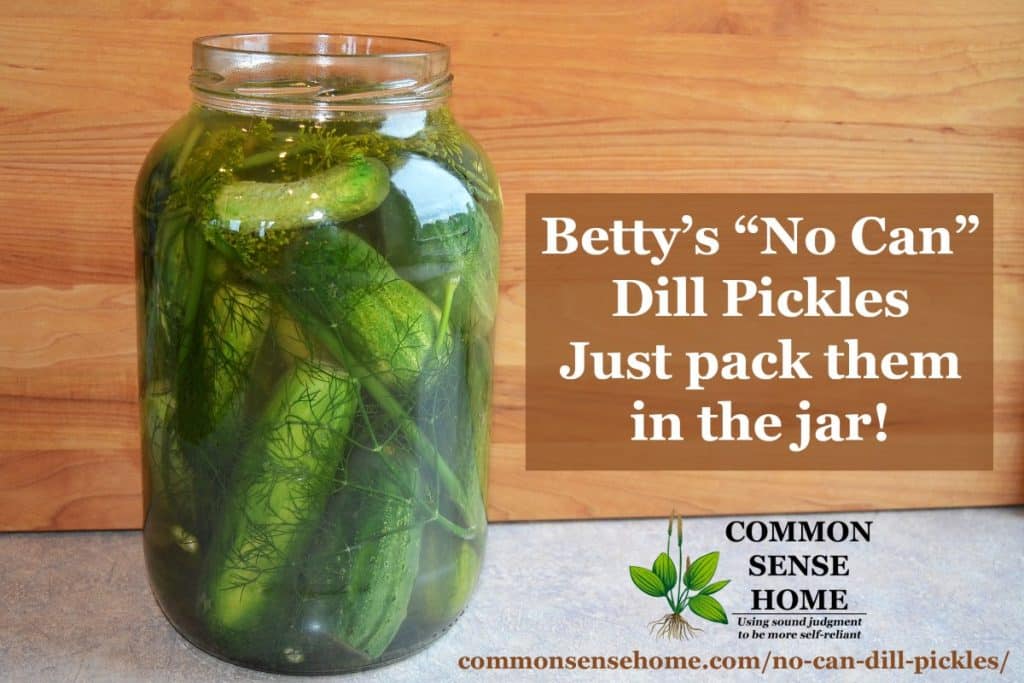
This recipe is from my neighbor Betty. Betty and I have swapped a lot of produce and recipes over the years (she’s also my son’s piano teacher and has become like a grandmother to him). Betty makes a simple old-fashioned brined dill pickle that doesn’t require canning, and couldn’t be easier to make.
Would you like to save this?
My early attempts at dill pickles were not very successful. I followed the FDA guidelines from the Ball Blue Book of Preserving, and ended up with tasty pickles with absolutely no crunch.
I love my Blue Book, but these were not the pickles I was looking for. As I understand it, many commercial manufacturers add alum (aluminum potassium sulfate) to give their pickles crunch.
Needless to say, I wasn’t going that direction. These no can dill pickles bring the crunch without the aluminum.
Betty’s No Can Dill Pickles
Ingredients
- 9 cups water
- 1 ½ cup vinegar
- 1/3 cup salt (Do not use salt with iodine, it will give the pickles a brown tint, Real Salt also gives a slight brown tint, canning salt works best)
- ½ cup sugar
- Dill, 2-3 stalks
- 2-4 inch long cucumbers, enough to fill a gallon jar
Directions
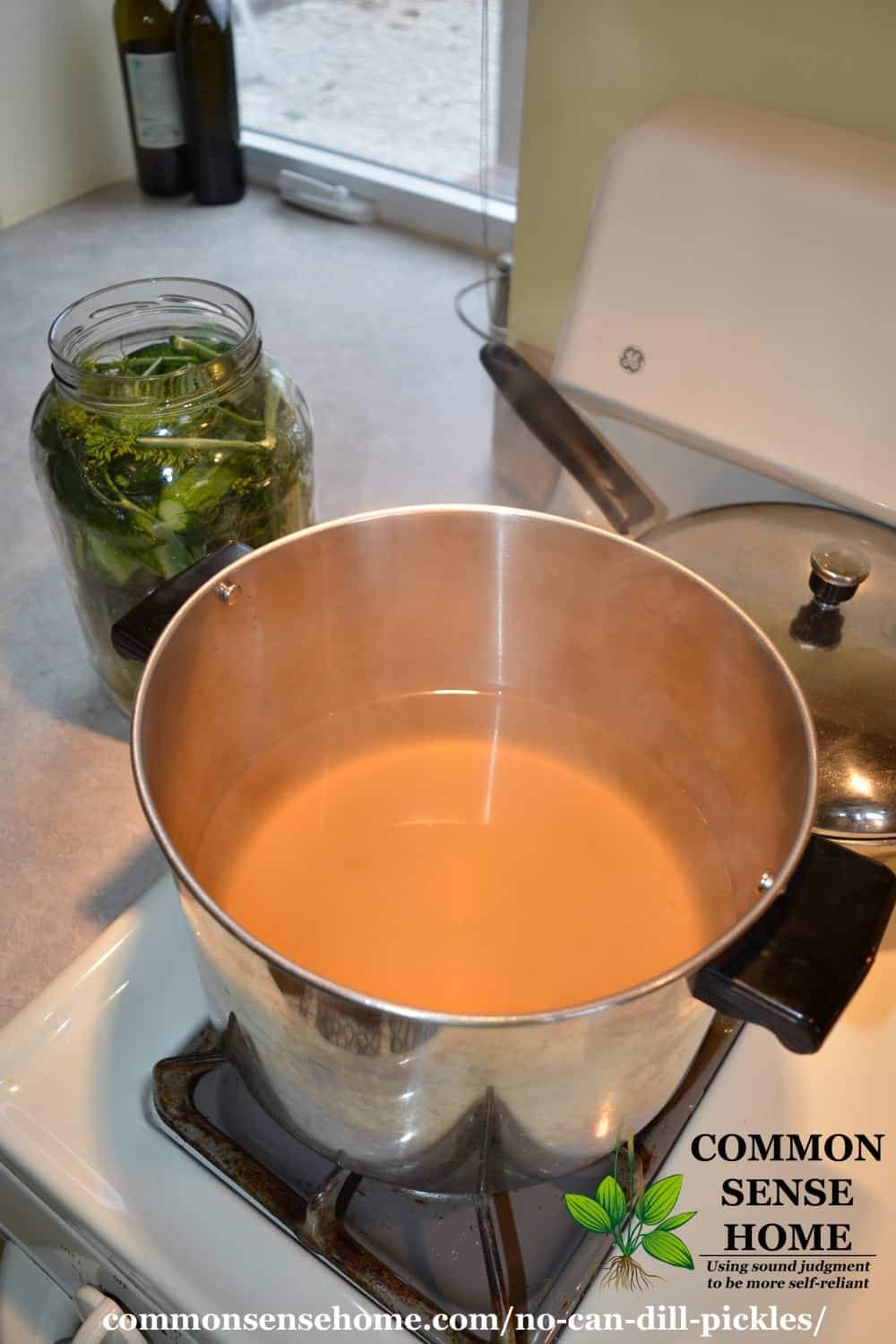
Combine the water, vinegar, salt and sugar and boil one minute. Cool slightly.
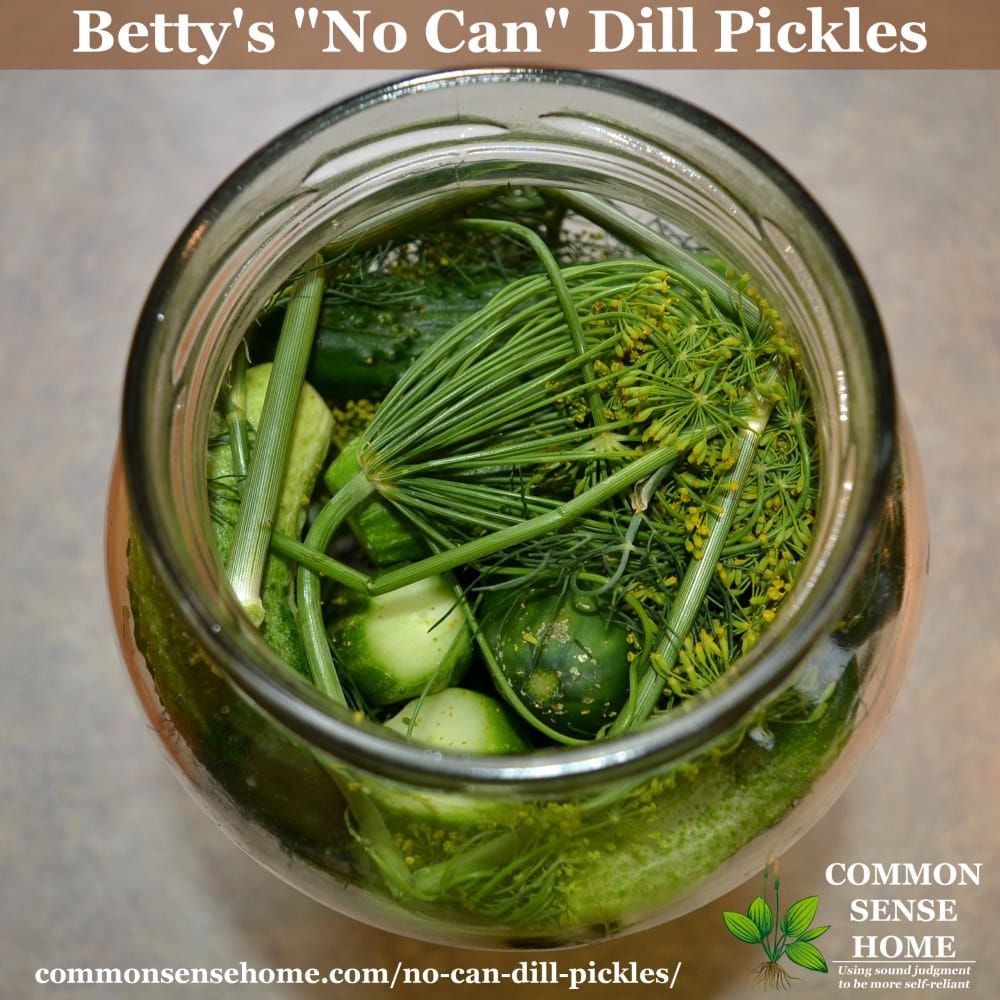
Wash the cucumbers and cut off about 1/16”from each end. This gets rid of some enzymes that would soften the pickles, and allows better penetration of the brine. Pack the cucumbers in a one gallon jar with the dill.
Note: I like to curl up some of the dill in the top of the jar to pin down the cucumbers and make sure they all stay submerged in the brine.
Pour the warm brine over the cucumbers. Let stand, loosely covered, at room temperature for three days. (Drape a towel over the jar opening or let lid sit on loosely.) I rubber band everything, especially in fruit fly season.
You could also use something like the Picklemeister Glass Fermenter Jar, which in addition to being fun to say, comes with its own airlock built right into the lid.
Cover and store in refrigerator. They are ready to eat after the three days but the flavor improves after a week or two in the refrigerator.
That’s it! No canning, no heat processing of any sort. These pickles stay fresh and crisp tasty for months. We’ve enjoyed them at Christmastime.
If you don’t have a lot of small cucumbers, you could cut the recipe in half, or make up a full batch of brine but process pickles by the quart and hold the reserve brine in the fridge for a couple of weeks. Delicious!
Thanks, Betty. I love my country neighbors!
If you don’t have fresh dill
Fresh dill is preferred, but if you don’t have any available, you can substitute 4-6 tablespoons of dill seed. (Adjust as needed depending on your flavor preferences.)
PrintEasiest Ever, No Canning Required Dill Pickles
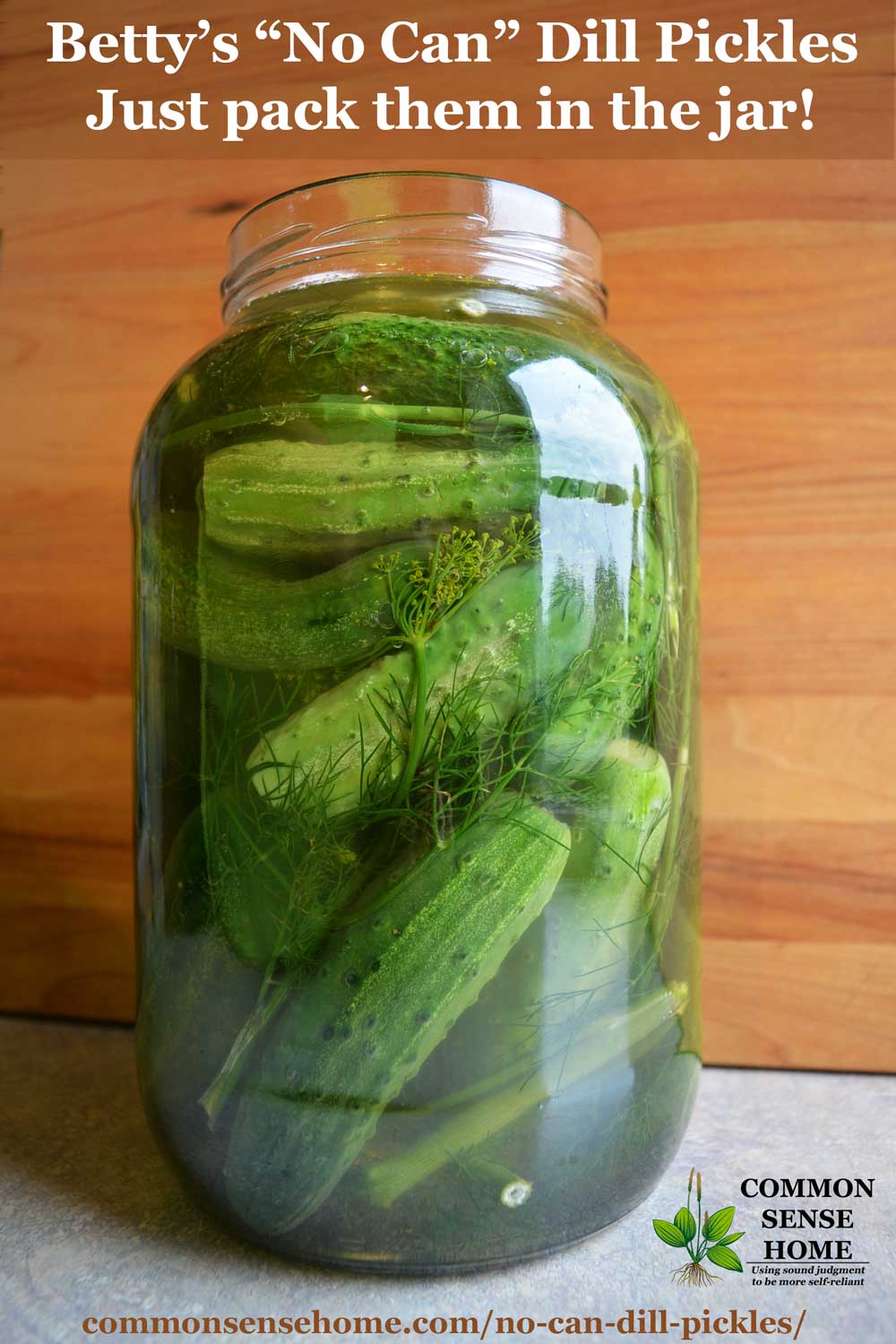
Super easy no-canning required dill pickles. No canning required, store in the fridge for months.
- Prep Time: 15
- Total Time: 15 minutes
- Yield: 1 1x
Ingredients
- 9 cups water
- 1 1/2 cup vinegar
- 1/3 cup canning salt
- 1/2 cup sugar
- Dill, 2-3 stalks
- 2–4 inch long cucumbers, enough to fill a gallon jar
Instructions
- Combine the water, vinegar, salt and sugar and boil one minute. Cool slightly.
- Wash the cucumbers and cut off about 1/16”from each end. This gets rid of some enzymes that would soften the pickles, and allows better penetration of the brine. Pack the cucumbers in a one gallon jar with the dill.
- Pour the warm brine over the cucumbers. Let stand, loosely covered, at room temperature for three days. (Drape a towel over the jar opening or let lid sit on loosely.) I rubber band everything, especially in fruit fly season.
- Cover and store in refrigerator. They are ready to eat after the three days but the flavor improves after a week or two in the refrigerator.
Notes
- I like to curl up some of the dill in the top of the jar to pin down the cucumbers and make sure they all stay submerged in the brine.
- Fresh dill is preferred, but if you don’t have any available, you can substitute 4-6 tablespoons of dill seed.
You may also enjoy:
- Pickle Relish Sweetened With Honey
- Home Canned Salsa Recipe – Plus 10 Tips for Canning Salsa Safely
- Pickled Dilly Beans with Garlic and Cayenne Pepper
- Creamy Cucumber Salad with Sour Cream Dressing
Originally published in 2010, updated 2016.
Not sure if folks are still reading the comments, but thought I’d pipe up with a couple of years of experimenting. I generally go with 1/2 cup of Kosher salt and 1/3 cup of sugar – we just like them a little saltier and less sweet. This switch is about perfect. I always add something to them. A dozen lightly crushed garlic cloves – they’re still whole, just cracked with a smack from a can or the flat of the knife. Last year, I made a round with jalapenos. If you like a little kick, these are PERFECT! My hubby, who doesn’t like things too spicy even loves them. They remind me a little of Tony Packo’s if you’ve ever had those. I rinsed and cut the tops off of about 8 jalepenos from the garden and put them in with everything else. So good. I can’t recommend this enough. I also did a round with baby carrots. The were quite delicious. If you’re a fan of the pickled veggie mixes from the store, this will make you happy. This year, we’ll be making more pickles, and also more pickled veggies with the mix. We’re still eating last year’s pickles right now – we make a LOT. Everyone loves them. They make great gifts and a great addition to potlucks!!
Thanks for sharing your experience, Lesley. Salt and sugar both help tie up the free water in the cucumbers, reducing the risk of spoilage, so that’s a reasonable substitution. It’s great that you found some combos you love. 🙂
When I went to seal the jar and put in fridge after the 3 days, there was mold on top of the dill. What did I do wrong? Super sad that I have to toss all these pickles 🙁
Without seeing your setup, it’s hard to say for sure. Plant material sticking out above the liquid could cause mold growth. Higher temps could cause mold growth. High levels of mold in the air could cause mold growth. I’ve never run into the problem here in northeast Wisconsin.
Some options you could try:
Air-locked fermentation vessel, to keep out any foreign bodies. This would probably be the most reliable option. They sell these through Cultures for Health, one of my affiliates, and through other online retailers and in some specialty shops.
Use some sort of weight to keep all plant matter below the liquid.
Use a shorter fermentation at room temperature. This may help if you are fermenting in warmer conditions.
Make sure you trim off the blossom ends, as these may harbor bacteria/molds that promote spoilage.
I’m sorry the pickles didn’t work out. I’ve never run into problems, but every kitchen is different.
What could you use for a weight? I had a layer of mold as well- produce was sticking up. What was below looked great but I was scared not to throw it all out
Amazon.com stocks Fermentation glass Jar Weights 3 pack (2 1/3″ to fit a wide mouth quart jar) and USA Made Crock Rocks© – Wide Mouth Ferment Weights
 , as well as other weights for fermenting.
I take a zip-lock sandwich bag, put some water (or some of the extra brine) inside, seal, put inside another bag, incase first bag should leak, and stuff into the jar to hold the pickles under brine.
Thanks, Helen.
Ok, so this is my first garden and i kinda took over the in-laws garden since we are staying with them right now. And they wanted cucumbers…i don’t really like them, except as pickles, so when i found this recipe i got very excited! I’m off today to go find a big jar and the salt. I do have to ask…what on earth is “cider vinegar with the mother”?? Is that fancy code for something? 😉 I was just curious.
lol – sort of fancy, I guess, as vinegar goes. It’s usually what I have on hand, so that’s what I use, but any good quality vinegar will work.
Vinegar is brewed using a culture, otherwise known as a mother. This makes “vinegar with the mother” a living food. Most commercial vinegar is pasteurized, which kills that mother/active culture. In this recipe, the vinegar is heated during preparation, which will also kill the mother, so these pickles are not a live cultured food. They are preserved via acidity, sugar and salt. Acidity creates an environment that is not welcoming to bad bacteria, salt and sugar absorb free water from the cucumbers, which also reduces breeding grounds for bad bacteria.
I prefer to buy vinegar with the mother because the flavor is a little stronger and more robust than vinegar that has been pasteurized and filtered. It will have some sediment in the bottom of the jar and may be a little cloudy. It’s a little strange looking at first when you are used to clear vinegar, but the flavor is very good. The two brands i see around here the most are Bragg’s and Eden Organic.
I love the idea of using apple cider vinegar with the mother, but would boiling it for one minute kill the enzymes? If so, why not just use regular? Just curious–do the lactofermented pickles taste different?
Yes, boiling does kill the enzymes. That’s the vinegar I usually have on hand, so that’s what I use for cooking and preserving. You can use whatever you have on hand. These pickles are vinegar pickled, not lacto-fermented. They taste like a good standard dill pickle. Lacto-fermented pickles tend to have a slightly more earthy taste.
Hi! Do you leave the dill in the container once it goes into the refrigerator?
Yes, the dill stays in and continues to add flavor.
Do you think this would work with coconut sugar as I have people that cant have sugar. Thanks.
I have seen it used in other recipes, so it should be okay. The vinegar acts as the primary preservative.
I add several cloves of garlic and about a tablespoon of mixed picking spice and one small dried red pepper per gallon jar. Have made these for years.
is it possible to exchange the sugar for Stevia instead?
The sugar helps bind free water molecules, aiding in preservation, so I’d be hesitant to eliminate it. If you’re looking for a low-sugar/no sugar option, I’d turn to lactofermenting, so that the cultures act as a preservative.
Do these have probiotics in them?
While not heat processed, these pickles do not contain live and active cultures. They may help assist digestion due to their acidity, but not to the extent of a live cultured (probiotic) food. For an assortment of live culture food recipes, I highly recommend The Complete Idiot’s Guide to Fermenting Foods by Wardeh Harmon – https://commonsensehome.com/the-complete-idiots-guide-to-fermenting-foods/
I do have a lactofermented asparagus recipe on the site, which could be used with other vegetables – https://commonsensehome.com/preserving-asparagus-three-ways-freezing-drying-and-lacto-fermenting/
Hey There, my family loves these pickles. I am curious if they can be canned? I am not sure we need to worry about it, they won’t last long.
you could probably can them, although the FDA might not approve, and they wouldn’t stay as crisp.
Greetings!
We have abundant pickling cukes from our garden this year, so I’ve made a couple batches. First batch, I followed the recipe exactly with plain old white vinegar. Hubby & son love it. My daughter said “You didn’t say these were sweet pickles!” They’re not, of course, but they are sweeter than store bought. I thought maybe so too, so second round, I increased salt to 1/2 C. (I’m using Kosher salt, by the way.) Also, made two jars. Added a dozen cloves of garlic to one. Added a hot pepper from the garden to the other. Better. Haven’t tried the hot pepper version yet, but the garlic version is good. I’m already planning the 3rd round. Next time, I will drop the sugar to 1/3 C. We love them and anticipate having pickles for quite a while to come. Or maybe not. I guess it depends how many we can eat each day!!
Lesley – that’s great that you have a house full of pickle fans! My boys would rather eat them fresh than pickled, but friends enjoy the crunchy treats when we have company.
and I went with Organic White Vinegar with the mother!
I’ve got a batch using cider vinegar with the mother right now. 🙂
ha ha!! Well, you’ll laugh even harder when you read that i’m only doing 4 pickles! My sad, nitrogen deficient garden only gave me 4 pickles at once, so I’m using them as a test run for the others that are (hopefully) coming! Garlic scapes and dill are ready to go!
Thanks so much 🙂
Patience is a virtue, right? Especially in the garden. 🙂
does it matter what kind of vinegar is used? Apple cider? Pickling? Organic white vinegar with the mother? white vinegar with 5% acetic acid?
Angela, I think I love you! I’m smiling as I read your comment. Pretty much any vinegar will do. My personal favorite is apple cider with the mother. I’m sure Betty just used a big old jug of cider vinegar.
This sounds really good! I have been wanting to make my own pickles. I planted my own dill and my silly chickens got into it and ate it all! I will have to try your recipe! I also like the idea of adding the garlic!
Blessings,
Susie
I’ve got a good crop of garlic this season, so I’ll likely be adding some to mine, too. Good for what ails you. 🙂
I’ve never tried refrigerator pickles. I, too, won’t use alum, so this sounds good!
For hot processing, a grape leaf helps keep them crisp. I refuse to use alum as well. Also, I only hot process my pickles for 5 minutes and haven’t had a problem with spoilage or a seal and they’re crisp. Refrigerator pickles are super easy and yummy though!
I switched to my mom’s recipe when canning (shorter processing time) and much prefer the results. Since the pickles are in a vinegar brine, the acidity should be low enough to keep them safe. Donna at Cultured Food Life discusses other materials you can add in for extra crispness, including grape leaves, in this post – http://culturedfoodlife.com/need-crunchy-pickles/
We have a fenceline covered in wild grapevines, so I want to try that for lacto-fermenting.
To keep pickles crisp you can use a leaf from grape vine, oak, horseradish and also 2-3 bay leaves per quart. Put your spices in the bottom of the jar along with the leaf.
I want to try this when cucumbers are back in season. In the meantime I still have beets in the garden that I would love to pickle in the fridge. Would this recipe work? or how would you recommend to modify it for beets?
Hmmmm…I don’t see a reason it wouldn’t work, if you want dilly beets. Otherwise try varying the spices, but don’t decrease the acid.
yum! I need a good pickle recipe too.
Would love to no can green tomatoes. Wonder if it’s possible? Love the idea of no canning process.
I have not tried it, but the same brine and process should work for green tomatoes.
yes its possible. my grandfather canned green tomatoes. Yummmmmmm
I just tried making pickles the other day for the first time and they turned out great!