
How to Make Lilac Jelly (Yes, Lilacs are Edible)

This post may contain affiliate links. Read my full disclosure here.
Lilac jelly is one of the easiest flower jelly recipes to make, because the lilac flowers are so abundant. They’re one of my favorite parts of spring, with their heady aroma filling the countryside. Seeing the large bushes adorning the old farmsteads and sprinkled through the towns makes me happy. It feels like a yard in our area isn’t complete without a lilac bush (or two).
We have two lilac bushes – a white and a light purple. Our lilac bushes get so covered in blossoms you can barely see the leaves. The neighbors have even bigger bushes. (We have some farmsteads that have been in the same family for over 100 years.) I wonder what those weathered bushes would say if they could tell the stories of those homesteads?
If you’ve tried dandelion jelly, this recipe follows a similar process. It has a softer, more delicate floral flavor.
Would you like to save this?
Table of Contents
A Lovely Lilac Jelly Recipe
Candied flowers are a classic way to enjoy lilac blossoms, but I wanted something a bit quicker. This recipe uses a simple infusion to create a beautifully lilac infused jelly. You can also adapt this method for other strongly scented edible blossoms.
See our Edible Flowers List for more flower jelly ideas.
For best results:
- Harvest lilac blossoms from unsprayed plants
- Avoid roadside plants (pollution exposure)
- Use freshly picked flowers for the best flavor
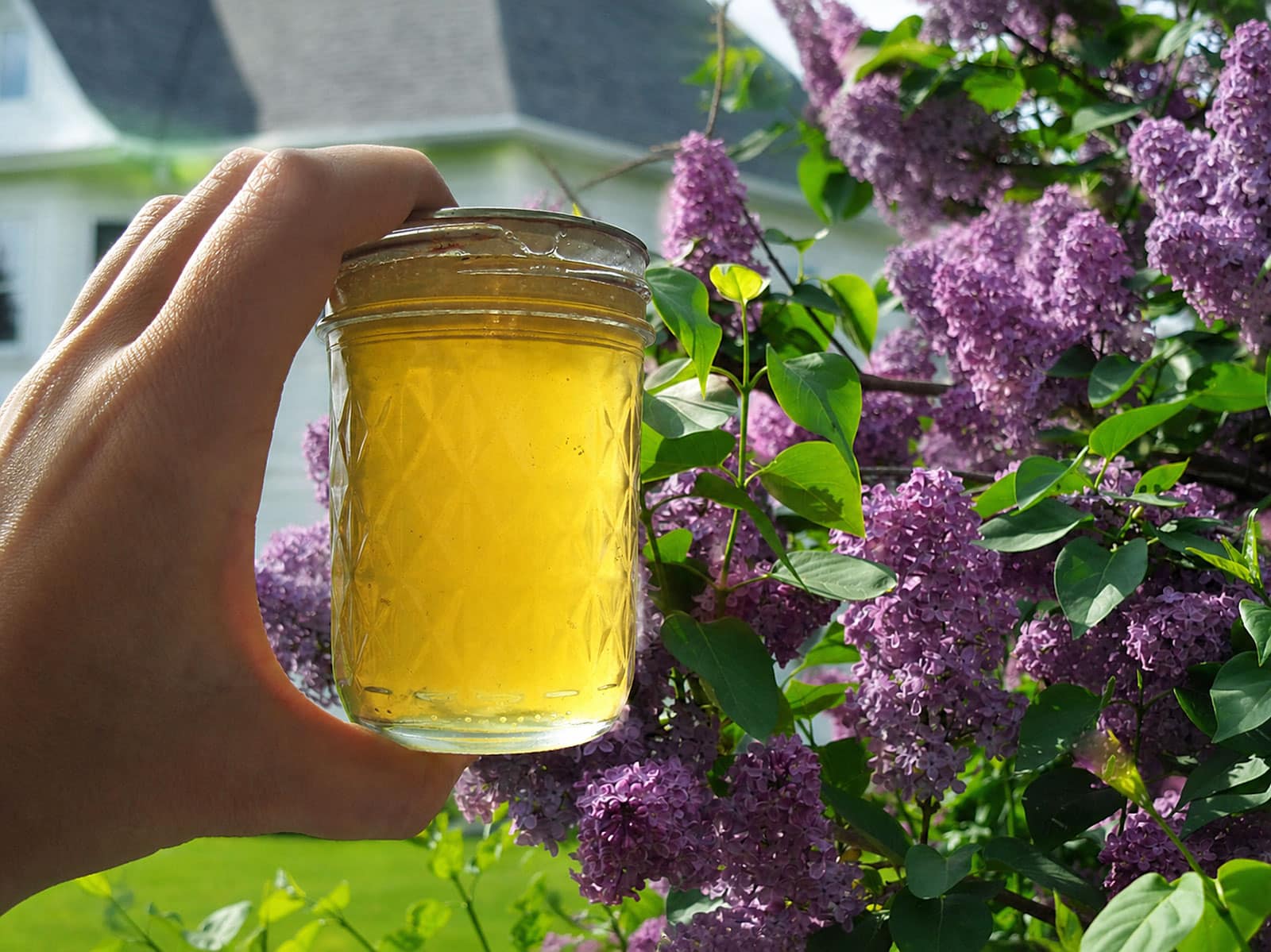
The flowers I used for my jelly were light purple, which gave me a bright yellow jelly. Dark purple flowers will give you a darker jelly.
Making Lilac Tea (The Base for Your Jelly)
To begin, you’ll create a lilac tea using the blossoms.
- Remove flowers from stems (stems can make jelly bitter)
- Place blossoms in a heat-safe container
- Pour the boiling water over the flowers
This creates your infused water, which will carry the lilac flavor into the finished jelly. Let the mixture steep for 8 hours or overnight. You don’t need to wash the flowers unless you think they might be dusty.
Ingredients
- 2 cups packed lilac blossoms (no stems or leaves)
- 2 1/2 cups boiling water
- 1/4 cup lemon juice
- 4 cups sugar
- One box Sure-jell powdered pectin (1.75 oz, or just over 4 tablespoons pectin)
Instructions
1. Prepare the Lilac Infusion
After steeping, strain out the blossoms and squeeze them dry. You should have about 2 1/4 cups of lilac infused liquid. Add a little water if needed.
For clearer jelly, you can refrigerate the infusion overnight and carefully pour off the liquid, leaving sediment behind.
2. Cook the Jelly
In a large heavy bottom pot, combine:
- Lilac infusion
- Lemon juice
- Pectin
Bring to a rolling boil over medium-high heat. Add the sugar all at once and return to a full rolling boil. Boil for 1 minute, stirring constantly. Skim foam if needed, then remove from heat.
3. Fill and Process Jars
Ladle the hot jelly into hot sterilized jars, leaving 1/4 inch headspace. Wipe rims clean and screw on the lids.
Place jars in a boiling water bath canner and process for 10 minutes (adjust for altitude if needed). Remove jars and let them cool undisturbed.
Yield: Makes around 4 half-pint jars or 8 – 4 ounce jars.
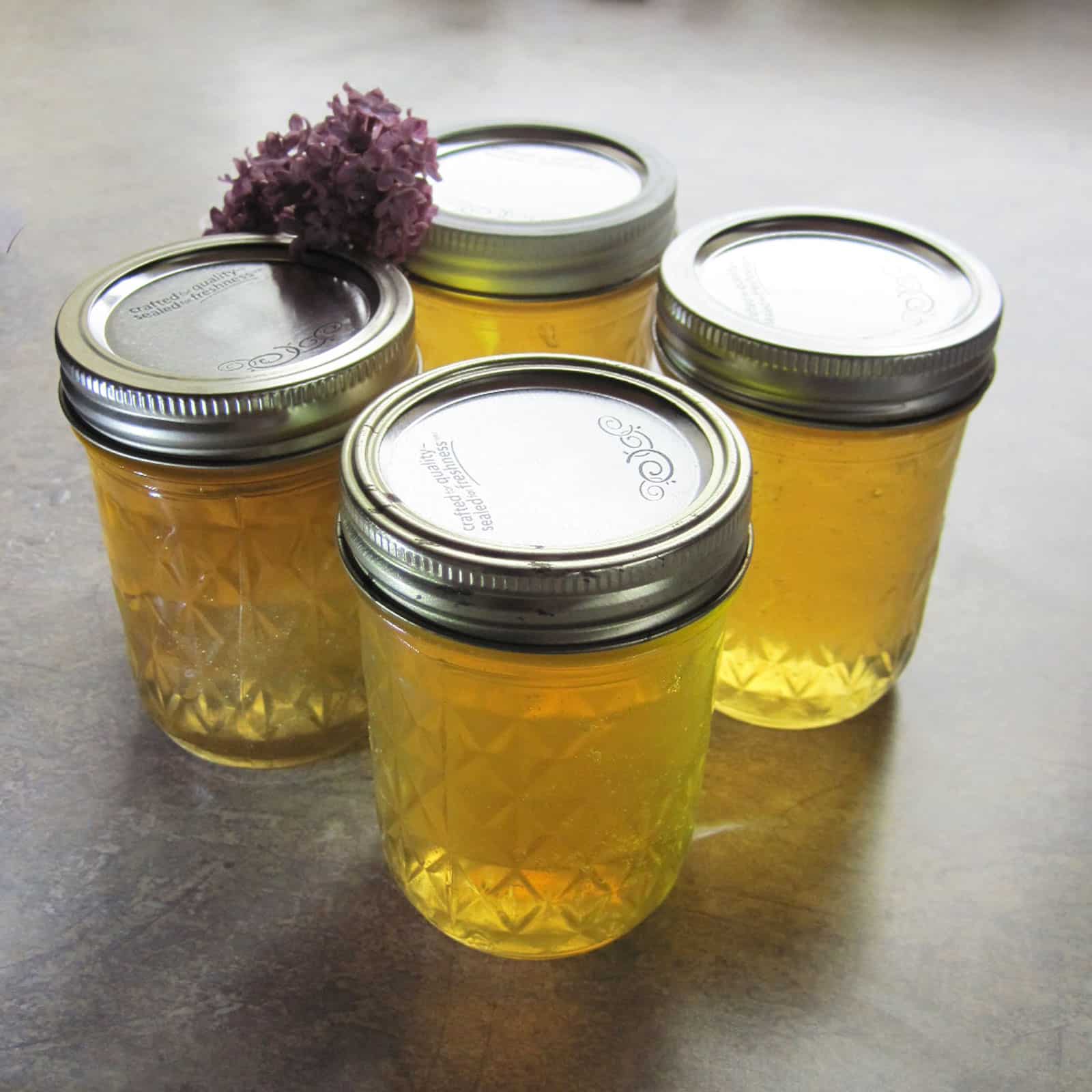
Note that although the recipe card has an option to double or triple the recipe, it’s best to make it in single batches. With a double or triple batch, it takes longer for the jelly to heat through. The quality will be better with a single batch at a time.
PrintLilac Jelly
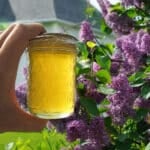
A simple lilac jelly recipe to share or enjoy at home.
- Prep Time: 10 minutes
- Cook Time: 10 minutes
- Total Time: 20 minutes
- Yield: 4 cups 1x
- Category: Jelly
- Method: Canning
- Cuisine: American
Ingredients
- 2 cups packed lilac blossoms, no leaves, no stems
- 2 1/2 cups boiling water
- 1/4 cup lemon juice
- 4 cups sugar
- One box Sure-jell powdered pectin (1.75 oz, or just over 4 tablespoons pectin)
Instructions
- Prepare the Lilac Infusion. After steeping, strain out the blossoms and squeeze them dry. You should have about 2 1/4 cups of lilac infused liquid. Add a little water if needed. For clearer jelly, you can refrigerate the infusion overnight and carefully pour off the liquid, leaving sediment behind.
- Cook the Jelly. In a large heavy bottom pot, combine: Lilac infusion, Lemon juice, Pectin. Bring to a rolling boil over medium-high heat. Add the sugar all at once and return to a full rolling boil. Boil for 1 minute, stirring constantly. Skim foam if needed, then remove from heat.
- Fill and Process Jars. Ladle the hot jelly into hot sterilized jars, leaving 1/4 inch headspace. Wipe rims clean and screw on the lids. Place jars in a boiling water bath canner and process for 10 minutes (adjust for altitude if needed). Remove jars and let them cool undisturbed.
Notes
Making Lilac Tea (The Base for Your Jelly)
To begin, you’ll create a lilac tea using the blossoms. Remove flowers from stems (stems can make jelly bitter). Place blossoms in a heat-safe container. Pour the boiling water over the flowers.
This creates your infused water, which will carry the lilac flavor into the finished jelly. Let the mixture steep for 8 hours or overnight. You don’t need to wash the flowers unless you think they might be dusty.
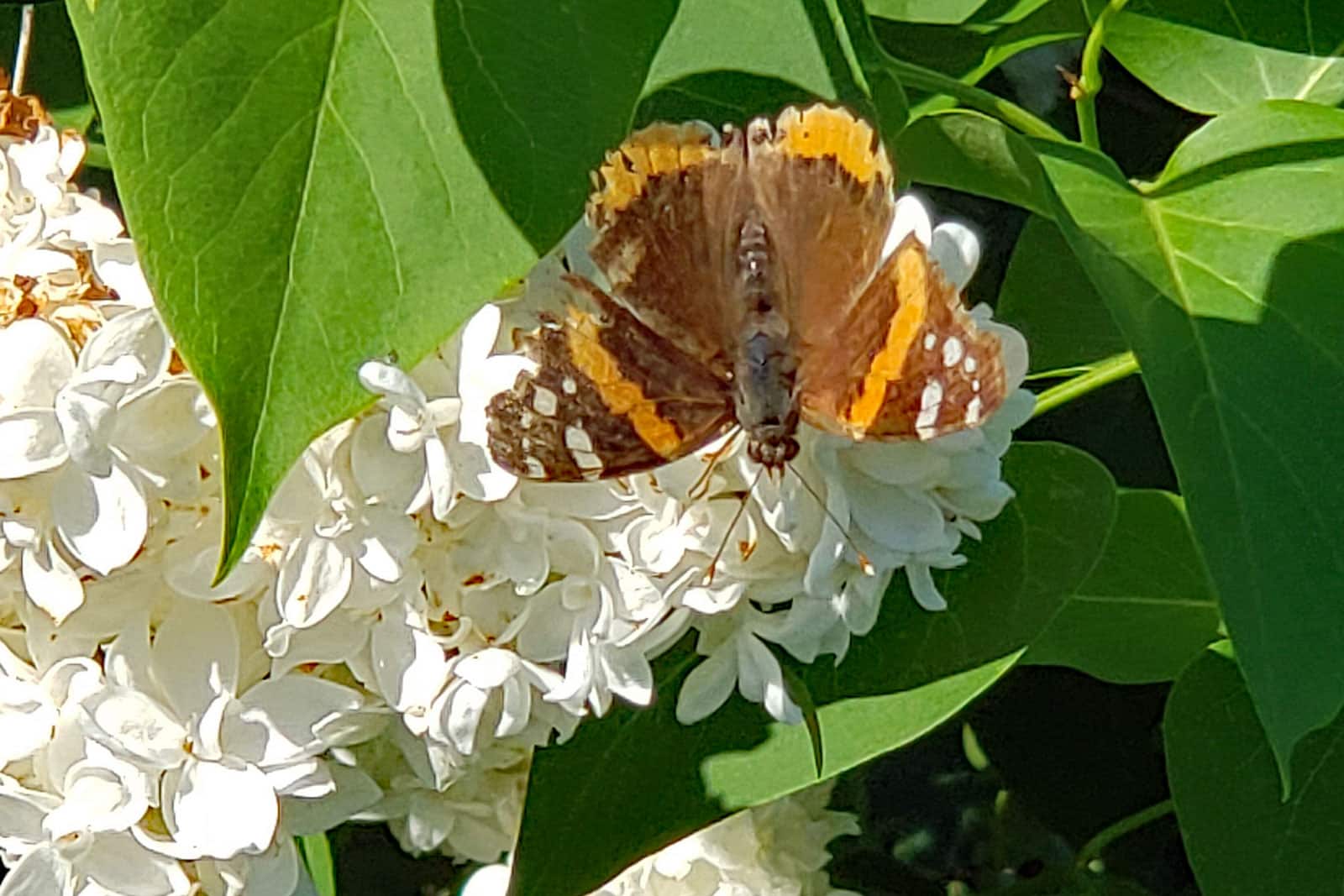
I found the flavor to be very mild and lightly floral. It improves after resting overnight, as the flavor develops.
My youngest said, “I liked it. It was very yummy!” It’s high in sugar, so this falls into the “treat” category, but it’s a fun experiment.
More Flower Jelly Recipes
If you enjoy working with edible flowers, you might also like:
My neighbor was genuinely surprised to learn her lilacs were edible. Now she’s eyeing her bushes a little differently. 🙂 If you’ve got a yard full of blooms, you might as well put them to good use.
This article is written by Laurie Neverman. Laurie grew up in the kitchen, learning baking and home cooking from her momma. At age 15, she and her mom and two sisters created Irene’s Custom Cakes & Catering. This was her summer job through most of high school and college.
Originally posted in 2013, last updated in 2026.
I have not made the jelly yet. My question is, has anyone just left the flowers in and made jelly that way? If so, how did it turn out? Thank you melissa
The flowers tend to discolor during the steeping process, and aren’t very pretty anymore. If you wanted to add in a few fresh blossoms as you are putting the jelly in jars, they should be preserved for a time (rather like sugared lilacs). I’d use those jars fairly quickly, as odds are you’ll get little pockets of liquid forming around the blossoms as the sugar in the jelly draws the moisture out of the flowers. How much water the flowers give off will vary with rainfall and available water to the tree. If you’re serving the jelly during lilac season, you could pour it into a serving bowl and sprinkle the flowers on top to highlight the flowers.
Seriously DELICIOUS!!! Don’t think about it just do it… I’m not a huge fan of floral tasting things and a friend mentioned doing Lilac’s because I was making RedBud Jelly that week. I was like meh ok maybe… another friend & I agreed to swap some jelly because she was going to make some dandelion jelly and she loves Lilacs. I’m so glad I did!!!! I’m going to be getting more from my Uncles yard this time to leave plenty for the winged friends that need it.
I’m glad you enjoyed it. No redbuds in our area, but I’ve heard that jelly is tasty, too. Each bloom brings a unique flavor, not quite like the flower scent, but tasty.
I just made this today for the very first time. Thank you for sharing the recipe. Will be making it again. Very delicious.
I’m glad it turned out well for you. Our lilacs are just starting to bud out this year.
When I click to triple the recipe everything changes except the pectin….is that right or do I need to triple the pectin also? I’ve only ever made apple jelly and didn’t have to use pectin. Also, do you think apple lilac would be good? I’m thinking I could freeze the infused water until apples are ready in late summer.
Hi Carol.
I wish I had the option to turn off the double/triple the recipe function in the recipe card for some recipes, namely jams and jellies.
For full sugar jam and jelly recipes (like this one), I don’t recommend doubling or tripling the recipe. Why? Because the batch size gets so large that it tends to cook unevenly. The jelly at the outer edge tends to over cook by the time the center heats through, even with stirring. Cooking in single batches works better.
If you were still determined to make a double or triple batch, you would need to double or triple the pectin. I have no idea why the recipe card calculator didn’t do that.
With low sugar jelly recipes, doubling the recipes works better, because the batches are smaller. There’s not more sugar than juice/infused liquid.
If you were making a no added pectin apple lilac jelly, I think the cooking time required to get it to gel, would eliminate some of the more subtle flavors of the lilac. If you add pectin to shorten cook time, you might retain more lilac flavor. If you have plenty of infusion, it doesn’t hurt a thing to try and see how you like the results.
I made two separate batches today. I have some white sort of filmy stuff on the surface. I strained the lilacs with cheese cloth so it’s not from the flowers. Seems to develop during the boiling after adding sugar. Boiling too high? Unresolved sugar? Anybody else experience this? Otherwise, beautiful colour and great recipe.
It’s not unusual for jam and jelly to develop a thin layer of foam that settles into a white film. Typically I just stir it in, as it doesn’t affect the flavor. You can also use a spoon to skim it off. Some older recipes called for a dab of butter to be added to the jam or jelly to reduce foaming.
I’m making this today and mine stayed a pink/purple color. I hope I didn’t do anything wrong. Its very pretty, can’t wait to taste it!!
The color changes some over time. I’m sure it’s fine. 🙂
If I use white lilac will the jelly still look beautiful are do.i need to.put food coloring in it t to make it pretty
I haven’t used white lilacs or seen them used, so I don’t know what color the jelly will be, but you can adjust it if you like.
Made this yesterday, and I tossed in about 15 blueberries into my “tea” to give it a more lilac-like colouring. It tastes great but 24 hours later, it is still quite liquid in the jars. I put some in the fridge and left some on the counter, neither seems to have jelled just yet.
Did you use the recommended amounts of pectin and sugar and recommended cooking time? All are needed for full sugar pectin to work.
I used the 4 cups of sugar, and one pouch of liquid pectin (Bernardin brand). The pouch has 85 mL of pectin (85 mL = 2.87 oz) of liquid pectin. The ones in the fridge are a bit more viscous after 24 hours of refrigeration, but still not quite a jelly. The ones at room temperature (I’m in the middle of a nasty heatwave where I live) are very liquid. I’m sure the ones in the fridge will solidify a bit more.
The liquid pectin is the issue. It tends to provide a softer set than powdered pectin by default. The jelly may set up more over time.
In the future, I’d suggest using powdered pectin, or reducing the flower water liquid by 1/4 cup.
Question? Is the infused liquid supposed to be bitter?
I didn’t taste it, but I wouldn’t be surprised if it had a small amount of bitterness.
I followed the recipe and mine gelled perfectly. It also came out a gorgeous shade of pink (from light purple blooms). I’ll definitely make this jelly again!
I made this lilac jelly today and it is delicious. I have never made lilac jelly before. It took quite a while to get all the tiny flowers off the plant but I just put on a movie and parked myself on the couch. It was worth it and it’s so fun to make something unique. Mine came out a light pink color. Thanks for sharing this wonderful recipe!
You’re welcome, Ginnine.
I just found this recipe on April 26, 2020, picked my light purple lilacs on the 27th and just took my finished jellies out of the water bath canner. My jellies have a beautiful mauve color and taste amazing! I got five 8oz jars and a 4oz jar for tasting throughout the day. Thank you SO MUCH for this recipe!!!
You’re welcome. Glad it worked out well for you.
Does anyone know of a way to do this with with sugar substitute, like monk fruit or similar natural sweetness. Or is sugar the only way?
Technically, the definition of “jelly” is “a sweet, clear, semisolid spread or preserve made from fruit juice and sugar boiled to a thick consistency”, so if you eliminate the sugar, it’s not really jelly anymore.
If you wanted to attempt a flower infusion based spread with less sugar or no sugar, I’d opt for using Pomona’s Universal Pectin, which will gel without sugar. Start with the low sugar dandelion jelly recipe as a base (https://commonsensehome.com/dandelion-jelly/), and substitute your sweetener of choice for the sugar.
I’m not certain how this would work since I have not tried it, but the odds seem pretty good.
I WISH along with the numerous links you do have you would add one for sending by email. I want to share this with EVERYONE I know. WHY haven’t I been told about this DECADES ago? Lilacs have been my all time very favorite flower ever since a little girl and the neighbors had on the property line two very large lilac bushes that while on the line, were still close enough to my one bedroom windows that when a breeze wafted over them I could lie in bed at night and enjoy their lovely aroma. Now, living in our family’s 200+ year old homeplace, where at one point, after my great-grandmother passed away my great-grandfather removed most of the shrubs and bushes she had. They interfered with his mowing. Well I have planted all sorts of varieties of lilacs on the property and it helps to keep the season lasting far longer than what we get with the standard normal lilac most people have. I have to try this.
Multiple lilac type sounds lovely. I’m glad you brought them back.
Just send people the url for the post. 🙂
I couldn’t wait to try this, so I picked a bunch of flowers today – before reading the recipe, ????
I have to work 12 hours tomorrow! ????
Can they steep longer?
Could I freeze the flowers and complete the process later?
Sometimes longer steeping can lead to off flavors, so I’d probably freeze them and process when you have more time.