
How to Make Lilac Jelly (Yes, Lilacs are Edible)

This post may contain affiliate links. Read my full disclosure here.
Lilac jelly is one of the easiest flower jelly recipes to make, because the lilac flowers are so abundant. They’re one of my favorite parts of spring, with their heady aroma filling the countryside. Seeing the large bushes adorning the old farmsteads and sprinkled through the towns makes me happy. It feels like a yard in our area isn’t complete without a lilac bush (or two).
We have two lilac bushes – a white and a light purple. Our lilac bushes get so covered in blossoms you can barely see the leaves. The neighbors have even bigger bushes. (We have some farmsteads that have been in the same family for over 100 years.) I wonder what those weathered bushes would say if they could tell the stories of those homesteads?
If you’ve tried dandelion jelly, this recipe follows a similar process. It has a softer, more delicate floral flavor.
Would you like to save this?
Table of Contents
A Lovely Lilac Jelly Recipe
Candied flowers are a classic way to enjoy lilac blossoms, but I wanted something a bit quicker. This recipe uses a simple infusion to create a beautifully lilac infused jelly. You can also adapt this method for other strongly scented edible blossoms.
See our Edible Flowers List for more flower jelly ideas.
For best results:
- Harvest lilac blossoms from unsprayed plants
- Avoid roadside plants (pollution exposure)
- Use freshly picked flowers for the best flavor
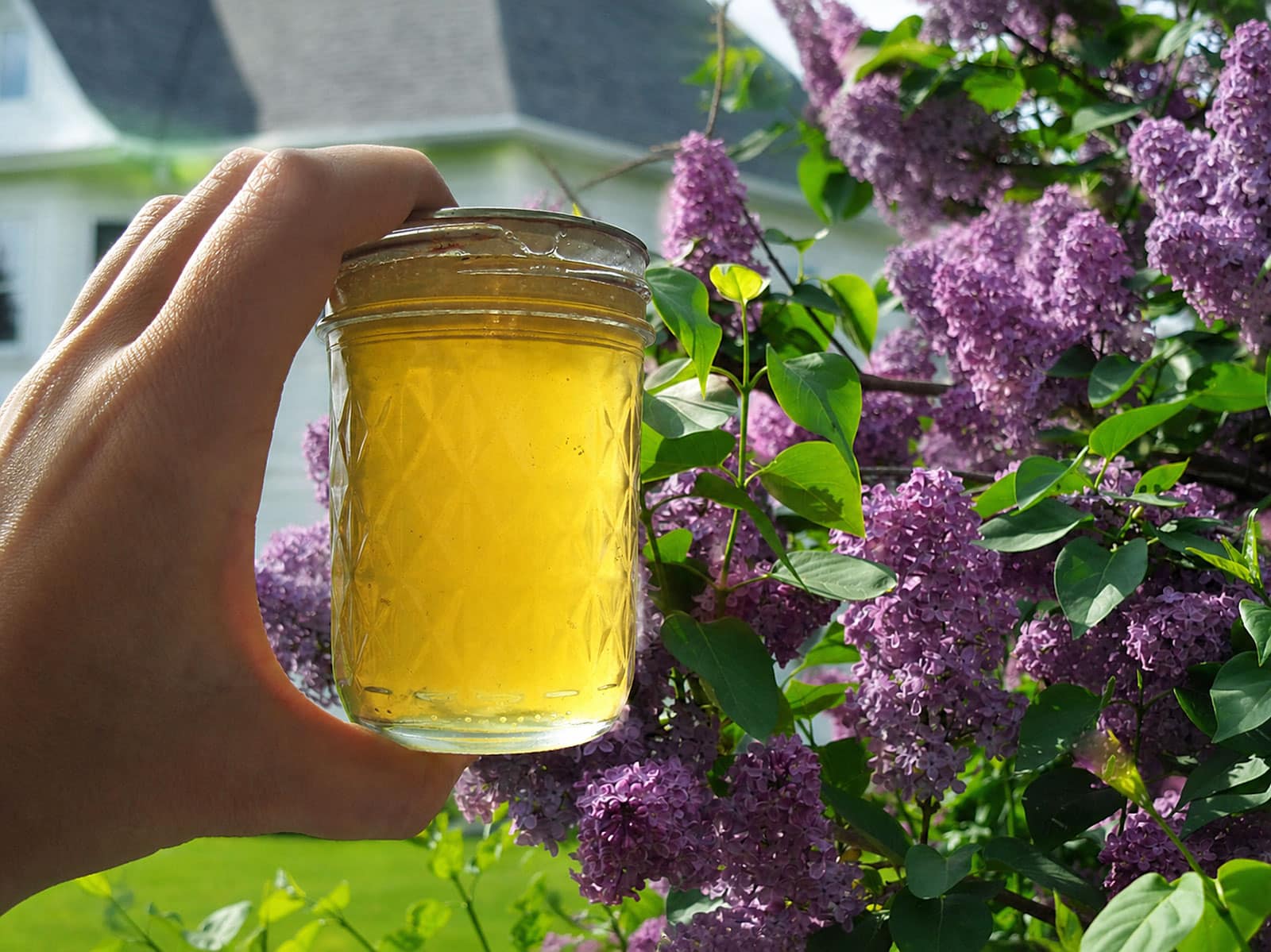
The flowers I used for my jelly were light purple, which gave me a bright yellow jelly. Dark purple flowers will give you a darker jelly.
Making Lilac Tea (The Base for Your Jelly)
To begin, you’ll create a lilac tea using the blossoms.
- Remove flowers from stems (stems can make jelly bitter)
- Place blossoms in a heat-safe container
- Pour the boiling water over the flowers
This creates your infused water, which will carry the lilac flavor into the finished jelly. Let the mixture steep for 8 hours or overnight. You don’t need to wash the flowers unless you think they might be dusty.
Ingredients
- 2 cups packed lilac blossoms (no stems or leaves)
- 2 1/2 cups boiling water
- 1/4 cup lemon juice
- 4 cups sugar
- One box Sure-jell powdered pectin (1.75 oz, or just over 4 tablespoons pectin)
Instructions
1. Prepare the Lilac Infusion
After steeping, strain out the blossoms and squeeze them dry. You should have about 2 1/4 cups of lilac infused liquid. Add a little water if needed.
For clearer jelly, you can refrigerate the infusion overnight and carefully pour off the liquid, leaving sediment behind.
2. Cook the Jelly
In a large heavy bottom pot, combine:
- Lilac infusion
- Lemon juice
- Pectin
Bring to a rolling boil over medium-high heat. Add the sugar all at once and return to a full rolling boil. Boil for 1 minute, stirring constantly. Skim foam if needed, then remove from heat.
3. Fill and Process Jars
Ladle the hot jelly into hot sterilized jars, leaving 1/4 inch headspace. Wipe rims clean and screw on the lids.
Place jars in a boiling water bath canner and process for 10 minutes (adjust for altitude if needed). Remove jars and let them cool undisturbed.
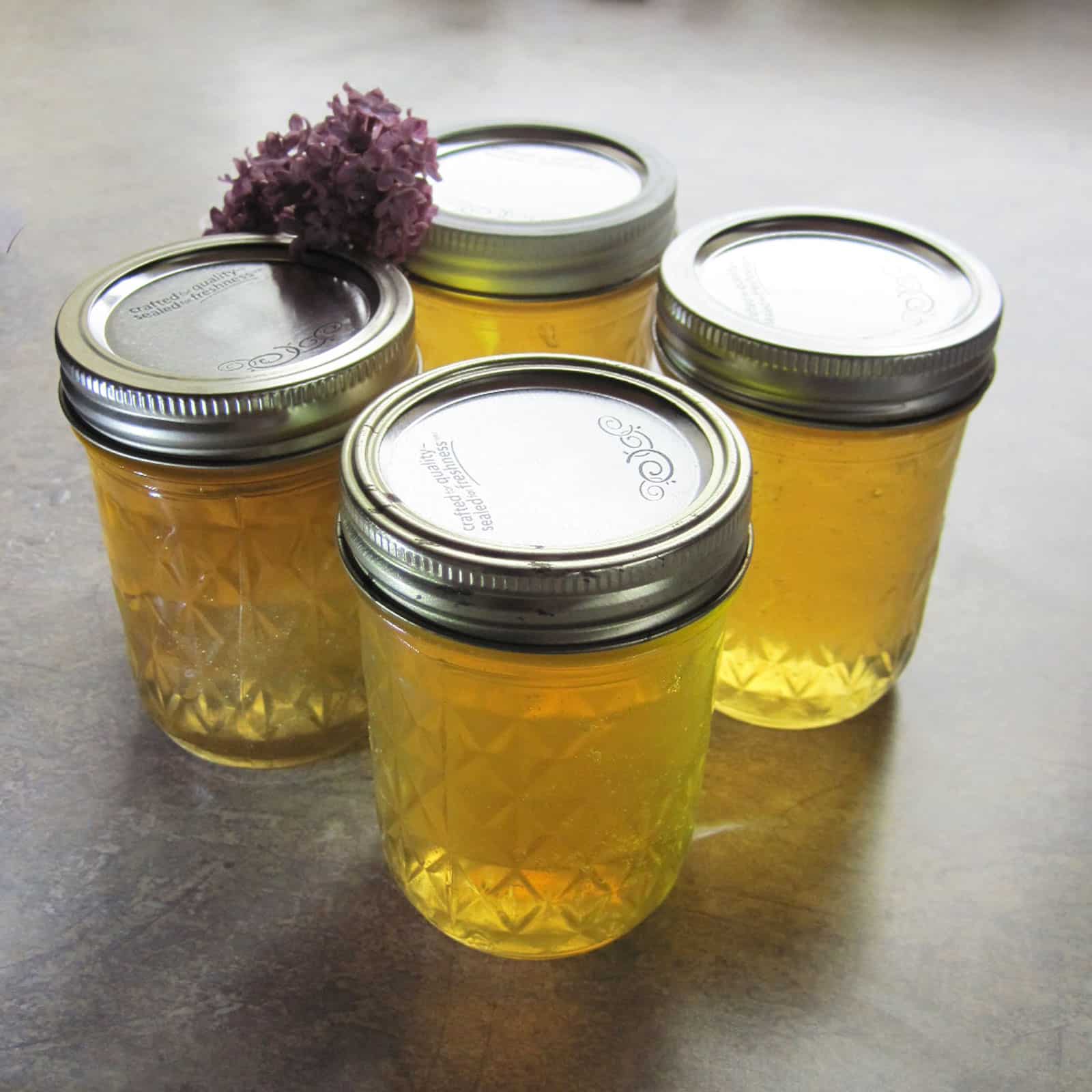
Yield: Makes around 4 half-pint jars or 8 – 4 ounce jars.
Note that although the recipe card has an option to double or triple the recipe, it’s best to make it in single batches. With a double or triple batch, it takes longer for the jelly to heat through. The quality will be better with a single batch at a time.
PrintLilac Jelly
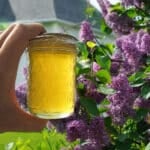
A simple lilac jelly recipe to share or enjoy at home.
- Prep Time: 10 minutes
- Cook Time: 10 minutes
- Total Time: 20 minutes
- Yield: 4 cups 1x
- Category: Jelly
- Method: Canning
- Cuisine: American
Ingredients
- 2 cups packed lilac blossoms, no leaves, no stems
- 2 1/2 cups boiling water
- 1/4 cup lemon juice
- 4 cups sugar
- One box Sure-jell powdered pectin (1.75 oz, or just over 4 tablespoons pectin)
Instructions
- Prepare the Lilac Infusion. After steeping, strain out the blossoms and squeeze them dry. You should have about 2 1/4 cups of lilac infused liquid. Add a little water if needed. For clearer jelly, you can refrigerate the infusion overnight and carefully pour off the liquid, leaving sediment behind.
- Cook the Jelly. In a large heavy bottom pot, combine: Lilac infusion, Lemon juice, Pectin. Bring to a rolling boil over medium-high heat. Add the sugar all at once and return to a full rolling boil. Boil for 1 minute, stirring constantly. Skim foam if needed, then remove from heat.
- Fill and Process Jars. Ladle the hot jelly into hot sterilized jars, leaving 1/4 inch headspace. Wipe rims clean and screw on the lids. Place jars in a boiling water bath canner and process for 10 minutes (adjust for altitude if needed). Remove jars and let them cool undisturbed.
Notes
Making Lilac Tea (The Base for Your Jelly)
To begin, you’ll create a lilac tea using the blossoms. Remove flowers from stems (stems can make jelly bitter). Place blossoms in a heat-safe container. Pour the boiling water over the flowers.
This creates your infused water, which will carry the lilac flavor into the finished jelly. Let the mixture steep for 8 hours or overnight. You don’t need to wash the flowers unless you think they might be dusty.
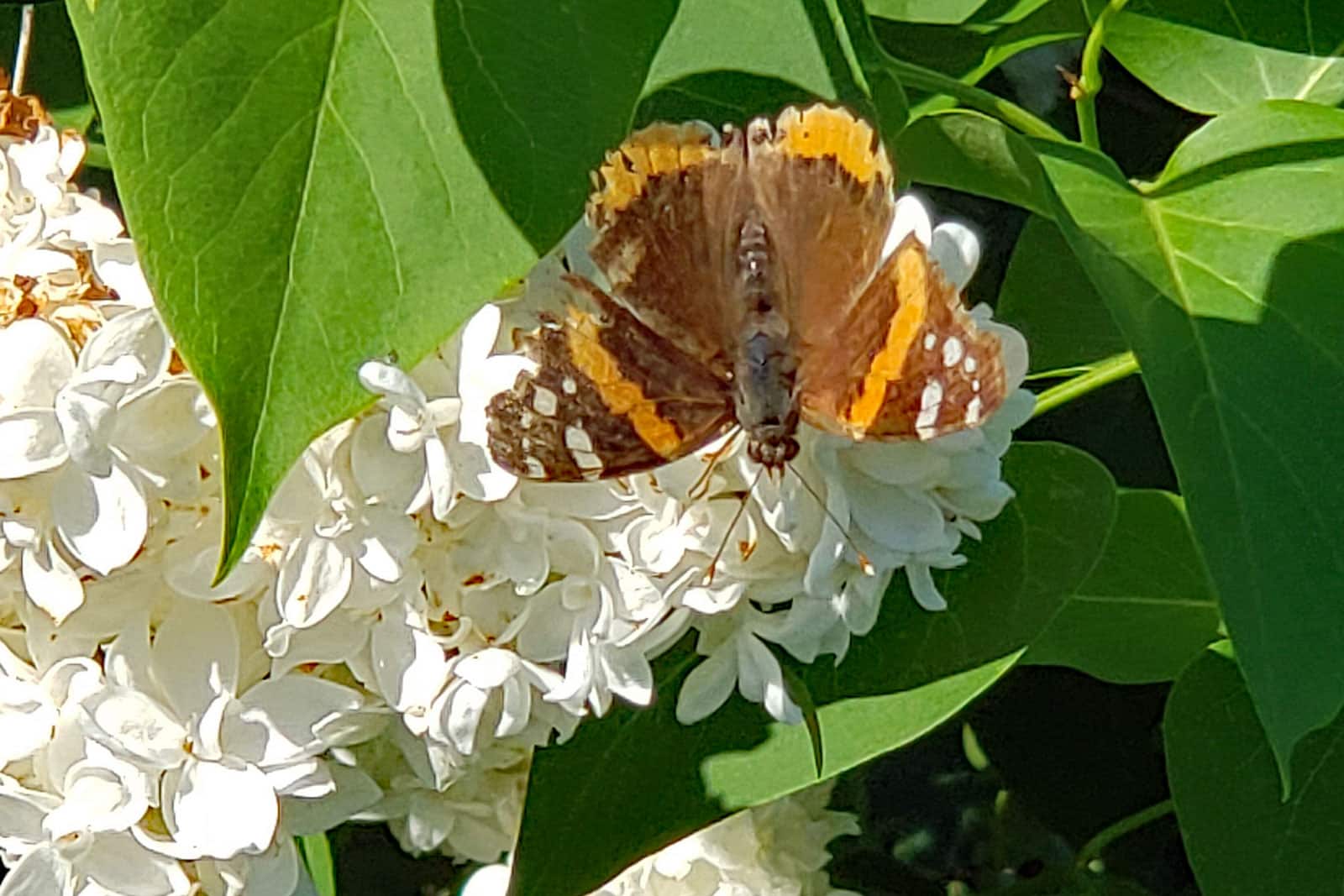
I found the flavor to be very mild and lightly floral. It improves after resting overnight, as the flavor develops.
My youngest said, “I liked it. It was very yummy!” It’s high in sugar, so this falls into the “treat” category, but it’s a fun experiment.
More Flower Jelly Recipes
If you enjoy working with edible flowers, you might also like:
My neighbor was genuinely surprised to learn her lilacs were edible. Now she’s eyeing her bushes a little differently. 🙂 If you’ve got a yard full of blooms, you might as well put them to good use.
This article is written by Laurie Neverman. Laurie grew up in the kitchen, learning baking and home cooking from her momma. At age 15, she and her mom and two sisters created Irene’s Custom Cakes & Catering. This was her summer job through most of high school and college.
Originally posted in 2013, last updated in 2026.
Are flowers that have a touch of brown on them okay to use?
Maybe. Without is better. Watch for signs of spoilage or unpleasant flavors in the flower water soak.
Just wondering if anyone has tried using dried flowers for the jelly. If I was to measure out the amount according to the recipe and then dry the flowers, would it still work? I am steeping the first batch as we speak and will process it tomorrow. I have used fresh flowers for this but wonder if I could dry and save the flowers for a future batch. I would hate to waste such beautiful flowers;)
I think the flavor may not be as strong, but it should work.
I’m confused. Are you using the strained water or the buds themselves for the jelly. Do any of the buds soaked overnight go into the jelly? TY!
It’s jelly, so as you can see from the photos, no buds. Jelly, by definition, is made with a clear liquid. In the case of flower jellies, the clear liquid is the flower infused water.
After soaking, the flowers aren’t very attractive. They brown and wilt, and would also be rather chewy as part of a spread. If you are making up food for a party and want to dress up your display with the flowers, I’d suggest candying them as described in the first paragraph of the post, or just using them “as is” picked off of the stem.
I have my tea steeping now, but it does not smell anything like lilacs. Is this normal? I waited till close to the end of the season to make this, and it has been raining for a week straight (I wish I was exaggerating) so would the watered down petals make it smell less lilac-y. I am so excited to try this, I make jelly out of just about anything so I want this to turn out well.
Yes, unfortunately extreme levels of precipitation are likely to water down the flavor somewhat.
Is there a website I can go to so that I may buy some? It sounds good but not much lilac in the south
There are sites that list them for sale, but I’d be hesitant to buy them without a guarantee that they are not sprayed with something you don’t want in your jelly. You can make a similar flower jelly from most edible flowers. Maybe there’s something that’s abundant in your area that you could try instead? There’s a post on edible flowers at https://commonsensehome.com/edible-flowers/.
Try fireweed jelly. Use this same recipe. Pick off the blossoms ,,,no green and by all means drink the water you pour off as a tea. Fireweed is amazing and many healing properties.
My jelly turned out perfect except it has a bitter flavor and don’t understand why. Any suggestions ?
Could you have gotten some stem in with the flowers? That’s the most common source of bitterness. If you eat them, you’ll notice the flowers themselves have a mild flavor, but any green is bitter. Otherwise, is there a possibility of contamination? Pesticide and herbicide drift will give off flavors. Was it cooked longer than recommended? This could also produce an off flavor.
made this
came out awesome
not sure on what to serve it with??
Toast with butter and jelly is a classic. You could also serve it with pancakes or waffles, or spread it with a dab of cream cheese on crackers.
Scones and clotted cream!
I haven’t made jellies before so this may be a bad question but is it possible to use stevia or Tru-via instead of sugar?
Not a bad question. You cannot substitute stevia or Truvia for sugar in a standard jam or jelly recipe, or it won’t gel. If you’d like to use less sugar or a sugar substitute, you should use a pectin specifically for low sugar/no sugar jam/jelly, such as Pomona’s Pectin.
I haven’t tried a low sugar/no sugar version of this jelly, but estimating from the dandelion jelly in the book Preserving with Pomona’s Pectin, you’d probably want to use 1/2 cup to 1 cup of Truvia, 2 teaspoons of calcium water (included in the Pomona’s Pectin package) and 2 teaspoons of Pomona’s Pectin.
Can you use honey or part honey instead of all sugar?
Honey will change the flavor and color of the final product, but it should work. Use 3/4 cup of honey for each cup of sugar (so 3 cups honey) and reduce liquid by 1/4 cup for each cup of honey (so use only 1 3/4 cup water to infuse the lilac blossoms).
So nice to see someone post the actual quantities instead of just saying reduce it by X mount or increase it by X amount because there are a lot of math dummies in the world! LOL
Hi Dawn.
I just added a note to the post. I’m not sure if you were thinking about making a double batch, but full sugar jellies work best in single batches.
Hi, I like to substitute Agave for surgery. Woul I follow the same instructions you posted for honey?
Pick your own suggests:
Could the infused liquid be consumed as a nice cold drink? If so, what might be the nutritional value, if any?
There’s no reason you couldn’t drink the infused liquid if you cared to do so. I’m not sure how much if any nutritional qualities would be retained, but here’s an interesting snippet from Scientific American about eating flowers:
If you add 1 teaspoon of citric acid in a 1/4 cup of water and crush or blend the flowers prior to steeping your flowers will not turn brow and will change to a rose pink color. I have not tried this with lemon juice.
Do the flowers have to be open? or can new unopened flowers be used?
I’m not sure, but sniffing around the lilac tree, it seems to me that the flowers reach their maximum aroma (and likely flavor) once they have opened.
My infused liquid looks like ice tea – will it turn the beautiful yellow after I add everything?
Not sure, as I have not had that happen. However it looks, taste should still be similar.
Mine did this too but turned a beautiful yellow once in jelly form
Can you let the flowers soak longer or keep the infused liquid in the refrigerator for several days before making the jelly?
I haven’t tried it, but refrigerating should buy you a couple of days.
Can you double this recpie? I have 4cups of lilacs steeping now.
I know it’s a lit bit of a hassle, but it would be best to process in two batches. Cooking in a single batch allows the liquid to come to temp more quickly and evenly, given the final product a lighter, less “cooked” taste. I have tried double batches of jam and jelly a few times over the years, and while it can be done, I think single batch quality is worth the extra time.
Absolutely do not try to double jelly and jam recipes. My “jammy mentor” Margaret taught me this, and it’s especially critical for recipes not using commercial pectin. Even then, stick to single batches.
I made my Lilac Jelly tonight and it turned out wonderful. I loved the delicate smell of lilacs while it cooked. My jelly came out a beautiful deep pink color… not yellow like yours. I am very pleased. Thanks for sharing.
If you used the darker lilacs, that would help with the color. Mine were very pale. Glad that it turned out well for you.
My jelly is very runny, how long will it take to set. I placed some in the fridge and thickened only slightly.
If your jelly did not set after it cooled, you may have made a mistake in the cooking process. You can either use it “as is” as a syrup, leave it an see if it thickens up over time (I had some grape jelly that set up after a few weeks in storage) or recook with additional low sugar pectin as discussed in “How to Remake Jams and Jellies That Didn’t Set“.
It could be because the instructions doesn’t say to add the pectin at all
I take that back, it has it in the first step ! I can’t wait to try this !
Try 2 packs of pectin per batch if your using the fluid packs or just double the dry mix formulaben
I leave in a country invaded with black flies at Spring time. They stick on the flowers and specially on lilac. I will like to make that jelly but how to get rid of those sticky black flies before infusing them in the water ?
Do the flies have any flavor? If it doesn’t freak you out, they could probably be left in. Otherwise, try a warm rinse with vinegar water, but don’t let them soak too long or you’ll lose the flower flavor.
Can you possibly just pick off the flowers that have the flies stuck to them? I don’t know what your black flies look like, or how big/small they are so am not sure if what I’m saying is do-able. Just a thought.
I have not yet made lilac jelly but a few years ago I made fireweed jelly as that is prominent edible flower in Alaska. I picked the fireweed late in the season and ran into the bug issues. I actually rinsed the petals as best as I could and strained them but ultimately, when I poured the boiling water on the petals, there were bugs. I let the petals and the bugs steep but when I strained it I used cheese cloth. I did not have any bugs in my jelly and it tasted great! I just don’t tell anyone about that part when I give it away as a gift. Haha!
I think it depends on the bugs. Bugs that eat a particular plant often taste/smell similar to that plant.
For instance, broccoli worms taste like broccoli. Most red and bright orange bugs are not pleasant to eat or recommended for eating, like Asian lady beetles. Those things are utterly bitter and revolting in flavor and would ruin any food they were in. A friend of mine did a guest post for the site on eating bugs – https://commonsensehome.com/eating-bugs/
I’m glad your jelly worked out, and thank you for sharing the bug story. Good to know – just in case!
I never heard of lilac jelly. We will have to try this next year. My daughter always likes trying new things. Does the jelly smell as good as the lilacs in bloom?
It’s not nearly as fragrant as the flowers themselves, just a hint of floral scent and flavor.
In the past my lilac bush was exploding with flowers so I asked around for a use for lilac flowers only to be told they are not edible. Imagine my surprise to find out I can make jelly from my lilac bush.
My friend has been eating candied lilacs for years with no ill effects.
Wonder how to make them?
As mentioned in the first paragraph, she simply brushed the blossoms with beaten egg white and sprinkles superfine sugar on them. I would only use local eggs you trust if you want to try this, not factory farmed eggs.
I made lilac jelly this week, as well – we’re drowning in lilacs, and they’re one of my favorite flowers, but their season is so short, and always coincides with putting the garden in or getting day old chicks, so I always miss it! Not this year, though – I finally got a chance to make that jelly I’ve been talking about for the past few years. My recipe is a bit different from yours, but I agree – it makes a very pleasant flavor, and not as overpowering as wild rose jelly. It kind of comes out a different color, though, doesn’t it?
Yup! The flowers oxidize while steeping. I added a little back light to get a brighter photo, but in normal light it looks a bit more golden. No purple to be seen.
I can’t seem to find the comment button, so I’m replying to your comment, maybe you can help me?
I’ve spent the last 8 hrs pulling out pollen and lil’ baby stamens, then I re-read the recipe and it says no leaves or STEMS lol
Can I leave these in or should they are removed?
Any help would be lovely. TIA
All the flowers go in the recipe, if that’s what you’re asking. No need to pull stamens out.
Ty 🙂 I’m guessing the little pollen things are find too then. Seriously. All that work just got me a cup lol. You just saved me another 8 hrs!
I pull the flowers off the stems. No flower dismemberment required.
So someone donated a bunch of lilac for my jelly today but many of them have small amounts of burn from the sun. I have bad lighting to differentiate. Will this affect the taste of my jelly? My guess is it will taste burnt. Do you have any experience with this? Any info would be super. TIA.
I’d suspect what you are looking at is the beginnings of rust/flowers fading, not sunscald, as I have never seen lilacs with sun damage, but I may be mistaken.
I’ve never tried working with flowers that are starting to fade, but everything is sterilized during processing, so spoilage shouldn’t be an issue.
Did you try tasting one to see if it has an “off” flavor? If so, spit out and don’t use them.
Nm. The water was to MAKE the infusion.
Please let me know if I’m wrong and missed something else 😉
Yes, you pour the 2 1/2 cups of boiling water over the blossoms to make the infusion.