
Ear Mites in Cats – Easy Treatment, Plus Common Questions

This post may contain affiliate links. Read my full disclosure here.

Ear mites in cats are quite common for cats that spend time outside. Since most of our kitties adopted us after living outside or in a barn, they still want outside time. They are also working cats, patrolling the garden and orchards for rodents.

Would you like to save this?
There are commercial earmite control products available, or you can get your vet to clean kitty’s ears.
Because cats put everything they groom/lick into their mouths, I wanted to use a non-toxic ear mite control instead of a pesticide. I cleared this technique with our vet. She said that coconut oil or olive oil are both safe to use.
How Do Cats Get Ear Mites?
Cats typically pick up ear mites from contact with other animals, including other cats, dogs, rabbits and rodents. Mother cats may pass them on to their kittens.
There are several species of mites, with the most common being Otodectes cynotis.
Mites can survive for a short time off of the animals, so they may be spread through bedding, carpets and other soft surfaces. Some species of mites may also spread outside the ears, causing patches of skin irritation.
When you treat you pet for ear mites, try to clean their primary areas at the same time. I cover our kitties’ favorite hang out spots in old blankets that I can throw in the wash.
You can also thoroughly vacuum and wipe down items that can’t go in the washer (like cat trees), and set them out in the sun for a day or so to help kill off the mites.
How Do I Know if My Cat Has Ear Mites?
Mites are tiny, barely visible to the naked eye. They chow down on the wax and oils in kitty’s ears.
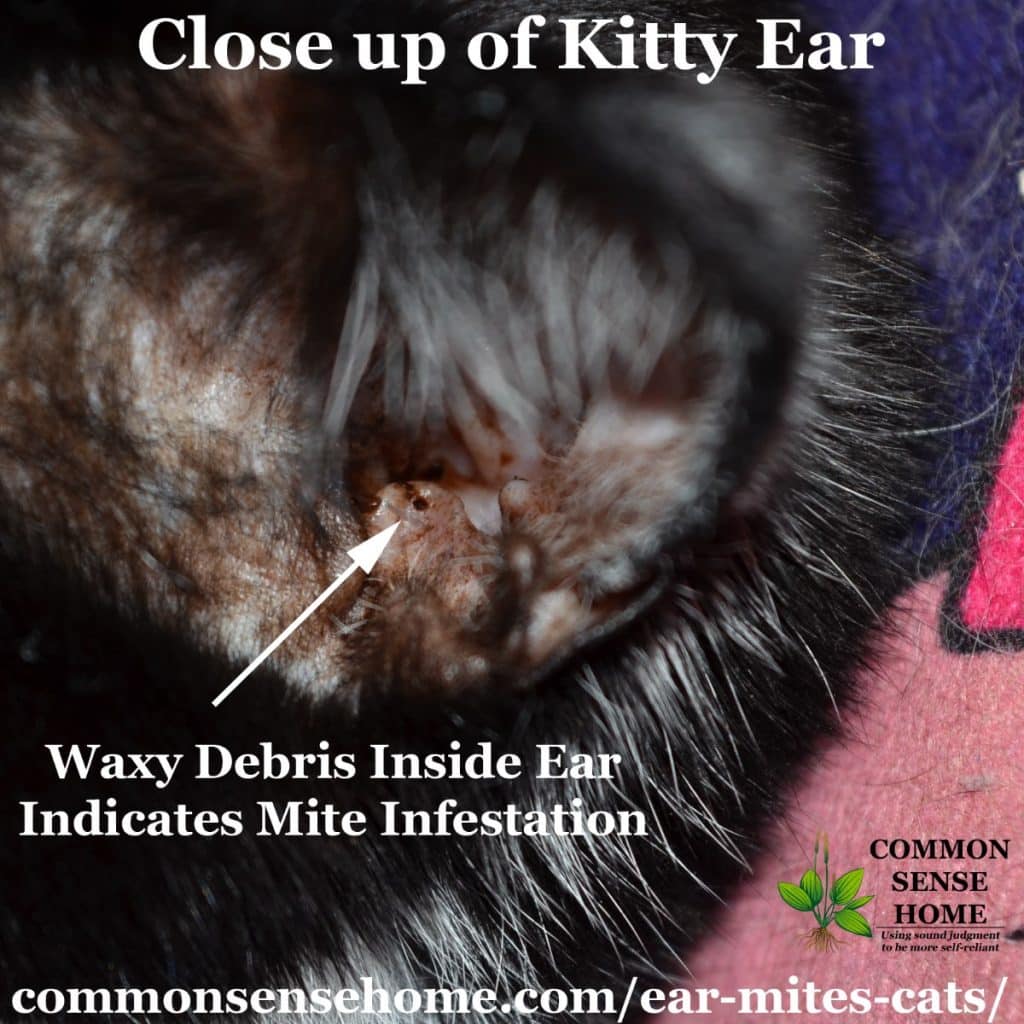
Though the mites themselves are hard to see, what you can see is, well… mite poop. They leave behind dark debris that looks something like sticky coffee grounds.
If it gets bad enough, the mite infestation may completely clog the ear canal with debris, and/or lead to ear inflammation or infection.
With some cats, you may notice excessive exterior ear grooming, leading to hair loss on the back of the ears.

Other symptoms you may notice:
- Smelly ears
- Head shaking
- Dark, waxy ear goobers
- Pink and swollen interior of ear
- Scratches or scabs near the ear
Can Humans Get Ear Mites from Their Cats?
Thankfully, ear mite infestations in humans are very rare. It’s still a good idea to keep your ears clean, and don’t encourage kitty to lick you due to risk of cat scratch fever transmission.
Cat scratch fever, unlike the name implies, does not need to be spread by scratching. It can also be spread by licking.
Learn more at Cat Scratch Fever – Why You Should Never Let Your Cat Lick Your Face.
Dogs and other pets may be susceptible to mites, so make sure to check all furry pets and thoroughly clean surfaces.
Ear Mites in Cats – Easy Treatment with Coconut Oil
To clear out kitty’s ears, we use coconut oil, a small syringe, some cotton balls or cotton swabs, and a towel to secure the cat. It’s helpful to have two people – one to hold the cat, and one to clean the ears.
Prep the Oil and Syringe
To use coconut oil to clean and remove ear mites in cats, first make sure your oil is in liquid form. The melting point of coconut oil is around 75°F, so in summer your oil may be liquid without heating.
You can also use fractionated coconut oil, or gently heat the oil. I heat up less than a tablespoon, and that’s more than enough to do 3-4 cats.
Make sure the oil is warm, not hot. Kitty’s safety is a priority.
Use a small syringe to squirt a little oil into the ear canal – about 1 ml (1/4 teaspoon) per ear. Never force anything deep into the canal.
Secure the Cat and Apply the Oil
To make it easier to handle your cat, you may wrap the kitty tightly in an old towel, tucking in paws and claws. We call this the “kitty burrito”.
Gently massage the ear area to work the coconut oil into the mites and debris. Use a cotton ball or cotton swab to wipe the debris and mites from the ear. Again, never force anything into the ear.
Be extra careful if using swabs, because the cat may get annoyed at having their ears touched and shake their heads aggressively. You don’t want the swab to poke too deep into the ear.
Once visible debris is removed, make sure to give kitty lots of love before releasing. Repeat in 5-7 days for bad infestations, or any time you notice your cat grooming their ears excessively.
Coconut oil is naturally antibacterial and and antifungal, so it will also help to heal and soothe any scratches in the ear.
If Your Cat’s Ears Look Very Sore or the Mites Don’t Respond to Treatment
If your cats ears are very red or sore, please take them to a vet, as there are some other conditions with symptoms similar to ear mite infestation.
With a typical ear mite infestation, there is usually some debris, and the ears may be a little pink. If kitty appears to be in significant pain, seek professional help.

You may also find useful:
I’ve recently seen my cat scratching its ears with its paw, which happens constantly throughout the day. I thought it was just his normal behavior until yesterday after opening his ears I discovered there were ear mites. I am really shocked and very sorry for my cat, she must have been itchy and very uncomfortable.
For the past two days, I’ve seen my cat scratching its ears with its paws and shaking its head constantly. I thought he was just kidding so I didn’t pay him much attention until today I hugged him and realized his ears smelled bad, he was even showing signs of an ear infection, I was shocked and thought maybe it was. it was very annoying and I think of the ear mites it gave my cat. I immediately went to buy ear drops and cleaned my ears but still watched how it went.
With regular treatment, kitty should be mite free soon. If you have trouble getting rid of them or the infection, a vet visit may be needed.
Hi Laurie,
I have a diabetic male cat about 12 yrs. old now, he was a rescue so don’t known for sure but he has mites in one ear. Have taken him to the vet to confirm. They prescribed ear wash solution and Bravecto (which I did not buy the Bravecto because I read horrible stories of being too toxic). So I have been using the VetnCare Oti-Soothe =PS ear cleansing solution and Olive Oil and now I am using sweet almond oil that containes vitamin E and sunflower oil. I clean his ear twice a day with tissues and cotton pads and use the oil and wipe out excess but everyday there is more mites and not sure if it is the dead debris and the mites are still coming out. I have been doing this for 3 weeks. They also look like they came out on his skin above his eye and some hair is gone in that spot. I gave him a bath that he doesn’t mind taking and that got the mites off his face. It did leave a mark on his face below his ear where the black spot was now it is a red spot. Do you think the mites are dead yet? I see black at the bottom of his ear but don’t want to get down there with a q tip. How will it come out? How long ? Am I doing the right way?
If you’ve been treating for three weeks and the issue hasn’t resolved, it’s probably time for another vet visit, as there may be something else going on other than mites.
The mites are on the surface, they don’t burrow, so they shouldn’t be “coming out of the skin”. You might be dealing with a fungal infection like ringworm, which can cause hair loss, or possibly something else.
Also, we only treat one time, then wait a couple of weeks, and treat again to get any mites that may have hatched. We don’t treat multiple times per day or daily.
Hi,
I believe my cat has ear mites as he has bald spots behind his ears and is constantly scratching. I have been using mineral oil, however, he is still scratching. I put a collar on him but I don’t know if this is helping or making the condition worse as it stays moist from the mineral oil. Is it common for scratching to continue even if the mites are gone? How long should it take for the fur to grow in?
Mites usually resolve fairly quickly. One treatment usually gives our cats relief. We’ve only used two treatments for really bad infestations, like when the barn cats decided to move inside.
You shouldn’t be using so much oil that the area is sitting wet. Just a tiny amount in the ear to smother the mites is all that’s needed. and kitty should be able to clean that up within a day.
You may be dealing with something else, like ringworm. It’s probably best to take the cat to the vet.
What about using avocado oil?
That should work fine.
Hi Laurie, what brand of Coconut oil do you use? I don’t want to buy the wrong kind ( So many different kinds!) as I am on a very limited income & in an assisted living home and don’t drive and would have to order it online at Walmart or Amazon. Also, I clicked on the highlighted syringe in your directions which took me to Amazon and it is no longer available. Any others on Amazon that I could use & how many cc’s would I use for each ear? Also, if I was to use a ear dropper, how many drops per ear? Do I do this once a week? And for how long? So sorry I seem to be making this so complicated but I have never done this before and can’t afford right now to take Boo to a vet. He’s been my best buddy for a long time and I just want to do my baby right.
Hi Sherry.
Pretty much any sort of coconut oil will do, as long as it’s food grade. I just use whatever I have on hand.
I reuse a syringe we got with other medicine. It’s a 5 ml, similar to this one.
Just a ml or two per ear should be plenty.
I haven’t used an ear dropper, so I’m not sure how big your drops are.
Your goal is enough oil to evenly coat the inside of the ear and smother the mites.
We do a cleaning if we notice any irritation or excess residue in the ear. If they have a bad mite infestation, you may want to treat again in one to two weeks.
Watch kitty’s behavior, and look in the ears. When ears are clear and kitty is relaxed, you’re good to go.
Hello laurie
Me and my husband adopted a new persian baby boy he’s 8 weeks now but I noticed that he has some dirty stuff in his ears and he doesn’t have hair on his belly and thats a little bit suspicious right!!
Anyways i cleaned his ears with coconut oil and i put coconut oil all over his but over night but i still can see some black dots…
The scary thing is my husband got a rash on his arm And then i found one similar on my chest and more on my arm starts like small red pimple then spread ..
so please please Please!! I need to know ASAP if the ear mites can bite or transfer to humans and if yes are they dangerous to humans, and how should i get rid of them ???
It sounds like you may be dealing with fleas in addition to ear mites. Check out “How to Get Rid of Fleas (Non-Toxic, Pet Safe Options)” for help.
Hi! I’ve been using coconut oil on my kittens ears for about a week and more and more black gunk is coming out – I’m assuming that’s a good thing as the mites are coming to the surface from the canal??
When you say that the coconut oil only smothers the mites does that mean that they don’t actually die and are continuing to live within my kittens ears? Or will this eventually clear the infestation up all together? My poor little buddy had a rough start! found abandoned, got ring worm and now mites. I just want to help him get healthy! Thank you!!
Smother = can’t breathe and will die, but the dead bodies and mite poop are still in the ear and need to be gently wiped clear. If kitty was in rough shape, it may take some time for all the gunk to work out. Once clear kitty should be good for several months, depending on conditions. Watch for excessive ear grooming or head shaking, and visually inspect ears regularly.
If kitty appears to be in serious pain, please take him to a vet.
I was wondering I use to have rabbits and for ear mites we would put baby oil in there ears. Is it ok to do it with my cats also?
I prefer to use an edible oil, since cats groom and lick the oil.
I just moved to a much smaller apartment. My 2 cats were feral cats and have only lived in one place their 11 yesrs. They are traumatized and it is difficult to treat them for ear mites but I am trying. They hide behind boxes,etc and I am having a terrible time. I am using olive oil as demonstrated by a internet vet tech. Each time I check their ears the mites are worse. They hide in the same place on the carpet under my bed and I wonder if the mites stay in the carpet. We barely moved in to the apartment and they got ear mites. I have never had a cat with ear mites in my life. No one in my family has had cats with ear mites. None of my friends either. Could the mites have been in the carpet when we moved to this new apartment. Fleas appeared at the same time but i treat my cats monthly with Advantage II. Rabbits run freely around this huge cpmplex and management is fine with this. I am exhausted and frustrated. Please help!
It’s possible the mites and fleas could have been in the carpet, or they could be transmitted by wildlife.
How frequently are you treating? For bad infestations, weekly treatment is probably needed. The carpet and other soft surfaces where the pests can hide should also be cleaned.
If you feel your cats are in discomfort and treatment is beyond what you can do, it may be time for a vet visit.
If that’s not possible due to cost or other factors, be patient and keep cleaning – the cats and the apartment. Give kitties as much TLC as you can, and good quality food and plenty of fresh water.
I’ve used Olive oil and coconut oil. She didn’t give me any problem with those.
I tried vinegar (my cat wouldn’t tolerate that one bit) she is still scratching. She’s not happy with me doing this in the first place and I’m not happy because it keeps coming back. She doesn’t mind when I put my pinky finger in her ear without the anything on it. That’s how I find out which ear has the mites in them. It goes back and forth from one ear to the other. I don’t know what to do anymore 🙁
Clean both ears thoroughly whenever you treat kitty, not just one. Stick to the oils, as they help smother any eggs and soothe the skin. The vinegar is acidic and will burn any open wounds, which she’s likely have because of the itching. That hurts.
If possible, wash bedding and surface where kitty hangs out to reduce risks of reinfection.