
How to Get Rid of Mice and Keep Them Out!

This post may contain affiliate links. Read my full disclosure here.

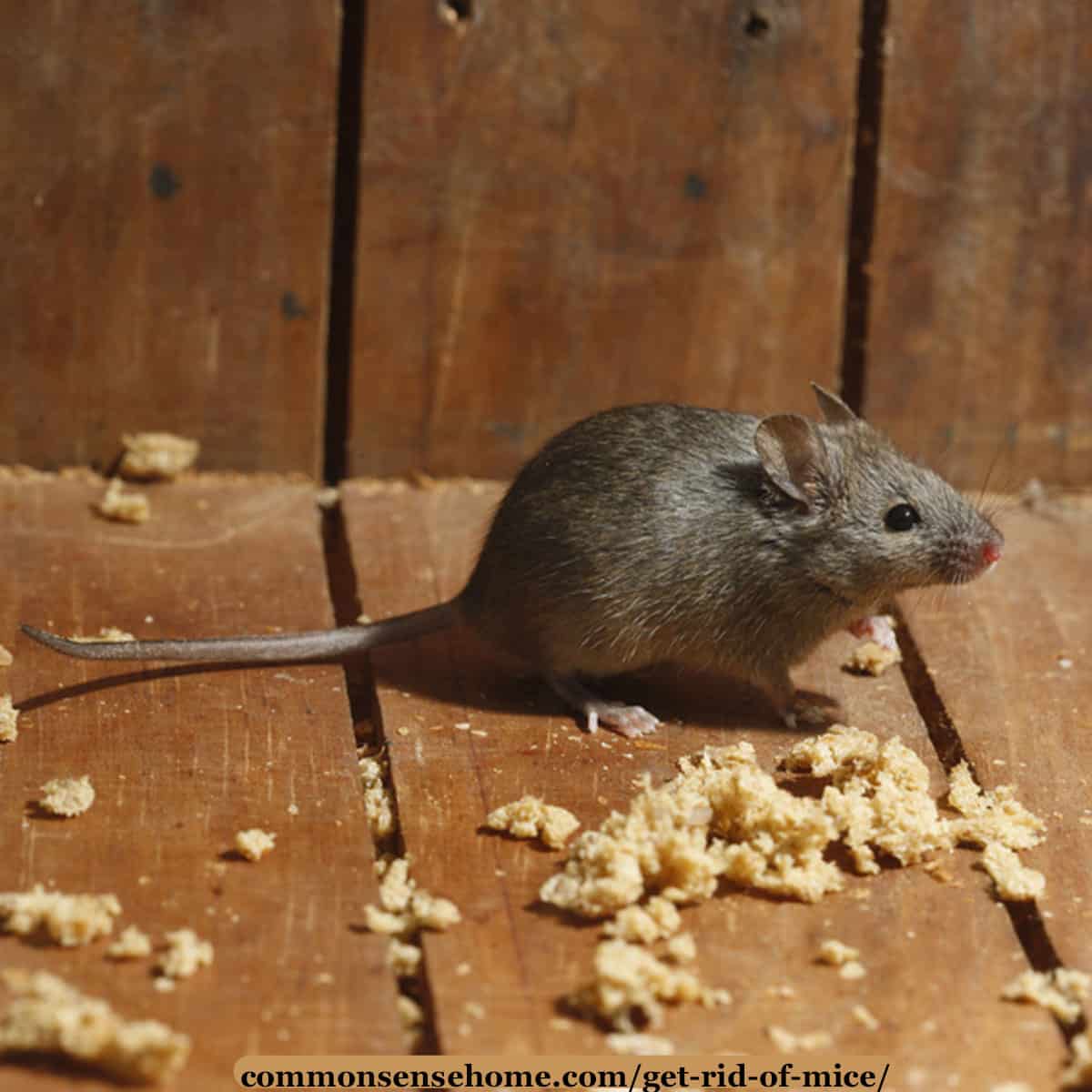
If you build it, mice will come. Sooner or later, you’ll probably need to get rid of mice or rats. Fall is prime time for an increase in mice in your house, as they look for winter protection, but mice and rats can move in at any time. We share how to spot signs of mice, removing them, keeping them out, mouse repellents, and cleaning up the mess safely.
Would you like to save this?
While small, mice and rats can cause big problems. They chew on everything, causing property damage and potential fire risks when they gnaw on electrical wiring and build tinder dry nests in dark corners.
Rodents can spread disease, on their own, through the parasites they carry (their fleas carried the Black Plague) or through their droppings (such as hantavirus).
Table of contents
Best Ways to Get Rid of Mice that Are Already in Your Home
Your four main options to eliminate mice infestations are cats, traps, poison or professional control services.
I’ve come to love my kitties, but it’s not practical for everyone to have a cat or cats in the house, and not all cats are good mousers. (I’ve had friends tell me about their cats who watch the mice run right past them.)
Traps
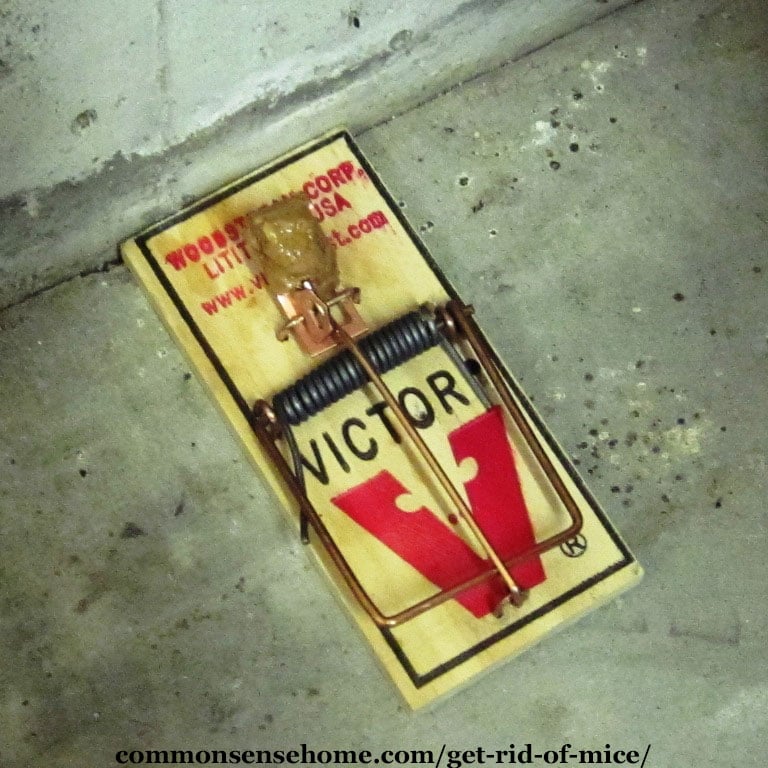
Basic wooden mouse traps are cheap and readily available, but don’t always work. A friend of mine was complaining recently that her mice kept stealing the bait but not getting caught in the trap.
I like Kness SNAP-E Mousetraps. These snap traps are much easier to set than the standard wooden traps, and work well for house mouse and deer mouse infestations.
I used them to clear out the mice that moved into the garage last winter to go after the poultry feed. We tried a couple other brands, but the SNAP-Es worked the best to get rid of mice.
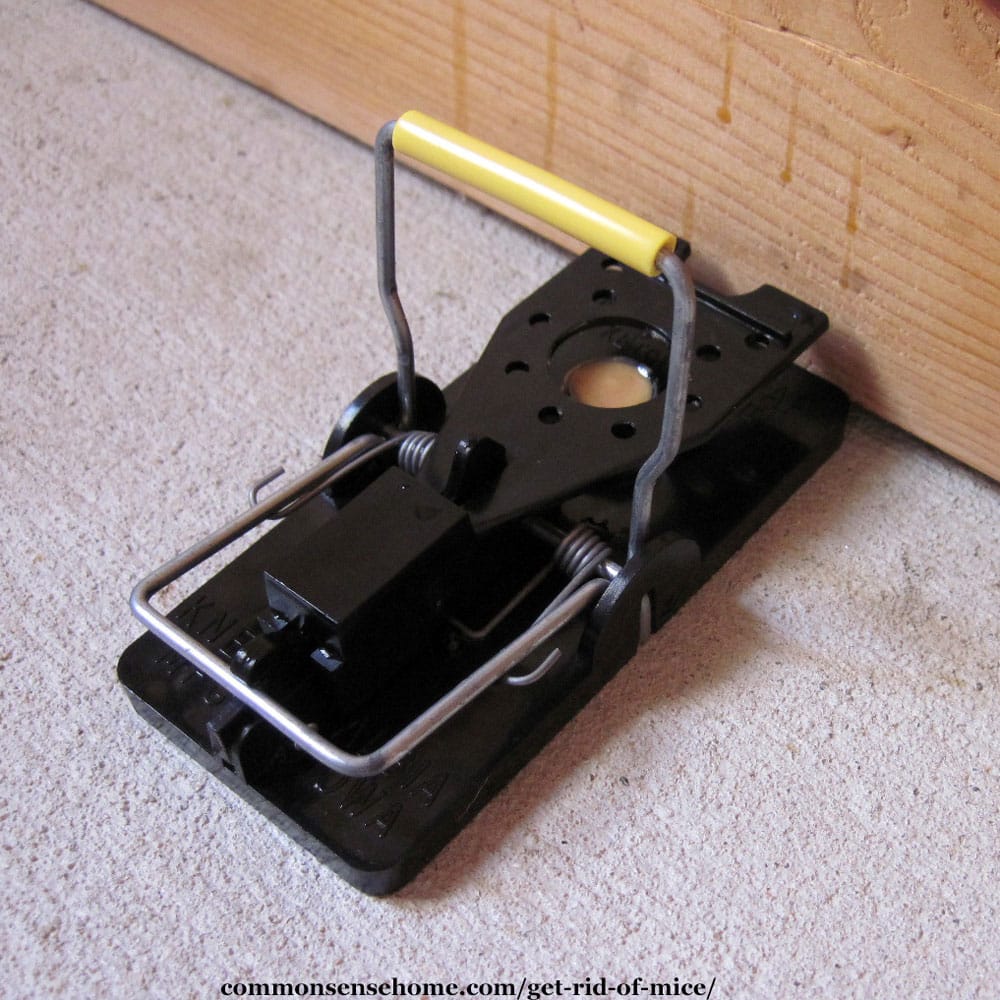
My mom’s favorite bait was peanut butter, which they can’t grab and carry off. Others suggest tootsie rolls as another “stick tight” option. When you’re placing traps, try to put them along walls where you believe mice are moving. Block their path with a buffet of your choosing instead of letting them into your cupboards.
Two traps side by side are better than one, as they will have a tougher time escaping both (remember – mini rodent ninjas). Set the traps perpendicular to the wall (see photo above).
Glue traps/glue boards may work better for small mice such as the eastern deer mouse or white-footed mouse. They tend to set off the snap traps but avoid getting caught.
Humane traps are also available, but one site states that you need to take your mouse at least two miles away to make sure it will not return. I am not a mouse chauffeur, and I don’t think it’s right to share my mice with my neighbors.
Check traps daily, especially if you have a bad infestation. Empty and reset the traps as needed.
Bucket Mouse Trap
Another option that our readers brought to our attention is the rolling mouse trap. It uses a bar, a bucket and peanut butter. The advantage is that it resets itself. The rolling trap can catch multiple mice per night.
This can be a live trap or filled partly with water to kill the mice. One option is the PAWMATE Rolling Mouse Trap which has a wheel in the center for the peanut butter.
Poisons – Why I Don’t Recommend Them
Poisons do kill mice, but not immediately. The mice will crawl off and die somewhere and potentially smell really nasty, plus who wants mummified mice sitting around their house?
Poisons can also be a danger to children, pets, and wildlife that eat rodents. By using poison in an attempt to get rid of mice, you may make the problem worse. I don’t recommend them.
How to Tell if You Have Mice in Your House
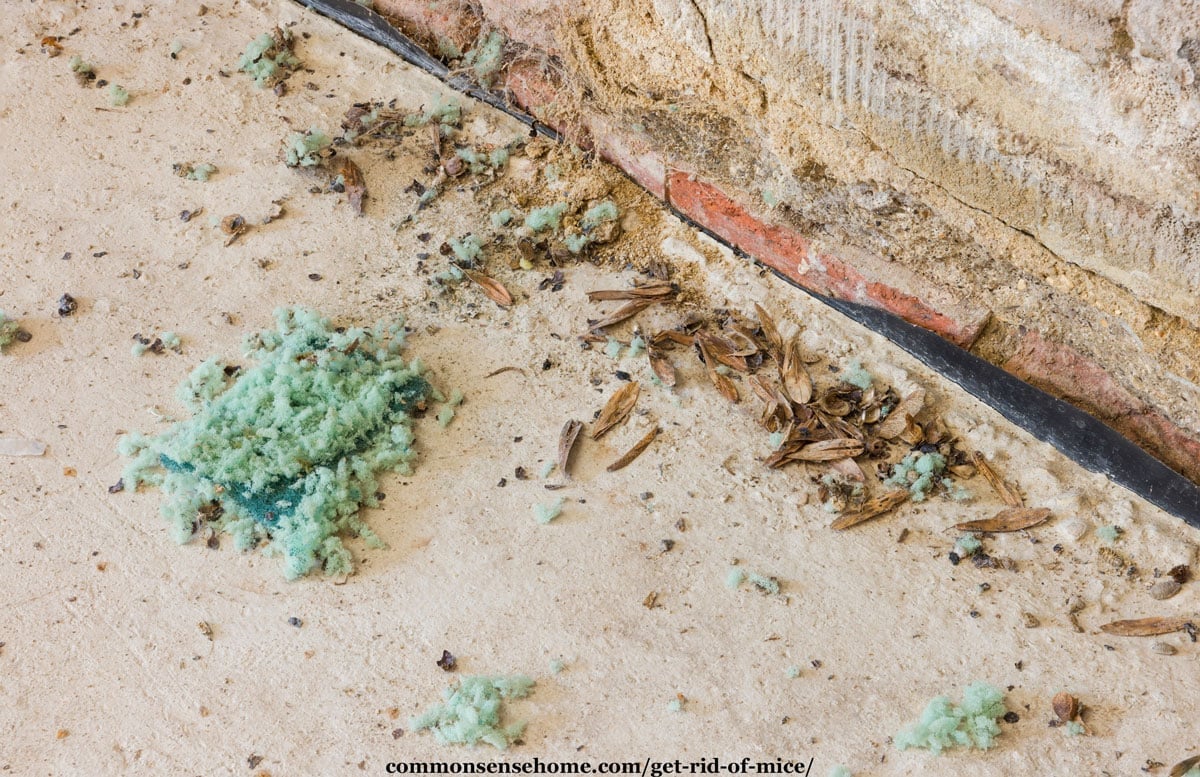
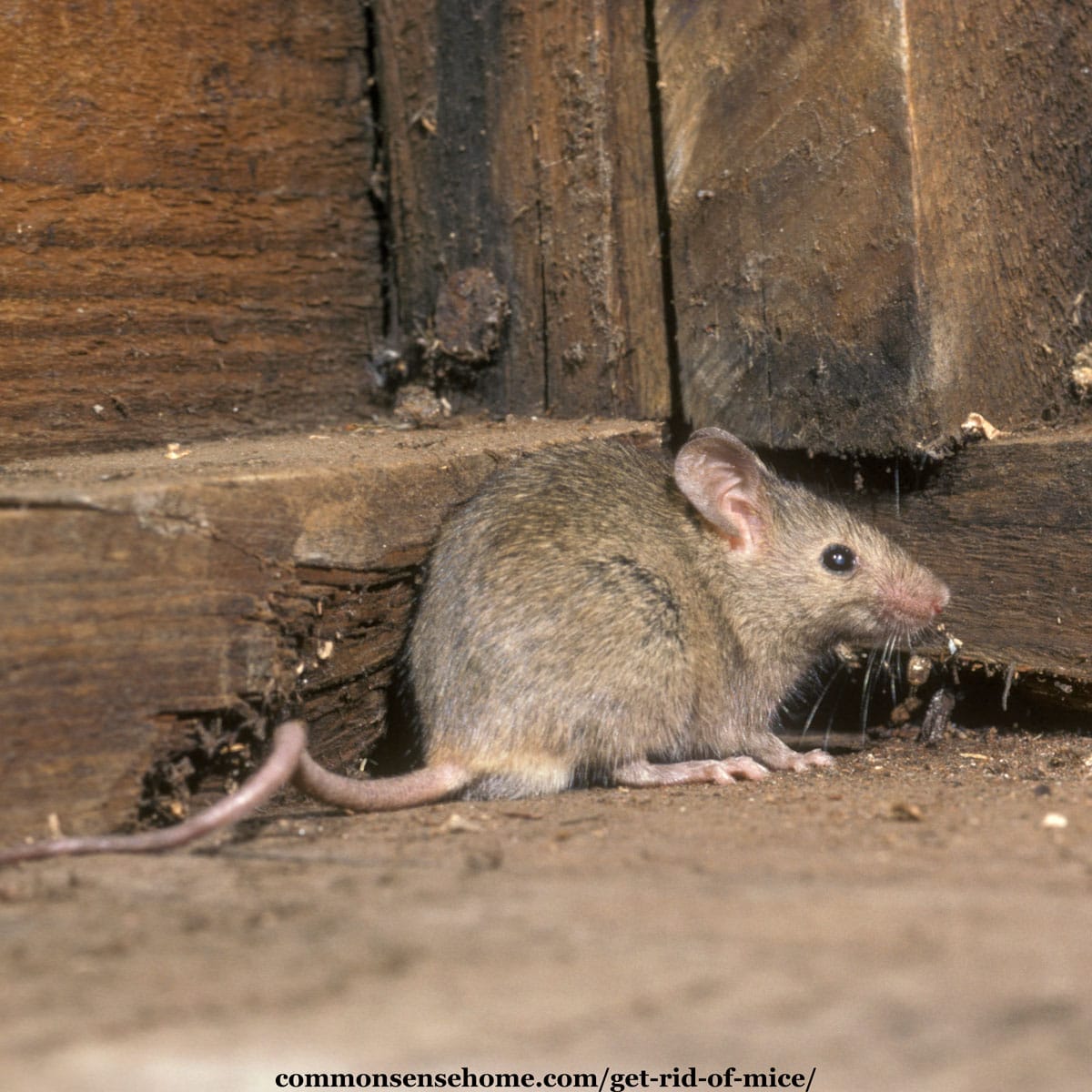
It’s probably more common to see mouse droppings or mouse damage before you see the mice themselves, as they are nocturnal.
When I was a kid, the little buggers would drive me crazy at night running around up in the attic. Thankfully we didn’t get rats in the house, but they would sometimes show up in the outbuildings around the farm.
Identifying Droppings and Urine
Killum Pest Control offers an excellent online guide to interpreting rodent signs. Please visit their site for more information, but I’ll just share briefly their comments on dropping and urine identification.
Rodent (Mice and Rat) Droppings
Fresh droppings of feces usually are moist, soft, shiny and dark, but in a few days they become dry and hard. Old droppings are dull and grayish and crumble when pressed with a stick.
The roof rat’s droppings are up to 1/2 inch long, spindle shaped and curved in contrast to Norway rat droppings which are about the same length but comparatively blunt. Mouse feces are small, averaging about 1/8 inch long, and are pointed on both ends.
Rodent Urine
Dried rodent urine will fluoresce bluish white to yellowish white. Commercial black lights often are used to detect rodent urine, however observing fluorescence is not a guarantee that rodent urine is present.
Numerous items will fluoresce under a black light, including optical bleaches found in many detergents and lubricating oil. Of course, if there’s a glowing track of pee, odds are you have mouse movement.
Mice commonly mark their trails with urine (yes, I know, you probably didn’t really want to know that…) so that other mice can follow their tracks to food sources.
One source I read said that they produce 50-60 droppings per night – ewwww…
Once you’ve found their way into your home, you need to block it, otherwise they be right back in via the pee track highway. They can climb, too – like mini rodent ninjas.
Rodent Food and Nests
You may also find food stashes and nests in out of the way corners. I remember finding a mouse nest in the back of a desk drawer in my room.
Gnawing damage is another dead giveaway. My mom had a cardboard box of old cooking magazines inside a wooden cabinet, and the mini rodent ninjas still found their way in and chewed the edges of the magazines.
How to Keep Mice Out of Your House and Garage
The best way to get rid of mice is to keep them out in the first place. To keep these critters out and keep your family safe and your goods protected, follow these simple steps.
1. Remove Food Sources
Bird food (grains), pet food and other edible odds and ends (even cardboard) that tend to pile up in garages are like mouse nirvana. Crumbs under the couch are a gourmet treat, and a cookie lost by toddler is a mouse family buffet.
Seal all food (for pets or humans) in solid containers, not just thin plastic food packaging. (Rats can and will chew through plastic bins, so be warned. You need to use metal containers to keep rats out.) Plastic garbage cans or Rubbermaid tubs for pantry storage will generally keep mice out.
Vacuum or sweep regularly. Gaps between appliances like stoves or refrigerators and cabinets can collect crumbs where they are difficult for you to clean, but handy for mice to dine.
Remember, if they can get their heads into a space, their bodies can get in, too.
2. Seal Openings
This is the probably the toughest but most effective way to keep mice out – seal entry points.
As I mentioned above, if a mouse can get its head though, the body can go through as well. The little pests only need about a ¼ inch (0.6 cm) wide opening. Check door sweeps and dryer vents, and any other wall perforations.
They can jump – up to 18 inches (I told you – mini rodent ninjas), travel upside down (you bet), and crawl along an electrical wire or pipes(piece of cake). If you can stick a #2 pencil through a hole, a mouse can probably use it to get into your home.
When you find cracks or holes, you want to seal them as tightly as possible. You should be able to find patching supplies at your local hardware store.
The Internet Center for Wildlife Damage Management recommends: Steel wool, copper gauze (stuff-fit) or screen wire packed tightly into openings is a good temporary plug. Note: If you use steel wool, you may get rust stains.
For long-term or permanent repair, mix a quick-drying patching plaster or anchoring such as Fixall® into a wad of Stuf-it® before pushing the material into the hole, and smooth over the outside.
Holes 3 inches (8 cm) or more in diameter should be covered or backed with 1/4-inch (0.6-cm) woven/welded hardware cloth prior to filling with a good patching compound.
One of our readers had good results with GREAT STUFF Pestblock 12 oz Insulating Foam Sealant. They specifically include a bitter ingredient to make the foam unappetizing to pests. Caulk may also work for small holes.
3. Reduce Outside Habitat
If possible, reduce the amount of mouse habitat outside your home to reduce the number of mice inside your home.
Trim trees and shrubs away from the home. Clean up debris, trash cans, brush piles, and other hiding spots where mice may shelter. Keep your compost bin(s) as tidy as possible (opossums and rats like to raid the compost, too).
I saw one site recommend moving wood piles 100 feet from the house and raising them one foot off the ground. Obviously they don’t live in Wisconsin. The mice will have to stay in the wood pile – their nests make great tinder.
4. Set up Barricades with Kitty Litter and Peppermint Essential Oil
One of our readers shared her experience with this natural deterrent:
I used peppermint oil dropped on plain kitty litter. I put a small bag of litter (5lbs.) in a container from dollar store added 4 oz. Peppermint oil. Put lid on and shook it well. I left it over night.
Then I put about a tablespoon of the litter in a small piece of old sheet or cotton balls whatever you have lying around. tie it into a little bundle or sachet.
Place these around your house outside about every 2 feet and in garage and basement areas along walls. The scent lasts longer than spraying the oil and you don’t have to worry about woodwork.
Remember mice have a keen sense of smell, after all they can find a lost potato chip behind a cabinet. So even though the smell decreases it’s still working.
All I do is add a fresh drop of the peppermint oil to each little sachet every 6-12 months. Its been over two years since my mice disaster so it is working well for me.
Click here to buy 4 ounces of peppermint essential oil.
How to Safely Clean Up Mice and Mouse Droppings
Because of the risk of hantavirus and other illnesses, care should be taken when cleaning up mouse droppings/remains, especially in quantity and/or in enclosed areas. (Information adapted from Environment, Health and Safety Online.)
- Wear gloves, either rubber gloves or work gloves you can wash in hot water
- Spray the droppings first with 3% hydrogen peroxide, then with white vinegar. This will kill 99% of bacteria. A bleach water solution or disinfectant is also an option.
- Wipe up droppings with a paper towel, throw towel in garbage
- Clean area with disinfectant solution or hydrogen peroxide/vinegar combo
- Wash hands with soap and water before and after removing gloves
If dealing with large amounts of droppings, you may need to hire cleaning or pest control professionals. At the very least, please wear a face mask or respirator. Please be careful! Your county extension office may be able to provide more information on any known rodent related disease outbreaks in your area.
Treat nesting materials and dead mice similarly. Always wash hands thoroughly after touching contaminated materials.
If you can’t get rid of the mice yourself, consider an exterminator or professional pest control company. Rodents can carry serious diseases and cause a lot of damage.

You may also find these other posts from our Green Home Series useful:
- How to Get Rid of Ants Naturally
- The Ultimate Guide to Natural Pest Control in the Garden
- Natural Mosquito Repellents That Work
- 9 Tips to Get Rid of Fruit Flies, Plus the Best Homemade Fruit Fly Trap
- Natural Spider Repellents – 8 Ways to Get Rid of Spiders
Last updated in 2023.
Good tips…except the antifreeze…to dangerous if you have pets only a little could kill your beloved fur family member! Wanted to let you know that the Tom Cat Mouse Attractant does just that!! Hubby was ill so I watched a YouTube video to show me how to reset a trap… and the professional pest control rep said that it works so much better than peanut butter… LIES, LIES I tell you!! we have more mice than we’ve ever had in our garage!! My kitten LOVES to go out and “hunt” in our closed garage at night before we all retire. We know there are mice in the garage just how he acts… if he wants to be out there all night long and cries when we pick him up and bring him in …there are mice… when he goes out and asks to come back in right away …no mice. Will be trying to figure out where all the entrances are and getting some peppermint oil and nonclumpint cat litter. Has anyone put Peppermint Essential oil under the hood of their vehicle and it work? first time ever I found mice scat on the battery cover… not very happy with that sighting but don’t want the little buggers to start gnawing on wires under there… or packing food or bedding somewhere in there either.
I use bubble gum that comes in the large bucket at Costco. The rats and mice love it, but can’t handle it swelling inside of them. It has worked better, or as well as, anything else, and is safe for cats, hawks, owl’s, that might catch them. It is war with the pack rats as they have done a few hundred dollars of damage by getting into my storage. For the chicken house I put it in a small wooden box with a small hole in the front and a sliding lid so the chickens can’t get to it.
Thanks for sharing. It’s always good to have more options, and I had not heard of this one before.
I moved into a mobile home that had a history of rodent issues but didn’t know it at the time. The first year or so I would hear sounds in the walls occasionally. I would bang on the wall and it stopped. I left it at that.
Finally one year my cat started hanging out in the kitchen, just sitting there which he never does. I looked over one night and there was a mouse scurrying along the baseboard. My cat just watched. But he was the reason I knew there were mice inside my house instead of just the walls. I called a pest control company and they gave me some live traps. I caught a mouse in it and felt bad because it was trying to bang its way out of it all night. I set it free in some woods away from my house the next day. Also the company came back the next day and plugged a hole they found under my house under the kitchen sink with 1/4″ hardware cloth. After that, no more mice inside my house.
However I still heard sounds in the walls and worried they would find their way back in. So I got some snap traps and set them in the crawl space under my house. I took some twine and tied a little piece to the hole where the bait goes and smeared peanut butter on it so they’d tug on that and it worked. I caught several mice over a few days. I used a pet pooper scooper to grab the trap with the dead mouse and toss it in a garbage bag. The wood traps are so cheap I didn’t want to mess with removing a dead mouse and resetting.
I also got some “natural” type poison pellets, which they seemed to eat. After that no more noise in the walls! Until there was again. I set traps again and this time I saw that the peanut butter was gone but the traps hadn’t snapped. I set out more natural poison and all of it disappeared overnight instead of some. I realized as I looked at the droppings and the traps that kept getting the bait stolen when before it they worked great that I was dealing with rats. That’s when I freaked out. Mice are one thing, rats are in my opinion a much more serious problem. I kept with the natural poison but even after more than a week it kept disappearing and I still heard sounds.
So I decided to buy “real” poison. I put the poison under my house in the crawl space (where I’d put the traps before) and they ate the piles empty every night for about 4 nights. Then the next day, the pile was untouched. It stayed that way for months, until fall came.
So I started refilling the piles each night again, and again it worked. Unfortunately one of them decided to die under my house and my bedroom smelled horrible for over a week. I used a diffuser with a four thieves essential oil blend and that helped but I still slept on the couch for a while! Two more died right next to the poison piles so I could use my pooper scooper to get them out from under my house.
I do not like using poison but it is effective for me. My new plan is to spray regularly all under my crawl space with peppermint oil and around the perimeter (and use the litter trick I read in these comments) but still leave a little poison as an indicator to see if they still visit.
I haven’t heard any noises in the walls since I started using the real poison so I think they don’t live there but just come looking for food since there are scent trails leading to my house. I’m hoping if I spray peppermint often it will slowly degrade their scent trails and they will not come visit. But if they do, I’ll know because the poison will be eaten and I can continue with that.
The poison bait I use is called Victors Rodent Killer and comes in a green pellet form. I got it at home depot. It can take several days of large amounts of bait, 2-3 cups, to work depending on how large of a population is visiting. I suppose I could put even more out each night and maybe it would go faster. Maybe I’ll try that next time.
Unfortunately I have realized I will always have to be diligent where I live. Behind me is a seasonal creek and then a neighbor who has several chickens, geese, and ducks. Several other neighbors have bird feeders and I know someone is feeding squirrels peanuts because I find peanut shells buried some times in my garden. Other than the hole under the sink which was apparently quite obvious it would be too expensive and not a guarantee to try to find all the possible holes under my house.
I never had to deal with things like this before and it took some time for me to accept the situation and also to “put on my big girl pants” and set traps and dispose of dead rodents. The rats were the worst because they were so much bigger and heavier than the mice. But if I can do it, so can you. I also recommend accepting reality sooner rather than later and taking action because rodents multiply with great speed.
Good luck everyone!
We can tell when we get the odd mouse in the house and we’ll catch it in a live trap using peanut butter and take it far away. But while we don’t have any inside the house this winter, now that we insulated the walls and ceiling, we can hear them living in the walls and attic/crawl space. They never come into the house so we’re not sure how to get rid of them. I’ve seriously thought of getting a snake and letting it loose up there, but the door to the attic is barely big enough to get my head through. (And my husband won’t let me.)
You sound like me many years ago. I would catch the odd one but could hear them all through the ceiling and walls at night. For me, the only option was go to resort to poison. I still use traps but without the poison…
However, here in Canada they’ve changed regulations. A number of years ago they made the real poisons available only to people with farm or similar licenses. I have farm friends who’ve been supplying me until recently. Bottom line is, even on farms, they are making poisons far less strong (the last stuff they gave me was only 20% as strong as what had been working well). This I learned after they found their way in and literally ate the clothes on their hangers last summer. My friends say they’ve reduced it so as to allow a few days to get your dogs or other living being treated rather than killed. Makes some sense but anyone using poison should have enough brains to know not to put poisons where their animals or kids are going to get them.
What they provided me last time didn’t kill them and dry them up, it killed them and let them rot. If you’ve never had a rotting mouse somewhere you will never forget the smell.
After several years I was able to get the brand I liked most. I didn’t work and I had mice all winter. I contacted the one company who told me they had gone to corn husks as poison. The return message came from a lovely voiced woman who told me if they are in my house I need to keep them inside and make their product exclusively the only food the mice would be able to get. She continued on saying it would take about 10 days but it would kill them.
IMPO, you will need to poison them. They are finding food somewhere – perhaps a neighbour who feeds birds and buys cheap bird seed that has filler seeds the nice birds won’t eat. (If find it stashed in lots of places both in and outside my place, yet only buy what the birds eat all of). Get as much info as possible about whatever poison you buy. Local regulations can vary. Try to get the type that dries them up, not just kills them. Warfarin is one that will let them rot after it does them in.
Bottom line. I’m an environmentalist, nature lover but there are times where one has to learn to kill. Animals kill to survive and I no longer have any qualms about killing mice, rats or anything else that invades my space. Keep all food in glass jars and when you use their contents such as flour, be sure the jar is clean after use. A bit of flour is a meal to a mouse. I get big jars at a charity shop for very cheap.
Good luck
Well what I used was a mixture of clorex and peanut butter I had put a low ratio of cloriex and more peanut butter.
What you could do also is put crushed sleeping pills into the mixture of peanut butter and potentially make rats overdose.
Timely article. My dryer started making loud, strange noises. When my husband opened it up he found a stash of dog food. I like the peppermint idea over poison and traps. Will give it a try.
I simply get four wooden traps for a dollar at the dollar store. The trick in using them is to smear skippy’s Peanut butter on the trigger and especially right under the trigger onto the wood. To get at the peanut butter under the trigger they push it away and they are done. If you just bait the trigger, their tiny tongues just lick it off without pressing the trigger. Trapping is easy and ninety % effective. I run a trap line in my pole barn and feed a local predatory bird that has become conditioned to check out the free meal. I put the mouse belly up in the lawn and it will be gone shortly after I leave the area. This spring I have averaged about one mouse a day.
Thanks for the trap setting tips, Lynn.
I camp 6 months out of the year. I put peppermint TEA bags with an added drop of the same oil. I tuck it around the inside of my rig to keep mice out. And 6 in the engine compartment. Put fresh ones in when I go to storage, Keeps them out all winter too.
Thanks, Debbie. That’s a more convenient way to spread the essential oils around.
thanks for the peppermint tea bag tips. perhaps the smell will last longer than the oil alone. they have been horrid this year! they’re in everything. they used to be a short pita in spring but it’s july! i keep increasing the number of traps (currently 12). they’re so bad this year they chewed the shoulder out of my best tie dye tee. i had sprayed my shoulders and back with natural sunscreen. guess they smelled the sunflower seed oil that’s in it. argh!
We’re in a similar boat with ants this year. Never ever have I seen so many. Thankfully they are mostly hanging out in the basement inside the house, but I can’t set out duck food anywhere in the yard without it being overrun, and ants are one of the few insects ducks prefer not to eat.
Re ants: common laundry borax works great. I sprinkle it as powder, a friend makes a bait adding it to sugar water. Where I am they banned ant poisons many years ago, if you read the label on most ant poisons you’ll almost always see borax. I think they carry it back to their nests. I’ve put it on large nests under flower and veggie pots and it’s always done the trick – even on the big fat wood ants. I also mixed borax with sugar for use in a closet where there were insects – silverfish I think (not certain as I sometimes find earwigs in the garden). For the most part, unless bugs are doing damage I leave them alone. They are food for the birds. I’ve gotten to where I’m willing to put up with a few scarred plants and know the birds are fed than to try to kill everything. Ticks and mice are definitely on my hit list though.
lol – I say much the same thing in more detail in the post “How to Get Rid of Ants Naturally & Why You Should Protect Outside Ants“. Given that the duck chow is outside, we don’t worry about it too much, and just keep moving it around the yard. If it gets too full of ants, it goes to the chickens, who seem to like ants better than the ducks.
We bought some property in the Texas panhandle. What passes for a house at the moment is a metal building on a concrete slab. It was already infested with mice when we bought it 5 years ago so we have been fighting them for quite some time now. We removed 2 overhead doors, filled in the exterior walls with metal panels and had a real kitchen built inside that covers half of what used to be a 20’x40’ garage. That helped somewhat. I was worried about Hantavirus but it turned out that isn’t the only problem.
We have 2 cats who both turned out to be halfway decent mousers. They just couldn’t keep up with the “replenishment of the resource.” Well, last year, one of the cats tested positive for Toxoplasmosis. This is a single called parasite that lives inside mice. It can reproduce asexually in mice, but like most creatures, what it really wants to do is get a little “nookie.” It can only reproduce sexually inside felines. So, whatever “powers that be” that you happen to believe in gave it the ability to change the neural pathways of mice so that they are attracted to the scent of feline predators.
When a cat eats the infected mouse, the organism enters the digestive system of the cat and gets its little heart’s desire… sex. Now, your cat is infected and only a regimen of antibiotics will kill off the organism, but apparently not completely. The vet said my cat’s “titer count” will always show some residual sign of having been infected. But, affecting the cat isn’t the end of it. The organism, while it is still active in the cat, gets transferred through the cat’s feces.
If a pregnant human ingests the fecal material, possibly by inhaling dust from the kitty litter or by not washing her hands after cleaning the litter box, the organism can cause birth defects in the fetus. And, if not pregnant, there is some evidence that shows the organism can cause schizophrenia in humans. I don’t know what “higher power” thought this was a good idea, but I beg to differ!
So…. we think we have just about gotten rid of the mice… finally. My DH went to the hunting supply section of our local Walmart and picked up a small spray bottle of Coyote Urine. He sprays that around the slab outside the house and we haven’t seen or heard much from the mice since he started doing that. He re-sprays periodically and after a heavy rain.
The mice also caused several hundred dollars of damage to the Jeep by building a nest under the hood and chewing the wire insulation. I bought a bag of Cab Fresh and hung it under the hood. We will see if that keeps the mice out of there.
In the meantime, plans are in the works for a “real” house to be built – this time with poured concrete walls, slabs and roofs. I am hopeful it will keep out the scorpions and tarantulas as well as the mice. ????????
Thanks for sharing the coyote urine tip. Does it have a significant odor? I haven’t worked with it before, but I know tom cat urine has a distinctive smell.
I hope the plans for your long term home come together soon.
Since it is sprayed outdoors, I have not noticed any odor from it, but mice have a much more sensitive sense of smell than humans, so it must be enough to discourage them. My DH had thought of spreading used cat litter around the foundation, but since the mice infected with Toxo seek out feline predators, that doesn’t sound like a good idea to me. Plus, you would have to deal with the ammonia odor, something I definitely would notice.
I am a retired architect but have hired a younger architect to do the hard work on the house. Planning to use ICFs, insulated concrete forms. Also, planning on putting in alternative energy systems and harvesting rainwater for at least some of the water needs. Doing as much as we can to survive off-grid in case it goes down, especially since we are 25 miles from the nearest town.
I agree that with the toxo in play, more cat odor is probably counterproductive.
Our current home is ICF and we have been very happy with it.
Hi,Laurie! Our yard is infested with voles (field mice). Do you have any tips for getting rid of these rodents?
Outdoors, cats and/or snakes are my preferred option to keep the rodent population managed. I don’t know where you are at, how much yard you have and whether or not a cat is an option, but they are mobile and don’t carry the risk of poisons. In spite of their reputation for stubbornness, they are trainable. We haven’t lost a songbird in some time.
Our yard is large enough that we have a number of natural snake habitat areas (we have purposefully created some, too). We don’t have poisonous snakes in the area, so those that move in are not a threat. Fox snakes are big enough that they can eat mice, but small enough they can follow them right into their burrows. We had pocket gophers attempt to set up a nest below our generator slab, and between the cats and the snakes, they were cleared out in short order. The pocket gophers were a problem in the main gardens early on, too, but again, cats and snakes for the win.
If cats and snakes are not options, then I’d try traps, placed in tubes (like a section of drain pipe) or coffee cans (or something similar) where rodent activity is highest. You want to keep them covered so they aren’t accidentally tricked by other things or people in the garden.
Poisons are my absolute last resort. Too easy for them to be eaten by unintended critters, or for helpful critters to eat the poisoned mice.
I used Rodent Sheriff or Rodent Defense and it really works they can’t stand the smell of Mint Oil. I had one in my bedroom and I started to spray he got out of my room I wish I had shut my door he probably would been dead by now, but I will continue using that all also get Repeller Electronic that you plug in your wall to keep them away.
We don’t get ‘houseguests’ every year, it seems just every couple years. I think this year, we have a shrew or vole, not a field mouse. It’s the size of a field mouse, but black, and DH said it’s blind (I haven’t gotten that close a look at it yet myself). Our last houseguest was solo, so we just kind of co existed until it left in the spring. There have been many good suggestions here in the comments, as well as in the post. I have to see if we have any tootsie rolls left over from Halloween, LOL! I also think we will be upgrading from the old fashioned traps.
I tried peanut butter & snagged one. Another figured out how to get the peanut butter without setting the trap. did this twice. Next night I tied pepperoni to the traps. I it tied so they couldn’t snatch & run. Got 3 that night. They got on to that right away. Last night I put a tiny dab of honey to use as glue for a sunflower seed. They must have thought it was fine dining night. Traps were snapping one after the other.
I hope you can get them all out.
I don’t want mice or rats in my house or buildings, but I think snap-type traps are horrible. These are mammals and they certainly feel pain, and it’s a horribly painful way to die; sometimes they chew their feet off. A humane trap is a good idea, and driving them a couple miles away is not a hardship. We all drive just about every day; there are farms/cemeteries/parks where they can be placed and join the other critters around there. The empty paper towel tube with peanut butter inside it, placed on a counter top over a tall bucket they would fall into if they travel into the tube for the treat, works well. I have caught mice that way and transported them away. I love the idea of peppermint infused cat litter placed in sachets around the building. They do not like peppermint.
You’ve gotta be kidding. These things are vermin and should be extermination to extinction.
Our neighborhood has had MAJOR problems with mice since flooding here in Colorado in 2013. ☔ You plug their holes with steel wool and they chew a new door right next to it.
The mice had made an “escape route” around an electrical switch plate in the kitchen.
I didn’t want to use steel wool near wires, so I opted for cotton balls soaked with peppermint essential oil.
I placed the 1st ball on one side & made a ball for the other side. I went to put the 2nd ball in, the 1st had DISAPPEARED! I put the 2nd ball in the outlet and watched. Sure enough, out pops a little nose & viola…he stole it & stuffed it into his “other” cheek. ????
I had invented mouse “peppermint cotton candy”. ????
Now we use the plastic snap traps. They work really well, are easy to set and empty with arthritic hands. But occasionally they “disappear”! Maybe the mice are dragging them home for jungle gyms? ????
Poison is NOT an option. Small children and pets in the home.
Thanks for sharing your experience, Cathy. Mice breed fast and adapt to many different environments, so I’m not surprised that there are some who are not deterred by peppermint essential oil. We find the plastic traps much easier to set then the old wood and wire traps, too.
Peppermint oil seems to lose its smell quickly. I didn’t find it much use. For holes I discovered they make a foam that has a rodent repellent. I had mice screaming mad for 5 nights as they tried to chew through 1″ plywood and finally gave up. One of the trap companies makes a bait that comes in a little bottle. I found it quite good and they don’t seem to reject as quickly as they reject anything else they were baited and caught by. I also get new traps or wash old plastic ones. I think they can smell fear on already used traps.
I am so scared of mice and afraid it might be on the baby and myself during the night. Ive tried moth balls, glue traps, poisons.. In one night I’ve caught about 4 mice and tried sealing up the house. I havent seen any downstairs since then (where the kitchen is) that was maybe two months ago… yet I’ve seen one up stairs when it gets quiet or dark. I put down a trap but it got free. I dont know how its getting inside or how to catch it. I’m so terrified..
Keep working to eliminate the mouse problem, but don’t panic. Fear clouds our thoughts and makes it tough to focus and solve problems. Just take one thing at a time and work through the problem.
First off, odds are there are many more things in your home that are more tempting to the mice than the baby. Clean, clean, clean. Keep eating in specified areas, and clean up crumbs, especially in out of the way corners. Make sure foods are sealed in mouse proof containers. Don’t forget to check attics and crawl spaces. Mice love to hide where it’s not easy to see them. Use masks, gloves and other protective equipment when cleaning up any mouse droppings or debris.
If the mice escaped one type of trap, try a different type or different bait. You can use the black light to find trails and help see where they are moving around, and use that information to help you place the traps.
If you’re still concerned, or run into a bigger mouse infestation than you expected, it may be time to call in professional help.
Hi , a few days ago I found some droppings behind my couch and next to my stove which made me freak out . I set glue traps with fabs of peanut butter on them and set them up around my apartment . Two I don’t know how they got I go my apartment which is the big issue . I found two mice on the glue traps that were in the kitchen I replaced the traps s d just found that one of the traps I replaced was dragged out of place and had droppings and signs that showed the mouse escaped off of the glue trap .I ordered peppermint oil off of Amazon to make a repellent and will continue to set up glue traps Luckily I’m moving out of my apartment but I am very nervous about any of these guys getting into my stuff since (I am using cardboard boxes) I’m afraid that they will come along with me to my new place . Help what should I do to avoid bringing them along ? ?????? Very terrified
No need to be terrified. When problems come up, we deal with them. Mice where they shouldn’t be is just another problem. You’ve got this.
You could get a black light to track their trails to get a better idea of where they’re coming in, but if you’re moving, it won’t be your concern much longer, so that’s up to you. Mice only need a very small hole to get in.
Keep up with the trapping. Make sure to place traps along walls or pathways where you think mice are mostly likely to travel or take cover. Make it easier for them to find your bait than to get into areas where you don’t want them. You *might* have a bold mouse that attempts to build a nest in one of your boxes, but they prefer to make more permanent quarters in areas that are relatively undisturbed.
Cleaning up to pack may help you to find where they’re hiding out. Make sure to check and dump any boxes or containers as you pack them. (For instance, tip over infrequently worn shoes or boots before packing.) Scrubbing floors and baseboards can help to eliminate their trails. If you have them available, using plastic totes for packing and keeping them sealed when you’re not working on them will protect the items in those totes from mice. (Rats can chew through plastic, but not mice.)
Trap, repel, clean, eliminate hiding areas, and keep watch as you pack. Those strategies should greatly reduce your chances of bringing unwanted roommates to your new home.
Thank you so much 🙂 for your help and support !
You’re welcome.
I have a problem with rats getting into my enclosed and covered garden. They can get through the chicken wire that I used to keep out the squirrels. Ok, so I made a couple traps for the rats using the rolling bottle in the bucket method. I did catch 2 rats that way but I have a large opossum that lives in my yard and he is eating the peanut butter off the rolling cans. Now I need to figure out a way to get rid of the opossum because I’m sure he is getting fat eating my buffet each night.
Any suggestions on getting rid of the opossum?
We don’t have rat trouble, and the opossums usually behave themselves, so I shared your question on Facebook to get feedback from other readers. You can read their suggestions at: https://www.facebook.com/CommonSenseHome/posts/1538745806175394
found your old post in old mail. Hope you’re critter free by now. I finally bought a proper trap to catch my one culprit. It turned out to be a cat. It managed to get out of the trap because of a faulty latch but it never came back. As for keeping those rats out where they get through chicken wire get some stuff they call hardware cloth… or used to be called… It’s a metal mess available in various sizes such as 1/4″, 1/2″ etc. I also use it for straining old soil from my container gardening, and make a new fat holder each winter for hanging bird fat. I also use it to open the crawl space or summer months by stapling it over where the panels open. (good ventilation is important to prevent mold, mildew and other gross stuff). You can get it at a building supply and sometimes surplus supply and liquidation stores. I’ve even seen some in a dollar store but it was thin and flimsy and not much of it.