
Before You Plant Sunchokes, You Need to Read This Post

This post may contain affiliate links. Read my full disclosure here.

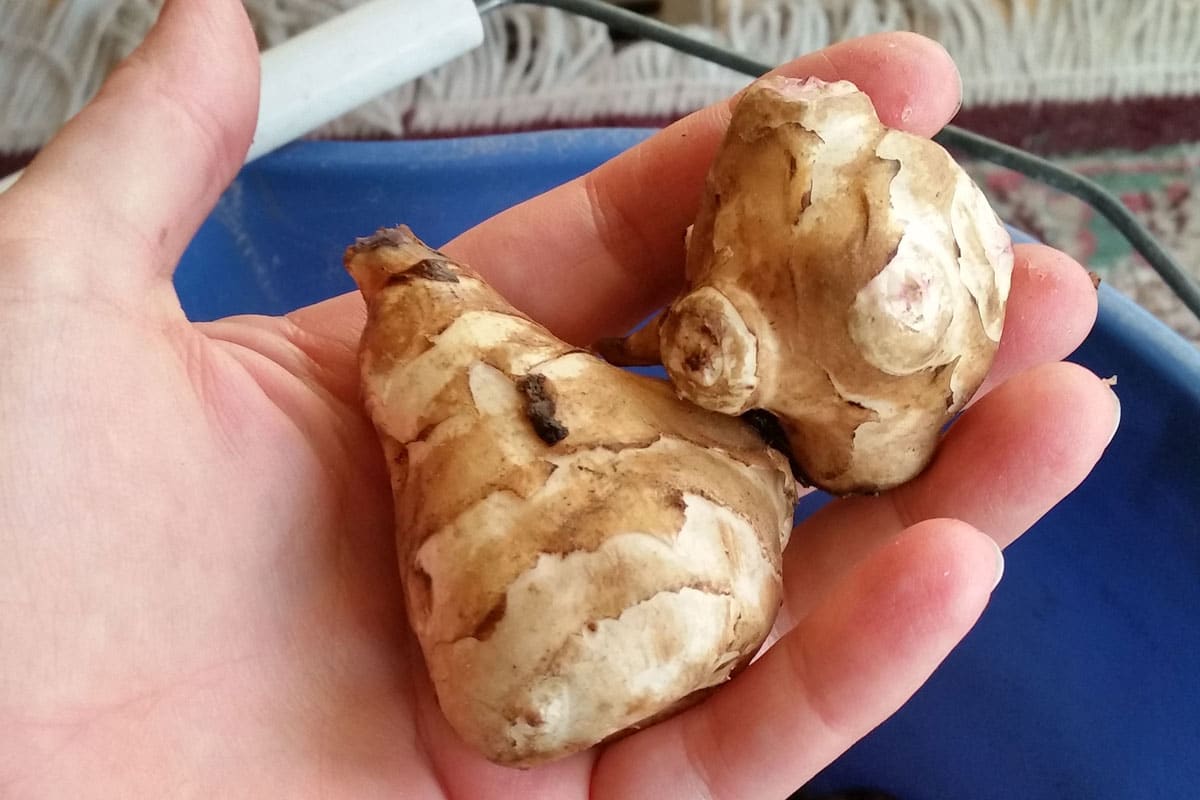
Sunchokes (AKA Jerusalem artichokes) are gaining popularity for their health benefits. I’m sharing how to grow sunchokes, when to harvest and how to use them – plus the big mistake that we made when we first planted them.
Would you like to save this?
Table of Contents
What are Sunchokes?
Sunchokes are native to eastern North America. They are also known as Jerusalem Artichokes or Sunroots. They are not related to Artichokes, but they are related to sunflowers. The whole “Jerusalem” thing is supposedly linked to the Italian word girasola, which means sunflower.
Sunchokes are a perennial plant that grows six to ten feet tall. While they do have pretty yellow flowers, most people grow them for their edible roots. Their roots are high in inulin, and eaten raw or cooked.
Historically, Native American valued them as a food source, especially during late winter when food supplies run low.
How do you Grow Sunchokes?
Grow sunchokes from roots or sections of root, planted in spring or fall while roots are dormant. You can grow the plants from seed, but starting with tubers is easier and faster.
For best results, use the following planting guidelines:
- The plants prefer loose, well-drained soil, but will tolerate poor soils. (Lighter soil makes harvesting easier.)
- Space sunchoke tubers 12 to 18 inches apart, 4 to 6 inches deep.
- Space rows 4-6 feet apart (they will be prone to spreading).
- Soil temperature at planting should be at least 50°F.
- Plant in full sun.
- Do not plant in areas that are consistently wet, as wet soil will rot the tubers. Plants are drought tolerant, but produce best will a regular supply of water.
- pH of soil best between 5.8 and 6.2 (neutral soil)
- Preferred growing temps = 65 to 90 F.
- Cover your soil with an inch or so of organic mulch for easier harvesting and root protection.
- Plant in a dedicated bed that can be mowed around for control. Or sink barriers into the soil around the sunchokes at least 24 inches deep to prevent spreading. (More on this below.)
When are they Ready to Harvest?
Harvest sunchokes in late fall or early spring. They require 110 -150 days to maturity, depending on the variety and growing conditions. Light frost increases the sweetness of the tubers.
Unlike potatoes and some other root crops, sunchokes do not store well. Their skin is thin and dries out easily. I keep them in the refrigerator for 1-2 weeks. They keep best in the ground, dug as needed for use.
In northern areas, a thick layer of mulch may keep your tubers accessible longer. It may also encourage mice or voles to move in and have a snack, but there’s usually enough to share.
For bigger roots, avoid crowding plants and water regularly. You can also cut off flower stalks to encourage root growth. Please don’t cut off all your sunchoke flowers! They flower late in the season, when pollinators have few flower choices.
How do I Eat Jerusalem Artichokes?
Sunchokes are edible raw or cooked, including the skins. They are difficult to peel and turn grey quite quickly, so a good scrubbing is a better option.
Raw, sunchokes are similar in texture to a water chestnut or jicama. After a light frost, they take on a somewhat nutty flavor. For my part, they taste best raw after a frost.
See Jerusalem Artichoke Recipes for easy recipes and cooking tips.
Do Sunchokes Cause Gas?
Sunchokes are loaded with inulin. Inulin is a type of starch that acts as a prebiotic in the digestive tract, feeding our beneficial bacteria.
Inulin is a widely used filler in many foods to bump up the fiber counts. It also increases calcium absorption in the body, and doesn’t spike blood sugar. There are even sweeteners made for diabetics made out of sunchokes.
See Jerusalem Artichoke Benefits: Nutrition, Flavor, and Uses for more information.
Eating a large amount of sunchokes may lead to “mild gas”. They have the nickname “fartichokes”.
I can verify that eating a large portion of boiled sunchokes will give you horrible, gut-racking gas like you have never experienced before… except for that one time when you were pregnant and thought it was a good idea to eat prunes, cheese curds and cucumbers in large amounts all at the same time.
Start slowly when eating sunchokes, and perhaps avoid serving them in large quantities at dinner parties. Give your digestive system time to build up the right bacteria to deal with the extra inulin.
Readers have suggested a couple of different tips to beat sunchoke gas. One suggested that you eat some sunchokes raw, and don’t scrub all the dirt off.
I assume that some soil microbes come with to help aid digestion. Another reader says that harvesting after frost is a big help, as the frost naturally breaks down some of the inulin for you.
A Word of Caution About Growing Sunchokes
“Easy to grow” and “disease-free through heat and drought” are code words for “You will Never Get Rid of this Plant!”
When I first planted sunchokes, I skimmed over the note in the seed catalog that said “they will spread and may be invasive”.
I planted my tubers late in spring, in one corner of a garden bed. There were nine rather wrinkled little roots, and I didn’t think they would all survive. Not only did they survive, they thrived. We tried to harvest the whole patch that first year, but must have missed a few.
The next spring they were back, and they were spreading. We tried to keep up eating them, but the fall was muddy and we couldn’t get in to harvest.
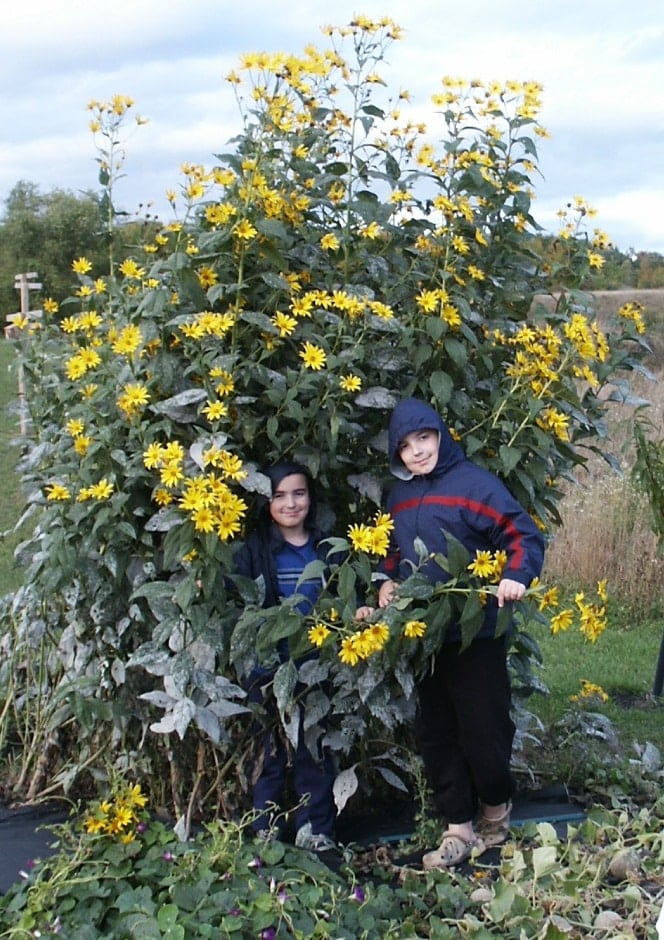
By the third season, we had the lovely thicket of 12 foot tall flowers you see at the post. As I was digging them in fall, I tossed some damaged roots off into the tall grass away from the garden.
Sunchokes Spread from the Smallest Bit of Tuber
Fast forward to spring. Those root bits haphazardly thrown into the weeds – they’ve now sprouted into plants. There’s a new sunchoke colony.
I decide to get rid of extra sunchokes. Two friends come over.
Four different adults attack the patch. Bushels and bushels of sunchokes leave the garden. The patch size is reduced roughly by half to start the spring.
Time passes. My boys work the bed again. They remove more sunchokes from the same area that the adults have already gone over.
Before I put the transplants in, I work over the same area one more time. THERE ARE STILL SUNCHOKES COMING UP! This area has been gone over by four adults and two kids, and there are still sunchokes hiding in the dirt.
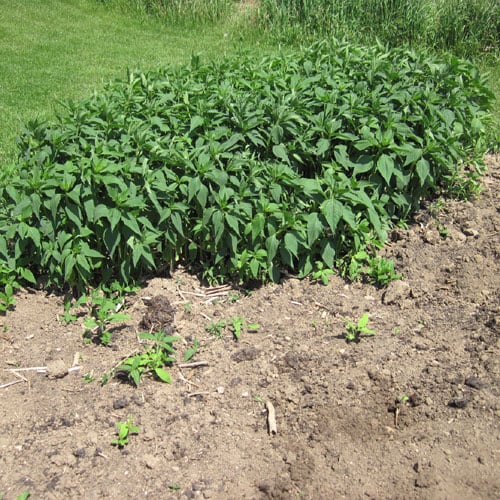
Here’s the main patch. You can see the smaller outliers in the foreground. That area should be clear.
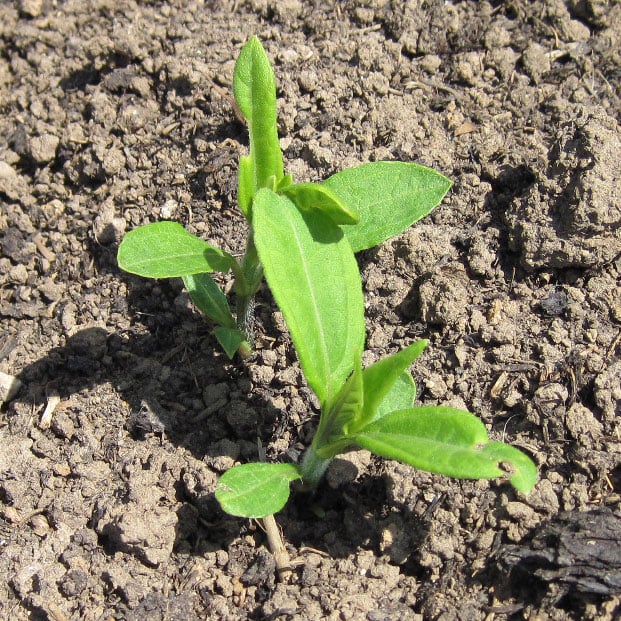
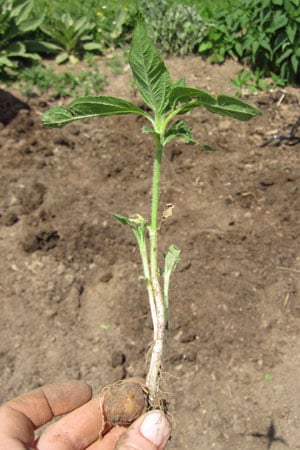
Here’s a nice, innocent looking sunchoke seedling.
Once we dig it up, we see that this single tuber is trying to regrow an entire sunchoke thicket.
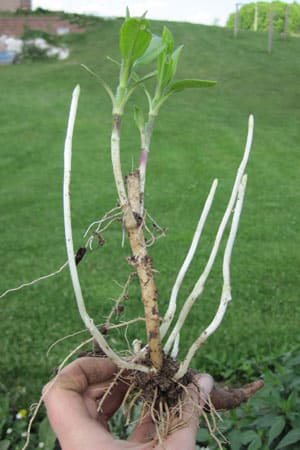
Even tiny pieces, no bigger than the tip of my thumb, can regrow entire large, vigorous plants.
They’re virtually unstoppable. Weeks later, and I’m still digging up shoots from among my cabbage seedlings.
Plan Ahead with Your Sunchoke Plantings
I urge you, do not plant sunchokes anywhere else you might like to grow other plants at some time in the future. You will spend very large amounts of time attempting to remove them if you do.
Plant them in their own area that you can mow around, to keep them under control. You can also plant them in pots – as long as they are big pots. Try one tuber per 18 inch diameter pot. Look for varieties that naturally grow shorter, and have an option for providing support if needed.
My neighbor says her horseradish plants are the same way. Plant both at your own risk. Maybe we should plant them next to each other, to see which one wins.
Alternatively, introduce pigs or chickens into your sunchoke area and let them tackle clean up duty. Jerusalem artichokes make a fine fodder crop.
What Tries to Take Over Your Garden?
Sunchokes are good for you. They look pretty, taste okay, and are quite expensive to buy in many areas, if they are available at all.
They’re a “perfect” choice for a new exotic vegetable to try. I just wanted to let you know that you’re likely to have a lifetime commitment with them once they enter your garden. Don’t say I didn’t warn you.
Are there any other plants you’ve grown that want to take over your garden? Leave a comment to warn other gardeners before they end up fighting them, too.
Also, if you could include in your comments roughly what area you are from, that would be great. Some plants will spread in some locations but not in others.



This article is written by Laurie Neverman. Laurie and her family have 35 acres in northeast Wisconsin. They grow dozens of varieties of fruiting trees, shrubs, brambles, and vines, along with an extensive annual garden. Along with her passion for growing nutrient dense food, she also enjoys ancient history, adorable ducks, and lifelong learning.
Originally published in 2012, last updated in 2026.
Other invasives include, lemon balm, bee balm(monardara), any mint, morning glory, and milkweed(good for monarch butterflies). All of these can successfully be grown in pots. 😎
I’m not too sure about Lemon Balm in pots not spreading. It spreads by seed as well as by root. I’m on a 1 1/2 city lot and started it in a pot. It got started alongside the garage in some Germander and I let it take over the whole corner between the garage and the house. It shows that it would love to spread into the yard, but 3″ – 4″ mowing keeps it in check. I deliberately started Peppermint along the house foundation for insects and of course, it too loves to try to spread into the yard. The only real problem I have with them in the yard is that when I mow, for some reason the odors make me so-o hungry!!
The house is far enough away from the neighbors I haven’t seen the Lemon Balm spread that far by seed and mowing keeps the runners from spreading far. One neighbor does have some Garlic Mustard that popped up under a pine tree. It’s just a matter of time.
It looks like the plants are infested with powdery mildew in the picture with the children.
Most other articles about sunchokes I’ve read praise them for being free of disease.
So far only one of all the people who commented has mentioned mildew.
I raised sunchockes for a couple of years in upstate NY back in the early eighties and don’t remember having a problem.
But in East Tennessee my sunchockes planted in full sun (in reasonably good soil augmented with a bit of compost) were overrun with powdery mildew the very first year mid-season. I had manually weeded around them until they created enough shade to crowd out weeds near them. I didn’t notice any mildew on other plants before it popped up on the sunchockes …
Have other readers experienced mildew problems?
Any good preventions or remedies that are effective with sunchockes?
Please remember to mention your location and growing conditions. Thanks!
Powdery mildew regularly pops up in my garden as the season goes on. Heavy rain is very common in fall. I don’t worry about it, because the season is winding down, but if you wanted to reduce it, I’d trying treating leaves in early morning with activation compost tea or effective micro-organisms, to crowd out the problem fungi. If there anything that can be done to improve air circulation and keep leaves drier, that may help, too.
Wolfman, west-central Pa., zone 5. We had a very wet summer in 2018 and it looks like another is setting up for this year. In years previous to ’18 I almost always had some powdery mildew somewhere, Peonies, Sunchokes, squash, pumpkins and more. It never harmed the plants. Last year it was super heavy because of all the rain and still didn’t cause any harm. It just doesn’t look good is all. I’ve seen some home remedy recipes for spraying plants and preventing mildew, but I have no idea if they work.
You can make wine from the roots and the flowers too. The wine I’ve made from the roots is a rather strong, earthy wine, not bad, but I prefer to use it for cooking. The wine I’ve made from the flowers is much more mellow and nice. I drink it as is or I’ll mix it with other wines to add a nice smooth earthy flavor.
Here’s how I made some onion soup;
4 medium yellow onions, chopped
1 + Tbsp of Olive oil
8 4″ sprigs of fresh English Thyme
4 4″ sprigs of fresh Peppermint
1 Tbsp Turmeric
1 cup ‘choke root wine
1 gal. water
Caramelize the onion with Olive oil in a frying pan for 45 minutes. In the last 10 minutes add the Thyme, Peppermint, Turmeric and ‘choke root wine.
Transfer to a stock pot and add 3 quarts of water and start to simmer. Deglaze the frying pan with a quart of water and add that to the stock pot. Simmer for 45 minutes.
For the root wine I use just the broth from 3 quarts of roots chunked and boiled, and for the flower wine I use the broth from 3 quarts of packed flowers boiled, each generously covered with water. Boil for 15 to 20 minutes. Add 4 lbs. sugar per gal. Add a handful of raisins for the natural yeast. Let work as you would any other wines. I don’t add citrus or anything else to the flowers, just flowers, raisins and sugar. The root broth will probably jell when it cools, that’s OK. As the yeast works the jell will fully liquify. As a plus, when the flowers are boiled or steamed, they resemble squash and are edible.
I made that soup as described… GHASTLY!
Blaine, do you really mean alcoholic ‘wine’? You don’t mention fermentation parameters, such as temperatures, time, and percent alcohol achievable. Or is it just a colloquial term?
Ruth, ….Likely, sunchokes sold in stores cost more, due to a few layers of middle-men hiking prices over grower’s price, every step until the store marks them up to gain a profit, too.
And, that there are no large growers, that I know of.
Small growers = limited supplies, which has always increased prices on commodities.
The person who thinks they are labor intensive?
I don’t think so.
Maybe in whatever climate they grow them, but in climates like our Pacific NW coastal-climate, they do fine. I leave them in the bin to grow, wait for stalks to start dropping flowers; then, berries start forming–that’s when I cut off upper stalks, leaving lower stalks with some leaves, to finish growing the sunchokes. That way, falling berries won’t spread this aggressive grower.
When weather chills, stalks brown & droop; I cut them down to top of soil…and leave the ‘chokes in the dirt.
Winter freezes chill them, nicely reducing their gaseous-action in the gut. The other part of reducing the gas-attacks from them, is to chop fine and cook well.
Those whose gut makes most gas from eating ‘chokes? That means they desperately need to eat more of these, to allow their gut to heal…then, hardly, if any, gas forms.
The Inulin in ‘chokes, heals gut lining, helps probiotics thrive…which helps digest foods far better.
Storing them if dug-up?
Ours did fine in a dry produce drawer in bottom of frost-free fridge, for almost a year.
They just took up a lot of room needed for other things. Our fridge was set to be as cold as possible without freezing, and, frost-free.
IF a fridge is damp inside, like chest freezers converted into fridges are, I don’t think they’d last as well…too damp. If they are allowed to hard-freeze–that breaks them down and rot can happen once thawed…texture suffers, too.
So, drier cold, ..almost freezing but not…seems key to longer storage. Some few will try to rot…just remove those. But even some from stores, have stored in our produce drawers for many months, without spoiling. I started our bin with ‘chokes from our local CoOp grocery, several years ago.
Or, leave them in their planting bin, under dirt, roots intact, & dig some up as needed.
We’ve been doing that for 2 years now, and it’s working great, so far.
Bonus #1: No created storage.
Bonus #2: Far less gas-attacks.
Bonus #3: Chopping off upper stalks seems to stop them forming flowers and berries…at least it did this season.
Bonus #4: Overall, Far less labor.
Laurie Neverman said she thot ‘chokes are Labor intense due to dirt? I don’t think so at all.
Plenty of root crops have that feature; with a bucket of water & a scrubby brush, that dirt comes right off…at least ours do….they’re planted in loose compost-potting soil, no clay, though…maybe that’s a difference?
We had to replace our old fridges (large and small), and both new fridges are too blasted tight to store anything that needs respiration properly. As an added bonus, the main fridge also has cold spots, so if you show anything too close to the back in the wrong location, it freezes. Total pain in the butt, and it has damaged a fair amount of produce. The produce bins are tiny, too, in comparison to my old fridge. Still, both fridge had enough humidity that my sunchokes did not keep well. Maybe I have a different strain of sunchokes? For roughly the same amount work, I can get a lot more potato, and my family likes potatoes better. But that’s just us – your mileage may vary. The potatoes keep better in the root cellar, too.
Chimonger! Right on! I’ve been taking an Inulin supplement daily along with occasional helpings of ‘chokes for the past year and my guts are so much better than before. OH! At first there was the gas, but after a good week or two of daily use, it passed … pun intended! As I posted above, we can ours early in the fall before the Inulin can convert due to freezing.
There are three main sources for commercial Inulin; Chicory root, Blue Agave and ‘chokes.
As for labor intensive, that depends on the variety. I have some Fuseau(?) that are shaped like carrots, no knobs and very easy to clean. I also have Stampede which are fairly knobby and of course much harder to clean.
I’ve lost track of what variety we have, but it’s a smaller root with lots of knobs, and the skin is layered enough to trap dirt in every cranny. That said, you two may still talk me into being a sunchoke lover – maybe. I’m glad you find them so useful and delicious.
Blaine , Laurie Neverman ,
IDK what kind we have…it was whatever the local COOp grocery carried in their produce isle several years ago–very irregularly knobby, usually. Russian?
They have tan/beige skins, and white meat inside. Stalks can get higher than 4’ to 6’.
Little flowers, when they had them, were lovely pale lavender/purple, with darker lines from the middles, and bright yellow centers.
Berries were almost black, no particular flavor…someone said it’s dangerous to eat those. This variety spreads by root, berries, and cuttings, making this variety rather aggressive spreader. Some get kinda large and convoluted, others are tiny, a few are a bit carrot-shaped.
2016, I cut the stalks about half-way, to prevent flowers and berries…those had started forming berries.
2017, I cut the stalks same way, but didn’t wait for flowers…maybe should have waited for flowers to start becoming berries…cutting the tops of the stalks stopped flowering or berries, entirely. Roots still did fine, as leaving the half-height stalks and leaves, provided the nourishment to the roots OK.
IDK if that will keep happening.
2018, I cut the top half of the stalks off, before flowers even set, because the bin was in a work area; the tall stalks kept getting in the way. Didn’t seem to make any difference to the roots.
Whether the plants stopped fruiting due to weather patterns changing, or, due to being cut before fruiting, IDK.
Just cooked up some in a stew…plenty good, very little gas-effect.
I really like letting them just stay in their bins, with their roots intact, and letting winter freezes do their job to develop the inulin, so I don’t have to!
The ‘choke inulin was something found while working alternative med. office….
Patients who got a certain meal replacement powder with it in, healed from dire gut health issues [like end-stage Chron’s Disease, for instance..dramatic story on that one, but Nutshell: total healing in 1 month…from “they want to cut out my guts”, to, “Now they tell me there must have been a mistake, that I never had Chron’s Disease!”]
What the modern medical system does to people’s digestive tracts is a travesty, so if anyone can learn to love sunchokes and consume them regularly, I’m all for it. Combine them with fermented food and you have extra good bacteria and the medium to feed them well.
Our sunchokes get really tall (probably 11-12 feet) and have significant yellow flowers and no berries. The bees love the flowers, so I don’t want to cut them. They are always loaded with buzzing, humming little garden guests. I have some video I should edit and get up on the site. Nearly every blossom had one or more bees on it when I caught the footage. The wind was heavy so the sound wasn’t great, and the clips are pretty short because I was using them on Instagram, but you can still see the abundance of bees.
Chimonger & Laurie, do a search on the term ‘Nemechek Protocol’. There are also several good Facebook groups concerning it. It uses daily doses of inulin or the antibiotic Rifaximin plus extra virgin Olive oil for inflammation, plus fish oil, higher in EPA for children or higher in DHA for adults. The fish oil helps repair some nerve damage. Dr. Nemechek developed this while treating AIDs patients. Other than the Rifaximin, everything is over the counter goods. There’s no multilevel marketing crap or anything like it. It will boost the autoimmune system which can positively affect several gut disorders and even developmental impairments. Dr. N. developed this to prolong health for his AIDs patients and it has great benefits for others too!
If the Sunchoke is so plentiful why are the so expensive?
Seems to be a good commercial venture for someone.
They’re so expensive because they are very labor intensive to harvest and clean. Dirt loves to cling in every little nook and cranny. They also don’t store particularly well. If you try to stash them in the fridge or root cellar for winter (for ease of access), they like to grow fur and rot.
The high prices are just because it’s the made up novelty of them. They used to be well known and very common. In and around my town I know of at least 12 patches in flower gardens and wild, but very few really know what they are. They’ve just been forgotten. As for storing them, we can them; plain like potatoes, pickles, relish and salsa. I just dried some and we’re going to try grinding them into flour.
Limited supplies of ’chokes, always make high prices. But, they’re so easy to grow, so durable and persistent, they are really a survival food!
Trying them ground into flour sounds interesting…it should work pretty well, and, gluten free!
You may need to add ground chia seeds, or some other binder like Xanthan gum, to stick it together when used for bread-like foods, otherwise, like most GF flours, it tends to crumble.
Never thought of canning them. But then, I don’t can much, as that sure is labor intense!
Been drying most produce, as more can fit into a canning jar, then get vacuum-sealed. Much lighter weight, loads fewer jars. Alt., vacuum-pack into bags. Sure helps tame a pantry size!
I was just given some small tubers but it’s definitely after last frost here in Michigan. Do you know how should I store them so I can plant them in the spring?
You can try keeping them in your refrigerator produce bin, but make sure they aren’t too moist or they will mold. If root cellaring is an option, packing them in leaves and keeping them in the root cellar may also work. Even though it’s past frost, you might try planting half and saving half, in case the ones in storage don’t keep. Modern fridges are often so airtight that they don’t breath well for veggies.
Plant them now. They survive from zone 8 to 4 and some will make it through zone 3 winters without mulching. Storing them is risky. When the soil reaches about 50℉ they are stimulated into sprouting.
I recently found a wild yellow flower, and I believe that it is a sunchoke. I live in South Western Ohio and I found it at work growing along the edge of a field on the tree/weedline by the river. I dead headed some of the older blooms, and the plants are loaded with more blooms. They are probably 4-5 feet tall. Any luck propogating them by seed or is tuber the way to go? I plan on covering the back field of my plant with them, it is wasted ugly field we have to constantly mow, and I’d much rather look at these than drive a tractor in the heat of the day mowing!
The tubers spread so easily and vigorously that they would be my default choice. Even damaged or partial tubers are likely to regrow. Since you’re simply trying to fill an area, there would be no harm in seeing if you can get the seeds to catch, too.
I’ve had holy basil spread in a raised bed and beyond. Didn’t see that coming.
Huh. I would not have expected that. It dies out overwinter here.
Regarding poke… An eccentric wine maker in the s.central Ozarks tried a folk remedy for arthritis. He heard that eating ripe poke berries would give pain relief. Knowing that they are poisonous he ate only one to see what would happen. After a few minutes he ate another and then another up to the recommended number of ten berries. Nothing happened to him and he said that after a couple of hours he noticed that his pain was gone. (He’s 80+ and also uses hawthorn berries for heart problem.) As a side note, poke root tonic is/was used for upper respiratory problems. I do not recommend trying any of this!
Thanks for sharing your story. And yes, we always note the material on the site is for informational purposes only. Folks should check with a trained healthcare provider before attempting the use of more potent herbal medications with high potential for side effects.
Poke root is medicinal. IDK about the berries. BUT..there IS toxicity features to some parts, depending on what plant.
A Doc I worked with, did some Chinese medicine, and prescribed a tincture of Poke root, in very controlled dosages, for a few patients. She emphasized to staff and patients, that this item can be toxic…handle and use with care!
That said….there are a number of plants called “Poke”. Various regions have different plants called by that common name. Therefore, it’s important to really carefully ID what plant you are looking at, that locals call “Poke”! Highly advisable to work with those who really know their herbals, and, how to properly use them!
Spray them with 1 gallon of vinegar, 1 cup of salt, and 2 tablespoons of dishwasher soap. Do it as often as needed, and they will give up sooner or later. Once they look dead, mow them with a low cutting lawn mower. Repeat as needed. They won’t last long.
Good ideas Randy Williams. But, can harm plants one wants, as well.
OR, if one lives where soil is naturally a bit acidic, most plants laugh at vinegar, and simply grow better!
The soap in that recipe helps the vinegar and salt get into plants that have some protective coatings.
The salt’s really the more deadly ingredient. For gardens, it can linger there, until enough rains have washed it through to deeper soil levels. Salt lingering in soils can harm the wanted plants.
Thanks for the tip about adding salt and the soap makes sense too. I’m in Canada. Here regular white vinegar is 5% acidity and pickling vinegar is 7%. compare prices. Sometimes it’s cheaper to buy the 5% and sometimes the 7%. I recently saw some ‘cleaning’ vinegar that was 10% but it was super expensive. Typical marketing to take advantage of people trying to not use chemicals.
When we were trying vinegar to kill weeds, the white vinegar from Costco [2 gallons go real fast!], the weeds drank it up like water…and thrived….nothing died. Then I starred asking those who know more [like commercial outfits that use vinegar to kill weeds]…all of those said, “must get the commercial-grade vinegar, which is upwards of 30% acidic, giver or take, for it to actually kill weeds.” We never learned where to get that..unsure I want to, since it would require protective clothing and gear!!
But salt DOES kill weeds…and other plants, if it gets to those.
So does Borax made into a strong solution with water…though, grasses here, seemed to laugh-off borax…it killed off some creeping thyme [accidentally]. Loggers use borax to kill some weeds too…so it must kill some grasses, as well.
I tried growing sun chokes 30 years ago as I liked them …. Never saw a one. 2, maybe 3 years ago I found what I thought was Helenium or perennial sunflower growing in my front garden I left it alone. Then later I saw at Douglas fir same leaf I dug…and sunchoke I thought how or where did this come from as I did not plant any in 30 plus years. Now I have problem in front garden, will see what happens at Douglas as I have red flowering dogwood close by for effect in winter. I want them out of my garden bed as they will cause problems in small area due to dwarf trees, bushes. I do not want to poison due to my other bed plants so do I start now digging up ?? They could have had the whole outside road area and grown for 3 decades with no problem save rocks
How would this happen to come my way….I do not believe anyone in area grows this, could it have come in plant? Trailer park down road would not be allowed to have these grow…. I would happily give it road if I can save my bed…. I will start digging now, pray???? NE Pennsylvania…woods
They are native to some areas and will simply show up on their own. You can dig them or use some the natural weed control options listed on the site at https://commonsensehome.com/natural-weed-control/, like the vinegar weed killer spray, which is non-toxic.
Oooo! Red flowering dogwood? That sounds gorgeous! Where might anyone find those?
How would those ‘Chokes get to your yard? Likely, a bird ate berries from some ‘Choke plants, and deposited their effluent on your yard…the seeds likely survive birds’ digestion, kinda like some tomato seeds can…and weed seeds, etc..
I deliberately planted ‘chokes, and, have never had to buy any since. BUT…trying to prevent them returning, is another game. They can spread by root and seeds.
They’re really a terrific “survival food” plant, because they are so …durable? And nutritious. BUT..they have quirks! I’ve learned a few things [besides how hard it is to dig root veggies out of rocky soil!]:
1. Keep them planted in a big tub of easy-to-dig dirt, not the ground…it helps limit them to where you want them, and acts as a raised-bed, making it easier to deal with.
Seems ours always have a few leftovers in the dirt, which over-winter well, and regrow a full tub of ‘Chokes.
2. After the upper stems get almost as tall as they will, and BEFORE they form berries, cut the stems to half-height, or just below where flowers are. This helps prevent spread by seeds from the berries.
3. It’s almost impossible to dig up all of the roots! Letting them start growing, so you can find them, helps locate them…that’s when to dig them up, if you want them gone. This might leave traces of roots, but, simply letting them start growing their upper stem/plant, helps find them to dig up.
4. NEVER just heap them onto a compost pile thinking they will rot-down…they get real happy in compost piles!!! I’m dealing with that, now…luckily, it’s fairly easy to pull them up out of the piles of oak leaves [oak leaves Supposedly thwart growth…clearly, the ‘Chokes didn’t get that memo].
5. Forget about digging them up then having to find room to store them safe through winter…we simply leave them in the dirt in their tub, and dig up some as needed…faaar less work! AND, the cold in winter [with several inches of mulch on top], helps drastically reduce the gas-attack feature of ‘Chokes. So does cooking them for a longish time.
6. Do everything you can to AVOID poison…it will always end up poisoning the wrong thing, and, it’s toxic, long-term, to living creatures, as well. So it might harm your wanted plants, more than it harms the unwanted ones….speaking from experience!
re dogwood. I don’t know about Michelle’s dogwood. but for mine – I’d have to hunt to see if I still have the tag – it has creamy white flowers and sparse white berries. It’s the wood that’s red. I had thought it would look nice in winter but it’s far enough off in a corner that I rarely notice it. I would imagine it would show itself off more if it got sunlight when everything is snowy, but, alas, I am not the north side of a hill and get no sun when its leaves have died off. I did discover that it’s as good as my bone for predicting rainy weather. When it was small I thought it was sick because all its leaves had folded closed. I discovered the leaves fold when it’s getting ready to rain. Pretty cool, eh?
Who knew? That is very cool!
IDK where I’d plant one here…but maybe eventually. Plants are wonderful, Imho…but, I get about plants, the way some get about shopping sewing, or crafters. Shopping can get dangerou$! So, I’ve leaned more towards finding plants I can transplant fairly easily, instead of buying.
Just fairly well covered front yard with edible, medicinal and native plants, to vastly decrease what needs mowed. Those’ll take some years to get really established.
More years, to hedge-height…a row each, of: lilacs, elderberries, laurel shrub starts, a willow tree, & a Japanese pink willow shrub. Once full-grown should give us privacy & some wonderful color/aroma. A [Russian?] olive tree is getting happy, & looks like it will trim into whatever shape wanted, so far; it’s about doubled in size over the past 2 seasons…this fall, there were plenty of leaves to pick and dry for herbal medicine.
Our lot has quirky sun angles…sun hitting front yard, doesn’t seem to make that area as hot as sun hitting the back yard. Been watching that phenomenon for 4 years, and still can’t quite figure how it does that.
Here, Vine Maple trees can be good weather predictors…dramatic drooping things, never get large trunk. I want to find one to plant in the back. The redder the fall color, and earlier that color shows, tells: The earlier the Vine Maple leaves turn red, the earlier the first hard freeze will be that winter; the redder those turn, the harsher the freeze.
Sorry to hear of your dilemma. I have a red dogwood too. I guess the best thing to do is to watch for any shoots coming up and dig when they do. I’ve never dug under my 20+ yr dogwood but would imagine the roots are quite tangly based on how many shoots they’ve made over time. Perhaps someone has better ideas. Point I wanted to make was 30+ years ago I planted some violets. They did okay for a couple years and died off. They were in a raised rockery bed. About 4 years ago one little one popped up about 6-8 feet from where I’d planted them but it was below the first, almost two feet down and over. Last year surprisingly, a couple popped up a fair distance away and around the corner of my place – next to my neighbour’s fence. This year there are scads of them on the other side of my home. They got loads of water from ice and snow I’d pushed off the roof and are just loving their new home. How did they get THERE? It doesn’t sound likely that their roots would or could have traveled so far so I figure either birds or mice had something to do with their relocation. Birds carry lots of things especially if you have any scavenger birds such as jays, magpies or even crows. Squirrels are another option. There’s no real way of knowing if the chokes you have now are new or migrants from years ago. I’ve had a number of things pop up a long way from where I originally planted them – I used the violets as an example. Anyone reading this that knows if ALL violets are edible or not I’d love to know. I had some Italian violet candies once that were to die for. Good luck with the chokes.
I definately know what you are talking about 3 years ago i had a volunteer tomatillo come up in my onion bed so i let it grow harvested and kept seeds from it and have grown them every year since i live in zone 5 I’m not even supposed to be able to grow them but they are perfectly happy to grow on the south side of the chicken coop
I am in the Santa Cruz mountains of California. My sunchokes are between the foundation and a walkway. They stay contained within this area. My problem is that they flop over instead of standing up thereby blocking the walkway. Any suggestions.
I’d probably put stakes at intervals in the patch and tie a cord between them to hold the sunchokes upright.
Mine crowd my walkway too. I have some 12′ Fuseau type that are pretty tough, but when the wind blows, they take to leaning. Options are;
Hill up around the stalks to give them more support.
Give them some fertilizer that will build the upper portion of the plant.
Give them whatever physical support you can, as mentioned, stakes and cords could work.
You asked about other invasive plants. Top of my list is lemon balm. Never, ever plant it! It spreads by both roots, as a mint, and also readily by seeds. Get it in the garden, or anywhere near it, and you’ll never get rid of it. It will take over. Instead, grow elmon verbena, which has a better flavor, and grows into a lovely bush!
At least lemon balm smells nice. 🙂 It loves to roam around my garden, too, but I don’t mind. I’ve tried lemon verbena, but it never seemed to thrive.
I have experience that delightful weather pattern for a decade while living near Wichita Falls TX. Didn’t have any problem with invasives other than licorice (Glycyrrhiza glabra ). I had a herb garden with an assortment of herbs that eventually gave up the battle of heat, drought and grasshoppers, that is all but the licorice. Our entire property was hard clay and what few decorative plantings that I had existed only because I had them inside chicken wire, otherwise the chickens ate them. The only thing that prospered was the licorice, three small plants multiplied, taking over the area of the herb garden about 100 sq ft, all adjacent paths, traveled under the parking pad of more than 20 ft, to “joyfully” grow in the beds and grass there. Every one of the last 5 years I pulled it up all during the long summer ( What Spring? What Fall?) and it still would come back. I am convinced that the roots lived under the house foundation and sent out new plants every year. Now I live in NM and know better, no licorice ever again.
Good to know. Thanks for sharing your experience.
I’ve had no experience with sunchokes or comfrey at all. I have heard that they are invasive species. I’m not particularly worried though because my climate & soil will limit the spread of just about any non-native plants introduced in this area.
I have heard that many other plants are invasive, such as any plant in the mint family, Chinese wisteria, Rosa rugosa, etc. I’m finding it difficult to get those plants established here though.
I live in south central Texas. We have long, hot, dry summers coupled with moderately cold, short, wet winters. We don’t have 4 seasons down here. If you blink you’ll miss spring & autumn, they’re that brief. This area was once the bottom of a shallow inland sea, so the soil is quite alkaline because we’re sitting on top of a large limestone formation. I have topsoil that varies from 6-24 inches in depth covering clay subsoil of unknown depth. The topsoil is nice, dark & loose rather than a hard pan type soil. I have learned from experience that it is quite fertile & can be cultivated for a couple of years before needing ammendments. I’m going to experiment with daikon radishes to help break up the clay subsoil in places where I plan to plant perennials. In other words, where I want to plant invasive plants. The limiting factors will be the ubiquitous limestone plates & boulders that are ‘floating’ beneath the soil surface & the arid climate. I feel almost 100% certain that any invasives I plant will stay put where I plant them.
Given your situation, I do believe that you are likely correct.
Artichokes make an excellent very easy soup. I cook it without a recipe. Approx 2 cups of artichokes, scrubbed or peeled, an onion, a garlic clove or two, and about two cups of vegetable or chicken stock. Sautee the onion and garlic gently in butter or olive oil. Add the chopped artichokes, and then simmer in the stock for about twenty minutes. Add seasoning of choice, (a little salt and pepper and sometimes a few curry spices is usually my choice!) and then puree. Delicious and easy. We have often served it at dinner parties, but yes …. it is somewhat gassy for some people.
I just leave my artichokes in the ground, but away from flower or vegetable gardens. I have a rather shaded location here, so they have never been too invasive in my zone 5 Ontario garden.
Have you found any difference in the level of flatulence with different harvest times or storage techniques?
The pickles are GREAT! The fiber content, taste, nutritional value, crunchiness, and enjoyment…is not to be compared with any other pickle I’ve ever had. Ok…eat ’em…and there may be an increase in gas…just don’t wear tight leggings and tennis shoes…and you won’t blow them off! Bottom line is …you want some of the best pickles you’ll ever have while having to look for a place to hide while you blow one, or does your syshintor muscle need exercise? Pickle them..eat them..and enjoy!
Thanks for the tips. Will avoid leggings.
Oh yeah! on the pickles! We also canned some taco relish that’s delish and crunchy!
BTW, I’m 60+ and have had mild constipation for a long time. This year I dug the chokes as soon as the tops died off, before any frost because we wanted the full benefits of the Inulin. Regular helpings, nearly daily have loosened me up and the gas ‘issue’ is a non-issue now. When your gut flora get balanced out, things just get better!
I was doing some checking around on what to do about the gas for when we have company drop by and they could get ‘loaded for bear’, and I stumbled onto a medical protocol put together over the years by a doctor who treated AIDs patients. These people don’t die from AIDs, they die from other illnesses. He worked on building up their immune system and began focusing on making their guts healthy. Along the way, he found that changing the gut chemistry changed blood chemistry and that changed organ chemistry, including the brain. He’s expanded into treating developmental disorders in children and adults with Inulin, pure virgin Olive Oil and Fish Oil. SIBO is the term for Small Intestinal Bacterial Overgrowth. The Inulin fixes the gut problem unless its severe, then special antibiotics are needed. The Olive Oil treats inflammation and the Fish Oil feeds the brain, helping to balance it’s chemistry further. Its not a cure, its a full time daily treatment for the life of the patient, the brain just doesn’t heal.
Do a search for ‘Dr. Nemechek’ and for ‘Nemechek Protocol’. Inulin can be real medicine!
I’m still looking for a way to help company that drops by at meal times to not suffer the gas issue from eating chokes.
Have you tried a product like Beano? Wondering how effective it is with different sorts of insoluble fiber.
Inulin can act as a pre-biotic, feeding the good bacteria in your gut. As you mentioned, it’s when you don’t have the bacteria that are used to dealing with inulin that there’s an issue.
Hi Blaine Clark, Having difficulty posting response here; some security site takes over and blocks posting.
You are absolutely right, that inulin helps heal the gut; and, that a long list of various kinds of probiotics, are crucially imperative for good health, good immune function, good digestion.
Those who suffer gas attacks, have poor digestion, and need help…many will not “get it” that what they choose to eat/consume daily, Matters, so will keep eating what they want, not what they should…and will end up with litanies of health problems.
There are several ways to help reduce gas-attacks.
—American Health Super Papaya Enzyme Plus tablets: for infants with colic, crush one tab into powder and add to breast milk or formula, and it stops colic; adults can chew several of these minty tabs, to help digest their food, and to help control GERD.
—Take “sipping vinegars” [live culture vinegars] in water, about 1 to 2 Tblsp. in water, with food. This helps replace deficient digestive stomach acid…most with reflux, suffer from too little, not too much acid.
—Sequential eating [at any meal, separate foods into types: then, 1st eat simple carbs; 2nd the complex carbs, last, are the proteins. This helps someone’s system wake-up and produce it’s own enzymes to digest.
—Dice then long-cook the ‘chokes; make sure they got real cold 1st, to help the inulin and sugars in them develop; chilling, then long-cooking, decreases gas.
Good luck!
Blaine, Also, ‘chokes allowed to get chilled, or stay in ground during frosts, have less gas; then, dicing ‘chokes up small, and long-cooking, drastically decreases gas attacks severity and length.
I stopped digging mine up, just let them over-winter. We don’t get bad freezes in the PNW coastal regions, so can pretty much dig them up as-needed…lots less work.
I’d never heard of them losing inulin from staying in-ground? This never seems to be a problem. It’s easy to gauge how bad-off one’s digestion is, by how long and severe the gas attacks are. Our’s allowed to over-winter in ground, must still have plenty inulin in them, as we can still use them as a gauge of gut health!
I guess that I tend generally to be harvesting in the fall when the tubers have really fattened up, so they are certainly pretty gassy then. I have managed quite often to store the tubers either in my very cool porch or the fridge, because once we get freeze-up here, sometimes in late November, I can no longer dig them. I will have to think about the air production next fall when I harvest them!! My son used to grow them in Vancouver, which is zone 9 so they could really dig them year round. i will have to ask him if he noticed any difference. They do tend to be sweeter when allowed to experience a little bit of frost. Would that be because they are absorbing sugars from the dying leaves?
The sweetness after a frost is from the cold converting root starch into sugars. It happens with other root crops, too, like dandelions and parsnips. I never harvest my parsnips in fall, as the spring roots are much sweeter and more flavorful.
I think most of us agree that sunchokes can be very invasive. Have any of you tried using them as a soil enrichment/mulch? I practice the “chop and drop” method on patches of the sunchokes I don’t want around anymore. Their stalks are semi woody and help add humus to the soil as well as shade for it during the hot summer months here in zone 9. I’ve actually finally managed to eliminate a patch using this method.
Free soil building grown at home? Maybe so. I’d encourage all of you to try it. The tubers will eventually run out of energy to produce new shoots and you’ve got some lovely loamy soil come the next season(s).
I have not tried that, but it sounds like a good idea.
I have a small electric chipper and when I first go through my patches of ‘chokes I pull the tops and remove what roots come with. I run them through the chipper and toss the chips over the patches. When I go back over digging for the deeper roots I mix the chips into the soil. They break down faster and better than trying to compost the whole stalks, especially the 12′ Fuseau stalks, those monsters take forever to breakdown otherwise. The other varieties I have grow to about 5′ to 8’ tall and aren’t quite as big and tough as the Fuseau, but I chip them too.
Don’t plant passionflower or maypops (in the South). They feed the Gulf Frittilary butterfly, which is good, but are very invasive, which is very bad. I’m trying now to get rid of them all.
Hi Laurie, shortly after tending to my sunchoke I broke out in a rash on my hands and arms. Foolishly I was not wearing gloves it long sleeves, didn’t think I had to. Any suggestions?
Hmmm… I haven’t heard of anyone reacting to sunchokes before, but there’s always a first time. There’s a skin soothing salve recipe in this post – https://commonsensehome.com/parsnip-burn/
Antihistamines may also be helpful to help calm the reaction from the inside out.
Georgann, are you allergic to latex? Some plants are sappier than others ; )
I’m willing to plant anything at this point. Especially since the vermin have aerated the soil so well for me…and the SunChokes have choked out most of my other plants 🙂 Thanks.
I see this as a “lift everything still alive”….prepare for critters to come pouring out of the soil…dig out all Jerusalem Artichoke plants and remnants/take them far, far, far away…and replant plants “I choose for myself” project. Ugh.
LOL! IDK if the pennyroyal plants will lift up everything alive….but, it should do a good job deterring rodents and bugs as well.
You will want “Mentha Pulegium” [European pennyroyal]. I just found some seeds on Amazon; various kinds. Look for heirloom organic seeds. One listed at the top was only 50 seeds, but farther down list, was one that had 400 seeds for close to same price.
Hope it does well for your garden, too!
I’ve been using the essential oil for decades, as an anti-bug thing in the house, daub onto back of our cat’s neck to repel fleas, etc. Oil can be daubed on baseboards, furniture legs, or made into a spray:
2 c. water + 2 drops liquid detergent + 20 drops pennyroyal oil.
Opt: other desired essential oils
That can be sprayed wherever…carpets, baseboards, cupboards. Or in garden.
Be aware: some seed-sellers have poor quality control of seeds…some off-brand sellers ship packets containing something Other than what’s labeled!
We got a couple larger packets from Amazon sellers this last spring, to plant flats of them, to jumpstart ground cover. What grew, looked and tasted close to Chickweed…which we already have in a few places, and use for food. But, weren’t real chickweed, either…..leaves got over twice the size of chickweed leaves. Someone thot it might be thyme…nope, not that either….
We never did learn what those really were.
Contacted seller, sent pictures of what grew in the flats, got them to send replacement seeds….but by then, too late for the season.
So maybe the new packet will grow pennyroyal next season.
Meanwhile, the 2 little starter pots of pennyroyal gotten at a nearby store, have grown OK, and, hopefully what I collected were seeds with the dying flowers this fall.
Hope they grow the right thing!
There are many related stellaria species, so you could well have gotten a chickweed “cousin”. All are edible and have similar medicinal properties, from what I’ve found in my research to date.