
Before You Plant Sunchokes, You Need to Read This Post

This post may contain affiliate links. Read my full disclosure here.

Sunchokes (AKA Jerusalem artichokes) are gaining popularity for their health benefits. I’m sharing how to grow sunchokes, when to harvest and how to use them – plus the big mistake that we made when we first planted them.
Would you like to save this?
Table of Contents
What are Sunchokes?
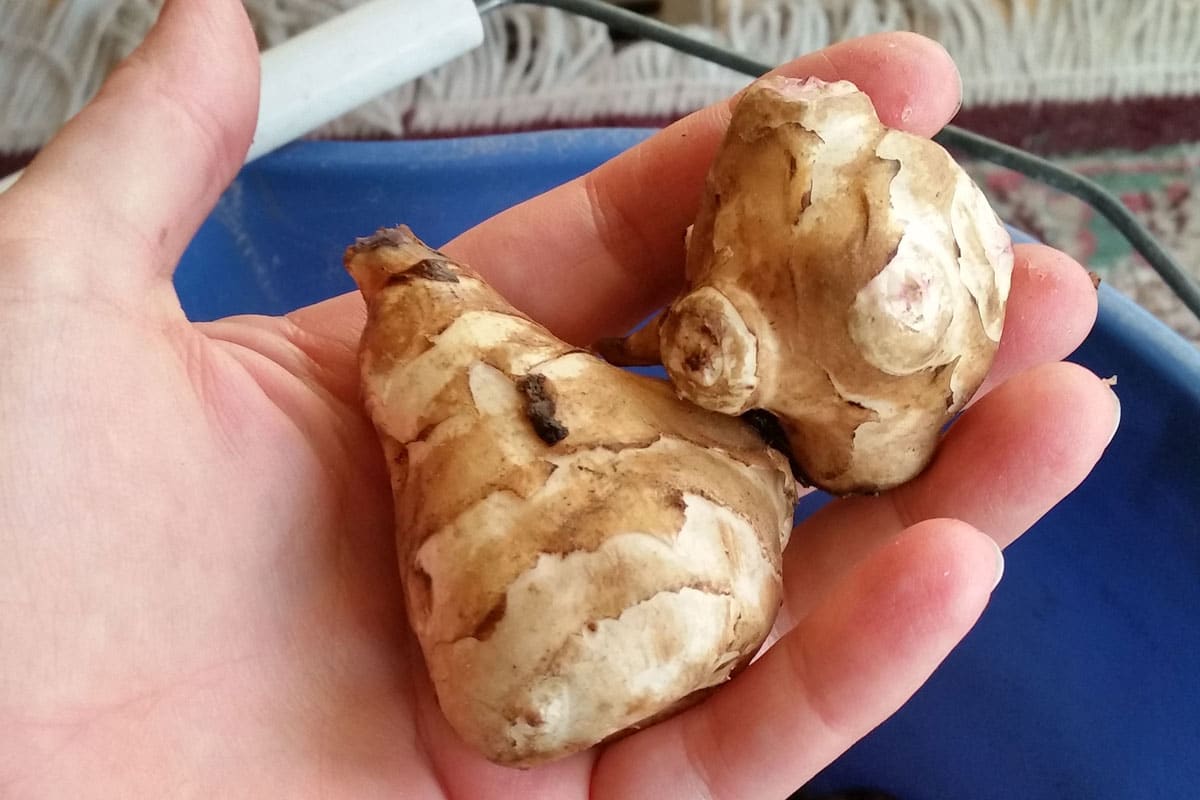
Sunchokes are native to eastern North America. They are also known as Jerusalem Artichokes or Sunroots. They are not related to Artichokes, but they are related to sunflowers. The whole “Jerusalem” thing is supposedly linked to the Italian word girasola, which means sunflower.
Sunchokes are a perennial plant that grows six to ten feet tall. While they do have pretty yellow flowers, most people grow them for their edible roots. Their roots are high in inulin, and eaten raw or cooked.
Historically, Native American valued them as a food source, especially during late winter when food supplies run low.
How do you Grow Sunchokes?
Grow sunchokes from roots or sections of root, planted in spring or fall while roots are dormant. You can grow the plants from seed, but starting with tubers is easier and faster.
For best results, use the following planting guidelines:
- The plants prefer loose, well-drained soil, but will tolerate poor soils. (Lighter soil makes harvesting easier.)
- Space sunchoke tubers 12 to 18 inches apart, 4 to 6 inches deep.
- Space rows 4-6 feet apart (they will be prone to spreading).
- Soil temperature at planting should be at least 50°F.
- Plant in full sun.
- Do not plant in areas that are consistently wet, as wet soil will rot the tubers. Plants are drought tolerant, but produce best will a regular supply of water.
- pH of soil best between 5.8 and 6.2 (neutral soil)
- Preferred growing temps = 65 to 90 F.
- Cover your soil with an inch or so of organic mulch for easier harvesting and root protection.
- Plant in a dedicated bed that can be mowed around for control. Or sink barriers into the soil around the sunchokes at least 24 inches deep to prevent spreading. (More on this below.)
When are they Ready to Harvest?
Harvest sunchokes in late fall or early spring. They require 110 -150 days to maturity, depending on the variety and growing conditions. Light frost increases the sweetness of the tubers.
Unlike potatoes and some other root crops, sunchokes do not store well. Their skin is thin and dries out easily. I keep them in the refrigerator for 1-2 weeks. They keep best in the ground, dug as needed for use.
In northern areas, a thick layer of mulch may keep your tubers accessible longer. It may also encourage mice or voles to move in and have a snack, but there’s usually enough to share.
For bigger roots, avoid crowding plants and water regularly. You can also cut off flower stalks to encourage root growth. Please don’t cut off all your sunchoke flowers! They flower late in the season, when pollinators have few flower choices.
How do I Eat Jerusalem Artichokes?
Sunchokes are edible raw or cooked, including the skins. They are difficult to peel and turn grey quite quickly, so a good scrubbing is a better option.
Raw, sunchokes are similar in texture to a water chestnut or jicama. After a light frost, they take on a somewhat nutty flavor. For my part, they taste best raw after a frost.
See Jerusalem Artichoke Recipes for easy recipes and cooking tips.
Do Sunchokes Cause Gas?
Sunchokes are loaded with inulin. Inulin is a type of starch that acts as a prebiotic in the digestive tract, feeding our beneficial bacteria.
Inulin is a widely used filler in many foods to bump up the fiber counts. It also increases calcium absorption in the body, and doesn’t spike blood sugar. There are even sweeteners made for diabetics made out of sunchokes.
See Jerusalem Artichoke Benefits: Nutrition, Flavor, and Uses for more information.
Eating a large amount of sunchokes may lead to “mild gas”. They have the nickname “fartichokes”.
I can verify that eating a large portion of boiled sunchokes will give you horrible, gut-racking gas like you have never experienced before… except for that one time when you were pregnant and thought it was a good idea to eat prunes, cheese curds and cucumbers in large amounts all at the same time.
Start slowly when eating sunchokes, and perhaps avoid serving them in large quantities at dinner parties. Give your digestive system time to build up the right bacteria to deal with the extra inulin.
Readers have suggested a couple of different tips to beat sunchoke gas. One suggested that you eat some sunchokes raw, and don’t scrub all the dirt off.
I assume that some soil microbes come with to help aid digestion. Another reader says that harvesting after frost is a big help, as the frost naturally breaks down some of the inulin for you.
A Word of Caution About Growing Sunchokes
“Easy to grow” and “disease-free through heat and drought” are code words for “You will Never Get Rid of this Plant!”
When I first planted sunchokes, I skimmed over the note in the seed catalog that said “they will spread and may be invasive”.
I planted my tubers late in spring, in one corner of a garden bed. There were nine rather wrinkled little roots, and I didn’t think they would all survive. Not only did they survive, they thrived. We tried to harvest the whole patch that first year, but must have missed a few.
The next spring they were back, and they were spreading. We tried to keep up eating them, but the fall was muddy and we couldn’t get in to harvest.
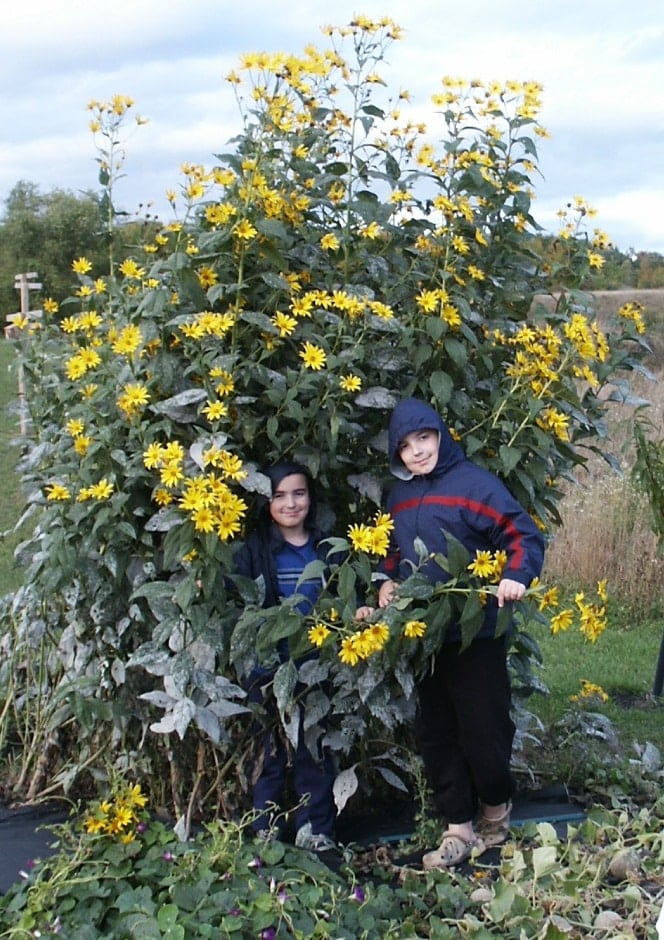
By the third season, we had the lovely thicket of 12 foot tall flowers you see at the post. As I was digging them in fall, I tossed some damaged roots off into the tall grass away from the garden.
Sunchokes Spread from the Smallest Bit of Tuber
Fast forward to spring. Those root bits haphazardly thrown into the weeds – they’ve now sprouted into plants. There’s a new sunchoke colony.
I decide to get rid of extra sunchokes. Two friends come over.
Four different adults attack the patch. Bushels and bushels of sunchokes leave the garden. The patch size is reduced roughly by half to start the spring.
Time passes. My boys work the bed again. They remove more sunchokes from the same area that the adults have already gone over.
Before I put the transplants in, I work over the same area one more time. THERE ARE STILL SUNCHOKES COMING UP! This area has been gone over by four adults and two kids, and there are still sunchokes hiding in the dirt.
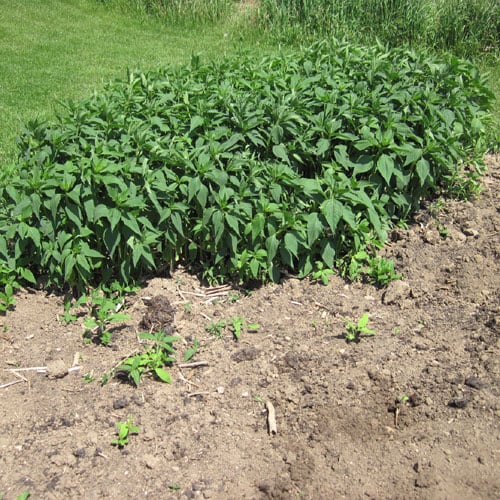
Here’s the main patch. You can see the smaller outliers in the foreground. That area should be clear.
Here’s a nice, innocent looking sunchoke seedling.
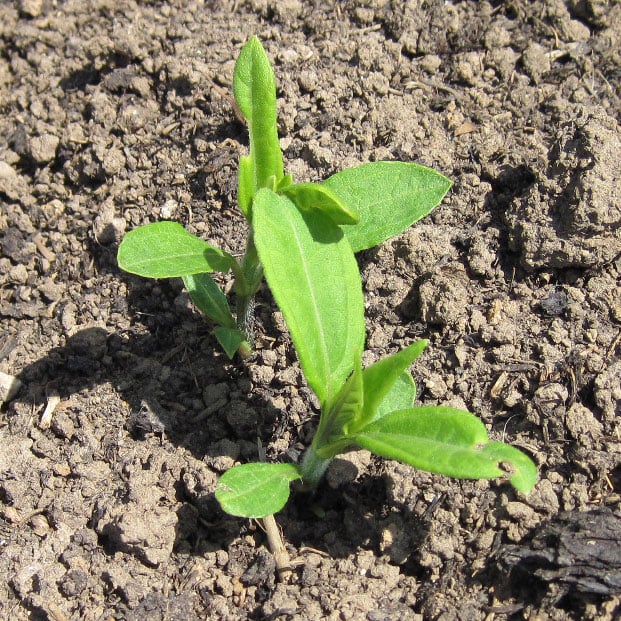
Once we dig it up, we see that this single tuber is trying to regrow an entire sunchoke thicket.
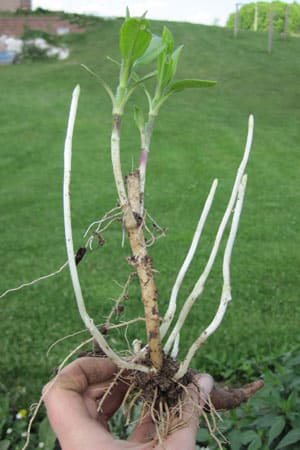
Even tiny pieces, no bigger than the tip of my thumb, can regrow entire large, vigorous plants.
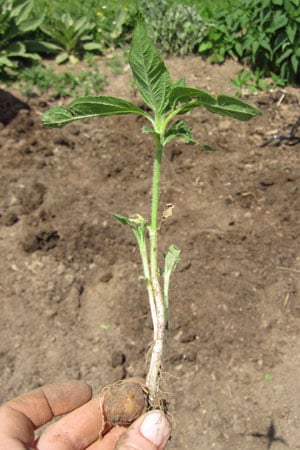
They’re virtually unstoppable. Weeks later, and I’m still digging up shoots from among my cabbage seedlings.
Plan Ahead with Your Sunchoke Plantings
I urge you, do not plant sunchokes anywhere else you might like to grow other plants at some time in the future. You will spend very large amounts of time attempting to remove them if you do.
Plant them in their own area that you can mow around, to keep them under control. You can also plant them in pots – as long as they are big pots. Try one tuber per 18 inch diameter pot. Look for varieties that naturally grow shorter, and have an option for providing support if needed.
My neighbor says her horseradish plants are the same way. Plant both at your own risk. Maybe we should plant them next to each other, to see which one wins.
Alternatively, introduce pigs or chickens into your sunchoke area and let them tackle clean up duty. Jerusalem artichokes make a fine fodder crop.
What Tries to Take Over Your Garden?
Sunchokes are good for you. They look pretty, taste okay, and are quite expensive to buy in many areas, if they are available at all.
They’re a “perfect” choice for a new exotic vegetable to try. I just wanted to let you know that you’re likely to have a lifetime commitment with them once they enter your garden. Don’t say I didn’t warn you.
Are there any other plants you’ve grown that want to take over your garden? Leave a comment to warn other gardeners before they end up fighting them, too.
Also, if you could include in your comments roughly what area you are from, that would be great. Some plants will spread in some locations but not in others.



This article is written by Laurie Neverman. Laurie and her family have 35 acres in northeast Wisconsin. They grow dozens of varieties of fruiting trees, shrubs, brambles, and vines, along with an extensive annual garden. Along with her passion for growing nutrient dense food, she also enjoys ancient history, adorable ducks, and lifelong learning.
Originally published in 2012, last updated in 2026.
Hi! A friend of mine planted one of these in my front garden as a “thank you” present three years ago~ as I had done a lot to help her out one summer. Well, she is no longer a friend…but the plant she gave me has stayed tried and true! It has taken over my entire garden. Not only that…I now have some sort of what I assume to be an enormous “rodent colony”~ though I have never seen one.
Originally, I had hoped it was just home to a bunny and family…a “Watership Down” in my yard. But, a friend came over to rain on my parade and said…”ummmm, rabbits don’t make that many obvious holes. And, rabbits don’t mound dirt like that. And, rabbits don’t uproot plants. And, you wouldn’t see the rounded tops of rabbit tunnels” Etc.
Needless to say…I am now completely perplexed and even more unhappy than I originally was.
Not only do I have a plant I can’t get rid of and most of my other plants have been killed off/crowded out…BUT I have some sort of vermin living in my garden…seemingly, quite happily co-habitating with the Jerusalem Artichoke. Aka~ “choke the life out of the rest of your garden!”
Can anyone tell me “what” critters may be living in my garden?????? They seem to LOVE this plant! I would love to have a clue “WTF?!” to do about BOTH problems! Thanks!
Have you seen the critter at all? What size are the holes? Pocket gophers (ground squirrels) are prolific diggers, as are actual gophers. The pocket gophers dig a hole a couple inches across. Ground hogs are diggers, too, but their holes are much larger.
I haven’t seen the critters. Just the damage to the garden. I’ve been away for a couple weeks…but am going to revisit this issue in a few days when I return. I can let you know the size of the holes. I live in the Philadelphia suburbs…and gophers don’t normally live there. Unless they really go out of their comfort zone to eat the darn sunchokes! Thanks for the feedback!
Would you be OK growing pennyroyal plants in same area? pennyroyal is a mint family plant, grows similarly. Minty aroma. And, critters and bugs hate it, because it interrupts them breeding.
IDK if mint would do same; though one person said it did, I have yet to try that.
I’m working on planting starts of chocolate mint all around the foundations of the house, as a kind of aromatic deterrent…we like chocolate mint. Really don’t care if it tries to take over the grass/weeds adjoining, since it mows same as those. I need to find some pennyroyal seeds to try starting those, too.
We keep our sunchokes in a large container, started doing that more because rocky soil prevents harvesting root crops. So got a couple 2′ deep galvanized watering troughs from farm store, and configured those with a water reservoir in bottom, a U-shaped drain pipe for overflow at the outlet [it can adjust higher or lower for water levels to drain]. Filled them with good dirt and compost. No critters [not in 2+ years at least], and easier to harvest [raised beds].
Because of the galvanized metal, even slugs avoid crawling up the sides….a strip of copper tape around the sides, would make that even more effective [electrical differentials slugs are sensitive to..they hate copper, dislike galvanized for that, I was told…seems to work].
This might be a dumb question but where do I buy sunchoke tubers for planting? Using the same tubers I buy to eat? thanks!
There are links in the post, but you should be able to plant those you buy for eating, too.
That’s exactly how we got tubers to make our stand of them. Bought organic Jerusalem Artichokes from the Co-Op grocers in our city. Planted a few small ones. The 1st season, those grew very tall upper plants, and plenty of tubers in the dirt…almost a 5-gallon bucketful of them.
Chilling them for a couple weeks, at least, decreases the gaseous effect on digestion; add lengthy cooking, and it really reduces gaseous effects. The longer the storage in the produce bin in fridge, the more reduction in gaseous effects.
These have a long storage life: we still have a produce bag of them in the crisper drawer, from last season….now have new crop planted in a container, about 8″ tall now in May.
I have a theory that this plant could solve the climate change problems we are being led to believe exist. I have grown a crop year after year in the same six square foot plot continually in UK for several decades. This has resulted in yields of over 3 Imperial pounds per sqft; far greater than anything else I grow. Apart from harvesting them, the ground has remained unaltered or treated. The site is not even in a sunny spot. Grown on moorland, they could provide a feed-stock for some digestive process from which renewable energy could be obtained from land that would otherwise go to waste.
To avoid them spreading, my plot is hemmed in with buried roofing slates.
Was it not William Shakespeare that described them as the “nobbliest rhizome of them all”? (No you misheard. He described Caesar as “The noblest Roman of them all” Ed)
John S Churchill, You might be on to something with that idea! These ‘chokes grow almost any soil, little tending. If one plants them in rich soil, they REALLY produce! We have a 2’w x 6’ L x 2’d planter, filled with really good soil and compost. A handful of ‘chokes produced giant shrubs, and about 2 gallon bags filled with ‘chokes….kept in the crisper drawer in the fridge, have been providing a portion of food from those, for several months. Enough were left in the planter, that we’ll get _loads_ more this season!
These are a survival food, because, they volunteer and need so little care.
CLUE: To much-reduce gas from these: 1] store at least 2 weeks in fridge, before trying to eat them; 2] chop into small pieces and cook long; 3] eat some on most days, even a little, and it will help rebuild gut biota and heal the gut [because of high inulin content, a pre-biotic]
….I know this might sound counter-intuitive, because of the gas-factor. But, the more one eats them, the better the gut health, and the less gas.
These _might_ make a good crop to make bio-deisel from. Can cold-store, then later grate/cook/mash and dry into “cakes” for later use, and reduces canning and storage weight and space.
Double cooking them will eliminate the gas problem so it is said- seems to work for me.Try roasted Artichoke soup- roast first them cook into a puree soup with some other ingredients…nice. or boil lightly then slice into an au gratin with potatoes and cheese,garlic and paprika. Enjoy.Mine are planted as summer windbreaks for wind sensitive plants (like young maple trees, gooseberries and hazelnuts) and come up every year reliably but have not spread past where I want them. I cook buckets of them for my hens with other vegie scraps too. They don’t eat them raw it seems.
Thank you! I am trying sunchokes this year to see how they will perform as a compost crop and addition to this winter’s chicken diet. A lot of foods that can be extra work to digest can be pickled and I wonder if you have tried that? I may, will comment on digestibility for all members of the household. Otherwise it’s really helpful to know they are acceptable cooked. What an intriguing crop sunchokes are! A bit of a puzzle, but a superfood for the ingenious gardener. Somebody somewhere is going to found an international sunchoke festival, and I’m going!
I haven’t tried pickling, but I know it can be done and is indeed effective in reducing the gas for some.
Excellent article. Fun and informative. Thank you. But the ads on this page makes it jerky/hesitant and makes it hard to do something as simple as scrolling – even with my powerful computer and fast internet.
May I ask what browser you’re using? I have a good computer but very slow internet, and haven’t run into any issues with ad loading interfering with viewing the articles.
I too experienced problems with scrolling but this seemed due to some of the content appearing and then vanishing; nothing to do with standard of computer or baud rate. I’m not sure that the content was ads as such!
I have commented earlier, but here is my latest for what it is worth: Nearly 50 years ago I acquired a start and since then have planted, moved and successfully grown Sun Chokes or whatever we wish to call them. Mine often grow to 10+ feet if stabilized and harvested after sunflower tops have wilted. They will migrate in time but digging will eliminate unwanted new locations. Cause Gas? Well for me, somewhat YES, but so do beans!! This is Portland area Oregon and everything grows here, including weeds. Don
Mitch. I don’t know about Texas sandy loam but I grow around a quarter of an acre here in Ireland (our soil is sandy loam with lots of stones) each year for my pigs to root over during November and December. Before doing so I dig up enough tubers to fill 4 barrels and cover subsequent layers with sand. Every year the last few, very small, tubers get discarded with some of the sand at the end of a row. They grow just as vigorously as the rest! So, I’m guessing the answer is yes! 😉
will sun chokes grow in texas sandy Lome ?????????
Oikos Tree Crops says that they should grow from Texas to Maine.
I slow roast them whole with oil in the oven for 1.5 hrs at 150c / Gas mark .
I then slit them individually like when gutting a fish then get the potato masher and squidge them fast & hard. All that white flesh just oozes out leaving an empty browned skin. Throw the skin away and collect all the white flesh.
I freeze this white flesh in little portions which I add to soups. Which add a unique flavour.
JA’s are one of the largest sources of probiotics and are good for you.
Jerusalem artichokes contain inulin, which acts as a prebiotic, not a probiotic. Squidging does sound fun. 🙂
I would love to grow some sunchokes, would anyone be willing to send me some? I’d pay for the shipping. Chris.verda@gmail.com
All true statements….but with one or two exceptions.
The tubers are VERY crunchy when made into pickles. Extremely so….and very tasty. As for control, not really a problem if you put them in a place that can be mowed should you decide to get rid of them. Also, RoundUp herbicide, heavily applied, will take them out. BUT, as good as they are, I can’t imagine anyone wanting to destroy their patch. Loose soil. heavy fertilizer, and plenty of water and the crops will be AMAZING! SO good!! Get some.
Here in central Virginia my boss grows both sunchokes and mint. She says both are extremely invasive. By the way, inulin is the key ingredient in pastas made for those on low carb diets. My family can’t eat it because of the gas it causes them, but it doesn’t cause me problems.
great info. i would like to try this in pots. what potting soil mix do you recommend ?
I’ve been very happy with the Foxfarm potting soil mixes, like their Happy Frog potting soil and Ocean Forest soil. Their blends have a good mix of nutrients, plus some of them include beneficial fungi, which can dramatically improve root/plant health. Of course, you can work with any good quality potting soil blend and give it a jumpstart with some compost tea, worm castings, your own garden compost or a variety of other add ins.
I have lived in my Northern Utah home for 30 years. The “weed” that myself and the previous home owners have been fighting for at least the past 50 years turned out to be Goji Berry! It is also called Wolf Berry or Lycium barbarum and is now widely considered a super fruit. It was brought by Chinese workers building the Transcontinental Railroad completed in 1869 and is definitely here to stay. It spreads by seeds and cuttings (any time a branch can contact the soil). It tastes lousy but is all the rage and has been cultivated in China for over 700 years. I guess I will give up and start cultivating instead of attacking this very persistent plant despite its long thorns. Maybe I will find a recipe to make it taste good.
You comment makes me chuckle a little, as I have two goji berry plants that I have been trying to grow for the last two years that just sit there. Maybe if you mix the berries with another fruit it will mellow out the flavor? I regularly make jams and fruit leather combining autumnberries with pears or apples, since the autumnberries are very astringent on their own.
The Goji berries I ate were dried and in a mix of pumpkin seeds, coconut, walnut, cashew, dried cranberries – a trail mix. It was delicious. Goji berries are supposed to be wonderful for you with great health benefits
We have two goji plants, but with our weird weather the last two years they’ve been struggling to get established. I hope they eventually take off so we can try fresh goji berries.
I’m just learning about permaculture design and food forests, and I love this post and the ensuing discussion. Invasive species are usually valuable in some way, breaking up or binding soil, fixing nutrients, attracting beneficial insects. By their nature invasive species produce a lot of biomass with no inputs or labor, which makes them incredibly valuable from a sustainability viewpoint.
The crucial trick is figuring out how to balance them when necessary, either with well-timed cut-and-drop or by finding animals that like to eat them or other plants that can cope with them and keep them in check. For every species we find sustainable controls for, we increase our understanding of nature and help rediscover our ability to co-evolve with the rest of the planet. Super important stuff, thanks!
Chris – I bet you’d love the book “Beyond the War on Invasive Species – A Permaculture Approach to Ecosystem Restoration“. I did a review of it recently and I thought it was excellent. It features and elaborates on many of the points that you make.
I need to put this post on the “update” list. We’re getting chickens this year (no pigs yet), so I’m curious to see how they work with the sunchokes. I did ask Larry if he’d be willing to share more of how they use sunchokes and he said he would write something up, but time has passed without hearing back from him, so I assume he’s busy farming.
Our bumper crop of Sunchokes is aging in the fridge, then to be grated, dried, & stored.
Learned: these do indeed come back; if they seed, they spread more. Sunchokes are Very gassy when eaten shortly after harvesting, but aging in the fridge for at least a couple weeks, really does lower the gas-factor. Saw suggestion to combine these with some protein, & it did also seem to decrease the gas-factor. But the more important thing: It appears that eating some almost daily is most key [along with healthy diet], since sunchokes help keep good biota & inhibit the bad ones.
Have tastily added finely chopped sunchokes to beans and rice, curries, stews.
Learned something even more important: Good gut bacteria is greatly helped by eating a small serving of sunchokes, daily. The fiber, inulin, etc. help good biotics survive, while not feeding bad forms….and, because of this, even eating about 1/4 to 1/2 c. chopped sunchokes with a bit of protein, daily, seems to trigger measurable weight loss…maybe 1/2 to 2 pounds. Really astounding, as I’d tried so much…this veggie was the only change…& losing a few pounds suddenly happened.
This article may lead people to some strange conclusions about H.Pylori, & what else, by saying H.Pylori is a good bacteria! THAT kind of idea must be quantified/qualified!!! Because, just as E.Coli is always in the gut, & usually helpful [IF other gut biotics are also healthy], E.Coli can also go rogue, causing horrible infections. H.Pylori gone-wrong, is strongly part of most cases of GERD, chronic nausea conditions, as well as maternal morning sickness, including the worst sort, Hyperemesis Gravidarum.
PERHAPS, it’s not simply the Type of biota, but the CONDITIONS all of those exist in, in the gut. If the cultures are a very large spectrum of types, that’s best.
What & how we eat, makes all the difference in gut health, therefore overall health.
There are many different strains of most common gut bacteria – some good, some bad. E coli strains have been identified in many food poisoning cases, yet other e coli strains are perfectly harmless. Different gut conditions do indeed seem to favor helpful bacteria over problem bacteria, and vice versa.
Thanks for sharing your weight loss story. Much cheaper than buying diet foods loaded with inulin.
Did you know that different people have different cocktails of ‘good’ gut bacteria and that as a consequence different foods have different effects on them meaning that a diet suitable for one person may not suit another? It’s more complex still because eating certain foods changes the mixture of this cocktail. For a more accurate description refer to the BBC (in UK); it’s scientific output – try “Michael Moseley”.
Yes, I’m quite familiar with gut biomes and their variations.
I have heard that pigs will turn over a plot in search of tubers, maybe worth a try.
Many critters will eat them. Looking forward to seeing how chickens like them next year.
Sunchokes can be easily controlled. If any tubers are left in soil, just pull the plants out in the next summer when all their energy is above ground and there are no tubers underground yet. Without leaves, they cannot make tubers and they will not be able to regrow. They start sending their energy to the tubers when they sense that the day is getting shorter in autumn. I’ve grown them for many years in different places and can clear them wherever I want to without any problem.
I’m glad you’ve been able to successfully control yours. Mine tend to keep coming back all over from the tiniest bit, even when pulled mid-season. Once we get chickens, I hope to rotate a chicken tractor over the bed for a more thorough cleaning at the end of the season.
If you need to get rid of a few…would you want to send me a few tubers, Lol????, to Michigan?
We’ve developed some sort of black “ick” in some of the tubers, so I’d be afraid of sending contaminated stock.
Here’s another one trying to take over: wild garlic, also known as bear garlic or ramson. I live in Germany, near Munich, where it’s a native plant called Bärlauch. Makes delicious pesto, so I was happy to have it. But then I injured my hand and couldn’t do much in the garden for a while, and now it’s everywhere! The roots/bulbs are tiny but quite deep and tenacious.
I also have sunchokes doing well along a fence.
I see it’s a wild relative of chives, which can also spread like crazy if not dead headed. Thanks for the warning!
I HAVE WILD GARLIC AND LOVE IT…I pull it up and steam it with my asparagus in the spring, and sometimes just steam up a pot of it for a vegetable, at the stage where it looks like a scallion. Add a little butter and seasoning if you like. I also pull it up and clean it and chop it in the blender and then dry it on the trays in the dehydrator and then blend it up again and put it in a spice bottle. It is a nice mild garlic flavor which is great for garlic bread or to season vegetables. I have even pickled it and my family love that. I saved the green tops to dry. It was a lot of work but everyone helped and we made quite a few pints of it. Once it starts setting head, then it is too woody. but I sometimes dig it up in the fall and use it. It is quite strong then. And usually when I dig, I can find “garlic pearls” below the roots or attached to the roots. They are little round garlic in a hard shell. Once you get them out of the shell they are quite tasty.( My old neighbor Tom C. turned me on to the pearls.) I live in NW PA.
But is has spread everywhere, as I don’t always head it and the seeds drop. I used to cut the heads as they were forming and steam those, but last few years, I just didn’t get around to it.
Thanks for sharing your experience, Lisa.