
Before You Plant Sunchokes, You Need to Read This Post

This post may contain affiliate links. Read my full disclosure here.

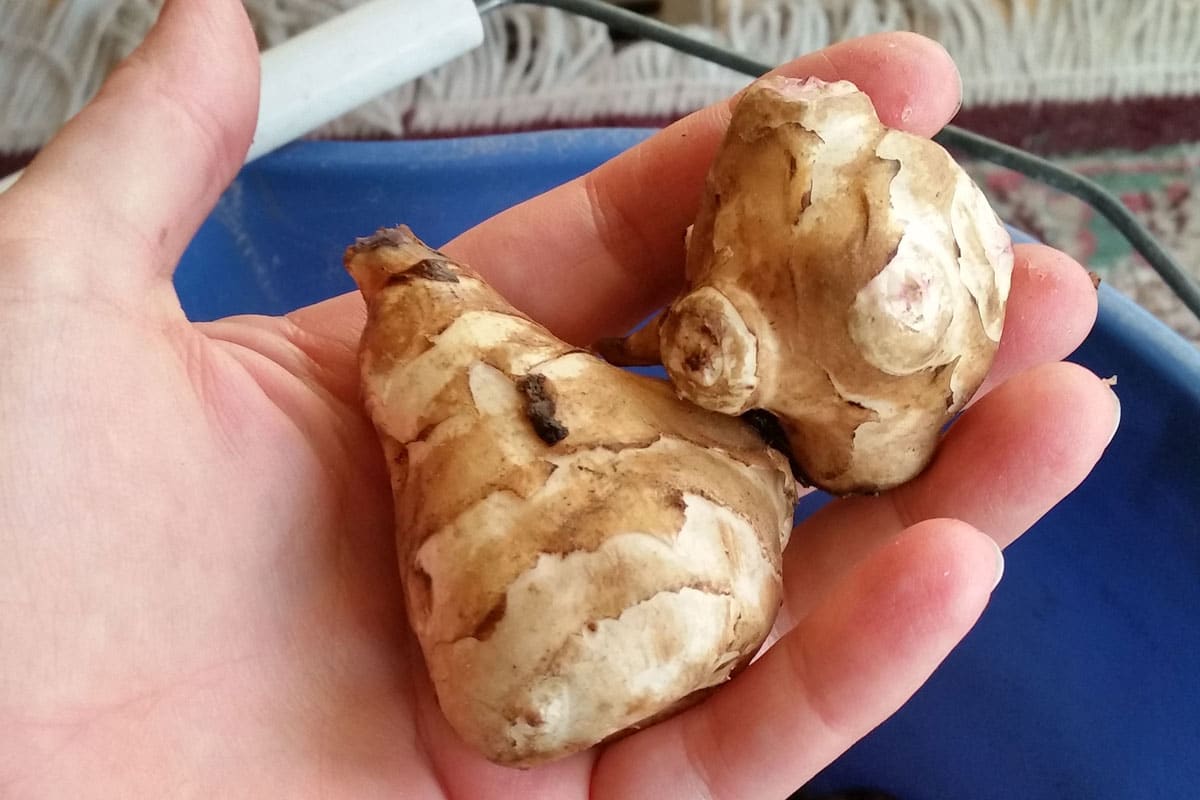
Sunchokes (AKA Jerusalem artichokes) are gaining popularity for their health benefits. I’m sharing how to grow sunchokes, when to harvest and how to use them – plus the big mistake that we made when we first planted them.
Would you like to save this?
Table of Contents
What are Sunchokes?
Sunchokes are native to eastern North America. They are also known as Jerusalem Artichokes or Sunroots. They are not related to Artichokes, but they are related to sunflowers. The whole “Jerusalem” thing is supposedly linked to the Italian word girasola, which means sunflower.
Sunchokes are a perennial plant that grows six to ten feet tall. While they do have pretty yellow flowers, most people grow them for their edible roots. Their roots are high in inulin, and eaten raw or cooked.
Historically, Native American valued them as a food source, especially during late winter when food supplies run low.
How do you Grow Sunchokes?
Grow sunchokes from roots or sections of root, planted in spring or fall while roots are dormant. You can grow the plants from seed, but starting with tubers is easier and faster.
For best results, use the following planting guidelines:
- The plants prefer loose, well-drained soil, but will tolerate poor soils. (Lighter soil makes harvesting easier.)
- Space sunchoke tubers 12 to 18 inches apart, 4 to 6 inches deep.
- Space rows 4-6 feet apart (they will be prone to spreading).
- Soil temperature at planting should be at least 50°F.
- Plant in full sun.
- Do not plant in areas that are consistently wet, as wet soil will rot the tubers. Plants are drought tolerant, but produce best will a regular supply of water.
- pH of soil best between 5.8 and 6.2 (neutral soil)
- Preferred growing temps = 65 to 90 F.
- Cover your soil with an inch or so of organic mulch for easier harvesting and root protection.
- Plant in a dedicated bed that can be mowed around for control. Or sink barriers into the soil around the sunchokes at least 24 inches deep to prevent spreading. (More on this below.)
When are they Ready to Harvest?
Harvest sunchokes in late fall or early spring. They require 110 -150 days to maturity, depending on the variety and growing conditions. Light frost increases the sweetness of the tubers.
Unlike potatoes and some other root crops, sunchokes do not store well. Their skin is thin and dries out easily. I keep them in the refrigerator for 1-2 weeks. They keep best in the ground, dug as needed for use.
In northern areas, a thick layer of mulch may keep your tubers accessible longer. It may also encourage mice or voles to move in and have a snack, but there’s usually enough to share.
For bigger roots, avoid crowding plants and water regularly. You can also cut off flower stalks to encourage root growth. Please don’t cut off all your sunchoke flowers! They flower late in the season, when pollinators have few flower choices.
How do I Eat Jerusalem Artichokes?
Sunchokes are edible raw or cooked, including the skins. They are difficult to peel and turn grey quite quickly, so a good scrubbing is a better option.
Raw, sunchokes are similar in texture to a water chestnut or jicama. After a light frost, they take on a somewhat nutty flavor. For my part, they taste best raw after a frost.
See Jerusalem Artichoke Recipes for easy recipes and cooking tips.
Do Sunchokes Cause Gas?
Sunchokes are loaded with inulin. Inulin is a type of starch that acts as a prebiotic in the digestive tract, feeding our beneficial bacteria.
Inulin is a widely used filler in many foods to bump up the fiber counts. It also increases calcium absorption in the body, and doesn’t spike blood sugar. There are even sweeteners made for diabetics made out of sunchokes.
See Jerusalem Artichoke Benefits: Nutrition, Flavor, and Uses for more information.
Eating a large amount of sunchokes may lead to “mild gas”. They have the nickname “fartichokes”.
I can verify that eating a large portion of boiled sunchokes will give you horrible, gut-racking gas like you have never experienced before… except for that one time when you were pregnant and thought it was a good idea to eat prunes, cheese curds and cucumbers in large amounts all at the same time.
Start slowly when eating sunchokes, and perhaps avoid serving them in large quantities at dinner parties. Give your digestive system time to build up the right bacteria to deal with the extra inulin.
Readers have suggested a couple of different tips to beat sunchoke gas. One suggested that you eat some sunchokes raw, and don’t scrub all the dirt off.
I assume that some soil microbes come with to help aid digestion. Another reader says that harvesting after frost is a big help, as the frost naturally breaks down some of the inulin for you.
A Word of Caution About Growing Sunchokes
“Easy to grow” and “disease-free through heat and drought” are code words for “You will Never Get Rid of this Plant!”
When I first planted sunchokes, I skimmed over the note in the seed catalog that said “they will spread and may be invasive”.
I planted my tubers late in spring, in one corner of a garden bed. There were nine rather wrinkled little roots, and I didn’t think they would all survive. Not only did they survive, they thrived. We tried to harvest the whole patch that first year, but must have missed a few.
The next spring they were back, and they were spreading. We tried to keep up eating them, but the fall was muddy and we couldn’t get in to harvest.
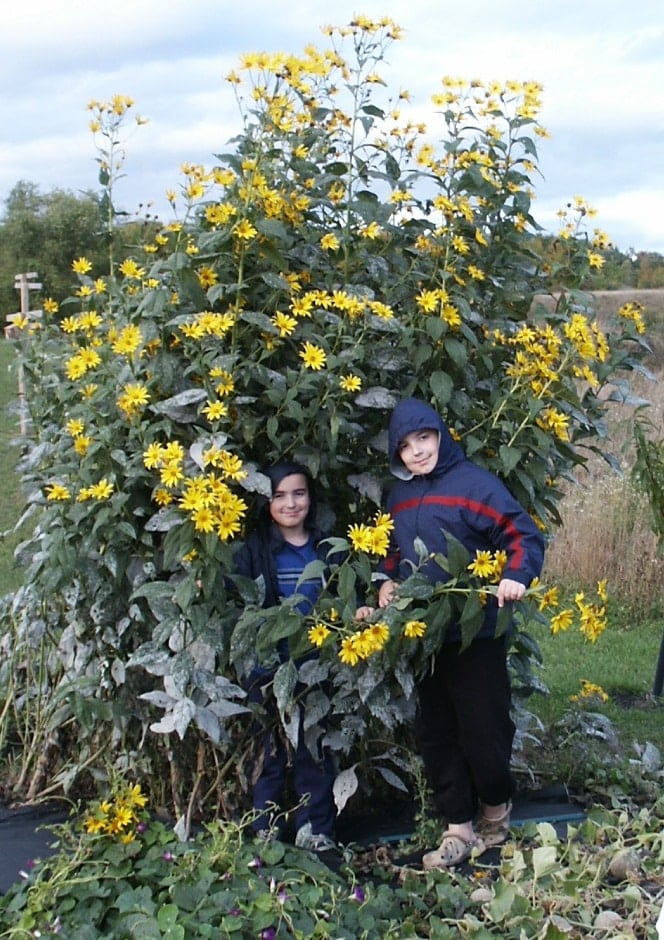
By the third season, we had the lovely thicket of 12 foot tall flowers you see at the post. As I was digging them in fall, I tossed some damaged roots off into the tall grass away from the garden.
Sunchokes Spread from the Smallest Bit of Tuber
Fast forward to spring. Those root bits haphazardly thrown into the weeds – they’ve now sprouted into plants. There’s a new sunchoke colony.
I decide to get rid of extra sunchokes. Two friends come over.
Four different adults attack the patch. Bushels and bushels of sunchokes leave the garden. The patch size is reduced roughly by half to start the spring.
Time passes. My boys work the bed again. They remove more sunchokes from the same area that the adults have already gone over.
Before I put the transplants in, I work over the same area one more time. THERE ARE STILL SUNCHOKES COMING UP! This area has been gone over by four adults and two kids, and there are still sunchokes hiding in the dirt.
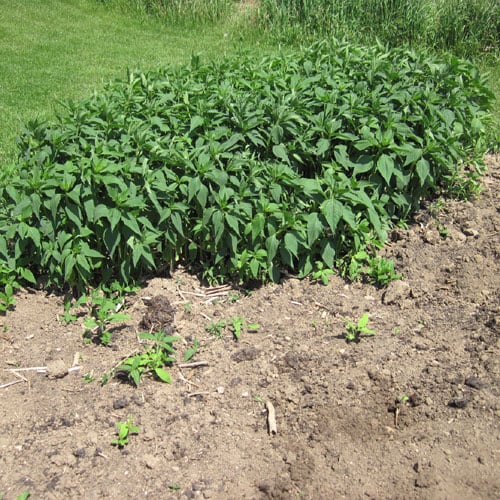
Here’s the main patch. You can see the smaller outliers in the foreground. That area should be clear.
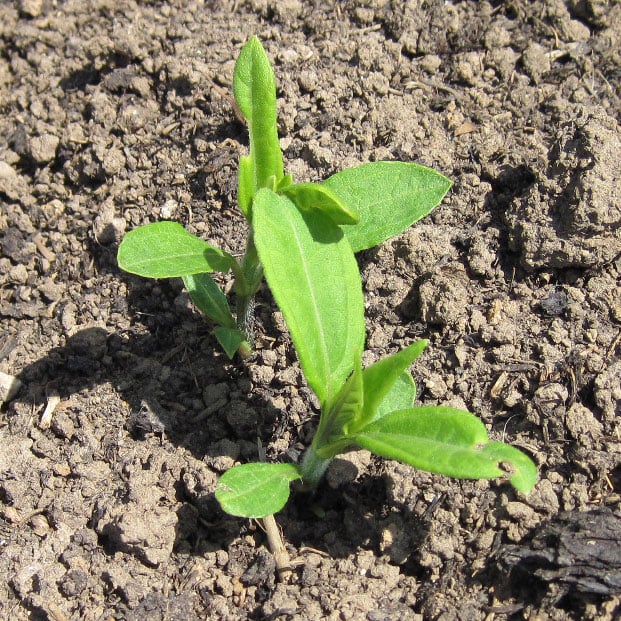
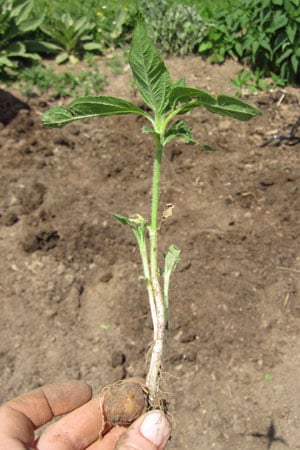
Here’s a nice, innocent looking sunchoke seedling.
Once we dig it up, we see that this single tuber is trying to regrow an entire sunchoke thicket.
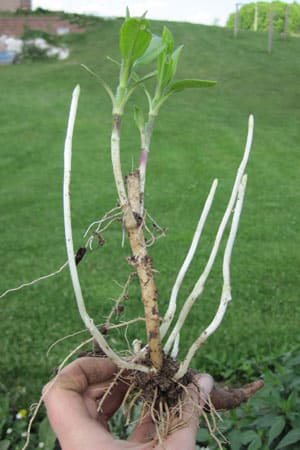
Even tiny pieces, no bigger than the tip of my thumb, can regrow entire large, vigorous plants.
They’re virtually unstoppable. Weeks later, and I’m still digging up shoots from among my cabbage seedlings.
Plan Ahead with Your Sunchoke Plantings
I urge you, do not plant sunchokes anywhere else you might like to grow other plants at some time in the future. You will spend very large amounts of time attempting to remove them if you do.
Plant them in their own area that you can mow around, to keep them under control. You can also plant them in pots – as long as they are big pots. Try one tuber per 18 inch diameter pot. Look for varieties that naturally grow shorter, and have an option for providing support if needed.
My neighbor says her horseradish plants are the same way. Plant both at your own risk. Maybe we should plant them next to each other, to see which one wins.
Alternatively, introduce pigs or chickens into your sunchoke area and let them tackle clean up duty. Jerusalem artichokes make a fine fodder crop.
What Tries to Take Over Your Garden?
Sunchokes are good for you. They look pretty, taste okay, and are quite expensive to buy in many areas, if they are available at all.
They’re a “perfect” choice for a new exotic vegetable to try. I just wanted to let you know that you’re likely to have a lifetime commitment with them once they enter your garden. Don’t say I didn’t warn you.
Are there any other plants you’ve grown that want to take over your garden? Leave a comment to warn other gardeners before they end up fighting them, too.
Also, if you could include in your comments roughly what area you are from, that would be great. Some plants will spread in some locations but not in others.



This article is written by Laurie Neverman. Laurie and her family have 35 acres in northeast Wisconsin. They grow dozens of varieties of fruiting trees, shrubs, brambles, and vines, along with an extensive annual garden. Along with her passion for growing nutrient dense food, she also enjoys ancient history, adorable ducks, and lifelong learning.
Originally published in 2012, last updated in 2026.
Thank you for this post and extensive thread! Lots of great info here — thanks everyone for sharing!
I planted one sunchoke and was planning to plant several more, but might try some in pots/growbags instead to mitigate spread.
Evelina — sunchoke kimchi is a great idea!! There are “water kimchis” made with vinegar and I imagine that would also be a good way to use sunchoke, which would also help presumably cut down the gaseousness effect even though it hasn’t been cooked (or frozen).
=
There is a theory that whatever is growing wild (or out of control) around you is there to benefit you. To that end, we have a Lot of vigorous BURDOCK growing here, which is Great for your liver and the whole plant is edible. I have not yet had success harvesting any roots (they come up mushy rather that firm), and instead I buy the roots at the store to cook and just eat some of the bountiful leaves here. They are super bitter, but so good for you. The younger, smaller leaves are softer and more palatable than the very thick larger leaves. I’d love to hear any suggestions for ways to prepare burdock leaves so I can get the family to also eat them. Maybe tomatoes/sauce and parmesan could help with the bitterness. Or coconut milk… Or instead of grape leaves in dolmeh!
The long burdock roots also help to work (decompact) the soil, which dandelions also help with.
This is a great explanation of the service that dandelion “weeds” provide to our yards balancing the soil nutrients and more, and how they go away on their own when they’ve finished the job: https://youtu.be/bpEy-Mpm6AI
And a very brief explanation of how DANDELIONs can help prevent/rebalance Cancer https://youtu.be/Rxjsmc4f4Nc
Another vigorous grower around here (central Illinois) is poison hemlock. Lovely, but poisonous, so I’ve been digging it up each spring and will hopefully stop the spread this year. If any of you have any insight as to benefits of poison hemlock, I’m curious to know if there are any…
=
Regarding the war against COMFREY — here is some additional information to reference as comfrey root might be something that would be directly beneficial to you or someone around you:
*Comfrey Root for Receding Gums, Wounds and Cancer
http://www.doctoryourself.com/gums.html
http://www.doctoryourself.com/comfrey_herb.html
What I’m hearing is that these would make a great gift for the nuisance neighbor? “Hey I saw these lovely flower bulbs and thought of you. I think you should plant them in the middle of your yard. I know how much you love sunflowers and these look just like them.”
I just purchased sunchokes to put into the garden –so glad I read this article. I’ve rethought where I am going to plant them–and no, however tempting it is, it won’t be the neighbor’s yard!
I have to say that idea might be tempting with some of my former neighbors, but they’d probably just whip out heavy duty herbicides – which is why I’m glad they are former neighbors.
We’re out in the country, so we have numerous semi-wild areas in the yard. Over the years, I’ve tossed damaged roots in different spots. We now have patches of volunteer sunchokes all over they place. They were damaged and not even planted in the ground, and they still grew. At least I know we won’t starve, so there’s that.
Sunchokes are a grazing decreaser. Animals love both leaves and roots. Tubers ferment well and go all right in stir fry meals. If a prepper, by all means raise a patch. American Indians let them in the ground till almost spring, then dug them. They get pretty sweet and are a good source of sugar.
We’ve often joked that with the way they spread, we will never starve, though we may get tired of eating sunchokes.
Unfortunately the ‘sugar’ is inulin, as in camas lily bulbs, which we can’t digest (hence the ‘fartichoke’ fame).
I find it best to pressure cook them, then the skins slip off, with any remaining dirt, and I use the insides in a soup or dish. Thus, double cooked.
I have friends who ferment them, too, to make them more digestible. Also, if you eat them regularly, your gut biome shifts, and favors microbes that help break them down so gas decreases.
I use them in kimchi, too. But, every dog I ever had loved the leaves. Not so much the roots, but the leaves. No sign of worms, either, and other than stealing water melons and kumquats off the tree, this is pretty much it.
Thank you for this, fabulous, article on Sunchokes. I was thinking of planting them along a fence line, along a field. I’ve a TON of gophers and ground squirrels, do you think those little buggers would keep them in check, or would they eat them all up, and I’d end up with nothing?
It depends on the population pressure, but I don’t think they’d be able to eat them all once the patch gets established. Ours have been popping up around the yard from where I tossed damaged roots, with no signs of stopping. The neighbors have woods right next to their patch and don’t loose many to varmints.
The best way to eat sunchokes is to make kimchi out of them 🙂 no gas, and incredible taste.
I LOVE kimchi! I get radish kimchi from a farmers market in Ashland Oregon, it’s fantastic. Sunchoke kimchi sounds pretty good.
I grew sunchokes ( as well as horseradish) in a dry garden that got at most 15 inches of water per year, mostly as snow in the winter. This garden is almost straight sand, so that might be part of the solution as well. They didn’t spread out of control and were actually very nice plants. The sunchokes spread by about two inches per year under those conditions. The roots were small.
They can tolerate quite a bit of drought. In west-central PA. we rarely get dry summers and with too much rain they can get pithy, tough with a honeycomb interior. My one patch was started on an old shale bed driveway. I got a cheap-o 1.25″ chipper and after pulling the stalks and what tubers came up with them, I chip the dry stalks and scatter the chips over that patch. When I go after the rest of the tubers with a sod fork, that turns the chips under very well. After a few years that soil built up nicely. That could help build up your sand and hold some moisture for you. My other patches are in decent soil. They all do quite well.
I’ve got three varieties. One spreads tubers 4′ in loose soil. That one can get out of hand easily! Another spreads about 20″ to 24″ and the last one only spreads about 8″ to 10″ per year. They don’t need good soil to produce, but the better the soil, the better they produce and the larger the tubers.
Forgot to mention, if you can water them, moderate watering from late September through October and perhaps a bit in November, when the tubers are forming will help. When the flowers are in full bloom until the stalks start to die is the target watering time. Your schedule may differ from mine as for the months but from solid bloom until stalk withering is key.
Thanks for sharing your experience.
In my garden I have two comer-backers every year: marigolds that seed indiscriminately and tomatillos. My husband used to call tomatillos “toma-t-weeds” because they were so prolific. One dropped fruit will sprout 50-60 plants in the spring!
I haven’t planted tomatillos in several years. I just think them out or replant them to where I want them in a particular year. Borage is the same way for me, but so far no self-seeding marigolds.
In south Texas we have an abundance of sunshine and loose sandy loam; Perfect for sun-chokes to thrive.
Planted about a dozen along the neighbor’s fence with the hope that the tubers would swell and raise his cracked driveway, which came right up to the fence.
The tubers did the trick.
Especially, as the rain run-off from his carport roof kept the plants well watered in the easily drained soil.
The plants kept coming back year after year and harvesting was always plentiful.
Unfortunately, after a disagreement with my neighbor, he purposefully washed his carport with gasoline and the runoff killed all my sun-chokes.
I’ve just ordered more tubers and will try planting them along the other neighbor’s fence-line.
Laurie, thanks!
I figured there had to be some Lacto breeds on raisin skins. When I make the Topinambor wine and toss in the few raisins there seems to be at least a double stage to the fermenting. I use jugs and drill a hole for 1/4″ tubing. I glue one end of the tubing into the jug lid and drop the other end into a jar full of water. When the fermenting starts there’s usually a fast bubbling for a few days then it tapers off to a slow but steady bubbling for up to a couple weeks+. When that stops I give it another few days to see if it’ll bubble any more. When there haven’t been any bubbles for several days after the second stage is when I open it up and bottle the brew by siphoning. I like this visual aid to the fermenting process.
I go 100% natural and don’t use the fermentation killer chemicals like Camden. I figure if that stuff kills yeast and bacteria in wine making it’ll also kill them off in the guts.
I don’t know if you’ve seen it, but there has been a small amount of research/interest in reviving wild yeast meads for their probiotic and medicinal values. I read some years ago about a company using wild brewing commercially, but haven’t seen anything more recent.
We made our first wild yeast mead last year and it was amazing. I tried an elderberry variation this year and may have gone a little heavy on the berries. It’s okay, but not amazing. Well, not for us. It’s a little dry for our tastes, whereas the first brew was effervescent and lightly sweet.
I’m sulfide sensitive, so don’t use the yeast killers, either.
The wild mix can be so different from batch to batch, but I’ve never had a bad batch, some better than others, but never bad. My wife is sulfide sensitive too, it can flare her asthma, give her fever blisters and on rare occasions a bit of a rash.
Cannas are great in a hidden garden. All part of the plant are edible. Seeds make tortillas, leaves are food wraps, when young cooked as a green, new stalks are called Inca asparagus. Indians in the north dug them up and dried them, saving the best in silo storage pits.
Women owned the land and fields, and they were the only ones allowed to decide what plants to grow and develop, which is why all our food is both very functional and also very pretty. Amaranth, for example, is a great one for hidden gardens. the leaves are good, if you like spinach-taste, and it produces as much grain by weight as a stalk of maize. Wild amaranth is green. For the flower bed or field, domesticated is red with red or gold masses of flowers.
In Arizona, here, canna is a perennial but need wind protection. It’s almost pest free, even in south america where it originated and one ranch alone plants something like 30,000 acres (Brazil) every year for the starch trade. Edible ornamentals are how to garden in the midst of a famine.
We have plenty of space here so I don’t *need* to hide the food in the landscape, but I always find it fascinating to learn about other foods that aren’t staples in our area. A good portion of our land is food forest in progress, and we keep adding layers as the years go on. It would have driven our old neighbors back in the ‘burbs nuts, but out in the country it just looks like semi-wild areas. And the family knows what plants are edible that the general public likely wouldn’t recognize as such.
I live on the edge of a village in a wide spot in a canyon. When we first moved here, few people were gardeners let alone preppers. We were always getting compliments on the pretty plants in the garden and asked what they are. Sweet potatoes, red amaranth, tepary beans, rosemary, thyme, purslane, canna lily, and so on. Winter is canna, nasturtium, coriander for cilantro, red flowering winter peas, bunching onions and so on. Everything is food that hides as an ornamental. There are wolfberries (American goji), salt brush, jujube, sunchokes covered in yellow flowers, dates, figs, citrus. Most is old-school American Indian style of garden, pretty but tasty. I’d like some sand cherries, as well but it’s zone 9 and while they do well as far north as zone 3, donno about here. A hidden garden is a garden hiding out in the open. Many folks in the area are doing theirs that way. God’s peace to you.
I have blood sugar issues and sunchokes were recommended to help get inulin in my body. It will help the good gut bacteria to grow. My husband and I now love sunchokes. They are $5 to$6 at our local stores.
I am going to find a place to grow them. The advice of all the posters will be heeded. Thanks everyone.
I hope they work out well for you.
You might also find the book, “Cultured Food for Life” helpful. I just started reading it, and it’s a keeper.
Donna (the author) gets into health impacts of cultured foods – and combining them with prebiotic foods. So much of our overall health gets back to our gut health. I’m hoping this will be one of the missing pieces my family has been looking for.
I recently read an article telling about using fermented ‘choke to culture fresh milk. It’s supposed to make a smoother, healthier raw cheese curd. I didn’t find any details but since I occasionally brew ‘choke wine, I may be forced to try this.
If you can find the article again, I’d be interested in reading it. I know nettles can be used to make rennet for cheesemaking, but hadn’t heard of sunchokes for that use.
It’s the use of Lactobacillus cultures that the Inulin in the ‘chokes grow that the scientists were working with. The same strains of Lactobacillus that grow in the large intestine will ferment tuber broth. The question I have is whether the way I set up my fermentation uses natural yeast or if some natural Lactobacillus ‘contaminates’ my batches. I sterilize everything, boil the tubers, strain off the broth and add sugar water until my fermenter is full. I then toss in just a few raisins for natural fruit yeast, cap and let it go. I’m wondering if there’s any natural Lactobacillus on the raisins that ferment the Inulin. I haven’t found anything that states if there’s any Lactobacillus on raisins.
I don’t remember which source I found the cheese curd info in and I’ve done a few searches to try to narrow it down, but without much luck. A hint for searching domains for specific information is using this format in a browser’s address bar:
site: sciencedirect.com “Helianthus tuberosus”+”cheese”
site: nih.gov “Helianthus tuberosus”+”cheese”
site: researchgate.net “Helianthus tuberosus”+”cheese”
Start off with site: followed by the base domain, without any https:// or www. followed by the search terms in quotes with multiple terms tied together with +, no spaces. To exclude a word or term from the search results us the – sign. Google and DuckDuckGo accept this form. I’m not sure if any other search engines do.
I did a quick cruise through and a couple of the sites returned quite a few hits. These were – I think – the sites I was looking over that day.
I found an interesting discussion of grape/raisins yeast on The Fresh Loaf:
They have a nice chart of typical yeast growth patterns, and brief mention of lactic acid bacteria.
Years ago, I got off gluten and within a week I felt a lot better. When Mom same to live with us, no more gluten! She (complained) about it (our word for Mom also means a mother wolf 🙂 but in a few weeks, her sugar was good, cholesterol normal, and she was going our to wedding parties and so on. No more open heart! Plenty of lemon and beans (not soy) helped.
Sunchokes can be stored in a cold, moist drawer in the fridge or left in the ground to sweeten.
And you can dehydrate raw ‘choke chips and make flour in a food processor. That’s gluten free flour! It’s heavy like Buckwheat flour and best mixed with other flours like rice or grape seed flour which still leave the product gluten free!
We’ve mixed it into dough when we’re making pizza and it stiffens the crust so it doesn’t droop so much. There’s an example of what it’ll do texture-wise. I’ve tossed raw chips and chunks onto pizzas too. And they do store for quite a while in the fridge as long as they don’t dry out. They’ll shrivel and either dry up or go soft and rot. I’ve tossed whole smaller sized tubers and split larger tubers into jars with pickled eggs. They ain’t bad that way either! I’ve even put them into jars full of water and kept them in the fridge for a long time. They will take on a bit of a musty flavor after while, that’s when we toss them. I’m thinking of trying that with salt water in the fridge to see if that kills the musty taste or if they absorb salt. I’m wondering if I might end up with something similar to sauerkraut. I’ve also tried brine fermenting shredded ‘chokes in a crock at room temperature, but it only takes one day for them to go from sort of decent kraut to nasty musty. I might play around with that some more and increase the brine % since I know they’re very moist and make their own water. I tried a 3% solution that one time. I wish I had Granddad’s experience. He could take shredded cabbage layer by layer in the crock with a handful of salt between each layer, let the cabbage make it’s own water and turn out perfect kraut every batch. I just can’t get the mix right like he did.
We love experimenting to see what all can be done with them.
Thanks for all the great ideas. I know they are a great prebiotic, but with everything else that needs harvesting around here in fall, we often don’t give them enough attention.
Make flour with canna lily roots. They have the second best type of starch known, and if refined down a little, make very good glass noodles. When the kids were little I made them for them and they had the giggles about eating invisible spaghetti. And of course the inevitable call from the school demanding to know why we were feeding the kids glass. After the incident with rat brain soup, you’d think they learned their lesson…
Explanation: When age 5, the youngest, Susie the Squirrel, went on a pasta kick and refused to eat anything that didn’t have pasta. So, we made egg noodle dough (with wheat flour that time) just pinching off pieces of dough and dropping them in chicken soup.
Susie gave it a suspicious look. “What is is? I’m not gonna eat that!”
Her older sister, still in her teens but married, said, “Oh, it’s rat brain soup!”
Susie ate till she couldn’t move. and the next day, the call… 🙂
That’s hilarious.
I’m laughing!!
Cannas don’t make it in my zone 5, but they sure are pretty. I’ve got a bunch of day lilies started and scattered in a few places. Every bit of them is edible and when I get enough I’ll be excrementing around … I mean experimenting with them too!
The way you ‘grew’ a new patch just by throwing broken bits over the fence, this may be a good plant to throw in an enemy’s yard! He’ll never get rid of it! (nasty, huh?)
Will the leaves and stems of the Sunchoke root or are they safe to use as mulch in other parts of the garden?
I have not had the leaves and stems sprout, so I think they are safe to use.
they’re great. No seeds (the pollen is sterile) and no stem sproutings.
I used to compost mine in a separate pile but I discovered that they have allelopathic chemicals. That means that like Walnut trees and several other plants, they have a chemical that tries to retard germination and sprouting of competitors, even different varieties of ‘chokes. Since then, I got a small electric chipper/shredder and when the stalks are dry, I chip them and spread the chips over the patch where I pulled them. Either later in the fall or usually early in the spring when I get out the garden fork to dig for the deeper ones, I turn the chips under and they compost in the soil in the patch they came out of.
I have one variety (white-tan skinned knobby)in an established patch and then rescued a sample of another variety (red skinned knobby) nearby. I mixed the new variety into the old patch but the new tubers didn’t do well for two years. They barely multiplied. That’s when I researched and found out that they’re allelopathic, even to their own siblings.
You don’t want to mix those chemicals into your flower beds or vegetable gardens.
Thanks, Blaine. I’ve only used the dry sticks, and never had a problem with those, so I appreciate the warning on the fresh plant material.
i have a terrible problem with an ailanthus. do you think that the sunchokes will be a good competitor in the same area where i’m always having to deal with the shoots of the ailanthus? due to neighbor issues, i can’t get rid of the tree…
We don’t have ailanthus here, but from what I’ve been reading, it’s so invasive that I don’t know if it or the sunchokes will crowd the other one out, or it will become a bigger tangled mess.
Digging sunchokes would allow you to knock back the spread of the ailanthus roots each fall, but I think the two will be difficult to control.
I just built a 4x8foot raised garden for these guys. It’s 2 foot deep and I put a weed barrier lining in it. I hope that’s enough to keep them contained… I plan on growing rutabagas in around them.
May the odds be ever in your favor.
Pole beans might be better. we don’t have to worry about the spread. If it doesn’t get watered (in the desert) it’s not going anywhere, fast. Worse case is, packrats and ground squirrels 🙂
Great article about sunchokes, thanks for the forewarning! My grandma was just about to put some in her garden in Vancouver….
Here in Alberta (Western Canada), Creeping bluebell (Campanula rapunculoides) is the bane of everyone’s existence. It’s established itself in all of the older neighbourhoods, and is impossible to get rid of! It spreads by seed and root, including any minuscule fragment of root left in the ground, you literally have to put the dirt through a sieve to get rid of it all. I’ve even tried pouring boiling water on it repetitively, didn’t work. Never ever purchase this plant! I can’t believe greenhouses are allowed to sell it.
I wonder if there are amendments that could be added to the soil to stall out the rampant growth (and not harm other plants)? It’s not a species I’m familiar with, and since it’s not a wild species, my Weed Control Without Poisons book doesn’t cover it, but typically there’s something in the soil that causes one plant to flourish at the cost of others.
Soil types and quality can be seen ion what weeds grow there. I use shovel psychology and that works. Undercut weeds about a half inch below the crown and leave the roots for organic ferrtilizer. Here, it’s rare they can regrow before it gets hot and dry for weeks. A heavy mulch is always good for soil insulation and to feed the plants.
Here in Arizona, morning glories are illegal, as well, but nurseries carry seeds and plants. They’re prolific and toxic, but the roots are sweet and attract rodents. Bermuda grass will take over and choke out pastures, and it’s a lousy feed, a wire grass, but the state allows it. Happy spring!
I’ve got three east coast varieties. Stampede, white Fuseau and Red Fescue, I’m fairly certain of the IDs. I collected the Red Fescue three years ago from a tiny patch along an alley. The patch was being destroyed so I nabbed a handful and tossed them into my Stampeded patch. The next fall when I harvested, the Reds were small, misshapen and few turned up. Last year was the same as was this fall. On a hunch I did a web search to find out if Sunchokes were allelopathic. Like Walnut trees, Jewelweed and a few others, they do indeed spread a chemical that retards germination and sprouting. These ones are not compatible.
The grasses in the established patches have disappeared and any other weeds that grow in the patches are stunted. Creepers like Strawberries seem to manage OK as they spread into one patch where I have Strawberries along one side. This fall when I dug the Reds up, I put the Reds that I found in their own separate patch. I’ll see what they do next year.
As a side note, several years ago I had a nice spread of Peppermint alongside the house. It keeps ants out. I figured I’d mix in some Jewelweed for a taller flower mix. Mistake! by the end of summer when I could have and should have made the last harvest of the mint leaves, the mint was almost gone! I ripped out Jewelweed sprouts for years and got the mint to spread back. So, if anyone has a run away patch of mint, scatter some Jewelweed seed around in it and the mint will be history. The Jewelweed is much easier to get rid of than mint.
Thanks for sharing your experience.
Thanks for the mint control hint! I was thinking of planting the 2 little sunchoke tubers that I received from a friend in the 2-foot×5-foot area bounded by the house and sidewalks that is over run by mint to see if the sunchokes would out-compete the mint – until I read the comment about damaging concrete….
” any other plants you’ve grown that want to take over your garden?” YES!! Garlic chives in my south-central Texas raised beds. The roots spread like crazy and make it hard for some other veggies plants to thrive. I also see some garlic chives sprouting under the deck (from when I had them in a pot and let them go to seed). Fortunately I love garlic chives. Maybe like your horseradish comment, I should plant some in the sunchokes dedicated raised bed? LOL!
My garlic chives died out in Wisconsin, but the regular chives are gaining ground in one of the retaining wall beds. Not much else does well in those beds, so i don’t mind them getting a little crazy, but this past summer I missed deadheading and I suspect I will see the result in spring.
‘Chokes are native to the eastern Great Plains. Sun lovers, they tend to die out if shaded. They were always planted on the windward side of fields, and pole beans were planted with them. All animals will eat them, even coyotes, if you leave them in the ground till spring. Inulin turns to sugar in cold, damp storage. In Europe and Asia, ‘chokes are used for the root and livestock forage. the roots are stored, and several months later, crushed for the juice,which is made into sugar. Baggasse, the remains, are used to fatten animals. this is one of the very best perennial garden plants.
Thanks, Red. Around here they are largely ignored, so it’s good to have some more background information.
Thanks for the warnings on the Sunchoke’s invasive nature! I was considering planting a couple at my summer job, but now I’m putting those suckers in pots so they don’t try to take over every sunny patch in the forest.
Well, they are edible and are used by a number of different species for food, but they certainly tend to be space hogs. We now have several different patches that have started up around the yard from damaged roots tossed into the tall grass. This fall I’m purposefully bringing some out to what we call “The Badlands”, which is a sparsely vegetated area covered in subsoil from the pond excavation. We’ve been bringing our seed heads and some plants to start colonizing the area. We’ll see if they are up to that challenge.