
Easy Strawberry Wine Recipe – Perfect for Beginners

This post may contain affiliate links. Read my full disclosure here.
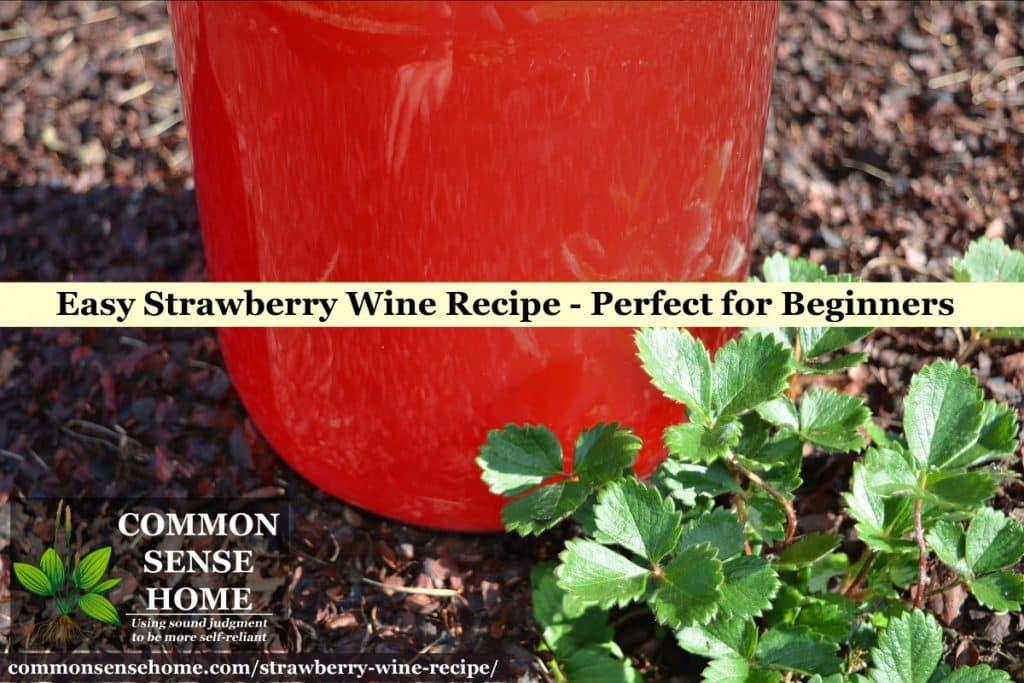
This is our first year making strawberry wine, so I’m not sure exactly what our final product will be like, but the initial stages of the ferment smell wonderful and are packing quite a kick. Due to reader requests, I’m sharing the easy strawberry wine recipe we used.
Would you like to save this?
It doesn’t get much more straightforward than this unless you go wild – berries, sugar, yeast, acid, nutrient and water.
Make sure you use good quality berries. There are no tricks or other flavors to cover bad fruit here. Previously frozen berries should work as well as fresh, as long as they are nice and ripe. (Use them as soon as possible after thawing for best color.)
Easy Strawberry Wine Recipe
Adapted from Jack Keller’s Winemaking page. Jack says about this wine, “The first is the simplest strawberry wine recipe I know of. Use only the sweetest, freshest berries and you’ll be rewarded with an exquisite, delicate wine.”
Ingredients
- 3 pounds fresh strawberries
- 2 pounds granulated cane sugar
- 2 teaspoons citric acid or wine acid blend
- 5 pints clean water (non-chlorinated)
- 1 teaspoon yeast nutrient
- 1 package of wine yeast
Directions
For a single batch, place strawberries, sugar and citric acid in a 2 gallon crock. (The berry mix will bubble in the early stages of fermentation and may rise out of a one gallon crock.)
Crush fruit with a potato masher or pastry blender. Cover berry/sugar mix with 5 pints boiling water.
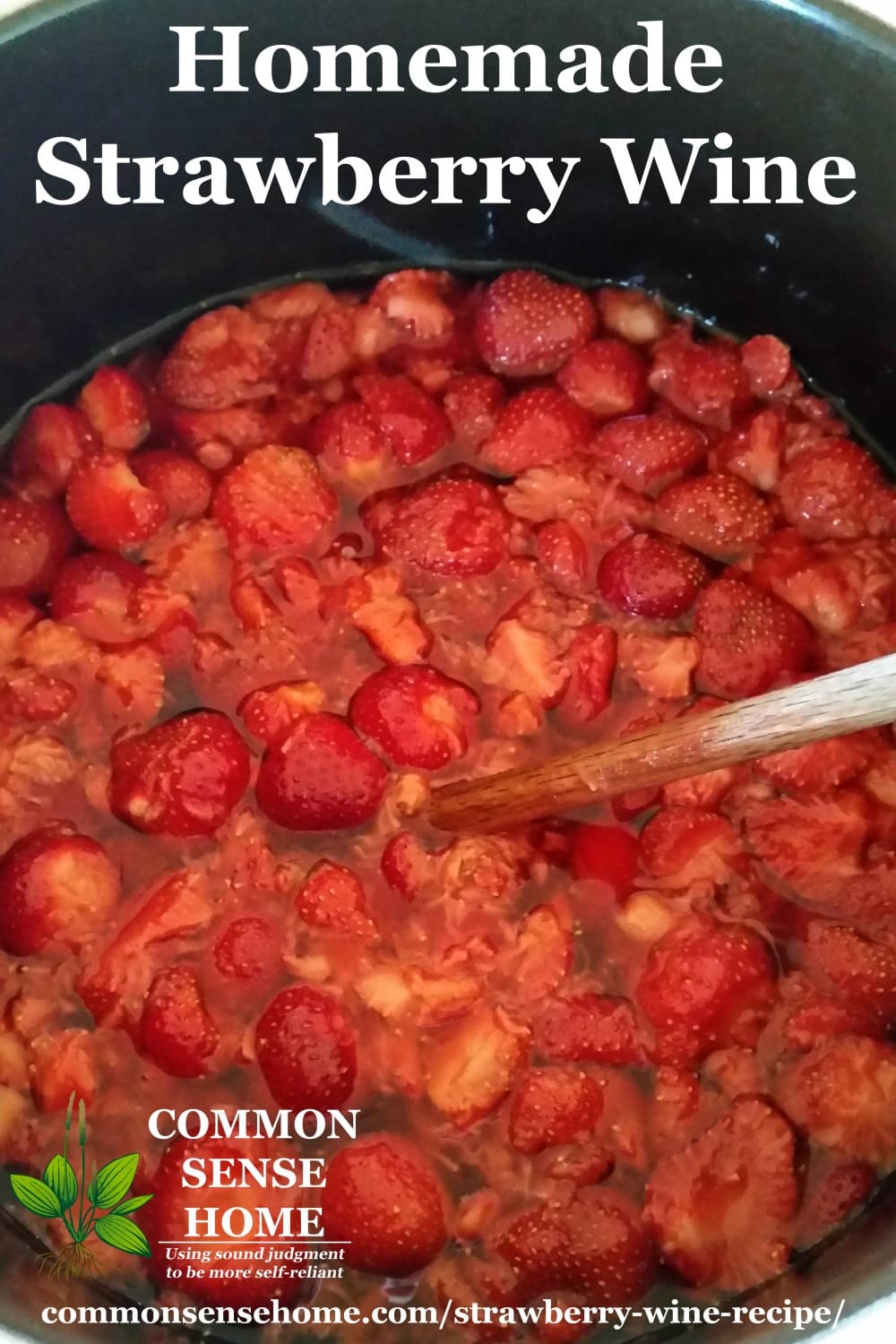
Stir wine must with wooden spoon to dissolve sugar and simultaneously mash the strawberries.
When cooled to 85°F (29°C), add yeast and yeast nutrient. Cover and stir daily for seven days.
One the 7th day, strain through cheesecloth or a flour sack towel. Transfer to secondary fermentation vessel with airlock. (I used one gallon glass jugs. A carboy would also work.)
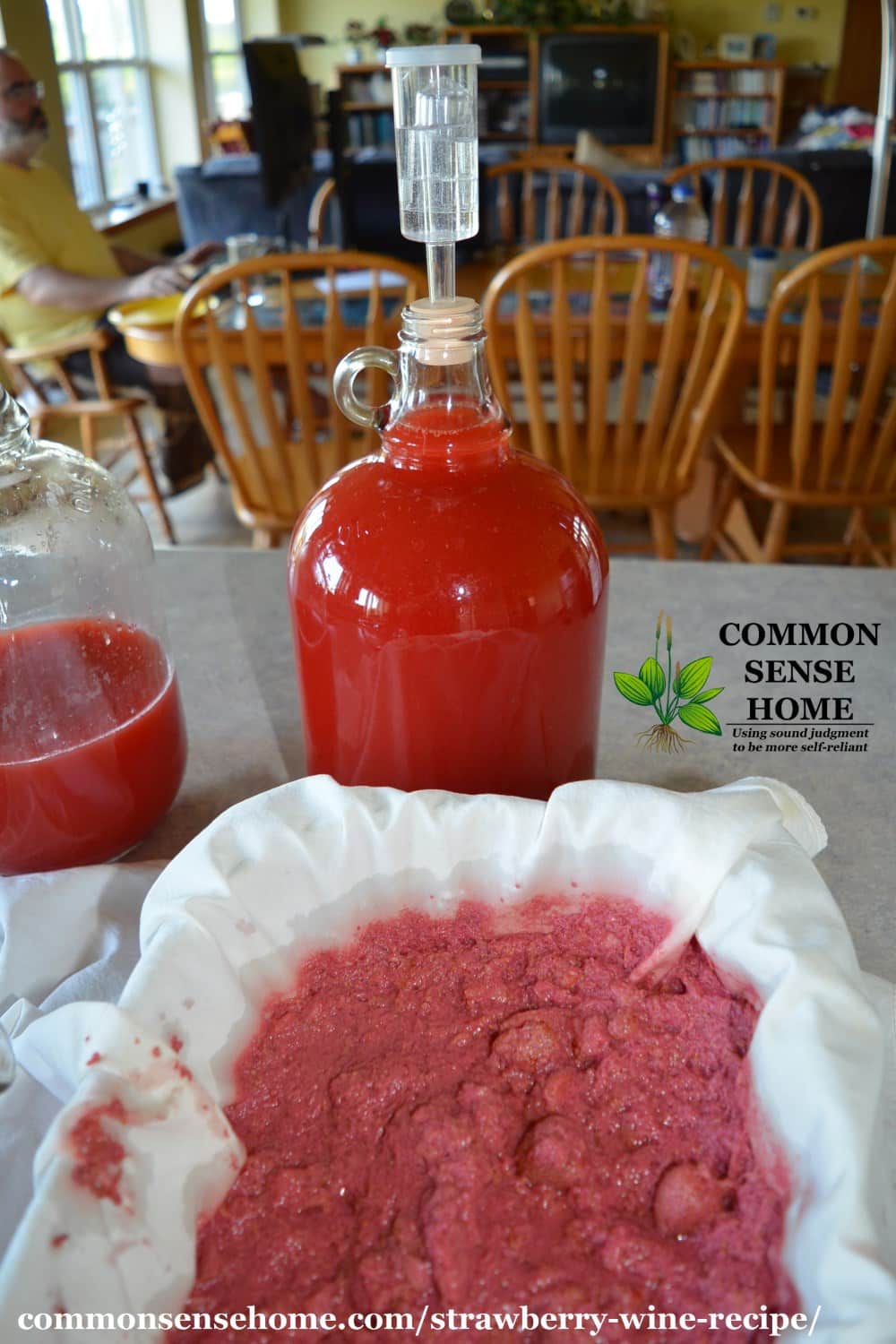
Add sterilized water to top up to one gallon of liquid and seal with a fermentation cap. (A fermentation cap is an airlock that allows carbon dioxide to escape but keeps oxygen out.)
Store out of direct sunlight for 30 days. Rack into a clean fermentation vessel. Store for 30 days more, rack again. Allow to settle 3-5 days and bottle when clear.
Age for at least 6 months. Flavor improves up to a year. From Jack’s description, this looks like a wine that will not improve with much longer storage, so it’s okay to enjoy it young.
Ingredients and Equipment List
To recap, you will need:
- Strawberries and sugar
- 2 gallon crock
- acid blend
- wine yeast
- yeast nutrient
- flour sack towel
- wooden spoon
- secondary fermentation vessel (gallon jar with airlock)
- wine siphon or siphon hose for racking
- empty wine bottles
- wine corks
- wine corker
A Note on Finding the Best Strawberries
The 2016 strawberry season was a bountiful one at our favorite local u-pick farm, Red Grouse Farm. Becky and her family spend long hours out in the berry patch, tending everything by hand so I don’t have to. 😉
They don’t use any herbicides or pesticides, and use holistic farming practices that build the soil instead of mining it like conventional farming.
Becky (the owner) and I had a great conversation about some of our favorite soil and permaculture gurus as she helped us fill our strawberry baskets for this wine.
I’ve had a number of readers ask why we don’t grow our own strawberries. We have land, but strawberries are labor intensive, and since I have a source I trust close by, I support their efforts.
Meanwhile, we’re focusing on crops I can’t find elsewhere, and/or those that are more expensive, like blueberries, raspberries, gooseberries, aronia berries, bush cherries, seaberries, hardy kiwis and others.
Watch out for “Dirty” Berries
If at all possible, get your berries from someone you trust, and ask them what, if anything, they spray.
Conventional strawberries are on the Dirty Dozen list. The Environmental Working Group found 17 different pesticides on a single strawberry sample. There’s no way I want to turn that into wine.
Organic strawberries may not be much better.
Recently, a neighbor of mine shared her own concerns about organic strawberries.
She used to buy a large carton of organic strawberries for her family at a local bulk foods club. One of the kids would clean and slice them when they were brought home, and they’d get eaten in a day or two.
This batch was different. No one in the family liked the taste, and eventually they were tossed to the chickens. The chickens refused to eat the organic strawberries.
It’s no lab test, but it did me wonder what the heck was on those berries.
What’s your favorite way to enjoy strawberries?
My youngest is a huge strawberry fan, so while they’re in season we keep a big bowl in the fridge for fresh eating.
To enjoy them year round, I use the recipe in the post 12 Ways to Preserve Strawberries – Plus Tips to Keep Berries Fresh Longer.
We also enjoy:
What’s your favorite way to enjoy strawberries? Leave me a comment and let me know!
PrintEasy Strawberry Wine
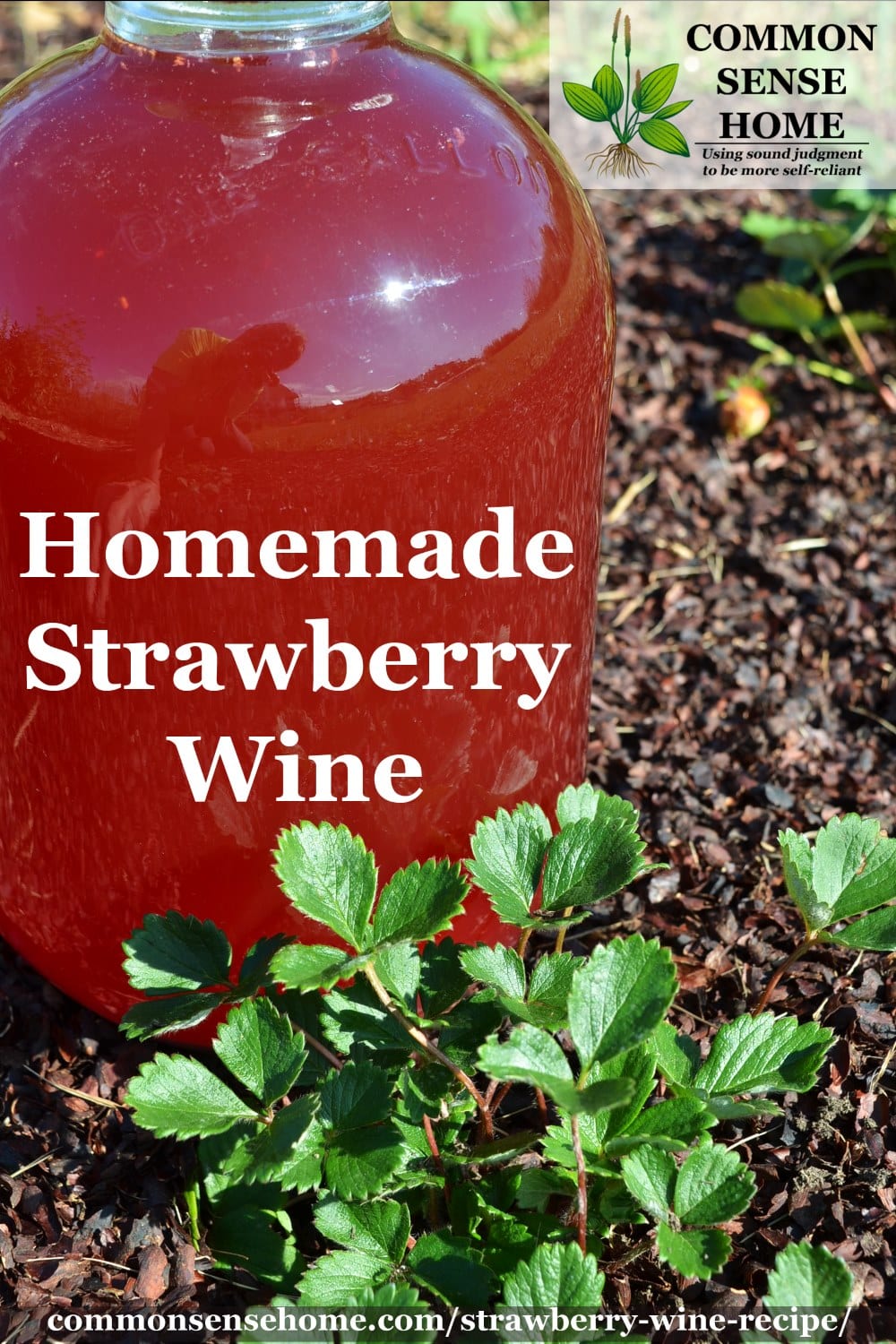
Add a little kick to your strawberry season! This homemade strawberry wine recipe comes together in minutes and is ready to enjoy in just a few months.
Ingredients
- 3 pounds fresh strawberries
- 2 pounds granulated cane sugar
- 2 teaspoons citric acid or wine acid blend
- 5 pints clean water (non-chlorinated)
- 1 teaspoon yeast nutrient
- 1 package of wine yeast
Instructions
- For a single batch, place strawberries, sugar and citric acid in a 2 gallon crock. (The berry mix will bubble in the early stages of fermentation and may rise out of a one gallon crock.)
- Crush fruit with a potato masher or pastry blender. Cover berry/sugar mix with 5 pints boiling water.
- Stir wine must with wooden spoon to dissolve sugar and simultaneously mash the strawberries.
- When cooled to 85°F (29°C), add yeast and yeast nutrient. Cover and stir daily for seven days.
- One the 7th day, strain through cheesecloth or a flour sack towel. Transfer to secondary fermentation vessel with airlock.
- Add sterilized water to top up to one gallon of liquid and seal with a fermentation cap. (A fermentation cap is an airlock that allows carbon dioxide to escape but keeps oxygen out.)
- Store out of direct sunlight for 30 days. Rack into a clean fermentation vessel. Store for 30 days more, rack again. Allow to settle 3-5 days and bottle when clear.
- Age for at least 6 months. Flavor improves up to a year.
Notes
The option to double or triple the recipe will automatically double or triple the amount of yeast. This in not required. One package of yeast is enough to make up to five gallons of wine.
So, how did your strawberry wine end up tasting? I’m curious to know and to find out if you have any tips to add. Thanks, Laura
The flavor is good, but not very complex. The strawberry flavor and aroma is very subtle in the finished product. I think next time I’ll try the recipe from the book Wild Winemaking,which uses raisins, strawberries, water, sugar and yeast.
By crock do you mean ceramic or could you use a stainless steel stack pot?
I use ceramic crocks, but you can use that, stainless steel or food grade plastic.
I love this recipe so far!! My first time making wine. I thought i was getting six pounds of berries, but got twelve. last night I strained it and moved it to a six gallon carboy, and this morning the fermentation cap was bubbling happily away. From what I licked off my fingers this is going to be some tasty wine!! I used an immersion blender to get the most juice from the berries. Thanks so much for the recipe. 🙂
I hope it works out well for you.
Think I could use half strawberries and half raspberries for this recipe?
Yes, that should be fine.
my first batch of wine ever, i am a true newbie! my question is; now that i have racked the wine into the secondary fermentation vessel, in my case a 3 gallon carboy, my wine is not foaming or bubbling any longer. is that normal for this recipe or did i kill my yeast? it was bubbling and foaming on the first 7 day stretch.
It’s normal for it to calm down after the first more aggressive ferment. Initially, the yeasts are gobbling up the more abundant sugars, so they burp more. Fermentation slows down after this period, but doesn’t stop completely – this time in the carboy as insurance against exploding bottles. As long as you didn’t boil it in between, your yeasts should be fine.
My yeast says up to 5 gallons. So could I do x5 on all ingredients besides the yeast?
Ive seen campden tabs and pectic enzymes used on other recipes. You dont use those?
Yes, the yeast can ferment up to five gallons.
Campden tabs are made with sulfites (typically sodium metabisulfite) and are used to sterilize the wine. Sometimes they’re used at the beginning of brewing to kill off wild yeasts and molds, sometimes they are also used just before bottling to kill off the commercial yeast, too. I’m sensitive to sulfites, and the modern strains of wine yeast are pretty aggressive, so they normally outcompete problem microbes as long as you follow basic sanitation rules. I’ve never had a problem with spoiled wine using commercial yeast.
Pectic enzymes help clear the “pectin haze” in the wine by some fruits. This is largely a cosmetic issue, and I don’t much care what my wines look like, so it’s not critical for me. After racking the wine from the carboy to the bottles and leaving behind the lees, the wine is usually clear enough for our tastes.
If you want to use additives, you certainly can. I’m just a basic country wine sort of gal. Simple is good.
Who said anything about methyl bromide?
I had an older link in the post that went to a discussion of methyl bromide being used on berries which I updated when the post was last updated.
I’m waiting for the wine yeast to come in a few days but am scared my fresh strawberries won’t make it that long. Can I add everything else Together then add the wine yeast to the fermenting strawberries 2-3 days later when it arrives?
Hi there, as an organic strawberry farm for 22 years running u-pick operation I can assure you methyl bromide is prohibited material in the state of California and The US
When do you add the citric acid
“For a single batch, place strawberries, sugar and citric acid in a 2 gallon crock.”
Hi I am coming back to wine making after 30 year lay off watching my dad brew.. sadly he is no longer with me so i cant pick his brain.. I never saw him stirring wines… it seems to me like this is a time you could potentially add airborne and unwanted bacteria to your wine.. I am sure he just used to seal it up and leave it to ferment.. I am making a coffee wine not strawberry but the principles are surely the same?.. Am i risky my wine by stirring it?? why do you do it?
I stir during the initial ferment simply to make sure the fruit is breaking down evenly and flavors are well mixed. It also makes sure that since I use an open crock during the initial ferment, that the same fruit doesn’t stay on the surface and potentially spoil. The commercial yeast is very vigorous, and will normally outcompete wild yeasts and other microbes. Once the fruit is out, I place the brew in an airlocked container and don’t stir anymore. If you go to an airlocked container right away, then you don’t need to stir, but I don’t like cleaning fruit residue out of my gallon jugs so this is easier for me.
Hi trying your recipe for the first time. I followed it times 3. My wine yeast is Lalvin EC-118 a packet is 5 g. Should I add 3 times the yeast to my must? Or will 1 packet be enough?
Typically one packet of commercial yeast is enough for up to five gallons of wine. Odds are it will say on the front of the package.
I started yesterday, it smelled so sweet and had such a pretty color, but now day 1, it’s not the pretty red color, looks like it’s turning brown. Is that normal?
It will get darker, but mine doesn’t turn full out brown. How does it smell? If the smell and flavor are okay (fermenting, not rotting), you’re probably fine.
Awesome recipe, Laurie! I’ve been looking to make something special for my girlfriend for a while now. She loves strawberry wine – so this is it!
Here’s a little trick learned form many fresh fruit batches. You can purchase a nylon mesh bag at your local beer/wine making shop or online. Just place it into your primary fermenter or crock, and then add all the ingredients per your recipe. When performing your first racking, just lift the bag out carefully and squeeze the juice out. Makes clean up and first transfer much easier. Launder it and your ready for the next go round.
Thanks for the tip.
When you say ” Cover and stir daily for seven days. ” do you mean with a lid that’s not air tight, no airlock?
You could use an airlock if you have one of the wide mouth ones that allows you to stir the ferment, but it’s not required.
About 1/2 tsp of pectic enzyme per gallon helps alot in clearing it up before bottling.
I would like to know if you double the recipe Do you need a crock larger than 2 gallons. also how many bottle does a batch make. Thank you.
It would probably be best to have a three gallon crock if you double the recipe. During fermentation, there is foaming and the berries rise up. A batch will fill 4-5 wine bottles.
Reading through the questions you have the patience of a saint, I have lost count how many people ask if a 2 gal crock will work for a double batch. Thank You for this recipe I have it brewing as I type. Have a wonderful day
Enjoy your wine, Jody.
My question is how much does 1 batch make bottled.? 2nd does the 2 gallon crock work or a double batch? Thank you so much looking forward to making this,
It would probably be best to have a three gallon crock if you double the recipe. During fermentation, there is foaming and the berries rise up. A batch will fill 4-5 wine bottles.
Thank you for the information. This smells so good on day 4. I love to experiment. Is there a good recipe and easy or Blueberry wine? Or could it be possible to make a Strawberry with blueberries wine? I wonder if you can mex the 2 berries together to make a flavorful wine,
Blueberries are so expensive here that I haven’t given it a try yet, but there is a simple recipe in How to Make Wine in Your Own Kitchen.
Blueberry Wine
Ingredients
4 quarts blueberries (wild berries are great if you can get them)
4 quarts of water
8 cups of cane sugar
1 slice of whole wheat toast
1 ounce of wet yeast
Note: She uses wet bread yeast in many of her recipes, because it was more available back in the day. You could substitute a good wine yeast and skip the bread.
Directions: Rinse berries quickly under cold water only if gritty and dusty. If they are clean, the natural bloom contains helpful wild yeasts. Place berries into large stockpot and mash with a potato masher. Bring 2 quarts of water plus the sugar to a boil. Boil for five minutes, pour over berries. This sets the color. Add the other two quarts of water and stir well.
Moisten yeast with a few drops of water and spread on the toast. float the toast, yeast side down, on the surface of the liquid. Put in a warm place to ferment for two weeks. Stir gently from the bottom every day during this period.
Strain the wine through a jelly bag or flour sack towel, squeezing pulp very dry to extract maximum color and flavor. Return to canner kettle to settle for two days. Siphon into clean sterilized bottles and cork lightly. This wine takes about three weeks to finish fermenting in the bottle, so don’t be too eager to fasten the corks tightly. When fermentation has ceased, cork tightly. Keep for at least six months, but if you wait a year the body and color of the wine will greatly improve.
The author uses a canner kettle for her home brewing. I’d likely move things to a crock covered with a flour sack towel to keep bugs and dust out. After straining, I’d transfer the brew to a gallon jar, and then bottle after the second ferment.
Hi
This list my first ever attempt at home brewing 🙂
When you say age for 6 months, is that from when I bottle or from after I strain and place into demijohn.
Thanks 🙂
6 months in the bottle.
Hi thanks for that. Currently on day two in the bucket after stirring i get bubbles :). I have placed the lid on top but not sealed down. Would this be ok. Sorry to be a pain and thanks for the speedy reply.
Hi i want to make this in a 5 gallon carboy im wondering what measurements i would use for that
Thanks
Jackie
To make a five gallon batch, increase the amounts of all ingredients except the yeast.
What do you mean by “rack into a clean fermentation vessel”?
“Racking” means to transfer, typically via siphon hose. So you transfer from one gallon jug to another, leaving the sediment behind in the first jug. If you don’t have a second carboy/gallon jug, you can siphon into a different container, such as a large stockpot, wash your original jug, and then transfer the wine back to the jug. The purpose of racking is to produce a clearer wine with a cleaner flavor profile. The yeast dregs (sediment at the bottom of the jug) will make the wine somewhat cloudy, and over time will influence the flavor. The dregs are edible, they just have a strong yeast flavor.
Thanks a lot!!!
You’re welcome.
Am interested for personal consumption and woild like to know where to get good ingrediays in north carolina
The yeast you can order online through the links provided, and sugar you should be able to find locally. The website Farm Fresh North Carolina has a post titled Where to find organic U-pick strawberries that may be of help.