
Solar Water Heating – How it Works

This post may contain affiliate links. Read my full disclosure here.
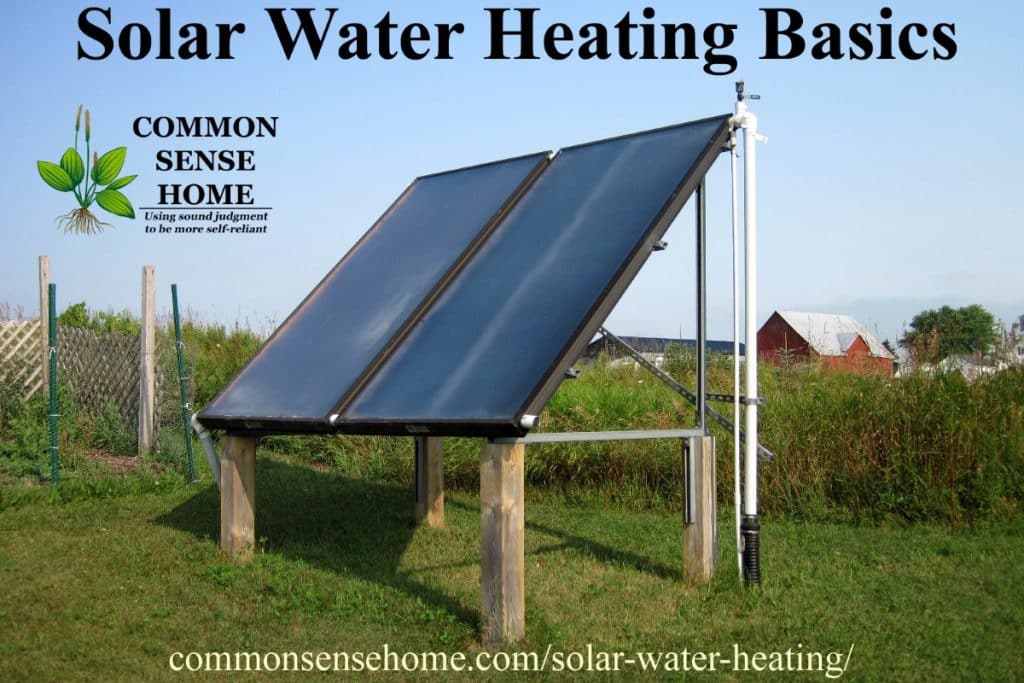
In this post, I’ll give you an overview of solar water heating basics so you can decide if this green home option is right for you.
Would you like to save this?
In my life B.C. (Before Children), I received my Masters Degree in Mechanical Engineering with an emphasis in renewable energy. After graduation, I worked for a company that operated the world’s largest flat plate collector solar water heating (SWH) system and did solar water heating installations.
When we built our current home, we added a solar water system shortly after the home was completed. It’s been providing us with hot water since 2006. (We also have passive solar heating in our current home.) Basically, I’ve had solar water heating in my life for over 20 years now, living in an area where you might least expect to see it (Wisconsin).
Why use solar water heating?
After heating and cooling, water heating tends to be one of areas where people use the most energy. Estimates range from around 15% to up to 40% of energy usage, with the high end coming from old, inefficient electric heaters.
A solar water heater uses solar energy from the sun to heat some or all of your water. At its most basic, this can be done with a dark container left out in the sun.
Friends of ours camped out on their property while building their home, and set up an outdoor shower with 50 gallon barrels painted black on a platform above their shower area. Another variant of this are the solar camp shower bags that can be filled and hung in a sunny location to provide hot water while camping (or during an emergency situation).
In our case, our solar collectors preheat water for our domestic hot water and for our in floor radiant heating. On sunny winter days, the passive and active solar cover the bulk of our heating load.
Heating a swimming pool is a great application for solar water heating, because pool usage is heaviest when the sun is most abundant.
Indirect Versus Direct Solar Water Heaters
Solar water heating systems can be classified in several ways. One of the main classifications is Direct or Indirect.
Direct systems heat the water that is being used. There is no heat exchanger. These systems work best in warm weather areas, because they must be drained when temperatures get below freezing. (Direct systems that are drained during cold weather are called, not too surprisingly, Drain Back Systems.) These systems are also prone to hard water buildup if the water running through them is high in minerals. These are also known as open loop systems.
Indirect systems heat a fluid (generally an antifreeze mix) and transfer heat from that fluid through a heat exchanger to the potable water in the storage tank. These are a must for year round operation in cold climates. Because you don’t introduce new fluid into the collector, they are less likely to get mineral buildup. The down side is that these will generally be more expensive because they have more parts. These are also known as closed loop systems.
Passive versus Active Solar Water Heaters
Passive solar water heaters rely on natural convection to move the cold water from the bottom of the collector to the top as it is heated.
Active solar water heating systems have circulating pumps that move the fluid around (normally a polypropylene glycerol mix).
Parts of a Solar Water Heating System
Collectors
All solar hot water heating systems need a way to collect the heat. Options range from a black painted tank or a black tank in an insulated box (batch heaters), to flat plate collectors and insulated tube collectors.
- Batch heaters combine the collector and storage in one unit.
- Flat plate collectors have fluid piping connected in parallel (typically copper tubing) with metal fins painted black to increase the absorption area, all inclosed in an insulated box.
- Insulated tube collectors are individual tubes with fluid pathways and fins inclosed in what is basically a thermos. No air around the absorbers = no air flow = superior insulation. If we were to expand our system, I’d want these collectors, since they have the lowest amount of heat loss in cold climates.
Storage Tank
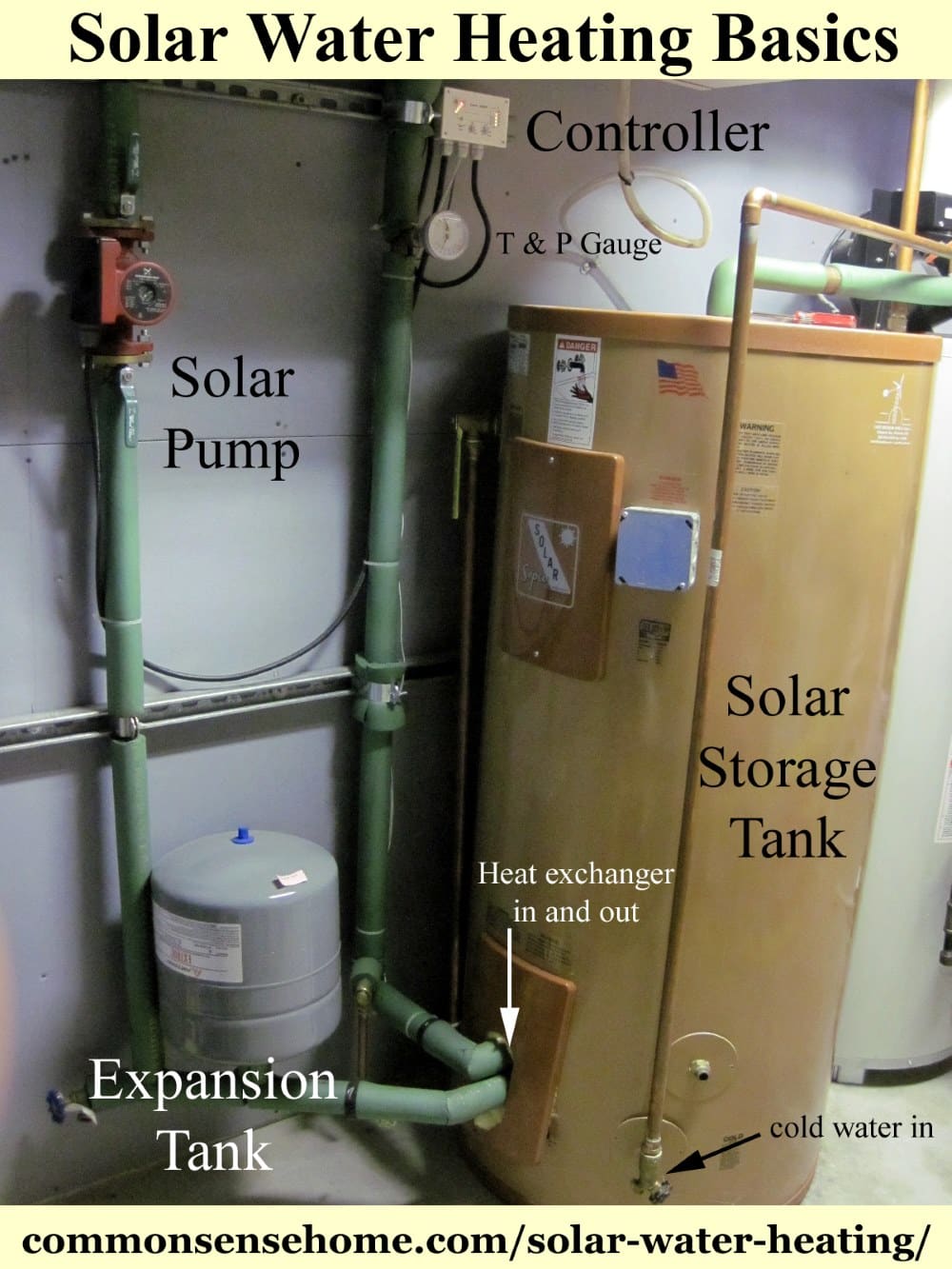
Where the heated water is stored.
- Batch heaters store the water right in the panel, tank, or storage tank attached to the top of the panel.
- Flat plate collectors and insulated tube collectors have a separate storage tank.
Depending on the type of system, it may or may not include the following parts.
Heat Exchanger
In indirect systems, the heat from the solar panels is transferred to the domestic hot water via a heat exchanger. This heat exchanger may be located inside the storage tank or outside the storage tank.
Inside the storage tank generally improves heat transfer, because it maximizes the amount of water surface area in contact with the heat exchanger, but it there is ever a problem with the heat exchanger, the entire tank and heat exchanger combination needs to be replaced.
With an external heat exchanger, they can often be plumbed into a standard electric water heating tank with the heating elements removed, which reduces costs, but they may not be as efficient as an internal exchanger.
Our current system has an internal heat exchanger, our last system had an external heat exchanger.
Controller
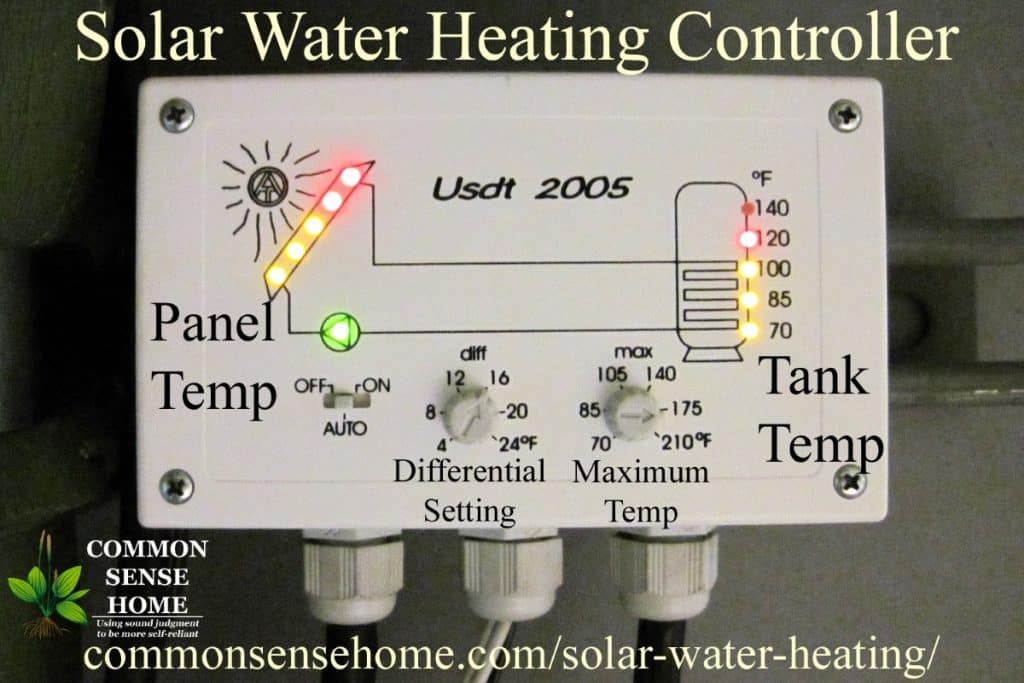
In indirect systems with an AC pump, the controller tells the pump when to turn off and on. This is also commonly referred to as a differential controller, because it looks at the temperature differential between the panels and the water in the storage tank.
When a set temperature difference is reached (when the panels get hot enough), the pump turns on. When the panels cool down, the pump turns off.
Pump
Indirect systems may have an AC pump or a DC pump. AC pumps are typically powered by the electrical grid. DC pumps are almost always powered by a solar electric (photovoltaic) panel. As mentioned above, AC pumps are turned off and on by a controller.
DC pumps turn on automatically when the solar electric panel generates enough power to turn on the pump. When sized correctly, the fluid in the panels should be hot enough to effectively transfer heat when the pump has enough power to operate.
At our last home, the solar water heating system used a DC pump and solar electric panel. Our current system uses an AC pump with controller.
The solar installer who worked on our current system indicated that he had seen significantly better performance in our cold temperatures with the AC pumps, because the DC pumps didn’t have enough power to move the fluid well when it got cold and slushy.
Temperature and Pressure Gauge
Most systems with inside storage will have one of these gauges near the storage tank so you can easily see at a glace the current conditions of the system, and make sure that it is properly pressurized.
Expansion Tank
Water, even water with antifreeze mixed in, will expand and contract as it goes through different temperature and pressure ranges. To give the excess volume of fluid somewhere to go in closed loop systems, a tank with a bladder that expands and contracts is plumbed into the loop.
Temperature and Pressure Relief Valve
As extra protection, many systems place a temperature and pressure relief valve at the top of the collector(s). If the panels are left sitting in the sun and get dangerously hot, fluid will be vented outside the house to avoid damage inside. There may also be a T&P relief valve on the storage tank.
There are many variations of the equipment, but you always need to collect heat and store heat. You can buy parts and assemble your own, get an entire kit that’s ready to install, or hire a contractor to install a system for you.
Things to Look for in a Solar Water Heating Installation
Make sure your solar system is installed correctly
Back in the 1970’s push for solar, many contractors installed sub par equipment, and did it poorly. One of my first solar jobs was to repair non-functioning systems in the Orphan Solar Program.
You can’t take short cuts or the system either won’t work right or will have a very short lifespan. When these puppies leak, they can make a really big mess, so it’s not generally a project for an unskilled homeowner (unless you’re doing something very simple like seasonal pool heating). Also, improperly mounted panels on the roof can cause major roof damage and even structural failure. Water is heavy, and roof penetrations should always be properly sealed. Whether mounted on the ground or roof, you want to make sure your panels are very secure, so they don’t act like sails when a good windstorm kicks up.

Work with quality equipment
The SRCC (Solar Rating and Certification Corporation) tests panels and systems to verify that they deliver the energy they promise. If your equipment isn’t SRCC rated, at least make sure it comes with a warranty. Solar water heating equipment must withstand some very extreme temperature and pressure ranges.
Not all material will stand up to the punishment. Some homeowners have tried to save money by running standard PEX tubing from the collectors to the house. Instead, the tubing ruptured under normal (for solar) operating conditions and had to be replaced.
Look for an installer with references
If you hire an installer, make sure they know what they’re doing. The North American Board of Certified Energy Practitioners (NABCEP) offers entry level knowledge assessment, professional certification, and company accreditation programs to renewable energy professionals throughout North America.
There are also a variety of local training programs in some states. Your system will be a significant investment, so make sure you work with someone you trust.
Take advantage rebates and incentives to reduce your system cost
DSIRE is the Database of State Incentives for Renewables and Efficiency. Depending on your location, these incentives may help you to dramatically reduce the cost of your solar water heating system. It pays to take a look.
Given that this article is already getting quite long, I’m going wrap things up here. Hopefully this has given you a basic overview of how solar water heating works.
Related Articles
- Solar Emergency Gear – Lights, Power, Radios, and Ovens
- Get Started with Solar Cooking – DIY Solar Cooker Ideas, Printable Cooking Guide
- What’s the Best Solar Cooker? Choose Right Unit for Your Cooking Style
Last Updated: Jan 2020
( Good ? why do they always show a windmill straight spinning around w/e/n/s ! Why not build it flat correctly catch the wind in all directions maybe three axles high ? Sounds goo to me .
Clarence, there are vertical-axis wind turbines designed to accept wind from any direction, so the concept does exist. However, conventional horizontal-axis turbines generally produce more energy for their size and cost, which is one reason they’re much more widely used.
Wind turbine design involves tradeoffs between efficiency, turbulence, structural loads, maintenance, and cost. Stacking multiple rotors or adding more axles also adds structural and mechanical complexity. The more parts you have, the more parts there are to break down.
(Very interesting ) myself i want to buy about20 acres with hills .Dig out one side about 22foot deep at a slight pitch for drainage 100foot wide A build my earth house stone walls 2 story 2 foot dirt on top a stream flowing over the top in front of my door .You will not even know a house is there.no heat 72 year round water powering my hydro & fresh water /power .Is that worth going for ?
A few major issues jump out:
Where does the water come from? Micro-hydro requires a dependable combination of flow and vertical head. Twenty acres with hills doesn’t necessarily provide either. A seasonal creek or runoff isn’t a reliable power source, and pumping water uphill so it can flow back down to generate electricity is a net energy loss.
Running a stream over the house is almost the opposite of good building practice. One of the fundamental goals of durable construction is to move water away from the building envelope. Deliberately putting continuously flowing water over an occupied structure dramatically increases the consequences of any failure in waterproofing, drainage, flashing, or structural movement.
Putting the stream in front of the entrance makes things even stranger. You need a dry, safe, accessible path into and out of a house—for everyday use, moving furniture, emergency responders, aging occupants, etc. In a freezing climate, flowing and splashing water could also create a substantial ice hazard.
The structural loads would be enormous. Two feet of wet soil is extremely heavy. Add vegetation, saturated soil, snow, ice, and potentially flowing water, and the roof would have to support loads far beyond those of an ordinary house. A two-story earth-sheltered structure also has tremendous lateral soil pressure against the walls. “Stone walls” alone aren’t a structural design.
Excavating 22 feet into a hillside is a major civil-engineering project. You’d have to understand soil stability, groundwater, bedrock, slope stability, drainage, retaining requirements, and the possibility of landslides or soil movement. A 100-foot-wide excavation at that depth is not simply digging a big hole.
Groundwater could make the entire concept unworkable. At 22 feet below grade, the structure might intersect groundwater depending on the site. Hydrostatic pressure can force water through surprisingly small defects. You’d need engineered drainage, waterproofing, perimeter drains, redundant drainage paths, and somewhere lower for all that water to go.
Humidity could be a persistent problem. Earth sheltering can moderate temperatures, but it doesn’t magically create a comfortable indoor environment. Cool surfaces combined with humid indoor or outdoor air can produce condensation. Without excellent waterproofing, insulation, ventilation, dehumidification, and moisture management, mold and mildew become very real concerns.
“72 degrees year round with no heat” isn’t how earth sheltering works. Deep ground temperature tends to approximate the area’s annual average air temperature—not 72°F everywhere. In much of Wisconsin, for example, deep soil temperatures are closer to roughly 45–50°F. Earth sheltering reduces temperature swings and heating/cooling loads; it doesn’t automatically heat a house to comfortable room temperature.
Cold climates add more complications. Frost heave, frozen drainage systems, ice dams, snow loads, freeze/thaw cycles, and frozen water around the entrance would all need consideration. Water infiltrating a crack and subsequently freezing can also make a small defect considerably worse.
Emergency egress becomes a serious concern. A buried two-story home needs safe exits, bedroom egress, fire access, ventilation, smoke management, and a way to escape if the primary entrance is blocked. “You won’t even know a house is there” isn’t necessarily an advantage when the fire department is trying to find you.
Radon and soil gases matter. An extensively earth-contact structure needs particularly careful radon and soil-gas mitigation.
Permitting could be difficult, if not impossible. Structural engineering, excavation, stormwater management, septic placement, drinking water, wetlands/waterway regulations, electrical generation, fire codes, and building codes could all become involved. Redirecting a natural stream across a residence may introduce an entirely separate set of regulatory issues.
We have a walk out basement with in floor radiant heat, ceiling fans, and forced air cooling, and we still get mildew issues if we aren’t careful.
( You are correct ) Where you live always play a major role in everything.
I have a passive house the south and north air flow. Had solar installed 2020. But I’m still looking to go solar water being in oklahoma not many resources and I still need to do a battery wall. I’m finding you pages interesting but still having concerns of will I be able to do it and will it work for me.
My water usage is small 200 to 1000 gallons a month… is there a way to control how much the water holding system passes thru. Sorry I’m very green horn to solar water systems and day to day operations. I’m a widow and doing all this on my own. Haven’t found a DYI solar and inventor type guy yet 🙂
If you want to dig into detailed design specifications for your needs and location and are determined to tackle it yourself, I’d highly recommend hitting the library or online bookstore and getting some books on the topic. There are a lot of different things to consider, so books will provide more in depth planning information.
Generally speaking, the panels and tanks come in premade sizes, so you start with sizes that are available. I haven’t checked on equipment recently, but the smallest system we would install was a 4ftx8ft collector with a 40 gallon storage tank.
It’s probably worth your time to search on the internet to see what ready to install systems are out there, and see if one matches what you have in mind to meet your load. It’s almost always easier to buy a kit with all the needed parts than to try to build from scratch.
(Have you thought of vacuum tanks) stair stepped up to about 20 ft 10 inch pipe 1 way flow water go up one way valves on all tanks to prevent back flow .From the 10 inch 4 ft below 8 inch then 6 inch when you get the presure needed that will turn a inline hydro. )Water can recycle to pond & go again !
The main technical problems with this suggestion are:
Getting the water 20 feet uphill requires energy. Whether vacuum, pumps, pressure tanks, or some combination is used, energy must be supplied to raise the water against gravity.
Vacuum doesn’t provide free lift. Atmospheric pressure can push water upward when a vacuum is created, but creating and maintaining that vacuum requires energy. There are also practical limits to how high water can be lifted by suction.
Check valves don’t add energy. One-way valves can control the direction of flow, but every valve, pipe fitting, and pipe reduction actually introduces additional friction and pressure losses.
Changing pipe diameter doesn’t create additional usable energy. Going from a 10-inch pipe to an 8-inch and then a 6-inch pipe can change water velocity and pressure relationships, but it cannot increase the water’s total energy.
The hydro generator introduces another loss. A turbine can recover some of the gravitational energy stored by raising the water, but never all of it.
Recycling the water makes the energy deficit unavoidable. Once the water returns to the pond, it has to be raised again. The energy needed to pump it back up will always exceed the electricity recovered from the turbine because pumps, pipes, valves, and turbines are all less than 100% efficient.
The main problem is that adding vacuum tanks, 20 feet of vertical piping, multiple check valves, a pond, and a hydro turbine would make Shirley’s system vastly more complicated and expensive without helping her heat her water.
(A vacuum of 10 lb’s in the tank with a way to keep from back flowing) .Then every tank above it built the same way. Ok I had a friend of mine in Mississippi has 20+ acres but the water was on the lowest part . So he wanted the water at his barn . Tanks spaced correctly right pipe size to the barn last tank on stand holds the weight pipe coming down to a 2 inch from a 10 inch shut off valve vacuum all air out of system . Close valve free flow water to his barn no power .He lives in Old Bay Springs MS .
My closed loop solar water preheat system has stopped circulating the glicol medium.
The SunEarth controller is functional and the circ pump has been replaced to no avail.
I am in the 94553 area, N Cal, and need a consult/repair.
I don’t have current contacts in your area. Would it be possible for you to check the controller sensors to see if they are registering the temperature differential correctly?
I assume you’ve checked system pressure after replacing the pump, and fluid levels. With those as they should be, it has to be something with the controller, the sensors, or the communication between the pump and controller.
Ive a flat panel system – 2 panels on the house roof, solar hot water tank on the ground that has a pump to circulate the water which is effectively a main pressure system. We are on tank water with a pump to get it to the house for the last 4 years and don’t has natural gas.
During winter our electricity bills double ($55 per week to 125 per week), day to day usage remains the same.
What I’ve found is at night and sometimes on really cold days (it doesn’t snow but we do get frosts), the solar pump kicks in to circulate warm tank water to the panels and the frost valves release water even at temps of 5 to 8 degrees. So in my mind, the negative benefits of this system in the cold months far out way the positives – tank pump kicks in because the frost valves are draining water, solar pump kicks in to circulate warm water, loosing hot water to circulate into the panels which then the electric got water element also kicks to heat the water in all consuming electricity.
Looking at options:
1. drain the panel for the winter – pain as I need to get up onto the roof to bleed the system of air when putting it back into service)
2. Retro fit evacuated tubes. – Don’t know if these required water to circulate in cold temps and would defeat the purpose if they did.
3. …maybe mount the panels on the ground for ease of access with option 1. – Not sure how far from the hot water tank/house I could do this without loosing heat pumping it back to the hot water tank.
Any suggestions?
The cheapest option would be to drain it for winter. A hassle, for sure, but the most affordable.
Evacuated tube collectors are still likely to freeze in temps below freezing. It’s recommended that they be used with antifreeze and a heat exchanger where temps get below freezing.
If you ground mount your panels for ease of access and run an insulated pipe below ground back to the house, heat loss should be minimal.
I’m considering a solar hot water system in my Colorado vacation home. The incoming water temperature is very cold year round, probably in the 40s. That means that my current electric hot water heater is working overtime when I’m here. I also have times where there are six users for short periods of time. Occupancy is usually in the winter with short stays in summer and fall. The house is two story and the upper story receives substantial solar gain on sunny days but the lower level remains pretty chilly all year round. It never gets above low 50s without electric heaters.
I’m thinking about installing a flat-plate collector on my south facing deck and optimize the angle for winter use. I would probably use a per-heat tank in my utility room on the lower level. I’m wondering if I can dump excess heat somehow into that lower level particularly when the house is vacant and hot water is not being used. Any advice would be appreciated
Given that you are there more often in winter than summer, optimizing the mounting angle for winter makes sense.
As for system specifics, you’ll need to talk to a local contractor who can get in the building and give you some estimates. Typically, solar space heating involves dumping heat into some sort of thermal mass, like a sand bed under the floor, or even radiant heating coils in the floor itself. (Coils in the floor gets tricky because of expansion and contraction.) There are solar space heaters that can mount on walls and floors, too. They aren’t as effective, but are easier to retrofit.
A big storage tank will act as thermal mass and heat up the area that it is in, but that doesn’t move the heat around the rest of the floor.
Great article, thank you. My question is about supplementing the heat during winter months when the temperature of the solar water is slightly too low to bath or shower. I would still like to use this hot water but as it is not hot enough, to but send it through a gas boiler. Problem is it needs to be a “Thermostatic” gas heater according to my plumber so that the gaskets etc don’t deteriorate. He is suggesting a small electric storage tank of 500watts instead as it would be cheaper to install. I don´t know which would be cheaper to run, can you say?
Do you have any information or opinions on supplementing the heat of a solar storage water heating system? Thanks in advance!
It depends on your gas and electric rates. In general, gas heaters are cheaper to operate, but the heater itself is more expensive and the installation is slightly more complicated so it will also be more expensive to install. That’s why your plumber is suggesting the small electric tank.
To install supplementary electric, they cut into the water line to install the tank. To provide heat, they might be able to use an existing outlet to plug it in (easiest option), or they need to run an electric line. Adding an electric line entails flipping a breaker to make sure the circuit isn’t live (or adding a new breaker), and running wire as needed. If your breaker box and water heater are in the utility space, it should be a quick and easy addition.
To install supplementary gas heating, they still need to cut into the line to install the heater, as with electric. Boilers (at least in our area) are quite expensive. Gas water heaters are less expensive, but still more expensive than electric. Assuming they use a gas water heater, they still need to run an electric line as above, because almost all gas water heaters have electric ignition and controls. In addition, they also need to add a dedicated gas line. Some plumbers are trained to work with gas lines, some aren’t. If they need to call in another contractor, that’s a significant added expense. Even if they can do it themselves, they still need to add both gas and electric lines.
If your need for supplemental heating is small, the electric tank will get the job done. If you need quite a bit of supplemental heat and plan to be in the home for some time, gas may be well worth the additional investment.
Laurie,
Question about heating a 6’x12’ black cargo trailer. I bought property in Southern NM ( plenty of sun, daytime highs in the 50’s & lows in the 30’s) off grid & was considering purchasing a 30 tube panel with a solar powered pump to circulate water into a 275 gallon uninsulated ibc tote inside to heat the interior. I understand that there’s no way to heat up the entire 275 gallons, but partially full would the tank give off enough heat at night if I put the head of the bed by the tank?
I have the ibc tank to haul water to my other black painted ibc tote with hand pump on property anyway, so why not put it to use instead of hauling & burning propane?
Without knowing the specs on your equipment, it’s impossible to run heating calcs. Check with the manufacturer of whatever collector you want to buy and look at their projected BTU output under your winter conditions. Calculate how much this many BTUs this would put into your storage tank. Whatever you are able to dump in, you’ll probably get between 50-80% of that back out as heat to your living quarters. Whoever you’re buying the collector from should be able to help you with estimates of how much heat their equipment could potentially gather.
http://www.dudadiesel.com/files/SRCC-DS5830.pdf
Thanks for the reply. I’m concerned about storing the heated water in a uninsulated tank. I figure however all that radiated heat will remain in the trailer. I attached the data sheet.
Neal
I’m sorry, Neal, but this goes beyond the scope of general information provided for free. I could probably dig up software to run the calcs, but if I did that, I’d need to charge you consulting fees for the time involved.
Your heat will bleed into your living area, even if the tank is insulated. It’ll just bleed slower or faster.
Talk to whoever wants to sell you the collectors. They should be able and willing to help you with some calculations, since they want to sell equipment. There are also online tools, such as https://www.123zeroenergy.com/free-solar-thermal-simulation-and-design.html
The programs require you to plug in your location, then they grab appropriate data sets of solar insolation numbers to calculate potential energy available to the collectors, based on collector parameters. These numbers work in combination with storage tank calculations. Solar thermal collectors are most efficient (gather the most energy) when they are operating under load when the sun is most available. Since you’d likely be dumping heat into a lukewarm tank, this is not going to optimize collector performance, but it’s a big tank, so you’d probably be okay – BUT – there’s the matter of freezing. If your nighttime temps drop below freezing, are you planning to use a drainback system that drains all water out of the collectors at night? Or are you planning to use antifreeze through your panels in combination with a heat exchanger?
You really need to talk with professionals in your area, or get some training yourself so you have a better idea of how to make a system that fits your needs. It’s not something that I can cover in a quick email answer.
Best of luck,
Laurie
Hi,
We installed a new heating system and would like you to comment on the practical application of this system versus solar thermal hot water, also would you have a name for this type of system. System consists of solar panels that provide electricity to air to water heat pump with glycol mix. Transfer plates transfer heat to 1000 gal storage tank that then runs through radiant floor. Propane and wood gasification boiler tied in as back up. We live in northern Vermont and are more than happy with the system keeping warm with temps in the -5 to -10 degree range on heat pumps alone considering we have extended periods of cloudy days and shorten winter daylight hours as we are on the 45 degree latitude.
I’m not quite sure what you need. The system works for you, so that’s the most important thing. 1000 gallons is an enormous storage tank. I think most folks would have some concerns about the size. That’s a lot of water to have hanging around inside your house. The system is also more complicated than a thermal system.
The advantage of using solar electric is that you could use the panels to meet your electric needs when you don’t need them for heating. I have a snappy name for it, although I suppose you could call it a hybrid solar electric heating system.
Hello Laurie,
I seem to have the exact same setup as your system. I reside in Moore, Ok. I do believe the last time my system was professionally looked at was in 1989. Unfortunately, the previous owner had passed before he could clue me in on an annual maintenance.Do you take care of any maintenance yourself? For instance, draining the water to flush out calcium. Replacing the antifreeze soulution. If you have any recourses as far simple updates and maintenance on this particular product, I would greatly appreciate the help.
Torren 2/20/18
Like a regular water heater, your storage tank may get sediment build up in the bottom over time. It’s a good idea to flush it out every couple of years or so, similar to the way you would flush out a regular water heater. (Shown below.)
To replace the anti-freeze, you’d need to have specialized equipment or hire a professional. The closed loop to the collector is under pressure, so if the anti-freeze is drained and replaced, the system needs to be recharged with a pump hooked up appropriately. During routine maintenance, the quality of the fluid is checked for obvious signs of damage as well as appropriate level of glycol for freeze protection. Propylene glycol tends to be pretty stable, but it can break down over many years of service. If the fluid looks good, they’ll check for any other signs of trouble and that pressure is correct and assume it’s good to go.
If the fluid is degraded, they’ll need to drain, flush and recharge the system. Without the right equipment, you can’t do this at home. The video below shows how to charge a similar system.