
Snow Fence Installation – How It Works and Where to Put It

This post may contain affiliate links. Read my full disclosure here.



A snow fence doesn’t stop snow. It controls where drifting snow gets deposited.
Put the fence in the right location, and blowing snow piles up harmlessly in a field or yard instead of drifting across your driveway. Put it too close to the area you’re trying to protect, and you may make the drifting worse.
We’ve used several hundred feet of seasonal snow fencing on our windy northeast Wisconsin property for years. The biggest lesson we’ve learned is that placement matters more than almost anything else.
In this article, I’ll explain how snow fence works, how far to place a it from a driveway, how we install ours, and what we’ve learned from years of use.

Would you like to save this?
Table of Contents
Snow Fence Quick Start
If you just need the basics:
- Place the snow fence upwind of the driveway, road, walkway, or other area you want to protect.
- Allow plenty of room for the drift to form. A common guideline for a 50% porous fence on relatively flat ground is around 35 times the height of the fence.
- Use porous fencing, not a solid barrier. Snow fencing is designed to slow the wind rather than stop it completely.
- Leave a gap under the fence. For a four-foot fence, we leave roughly 5 to 6 inches between the ground and the bottom of the fencing.
- Use sturdy posts. Wind and drifting snow put considerable pressure on the fence. We suggest a quantity of 7 to 11 posts (depending on spacing) for 50 ft of fencing.
- Attach the fencing to the windward side of the posts. This lets the wind push the fencing against the posts instead of pulling it away from them.
- Watch the snow after installation. Your actual drift patterns are one of the best guides for fine-tuning placement.
Every property is different. Buildings, hills, trees, existing vegetation, wind direction, fence height, and the amount of blowing snow all affect where the snow eventually lands.
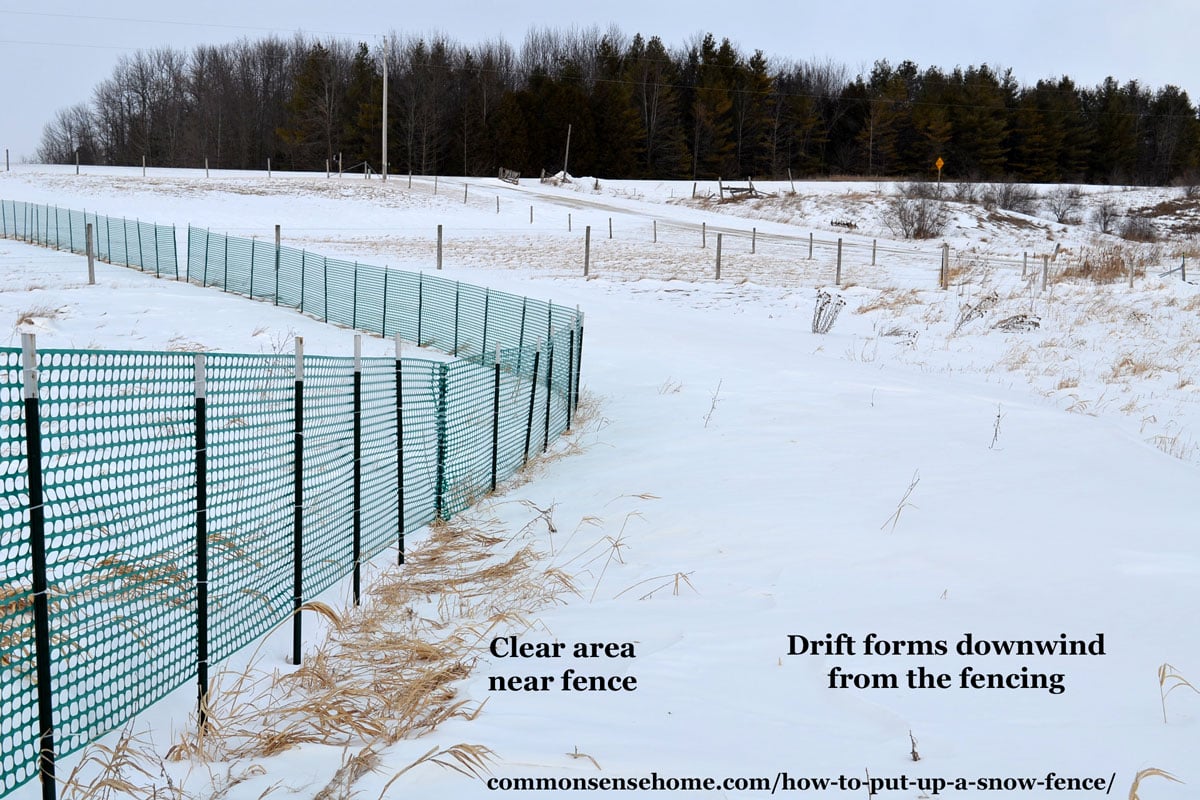
Why We Started Using a Snow Fence
Snow fences have been part of my winters for as long as I can remember. When I was growing up on our family farm, my grandmother had a long wooden fence that was put up each fall to protect the driveway from drifting snow.
Eventually, my brother planted trees to replace Grandma’s fence. The trees grew into a permanent living windbreak.
When we built our own home, we planted windbreak trees, too. Trees take time to grow, so until ours were large enough to do the job, we needed another option. Also, part of our driveway lies next to our neighbor’s field, so there’s no room for trees there.
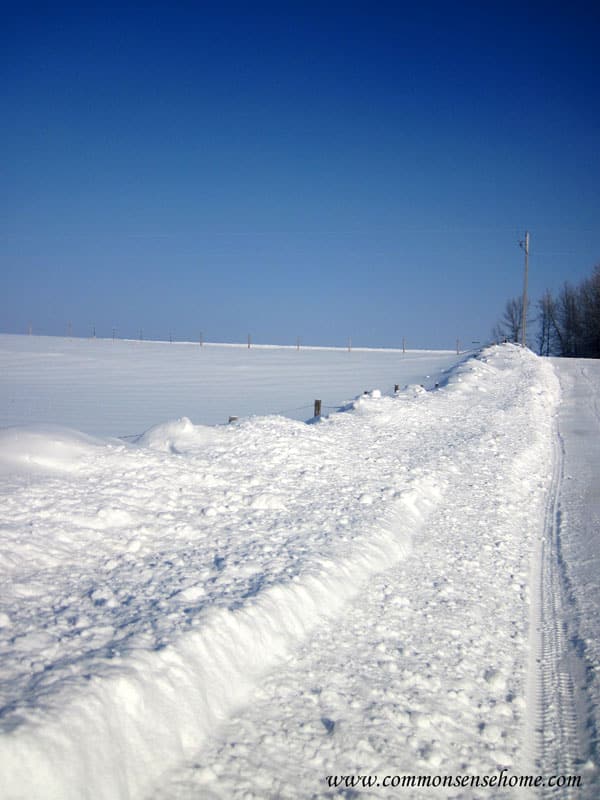
Our home sits in an exposed location surrounded by open farm fields. When winter winds get moving, there’s plenty of snow available to blow across the landscape and pile up wherever the wind slows down.
We got tired of having our driveway constantly blocked one snowy winter, and decided to invest in fencing the next year.
What is a Snow Fence?
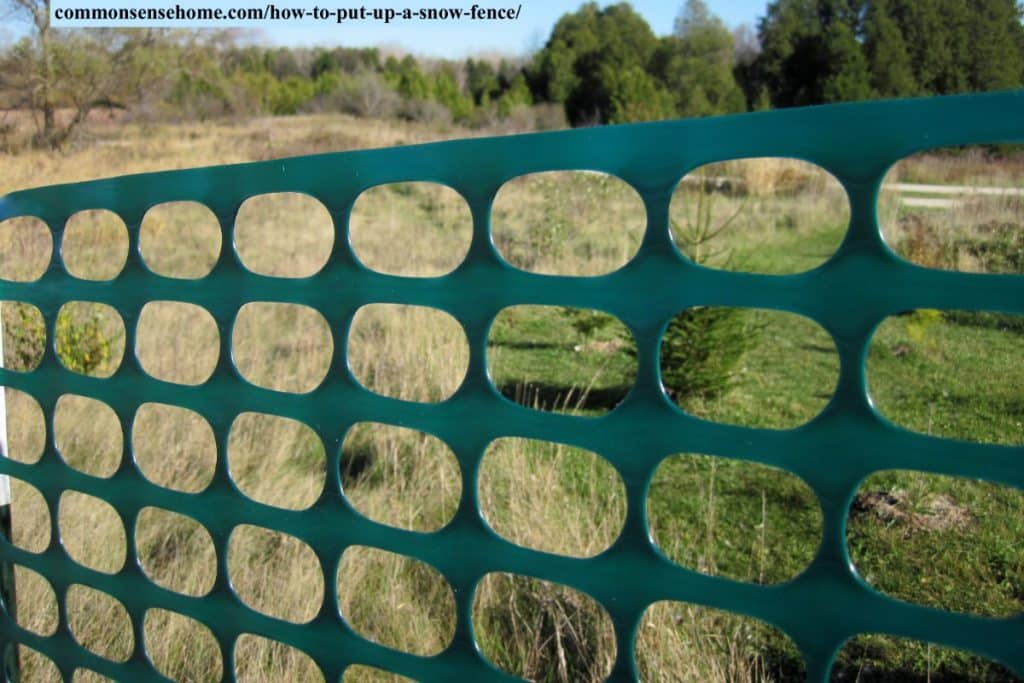
A snow fence is a porous barrier designed to control blowing and drifting snow.
Traditional snow fences were often made from wooden slats held together with wire. Today, plastic mesh is common because it’s lightweight, relatively inexpensive, and easy to roll up for storage.
Permanent fences, shrubs, and rows of trees can also act as snow fences when they’re designed and placed correctly. The important point is that an effective snow fence is not solid.
How Does a Snow Fence Work?
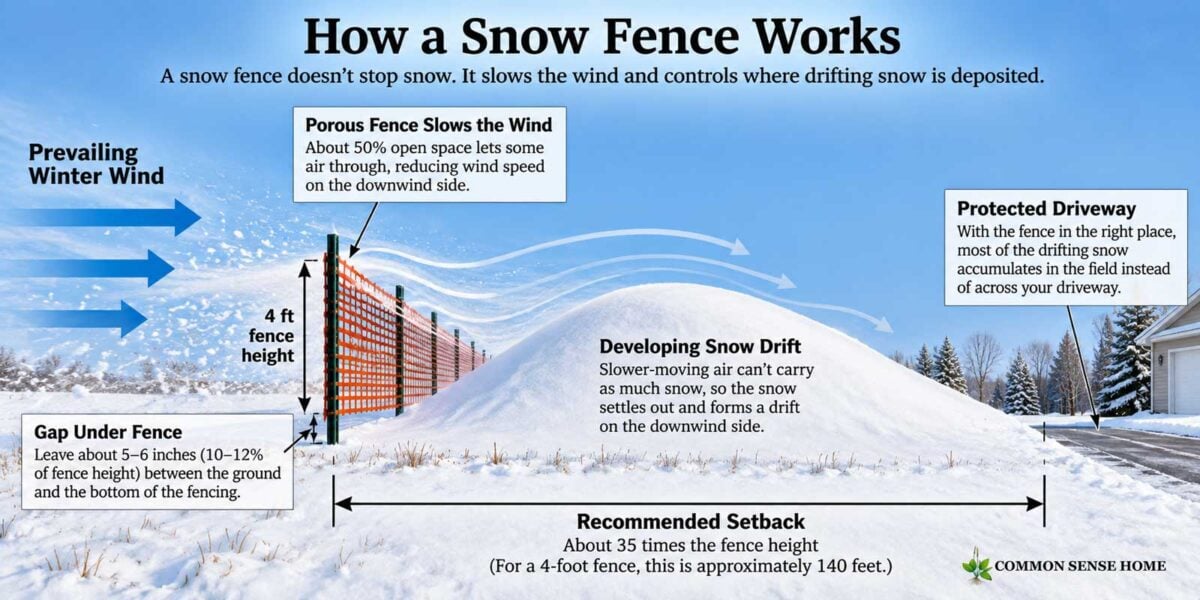
A snow fence works by slowing the wind. As wind passes through and over the fence, wind speed drops on the downwind side. Slower-moving air can’t carry as much snow, so the snow settles out and forms a drift.
This is why putting up a solid wall isn’t necessarily better.
Snow fencing is typically around 50% porous, meaning roughly half of the surface is open space. This allows some wind to pass through it while still reducing its speed enough to encourage snow deposition.
Think of the fence as telling the snow:
“Drop your load here instead of fifty yards farther down the driveway.”
That’s also why snow fence placement is so important. You aren’t eliminating the drift. You’re choosing a better place for it to form. In some areas, farmers purposely stack the drifts so they melt and flow into a water basin in spring.
Where Should You Put a Snow Fence?
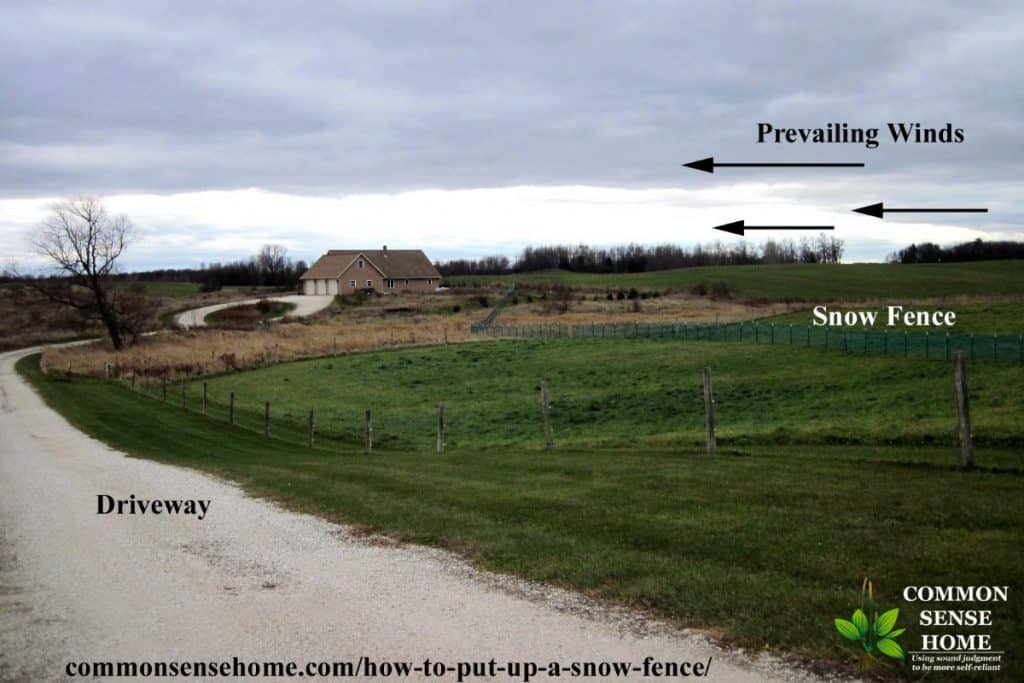
The fence should be upwind of the area you want to protect.
Start by identifying the direction your strongest snow-carrying winter winds normally come from. Don’t assume your winter winds behave exactly like winds during the rest of the year. Look at your property.
- Where do drifts normally form?
- Which side of buildings stays scoured clean?
- Where does snow collect behind trees, shrubs, fences, or other obstacles?
Those patterns give you clues about how wind moves across your site.
How Far Should a Snow Fence Be From a Driveway?
One commonly used guideline is to place it about 35 times the fence height away from the area you want to protect.
That gives you approximately:
| Snow Fence Height | Approximate 35H Setback |
|---|---|
| 3 feet | 105 feet |
| 4 feet | 140 feet |
| 5 feet | 175 feet |
| 6 feet | 210 feet |
This doesn’t mean every four-foot snow fence must be exactly 140 feet from a driveway. The formula is a starting point.
Terrain, vegetation, fence porosity, wind direction, snowfall, and the amount of snow blowing across the site all influence the size and location of the drift.
When we first installed our fence, we experimented with different distances. Over time, we watched where the snow actually accumulated and adjusted sections of fencing to better match our site.
The snow will show you whether your fence is in the right place.
If the drift reaches the driveway, you probably need more setback, more snow-storage capacity, or a different fence configuration.
Don’t Forget the Ends
Snow doesn’t always travel perpendicular to the fence. Wind direction changes during storms, and snow can sweep around the ends of a short fence.
Extend the fence beyond the area you’re trying to protect (if possible) so it still provides coverage when the wind comes in at an angle. I know sometimes space is tight and there’s limited room for fencing.
How to Install a Snow Fence
Our installation is fairly simple. We use plastic snow fencing attached to metal T-posts.
Materials
You’ll need:
- Snow fencing
- Sturdy fence posts
- Fence ties, wire, or heavy-duty zip ties rated for outdoor use (3-4 per post)
- Post driver
- Tape measure
- Gloves
We prefer sturdy T-posts because our site gets strong winter winds. Lightweight posts may work in more sheltered locations, but wind and snow can put a surprising amount of pressure on a fence.
1. Mark the Fence Location
Once you’ve identified the prevailing winter wind direction, mark the line where you want the fence. Remember that you’re really choosing where you want the snow drift to form.
Make sure there’s enough open space between the fence and the driveway or other protected area for snow to accumulate.
2. Set the Posts
Drive the posts deeply enough to stay secure through winter winds and frost. We generally space our posts about five feet apart because our location is exposed and windy. A more sheltered location may allow wider spacing, but I’d rather use a few extra posts than find the fence flattened after the first major storm.
Install the fence before the ground freezes. Driving T-posts into frozen Wisconsin soil is not my idea of a good time. We use 7 foot post driven approximately 1.5 feet deep for 4 foot tall fencing.
3. Leave a Gap Under the Fence
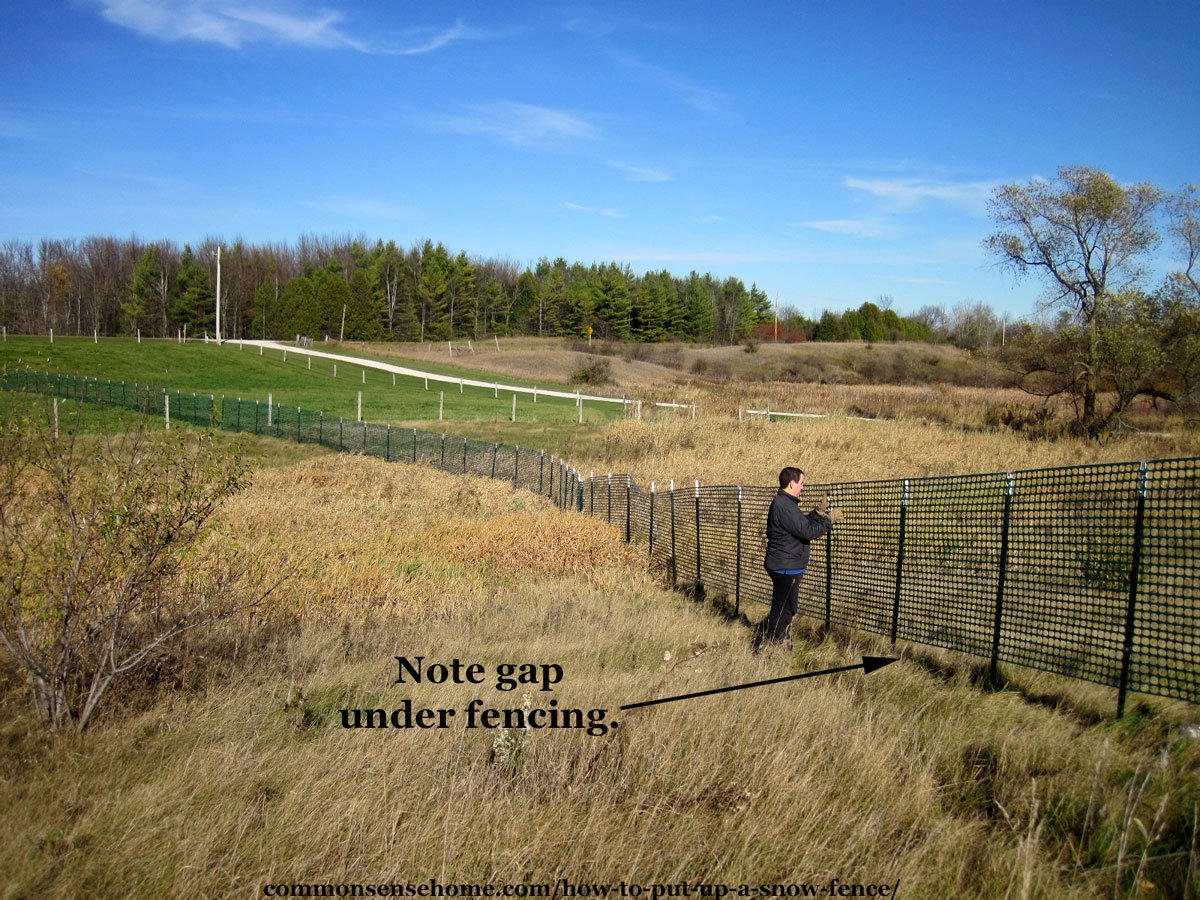
Don’t install the bottom of the snow fencing directly against the ground. We generally leave about 5 to 6 inches of open space under a four-foot fence. This allows air to move under the fence and helps create the airflow pattern needed to deposit snow farther downwind.
Keep tall grass and weeds in mind, too. If vegetation fills the gap, it changes how air moves through the fence. Mowing the fence line before installation makes the job easier.
4. Put the Fencing on the Windward Side of the Posts
Attach the snow fencing to the side of the posts facing the prevailing wind. That way, wind pressure pushes the fencing against the posts. If the fencing is installed on the opposite side, every strong gust pulls against the fasteners instead.
5. Stretch and Secure the Fence
Unroll the fencing along the posts and pull it reasonably snug. You don’t need to stretch plastic fencing like a guitar string, but you don’t want large loose sections flapping in the wind. Secure the fence at several points on each post.
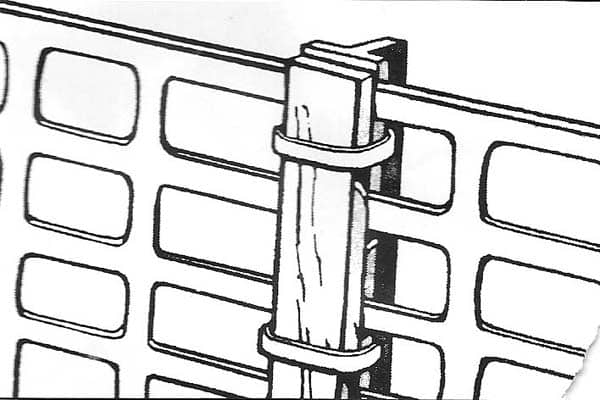
In high wind areas, it is highly recommended that the fence be sandwiched between the flat side of the metal posts and a 1″x 2″ wood slat. (See below.)
6. Check the Fence After the First Major Storm
Once you get a good drifting snow, take a walk outside and look at what happened.
- Where did the snow pile up?
- How far does the drift extend downwind?
- Is snow still reaching the driveway?
- Is one section of fence doing more work than another?
This information is more useful than blindly following a formula because it shows how snow actually behaves on your property. Take photos if you can (or drone footage). They’re handy when you’re setting the fence up again next year.
Does a Snow Fence Really Work?
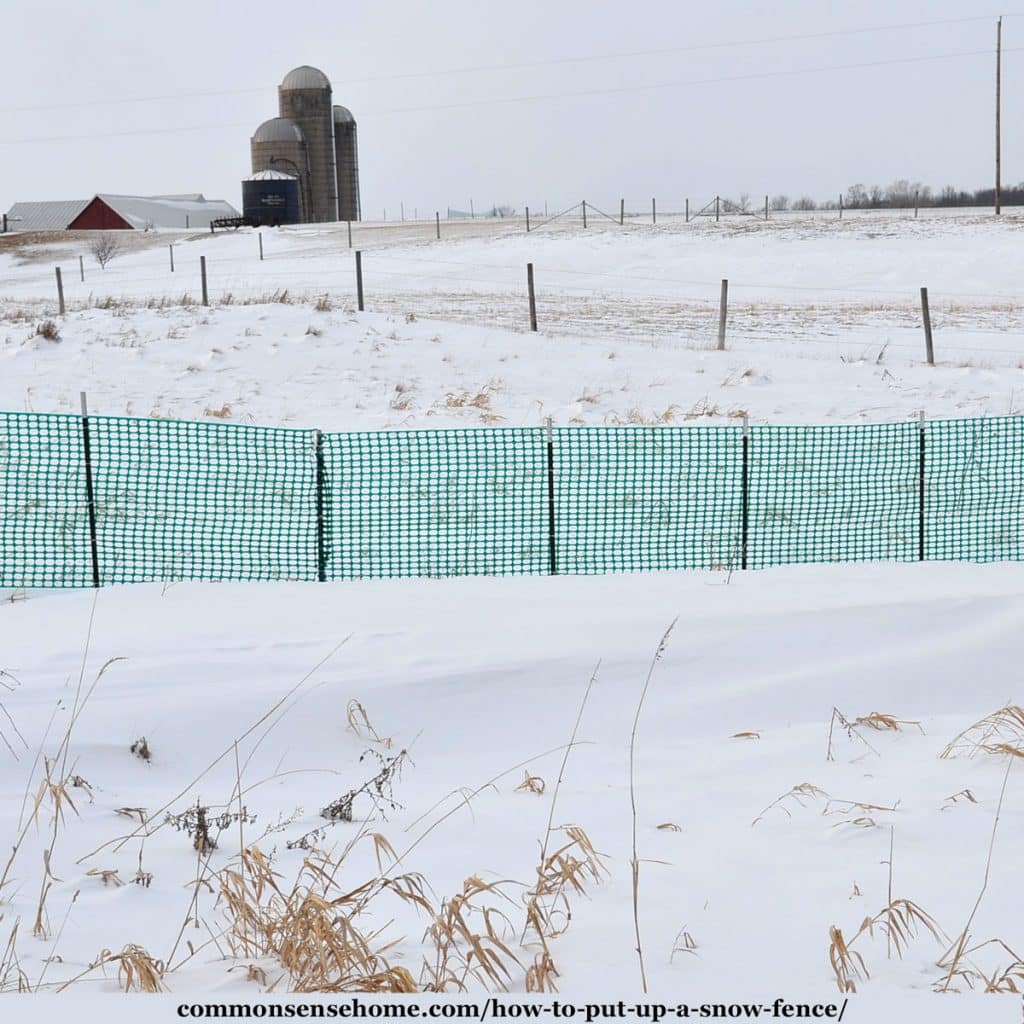
Yes—when it’s placed correctly. We’ve seen a dramatic difference between areas protected by our snow fence and areas without fencing. Instead of snow sweeping across the open field and dropping into the driveway, much of it accumulates behind the fence.
In our case, we clearly see the drifting on the downwind side of the fence. The video below is from February 2019. (Please make sure adblockers are disabled so video displays correctly.)
The fence doesn’t eliminate snow removal. We still live in Wisconsin. It simply puts a lot more of the snow somewhere we’d rather have it. And when the wind is howling and the driveway stays mostly open instead of filling with a deep drift, that’s a worthwhile improvement.
Taking Down and Storing a Snow Fence
The fence comes down each spring once the main risk of heavy snow is past. We use a wire clipper to remove the zip ties, and gather them up for disposal. Then we roll the fencing and store it for the summer. We remove the posts and knock the dirt off.
We don’t leave the snow fence up all season, because the materials would degrade sooner due to sunlight and general weathering. Part of the fence goes through the neighbor’s hay field, so he needs access during the growing season.
Snow Fence Alternatives
A temporary snow fence isn’t the only way to control drifting. Depending on your property, other options include:
- Wooden slat snow fencing
- Permanent porous fencing
- Shrubs
- Evergreen trees
- Mixed tree and shrub windbreaks
- Existing hedgerows
- Strategic landscaping and earthworks
Permanent plantings take longer to establish, but they can provide benefits beyond snow control, including wind protection, wildlife habitat, privacy, and reduced heat loss around buildings.
From Snow Fence to Living Windbreak
A temporary snow fence can actually help with permanent planning because it lets you experiment before committing to trees that may be there for the next fifty years.
Watch where the snow moves. Notice which areas stay sheltered. Pay attention to wind direction. Then use those observations when planning permanent windbreaks.
Learn more about windbreak design.
This approach applies to more than snow fencing. Good homestead design starts with paying attention to what the land is already telling you.
Make Your Home More Winter Resilient
Keeping snow off the driveway is only one part of making winter easier. If you live where cold, snow, ice, and winter power outages are part of life, a little preparation ahead of time can save a lot of trouble later.
You may also find these helpful:
- Winter Preparedness Checklist – Simple steps to get your home, vehicles, supplies, and family ready before severe winter weather arrives.
- How to Stay Warm During a Power Outage – Practical ways to conserve heat and stay safe when the power goes out.
- How to Prevent Frozen Pipes – Protect your plumbing before temperatures plunge.
Winter preparedness doesn’t have to mean preparing for some dramatic disaster. Sometimes it simply means not having to shovel the same stretch of driveway three times after one windy snowstorm.
Build Resilience One Practical Step at a Time
Snow fencing is a good example of the way we approach preparedness at Common Sense Home. You don’t need to anticipate every possible emergency or change everything at once.
Look at the problems you’re most likely to face. Start with practical improvements that make everyday life easier. Pay attention to what works, and build from there.
That’s how resilience grows—from ordinary skills, useful supplies, thoughtful design, and small actions repeated over time.
If you’d like help deciding where to start, download our Common Sense Preparedness Quick Start Checklist for practical steps you can take this week.
Get the Common Sense Preparedness Quick Start Checklist.
And for a more complete approach to food, water, home and shelter, hygiene and waste, and developing a prepared state of mind, see Common Sense Preparedness: Building Resilience for Uncertain Times.
Have any questions? Leave a comment below.
About the Author

Laurie Neverman has a BS in Math/Physics and an MS in Mechanical Engineering. She and her family have spent more than 20 years building and adapting their northeast Wisconsin homestead for cold, windy winters. Their home and property incorporate passive solar design, wood heat, renewable energy systems, backup power, windbreak plantings, and several hundred feet of seasonal snow fencing.
Laurie is the author of Common Sense Preparedness: Building Resilience for Uncertain Times and the creator of Common Sense Home, where she shares practical ways to build a more resilient and abundant life.
Originally posted in 2015, last updated in 2026.
I just purchased a house situated in a large open field on the Western side of a high hill overlooking a wide and windy lake valley in Vermont. My driveway runs North and South along the hillside and I’m told that one particular section is known for catching 7 foot snow drifts. Because of the slope of the hill up to the driveway and then beyond, I’m wondering how much the slope will be a factor in determining the distance downhill away from my driveway I should place a snow fence? Any advice will be greatly appreciated!
I still don’t have any new experience dealing with slopes since the last time you commented, Dan. Put a fence up, see where the snow stacks, adjust accordingly the following year, and make sure you have some way to plow heavy drifts this year in case you don’t get the fence placement right.
I just purchased a house situated in a large open field on the Western side of a high hill overlooking a wide and windy lake valley in Vermont. My driveway runs North and South along the hillside and I’m told that one particular section is known for catching 7 foot snow drifts. Because of the sloop of the hill up to the driveway and then beyond, I’m wondering how much the sloop will be a factor in determining the distance downhill away from my driveway I should place a snow fence? Any advice will be greatly appreciated!
I don’t have any direct experience with slopes, and every situation is a little different because every driveway and wind pattern is a little different. I’d opt for the default distance to start, and adjust the next winter based on how it works the first season.
I live in a mobile home park. I have a 45′ x 10′ patio deck that runs east/west. The neighbor’s trailer and mine, are about 10 feet between us, with him being to the south of me. My deck sides (east/west), as well as north/south ( where the steps go down), are the normal white metal patio sides, which are about 3′ high, with a gap under. I am not worried about the north side, as there is a high fence. My deck gets ALOT of snow, and sometimes it actually blocks my door. My driveway is on the east side, just in front of the front stairs. I was thinking, what if I was to interweave the fencing through the bars on the deck. down the 45′ long side, and also closing in the back side (where the steps at the back are (west), and partially through the east side, as well as the landing on the east side (2 sets of steps), just in front of where I park my car. Do you think that would work some, or could you suggest something different that might? Any advice would be greatly appreciated. Thank you.
Which direction do your prevailing winds come from?
You don’t mention the wind direction or location of your mobile home.
Snow fences aren’t designed to stop all snow from getting past them, they’re designed to drop snow closer to the fence and away from a driveway or other area you want to protect. If you fence the sides of the deck, it’s possible that the snow fence may cause more snow to stack up, if you use it like a normal snow fence with the gap underneath.
I don’t know if you’ll be able to block the all the snow if you attempt to make a solid wall out of your “normal white metal patio sides”, because I don’t know what “normal white metal patio sides” are. Most mobile homes around here have wooden decks and railings. It sounds like you may already have a three foot high solid fence with a gap? I can’t tell from the description, but if that’s the case, then your sides are probably giving all the protection they can. Closing off the west stair may help, but it’s not a guarantee.
Are the winds out of the west? If so, then putting a fence to the west of the deck is the direction you would want to go, if there’s room.
So sorry I wasn’t clearer. I just drew a picture, but I can’t figure out how to post it here. 🙁
I am realizing I don’t know if the drift started inside the pen and spilled out into the yard, or started in the yard and spilled over into the pen. It could have been either.
I think the real solution might be moving to a warmer climate. We had record breaking snow this winter. It’s been just awful.
You could email the picture, but I think my recommendations would be similar – figure out where the snow is coming from and block it. And yes, moving to a warmer climate may be the only real solution.
Hi Laurie,
I’m so glad to see you are still answering questions here. I am having trouble figuring out where I should put my snow fence to protect an 80′ round pen from drifting. This winter a windslab drift collected over the top of the round pen’s 6′ high post and rail fence and broke the top rail! I dont think it will melt out before July and I need to use my round pen all winter.
The round pen is at the top of a hill that steeply drops away to the north. A western parallel post and pole fence line with a row of shrubs on its south face runs due west from where it meets the round pen. The monster drift begins just south of this fenceline, in our level front yard. The prevailing wind direction is northwest, west, and southwest, depending on the storm. The drift accumulated over the round pen fence on its western side, south of the hedrow and line fence.
If I simple board up this side of the round pen and leave no gaps, will it prevent the monster drift Inside the pen? A drift fence erected as you advise would land smack in the middle of our front yard and I fear would cause drifts to build up against our house, further to the west.
As an alternative, would putting a drift fence north of the line of shrubs, running east-west, and set back about 15 feet or so from the shrubs help at all? I can’t set it back any further than that because it would then interfere with the barn and paddocks.
Thanks
I’m doing my best to picture what you’ve described, but there are missing pieces and it’s a complicated situation.
If the drift accumulated from the western side, and you want to avoid drifting from that side, you’ll need to block the wind from the west. I don’t think a fence that runs east to west would have the desired affect, unless I’m missing something in your description.
If I understand correctly, the drift piled up south of the existing fence and shrubs, but built from east to west. If this is correct, then as I said above, you need to block from the west.
If the drift built from north to south (piling up to the south of the fence and shrubs), then a fence north of the shrubs would probably help.
If you’re worried about too large of a drift building up close to the house, you could use two fences to try and keep the drifts from getting too deep – one to the west of the house, and another in the yard. (Or plant trees to the west of the house.)
Look which direction the drift is building from, aim to put your snow fence or fences to block that direction. That’s all you can do.
Boarding up the fence will force more snow to stay on the outside of the fence, but it sounds like you get enough snow that eventually the drift would still force its way over the top of the fence.
You may need to experiment with different fence configurations and see if one helps more than another. It’s tough working around existing buildings and keeping right of ways open for access, but think about natural extensions of wind blocks that make sense. Even if you have to put up a fence or plant trees farther out, they can still be used to slow down the wind before it gets into the yard and causes trouble.
Hi Laurie,
Great info, thanks! I definitely want to do a snow fence along our driveway for next season as we have a large open field to the windward side. So I understand that the fence causes a drift on the leeward side of the fence, which is the windward side of the driveway. I guess what I don’t understand is, as that drift builds up, why wouldn’t that snow continue to be blown onto the driveway. Also, won’t what is plowed to the windward side end up being blown back over the driveway, regardless of the fence? I’m just trying to determine how much a fence will help as I estimate it will cost about $500 to do. Thanks.
The fence doesn’t keep all snow off your driveway. If that’s your expectation, it’s not going to happen.
With an appropriately sized fence, it should continue to drop snow near the fence all winter. (Some melts down when it warms up outside. So far our drifts haven’t gotten more than a couple feet deep.) As long as fence is exposed above the snow, it should keep slowing down and catching the snow. That’s why they install big, honking snow fences in deep snow territory. So far our four footer has been more than up to the job here in northeast Wisconsin.
If you stack snow to the windward side of your driveway, between the driveway and the fence, you are likely to have drifting back into your driveway from those piles. (Sticky snow won’t readily drift right back in, but most winters include dry snow that will drift.) I don’t recommended stacking your snow on the windward side of your driveway, at least not in excess, if you can avoid it. Some mounding on either side of the driveway is expected, especially if you get a heavy snow fall. You’ll see the drifting creeping in from the windward side, next to those banks, and maybe some on the other side, as the snow tries to push across and back out of the “driveway trench”. I’ve seen folks with below grade garages have the path down to their garage completely fill with drifted snow. (No snowfence visible in the photos.)
I hope this clears up what the fence can and cannot do.
Thanks. No, I don’t expect a snow fence to keep ALL snow off the driveway (especially dry snow that will continue to blow), but keeping the big drifting off would be a big help. Just one point of clarification- you say, “I don’t recommended stacking your snow on the windward side of your driveway.” You must be referring to plowing, right? Because the idea of the snow fence is to stack snow on the windward side of the driveway, right?
Thanks again!
Yes, I’m referring to snow plowing, since as I understood it, you mentioned plowed piles on the windward side blowing back into the driveway. The snow stacked by the fence should, for the most part, be well away from your driveway, mostly stacked up right near the fence.
We have a driveway that runs north and south. The West side of the driveway has a 3 ft retaining wall. The east side has a 6ft retaining wall…the wind blows out of the West and northwest. The West side of the driveway fills full of snow. Anyway to prevent this?
The lawn is level with the West retaining wall and open to a large field.
If I understand correctly, your driveway is effectively a trough that is higher on the east side. That trough fills with snow. I don’t know that you could prevent it entirely given that it’s now a low spot for snow to collect, but you should be able to reduce the snow with a snow fence to the west.
Hi Laurie, I also have a question about my snow buildup. I have a small farm in the middle of 300+ acres of rolling hills of alfalfa between Buffalo and Rochester, NY. My house is 50′ from a highway where there seem to be more accidents because of it. My horse barn is 36′ x 24′ and is parallel to the road which goes N-S. The front and back doors of the barn are N-S, and the driveway (which goes straight back to the barn) is perpendicular to the hwy. When I moved here I had a 3 story bank barn which was on its last legs.
I moved in February and started building the small barn in August. I built the horse barn and 10 days after I had moved the horses from the bank barn, I was walking between the two with the wheelbarrow and heard a crack-I dropped the trolly and ran towards the new barn. The entire barn collapsed in a zig-zag-into the driveway.
I have been trying to figure out how to keep the snow which is always horizontal, and high winds from collecting in front of the front doors of the new barn. I made a wind break out of a 6’x8′ barn door, and extended it out from the west back wall so that it created a corner. I thought it would work, but course, because it was like an extension of the back wall, the snow piled up in the corner.
I finally then made the extension off the N-S corner so that it just extended the North side of the barn and the snow and wind would go beyond the front doors of the barn and accumulate towards the front of the property towards the road. It was fine until last night when it came down in the wind.
Sorry this is so long- so now I’m going to build a permanent section between that corner and the paddock post behind the barn. My question-Should I start 1′ off the ground and then put the boards up with spaces in between them, or not. I’m using 1″ x 8″ oak boards from the old barn. I have a bit of protection from an Annex barn that is still standing where I store my wood, and the old barn that collapsed. I have photos but figured you didn’t accept them. Thank you for your patience.
Dinah
You can send photos to laurie at commonsenshome dot com, but I think I’m mostly following.
Key points for fence planning:
In most cases, you want the fence to slow the snow down, not block it entirely. Locate fence where there is room downwind for the drift.
The gap underneath influences where your drift will start forming. It sounds like you’re in big snow country, so I think a gap is a good idea.
The same goes for the gaps between boards. You want to slow the snow down and create a drift, not try to keep all the snow stopped behind the fence. Small spaces between the boards will help with this.
Thank you so much Laurie for wading through that tome. I will take some photos and send them when I get my barn work finished this morning. I have the boards all ready to install.
Dinah
Sounds good. I’m off to a slow start today. I think I may be fighting off some sort of bug.
Laurie, thank you for your notes and responses to the above. I have a little different situation. My neighbors have a horse fence about 10′ from my driveway which is the cause of my large drifting right in the middle of my driveway. They are willing to let me put a snow fence inside their horse paddock. Considering the horse fence will remain, how far in should we put the snow fence? I’m guessing based on the other comments that 30′ inside the horse fence would seem reasonable. What are your thoughts?
Thank you!
30′ inside the horse fence should provide significant improvement.Since the fence is likely to be seasonal, you can watch your drift patterns the first year and adjust if needed.
I got a lot out of your research on snow fences. I want to ask you if you think a fence would help me.
I have tons of room to put a fence, BUT….my driveway has a gradual, vertical rise of a good 30-40 feet from the place where I would stake in the fence, 60 or so feet away.
Think a fence would help me at all?
If the wind is still moving along the ground, pushing drifting snow up that rise and onto your driveway, I would think that the fence would still slow down the flow.
Another use for snow fence in the winter is to use it to accumulate snow in a specific area. A few years ago I ran into a situation where my septic drain field froze (very, very bad). Since then I have used snow fence to control the drifting so it placed the maximum amount of snow right down the line of my drain field, thereby increasing the insulation value.
As per the article “Wind-blown Snow as a Water Resource – Basics of Blizzards and Snowdrift Control” (http://www.wrds.uwyo.edu/wrds/rmfres/fendrift.html), the maximum drift depth develops near 6H (6 times the height of the fence) downwind and is about 1.2 times the fence height.
So in my case, with a 4 foot fence plus 5 inch clearance on the bottom, the ideal placement of the fence was 27 feet from my drain field. I have been amazed at how well this works!!
Good note. Thanks for sharing your experience, John.
Thanks for this post–it’s helpful and I have a follow up question. I am hoping to do a fence of trees and shrubs but don’t have the 130′ or even the 60′—maybe I have 40′. So I wondered if you have any idea if it works to “sock in” the area with lots of trees and shrubs to slow down the snow so much that you don’t get a drift? A friend thinks I’m better off to just let the wind blow through and take the snow with it. The problem with this idea is that I already know that there is one area on my drive that gets drifts so that is the area I was going to focus on. I’ve done a quick search but so far nothing has turned up that is useful.
Unfortunately, with that small amount of distance to work in, you may indeed compound the problem with a snow fence, living or non-living. The only thing that I can think of trying to layer multiple fences by the problem area, so that each one will catch part of the snow to keep it off your driveway.
Would the snow fence work with sand in the same way?
Not exactly. Please keep in mind I am not a blowing sand expert, but given the differences in particle size and density, I think you’d see a reduction in drifting, but the drift conformation wouldn’t be quite the same. The sand fences I’ve seen have been wooden, and mounted at ground level – which means your drift starts at the fence. They also have to be even stronger than a snow fence, so I’d put my support posts closer together.
Thanks for the great information. We just experienced our first winter in Colorado and we have the snow drift issue on our driveway. When the storms come through, the wind is blowing from the W/NW across the driveway which runs mostly North and South. To the West of the driveway, it’s pretty open other than some younger Aspen trees. The driveway is about 10 feet wide where the snow drifts. How far would a snow fence need to be placed to the West of the driveway to help cut down on the drifting? Thanks again!
As mentioned in the article, we aim for at least 60 feet away from the driveway.
What is the strategy for protecting a driveway which runs parallel to the wind direction? We have a 500+ drive which collects a fair amount of snow, some of it probably due to sloping terrain.
I’ve heard of a herringbone pattern to the sides of a road but can’t find any information beyond that such as how close to the road it should start, at what angle away from the road it should be installed and how far apart they should be. Any thoughts about that?
That’s a darn good question, George, and certainly not a typical snow fence use. I think a solution would have to be terrain specific. Check out where the snow is blowing in from, and why it stacks up where it stacks up, and work to change it to something more favorable. If there are curves or a slope, you’ll need to work with those. What’s upwind of your biggest snow drifts? Can you somehow stop or slow down the snow 30-50′ before it gets to the area you want to avoid? A herringbone might work, but if the wind is almost always coming straight down your driveway, I can’t see it being extremely effective. Whatever you try, make sure the fence isn’t within 30′ of the driveway if you can avoid it, as that’s likely to make the problem worse.
I have an uphill driveway about halfway up the road takes a sweeping left turn and gets steeper, to the right the land rises in about 125’it rises about 30′ the wind comes from that direction. The snow drift is about 8’+ sloping to 3′ across the driveway. Would a snowfence help and where would it be located to most effective.
Thanks AL
Unfortunately, I can’t say for sure, because it’s hard for me to visualize your exact scenario. I think the odds are in your favor if you track where the drift is coming from and put a fence about 30 yards upwind of that spot in the driveway. Look at the way the snow blows around your hillside, and try to interrupt that flow before it stacks up on your driveway.
Laurie, can you recommend a company to order high quality snow fencing, online?
We have several hundred feet of driveway as well. Fortunately, we also have plenty of room to install the fencing.
Also, can you double the height? Will that be a benefit, or a hindrance?
Thank you.
We purchased Quest brand snow fence through our local hardware store, but I can’t find that type on Amazon. The Tenax Snow Guard Fence, Green, 4 by 50-Feet looks very similar and has good ratings. You can go with a 100 foot roll instead of the 50′, but the 50 footers are much easier to manage. 100 feet is very unwieldy.
Unless you built a permanent structure, I think going higher would be difficult and unstable, with modest benefits, if any. Most of your drifting issues happen at ground level, and the default fence height is 4 feet tall. This is raised up off the ground, so you’re getting some wind blockage up to roughly 5 feet off the ground. We’re planting more trees and shrubs to take the place of a higher fence. In some areas of the plain states, they do put in taller permanent fences to protect roadways.
We’ve been fighting with snow drifts the past few years and I decided to try out a fence this year. After asking at our local store, and browsing online, I found your site. Your article was by far the most informative and helpful. I’ve just come in from installing our snow fence, only 50′ due to space, and i’m hoping it works as well as your has so far.
I’ll keep you updated. Thank you for all your help!
Glad you appreciate the post. It would be great to hear how yours works out. As you said, much of the info out there simply isn’t very helpful.
Hi, I find your article and the question/answer section very informative. I have a question I am hoping you can answer. I am not trying to stop snowdrifts onto a driveway, but I am trying to stop snow blowing/drifting onto a covered patio that has trees/bushes about 5′ away on the wind side. I initially was going to purchase some sort of roll of black plastic or roll of privacy fencing (not slatted) and install right at the edge of the west side of the patio, maybe even taking it all the way around. The trees/bushes do not keep the snow from blowing onto the patio. I was on-line looking for what I should buy when I stumbled upon your article. Do you think my plan will help? It seems opposite from what everyone is suggesting for their driveways. Thank you.
If I’m understanding correctly, you’re talking about putting up a solid fence in an attempt to keep the snow on the wind side of the fence. How effective this will be will depend on your winds and your snow. There will be a negative pressure area that wants to drop the snow downwind from the fence – whether the fence is solid or not completely solid. A lattice may be more effective, placed on the wind side of the shrubs out about 5 feet farther.
I found 30′ works fine and we have an open field and lots of wind in upstate NY. One section of our long driveway is angled 45 degrees with respect to the prevailing wind direction. Would you recommend several separate lengths of fence, each configured perpendicular to the wind? It would be easier just to keep going parallel with the driveway, but how much less effective would this be? Thanks for your advice.
It’s pretty much impossible to say for sure how much of a difference it would make (no magic one fits all formula, unfortunately). I’d probably lean towards “easy” and see if if gets the results you want, and then if it doesn’t, modify next season and see if it works better. Since I wrote this post, we shifted our fence line closer to the road this year. The farther distance worked, but I think the distance on the snow fence packaging will also work, and may give a little more protection to our neighbor’s road to his hunting shack, which runs parallel to our driveway, downwind.