
Your Common Sense Preparedness Quick Start Checklist Is Ready
Preparedness can feel overwhelming when you start thinking about everything that could go wrong. It doesn’t have to be.
The Common Sense Preparedness Quick Start Checklist helps you focus on the things that matter most and start building resilience one practical step at a time.
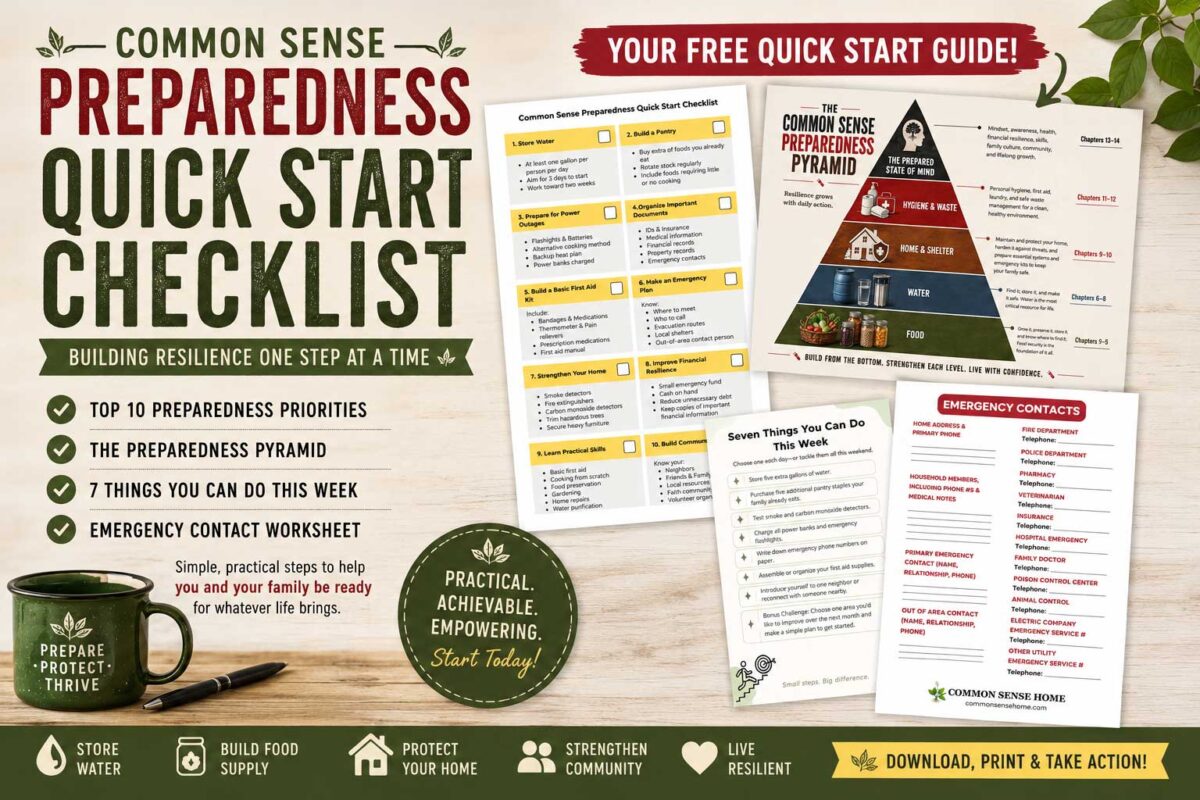
Inside the guide, you’ll find:
- Top 10 Preparedness Priorities — a simple checklist to help you see what you already have covered and where you may have gaps.
- The Common Sense Preparedness Pyramid — a framework for building resilience from the basics up.
- 7 Things You Can Do This Week — small, achievable actions that can make a real difference.
- Emergency Contact Worksheet — important information you can keep on paper in case your phone, internet, or power isn’t available.
Download Your Guide
Print a copy, grab a pen, and work through it at your own pace.
You don’t need to complete everything today. Pick one thing you can improve and start there.
Preparedness isn’t about perfection. It’s about steady progress.
A Little Preparation Makes Everyday Life Easier, Too
The same things that help during a major emergency often help with much smaller disruptions.
A stocked pantry helps when you’re sick and don’t want to go shopping. Stored water comes in handy when there’s a boil-water advisory. A charged power bank can save the day during an ordinary power outage. Knowing your neighbors gives you someone to call when you need an extra set of hands.
That’s the heart of Common Sense Preparedness.
We’re not trying to predict exactly what will happen.
We’re building homes, skills, supplies, and relationships that give us more options when life doesn’t go according to plan.
Ready to Go Deeper?
The Quick Start Checklist gives you a place to begin. If you’d like to continue building your preparedness skills, you can explore more practical preparedness information on the Common Sense Home website, or purchase my new book, Common Sense Preparedness: Building Resilience for Uncertain Times.
BUY COMMON SENSE PREPAREDNESS:BUILDING RESILIENCE FOR UNCERTAIN TIMES
EXPLORE MORE PREPAREDNESS RESOURCES
Small steps. Big difference.
Enjoyed the presentation. Amazing aerial view of your farm! So cool to have your own ponds.
Liked how you focused on keeping objectives within your abilities and resources while still striving to maintain sustainability in tougher times.
PS – already subscribe to your newsletter…think you do a amazing job of also describing the more spiritual matters of working through the seasons of the year and of life. God bless ya.
Thank you, Marlena. I’m glad you enjoyed the presentation, and the newsletters.
I would like to read your newsletter. Thanks
Hi Peggy. I sent you an email and got you on the newsletter list.
I am 78 and live alone. My biggest problem is water storage. I can’t drink the local water. When I first moved here, I ended up in the hospital from drinking the water. I have to buy bottled water. I tried a RO filter, but that didn’t work because it was a counter top unit and didn’t add the minerals. I have trouble carrying the cases of water because of their weight. I have filled 5 gallon jugs, but I can’t pick them up. 3 gallon ones aren’t much better.
I am a renter. I was allowed to have a greenhouse, but the landlord told me it had to be placed on the patio on the west side of the house in the shade of the huge oak tree. The lettuce did very well, but other veggies didn’t do so. After 7 years I just sold the greenhouse in July. I couldn’t safely drag the garden hose half way around the house anymore since I have to use a rollator now. I try to do my best, but I sure wish I had the help of strong, young muscles at times!
For water storage, I would stop worrying about the larger containers altogether. Five gallons of water weighs more than 40 pounds, and even three gallons is around 25 pounds. If you can’t comfortably lift that much, those containers aren’t a good solution for you.
Instead, I would build your water supply around containers you can safely handle.
Use smaller bottles or jugs. A one-gallon jug weighs a little over 8 pounds, and a half-gallon weighs about 4 pounds. Individual water bottles are another option. It takes more containers, but you can actually use them without hurting yourself.
Use your rollator to move water. Since you’re already using a rollator, you may be able to put a few smaller bottles on the seat or in the basket and move them around the apartment that way instead of carrying them. Just be careful not to overload it or make it unstable.
Have water delivered if that’s available in your area. Grocery delivery may be easier than buying cases yourself. You could order smaller bottles or one-gallon jugs and have them brought right to your door. If someone is helping bring groceries inside, they could also put the water where you want it stored.
Don’t store all your water in one place. Keep some in the kitchen, some near the bathroom, and perhaps a few bottles near your bed or wherever you spend the most time. Then you don’t have to move much water at once.
Store it where it’s easy to reach. Avoid putting heavy bottles on the floor or high shelves if possible. A sturdy shelf somewhere between knee and waist height may be much easier and safer.
Build your supply a little at a time. You don’t need to buy a large emergency supply all at once. Start with enough drinking water for a few days, then add a few bottles with each grocery order. Eventually you can build up a week or two without having to wrestle with cases of water.
Use bottled water primarily for drinking and cooking. If your tap water is safe for washing, cleaning, and flushing the toilet, you don’t need to use your good drinking water for those jobs. Since you became seriously ill from the local water in the past, though, I would want to know what the actual problem with the water is before suggesting other uses or a filtration system.
One other thought: don’t completely rule out reverse osmosis because the countertop unit didn’t add minerals back to the water. RO water doesn’t necessarily need to be remineralized to be safe to drink. If you know what contaminant caused the problem with your local water, you may be able to find a treatment system specifically designed to remove it. That could potentially reduce how much bottled water you need to buy and store.
I would also make people part of your preparedness plan. If you have a neighbor, friend, relative, church member, or someone else nearby whom you trust, let them know that water is one of the things you have difficulty handling. Perhaps someone could bring several weeks’ worth of small bottles into your apartment occasionally, or make sure you’re stocked up when severe weather is coming.
Most importantly, don’t judge your preparedness by what someone younger or stronger can do. Your preparedness plan needs to work for you.
Ten small bottles of water that you can reach, move, and open are far more useful than a five-gallon container that you can’t lift. The goal isn’t to have the biggest stockpile. It’s to have a system that helps you stay safe and independent.
look into Berkey filters. We have been using ours over 10 years, and love it. You can pour icky water in the top, and get clean, tasty water out the spigot. They are expensive, but much less than bottled water, and stainless steel, not plastic.