
How to Make Homemade Extracts – Vanilla, Lemon and Almond

This post may contain affiliate links. Read my full disclosure here.
I do a fair amount of baking, especially once the weather gets cooler, so I figured I could save quite a bit of money if I learned how to make homemade extracts. It turns out it couldn’t be much simpler – the biggest skill required is patience – and I can have plenty of extract for pennies on the dollar compared to buying high quality extract.
Would you like to save this?
This post covers how to make the three homemade extracts I use the most – vanilla, almond and lemon.
Always make sure all your containers and kitchenware are well cleaned. If you want, you can sterilize by boiling for ten minutes, plus one minute per every 1000 feet above sea level. I haven’t boiled, I’ve just used well-washed everything, and I haven’t had any problems.
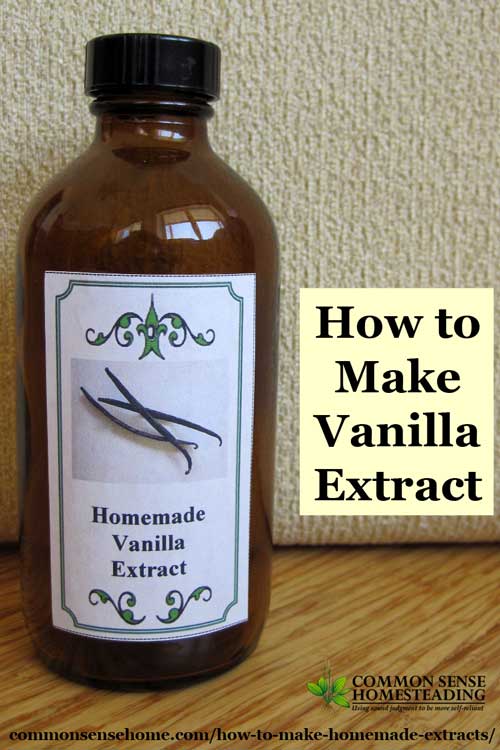
How to Make Homemade Vanilla Extract
1. Use 2 ounces of vanilla beans and one pint vodka for every pint of extract that you want to make. (For one cup of extract, use one ounce, and so on.)
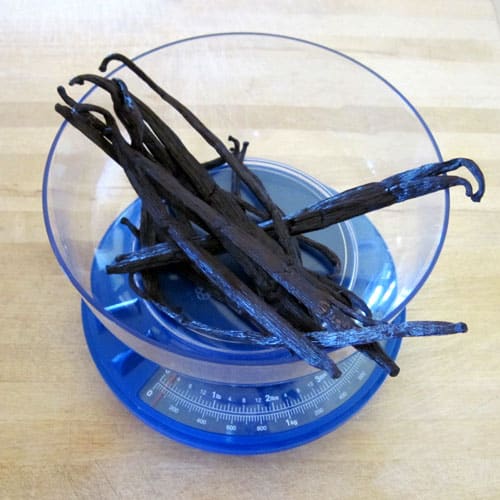
2. Chop the beans into 1/4 to 1/2 inch long pieces. Many recipes call for slicing and scraping, but if you simply cut the beans into small pieces, you can get the same results with much less mess and effort.
3. Place the cut vanilla beans in a lidded, glass jar with 80 proof (40% alcohol by weight) vodka. I prefer to use vodka bottled in glass rather than plastic, and watch for whatever’s on sale. Lately I’ve been using Svedka. You can see the bean pieces at the bottom of the jar and the floating vanilla flecks.
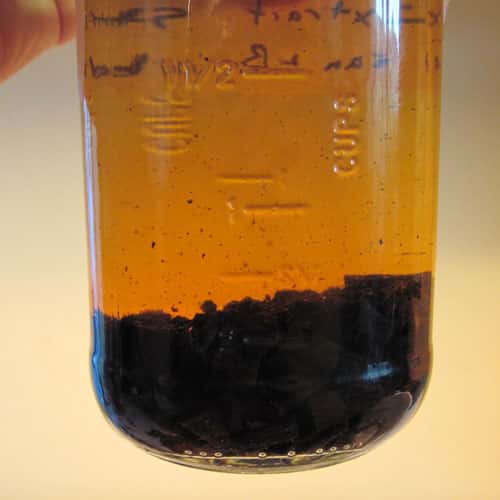
4. Shake the bottle once a day for at least a month, and you have homemade vanilla extract. I usually aim for two to three months. The color and flavor will deepen with age.
5. Strain the finished extract through cheesecloth or a coffee filter and place in a dark bottle. You can order bottles online or find them in some specialty stores, or reuse empty extract bottles that you already have on hand. Alternatively, you can measure right out of your brewing bottle and continue to let the rest steep, or pour off some and let the rest steep. I like to bottle what I’m using separately to reduce any risk of contamination from dipping into an open jar (even if it is filled with alcohol). You really don’t need to strain if you’re just pouring off the top, and you can add more alcohol a few times (depending on how much you draw off and how strong your beans are).
6. Store in a cool, dark location.
If you buy the vanilla beans in bulk you can save even more (I have split orders with friends). You can also buy assortments of beans and mix and match types for subtle flavor differences. I think my homemade extract with a mix a beans tastes and smells as good or better than any commercial extract I’ve tried.
Purchase Boston Round Bottles, 4 Oz Pack of 12
For gift giving, you may want to consider using different alcohols (such as brandy or rum) combined with different bean types for a truly unique gift. Or just make up one big batch and split it into small decorative bottles.
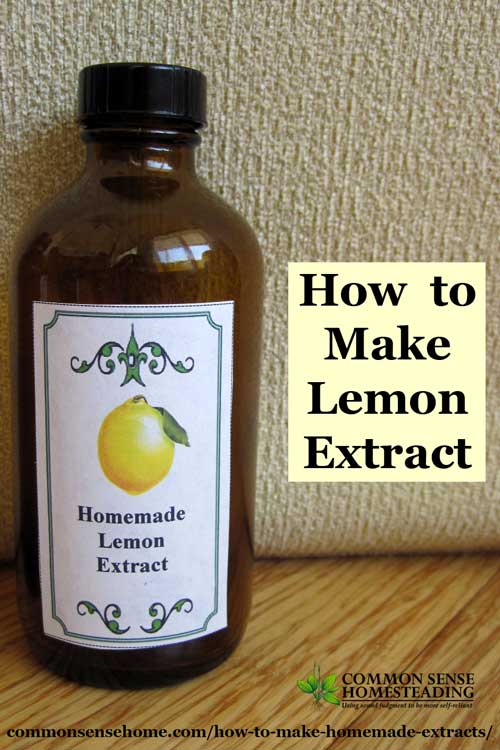
How to Make Homemade Lemon Extract
This recipe is based on the post “How to Make Baking Extracts” from the Denver Post.
1. Combine the zest from 1 lemon, 1 teaspoon sugar and ½ cup 80 proof (40% alcohol by weight) vodka. Don’t use the pith (white part) of the lemon- just stick to the yellow – as the pitch is bitter. I like to use my Microplane zester to get a beautiful, fine lemon zest.
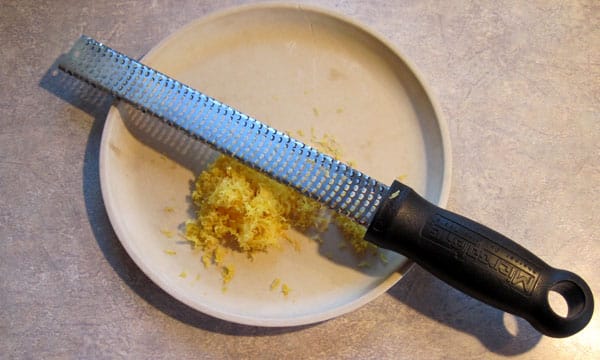
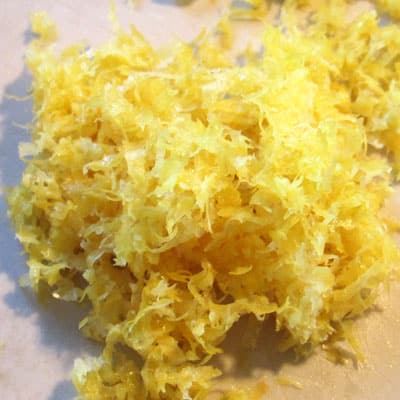
2. Place zest, sugar and vodka in a lidded, glass jar.
3. Shake the bottle once a day for at least a month, and you have homemade lemon extract. I usually aim for two to three months. The flavor will improve with age.
4. Strain the finished extract through cheesecloth or a coffee filter and place in a dark bottle. Alternatively, just pour off a small portion for use and allow the rest to continue steeping.
5. Store in a cool, dark location.
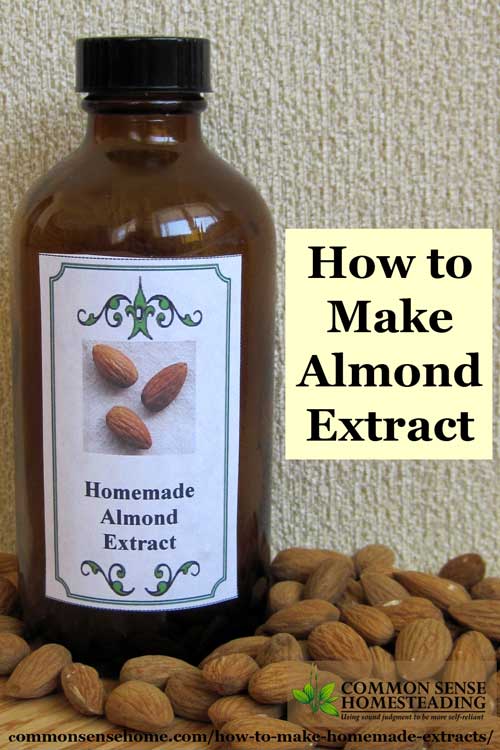
How to Make Homemade Almond Extract
Commercial almond extract is made with bitter almonds, which contain a cyanide precursor, which I don’t suggest brewing at home.; In fact, some folks argue that you should not use natural almond extract at all, only the synthetic. For my part, I’m more likely to trust nature than chemists. I’ve read that the same pits and seeds that contain the cyanide precursors also contain anti-cancer compounds. I don’t go out of my way to consume extra seeds and pits, but I don’t worry if they occasionally get eaten.
These instructions are based on the E-how post “How to Make Your Own Almond Extract“. By now, you know the drill, but we’ll go through the steps and proportions.
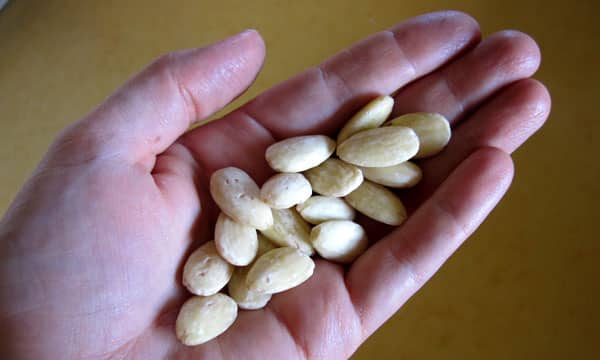
1. Use 12 whole, raw skinless almonds and one pint 80 proof (40% alcohol by weight) vodka for every pint of extract that you want to make.(For one cup of extract, use 6 almonds, and so on.) My almonds had been in the freezer for while, so I used more. The skins will make the extract more bitter, so it’s best to opt for skinless. Better tasting almonds make better tasting extract.
2. Chop almonds and place almonds and vodka in a lidded, glass jar. More surface area means more flavor transfer from almonds to alcohol.
3. Shake the bottle once a day for at least a month, and you have homemade almond extract. I usually aim for two to three months. The flavor will improve with age.
4. Strain the finished extract through cheesecloth or coffee filter and place in a dark bottle. Alternatively, just pour off a small portion for use and allow the rest to continue steeping.
5. Store in a cool, dark location. This extract will not taste as strong as commercial almond extracts, so you may want to make a small batch and see if you like it before making it in quantity.
And now you know how to make homemade extracts.; The same concept can be used with homegrown mints for homemade mint extract, or to make homemade orange extract and coconut extract. The shelf life is indefinite – alcohol is a preservative. I’d still recommend using in a year or two because the flavor will fade once the solids have been removed.
If you want to try different fruit extracts, like watermelon or strawberry, I’d recommend dehydrating or freeze drying the fruit first to concentrate the flavor.
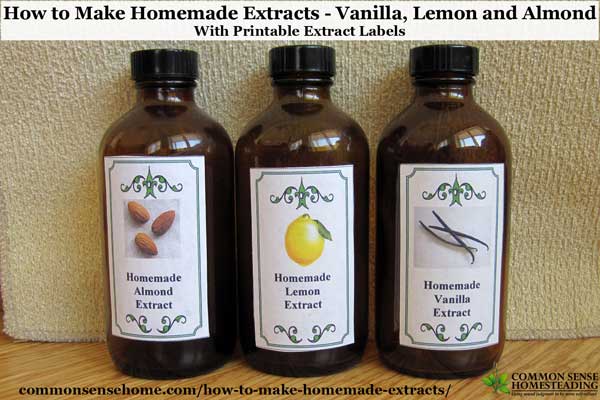
If you’d like to use the labels shown in the photos above, just click on the image below. The file is large, so it make take a couple minutes to open.
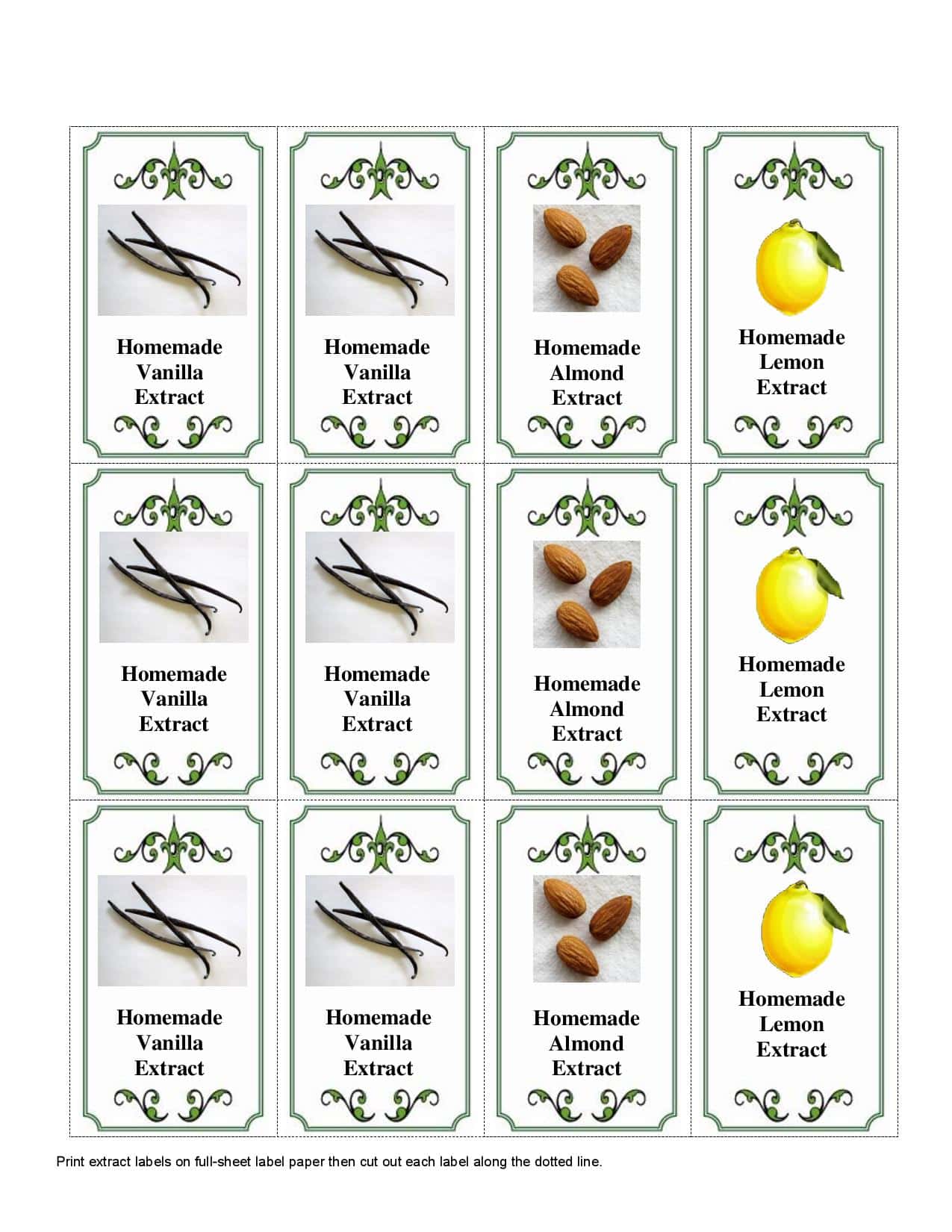
Update: I just added a jpg copy of the labels, shrunk down to fit on 4 oz bottles. This will only fill about half a page when printing. Download extract labels sized for 4 oz jars.

More Great Extract and Infusion Recipes
- How to Grow Stevia and Make Your Own Extract
- Easy Chocolate Mint Extract
- How to Infuse Herbs in Oil, Water, Vinegar, Alcohol or Honey

Originally published in 2012, updated in 2016.
How long do the pkgs of beans you order from Vanilla Products keep unopened? Have you ever used part of a pkg and left some for later? I like the idea of trying different mixes and not sure I want to do it all at once.
The beans from Vanilla Products come vacuum sealed. When they arrive, I put them in a sealed mason jar in the pantry until I’m ready to use them. I’ve kept them in the pantry for over a year this way with no notable change in quality. I think it’s generally recommended that they be used within a year. If you have a vacuum sealer, you could carefully clip the end to open and reseal until your next use. Air, heat, light, and moisture will speed the breakdown in quality of the beans, so anything you can do to avoid those conditions should help extend shelf life.
One other note – the extract last about forever, so when in doubt, put the beans in the booze rather than have them aging in the pantry. Alcohol acts as a preservative.
The reader who advised on putting the beans directly in a jar of alcohol is correct in my experience. Ive had an ongoing jar for about 40 years. That’s not a typo. My jar is now a gallon and contains a lot of beans and empty pods steeping in rum. My “vanilla” is very rich and thicker than store-bought. No! It will never go bad if you keep the level of liquor above the pods. Seriously, this I keep for very special applications and buy highest quality vanilla for things like brownies, etc., where the focus is on another aggressive flavour like chocolate or the warm spices. The homemade stuff is not a compromise and a plop on anything with apples is Devine.
Hi, Laurie,
I got curious about making my own extract and was delighted to find your website and recipes. I’m curious, why Vodka as the extracting agent? For example, why not Pure Grain Alcohol?
I look forward to your reply.
Warm regards,
Jim
Mississippi
Pure grain alcohol could be used, but some discussions I’ve read indicate that the higher proof alcohols may pull out more of the bitter compounds from the botanicals being infused into the extract.
Wuuh – I’m looking so much forward to make the lemon extract!
I would love an advice of how to make it even more “smelly” so I can use it to refresh the livingroom with a lot of this flavour – do you (or anyone) know of how to do that best?
Thank you for your site – I will look a lot more at your other hints and good advices.
Chris, Denmark
Essential oils are super concentrated, so those are often used as air fresheners. The more of the zest you can pack into the extract, the more smelly it will be, so you may want to try making a batch, letting it sit, and then straining and putting in a fresh batch of zest for more “oomph”.
My almond extract has been sitting for a couple of months, but it still really really smells like vodka. Is that ok? Or, does it mean I didn’t use enough almonds, and it’s too late to fix? Thanks!
If you don’t have much almond smell/flavor, more almonds would probably be a good idea.
h this makes me very happy, I have been making my own amaretto but the shop bought Almond and Vanilla extract’s are oily leaving a oil slick on top of the amaretto so means filtering it. The solution to this is to use a alcohol based extract but there so expensive in the shops. To give you a idea in uk pounds 50ml of Almond extract (asda chosen by you is 1.29) to get the same but alcohol based is like 5 uk pounds plus.
Going to have a go at this making my own Almond and Vanila extracts. Doing it the shop bought way we make the best Ameretto , far better than shop bought. Will report back when we have done our own extract lol.
Paul.
What part of the Lemon is “Zest”? the peel or pulp?
The zest is the outside (colored) part of the peel. The white part is the pith, which will tend to be more bitter. You don’t want the white part.
Is there a purpose for the sugar in the lemon extract other than to sweeten? I cannot tolerate any amount of sugar.
Primarily just flavoring. The alcohol will act as a preservative.
I am curious to know if there is a life shelf for the extracts?
They will keep indefinitely in a cool, dark location, but the flavor will fade slowly over time once you take the ingredients out. It’s better to make in small batches, and/or keep whatever you’re infusing in the liquid to get the best flavor.
Do you have a rough estimate of how much lemon zest? Your picture looks like it is about 3x what I am getting from one lemon.
The more zest, the stronger the flavor. I didn’t measure, but this was a fairly large lemon, and I estimate there was around one tablespoon to 4 teaspoons of zest, lightly packed.
If you have a whipped cream siphon, like an ISI whip, you can do a Rapid Infusion technique. Turns minutes into weeks. Now, some of the flavor aren’t as deep, but for most applications it’s more than acceptable.
I start with ever clear (75.5%abv) 151 proof. Run my extraction, and then either dilute 50/50 water/everclear for a flavored vodka, or keep pure for extracts/tinctures.
Just google rapid infusion and there’s plenty of tutorials. The process is the same, no matter the end product.
As a bonus, if you make a maraschino (sp?) cherry extract, you have a bowl of moonshine cherries after! 🙂
Charge those cherries again in the same whipper with a soda cartridge, Co2 not N2o and you would have fizzy/carbonated moonshine cherries.
Not just extracts, oil infusions (preserves the flavor of EVOO by not heating), mixed drinks “celery-infused vodka Bloody Mary’s anyone?” heck, you can even make pancakes with the whippers….
Could you do a pomegranate extract?
I think it would be difficult to get enough flavor, but maybe if you made pulp and dried it, and then tried to infuse the dried pulp?
I would love to make Black Walnut Extract. Could you please tell me, How much walnuts to what kind and how much liquor. and how long would it need to sit in my cabnet till ready for use?
Black Walnut Extract Instructions
When you use the zest from citrus, the flavor is coming from the oil. Could you use pure essential oils instead of the zest? I feel an experiment coming on….
I know that doTERRA has recipes that simply use essential oils, but I personally hesitate to ingest them because they are so very concentrated.
Have you ever made an extract from bananas?
I have used commercial flavorings and extract for baking, and am interested in learning to make my own.
Nope, haven’t tired that one, either, but if I were going to I’d do it like the watermelon. Dice finely, dehydrate to concentrate the flavor, and then put in vodka. I think riper bananas would have a better chance of imparting flavor because they are more aromatic, but would be messier to work with.
I was just wondering if you could give me some advice on making watermelon extract. I need it to flavor some candy but it is very expensive to buy.
thanks
I’m not sure if it can be done at home, because watermelon is so watery – BUT – if I were to try it, I’d dice the watermelon finely and dehydrate, and then try putting it in vodka to make extract.
Another question, about how many vanilla beans are in two ounces?
What’s shown in the bowl was two ounces of beans. I use a scale because it will vary depending on the size of the beans. Extract grade beans tend to be smaller, so you need more of them, but they are less expensive and work just fine for extract, as one would expect from the name. Gourmet vanilla beans tend to be larger and shinier.
Are the dried Vanilla beans ok to use? Where do you usually purchase yours?
I think all the vanilla beans I’ve seen for sale are dried/cured. I’ve had good results purchasing from Vanilla Products USA. Their prices are great, and their quality is also very good. I order the vanilla bean assortment or the bourbon vanilla beans.
Excellent article, thanks! Do you have a good source for bottles?
Mountain Rose Herbs has a ton of different bottles, jars, droppers and just about anything else you can think of for extract making or homemade herbal remedies.
Thanks 🙂
Laurie, I’ve had my vanilla steeping for a couple of months. Ready to buy bottles but want to use your labels. What size will work? Looking at the 4 oz pkg of 12 from Mountain Rose Herbs. Planning to use as gifts.
The bottles shown in the photos are 8 ounce. I did some fiddling and was able to create a smaller version of the image that will fit better on 4 oz bottles.
Where would I go to find your 4 oz or 8 oz labels, please? I can’t wait to try these ideas.
See that image of labels where it says “Homemade Extract Label for 8 ounce jars” underneath? You can click on the image or the text “homemade extract labels” to get the pdf with 8 ounce labels.
Right below that is a paragraph that includes the text “download extract labels sized for 4 oz jars”. If you click on that text, it’ll take you to a pdf of the smaller sized labels.
I’m not supposed to use the words “click” and “here” next to each other, because that makes google think it’s a spam site. Even the word “click” may cause problems, which is very frustrating for those of us trying to transfer legitimate information. The world has gone nuts.
How long can you use vanilla beans over again? Do you just throw away after 3 months of soaking?
At the end of the steeping process, you can add more alcohol, but a second batch won’t be as strong. You can also bottle only small amounts at a time, and leave the rest to steep. At some point all the flavor will be gone from the beans and they will simply be compost.
This is great, except for the almonds. I would recommend never tincture ANY nut!
I hate to quote Wikipedia here but it explains why pretty well. I really just don’t feel safe risking it. I love tincturing other things, though, and really want to try your lemon recipe here.
http://en.wikipedia.org/wiki/Almond
“Extract of bitter almond was once used medicinally, but even in small doses, effects are severe, and in larger doses can be deadly; the cyanide must be removed before consumption.”
“All commercially grown almonds sold as food in the United States are of the “sweet” variety. However, The US Food and Drug Administration reported in 2010 that some fractions of imported sweet almonds were contaminated with bitter almonds. Eating such almonds could result in vertigo and other typical bitter almond (cyanide) poisoning effects.”
Simple solution – don’t buy imported almonds. Bitter almonds are a very specific type of almond, and I’m sure anyone caught selling them in the US would be busted.