
Honey as Medicine – Prevent Infection, Kill Bacteria, Promote Healing

This post may contain affiliate links. Read my full disclosure here.
Did you know you can use honey as medicine? If I had to choose only one medicine I could have in stock, I think it would be honey. These days, specialty wound-care centers might agree.
Would you like to save this?
Honey has become a staple for those hard-to-heal wounds, such as diabetic leg ulcers, burns, even wounds with gangrene. It kills bacteria resistant to other antibiotics and actually heals tissue, nursing the skin back to health. Not only that, but it can decrease the pain. But here’s the catch. Some types of honey work better than others. Before we get into that, let’s go over the basics, like …
How Honey Prevents Wound Infections
- It seals the wound from outside contaminants.
- It’s a mild acid. Most bacteria can’t grow well in that.
- It has a low water content. Bacteria don’t like that either.
How Honey Kills Bacteria
- It dries them up. The high sugar content dehydrates bacteria.
- It produces hydrogen peroxide. When diluted with, say, body fluids, enzymes in the honey create a small amount of hydrogen peroxide. Enough to kill bacteria.
- Its enzymes create antibacterial chemicals we’re just beginning to isolate. Some types of honey produce more of these chemicals than others. Some don’t produce much at all.
How Honey Heals
Honey has been shown to speed up the growth of various body tissues. It helps form new blood vessels, collagen, and the epithelial cells that cover the underlying tissue. The way it does this is:
- Honey seals in the good tissue fluid containing enzymes and proteins that promote healing.
- It provides nutrition to the tissue.
- Honey decreases inflammation and swelling in a yet unknown way.
Some studies have suggested honey even decreases scarring.
Some Concerns About Using Honey
Even with all its antibacterial properties, honey can contain a few bacteria. Although some can cause bad skin infections, I can’t find a study where any have. Still, physicians worry because it’s possible. We do know babies have died ingesting honey that contained a few botulism spores. This is thought to be due to their still developing digestive system. To my knowledge, no one over 12 months old has ever even gotten sick from these sparse spores. Okay, now for the finale.
Some Types of Honey Fight Bacteria Better Than Others
Even though all types of honey are acidic and dehydrate bacteria, and most types create hydrogen peroxide in varying quantities, not all contain those other antibacterial chemicals we’re just now discovering.
Have you heard of Manuka honey? It’s made in New Zealand, and it’s known as the most effective honey and the one with the most antibacterial chemicals. That may be because it’s been studied the most or because it’s been marketed the most, or just maybe because it really is the best bacteria fighter.
Medihoney is Manuka honey that’s been zapped clean of bacteria (including botulism). The zapping may kill the peroxide-creating enzymes but apparently doesn’t harm the antibacterial chemicals. It’s the honey the wound-care centers use. I hoped to find a study comparing the antibacterial potencies of various U.S. honeys but could only find studies on honeys made abroad.
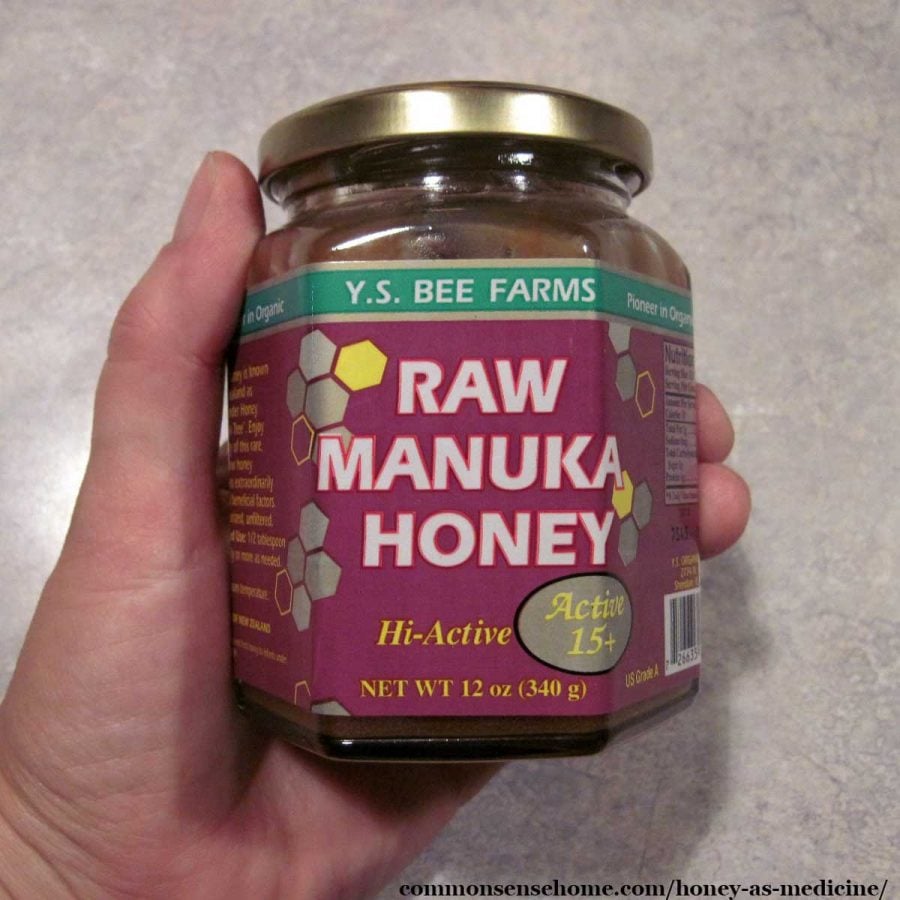
Honey as Medicine – Which Honey Should You Stock for Medicinal Use?
- I’d get some Medihoney for the medical survival kit. It’s more expensive, but it’s not going to spoil. (Actually no honey is going to spoil.)
- I’d have some good-tasting local honey for extra stocking supplies. Use it to eat, for coughs, etc., and for an antibacterial in a pinch. (Learn more about using honey for coughs in my blog post, “The Safest Cough Medicine“. Don’t feed it to babies. Laurie’s note: you can also use honey to make simple cough drops.)
Important caution: Never try to treat a bad wound by yourself when you can get medical help. For one thing, even with honey, it could turn into a very serious limb- or life-threatening infection.
How to Use Honey on Wounds
After cleaning the wound, put honey on one side of gauze or a clean cloth, and lay it onto the wound. Or pour a thin film of honey directly onto the wound and put the gauze over that. Either way, seal the honey in with surgical or duct tape on the edges of the bandage. Clean and repeat twice a day. If supplies are scarce and the dressing stays clean, you could cut that back to once a day or even a bit longer. Have you ever used honey for a skin infection? What type? Do you have some stored just in case?
Comment from Chody D. on the Common Sense Home Facebook page:
A friend of mine cut the end of her thumb off with a machete. She was keeping it covered in honey. I thought I was gonna have to force her to go to get antibiotics when it got infected. About a week later she came to my house and her thumb was COMPLETELY healed!!! I was shocked! I will never doubt the magical medicinal uses of honey again.
Is Manuka Honey Safe to Use on Pets?
Update by Laurie: Several people have asked whether it is safe to use manuka honey on pets. The answer is “yes”. You can read more about treating pets with honey at “Using Manuka Honey for Dogs, Horses, and other Animals“
Make Sure Your Honey is Real
Much of the honey on US store shelves is imported from China, and may be contaminated with heavy metals and illegal antibiotics. Look for products from local apiaries and other trusted brands.
This is a guest post by by James Hubbard, M.D., M.P.H. Dr. Hubbard teaches down-to-earth, improvisational survival medicine for disasters. He’s been a family physician for over over 30 years.
Disclaimer: This post is for general information only and not meant to be your only source of information on the topic. Use at your own risk. Please consult your health-care provider for personal advice.
My good friend had vaginal repair surgery and now has an infection. She is on oral antibiotics but I told her about manuka. What would be a safe way to use it in a “closed” area of the body?
Your friend should really talk to her doctor about internal use. Getting the honey to the area in question may introduce additional outside microbes to the infection area if one was not very careful. Excess sugar in the area could also throw the microbe balance out of whack, encouraging yeast overgrowth.
I just bought a jar of manuka honey at Trader Joe’s. It say it is from New Zealand and has 10+ on the lid. I bought it to have “just in case”. do you think this would be ok or do I need to have the medihoney?
I’m sure it will be fine.
HELP! Mother with cancer is bed bound and developed tailbone bed sores. Some open, some new, some black, some red. I’m confused if I should or can use manuka honey or raw honey. Because of her decreasing health and poor prognosis, her body is unable to heal. Should I even consider manuka? THANK YOU !!
Either raw or manuka should help. The manuka just has a little extra help. Do talk to your mother’s healthcare providers so they know about the issue, and make sure there aren’t any problems with using the honey. Saying a prayer for your mom. Cancer is terrible.
I have got a bad rash under my left breast. It happened after a particularly sweaty workout session about 9 days ago. The rash was red and itchy. When it didn’t improve after I tried hydrocortisone cream on it for two days, I went to see my family doctor. She took one look at it and said it’s yeast infection. She prescribed Clotrimazole 1% cream. I have used it for 6 days and the rash has not improved (seemed to be spreading too). Do you think manuka honey will help? I don’t have access to medihoney, but have put some NZ manuka honey UMF20 on the rash. I’m just worried that the sugar in the honey will feed the yeast.
I would not use honey, for exactly the reason you mentioned – any sugar will feed the yeast.
Topical creams may provide relief for some, but if it’s not improving with the cream, you’ll probably need a systematic approach. I had a bad overgrowth a couple years ago and got it under control with diet changes, supplements and herbs.
More on candida – https://commonsensehome.com/candida/ and https://commonsensehome.com/anti-candida-anti-psoriasis-diet/
The doctor said to use sterile honey…. OK that’s a good option, but if it’s not readily available would regular Manuka honey do the trick? I imagine in the ‘old days’ the honey was not gamma-rayed to sterilise it and it was still safe to use! As long as authentic Manuka honey is used, it should be OK, right????
For my part, I’d say good quality honey of any sort (not something laced with corn syrup) would be acceptable.
I have had very good luck with giving my 17 year old fur baby Honey – it has helped whatever bug she had that caused her breathing problems at night – where the vets and dr.s x-rays proved nothing! Now with one tablespoon each night (those allergies) or whatever it was are not interfering with our sleep (and that is healthy in and of itself.)
Will be posting something I am now trying instead of all these expensive bandages. Like the AB bandages that we have to use due to fluid leakage on dad’s legs. Will share in a couple of days. If this works. One could save a lot of monies here instead of using AB bandages. However, please note that I am not telling anyone to do this. Always, always check with your doctor. Everyone is different and has different ailments.
Note: I am going to be whipping the raw honey to take out the larger size granules due to wrapping his legs some of the granules even though it melts on skin since I apply AB’s bandages to them. I don’t want to take any chances here. On possibly any imprints of large granules pressing on his legs once wrapped.
Whipping the honey, makes it smoother to apply to areas of concern. At least for me it does.
The bandages are AB bandages for fluid seepage and then use a gauze wrap over the bandages to secure the AB’s into place.
Then cover both legs with a gate stocking. I then put non skid footie’s on him while he is in doors.
When he goes out for his appointments. We bought him Dr Scholls shoes.
We bought the next shoe size up for him due to his edema. You fold over two Velcro tabs over top of foot to adjust to the edema of the feet.
They cost around $20.00 at Walmart. I also, am careful to remove the gauze wrapping on his his legs.
These can be cleaned by soaking in peroxide with little Castile soap and very hot water.
Rinse and line dry. If you don’t have a line? Then take clothes pins holders and hang them on to the fan for quick drying time” making sure you don’t clip them to far back into the fan blades.
Do not put into washer or dryer they will fray.
You can re-use to save money on the gauze wraps and the gate stockings. Bandages throw out!
Remember to keep everything sterile!
Walgreens stocks some good really stretchy, breathable socks for diabetics, too. I get them for my husband because he has very large calves.
I will have to see if our Walmart carries these socks. We don’t have a Walgreens here. :(. Will be doing the infrared light therapy tomorrow on dad’s right lower part of his leg. The sores are now pretty much closed up on this leg. Talking about the raw open sores he had on his leg not too long ago! Yippy! Praise God!
Glad the holes are healing.
I am my Father-in-law caregiver. However, took my two years course to become a Cert. Aromatherapist which was back in 1998 graduated and continued into the fields of natural therapy.
Please note here, I am not a doctor nor an RN. And I always tell my patients. Always check with attending doctors before embarking on any alternative healing measures.
My father-in-law is not a candidate for vascular surgery. By both doctor and wound clinic due to his age of 95.
He was first diagnosed with cellulitis on his lower extremities over a month going on two months now with edema and ulcers. And the bottoms of his feet had a mild fungal problem.
Now, mind you his regular doctor did what he could. Which the one thing that he had done was stopped the anti-fungal for his feet? Okay, I thought. I can deal with this. Then a couple of weeks ago he was finally finished taking his oral antibiotics.
Not much the doctor could do. So, Doc referred dad to the wound clinic.
After some testing by the wound clinic. Diagnoses was “Chronic Venous Hypertension with edema and ulcers”. And the bottoms of his feet had a mild fungal problem. “Treatment for feet was “I used tea tree oil, and olive oil, to heal that one.
So the fungal infections is now gone from the bottoms of his feet.
Now, mind you his regular doctor did what he could for his legs.
Took him to the wound clinic. They said there is nothing that can be done.
I spoke up and then asked this question? Since the wound clinic took pictures from all angles of his low extremities that were all blistered up, seeping, red and raw with open sores along with edema.
Let’s just say. I was ready to just take over here. But couldn’t. You have to watch your mouth and go about this in the right way. I did just that.
I said to the doc at the wound care center in front of all three RN’s. If there is nothing that you can do for him. Then I have a few ideas here. They said it could not hurt.
However, the first and more important step here is to make sure you clean areas very well before applying raw honey.
I use our raw honey we buy from local bee keeper.
The first more important step here. Is to make sure you clean areas very well with warm soapy water and pat dry.
Never rub hard on the open areas. I started using raw honey for about 5 minutes, 30 next day. Then would rinse off and bandage up and use gauze for his wrap. Now have worked up to doing this method of using raw honey for 24 hours let still. Unless, your gauze is wet from fluid leakage. Then you will have to do this again at least before bedtime.
Wound clinic wanted to see my father in law again a week later. They were very well pleased but just bandaged him up, wrapped both leg and put a gate stocking on him over the bandages. Nothing more!
Said we would like to see him back in a week. I said I take care of a lot of people. I can’t! He was doing much better, his legs were not blistered, or raw. So, I am continuing with my process here with raw honey, and dressings here.
I will post again in two weeks. If you all don’t mind? His appointment is scheduled again for Oct 26th. There is much more that is in store for my father in law. But first have to take this one step at a time here.
God Bless You All.
Thank you for sharing your family’s story, Kellie, and I’m so glad your father-in-law is doing better. If you would like to share photos of his progress, too, you can email them to me at laurie at commonsensehome dot com, and I will add them to the post.
On October 26th when I take my father in law back to the wound clinic. I will get the first digital pictures that were taken at the wound clinic and will scan them for you and will add my new pictures of his healing. My printer is not working right now. So once I get the new printer. I will share with you. Thank you, for your page. This is great! Will be getting some pictures tomorrow evening. I will be doing infrared light treatment once his skin is all healed up. Will again after a few weeks will send you other pictures. Mind, the doctors said it can’t hurt. Since there was nothing they could do for him. Plus have spent many, many hours on researching.
it’s pain or not when put manuka honey on the wound. I tryon my open wound that already 3month. it’s because motorcycle hit a wood. that wood hit my feet. doctor sew up.but cannot close. now all open again. Its pain so I wash off. maybe I try again. thank you.
Is there any chance that wood is still in the wound? After 3 months, the wound should be closing – BUT – if you still have chunks of wood in it, that would prevent healing.
If you can find plantain (the weed, not the fruit), and make a drawing poultice, this may be helpful. There are photos here – https://commonsensehome.com/grandma-called-it-medicine-leaf/
Cabbage also makes a good drawing poultice. Chop and crush the leaves to release the juices. Wrap the leaves in a thin cloth to form a poultice. Apply the poultice to the wound. Leave in place for 15 -60 minutes. Rinse the wound with tepid water. May be repeated 2-3 times daily.
Plantain is used in a similar manner, but can be left on up to 8 hours.
Laurie,
Have you ever heard of using honey on dry, chapped lips? Bad case of dry, irritated (inside) lips which often flare up. Thanks.
I know honey can be used as a lip scrub to remove lose skin on the lips, but I haven’t heard of it being used as a balm. You could test on a small area and see if it feels better or worse. I’d probably look into diet changes and probiotics, to help boost the good microbes in your system and general health. A healthy human body has 10 bacteria cells for every human cell, so it’s important to have healthy bacteria. You may also want to do a simple saliva pH test to see if you are too acidic, which could contribute to mouth irritation.
but since hv used honey it reliefs me nd d face is drying
Just please be careful and get help if it gets worse, okay?
hi…i’m sodiq I hv a small wound 3weeks ago but felt like it is a minor injury and I kept putting on shoes till the wound gets worse now it has hole and lage area…I tried to dry it with hot things sometimes still no difference nd nw I smell odour and whenever I put on long trouser to close d leg in case im going out it swells up nd like water comes out….im fed up can I try honey ?
Please see a doctor! You may still have something stuck in the wound, and it sounds like it has a deep infection that may kill you. This could be very serious. Please get help from someone local who can look at the wound and treat it properly.
plz I hv wound on my leg I hv used many drugs still nothing has come out of it….it pains me…nd smell odour.. and like a hole is on the wound should I use honey nd how should I use it ?
You can cover the wound in honey and bandage it, but it would be a very good idea to see a trained healthcare provider, as it sounds like you may have an infection.
Hi! On nov27th I had an abscess drained at the ER it turned out to be a staph infection. On December 1st I was told I don’t have to pack the open wound anymore and that’s it’s healing when the doctor looked it. Now today December 5th the last few days my open wound has been itchy the foul smell is going away. But today as I was changing the dressings I saw a blood spot about the size of a mini m&m’s. I got scared and worried and I called urgent care they are telling me to get it drained again? Which is weird everything has drained out the past few days. So I decided to buy the manuka honey today. I’m asking how do I apply it onto my wound? Or on the dressing gauze? Will it help my wound to heal faster and also drain whatever is left in my open wound? Sorry for my little story. Thanks in advanced.
The honey can be applied to gauze and then to the wound, or directly to the wound. Please be careful and seek medical attention if the would gets worse or does not improve. It should draw out moisture from the wound and speed healing. Again, if you do not see improvement, please see a doctor.
Can anyone speak on honey helping severe eczema that causes skin cracking/splitting issues? Would it just be applied a couple times a day?
Thanks!
You could try it, but long term diet changes and gut healing is probably a better bet. I’ve been dealing with psoriasis this year, and relief from topical treatments has been temporary at best.
Thank you for your article n I learned a lot thru the various comments.
I need to ask if anyone can advise. Let me share about my sis. My 67 year old sister is diagnosed with stage 4 vulva cancer, after chemo n radio therapy, she developed very bad bacteria infection which leaves her with a large hole in her groin. we tried manuka honey and, thank God, the swelling went down and pus significantly reduced.
Her case is complicated as she has to change her dressing at least 3 times a day as she is wearing a diaper.
may I ask, would u know if applying a lot of manuka honey on the wound dehydrates a patient?
Thank you.
I don’t think the manuka honey itself would cause excess dehydration, but the infection could lead to dehydration since the body is concentrating fluids in the swollen area instead of in normal circulation. Plenty of fluids (unless you are told otherwise by your doctor) is normally a good idea.
I was wondering if this would help on boils on someones butt. But my mom is diabetic . And she has one we cant get rid of. I was hoping this might help. What are your thoughts on this. Useing that manuke honey.
At the very least it shouldn’t hurt, and it’s worth a try.
You make no mention of honey used to treat eye problems. I use runny honey to reduce the irritation of blepharitis, a chronic condition for which there is no known cure, and would also use it on sties and other eye infections.
Interesting. I had not heard of that.
What’s the recipe for the honey cinnamon tea, please???