
Homestead Geese – Homestead Protectors and Weed Eaters

This post may contain affiliate links. Read my full disclosure here.

Homestead geese are not the first animals that come to mind when you consider homestead livestock. That award usually goes to backyard chickens, or dairy goats with the occasional pastured pig thrown in. But geese deserve to be fourth on that list in my opinion. Geese are entertainment, lawn control, homestead guardians that also happen to taste pretty darn good.
Would you like to save this?
Goose fat is prized among top chefs, and many a hawk or fox has been scared away from a chicken dinner by the threatening wing span of an angry goose. You might share that opinion if you encountered an aggressive goose in childhood (or adulthood for that matter).
However, geese raised by you, from goslings (a young goose), can be as friendly as the family dog and twice as formidable when strangers or predators happen on to your homestead! There’s nothing quite like a group of 10+ lb birds rushing at you with wings spread, loudly honking their irritation at your presence. I know our UPS driver respects them, as do the hawks that fly overhead checking out our free range laying hens.
Table of contents
Which Goose Breed Should I Get for My Homestead?
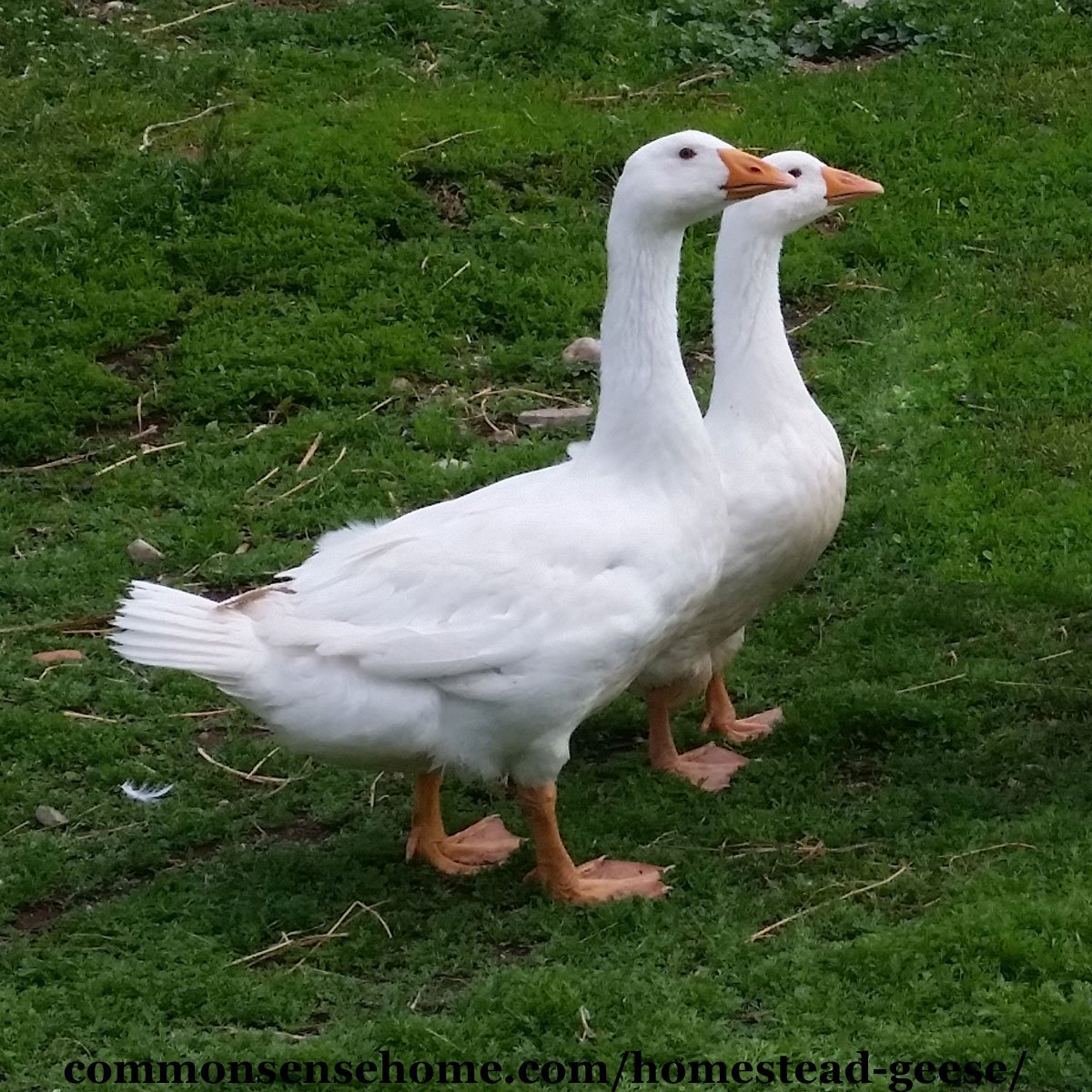
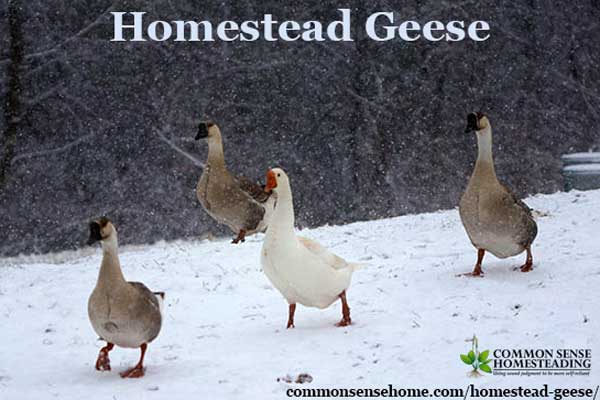
When I first decided to get geese, I wasn’t sure which breed I wanted so I ordered the random mix “Weeder” package from a hatchery. We ended up with Africans, White Chinese and a single Embden (also spelled Emden). While I’ve enjoyed them all, our Embden is the sweetest and most interactive of our geese.
Toulouse and Pilgrims are also highly recommended for calm, gentler personalities. They might not be *quite* as effective as guardians due to their laid back nature, but they’ll still give an alarm honk when something is going on!
For a full list of domestic goose breeds, visit poultrykeeper.com “Domestic Goose Breeds”. The American Livestock Breeds Conservancy has a priority list of goose breeds that are considered Critical, Threatened, under Watch and under Study. On the Critical list are:
- American Buff
- Cotton Patch
- Pilgrim
- Pomeranian
- Roman
- Shetland
Sebastopols are considered Threatened. Africans, Chinese, Toulouse-Non-Industrial are on the Watch list.
When Should You Get Your Geese?
We ordered ours for delivery in the spring from Murray McMurray hatchery, but they are available from a variety of online hatcheries. If you have a particular breed in mind, place your order early as they sell out quickly!
Just like you would with young chicks, you’ll want a sheltered brooding area, safe from predators, until they feather out.
Some options for food and water include:
- Feeder base for quart jars (for goslings)
- Waterer base for quart jars (for goslings)
- EZ Fill Poultry Drinker (for inside water)
What Do Geese Need for Shelter & Food?
Our adult geese prefer to free range 24/7, and even with coyotes and foxes in the nearby woods, we haven’t had any issues. They stay close to home and don’t wander off. While I’ve tried providing shelter for them, they have rejected it at every turn…which is something I’ve seen from other goose keepers.
Editor’s note: My mom raised large flocks of geese and ducks for years. I would highly recommend putting them inside for the night, whether they like it or not. Over time, or under stress, predators will get bolder. One night when I was a girl, I forgot to lock the shed door where the geese and ducks were kept. The neighbor’s dogs came over and ravaged the breeding stock. It was horrible, and I will never be able to get those images out of my mind.
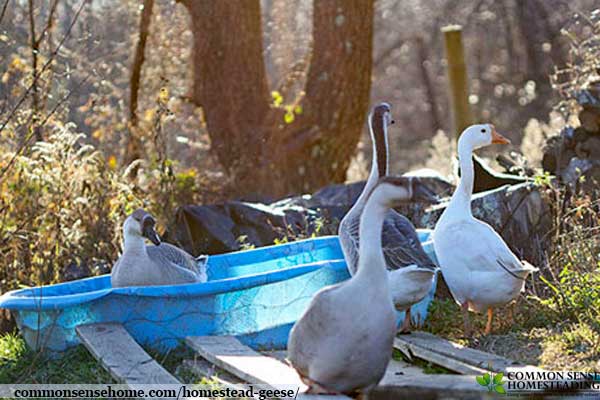
The big thing you need to keep your geese happy is a place to bath and play in water. We have a plastic kiddie pool that they adore, but in the winter it’s difficult to keep it from freezing solid. So I keep a deep rubber tub filled for them to play in, and of course, there are always a few 5 gallon buckets to dunk their heads in. Water = happy geese.
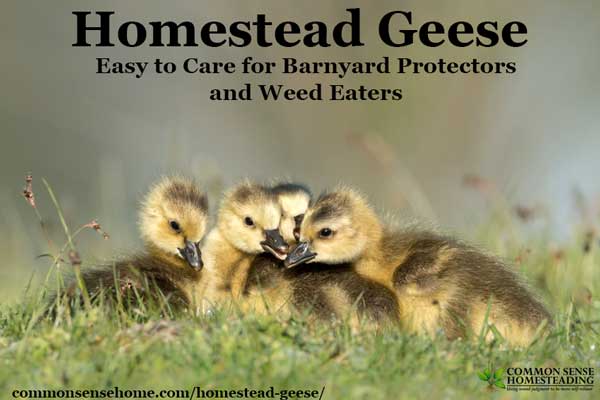
As for food, they are big time grazers and spend most of their time walking around and nibbling on greens with a few bites of chicken food mixed in. During the winter, we’ve been feeding ours a free choice mix of field peas, black oil sunflower seeds, oats and cracked corn. When they were goslings, we had them on a chick starter crumble, and fed LOTS of green grass while they were confined to the brooder. They would devour that grass faster than you can imagine!!
Can You Free Range Geese with Your Chickens?
Yep! Ours do, and the only big warning I’ll provide is making sure your chickens have a safe area for water. The geese tend to be bucket hoarders and won’t let the chickens in to drink. Bullies!
Aren’t Geese Aggressive?
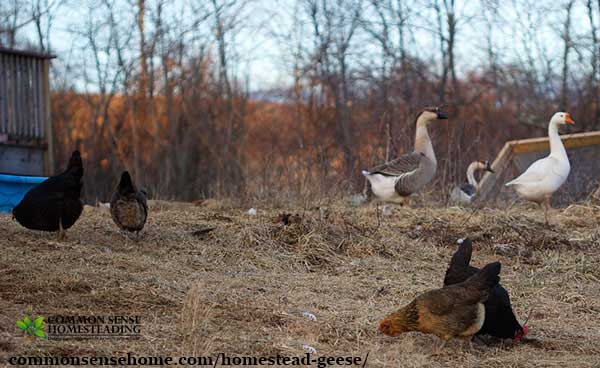
That is dependent on breed, gender and whether it’s breeding season or they have a nest nearby. Two of the breeds we own are commonly known as the most aggressive, and with the exception of a minor goose pinch to the UPS driver that didn’t obey their honk warnings, we haven’t had any incidents. They tolerate the chickens (but protect them), and they’ll chase our cats/dogs if they come too close to the geese. I prefer to say they have a pretty wide personal space bubble, rather than being “aggressive”!
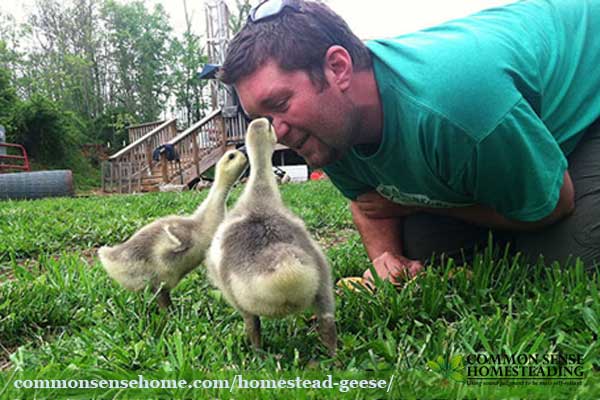
But that said, I’ve worked really hard socializing them from a young age with the cats, dogs, kids, adults and so on. They love to follow me around when I’m doing chores and nibble on my clothing or jacket if I stay still long enough. It’s both endearing and annoying, depending on what you’re doing!
Editor’s note: I had a pair of pet geese one summer as a teenager. They hatched out late and were raised separately until they grew large enough to join the main flock. They were named Tweedledee and Tweedledum, and they followed me everywhere!
More Information About Homestead Geese
I’ve found The Small-Scale Poultry Flock by Harvey Ussery a great resource for geese and all backyard flock questions. Other good resources include:
- Domestic Geese
- Keeping Geese: Breeds and Management
- Choosing and Keeping Ducks and Geese: A Beginner’s Guide
I will warn you that geese are QUITE loud, varying by breed, and messy. If those things bother you, it’s possible geese aren’t for you. But if all else fails, you’ve just raised up a Christmas goose for roasting, right?
This is a guest post by Erin Baker of Blue Yurt Farms. She writes about “all things related to responsible travel, country living, healthy eating, homesteads, and farm living in general“.
Don’t miss the rest of the posts in our Homesteading series, including:
- Duck Pest Control – Working with Ducks in the Garden
- 7 Best Chicken Tips for First Time Chicken Owners
- Best Laying Hens – Fro Beginners, White Eggs, Brown Eggs
- Getting Started with Homestead Goats
- Rabbit Breeds, Basic Rabbit Care and Interesting Rabbit Facts
Originally published in 2014, updated in 2017.
Hi, I find your site fun & very informative! I live in Minnesota & I’m the proud owner of 2 baby geese. They are almost a month old & I have them currently in a pen with 10 baby chickens that are about 2 weeks older than the geese. I prefer to free range the chickens & geese but several years ago when I had just chickens they were slowly picked off by predictors. We have a lot of racoons around but the main problem were hawks & eagles. I don’t plan to free range the chickens this time but their pen is way too small for the geese once they’re fully grown & even before that now that I see how fast they’re growing! Although I’m in the pen with them daily while I clean it & feed them, they stick pretty close to their chicken buddies. I handle the geese daily & take them to a small fenced in area outside where I have a small pool for them but they still seem to be afraid of me. Do I need to handle them a lot more to ensure they don’t get aggressive? I need to eventually free range the geese during the day but not sure how to start doing that. If they’re not fenced in do geese typically stay around the farm or the area of their shelter? They are just starting to get their feathers & I have no idea what kind they are or their gender. Is there usually problems if they turn out to be both male or both female? I know, so many questions! But I appreciate any knowledge or information you would be willing to share. Thank you!
It sounds like the geese may have imprinted on the chickens rather than on you. The only times we had geese that were more affectionate and less skittish is when they were raised in the house for several weeks (oddball hatchings) and imprinted more strongly on humans.
If there’s a special treat they like, you may want to work with them like we did for our duck flock, with a whistle to signal that it’s treat time and they should come in. More on the duck training here – https://commonsensehome.com/duck-pest-control/
Back on the farm, the geese tended to stay around the yard. There was a small pond, and sometimes they would try and stay in the pond overnight and it was my job to go in after them and get them out.
We never tried training them back on the farm because the bulk of the flock was harvested for meat each year.
They should get along with just two, but anything is possible.
Our goose is sitting on eggs but were not sure what to do when they hatch because we dont want to take them away from her. So is it possible to let her keep them without giving them extra food other than grass??
It’s best to have her regular food and water somewhere nearby so she can leave the nest for short periods of time to get a bite to eat and drink as needed.
I have purchased a pair of geese to put with my pygmy goats. Living in west Texas grass is not something we have. What else can I use to replace grass for them?
Geese will eat a variety of plants other than grass. See if you can find another local with geese, and see what they grow for their flocks.
I’ve read that Emdens can be aggressive toward other geese breeds? Yet I see you mention you had a chinese and emden goose? Those are the two breeds I’m most interested in and wonder if they would both get along together?
We had Emden and Chinese together in the barnyard with no issues.
I am planning to plant some trees, evergreen plugs, and was wondering if i could use geese to keep the weeds and grass down in the new shelter belt?
I’m sure they would help some. They’re not as reliable as a mower, and heavy grazers like sheep would clear more thoroughly, but the geese won’t eat your evergreens. I’ve never seen any stats on recommended stocking level for weed control. I’m sure it varies dramatically depending on the forage, the geese and other factors.
I have read in books to use somewhere around 7 geese per acre for orchards.
I would imagine it depends on the geese and the orchard, but that seems like a reasonable place to start.
I have a story I want to tell and you all can make of it whatever you wish and maybe add a comment about it with your own theories. My dad had about a dozen geese that he loved when I was a young man on our farm (1960’s). The geese were always around the farm area and never left. The day came when my dad died and I noticed that the geese would not stay in the yard anymore. They would travel to the far end of the farm (640 acres) until they met a fence and would stay there until I went and got them back. I did this several times and quickly got tired of doing it. I mentioned to my wife how strange it was for them to do that because they had never done that before. Why it didn’t occur to me is anybody’s guess, but my wife pointed out to me that they left the week that my dad died. I never could keep them around anymore and eventually the predators got them all. Anything to it? I don’t know but I can’t think of any other reason that caused this change with the geese.
Geese are smart, and they form attachments. They can also live quite long. Mom used to raise them for meat, but I don’t think I could do it.
Glad I found this page, some real good stuff
My situation completely different moving onto 3 acres in Philippines, so no winter weather issues.
I plan on geese, dogs, goats, rabbits and pigs (2 of each) and a dozen hens.
Good idea to get dogs & geese at the same time so they grow and know each other?
The area is getting more gentrified – nearest neighbours are 3-4 hundred yards away – do geese honking sounds carry very far? have your neighbours complained?
Predators I need to be wary of are water monitors and pythons, I hope 1″ mesh on 4′ fencing will keep them at bay
Geese can honk quite loudly, so you may want to make peace with your neighbors and make sure they are okay with your planned animals, or at least that you don’t violate any local zoning laws.
Any dogs kept on the homestead with livestock of any sort must be well trained. It doesn’t matter specifically when either the dog or other animals are introduced, but you must work with your dog to establish that your animals are not to be chased for “play” or treated as food. Dogs can very quickly decimate a flock of chickens and seriously injure larger animals.
As for keeping out the snakes and water monitors, I’d check with neighbors who keep animals and see what they found to work best. Hopefully that will save you time, money and missing animals.
Area we have the property is former agricultural becoming residential – we don’t need np stinkin zoning laws here.
Most neighbours have goats, pigs and chickens and cows……chickens are left to run free mostly so doubt predators will be much of an issue, although my brother caught and killed a 10′ python on one of our other lots but that lot was waaay more remote and up in the hills…..I have seen a couple of 4-5′ water monitors about 3 miles away, nearer water.
When I was growing up in England we had a couple of dozen chickens in a pen in the backyard and a bulldog…Bill was introduced to them as a pup and would chase them, eventually one of them would turn and give him a peck on the nose = that meant end of the chase. Sadly he began to break into neighbours chicken runs and chase theirs…..they didn’t realise it was only play and chase them until they collapsed and died……that was the end for Bill in our village
I used to live near someone who kept peacocks and we could hear them a couple of hundred yards away….no-one complained,,,,noise was mitigated by the trains at the back of the house and their horns (there was a level crossing 1/2 mile away)
There’s a new international airport being built about a mile away…….:)
amazing what you get used to over time
Here in the States, there are a lot of restrictions as to what can and can’t be on a property. I figured it might not be a concern in your area, but didn’t want to assume.
In my experience, where you have livestock, there’s always something looking for a free meal – whether it’s wildlife or humans. Free range for some animals during the day may be fine, but at night, I like my crew locked up in a sturdy shed.
Sounds like the noise should be a non-issue, given the level of existing background noise.
On the dogs – I personally would never, never allow a dog to chase poultry – at all – even as a puppy. It sets a bad precedent. To them, it’s a fun game they really like to play. This is asking for trouble. Back on the farm, we firmly established that poultry were off limits. The dogs were trained to help herd the larger animals.
I previously posted about my raccoon problem and this is an update and reply to Leslie’s loss. At the time of my previous posting, I had gotten 30 raccoons. Believe it or not, I am now up to 95 as of a few days ago (six months of trapping them). Since it is now winter, I only catch them when a warm night happens. All of my raccoons have been trapped within a 1/4 mile radius from the geese. I have not lost a goose for a long time now but I am sure I will have to keep trapping almost year round. As far as there being signs of the attack on a goose, I sometimes saw it around, but most times not. I think they grab them and take them away most of the time. In the 60’s, we had a lot of pheasants around and now you can’t find any and those that try to introduce them, fail every time. I believe it’s because of the rampant raccoon problem. They hunt the fence lines and grassy areas where pheasants stay and get their eggs and their young. I don’t believe the Game & Fish Department puts enough emphasis on factoring in raccoons for the lack of pheasants.
Thanks for sharing your experience, Ed.
Ed,
We live in upstate New York and also have raccoons, but not nearly as many as you have. Our DEC is supposed to take them and rehome them, but they’re always “too busy.” If you trap them and then release them within a quarter mile of where you trapped them, they’ll return. If you release them further away, they’re unable to fend for themselves and they die. NY state law prevents us from killing them. It’s frustrating, to say the least.
What do you do with them, if you don’t mind me asking?
Sorry, Robynne, I didn’t notice your question until tonight. In South Dakota they are considered a predator so we can trap them any time they are a nuisance and destroy them. I am not sure why you say that taking them farther away than a quarter of a mile from you would cause them to die. Raccoons are very adaptable and would have no problem living anywhere you take them, unless you are talking about very young raccoons. Then they might have a problem without their mothers nursing them. Otherwise, I am sure they would be ok. Only problem would be giving someone else the headache.