
Homemade Ground Beef Jerky Recipe (For Dehydrator or Oven)

This post may contain affiliate links. Read my full disclosure here.
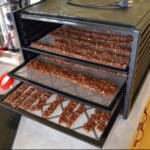
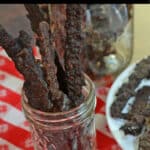
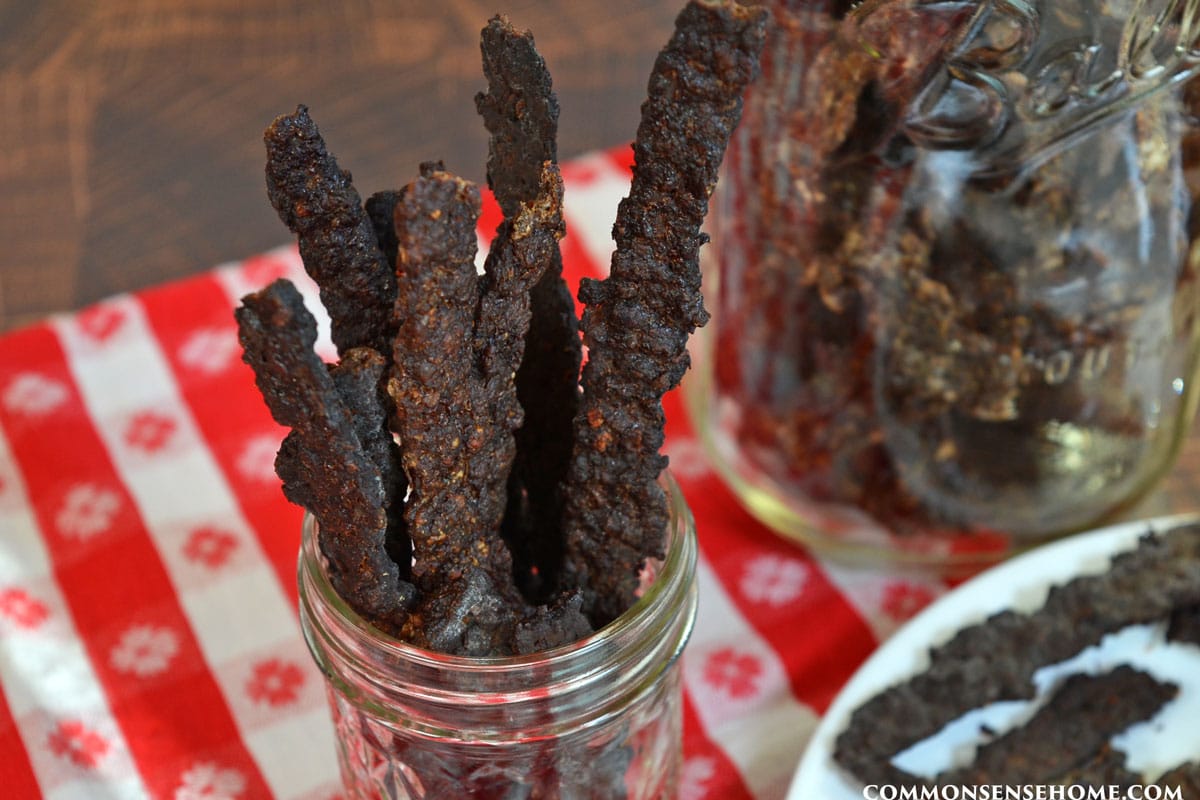
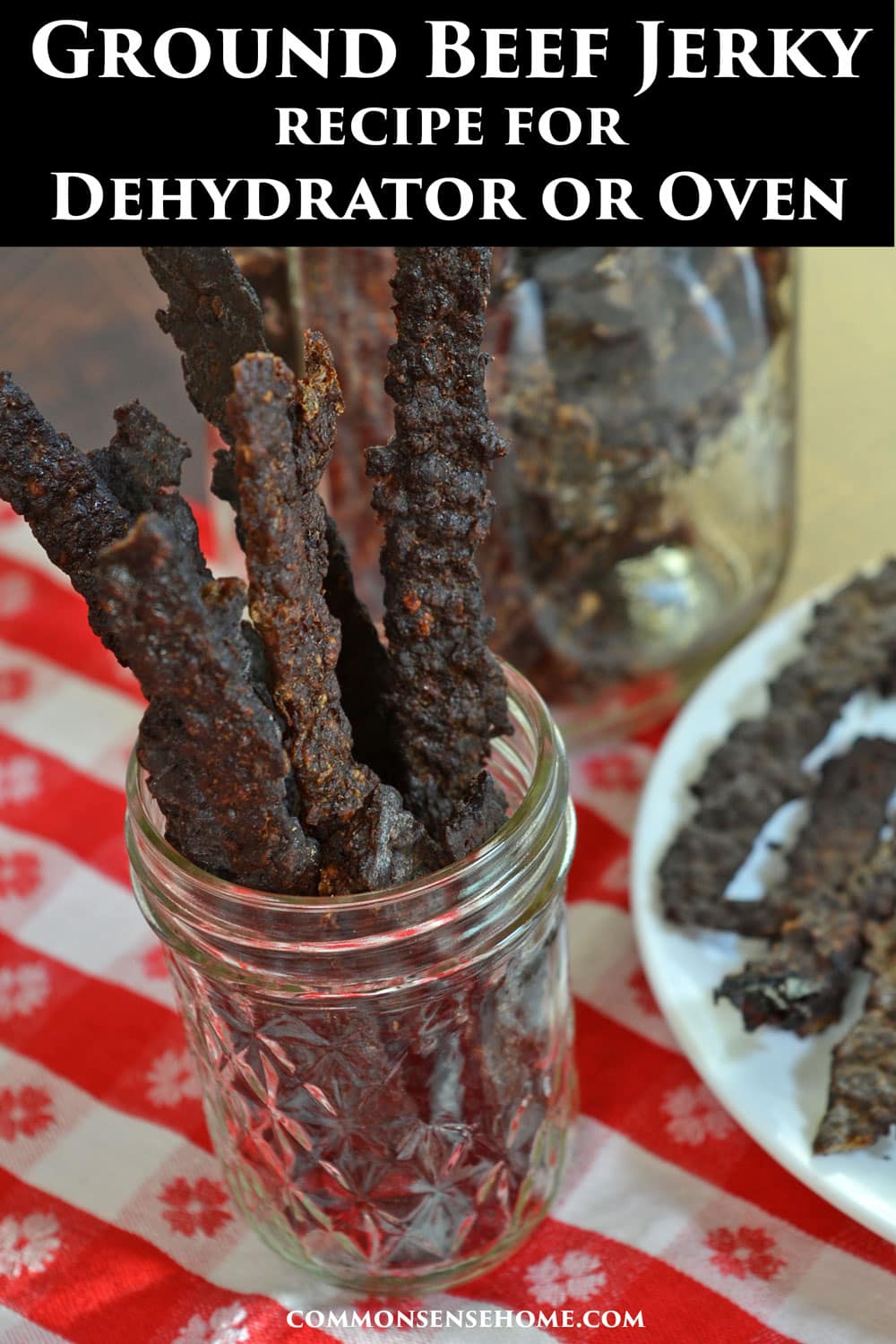
Ground beef jerky is easy to make and less expensive than store-bought jerky. You can make it with a dehydrator or dry it in the oven. Use your choice of ground meat – lean beef or venison – whichever you have available.
Would you like to save this?
My jerky gun came with seasoning and cure packets. Unfortunately, these were full of ingredients I’m trying to avoid in commercial jerkies (MSG, hydrolyzed soy protein, nitrates, etc.). (Those little packets are expensive, too, if you purchase them separately.)
This recipe uses soy sauce and sea salt for preserving instead of curing salt. It doesn’t contain nitrites or nitrates.
Do you need a jerky gun to make jerky with ground beef? Nope! You can make jerky without a dehydrator or a jerky gun, but the jerky gun is handy and entertaining.
We have a basic Nesco jerky gun. For those who want to make big batches of jerky, try the LEM jerky cannon.
Why Use Ground Beef for Homemade Jerky Instead of Beef Strips?
I prefer ground beef jerky for three main reasons:
- It’s cheaper. I can get ground beef or venison much cheaper than a roast.
- It’s easier to make. Working the jerky gun or rolling the meat out thinly goes quickly. Wrestling to cut strips out of a piece of meat with bone and connective tissue intact is tough.
- It’s easier to chew. Eating a piece of regular muscle jerky can sometimes be like chewing on an old shoe, especially when there’s a lot of connective tissue. Ground beef jerky has the meaty, salty jerky taste we love, without getting stuck in your teeth.
This recipe is adapted from Mary Bell’s Complete Dehydrator Cookbook – “All American Marinated Beef Jerky”. Mary makes hers with beef strips, but it worked well as a ground beef jerky recipe, too.
How to Reduce Sodium in Beef Jerky
For the soy sauce, I prefer grain free organic tamari. Most US non-organic soy is genetically modified, and may have glyphosate residue. Non-organic wheat may be sprayed with glyphosate prior to harvest.
I use San-J, which has 940 mg of sodium per tablespoon. In comparison, La Choy has 1330 mg. A tablespoon of regular table salt has 6976 mg of sodium(2325 mg per teaspoon).
If you use a saltier soy sauce, it’s easy to overdo the salt in the recipe. Stick with a soy sauce that has less sodium. If you want to skip the teaspoon of sea salt, store the finished jerky in the fridge or freezer. Salt is a preservative.
If your finished jerky is still too salty, you can soak it for 15-20 minutes to remove surface salt, then dry it again. Store the de-salted jerky in the refrigerator or freezer. Another option is to use the salty jerky for flavoring another dish, so the saltiness is diluted.
Homemade Ground Beef Jerky Recipe
Ingredients
- 1/2 cup soy sauce
- 1 teaspoon liquid smoke
- 1/2 teaspoon onion powder
- 1/2 teaspoon garlic powder or 1 teaspoon minced garlic
- 1 teaspoon sea salt
- 1 pound lean ground beef or venison, at least 93% lean
Directions
In a glass bowl, combine all ingredients and let sit (refrigerated) for at least two hours. I mixed this up at bedtime and let it sit until after lunch the next day, and it wasn’t too strong.
Load the mixture in the jerky gun and use the gun to load your dehydrator trays. I do recommend using the mesh inserts or fruit leather trays for your dehydrator. This mixture is fairly soft because of the liquid ingredients, which makes it easier to fire through the gun.
If you don’t have a jerky gun, use a rolling pin to roll the mixture out very thinly (1/8 inch thick). Score lines to form long strips of jerky.
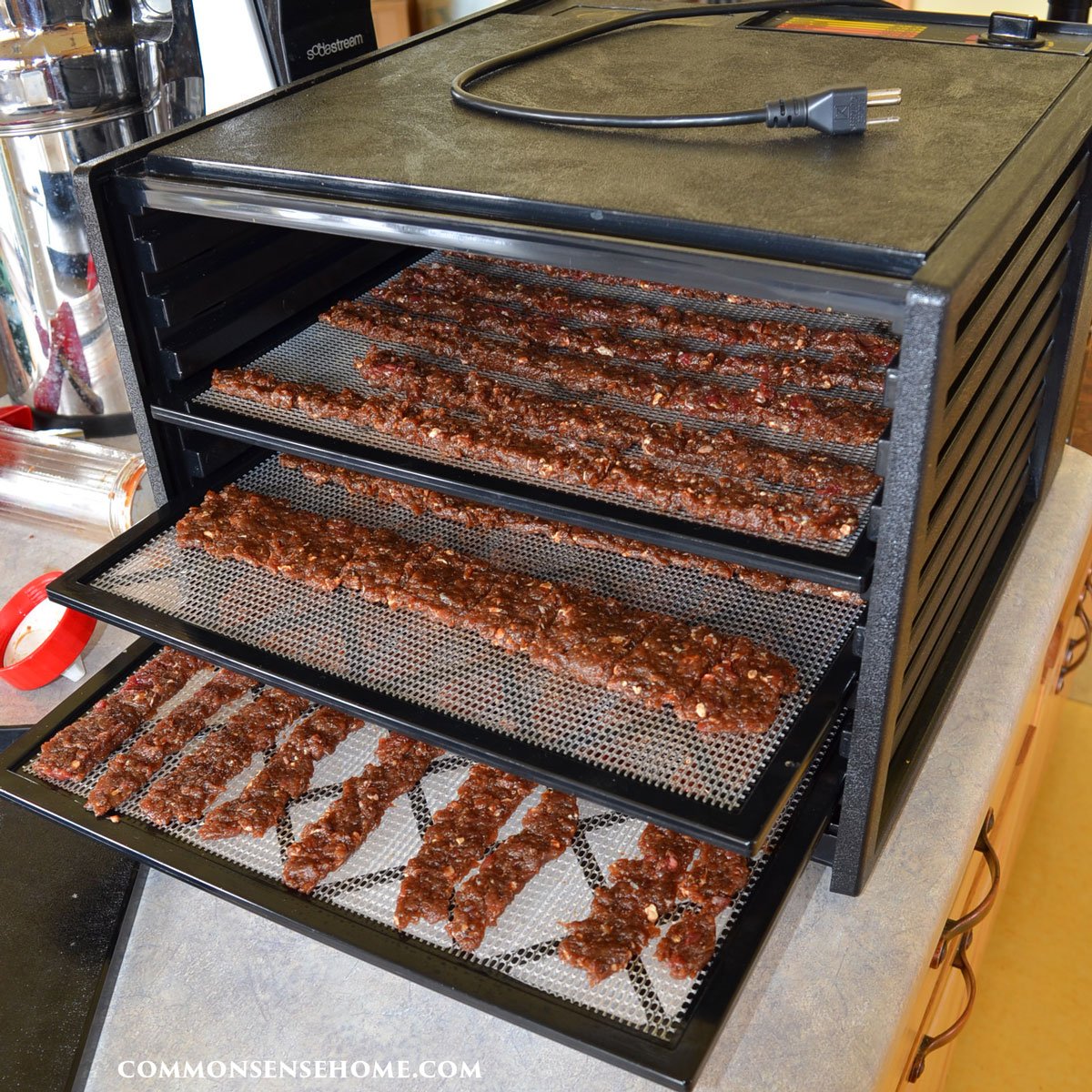
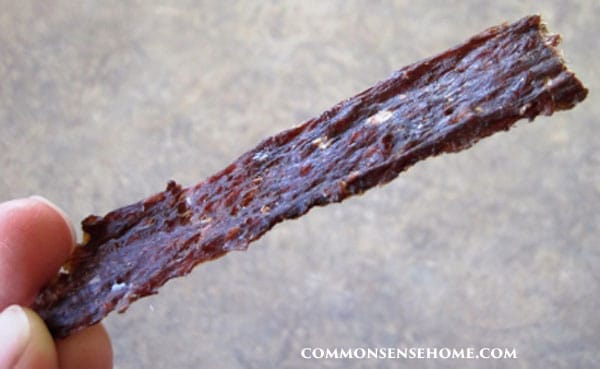
Dry at 145° – 165°F (63° – 74° C) for 4 to 12 hours. The jerky should be hard but still flexible and contain no pockets of moisture. For extra safety, heat finished jerky in a 275° F (135° C) oven for 10 minutes.
Jerky will last in an airtight container at room temperature for 1 – 2 months. For longer storage, place in an airtight container in the refrigerator or freezer. Vacuum sealing extends shelf life.
How Much Homemade Jerky Do You Get from One Pound of Raw Meat?
The weight of the jerky decreases by about two-thirds during the drying time. So for every pound of raw meat you use, you’ll get around one-third pound of finished homemade jerky.
How Can I Be Sure My Jerky is Safe to Eat?
The University of Wisconsin suggests the following two options for safe jerky making at home:
- Dry meat at 145° – 155°F for at least 4 hours followed by heating in a preheated 275°F oven for 10 minutes. Drying meat at a temperature below 145°F produces a product that looks done before it is heated enough to destroy pathogens, and before it has lost enough moisture to be shelf-stable.
Only a few dehydrators currently on the market will maintain the necessary temperature of 145° – 155°F. The Gardenmaster by Nesco/American Harvest and the Excalibur are two such units.
Each of these units has a large heating element, strong air flow, and adjustable temperature setting. Dry for at least 4 hours (6 hours is preferable) and remove jerky from the dehydrator.
Place dried strips on a baking sheet, close together but not touching or overlapping. Heat in a pre-heated 275°F oven for 10 minutes to an internal temperature of 160°F. Strips thicker than ¼” (when raw) may require longer to reach 160°F.
In our research, strips removed from the oven were sizzling hot. Remove oven-heated samples from the oven, cool to room temperature, and package. Always include the post‐drying oven‐heating treatment as a safety precaution.
- Steam or roast meat strips in marinade to an internal temperature of 160°F before drying. Heat poultry to 165°F (internal temperature) before drying. The USDA Meat and Poultry Hotline currently recommends this method for making safe jerky.
The pre‐heating step assures that any bacteria present will be destroyed before drying. This allows a lower dehydrator temperature (130° to 140°F) to be used. After boiling, dehydrate meat for 4 to 6 hours. No post-dehydration oven-heating is necessary.
Since it can be impossible to accurately measure the internal temperature of a thin strip of meat, consumers can boil meat in marinade (or water) for 5 minutes before drying. Unfortunately, this USDA recommended method produces a dried, crumbly product. It would be judged inferior by Wisconsin standards for chewy, flexible jerky.
Holding meat above 145°F for over an hour pasteurizes the meat. Pathogens start dying at temperatures above 130°F, but the lower the temp, the longer they take to kill.
We get our beef or venison from a single animal, so I use the dehydrator above 145°F and call it good. If you had ground beef from unknown animals, I’d suggest some time in the oven to finish it.
Do I Need a Dehydrator to Make Jerky?
It’s possible to make jerky without a dehydrator. Here’s how to make jerky in the oven.
Roll out the jerky on a piece of parchment paper and place it on a baking sheet (or use a jerky gun). Dry the homemade jerky at your oven’s lowest temperature with the door slightly open for 2 hours. Our oven’s minimum temperature is 170°F (77°C).
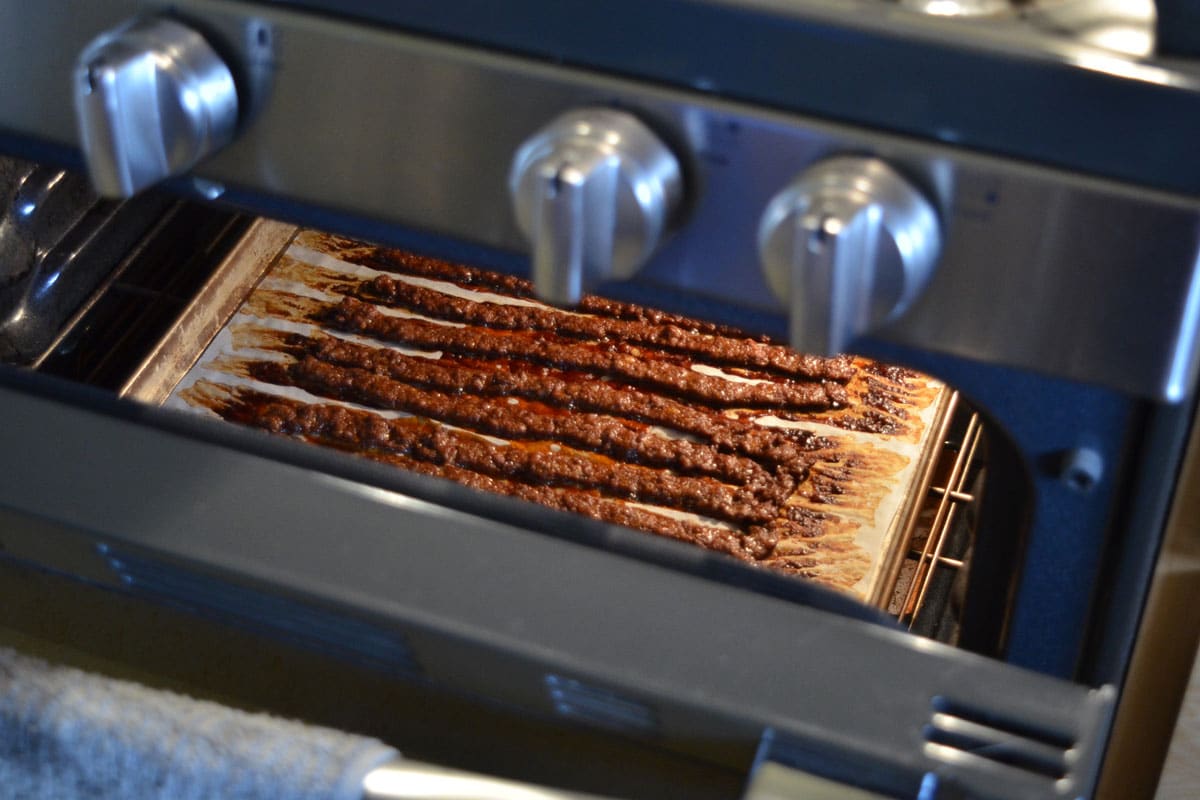
Flip the jerky and rotate the baking sheet. Bake for 1-2 hours more, until jerky is dry but flexible. Oven drying jerky shrinks it up faster and plumper, and creates more of a salty crust.
Using the Excalibur Dehydrator and Jerky Gun
With the Excalibur dehydrator, a batch of jerky is done in about 4-6 hours, depending on the humidity level. Drying overnight gets the jerky a little too dry for my taste. It’s still good, but a little too crumbly.
The last time we made jerky, my eldest mixed up the jerky marinade and meat the evening before drying. My youngest loaded up the Excalibur the next morning.
Make sure to pack the ground meat tightly into the tube to avoid air pockets. The jerky gun shoots strips about an inch wide when you use the “double barrel” attachment. The gun also has option of a single wide strip or a tube shape.
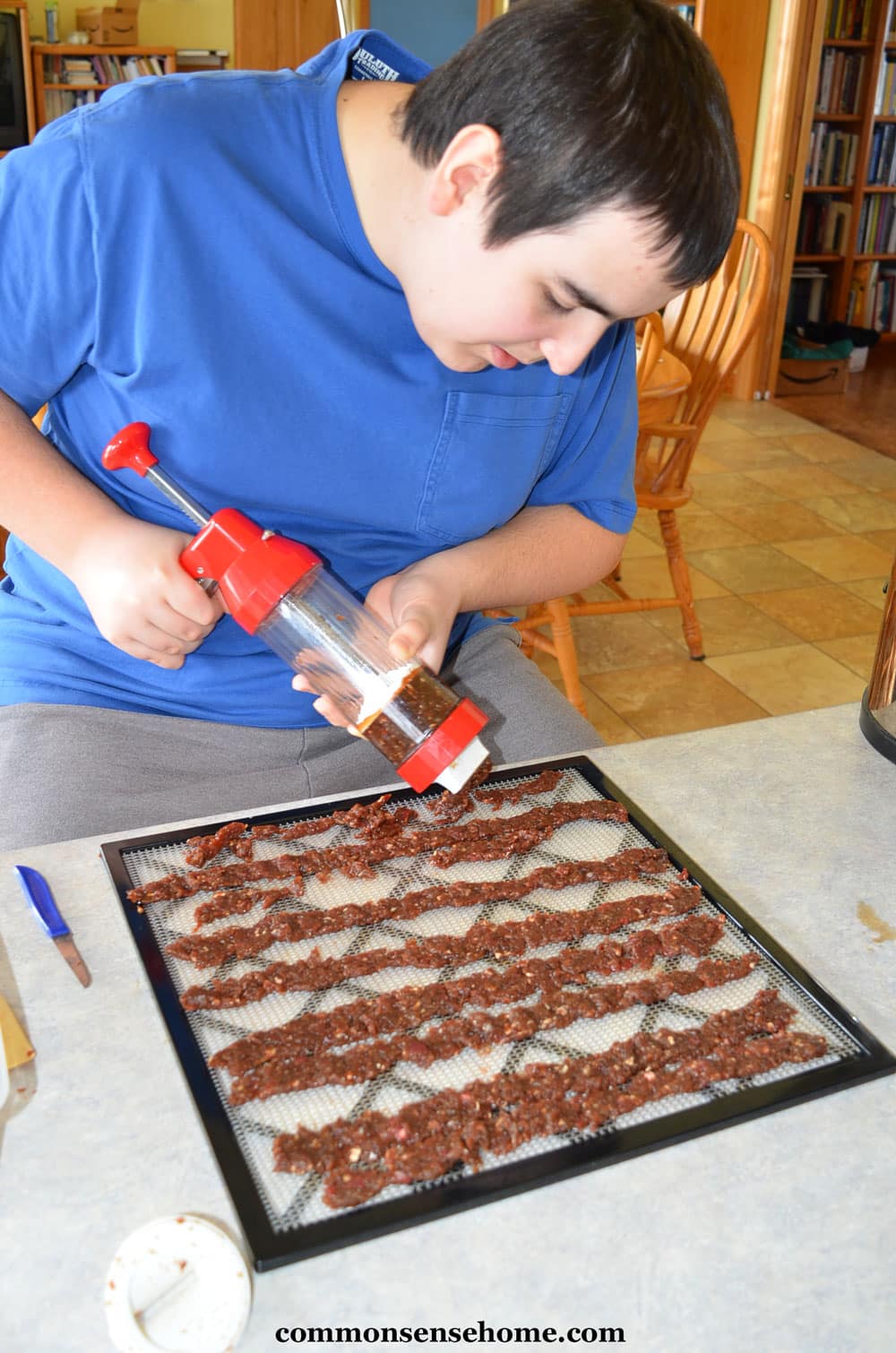
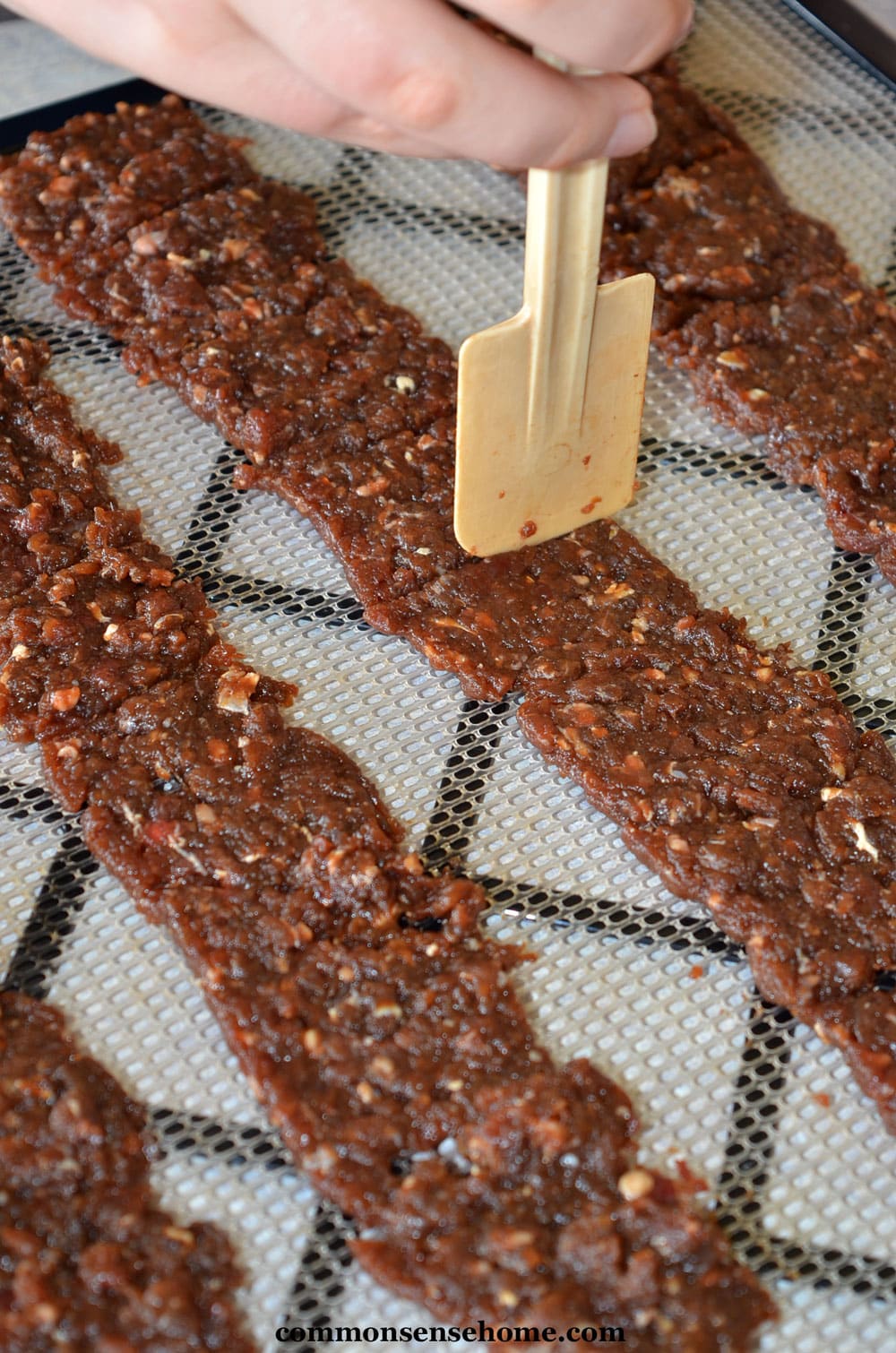
We made wide strips and scored them with a thin spatula. This makes them easier to break apart once dry. (You can use this same scoring technique for jerky made with a rolling pin.)
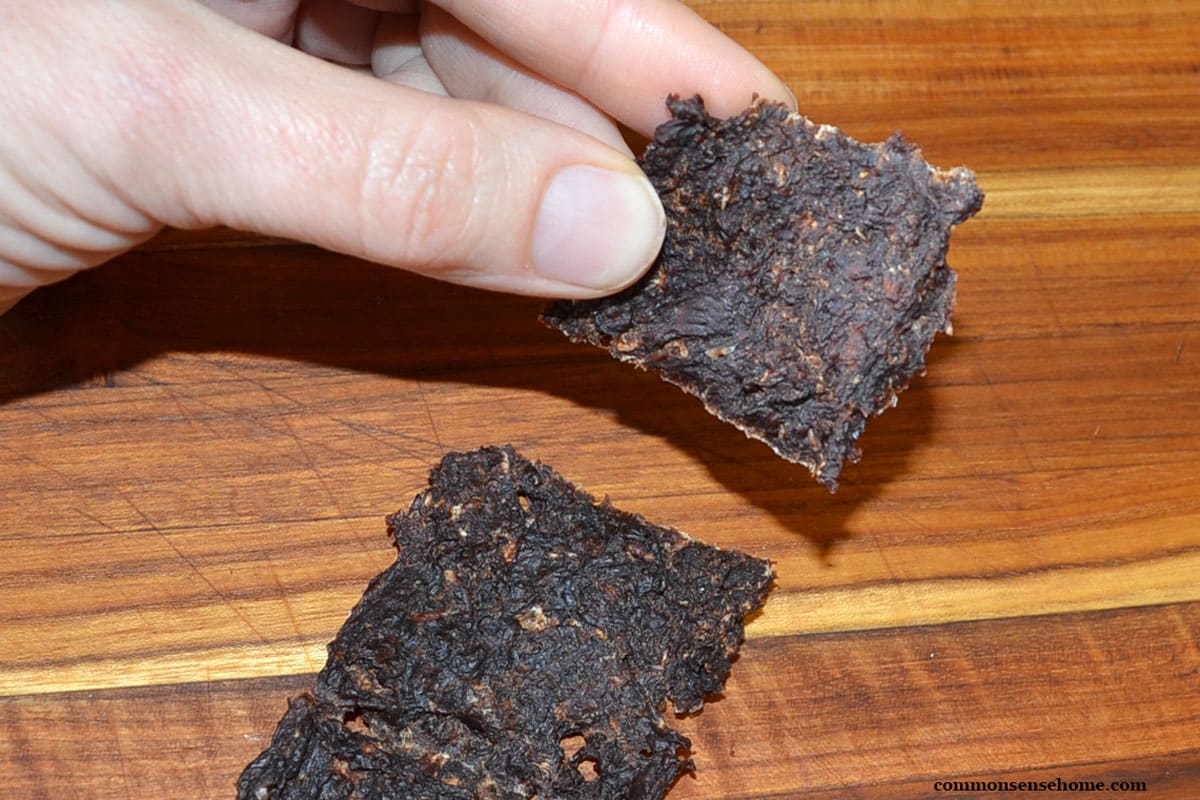
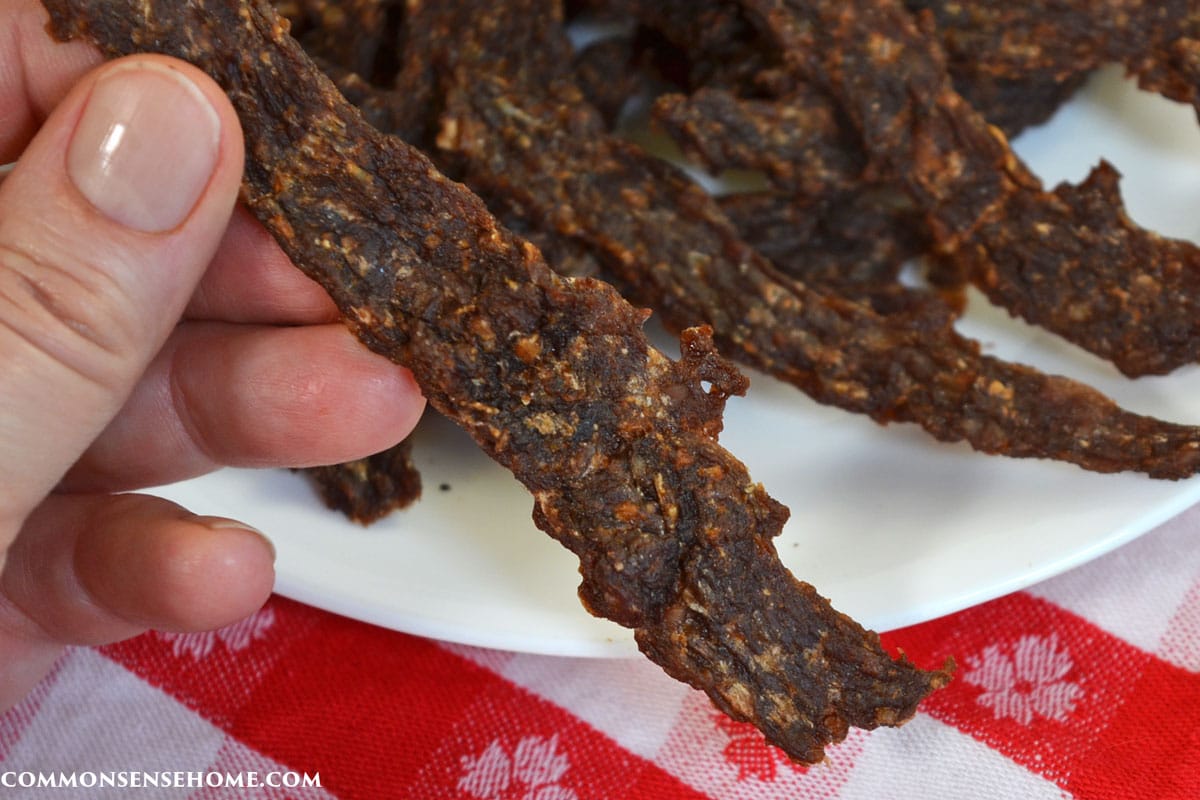
This has become one of my favorite snack foods since we’ve been working to reduce our carbohydrate and grain intake. It’s relatively quick and easy to make, and the gun was pretty inexpensive.

Homemade Jerky without Soy Sauce (Gluten Free, Soy Free Option)
For those who avoid soy and/or gluten, substitute liquid coconut aminos for the soy sauce. Coconut aminos have a similar flavor profile, and are gluten free and soy free.
Beef Jerky Recipe with Ground Beef
Easy and economical jerky recipe that’s great for lean beef or venison.
- Prep Time: 10 minutes
- Drying Time: 4 hours
- Total Time: 4 hours 10 minutes
Ingredients
- 1/2 cup soy sauce
- 1 teaspoon liquid smoke
- 1/2 teaspoon onion powder
- 1/2 teaspoon garlic powder or 1 teaspoon minced garlic
- 1 teaspoon sea salt
- 1 pound lean ground beef or venison, at least 93% lean
Instructions
- In a glass bowl, combine all ingredients and let sit (refrigerated) for at least two hours. I mixed this up at bedtime and let it sit until after lunch the next day, and it wasn’t too strong.
- Load the mixture in the jerky gun and use the gun to load your dehydrator trays. I do recommend using the mesh inserts or fruit leather trays for your dehydrator. This mixture is fairly soft because of the added liquid, which makes it easier to fire through the gun.
- If you don’t have a jerky gun, roll the mixture out very thinly (1/8 inch thick) and score lines where you would like the pieces to break apart.
- Dry at 145° – 165° F (63° – 74° C) for 4 to 12 hours, until jerky is hard but still flexible and contains no pockets of moisture. For extra safety, heat finished jerky in a 275° F (135° C) oven for 10 minutes.
For oven drying:
Roll out the jerky on a piece of parchment paper and place it on a baking sheet (or use a jerky gun). Dry the homemade jerky at your oven’s lowest temperature with the door slightly open for 2 hours. Our oven’s minimum temperature is 170°F (77°C).
Flip the jerky and rotate the baking sheet. Bake for 1-2 hours more, until jerky is dry but flexible. Oven drying jerky shrinks it up faster and plumper, and creates more of a salty crust.
Notes
Jerky will last in an airtight container at room temperature for 1 – 2 months. For longer storage, place in an airtight container in the refrigerator or freezer. Vacuum sealing extends shelf life.
Do you have a favorite jerky recipe? Have you tried making jerky with ground beef? Has anyone tried making jerky out of organ meats? I’d love to hear from you.
Recommended Dehydrators
- Nesco Gardenmaster Dehydrator
- 9 Tray Excalibur Dehydrator – This is the unit we have.
More Snack Recipes
More Food Storage
Home Food Drying – 6 Things you Need to Know
Food to Stock Up On (For Daily Use or Emergencies)
Dehydrator vs Freeze Dryer – What’s the Difference?

This article is written by Laurie Neverman. Laurie grew up in the kitchen, learning baking and home cooking from her momma. At age 15, she and her mom and two sisters created Irene’s Custom Cakes & Catering, which was her summer job through most of high school and college.
Last updated in 2024.
If you wanted to run a full dehydrator, would you need to rotate the trays (using an Excalibur)?
Because of the high powered fan being located perpendicular to the drying surfaces, Excaliburs tend to dry fairly evenly, but it certainly wouldn’t hurt anything to rotate midway through drying. That would give you a chance to check everything, flip strips if you like, and possibly remove of rotate out to the edges any strips that are much thinner than the average strip.
Is the Soy sauce only for flavor? Or necessary for preservation? I prefer to stay away from soy at all.
It’s primarily for flavor, but does aid in preservation due to the salt content. If you need/want to avoid soy, I’d suggest substituting coconut liquid aminos, such as Better Body Foods Organic Coconut Aminos. Coconut aminos are commonly used as a soy sauce replacement and have a similar flavor profile.
I have a Cabela’s dehydrator. I love it, right down to the quality of the build compared to every other dehydrator I’ve owned. And I’ve owned about every dehydrator you could buy, including the Excalibur.
I live in farm country (apples, cherries and row crops) and, until I got my freeze dryer, it got a LOT of use. For example, I’d dehydrate apples by the apple box (40 pounds).
NOW, the down side. When it comes to jerky, the high end Cabela units fall short. They do not get hot enough to make jerky. As such, it’s off to the convection oven or air fryer that have settings just for this use.
Thanks for letting me know. I haven’t worked with their dehydrators.
I found a comment on a page discussing the Cabela dehydrator (https://www.youtube.com/watch?v=9By_L1i9BnU). It and other comments on that YouTube page cast a whole different light on the matter:
“You need to talk to a food scientist…seriously…and yes, that’s an actual title. Foodborne pathogens DO NOT require 160F to effectively pasteurize them, including Escherichia coli O157:H7…the bad one. To be perfectly clear, an efffective pasteurization of E. coli as defined by the USDA means a 7 D reduction in pathogens, or killing of 99.99999% of the organisms. There are multiple ways to make this happen. You can do it in under a second at 160F(it is actually 158F but that’s hard to read on a 1” diameter dial thermometer), …OR… you can MAINTAIN an internal temperature of 145F for 3 minutes and get the EXACT SAME REDUCTION OF ORGANISMS. This is for uncured, 70% lean ground beef without pH modifiers. If you reduce the fat % or add acid, the times are even SHORTER, but not by much! This is scientific data and these are facts published by the USDA. It is called the thermal death-curve or thermal inactivation rate and it is slightly different for each pathogen. For the most part, E coli and Salmonella are the worst offenders, and when we’ve killed enough of those, we’ve killed enough of everything else. I could give you hundreds of reference documents that would take hours to read, or you could do a quick google search for “Temperature and Time Requirements for Food UMN” and click on the first item that comes up from University of Minnesota Extension. You will see 155F for 15 sec, or 150 for 1 min or 145 for 3 minutes for ground meats.
Why do we see USDA recommendations of 160F? That 160F temperature is for the masses…the general population…with an IQ range of 50 to 150. You try explaining a time vs temperature pasteurization curve for a 7 D reduction of E. coli or 6.5 D reduction of Salmonella to the 16 year-old burger-flipper at Mickey D’s or the Waffle Hut over on State Rt 47 and see how successful you are!!
I understand what I have told you goes against everything you’ve ever been taught regarding food safety, but I assure you it is true and accurate and food processing facilities around the world count on the effectiveness of those time vs temp values.
So…you were at 145F or higher for HOW LONG? Hours?!?!! Dude, your beef-jerky is INCREDIBLY safe to eat!!!!”
Actually, we discuss pasteurization elsewhere in the comments, but as you note, both the “official” dogma and some concerned persons want extra protection.
Bacteria also needs free water to multiply. Salt binds up water.
Unfortunately, in these limited page formats, nothing readily appears to point us in those directions [educating us on the details].
Accordingly, it would seem elaboration, even on elsewhere touched upon topics, would be in the best interests of those landing on these pages.
Meanwhile, I just became a fan of low fat hamburger jerky.
AN IMPORTANT UPDATE: The Cabelas may not get as hot as many dehydrators, but will do jerky just fine, if you add time to your run.
I, since the initial post, researched the sites that address food safety, including dehydrating meats. UNFORTUNATELY, these sites are written in simple terms and bury critical details well down in their documents.
If you read enough, it turns out the recommended 160-degrees Fahrenheit is far from the magic number to insure safe, quality product from your chosen device used for dehydrating, because that number changes with time. Literally.
For example, just as you can turn the heat down in a smoker and safely cook meat, you can do the same with your dehydrator, by adding more time. Often, that time does not increase greatly.
So, for example, and I am just making these numbers up, you could cook your jerky at 150, but might have to cook it up to an hour longer. That’s not a big deal in the scheme of things.
In short, it’s worthwhile to look into the matter, because the difference between using your [within reason] lower temp dehydrator may just be a matter of cooking longer.
Hi Kelly.
I don’t know if you looked at the article as it is currently, but I did add the note: “Holding meat above 145°F for over an hour pasteurizes the meat. Pathogens start dying at temperatures above 130°F, but the lower the temp, the longer they take to kill.”
I have to include the official current guidelines, but salt binds up water that bacteria need to breed, and I’m quite sure that folks in the past didn’t have precise temperature control. I do recommend single source beef from a trusted source, if at all possible. Some ground meat in the grocery store is of very questionable quality. Improper drying would be asking for trouble.
This is a recipe I have wanted to try for a long time and just completed a large batch. We dehydrated the jerky in an Excalibur unit at 150 degrees for 6 hours and then baked it for 10 – 15 minutes in the oven at the 275. While it tastes GREAT, my jerky seems to be a bit greasy even though we used lean ground beef. Like had to wipe off the grease, greasy.
Is that normal or did I not hydrate it long enough? Also, I have stored the jerky in Mylar bags with a food grade oxygen absorbing packet. In your opinion, is that safe enough to store on the shelf for a few months or should we take extra precautions based on the above?
Thank you for your website and sharing your knowledge. Having lots of fun being a better steward of our home and lands!
Extra time in the dehydrator or oven won’t make meat less greasy, so you didn’t do anything wrong there.
The jerky is plenty salty, so with the Mylar and the O2 absorber, it should be shelf stable for a short time. Oxygen is what causes rancidity when it interacts with the fat, so the airtight packaging in combination with the O2 absorber should take care of that. If you have extra freezer or fridge space, that’s great, but it should be okay. I’ve noticed with longer storage in Mylar that meat with any fat tends to pick up a hint of metallic flavor. Edible, but not as tasty.
When you say “lean”, how lean? I’ve gotten used to using grassfed beef or ground venison. Both of these can be cooked for other recipes and I don’t need to pour off excess fat. If the beef you’re using would require that you pour off excess fat if you browned it, then it would make sense that the jerky would also have some excess fat.
Thank you for your kind words. We’re feeling the stress of all the crazy going on, so it’s much appreciated.
Could you make “jerky” using jarred meat purees? I’ve got lots of extra baby food. Thanks
I think the fine texture of the puree would make jerky with the meat only somewhat unpleasant, but a friend of mine suggested mixing the meat puree with flour until you get a doughy consistency. Roll the dough think and slice with a pizza cutter after dry-frying, then dehydrate to crispy. I don’t think standard jerky proportions for seasonings would work well, so you’d need to experiment.
Thank you
Glyphosate is not a danger to anyone! The very minuscule amount that maybe might possibly be in any food will not harm you! I’ve used it extensively for many many years and have no ill effects from it!
I disagree with you. It was patented as an antibiotic, as as such is destructive to the soil biome, at the very least.
Many of us prefer to error on the side of caution. Especially since no one seems willing to establish a million dollar bond, even if we pay for it, guaranteeing the herbicide is safe. And there is that Roundup has already paid out millions for injuries common to individuals who used the stuff.
While others report developing cancer after long-term exposure to glyphosate. Everyone’s body responds differently to chemicals. Just like with medications or allergens, what doesn’t affect one person can absolutely affect another. 😉 The WHO’s cancer research arm (IARC) classified glyphosate as ‘probably carcinogenic to humans,’ and several large lawsuits have been won by people who developed non-Hodgkin lymphoma after heavy exposure. Dismissing those experiences outright ignores both the science and the people affected.
I just finished 5 lbs of hamburger without the added salt….I thought the salt content of the soy sauce would be adequate…..now I’m worried that my jerky won’t be preserved
Best to keep it in the fridge or freezer for longer storage.
Can Ground turkey be used? Can I replace the sea salt with pink curing salt?
If you want to use turkey, it’s probably best to precook the meat to 165F before drying to eliminate bacteria per USDA guidelines. Yes, you could use pink curing salt, which contains nitrates and nitrites to increase shelf life.
I put the dehydrated jerky ( Not precooked) into a 275 oven for 20 minutes. Texture was perfect.
Thanks for sharing what worked for you.
Has anyone tried using the coconut aminos instead of the soy sauce?
No, but if the sodium content is similar, it should be fine.
Oh Darn! I am so confused! Should I make and dehydrate first then finish cooking in oven to remove “the bad stuff” or should I cook the whole pkg of meat at one time FIRST so temp is 160 then dehydrate? Do I cook it like a meat loaf with all the other ingredients mixed in, then cool and put into the jerky gun?? I’ve made jerky before but always used the pkg mixes…I can’t have MSG, so this looks so good to me, but…I want to be as safe as possible.
If you cook it first, it will not work in a jerky gun. If you’re concerned about possible bacterial contamination, make the jerky, then heat it (pasteurize it) in the oven. Some dehydrators now have higher heat settings, too, so you may be able to bring it up to temp right in your dehydrator.