
Canning Questions Answered – A Great Canning Resource

This post may contain affiliate links. Read my full disclosure here.
As a beginning canner, there are often canning questions that come up that might seem obvious to experienced food preservers, but aren’t so obvious when you’re starting out. I’ve teamed up with some of my blogging friends (Chaya Foedus from Pantry Paratus, Janet Garman from Timber Creek Farm, and Diane Hamilton Coe from Peaceful Acres Farm) to answer over 15 of your home food preservation questions and recommend some great resources. If you don’t find an answer to your question here, feel free to leave a comment below and I’ll do my best to help you out.
Would you like to save this?
How do I get started canning? What do I go to the store and buy?
The post “Getting Started With Home Canning” gives a detailed list of equipment commonly used for canning. The most important piece is the canner. A water bath canner, which is basically a large pot with a rack in the bottom, is the easiest to use and less expensive than a pressure canner.
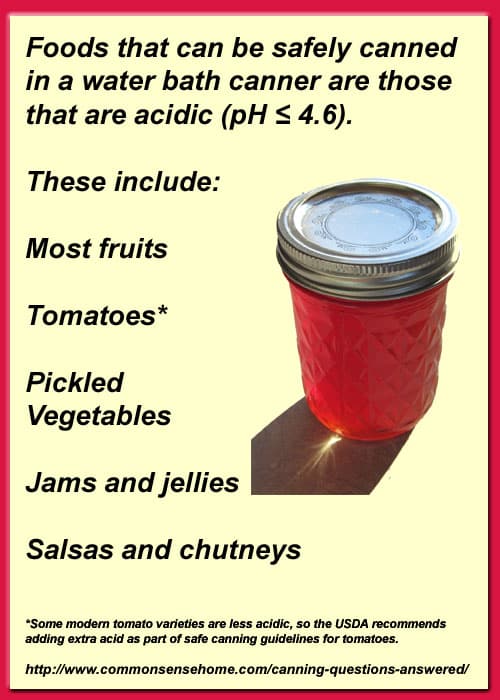
Foods that can be safely canned in a water bath canner are those that are acidic (they have a pH ≤ 4.6). These include:
- Most fruits
- Tomatoes*
- Pickled vegetables (those that are processed with added acid)
- Jams and jellies
- Salsas and chutneys (those recipes that are approved for canning)
*Some modern tomato varieties are less acidic, so the USDA recommends adding extra acid as part of safe canning guidelines for tomatoes.
Along with your canner, you’ll need jars and lids (make sure your jars are free of nicks and chips). A jar lifter, small non-metal spatula, lid lifter, jar funnel and canning ladle are also recommended.
The Getting Started Canning post includes additional items for specific canning projects, like jelly bags, food strainers, kitchen scales and an apple peeler/corer/slicer.
I’m new to canning, but would love to learn. What is the best step-by-step resource?
Diane says, “I personally think Jackie Clay is one of the best experts there is!!! You can find her at Backwoods Home, in the Ask Jackie Online Archives.”
Janet says, “One of my favorites is Sharon at Simply Canning.”
Blue Book Guide to Preserving (by Jarden Home Brands) and Ball Complete Book of Home Preserving are great basic reference guides for canning, freezing and dehydrating, offering step by step instructions for safe food preservation. Preserving with Pomona’s Pectin: The Revolutionary Low-Sugar, High-Flavor Method for Crafting and Canning Jams, Jellies, Conserves, and More is a recently published book by the folks at Pomona’s that’s a great resource for those looking for recipes that are lower in sugar.
Do I have to have a pressure canner, or is water bath adequate for most canning? I want to preserve mainly pickles and tomatoes.
You do not need a pressure canner for tomatoes (although some tomato sauces may require a pressure canner) or high acid pickles. The first few years I canned I only used a water bath canner, and I preserved jams, jellies, fruit, tomatoes and pickles.
What kinds of modifications can you make to a recipe without compromising safety? (For both water bath and pressure canning)
Chaya says, “With water bath canning, it is very dependent upon the acid levels. It is not a good idea to tweak the recipe. The one exception might be adjusting the spices in pickling (some of us like peppercorns, some of us don’t), but with the plethora of recipes available there shouldn’t really be a need to adjust at all…someone has the perfect recipe out there for you! Check out the books & videos at Pantry Paratus. Also, Kendra Homestead-Girl ‘s new video (At Home Canning for Beginners & Beyond) is a great place to start.”
The Natural Canning Resource Book gives detailed guidelines on safe recipe creation, including a discussion of pH testing, water activity (the free water available to microbes), heat penetration, salt and sugar concentrations, pectin content and more. For the home food preserver who just wants to use what they have on hand or tweak recipes just a little bit for their family’s tastes, stick to high acid products. Fruits that are naturally high in acid (pH ≤ 4.6) are safe to mix together in a jam, jelly or preserve. The chart below will give you an idea of safe fruit canning combinations. (Adapted from The Natural Canning Resource Book.) As Chaya mentions, small amounts of dry herbs and spices may also be added or removed. Fresh herbs (especially in quantity) will raise the pH, so they are not safe to casually experiment with.
| pH 4.0-4.9 (borderline) | pH 3.5-4.0 | pH 3.0-3.5 | pH 2.0-3.0 | pH < 2.0 |
| Asian pear Banana, Fig, Ripe mango, tomato | guava overripe blackberries some grapes, some raspberries, peach, pineapple, ripe apples, ripe apricots, sweet cherry, tomatillo, underripe pear | blackberry, blueberry, grapefruit, orange, some grapes, some raspberries, ripe plums, rhubarbstrawberriessour (pie) cherriestamarind
underripe apples underripe apricots underripe peaches | Gooseberries, grapes (Concord and wild), lemons, underripe plums | Limes |
For a list of of pH from Abalone to Zwiebach, visit the USFDA “Approximate pH of Foods and Food Products“.
The Utah State University Cooperative Extension offers these guidelines for safe canning changes.
You may safely:
- Change salt level in anything except pickles. Salt acts as a preservative and adds flavor and crispness to pickles. In other foods, it is mainly used as a flavoring agent and is added as a personal preference.
- Change sugar level in syrup used for canned fruit. Sugar helps fruit retain a bright color and firm texture, but is not necessary for safety.
- Add EXTRA vinegar or lemon juice. Bottled acids help obtain required pH (acid levels) in tomatoes and pickles. If a more tart or sour flavor is desired,
more vinegar, lemon or lime juice may be added. - Decrease any vegetable except tomatoes in salsas. Salsa recipes have been tested to ensure that they contain enough acid to be safely processed in a boiling water-bath canner. This
acid is provided by the correct amount of tomatoes. The addition of vegetables has also been calibrated to balance the acid level. While it is dangerous to add more vegetables to salsa
recipes, fewer may be used for a milder flavor. - Substitute bell peppers, long green peppers or jalapeño peppers for each other in salsa recipes. So long as the total amount of peppers remains the same (or fewer) as what is listed in
the tested recipe, peppers may be interchanged.
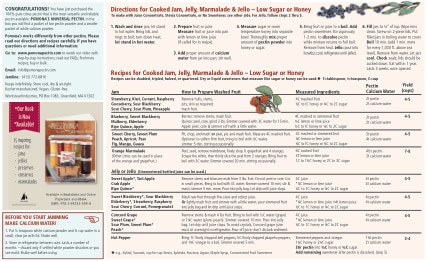
You can download a set of pdf instructions for making and creating your own low and no-sugar jams and jellies with Pomona’s Pectin using the image or text below. Shared with permission from Pomona’s Pectin.
I’m new to pressure canning and it intimidates me to can meats. I want to broaden my skills but getting some one sick scares me. Any good tips, and what are the risks?
Janet says, “I used to be afraid too, Kim but the desire to save the beans and other produce that could not be hot water bath canned finally won out. If you follow good hygiene habits in the kitchen and wash the veggies first, there should be very little risk. Also, remember, you probably won’t be eating right from the jar. I usually boil the green beans again before serving. With your meats, the pressure is so high that it would kill just about anything that was in there to begin with. I trust home canned chicken and beef more than store bought any day.”
Diane says, “Kim, I too was scared to death not of eating the food but of the canner exploding! This canner is so easy to use and as long as you follow the instructions and like Janet said, boil the food for 10+ minutes it will kill any bacteria….plus if the lid bubbles the toss jar and all. But we too LOVE pressure canned green beans! I know by that point I’ve killed all the nutrients but I love them anyway!!!!! We’ve eaten many a jar of stew, meats etc. They came in handy when we had family emergencies that we only had an hour to pack and get out of town for a dying loved one.”
If you follow safe canning guidelines, risks are minimal. The only stories I’ve seen about people getting sick from home canned meat are ones where they were very foolish, doing things like eating foods from jars with failed seals, or water bath canning instead of pressure canning for low acid foods.
Basic Canning Safety Tips
- Keep Everything Clean
- Always Use Fresh, Good Quality Food Products (you can cut our blemishes, but discard items with signs of spoilage)
- Keep Your Hot Items Hot
- Use the Right Method of Canning – Water Bath for High Acid Foods, Pressure Canning for Low Acid Foods
- Use the Correct Processing Time
- Process at the Correct Pressure (for Pressure Canning)
- Do Not Tilt Jars When Removing from Canner (Food may get between the jar and rim and ruin the seal)
- Allow Jars to Sit and Cool Without Being Disturbed
- Remove Rings and Check Seals Before Storage, Wipe Jars Clean
- Date and Label Contents of Jars
- Do Not Stack Jars in Storage (stacking may give the appearance of a false seal due to weight of jar on top of other jar)
- For Best Quality, Use in 1 – 2 Years
Most of the time when food is spoiled, there are signs of spoilage – mold, foul odor or discoloration. One deadly microbe you can’t see is Clostiridum botulinum – otherwise known as botulism toxin – which can be deadly. This bacteria lives in soils and sediments, so it’s everywhere, but most of the time it doesn’t cause trouble, because it lives with lots of other bacteria. Here’s the problem – botulism grows at temperatures between 40-120°F (5-49ºC) and oxygen levels below 2 percent – like the inside of a sealed canning jar. High acid foods (pH ≤ 4.6) keep botulism spores from germinating into live cells. Adding sugar and salt to foods also ties up the water in the food, making that water unavailable to the bacteria, so the bacteria can’t grow. Canning also eliminates the other bacteria that would keep the botulism bacteria in check. To destroy the botulism spores, low acid foods must be processed at 240-250 F (116-121 C) under pressure of 10-15 pounds per square inch (psi) at sea level. Always follow a tested recipe when canning low acid foods.
I canned some carrots and the water level dropped in one of the jars but the seal is good. Are they safe to eat?
Chaya says, “Yes, they are safe to eat but they might change appearance over time. They are shelf-stable but they should be eaten first in your rotation because they will not last as long as the others. (Most canned vegetables will retain best quality for 1-2 years.)”
Is there anything you cannot can?
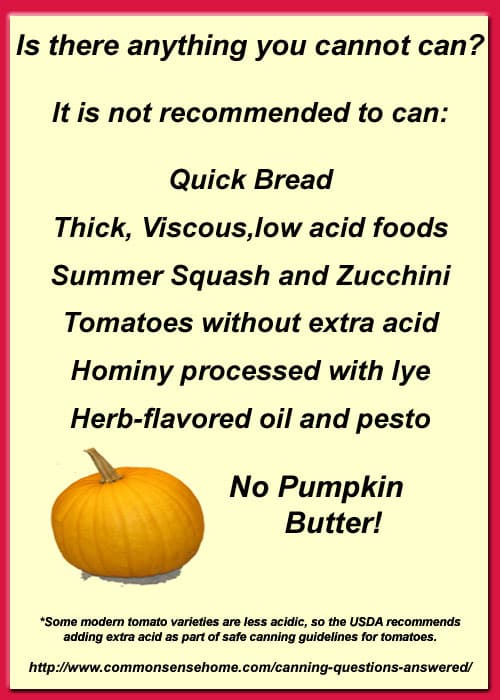
It is not recommended to can:*
- Quick Bread
- Thick, Viscous, low acid foods
- Summer Squash and Zucchini
- Tomatoes that have not been acidified
- Hominy processed with lye
- Herb-flavored oil and pesto
*Adapted from The Natural Canning Resource Book.
When in doubt, find an approved recipe from a tested source, or use another food preservation method. Lots of folks on the internet use recipes that do not follow current guidelines.
Are there veggies/foods that I should be blanching first?
Yes. For those who don’t know, blanching is a quick dip in boiling water, followed by an ice water (or cold water) bath to stop cooking. Blanching softens tough skins and breaks down enzymes that break down the food.
Generally high acid foods (like the fruits listed above) do not require blanching. Foods that readily convert from sugar to starch (like peas and corn), benefit highly from blanching, because it keeps them sweet. Greens (like kale and asparagus) will be more tender and palatable with blanching. Chaya talks more about blanching in the article, “To Blanch or Not to Blanch“.
When do you start the timer for the processing time? I always end up processing things way too long, because I can’t tell when is the right time to start counting it as officially “processing,” in water bath OR pressure canning.
For Water Bath Canning: After jars have been added to the canner and are covered by at least two inches of water, cover the canner and turn the burner to high until the water boils vigorously. Start the processing time at this point.
Note: Following the current guidelines for cucumber pickle canning have produced nothing but soggy cukes for me, so I usually do at least one batch of refrigerated dill pickles with a salt and vinegar brine. These must be kept in the refrigerator – they are not shelf stable. See No Canning Required Dill Pickles for the recipe.
For Pressure Canning: Fill canner with water as directed, place the jars in and close the lid. Turn the burner until a steady stream of steam is produced, and vent the canner for 10 minutes. This removes oxygen from the canning vessel. Place the weight on the vent pipe or close the petcock. Bring the canner to the correct pressure, and then start your processing time.
If you are craving crunch, I highly recommend looking into lacto-fermatation for part of your food preservation.
I have some favorite marinara sauce and salsa recipes that are not “canning” recipes. I would really like to find out if it is safe to can these or learn ways to tell if regular recipes are ok to be canned or if there are ways to alter them a tad to make them more safe. Everything I see says to always stick with canning recipes.
Chaya says, “Yes, it’s best to stick with safety tested recipes, because of acid levels. If you have a favorite recipe for marinara or salsa you should be able to safely can it in a pressure canner based upon the guidelines given in the manual–the All American pressure canner comes with an awesome manual that will lay out the times for you based upon altitude.”
How long is canned food good for? Does it depend on what it is?
As I mentioned earlier, quality is best during the first 1-2 years. As long as safe canning processes were followed and there is no sign of damage or seal failure, foods should be safer to eat considerably longer. Acid, salt and sugar will all extend the shelf life of foods and help prevent discoloration and changes in texture and flavor. (This is why salt and sugar are loaded into cheap mass produced food.)
Storing your canned goods in a cool, dark, dry location will greatly improve storage life and quality. Having your jars on display on an open shelf in your kitchen looks great, but doesn’t do the food any favors in terms of shelf life.
Do I Really Need a Pressure Canner?
If you want to can vegetables, meat or meals – YES. I pressure can more green beans than anything else out of my garden. They’re my boys’ favorite veggie.
Is It Hard to Use a Pressure Canner?
Not really. It takes more patience than anything else. With a water bath canner, you lower jars into boiling water and start your timer. With a pressure canner, you must let the canner exhaust steam for ten minutes. Then you put the pressure regulator in place.
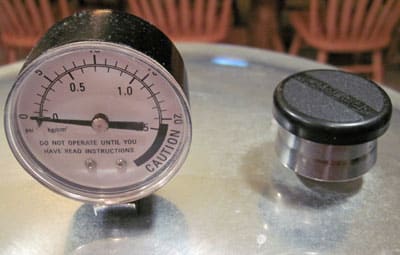
See the little round black thing on the right? That’s the pressure regulator. Once the regulator is on, you wait for the pressure to build. Once the pressure gets high enough, there’s a little button (the air vent/cover lock) that pops up to stop steam from venting (at least on my canner).
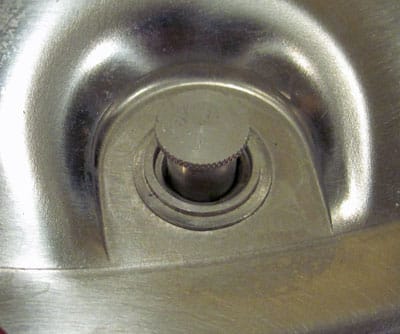
Once the button sets in place, you wait for the pressure to build some more, until you reach processing pressure. Then you hold it at pressure for the required amount of time. Then you turn off the heat and let the pressure drop to zero on it’s own (the little button will also pop back down). When the button is up, you can’t open the lid. This helps prevent you from doing something stupid by either burning yourself and/or busting all your jars. Complicated – no, time consuming – yes. Mom told me it’s a lot faster than when gramma had to water bath can everything for a really, really long time.
Will My Pressure Canner Explode?
Not very likely, unless you use some plastique. It may be possible with older canners, which have been damaged or were improperly forged, but recently made steam pressure canners are pretty tough. Mine is equipped with a locking mechanism, others bolt shut. You can’t operate the canner unless it’s locked tightly, and that is some pretty thick metal. It also has a little overpressure plug that will blow if the pressure gets too high.
My brother-in-law has told my sister than she can can everything in a boiler bath because the Amish do it and are okay. Yikes! Any information I can arm her with any information/guidelines to convince him she needs a pressure canner for low acid foods would be greatly appreciated.
Chaya says, “See if you can hook her up with her local Cooperative Extension Office. They often have local canning classes. Community colleges do, too. Simply Canning is a great website with a lot of this type of information.”
Note: See the discussion above about safe canning guidelines and botulism. Water bath canning of low acid foods creates the perfect conditions for botulism.
I canned beef last fall in chunks and although the flavor is good, and certainly works in a pinch – I just like more tender/rare beef that doesn’t come apart in strings. Is there a way to can meat safely and not have it quite so well-done?
Chaya replies, “Did you raw-pack or heat pack? That means, did you can the meat while still raw, or cook it first? It’s safe both ways, but that might change the texture for you.”
I need more ideas for strawberries. I’m getting a pound a day and about over making jam. Also, tried honeysuckle jelly this year and I really couldn’t get the flavor to take right. It always had a twang of lemon following. Can I put less lemon juice in and it still set right?
Pomona’s Pectin give the following recommendations for substituting citric acid for lemon:
Citric Acid can be substituted for lemon juice – it will adjust the acidity (lower the pH) of the fruit, which is what you want to do. 1/2 teaspoon powdered Citric Acid is equivalent to 1 Tablespoon lemon juice. 2 teaspoons powdered Citric Acid is equivalent to ¼ cup lemon juice (4 Tablespoons). Citric Acid lowers pH and imparts tartness to the fruit mixture, but it doesn’t add a particular flavor.
As for the strawberries, check out, “Preserving Strawberries Four Ways – Freezing, Drying, Fruit Leather and Kombucha“.
I hope you find this resource helpful, and much appreciate your sharing it with friends on social media.
I’m pressure canning potatoes. I noticed once I put on the weighted gauge that there was a lot of steam venting from the sides of the canner where the lid fits onto the main container. It took a long time for the jiggler to start jiggling and when it did it maybe jiggled once in a minute or two. The pressure is 15 and maintained a steady 14. I’m waiting for the pressure to come down before removing the lid. Are my potatoes going to be safe to eat.
As long as the canner was able to maintain pressure, they should be fine, but it sounds like you need to get your gasket checked because it isn’t sealing quite right.
Hi! I canned applesauce without peeling the apples and later learned that that is risky. Do I really need to discard my applesauce? Are there any safe recipes for unpeeled applesauce and slices?
What risk is attributed to applesauce with peels? Are you talking about windfall apples?
While windfall apples may have a higher microbe count, pretty much everyone I know who has an apple tree has canned them at one point or another. I do usually peel them, but if mold is the issue (which is what I’m seeing suggested by the extension service), spoilage should be obvious. Discard the contents of any jars that look or smell moldy or otherwise spoiled. It’s probably best to use them sooner rather than later, but if there’s a problem, using them in a recipe won’t make it disappear. Just make sure to inspect the contents before use.
I just read that the recipes are tested without peels and leaving the peels on increases the bacterial load which means that the processing time may not be enough to kill the extra bacteria and yeasts. I’ve met the requirements to eliminate botulism risk though right? Pretty much any other spoilage can be detected before eating? I would really love to continue canning holes with peels. It’s so much easier and more nutritious.
Apples have a pH between 3.5 and 4.0, keeping them out of the range where botulism spores will grow. Other microbes shouldn’t be terribly active after processing, but if somehow yeast or mold or bacteria get growing, signs of spoilage should be obvious. (Yeasty smell, fur growing, etc.) Apples picked from the tree rather than from the ground should have a lower microbe count.
Lately it seems like the food police are freaking out more about bacteria and foods that people have been eating for a very long time. I’m personally more concerned about pesticide residue, as almost all commercial orchards spray, spray, and spray some more to keep the apples clear of pests. I’ve talked to a couple different regular orchards about their spraying schedules. They stop closer to harvest, but with years like this one, we’ve had hardly any rain. I’m sure any sprays haven’t had much opportunity to get washed off. Apples regularly make the Dirty Dozen list.
Now some producers are spraying their apples with Apeel coating to extend shelf life (though not small growers, thankfully), so that’s more garbage in the food chain that we don’t need. It penetrates the skin and won’t wash off.
I saw this question posted on a canning site. a woman accidentally canned meat 65 minutes rather than 75 at 15 lbs pressure. She realized the mistake less than 6 hours later. Her question was can I recan it? Someone said it was too late and she had to throw it out after 2 hours. I had always been taught there’s a 12 to 24 hour leeway between when it was possessed and could be safely reprocessed.
Yes, it’s safe to reprocess within 24 hours.
I canned my homemade tomatoe sauce and did not put any citric acid or lemon juice. I usually brown my meat at bottom of pot with a little olive oil, add chopped garlic, tomatoe paste, salt, pepper and fresh basil. How long will it last without either of those items in it? Also, I did it the weekend of Labor Day on Sunday, would I be able to put the sauce back in the pot and then recan with putting either citric acid or lemon juice in jars? Please advise, this was my first time ever canning tomatoes, didn’t know you had to put that in it.
Thank you in advance for your help.
Patti
Did you can it in a pressure canner or water bath canner?
If you canned it with a water bath canner and it’s been sitting for over two weeks, it’s not safe to eat or recan. Botulism spores are tasteless and odorless, and breed in low acid, anaerobic conditions. (You can learn more about botulism here.)
The National Center for Home Food Preservation has a spaghetti sauce with meat recipe that is safe for canning. They process pints for 60 minutes and quarts for 70 minutes at 11 pounds of pressure. (Extra processing time is needed for higher elevations.)
Meat products must be processed in a pressure canner. Adding acid is not enough to make them safe.
Regarding carrot/christmas pudding steamed in jars – I know how to make these puddings and steam them in a dozen pint size canning jars in a water bath on top of the stove for 3-3.5 hours. My new canning pot is too large to fit on my new stove top with enough space around it for safety. I would like to be able to steam the jars in the oven. There is one reference that the water should be halfway up the jars and the oven temperature should be 350F but there is vague information on timing ie “1.5 to 1.75 hours according to the recipe instructions”. I am a bit concerned in that the oven steaming time is half that of the stove top method. Does that seem reasonable? Given today’s cost of ingredients and the labor intensity of these puddings, disasters should be avoided if possible. Thank you in advance for any opinion that you could offer on this matter.
I have not made a steamed pudding, but cooksinfo says of oven steaming,:
It’s boiling water in one location or another, so using the same processing time seems like a reasonable choice.
I have a question, might not be the exact topic but…………I made apricot jam last night then realized I didn’t have lids. We live in a small town so all the stores are out. Can I leave the jam in the fridge for a could of days until I find some.
Thank you
The texture may be changed because you need to reheat the jam to boiling, but it should be safe to do, as long as you do reheat the jam, use sterilized jars and process as directed by the recipe.
If you can’t find lids, Uline has them in stock. (I’m not a rep for them, but that’s where I found mine.)
I have been growing most of my own food canning for years. I really enjoy the process. I was going to can some beef this week. I would like to try a canned meatloaf with some oats in with the beef, but the guidelines strongly avoid starches for fear that air pockets will be present that won’t properly heat. Is there any experience/research about using some oats in pressure canning recipes
I can’t recommend canning grains, even with pressure canning, with current equipment and safe canning guidelines.
I’ve gone digging on The National Center for Home Food Preservation site and university sites and can’t find specific data, but I do know there are several concerns.
As you mentioned, air pockets are possible, which impede heat transfer. The other heat transfer issue is the inability of fluids to move around in a densely packed product. When you can chunks of meat or ground meat, they are always packed in liquid. The liquid should be able to move freely around the meat, assuring good heat transfer throughout the jars. If you have a solid product like a loaf, that fluid movement can’t take place. Something like a meatball format would be better, but there would still be a lot of variation in density throughout the product.
Assuming even heating and pathogens killed off, I still suspect that the product quality once open would be less than ideal. It seems like any sort of starch will be slimy after sitting for months in liquid, especially since home canned products wouldn’t use stabilizers like commercial products.
I have a canning question. I made a type of jalapeno relish that I canned. The recipe calls for 15 minutes in a water bath. I accidentally left in for two hours. The water level started two inches above jars and when I realize my error the water level was at about 1/4 the level of the jars. The jars were sealed while sitting in the pot. I didn’t notice any leakage. Do you think they are still safe?
That’s a question I have not heard before. I would think they are safe, given that the 15 minute processing time was met – and then some. You’ll probably want to watch the seals, as it’s possible the extended heat may have made the sealant more prone to failure over time.
I made bone broth using just water and bones. Put in sealing jars and put in water bath covered by 2 inches or more of water. Boiled 45 minutes. I am wondering if the broth is safe to use.
What is the correct way to preserve bone broth other than freezing?
Thank you in advance for your reply.
The National Center for Home Food Preservation guidelines for canning meat stock (broth) are as follows:
Reheat broth to boiling and fill jars, leaving 1-inch headspace. Wipe rims of jars with a dampened clean paper towel.
Adjust lids and process in a pressure canner following the recommendations in Table 1 or Table 2 according to the canning method used.
If you processed your broth within the last 24 hours, it’s probably safe to reprocess (reheat the broth and pour into clean jars with new lids) in a pressure canner. See the post on Botulism – Causes, Symptoms, Treatment, Tips for Safe Home Canning for additional information.
I recently made some Cherry Jam. It turned out great. The next day I looked at my jars and I found a yellow layer at the top of jelly. I was puzzled. I reviewed my recipe and realized I had added 1 stick of butter instead of 1 tsp. Is the jelly still good (my husband thinks you would just have to mix it in the jelly when you open the jar)? If it is should I store it in the refrigerator?
It’s safest for that to go in the refrigerator to make sure the butter doesn’t get rancid. I know some sites talk about canning butter, but it’s not generally recommended because it’s a low acid food.
Can you tell me how long to water bath homemade plum barbecue sauce. I am inundated with
Plums and have already put up plum jams. The recipes for plum barbecue sauce usually have ketchup,
Molasses or maple sugar and spices. I haven’t been able to find a recipe for canning a frut
Barbecue sauce similar enough to feel like I could trust it. Thanks !
Jacqui
I haven’t made plum barbecue sauce (no plums), but it sounds like from what you describe, it should be similar to rhubarb barbecue sauce. You can find instructions for canning that here- https://commonsensehome.com/rhubarb-sauce-for-canning/.
I recently water bathed a batch of green beans. I now know that I should have put them in a pressure canner. Can I now pressure cook them now and they will be safe? I canned them 3 days ago
I’m sorry, but I wouldn’t eat them. As I note in the botulism post:
I have some caned fruit, the seal is still holding real good but the fruit is very discolored, are they safe to eat???
How old is it?
Dicoloration happens when fruit gets oxidized, so it’s possible for fruit to be recently canned and still be dark in color if it wasn’t handled well during processing.
Color will also fade with age.
If the seal is still intact and there is no lid bulging or odors, it’s probably safe, but not in optimal condition.
What would cause the jars to break at the bottom of the glass.?
What would cause the jars to break around the bottom of the glass?
The most likely cause was a hairline crack in the glass that was not visible at a glance.
Can I make homemade vegetable soup and chicken noodle and put them in hot jars and lids and store them in a pantry.
Only if you want to risk botulism poisoning.
First, ALL LOW ACID FOODS MUST BE PROCESSED IN A PRESSURE CANNER. I cannot emphasize this strongly enough. Simply sealing low acid food in hot jars sets up perfect conditions for germination of botulism spores, which can kill you. Please see https://commonsensehome.com/botulism/ for more information on botulism.
Second, no noodles in home canned foods. Commercial processors are able to do it because they have specialized equipment we don’t have as home canners.
You may be able to adapt your favorite soup recipes (without noodles) using the National Center for Home Food Preservation guidelines for soup at https://nchfp.uga.edu/how/can_04/soups.html
Some key recommendations, per their website:
Only fill half the jar with solids, then fill the rest of the way with liquid. This ensures that there’s enough liquid to promote good heat transfer.
For dial gauge canners, the recommend 11 pounds of pressure for 60 minutes for pints, 75 minutes for quarts.
For weighted gauge canners, they recommend 10 lbs of pressure for 60 minutes for pints, 75 minutes for quarts.
The site includes adjustments for higher altitudes and seafoods.
My daughter and I canned salsa a couple of weeks ago and I opened a jar last night that had mold on top.
It turns out all of the jars, even the sealed ones have mold growing on top. We wonder if it is because we
forgot to heat the lids in boiling water or didn’t get the salsa hot enough before putting in jars. So sad to
have to dump them all out!
How acidic was your salsa? Did it have added lemon juice, lime juice or vinegar? If not, it was likely not safe for water bath canning. pH for safe water bath canning should be 4.6 or lower.
Jar lids should never be boiled before use. Doing so can damage the gasket, making seal failures more likely. Lids and rings should be clean, and can be gently heated in warm water, but don’t boil them.
How did you seal your jars? If you just ladle hot food into jars and screw the lid on, that doesn’t evacuate the air from the headspace of the jar. If there’s air in the top of the jar, and the food isn’t acidic enough, you have a perfect environment for mold growth.
Food should be how when loaded into jars (cold pack fruits and vegetables have hot liquid ladled over them). Jars should also be kept warm. Warming lids is now optional, but I find that my seal rates are better when I warm the lids. Processing times should start when the water reaches boiling.
Thank u for your help!
You’re welcome. Stay safe!
Great information, thank you! This answered a lot of questions I’ve been having.
Here’s a tricky one: I want to used smoked peppers in a salsa recipe. Do you think it’s safe to can the salsa if I use the recommended amount of peppers but smoke them first? I wouldn’t use any oil on the peppers during the smoking process. Full disclosure–I did this last year and it seemed fine (delicious!), but I did add extra vinegar because I was nervous about altering the recipe.
Thank you very much!
If you’re not adding oil, and you’re keeping the quantity the same, it should be fine – not unlike adding dry spices to a recipe.