
Before You Plant Sunchokes, You Need to Read This Post

This post may contain affiliate links. Read my full disclosure here.

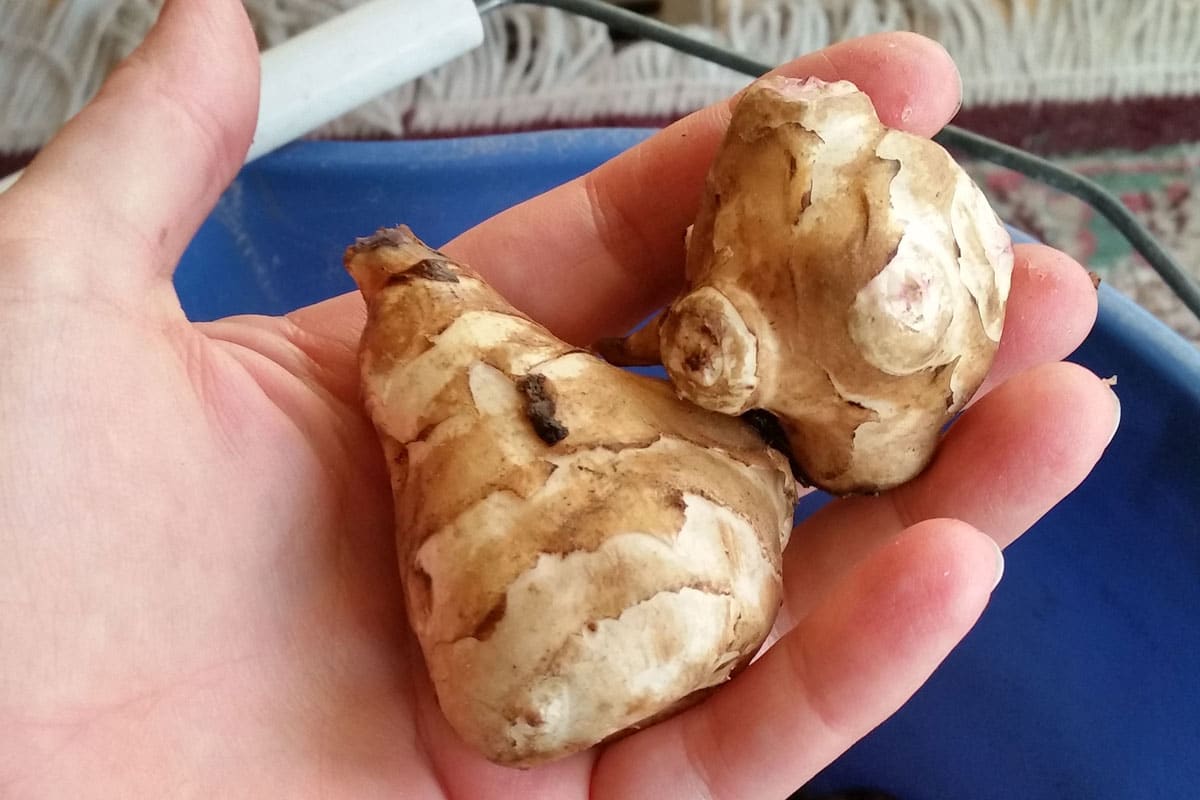
Sunchokes (AKA Jerusalem artichokes) are gaining popularity for their health benefits. I’m sharing how to grow sunchokes, when to harvest and how to use them – plus the big mistake that we made when we first planted them.
Would you like to save this?
Table of Contents
What are Sunchokes?
Sunchokes are native to eastern North America. They are also known as Jerusalem Artichokes or Sunroots. They are not related to Artichokes, but they are related to sunflowers. The whole “Jerusalem” thing is supposedly linked to the Italian word girasola, which means sunflower.
Sunchokes are a perennial plant that grows six to ten feet tall. While they do have pretty yellow flowers, most people grow them for their edible roots. Their roots are high in inulin, and eaten raw or cooked.
Historically, Native American valued them as a food source, especially during late winter when food supplies run low.
How do you Grow Sunchokes?
Grow sunchokes from roots or sections of root, planted in spring or fall while roots are dormant. You can grow the plants from seed, but starting with tubers is easier and faster.
For best results, use the following planting guidelines:
- The plants prefer loose, well-drained soil, but will tolerate poor soils. (Lighter soil makes harvesting easier.)
- Space sunchoke tubers 12 to 18 inches apart, 4 to 6 inches deep.
- Space rows 4-6 feet apart (they will be prone to spreading).
- Soil temperature at planting should be at least 50°F.
- Plant in full sun.
- Do not plant in areas that are consistently wet, as wet soil will rot the tubers. Plants are drought tolerant, but produce best will a regular supply of water.
- pH of soil best between 5.8 and 6.2 (neutral soil)
- Preferred growing temps = 65 to 90 F.
- Cover your soil with an inch or so of organic mulch for easier harvesting and root protection.
- Plant in a dedicated bed that can be mowed around for control. Or sink barriers into the soil around the sunchokes at least 24 inches deep to prevent spreading. (More on this below.)
When are they Ready to Harvest?
Harvest sunchokes in late fall or early spring. They require 110 -150 days to maturity, depending on the variety and growing conditions. Light frost increases the sweetness of the tubers.
Unlike potatoes and some other root crops, sunchokes do not store well. Their skin is thin and dries out easily. I keep them in the refrigerator for 1-2 weeks. They keep best in the ground, dug as needed for use.
In northern areas, a thick layer of mulch may keep your tubers accessible longer. It may also encourage mice or voles to move in and have a snack, but there’s usually enough to share.
For bigger roots, avoid crowding plants and water regularly. You can also cut off flower stalks to encourage root growth. Please don’t cut off all your sunchoke flowers! They flower late in the season, when pollinators have few flower choices.
How do I Eat Jerusalem Artichokes?
Sunchokes are edible raw or cooked, including the skins. They are difficult to peel and turn grey quite quickly, so a good scrubbing is a better option.
Raw, sunchokes are similar in texture to a water chestnut or jicama. After a light frost, they take on a somewhat nutty flavor. For my part, they taste best raw after a frost.
See Jerusalem Artichoke Recipes for easy recipes and cooking tips.
Do Sunchokes Cause Gas?
Sunchokes are loaded with inulin. Inulin is a type of starch that acts as a prebiotic in the digestive tract, feeding our beneficial bacteria.
Inulin is a widely used filler in many foods to bump up the fiber counts. It also increases calcium absorption in the body, and doesn’t spike blood sugar. There are even sweeteners made for diabetics made out of sunchokes.
See Jerusalem Artichoke Benefits: Nutrition, Flavor, and Uses for more information.
Eating a large amount of sunchokes may lead to “mild gas”. They have the nickname “fartichokes”.
I can verify that eating a large portion of boiled sunchokes will give you horrible, gut-racking gas like you have never experienced before… except for that one time when you were pregnant and thought it was a good idea to eat prunes, cheese curds and cucumbers in large amounts all at the same time.
Start slowly when eating sunchokes, and perhaps avoid serving them in large quantities at dinner parties. Give your digestive system time to build up the right bacteria to deal with the extra inulin.
Readers have suggested a couple of different tips to beat sunchoke gas. One suggested that you eat some sunchokes raw, and don’t scrub all the dirt off.
I assume that some soil microbes come with to help aid digestion. Another reader says that harvesting after frost is a big help, as the frost naturally breaks down some of the inulin for you.
A Word of Caution About Growing Sunchokes
“Easy to grow” and “disease-free through heat and drought” are code words for “You will Never Get Rid of this Plant!”
When I first planted sunchokes, I skimmed over the note in the seed catalog that said “they will spread and may be invasive”.
I planted my tubers late in spring, in one corner of a garden bed. There were nine rather wrinkled little roots, and I didn’t think they would all survive. Not only did they survive, they thrived. We tried to harvest the whole patch that first year, but must have missed a few.
The next spring they were back, and they were spreading. We tried to keep up eating them, but the fall was muddy and we couldn’t get in to harvest.
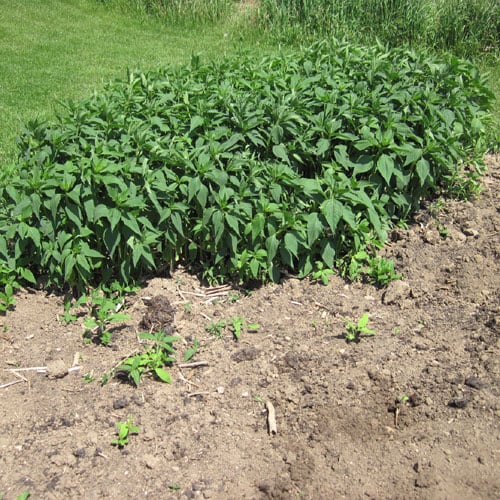
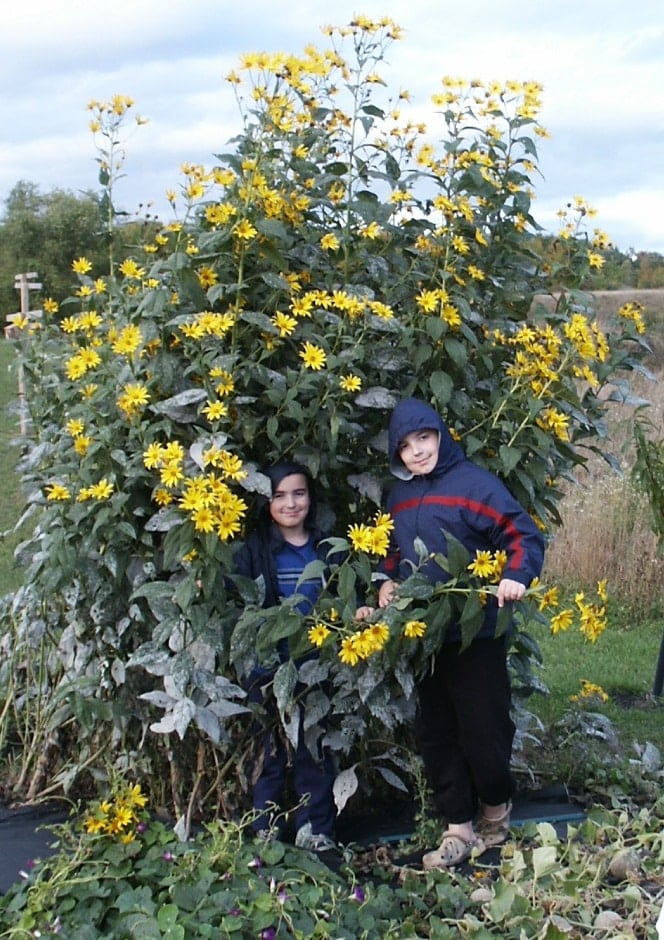
By the third season, we had the lovely thicket of 12 foot tall flowers you see at the post. As I was digging them in fall, I tossed some damaged roots off into the tall grass away from the garden.
Sunchokes Spread from the Smallest Bit of Tuber
Fast forward to spring. Those root bits haphazardly thrown into the weeds – they’ve now sprouted into plants. There’s a new sunchoke colony.
I decide to get rid of extra sunchokes. Two friends come over.
Four different adults attack the patch. Bushels and bushels of sunchokes leave the garden. The patch size is reduced roughly by half to start the spring.
Time passes. My boys work the bed again. They remove more sunchokes from the same area that the adults have already gone over.
Before I put the transplants in, I work over the same area one more time. THERE ARE STILL SUNCHOKES COMING UP! This area has been gone over by four adults and two kids, and there are still sunchokes hiding in the dirt.
Here’s the main patch. You can see the smaller outliers in the foreground. That area should be clear.
Here’s a nice, innocent looking sunchoke seedling.
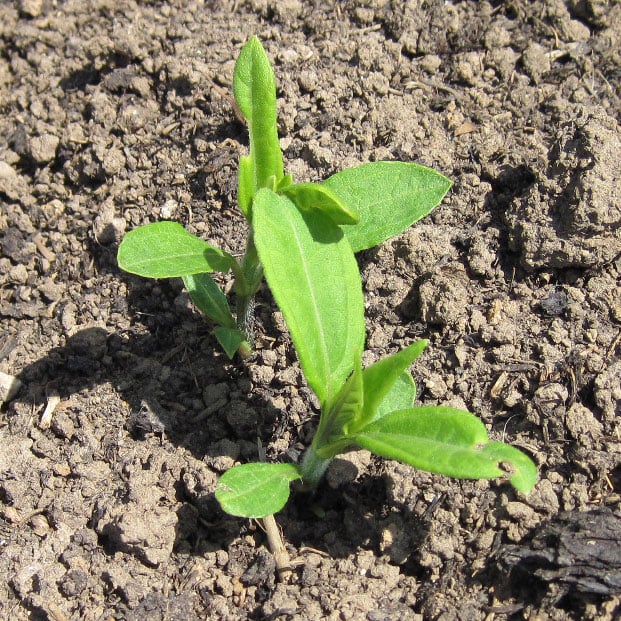
Once we dig it up, we see that this single tuber is trying to regrow an entire sunchoke thicket.
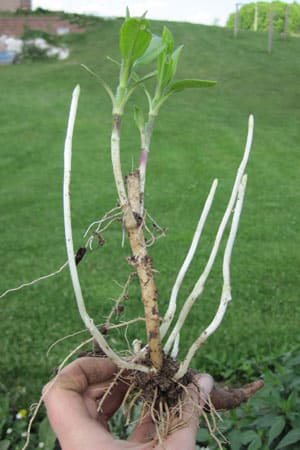
Even tiny pieces, no bigger than the tip of my thumb, can regrow entire large, vigorous plants.
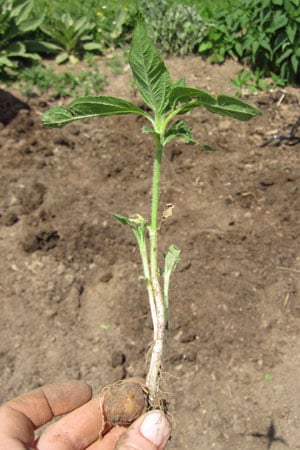
They’re virtually unstoppable. Weeks later, and I’m still digging up shoots from among my cabbage seedlings.
Plan Ahead with Your Sunchoke Plantings
I urge you, do not plant sunchokes anywhere else you might like to grow other plants at some time in the future. You will spend very large amounts of time attempting to remove them if you do.
Plant them in their own area that you can mow around, to keep them under control. You can also plant them in pots – as long as they are big pots. Try one tuber per 18 inch diameter pot. Look for varieties that naturally grow shorter, and have an option for providing support if needed.
My neighbor says her horseradish plants are the same way. Plant both at your own risk. Maybe we should plant them next to each other, to see which one wins.
Alternatively, introduce pigs or chickens into your sunchoke area and let them tackle clean up duty. Jerusalem artichokes make a fine fodder crop.
What Tries to Take Over Your Garden?
Sunchokes are good for you. They look pretty, taste okay, and are quite expensive to buy in many areas, if they are available at all.
They’re a “perfect” choice for a new exotic vegetable to try. I just wanted to let you know that you’re likely to have a lifetime commitment with them once they enter your garden. Don’t say I didn’t warn you.
Are there any other plants you’ve grown that want to take over your garden? Leave a comment to warn other gardeners before they end up fighting them, too.
Also, if you could include in your comments roughly what area you are from, that would be great. Some plants will spread in some locations but not in others.




This article is written by Laurie Neverman. Laurie and her family have 35 acres in northeast Wisconsin. They grow dozens of varieties of fruiting trees, shrubs, brambles, and vines, along with an extensive annual garden. Along with her passion for growing nutrient dense food, she also enjoys ancient history, adorable ducks, and lifelong learning.
Originally published in 2012, last updated in 2026.
HILARIOUSLY WRITTEN STORY AND GREAT WARNING THANKS AS I AM ABOUT TO PLANT SOME !
Exactly what I wanted to hear. I planted a couple pounds of these this past spring and they’re coming up quite nice.
The reason I have them planted is for emergency food for my family. Sure, I’ll probably never need it, but if I ever did, I’d probably be quite grateful to have nutritious food that I just “can’t git rid of”.
A typical garden is great, but for real survival purposes, having crops that are the best at it themselves, seems like a good idea. I’m trying to figure out what crops these are and to grow them. If nothing else, I’d like to let these sort of invasive crops do battle with each other to keep themselves in check. We’ll see how it works.
Thank you so much for the information about Jerusalem artichokes. The way you presented it brought a smile to my face and I feel like I know you. Thanks from a former “Mainerd”, ayuh! , now in the desert s.w.
You’re welcome, Pam.
Great post and comments.
I have planted them in containers…will they escape?
I love them as a veg…very like the parsnip with more texture and character…and I would like the sunflowers ….but I don’t want the invasive plants…The Day of the Triffids is almost my favourite John Wyndham book, but I am not keen to become a triffid (sunchoke) victim!!!
I don’t think they’ll escape – unless you toss parts of roots or tops somewhere away from the container. Then all bets are off.
Thanks…that’s why I potted them….will let you know if the Triffids escape
I am a proponent of companion planting, that is planting “friendly” plants near to each other. In one of my books I read that planting horseradish in the potato patch would repel potato beetles. Both the potatoes and the horseradish thrived, and I had no potato beetles. (I don’t know if it was because of the horseradish or that we just didn’t have any potato beetles that year.)
The next year I learned the miserable truth about horseradish – you can’t get rid of it! Even the smallest thread left in the ground sprout next year. Even covering it with mulch won’t suffocate it, but only anger it. I laid down several layers of newspaper and covered the area with grass clippings. All other plants/weeds were smothered, but the horseradish plant formed a point and sliced its way up through the mulch and live happily ever after.
To make matters worse, since horseradish likes loose soil and my soil tends to be dense, the resulting horseradish root tended to be long and skinny with lots of threads, but not much horseradish.
Anyway, 25 years later I’m still trying to get rid of that horseradish.
Just one question – does it still repel the potato beetles?
When I moved from Delaware to California, I moved some house plants I used to keep outside in the summertime. I did have lemon balm growing out in my yard in DE and apparently one seed managed to find it’s way to one of the potted plants. In CA I had those potted plants sitting on my deck and that summer a lemon balm plant appeared. It grew nicely and then one of my friends said he’d like some seed.. … From that one little plant’s seed, it spread all over my friend’s yard and 25 years later it’s even all over the yard at my new house. That’s one determined plant.
I started with one lemon balm plant 8 years ago. I now find it all over the garden. At least it smells nice and is useful!
Love lemon balm
I have been looking for sunchokes like mad and I have an old bathtub I want to use as a planter… does anyone by chance have some to ship to FL?
Many nurseries sell them, and you can order through amazon. I’m not sure if there are any rules restricting sale to Florida.
You might try going to the grocery store and see if you can get some there. I bought lemon grass and horseradish at the grocery and was able to get it to grow very nicely.
Lambs Ear. Such a cute and innocent plant in a three inch pot. Little did I know what was waiting for us. I planted it by the small pond by our back porch and watched with joy as it rapidly grew. Beautiful lavender flowers, soft silver leaves to pet. The next year I got a small taste of what was to come. The seeds had traveled to every other flowered in the yard. I kept busy pulling them out, as well as the weeds. Next I found them growing in the cracks of our blacktop driveway. In the cracks of our cement sidewalk. The original plant had grown huge. The next summer I just couldn’t keep up with it. My husband finally took Roundup to it. We took out the pond and put a cement driveway over three of the flower beds. We still see them coming up in the lawn. We run them over with the lawnmower. Maybe one day they will be gone.
I didn’t realize that one was so prolific. Thanks for the warning!
Gosh! There was a small patch of lamb’s ear plants in the front shaded L of a place we rented for years. But that patch of lamb’s ears always died back in winter [Pacific NW]. After several years, it was entirely gone. Never returned. IDK why it failed to thrive….too much rain here? Winter freezes? Too much shade?
Came across this post and thought I would add a different viewpoint! I’ve grown Jerusalem artichokes on a small field scale (about 1/2 acre) for 15 years. I rotate them along with potatoes, fodder beet and kale. We allow our pigs to forage freely over them during November and December before bringing the pigs in to farrow in comfort during the New Year. We hand dig enough ‘seed’ for the following year, before letting the pigs in and apart from a few ‘volenteers’ they are never a problem for the subsequent crop of potatoes. We don’t eat that many due to the ‘side effects’! but the pigs do very well on them alone and we always have very healthy piglets! Great fodder crop for us. Happy planting!
Clearly, I need some pigs. 🙂
ha! try it maybe..but fence well first! 😉
Planning to start with chickens this year, then we’ll see how things go. I’m not much of a larger animal person (poultry was always my area growing up on the farm). Maybe one of the boys will bring home a daughter-in-law who loves bigger animals in a few years. 😉
I have a suchlike in the southwest corner of my yard by the privacy fence. It’s been there for over 15 years and has not spread at all. It’s in kind of a shady area so that may be why…and we have never pulled up tubers to eat them. It’s a beautiful plant and really brightens the shady area but it dues get dusty mildew and little red bugs that attach to the stems which are gross. I used to spray it but the bees love the flowers so I deal with the ugly bugs and mildew now.
as for invasive plants….day lilies, gooseneck, garlic chives, have taken over my perennial garden! Make sure to cut the flowers before they seed and plant lillies where they can go rogue.
Daylillies took over most of the foundation of my mom’s house.
I planted mint in an enclosed garden area last year, this year I wound up pulling like three pounds of runners that were starting to sprout up elsewhere. It hasn’t left the bed yet, but it’s trying.
I plant my chicken run with mint. It really helps keep the mice away. I have movable fencing so I let my girls take over a mint area if it gets above 3″. So far so good!
A friend gave me a few tubers this weekend. I had never grown them before, but was intrigued. I am glad that I read your post. I will treat them like our horseradish which survives on benign neglect. But before I firmly commit to them, I think I will plant them in a large container destined for the patio so they don’t take over my garden.
We’ve gotten some sort of grubs in our patch now, too, so I’m hoping to be able to get chickens in there this year and get it all cleaned out.
Good luck with that. I find that our chickens do a great job of getting grubs out of our garden.
Tansy, a popular herb for several reasons, including an insecticide. Wildly invasive. It will quickly take over.
Well they sound PERFECT for me, considering I kill everything. 😀
There you go!
At my old house there was a shaded area by the next door neighbor’s house, that UNFORTUNATELY was a perfect microclimate for the English ivy they planted under their tree! Normally, English ivy doesn’t grow that well here in southwestern Ohio. It mainly only can be grown at the base of large trees. UNFORTUNATELY, at this house it was the WHOLE ENTIRE SIDE YARD. No grass, just woody, thick branches of ivy. I tried to plant a shade garden there of all my favorite shade-loving flowering plants. It didn’t make it. I’ve NEVER seen English ivy grow like that anywhere before!
When I lived in TN northeast of Nashville, black eyed Susans were my enemy. The people living in the house before us decided to add them to the flower garden. Two years I spent trying to get them to let the other flowers grow. Just like mint and comfrey a tiny piece of root will survive to make a new plant. I was never a fan of these flowers, but truly despised them while living in TN. I moved to Oregon into what was basically the high desert region. Here they plant Black eyed Susans everywhere they are one of the only plants the dry weather can’t kill. lol and they don’t spread out much in this area. Just goes to show that native plants make better immigrants sometimes.
i feel the same way about any herb related to the mint or onion family – container only unless you want to grow them everywhere
lol – I keep finding volunteer plants in the mint family yards away from where they were originally planted. Good thing the bees love the blossoms.
Wow. I just love Jerusalem artichokes. They make a lovely puree and soup which, yes, is creamy despite what the OP said. They make crunchy baked chips. Our family adores them, and none of us have any issues with gas. They are also a pretty addition to our vegie patch.
With any plant you have to plant wisely which is why we planted them in large tubs (OK an old bathtub actually!) – but they are not the only plants capable of spreading. My parsley and chard keeps self-seeding in odd spots in the gardens (no complaints here!) – and raspberry or mint can be a pest if planted in the wrong spot. A bit of homework goes a long way.
Excellent post! I wish I would have read it before allowing a friend to plant a few sunchoke tubers in my vegetable garden. I now have a sunchoke garden and the bees love it, which makes me happy. I live in a northern suburb of Minneapolis-St.Paul, Minnesota and the sunchoke thrives even after tilling up the soil 12″ deep and taking out every single tuber found. The plant doesn’t flower until the end of summer. The inulin found in the tubers will be lower in colder climates.
They are amazingly resilient, aren’t they? At least I know we won’t starve. 🙂
Sunchokes can also travel and crack your new concrete patio. It was the neighbors patio, we moved and I don’t think he ever understood what happened. They will also grow in graveled walkways and driveways. But aside from that, I think sunchokes are tasty and with a good recipe can be super healthy for diabetics.
Oh man! I hadn’t thought of that, but I fully understand the dangers. They are tough.