
Before You Plant Sunchokes, You Need to Read This Post

This post may contain affiliate links. Read my full disclosure here.

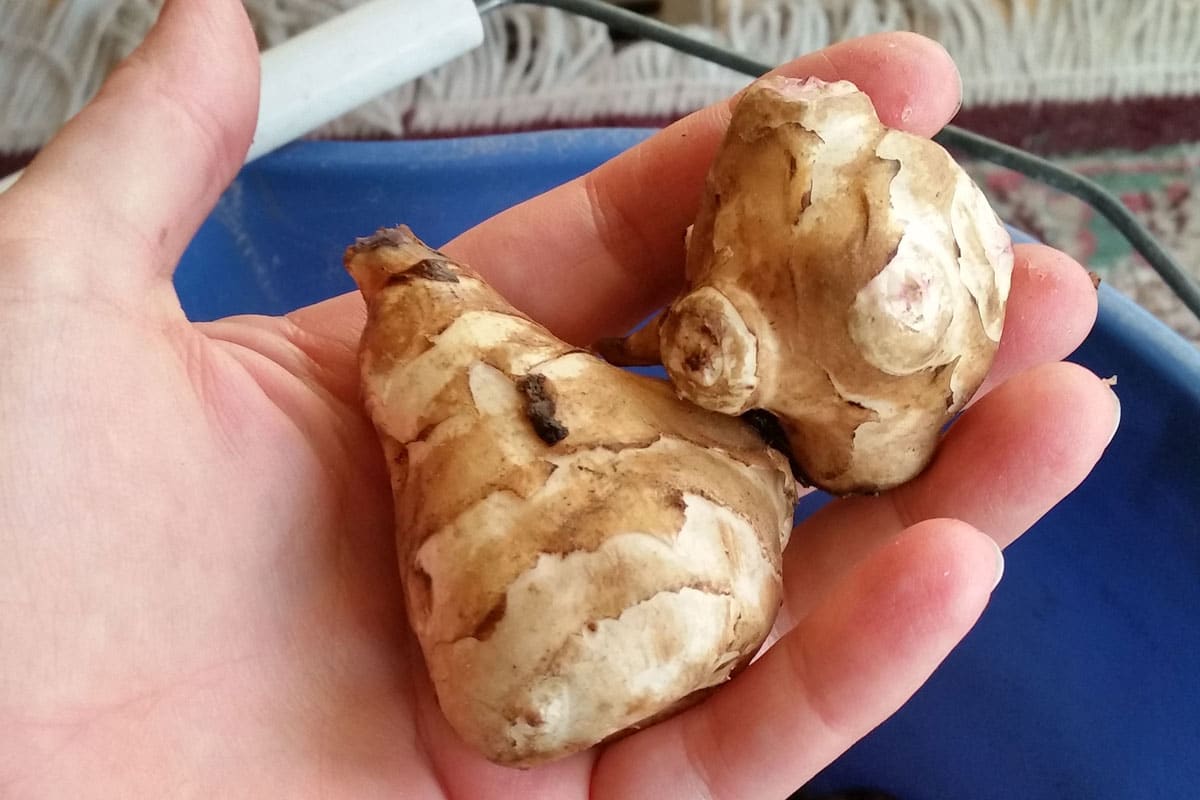
Sunchokes (AKA Jerusalem artichokes) are gaining popularity for their health benefits. I’m sharing how to grow sunchokes, when to harvest and how to use them – plus the big mistake that we made when we first planted them.
Would you like to save this?
Table of Contents
What are Sunchokes?
Sunchokes are native to eastern North America. They are also known as Jerusalem Artichokes or Sunroots. They are not related to Artichokes, but they are related to sunflowers. The whole “Jerusalem” thing is supposedly linked to the Italian word girasola, which means sunflower.
Sunchokes are a perennial plant that grows six to ten feet tall. While they do have pretty yellow flowers, most people grow them for their edible roots. Their roots are high in inulin, and eaten raw or cooked.
Historically, Native American valued them as a food source, especially during late winter when food supplies run low.
How do you Grow Sunchokes?
Grow sunchokes from roots or sections of root, planted in spring or fall while roots are dormant. You can grow the plants from seed, but starting with tubers is easier and faster.
For best results, use the following planting guidelines:
- The plants prefer loose, well-drained soil, but will tolerate poor soils. (Lighter soil makes harvesting easier.)
- Space sunchoke tubers 12 to 18 inches apart, 4 to 6 inches deep.
- Space rows 4-6 feet apart (they will be prone to spreading).
- Soil temperature at planting should be at least 50°F.
- Plant in full sun.
- Do not plant in areas that are consistently wet, as wet soil will rot the tubers. Plants are drought tolerant, but produce best will a regular supply of water.
- pH of soil best between 5.8 and 6.2 (neutral soil)
- Preferred growing temps = 65 to 90 F.
- Cover your soil with an inch or so of organic mulch for easier harvesting and root protection.
- Plant in a dedicated bed that can be mowed around for control. Or sink barriers into the soil around the sunchokes at least 24 inches deep to prevent spreading. (More on this below.)
When are they Ready to Harvest?
Harvest sunchokes in late fall or early spring. They require 110 -150 days to maturity, depending on the variety and growing conditions. Light frost increases the sweetness of the tubers.
Unlike potatoes and some other root crops, sunchokes do not store well. Their skin is thin and dries out easily. I keep them in the refrigerator for 1-2 weeks. They keep best in the ground, dug as needed for use.
In northern areas, a thick layer of mulch may keep your tubers accessible longer. It may also encourage mice or voles to move in and have a snack, but there’s usually enough to share.
For bigger roots, avoid crowding plants and water regularly. You can also cut off flower stalks to encourage root growth. Please don’t cut off all your sunchoke flowers! They flower late in the season, when pollinators have few flower choices.
How do I Eat Jerusalem Artichokes?
Sunchokes are edible raw or cooked, including the skins. They are difficult to peel and turn grey quite quickly, so a good scrubbing is a better option.
Raw, sunchokes are similar in texture to a water chestnut or jicama. After a light frost, they take on a somewhat nutty flavor. For my part, they taste best raw after a frost.
See Jerusalem Artichoke Recipes for easy recipes and cooking tips.
Do Sunchokes Cause Gas?
Sunchokes are loaded with inulin. Inulin is a type of starch that acts as a prebiotic in the digestive tract, feeding our beneficial bacteria.
Inulin is a widely used filler in many foods to bump up the fiber counts. It also increases calcium absorption in the body, and doesn’t spike blood sugar. There are even sweeteners made for diabetics made out of sunchokes.
See Jerusalem Artichoke Benefits: Nutrition, Flavor, and Uses for more information.
Eating a large amount of sunchokes may lead to “mild gas”. They have the nickname “fartichokes”.
I can verify that eating a large portion of boiled sunchokes will give you horrible, gut-racking gas like you have never experienced before… except for that one time when you were pregnant and thought it was a good idea to eat prunes, cheese curds and cucumbers in large amounts all at the same time.
Start slowly when eating sunchokes, and perhaps avoid serving them in large quantities at dinner parties. Give your digestive system time to build up the right bacteria to deal with the extra inulin.
Readers have suggested a couple of different tips to beat sunchoke gas. One suggested that you eat some sunchokes raw, and don’t scrub all the dirt off.
I assume that some soil microbes come with to help aid digestion. Another reader says that harvesting after frost is a big help, as the frost naturally breaks down some of the inulin for you.
A Word of Caution About Growing Sunchokes
“Easy to grow” and “disease-free through heat and drought” are code words for “You will Never Get Rid of this Plant!”
When I first planted sunchokes, I skimmed over the note in the seed catalog that said “they will spread and may be invasive”.
I planted my tubers late in spring, in one corner of a garden bed. There were nine rather wrinkled little roots, and I didn’t think they would all survive. Not only did they survive, they thrived. We tried to harvest the whole patch that first year, but must have missed a few.
The next spring they were back, and they were spreading. We tried to keep up eating them, but the fall was muddy and we couldn’t get in to harvest.
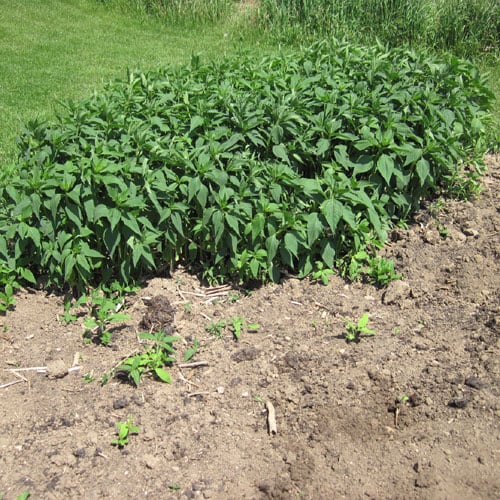
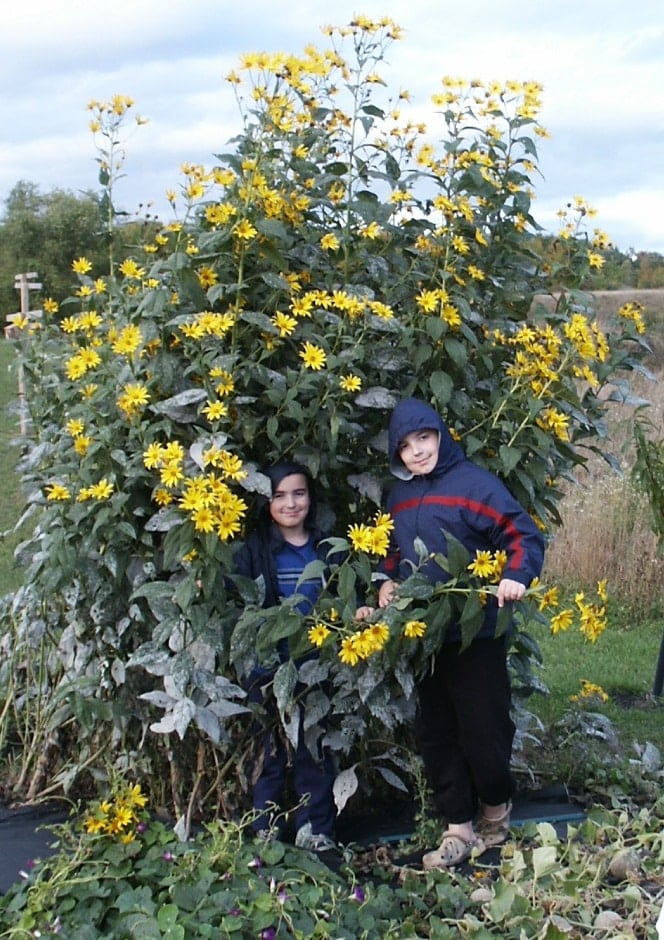
By the third season, we had the lovely thicket of 12 foot tall flowers you see at the post. As I was digging them in fall, I tossed some damaged roots off into the tall grass away from the garden.
Sunchokes Spread from the Smallest Bit of Tuber
Fast forward to spring. Those root bits haphazardly thrown into the weeds – they’ve now sprouted into plants. There’s a new sunchoke colony.
I decide to get rid of extra sunchokes. Two friends come over.
Four different adults attack the patch. Bushels and bushels of sunchokes leave the garden. The patch size is reduced roughly by half to start the spring.
Time passes. My boys work the bed again. They remove more sunchokes from the same area that the adults have already gone over.
Before I put the transplants in, I work over the same area one more time. THERE ARE STILL SUNCHOKES COMING UP! This area has been gone over by four adults and two kids, and there are still sunchokes hiding in the dirt.
Here’s the main patch. You can see the smaller outliers in the foreground. That area should be clear.
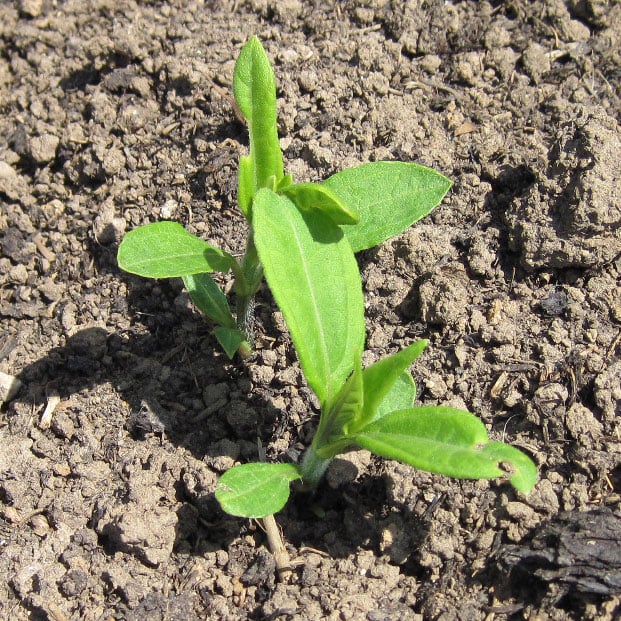
Here’s a nice, innocent looking sunchoke seedling.
Once we dig it up, we see that this single tuber is trying to regrow an entire sunchoke thicket.
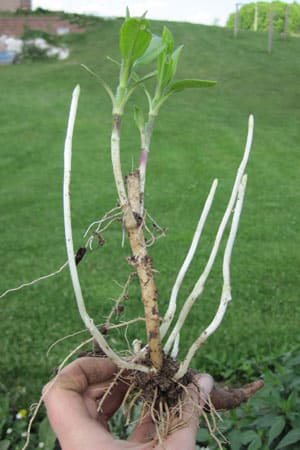
Even tiny pieces, no bigger than the tip of my thumb, can regrow entire large, vigorous plants.
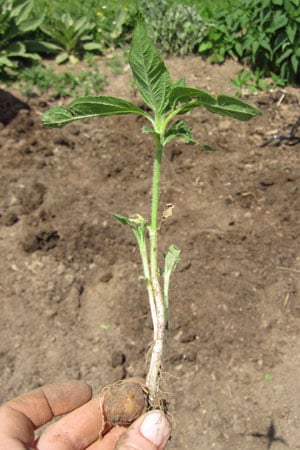
They’re virtually unstoppable. Weeks later, and I’m still digging up shoots from among my cabbage seedlings.
Plan Ahead with Your Sunchoke Plantings
I urge you, do not plant sunchokes anywhere else you might like to grow other plants at some time in the future. You will spend very large amounts of time attempting to remove them if you do.
Plant them in their own area that you can mow around, to keep them under control. You can also plant them in pots – as long as they are big pots. Try one tuber per 18 inch diameter pot. Look for varieties that naturally grow shorter, and have an option for providing support if needed.
My neighbor says her horseradish plants are the same way. Plant both at your own risk. Maybe we should plant them next to each other, to see which one wins.
Alternatively, introduce pigs or chickens into your sunchoke area and let them tackle clean up duty. Jerusalem artichokes make a fine fodder crop.
What Tries to Take Over Your Garden?
Sunchokes are good for you. They look pretty, taste okay, and are quite expensive to buy in many areas, if they are available at all.
They’re a “perfect” choice for a new exotic vegetable to try. I just wanted to let you know that you’re likely to have a lifetime commitment with them once they enter your garden. Don’t say I didn’t warn you.
Are there any other plants you’ve grown that want to take over your garden? Leave a comment to warn other gardeners before they end up fighting them, too.
Also, if you could include in your comments roughly what area you are from, that would be great. Some plants will spread in some locations but not in others.



This article is written by Laurie Neverman. Laurie and her family have 35 acres in northeast Wisconsin. They grow dozens of varieties of fruiting trees, shrubs, brambles, and vines, along with an extensive annual garden. Along with her passion for growing nutrient dense food, she also enjoys ancient history, adorable ducks, and lifelong learning.
Originally published in 2012, last updated in 2026.
I live in northwest Wisconsin and when my husband and I bought our house, there was a beautiful flower bed with a couple of pretty plants that had variegated leaves among the other perennials. I learned that they are called Bishop’s Weed. It spreads fast and will keep coming back if even a tiny bit of the root is left when dug up. Supposedly, Bishop’s Weed is a tasty edible.
Oh yeah! We bought some of that for a groundcover at our last place (they were calling it “snow-on-the-mountain”) and it went nuts. More on it in this video:
Bishop’s Weed, despite it’s invasive character, has some valuable herbal properties, as noted in the blog below. I had heard the flower, also known in Ayurvedic medicine as Ammi visnaga, or Khella, described as beneficial for relieving asthma symptoms. It has a nice fragrance somewhat reminiscent of Moroccan Blue Chamomile, a scent that I really love and have used for allergies. And guess what, Laurie, in the first comment dated Sept. 22, 2007 it is also used topically to treat psoriasis, with one of its components termed “psoralens”. Treatment with it is described, but in a way that I would approach as an opportunity for cautious experimentation. I discovered a little patch of the variegated variety in a shady spot under a tree that seems to be staying right there. The non-variegated variety was recommended to me as an attractant for trichogramma wasps. It reminds me of one of those troublesome relations who hav numerous and substantial charms and a few dreadful habits. http://www.thisgardenisillegal.com/2006/05/virtues-of-bishops-weeds.html
A further, and maybe my last note on the Bishop’s Weed topic. Wikipedia has a brief discussion on Bishop’s Weed that lists several quite different plants. The dreaded invasive Snow-On-The-Mountain aka Bishop’s Weed is termed Aegopodium podagraria. The Ammi visnaga/Khella of which I am so fond is very different in appearance, with lacy, all green leaves. This distinction is important to me personally, because in my township uncontrolled patches of Bishop’s Weed/Snow-On-The_Mountain can make me subject to a fine of $125! I can now demonstrate that the patch of Ammi visnaga I will be planting this year is all good and penalty free! There are other therapeutic plants that have the name Bishop’s Weed attached to them, including Ammi majus, which the one used to treat psoriasis, though it is phytophoto-sensitizing, and should be used with caution. How so many plants got the name Bishop’s Weed is not explained.
Always good to have a positive ID when dealing with medicinal and potentially invasive plants. It’s been an eye-opener to me as I continue researching just how many different plants may share a common name.
I planted the Jerusalem artichoke two years ago. It is multiplying this year. I have a forest area in the rear of my home. I am moving it there. I found that if planted next to other invasive plants it stays put a bit better. Also, the deer eat it. I have a LOT of deer. I have no intention of eating it or doing anything other than enjoying the flower. SE Michigan
We live in Southwest Colorado and love our Jerusalem Artichoke plants, they don’t seem to be spreading and provide welcome shade and pretty yellow flowers. Have never tried eating the tuber though. Our problem with invading plants is the Russian Sage, with pretty purple flowers. We have tried just about everything to at least keep them under control, but nothing has helped. They are root based and spread like crazy, friends said it has taken them 3 years to ‘finally’ get rid of them (haven’t heard if they are back again this year). They have used Roundup and hooking a chain/rope around the base and pulling out with a truck! Roundup doesn’t seem to work on them.
Lots of plants have become resistant to RoundUp, which is why they’re now making even more toxic weed killers. Weeds are survivors, and many of them have seeds that can last for decades in the soil until the right conditions for growth are available. The best long term strategy is changing the soil and microclimate, but it’s a long term commitment.
BAMBOO/MINT/SNAKE GRASS/HORSETAILS/ just for starters, the bamboo looks spectacular but it kills everything it touches, the dead
leaves that fall also kill any other green, it sends out hideous roots that will buckle concrete, paving stones, grow through walls… plant at your own risk!
Bamboo is also hard on loppers and shears because it contains silica. Bermudagrass is worse.
This is a great article and the posts are very enlightening. I ran across an article about sunchokes that said they are a native plant that you only have to plant once and never worry about. It never mentioned how it proliferates or should I say takes over. Thanks to all of you for all the information found here. I will put it to good use.
I think we have sunchokes in with the sunflowers that were here when we bought our land. We love the privacy and beautiful flowers they both give. The problem is I am not sure they are sunchokes and afraid to eat them until I’m sure. It would be great to try them, and know we have food stored in the ground.
A few plants that are invasive here in zone 5 are common Pink and Purple Morning Glory and Perilla (I think its Perilla). A friend gave me a few plants years ago and she had forgotten what they were. I just thought they were pretty with deep redish purple ruffled leaves so I planted them. They self reseed everywhere. I like them everywhere, but in a small yard they would be a pain. I am transplanting a bunch every year as a border along the gravel drive. Pretty!
If you take a plant sample into your local cooperative extension office, they should be able to give you a positive ID.
Dear Laurie,
I enjoyed your post very much, and how true it is! Years ago I planted sunchokes in our small urban garden. I enjoyed the sunchoke forest that grew and the little leaf hoppers that appeared with them. I enjoyed the harvest, also, and shared the sunchokes with my diabetic grandfather. But–just as you said–I like to plant different flowers and vegetables each year, so it was, indeed, a battle to eradicate them.
Thank you very much for your post warning us happy gardeners! It is informative and entertaining, too! Loved the pictures, as well!
Rosemarie 🙂
They may be a great way to feed the world, but they do not play well in the garden. 🙂
Oh my goodness I laughed so hard as I read this only because I can totally relate. We have a raised garden area. It had sunchokes planted in it. My mother and I tried to get them all out…we dug a good 12 inches down through the whole bed and I STILL have them coming up. Obnoxious, persistent buggers!
On the plus side, you will never starve. 😉
I just found your blog and I love this! You had me cracking up. 🙂
I think I’m going to try some “chokes” next year in a half wine barrel as specimen plants and for eating. I would LOVE to grow them in a lightly shaded area on our property for a privacy screen, but I’m not sure how well they would grow in dappled light. I might try just for giggles.
In the meantime, I’m going to try them in a half wine barrel in the sun.
I suspect they’d do fine in partial sun, but so far I haven’t tested it since my growing area is all full sun.
I’m growing them for several reasons. I have an area that nothing but weeds will grow in and because they are easy to grow and invasive I am hoping they will COVER the area. The more the better because my bees (50 hives) will love the flowers, my goats will devour the plants, the seed heads will be good for the poultry, and the roots will be good to grind up for all of the animals as well as for me to eat. I’ll be growing comfrey along with it. Just wondering what to do with all of the fat goats, chickens, and honey I’ll have. Win, Win! :^)
Sounds perfect!
I’ve enjoyed growing sunchokes for several years now, both at the garden-forest boundary and in half wine barrels (which they will absolutely fill up with tubers!), but my wife never really liked the taste, until…
I made veggie fritters with them! I know this isn’t a cooking post but I just have to share this. Boil a mixture, about equal parts, of white potatoes and sunchokes, and about half as much carrot and leek, until tender enough to smash. Drain and smash. Add an egg and another egg yolk (extra yolk keeps fried foods from absorbing as much grease), 2 or 3 Tbsp of butter, a little milk, salt, pepper, and garlic to taste, a few dashes of soy sauce (I actually prefer Bragg’s liquid aminos), and enough flour to make it like pancake batter. Chill it to thicken some more, then simply drop spoonfuls of the mixture into hot deep fat fryer at 365F-ish. Fry about 2 minutes, then flip fritter over and fry for about 2 more minutes. Excellent plain or with a horseradish flavored dip (use those “invasives!”) Makes more than you think it will, so make less than you think you need.
My wife said, “I LOVE sunchokes like this!!” I think I’m going to have to make some for dinner now…
Love your site and the commenters.
Tripp from North Georgia
http://Www.smallbatchgarden.blogspot.com
Thanks for the recipe!
Fascinating thread! I just dug my first crop of sunchokes (Georgia). I see the plant wild all over, but when I dig in the ground the wild ones don’t have tubers?..I have some of the mentioned invasives, especially lemon balm. Also yarrow, passion vine, mint. I like them. Good to have tea around all year.
I think the domesticated ones have been selected for larger tuber size.
I have a problem with blackberry bushes-they’re self reproductive and, very invasive all over Washington state. I’m diabetic and just received the 20 sunchoke tubers I ordered from back east. I want to start eating them to see what effect they will have for my diabetes. Will plant most of them in large containers until next spring when I’ll make my final decision where to plant them.
My question, if anyone can answer is, how well do they fare against these invasive blackberries?
Leonard, I have never seen any plant that Sunroot cannot shade out of existence, including black raspberries and quackgrass.
Ha! I wish we had that problem here in Ga. We can’t keep a crop from year to year, and the crops we did have dwindled in production.
I don;t have a problem with spreading here in central WV…the deer love the plants. I have to fence them in to have any at all. Lost all I had planted a few years ago to the deer. Will be replanting some soon this spring.
How To Get Rid of SunChokes : ( not recommended – lol )
Dump too much Soil Sulfur on em and dig it in ! (They call it “Agricultural Sulfur” now).
The Sulfur is good medium for some kinda fungus or bacteria or something which rots the SunChokes when it gets warm/wet enuf for the Sulfur to become “active”.
Then don’t let em get any water for winter so the soil becomes like a hunk of cement on top. (If u don’t live in desert climate, I suggest maybe covering with plastic for the winter? – or probly someone else has better suggestion for this).
Takes a whole year in high altitude desert climate (NM, 6 to 8 months of winter with little bouts of “spring” happening during normal spring & fall and sometimes during normal early or late winter, can snow here allah way into June) with very heavy clay soil (alluvial plain, mostly naturally neutral Ph here, which surprised me after Southern CA and was why I made the mistake of using too much Sulfur without doing a Ph test first.)
Of Course then u’ll hafta re-do the soil in that area, ugh . . . and it won’t be useful for anything else for quite some time . . .
Not a very good solution, I’ll admit, but it does work, tho I don’t recommend it.
I’m very successful at digging em out, dig deep (about 1.5 to 2 feet or more if the soil is richer and deeper) and wide and comb thru the soil for stray pieces then keep eye out for new sprouting pieces to dig out – in one growing season, have eradicated them completely this way in the areas where I’ve been persistent thru-out the growing season. I must be a “pig” LMAO!
The plant I need to be MOST vigilant of is Yellow Dock, aka Wild Rhubarb, aka Curly Dock (among other names) — also a useful plant but, talk about a DEEEEEEEP root ! If it gets established I hafta dig SEVERAL feet to get it all.
SunChokes make a great wind break if u have enuf space to dedicate solely to SunChoke – leave the stalks standing and wind break is good thru winter. This year I’m not gonna bother removing the stalks at all (except when I wanna use em for other things – very useful) – becoming a tangled thicket . . . But then, I don’t have any HOA on my back and rural area so no neighbors close enuf to complain about how it looks.
Gophers like em in the winter and have done quite a lot of clearing for me.
But come spring when they start sprouting, even Gophers don’t like em it seems.
They dry very nicely for long term storage – cut into ~ 1/2″(-) pieces B4 drying in the sun or in warm dry place then store in plastic baggies – dry em soon after harvest in the fall, B4 their starch composition changes to potato texture if u want the inulin & sweet sunflower seed flavor.
About “seeding” – I have read that seeds take 530 something days to germinate (sorry, lost track of the article in my file storage). ? ? ? Interesting about the dif varieties. Maybe I have the non-viable seed variety ? ? ?
In my early SunChoke days, I tried seeding em. Wondered why they wdn’t sprout.
I’d guess that what ppl are seeing are mostly not seedlings but shoots from pieces of root and/or tuber or else they have a dif kind ? ? ?
In Dicotyledon species,(flowering plants as opposed to grasses which are monocots), the cotyledons are the first pair of little leaves that are formed from the seed “food” around the little plant germ in the seed. They are usually a dif shape from the normal leaves of the plant on Dicots . . . If it never has cotyledons, then it’s not from seed.
I have enuf dried SunChoke to last me for YEARS! Gotten tired of eating em. LOL ! ! ! ! ! ! But they’re still very useful and extremely good nutrition.
Ani
Yellow Dock grows vigorously where I live up North. Accidentally discovered that cutting of all the leaves at ground level and laying them over the top of the root (corm?) so that it is completely shaded off will keep it from growing back for the rest of the season, the bigger the plant and its leaves, the more complete the effect. Before discovering this I laboriously dug many of these out by the root during the wettest of spring winter and had broken bits of the root re-grow. This mulch technique is so much easier, and it often causes the plant to die and not reappear. I also hunt for and cut off the flower stalks when they appear in summer. If they have matured into seed, I burn them. There are plenty of of other weeds that I allow to go to seed, plenty for the critters to eat without the dock.
There is a variety that does not flower which means it doesn’t seed. It spreads by tuber only and can be grown in buckets. It is called Supernova Sunchoke. It may not be as pretty as some of the others but if you are growing it for food and keeping it contained then this is the variety that will be best suited for that purpose. It has a very mild flavor for a sunchoke and is pretty much universally liked. I hope this helps. Best of luck guys!
Thanks, Erin.
I am so glad that I read this. I just bought 6 tubers and was planning on just digging a hole in the back corner of the yard and tossing ’em in. Now, I will definitely be walling those suckers in before I do. Do you know about how deep their roots go?
About a foot, give or take.
Thanks for the informative and thoroughly entertaining account of your experiences! I am planting sun chokes that I let mould by accident in hopes they will sprout the way potatoes will if you put peelings into the ground. From your post, I assume this will work easily.
Until I read your post, I felt guilty eating these because I assumed that something that tasted this sweet must be high on the glycemic index or otherwise not good for me. Luckily my body processes these with no issue but, I will look out for increased gas in case I missed it.
I want sun chokes to take over my parking strip (between side walk and street) and I am encouraged by your piece that this will happen.
Since you have not enjoyed eating these, may I suggest that you try softening them by sautéing thin slices in butter until they are bendable and then layering them in a buttered gratin dish with gruyere, s&p, butter, and cream & baking for 40 min on 350. Yummy!
I forgot to say (and you asked that we mention this) that I will be planting the sun chokes in San Jose, CA. I am also glad you mentioned they come back after mowing because I’d love it if the sun chokes edge out the lawn currently in the parking strip. Until that is successful, I still must mow. It’s so helpful to know that the sun chokes are likely to survive this well. After paying $4/lb for these at the Farmer’s Market and $6/lb at Whole Foods, I will be grateful to have a huge supply for only the cost of the watering.
I agree they ARE prolific. I started mine in a monster pot a couple years ago and still harvest, with out re-planting. The friend that gave me the original (she gave me one root) started selling her excess at the farmer market. I know it doesn’t help with the invasion, but it might help with the surplus.
My yard has oregano, chives, spearmint, sunchokes, and wild black/rasp berries. Good thing I have a BIG yard! My sunchokes have been in there for 20 years + now and are rarely harvested. However, a board over the top of them flat before they come up in the spring helps, as does pulling them out in the spring before they flower. We don’t like them very much, although they aren’t bad with Euell Gibbon’s crock pickle liquor, pickled. But otherwise? If I had chickens (next year) I’d just give the chickens almost all the roots. The oregano, chives, and spearmint get mowed down when they “escape” their beds. I also pull leaf bags full of plants up in the fall and dry them. Gives me enough for almost a year (2 people). We drink mint tea year round and I add the oregano to almost everything stew or soup like. I also have chive butter in the freezer — good on baked taters and in soups.
How do you make your chive butter? Do you dry the chives, or blend them and mix with the butter?