
Working with Nature – Shifting Paradigms – Book Review

This post may contain affiliate links. Read my full disclosure here.
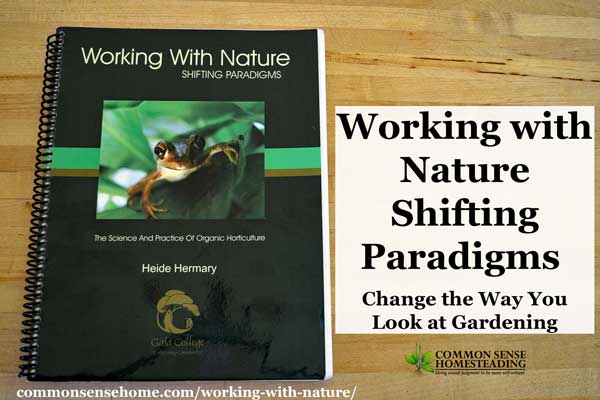
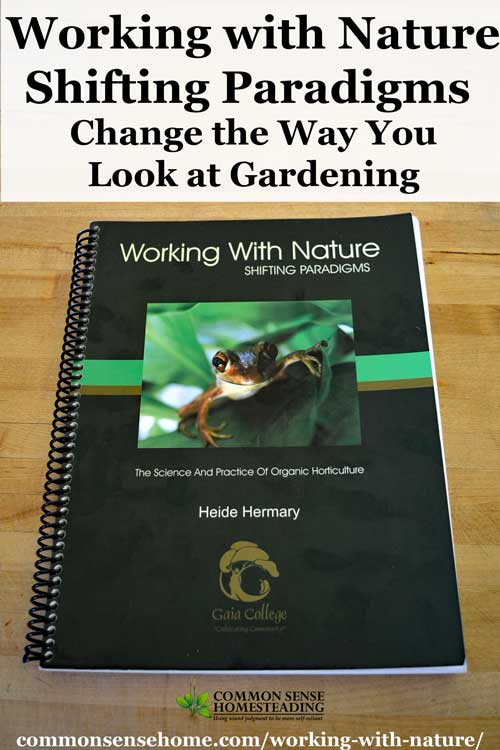
Working with Nature – Shifting Paradigms: The Science and Practice of Organic Horticulture was one of those books that had me jumping up and saying to my husband and boys, “Look at this!” The author, Heide Hermary, opened my gardening world to a whole new range of ideas and possibilities.
Would you like to save this?
How is “Working with Nature – Shifting Paradigms” Organized?
Working with Nature – Shifting Paradigms is divided into eight chapters:
- Relationships within Ecosystems
- Soil Relationships
- Water Relationships
- Working with Water
- Working with Soil
- Diagnosing Ecosystem Needs
- Working with Energy
- Working with Health
In her introduction, Heide outlines some of the problems with the status quo, including:
- Contamination of our food supply with GMOs (genetically modified organisms) and chemical toxins.
- Decreasing biological diversity and increasing ecosystem destruction
- A food supply that is lower in essential nutrients. We are starving in a land of plenty.
She suggest that we start asking new questions instead of simply attempting to fund new solutions for the old questions. If we care for the land, the land will provide for us. It’s a win/win.
Highlights from Working with Nature – Shifting Paradigms
The book contains over 200 pages densely packed with information, plus a bulging reference list for further investigation (there’s literally a lifetime of investigation waiting for you here). I’d like to share some of the ideas that caught my attention.
Trade Alliances Between Plants and Microbes
In chapter 1, Heide discusses Trade Alliances, that is, alliances between organisms that benefit both parties involved. Most of us are familiar with the pollinator/plant relationship, but I think many of us are unfamiliar with microbe and soil allies.
She shares that all plant leaf surfaces are “naturally colonized by a great diversity of microbes that feed on the metabolic wastes excreted by plants”. These microbes, in return, protect the plant from diseases, insects and possibly airborne pollution. I
noculating a plant with compost tea has been shown to protect a plant from aggressive plant damaging fungi. Have issues with downy mildew or blight? Compost tea and Effective Microorganisms may be your answer.
The Role of Myocorrhizal Fungi
Have you ever heard of mycorrhizal fungi? Oddly enough, I first saw the term “mycorrhiza” years ago in a fantasy novel – “The Dragonriders of Pern”. In that series, they adapted naturally occurring plant protectors found in the soil to protect and heal plants from an extra-terrestrial attack. 🙂
In our world, mycorrhizal fungi colonize plant roots. They then send out hyphae (branching filaments) into the soil (potentially miles of filaments) to gather nutrients from the soil that the plants have difficulty obtaining on their own. They trade these nutrients to the plants for carbohydrates. Pretty cool, huh?
These fungi also acts to protect the plant roots. They repel bacteria that would consume the roots. In fact, soil dwelling fungi have been used to develop commercial antibiotics.
Basically, there is an entire ecosystem in miniature associated with every single plant. The healthier and more robust this ecosystem is, the more likely your plants are to thrive.
Any time you disrupt this ecosystem – via tilling, applying chemicals (even fertilizers – many synthetic fertilizers are toxic to microbes) or introducing GMOs – you damage this ecosystem. Conversely, with the reintroduction of helpful microorganisms (such as the application of compost tea), badly damaged “worn out” soil can be healed.
Using Biological Transmutation to Heal the Soil
Another intriguing concept addressed in the book was biological transmutation. Heide describes how living organisms (animals, plant and microbes) can transform certain isotopes of some elements into specific isotopes of other elements. (Yes, some animals, plants and microbes have mastered alchemy.) This is relevant to gardening because it appears that within an ecosystem, certain plants don’t simply grown well together as companions, they do so by providing for the needs of the system by transmuting the very elements available in the soil.
I know this sounds pretty bizarre, but an example she gave was how calcium rich dandelions show up in calcium depleted lawns. I have always read that the dandelions have deep tap roots, which allows them to mine these minerals from deeper in the soil. (Heide notes the same thing.) However, in her horticultural experience, she has found that dandelions have roots that are not much deeper than grass roots. She asks the question, “Are dandelions depriving the grass of calcium, or are they producing (transmuting it) it?” She continues to state, “It looks like our war on unwanted plants, insets and microbes is costing us money twice; once to kill the organisms, and again to apply the nutrients that are now no longer provided by the ecosystem.”
Feed the Soil, Feed the Plants
I could go on and on – from debunking the myth that blueberries need acidic soil (they really just need the nutrients that are often available in such soils – pg 146), to pointing out the problems with drip irrigation (how can you have a healthy, diverse ecosystem in a soil that’s starved for water? pg 82) to working with energy in the garden (chapter 7 – somewhat “out there” for many, but if you read it a lot of it just makes sense) – this book is a wealth of information. It’s like no other gardening book I have ever read.
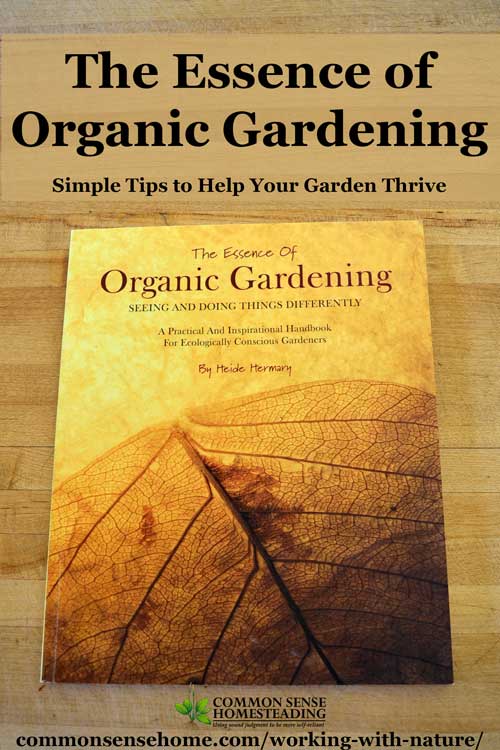
The Essence of Organic Gardening: Seeing and Doing Things Differently
Along with Working with Nature – Shifting Paradigms, Heide has also written a book titled The Essence of Organic Gardening: Seeing and Doing Things Differently. This 43 page book is a great introduction to organic gardening, explaining to the reader the basics of what defines a healthy garden, and simple tips for making your garden thrive.
She discusses:
- Creating communities via companion planting and providing food and habitat
- Feeding the soil dwelling organisms via mulching and fertilizing
- Increasing microbial diversity via compost, compost tea, fermenting microbes and mycorrhizal fungi
This book would be a wonderfully quick and easy read for those new to gardening, or those who have been gardening for a while using mainstream gardening tactics. We shouldn’t be fighting nature, we should be working with nature.
In many ways, we have acted like curious toddlers, wandering into our environment and making changes with having any true understanding of the long term and widespread effects of our efforts. These books are part of a slowly growing movement to work with the earth instead of simply bending it to our will. It is long overdue, and I believe we will all be the better for it.
In Remembrance of Heide Hermary 1948-2016. Heide was president of Gaia College in British Columbia, Canada until her passing in 2016. Gaia college offers a variety of classroom and online programs. Heide held a Masters Degree in Sustainable Agriculture and a Diploma in Landscape Design, Maintenance and Installation. In 2007 she received the Educator of the Year Award from the B.C. Landscape and Nursery Association. She was also the co-founder of the Society for Organic Urban Land Care.
I’m new to gardening and am loving it. I would love to learn more about it.
I am very concerned about the rampant and irresponsible use of GMO’s. I have posted on my timeline as much info as I can find and wish there were more people paying attention to what is going on. We are worried about weight in our children as we stuff them full of alien foods filled with hormones and heaven knows (or doesn’t know because it wasn’t suppose to be this way) what has been done to foods designed to feed our bodies well. Thank you for spreading the word.
Glad you stumbled across this Laurie – I can vouch that it’s a fantastic book. Good review, too.
These sounds like great books. I think many of us are ready for a shift into a truly sustainable culture and the way we treat the land that provides us our food is an important place to start.
Our family is working hard to get our good sized backyard turned into a productive garden but we all have brown thumbs. Wondering if you could tell the best tips you have for “folks like us”.
Hi Delores from Central Valley, Ca.! I also live here and have been growing foods organically for some time. These books have some refreshing new ideas I’d like to find out about. I have read about certain plants with the long taproots and the seasonal planting just for the purpose of tilling in nitrogen each year. Each new idea just adds to leaving the earth better than how we find it.
What a timely post! I am always amazed at how God created our Earth to handle so many of its own issues if we will just get out of the way!
I have been gardening all of my life and I still can never wait until it is time to garden every spring again!!
This looks like such a fascinating book! I’ve got it wishlisted on Amazon now, but I must say I’m hoping to win it- our garden is getting bigger and better every year and I want to learn all I can about it!
I don’t have much experience with gardening, but I am just about to move out of an apartment and into a house with a nice empty yard (no grass or anything) and a lovely hill covered with vines and brambles. I’m very excited to start planting!
Great review and a definitely a tool I can use – Not only to better my own working knowledge but argue more effectively in favor of my hobby/obsession!
Looks like a wonderful book! We are starting a sustainable garden in hopes of selling produce at farmer markets. This would help immensely.
I believe it, you cant feed soil fast food chemical fertilize and expect different
Results. Ive been living in the cental valley of calif my whole life, when farmers used real fertilizer the soil was Darker, fruits were sweet, now there are no worms in the commercial crop areas as there is no organic
Matter in the soil to process. No worms no top soil, no top soil no food.
Healthy plants are not as affected by pests as are sicklly ones. It only makes sense. Healthy food needs healthy conditions, it cant give nutrients to the food when there is none to put in it. We are a symbiotic planet, we need to work together for the good of all.
What a wonderful book. Thank you for the opportunity and for the information on your blog.
Makes SO much sense
I am interested in companion gardening and specifically in organic gardening efficiently in small spaces. I’ve been interested in aeroponics and aquaponics as ways of growing in vertical spaces.
I’m finally having a little garden (in the dirt, not pots!) this year. Probably the first time in 11 years. 🙂
This is my third year of Organic gardening and every year is more exciting, more information to help me. I’ve had good crops and some not so good, but love every minute. I’m planning on expanding my garden and to try my own compost. I would love to win to continue learning.
I have a greenhouse and was wondering what is the coolest temperature it could reach without hurting my seedlings?
I haven’t been gardening long (2 yrs), and have 3 girls who love being in the garden with me. I love this time, because we get to learn together how plant grows and reap the benefits of growing our own food. They absolutely love the fruits and veggies we grow as oppose to store bought. Once the plants start to bear fruit the kids are always out there eating right off the plant. This year we have new plants; nectarines, blueberries, and raspberries.