
How to Stay Warm During a Power Outage

This post may contain affiliate links. Read my full disclosure here.
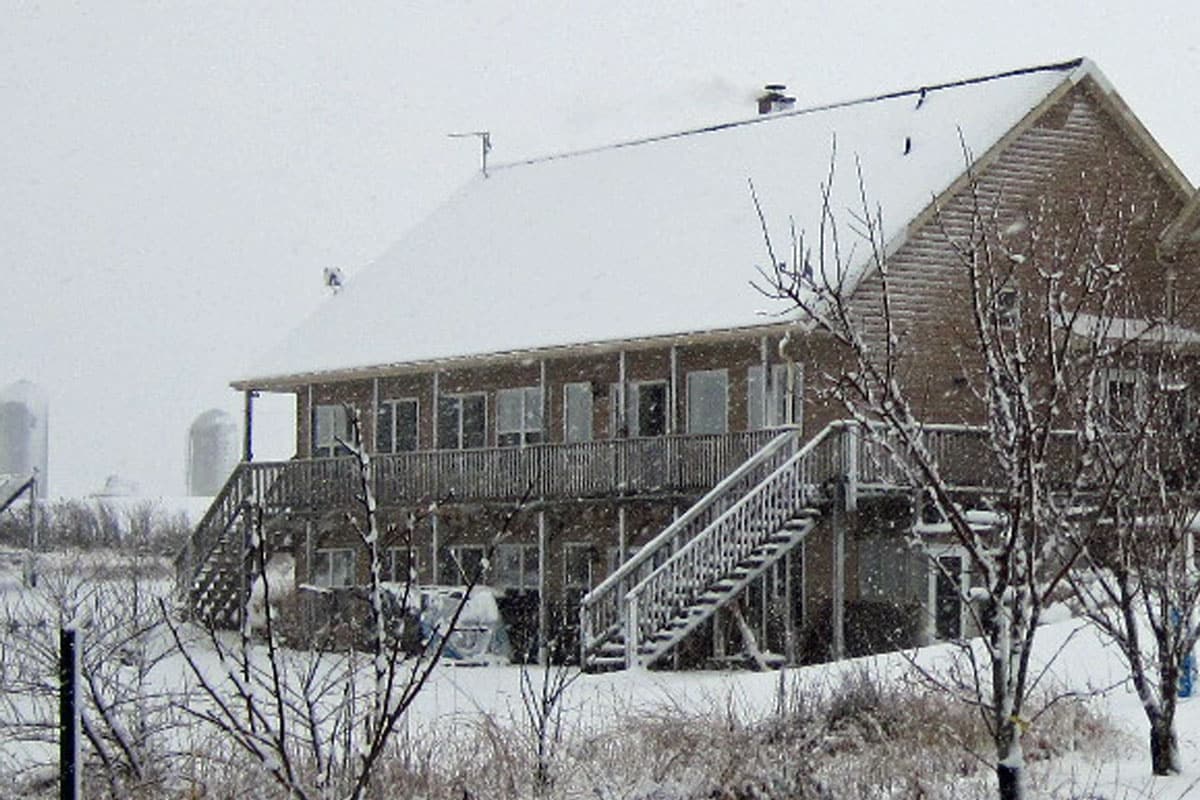
When a winter storm knocks out power, staying warm becomes more than a comfort — it’s a matter of safety. Extreme cold weather, wet clothing, and lack of heat can quickly lead to frostbite and hypothermia. The good news is that with a little preparation, you can stay warm during a power outage – and pass the time in relative comfort.
This guide covers how to stay warm during a winter storm, prevent your pipes from freezing, and avoid the dangers of carbon monoxide poisoning. Whether you’re hunkered down at home or helping older adults and neighbors get through extreme cold, it pays to prepare.
Would you like to save this?
Table of contents
Prepare Before the Storm Hits to Stay Warm
A few simple steps before a storm can make a big difference when the temperature drops and the lights go out.
- Fuel up. Make sure your propane tank is full and you have extra firewood stacked and dry. If you own a generator, test it and top off fuel supplies.
- Turn up the heat. If you know a storm is coming, set your thermostat a few degrees higher than normal to build up warm air in your home.
- Check your heating system. Clean filters and test your furnace, heaters, and fireplaces before the storm so everything’s ready to go.
- Gather emergency gear. Keep flashlights with fresh batteries, extra blankets, and a first aid kit in your home.
- Stock water and easy meals. Fill bathtubs and sinks with warm water for washing and flushing toilets. Prepare ready-to-heat foods before the storm so you can save your fuel and body heat later.
See also: Winter Preparedness Checklist for You and Your Home
Step 1: Stop Heat Loss
Before you think about adding heat, focus on keeping the warmth you already have.
- Seal off drafts. Close doors to unused rooms and block drafts under doors with rolled towels. Hang heavy blankets over windows and doors to stop cold air from creeping in.
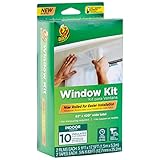
- Insulate windows. Shut blinds or curtains tightly. For extra protection, tape up bubble wrap or use a 3M window insulation kit.
- Create a “warm room.” Choose one small interior room — preferably away from the wind — and have everyone sleep and live there. Layer rugs, blankets, or even cardboard on the floor to trap body heat.
- Use airlocks. If you need to go outside, enter and exit through a porch or garage to keep cold air blasts out of the main living space.
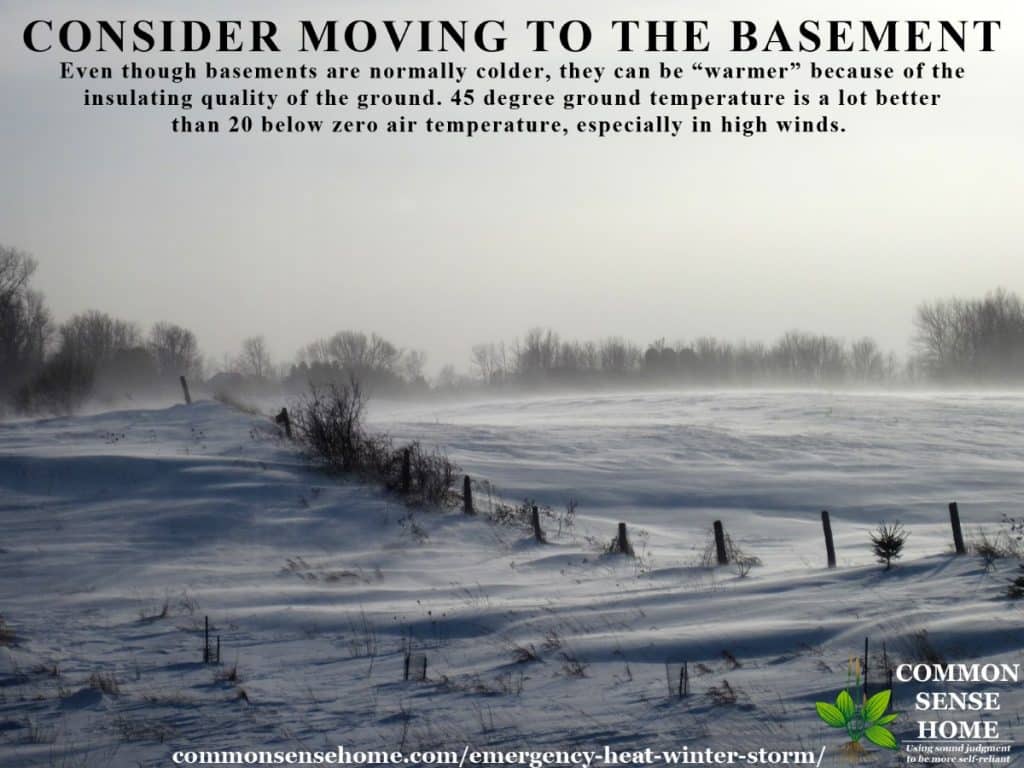
- Head for the basement. The ground’s insulation often keeps basements warmer than upper floors, especially when outside air dips below zero.
Step 2: Add Safe, Alternate Heating
Once you’ve sealed the drafts, you can focus on safely adding heat back into your home.
Indoor heaters and fireplaces
- Wood burning stoves are one of the best sources of heat during a power outage. Burn in cycles to conserve wood — it’s better to warm up the room well, then let it cool slightly before the next burn.
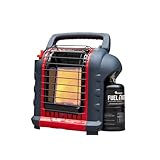
- Indoor-rated propane space heaters (like Mr. Buddy heaters) are excellent alternate heating sources. Keep extra propane canisters on hand and make sure the unit is clearly labeled for indoor use.
- Fireplaces add both heat and morale. Keep screens in place to avoid sparks and be mindful of proper ventilation.
Use the sun and other safe tricks
- Capture solar heat. On sunny days, open curtains on south-facing windows and let the light in. Place dark blankets or rugs where the sun hits to soak up warmth.
- Hot water for warm air. A full tub of hot water radiates gentle heat into the room — just remember to drain it if the house temperature drops near freezing.
- Heated bricks. Warm firebricks on an outdoor grill, then safely bring them inside to release slow, steady heat.
⚠️ Never use grills, ovens, or unvented heaters indoors. Carbon monoxide poisoning can happen quickly in enclosed spaces. Always use a battery-powered CO detector when running any open-flame device.
I do not recommend the terracotta pot with tealights heater that regularly makes the rounds on social media. They can cause house fires, and don’t work very well.

Step 3: Conserve Heat and Body Energy
When the power’s out, think like a camper — every bit of body heat counts.
- Live in one room. Stay together in your “warm room.” Cover doors with blankets and have everyone sleep in the same area. Shared body heat can raise the temperature several degrees.
- Try “camping inside”. Set up a small tent indoors to trap warm air. Use sleeping bags to hold even more heat, especially with a layer of cardboard or a rug underneath to block cold from the floor.
- Cover Those Heads. Put on a light comfortable hat or other headcover to sleep. (“And ma in her kerchief and I in my cap, had just settled down to a long winter’s nap.”)
- Have something to help pass the time that doesn’t require power. Get a couple of decks of cards and a card game book, or some print books. Board games are great, too.
Dress Right to Stay Warm
Your clothing is your first line of defense against extreme cold.
- Dress in Layers. Start with a moisture-wicking base layer, add insulating layers like wool or fleece, and top with a wind-blocking shell.
- Protect extremities. Wear gloves under mittens, thick socks, and insulated slippers or boots. Cover your head — you can lose a lot of body temperature through it while sleeping.
- Stay dry. Change out of wet clothing immediately. Damp fabric steals heat fast and increases the risk of frostbite and hypothermia. (More on this in the post, “Emergency Underwear and Socks“.)
- Use hand and foot warmers. Chemical warmers or rechargeable heat packs are great for gloves and boots.
- Choose quality insulation. Look for higher-gram Thinsulate™ or traditional wool and down. For very cold conditions, 600–1,000 gram insulation in boots is ideal.
See “The Ultimate Guide to Practical Cold Weather Clothing” for more information.
Eat and Drink to Stay Warm
Keeping your metabolism up helps maintain body temperature from the inside.
- Eat more calories. Your body burns extra energy just to stay warm. Focus on hearty foods like nuts, jerky, nut butters, and soups.
- Enjoy hot drinks. Herbal teas, cocoa, or broth can warm you while adding hydration.
- Avoid alcohol. It may make you feel warm temporarily, but it actually lowers core body temperature and impairs judgment.
Stay hydrated — dehydration makes it harder for your body to regulate heat. Melt snow if needed, but filter or boil it first.
See also: Emergency Cooking – 10 Ways to Have a Hot Meal When the Power Goes Out
Protect Pipes and Water Supply
When cold air lingers, frozen pipes can become a major problem.
- Let faucets drip slightly to keep water moving and prevent pipes from freezing and bursting.
- Open cabinet doors under sinks to let warm air circulate around plumbing.
- If you have a well pump, remember it won’t run without power. Keep water stored in tubs, sinks, or portable containers before the storm.
See “Prevent Frozen Pipes – Extreme Cold Weather & Construction Tips“.
Personal Hygiene and Safety
A long winter power outage can make sanitation tricky.
- Use stored water for washing and toilet flushing.
- Follow the “mellow yellow” rule to conserve water.
- If you lose running water entirely, use a lined 5-gallon bucket as a temporary toilet. Add sawdust or shredded paper to absorb waste. See Portable DIY Toilet instructions here for more information.
- Keep baby wipes for sponge baths instead of full washing — staying dry helps you stay warm.
Use the cold to keep food fresh. If it’s warm enough that food will spoil, move food to an unheated garage or outside for natural refrigeration. Statistically, here in Wisconsin, January is the coldest month on average.
When It’s Too Cold to Stay Indoors
If your home becomes dangerously cold, use your vehicle for temporary heat — but never run it in a closed garage. Let it idle outside for short periods, bundle up with blankets, and warm your body before returning inside.
Older adults and small children are especially vulnerable to hypothermia. Check in with neighbors and family members. If indoor temperatures drop near freezing despite all efforts, relocate to a shelter or friend’s house.
Final Thoughts: Stay Safe and Warm
Winter storms can test your resilience, but preparation and calm action make all the difference. Seal out cold air, add safe alternate heating, wear warm clothing, eat well, and stay dry. Keep a carbon monoxide detector nearby, and always err on the side of safety.
With a little foresight — and maybe a tent in the living room — you’ll be ready keep your family safe, warm, and comfortable.
Related Articles

This post was written by August Neverman IV. August has a strong background in emergency preparedness. He served on several emergency preparedness teams during his tenure at Brown County WI Government, the Medical College of Wisconsin, HSHS, a 13-hospital system and emergency response training during his time with the Air Force and Air National Guard. Learn more about August.
Originally posted in 2015, last updated in 2025.
If you know a storm is coming:
*Charge outdoor solar lights to use indoors if power goes out.
*Keep a supply of chemical hand warmers to use on yourself or in your bedding, indoor tent set up and more.
*Invest in a power inverter. It can be used indoors, is quiet, and can be charged by electric, your car or solar panels.
*Boil water and fill all your thermos containers ( prep by filling with hot water while the remaining water is beginning to boil. Dump hot water out and fill with boiling water.) In my experience, my 4 Stanley Thermos containers keeps hot for at least 12 hours, and warm for several hours more. This allows you to make instant coffee, tea, hot chocolate, instant soups, or dehydrated camp meals. If you don’t have thermos, use your crock pot(s) on high (Replenish water as needed) until power goes out.
*Prep easy to eat foods such as sandwiches, cut up veggie sticks, fruit cups/ fruit such as apples, oranges, grapes, yogurt pouches, pre made granola, brownies or cookies. place in a small cooler with some frozen water bottles ( these stay colder longer than any freezer packs.) Lay a towel over top of your filled cooler to keep warm air off the items you’re trying to keep cold.
if you have a grinder pump, it will not work. do not flush or let any water run down the drain unless you want a basement or crawl space full of raw sewage.
my family is pretty well set up for a power failure. first, our community’s wires are underground
so unless a tree falls on the main road, we are usually ok. it’s a mobile home with propane heat and well water. i catch the water that runs while you wait for it to get warm and save it in empty, rinsed kitty litter jugs. i currently have about 100 gallons saved. we have a large supply of non-perishable food. our stove is propane with a pilot light, so we are pretty well set up for a power failure.
I’ve never heard of grinder pumps, but that’s good to note. Sounds like you have a plan for power outages, which is good.
For others unfamiliar with grinder pumps (from Clark Regional Wastewater District):
When a residence is at a lower elevation than the sewer main, it requires the use of a pump to force the wastewater up to the gravity sewer main. A grinder pump works like a garbage disposal – it grinds up wastewater from a home (i.e. toilet, shower, washing machine) and pumps it into the public sewer system.
Thanks for this, found it searching online after the oil company forgot to deliver our oil and we didn’t realize and they made us freeze in 4 degree weather for 8 hours. One other time the electricity went out for days in the winter…. so I’ve decided to become independent of utilitiy companies. I was looking for electric blankets to run off a small generator but every single one sucks, they don’t get hot enough or they burn your house down. My solution is now to use your tent idea with a couple of small space heaters (250w) running off a small 1000w generator, that way we can also charge phones and run an LED lamp from the same generator. Thanks for the idea, I feel safer already and I’m off to buy a tent.
Please be careful with any heat sources inside enclosed areas.
In case this was not mentioned…many rural houses have a septic system. Often forgotten is the fact that most modern systems use mounds with electric pumps. If this is you, be prepared to not use the toilet with a bucket and trash bags etc..
Car camped in early Spring/woke up comfortably in 29F degree weather. I had reflectix on the windows (one window cracked), dog but wasn’t a snuggler, battery operated CO alarm & when I got in, I ran the car/heater for 10-15 minutes & didn’t have to turn it on the rest of the night. I was surprised at how comfortable I was.
My daughter and I just “survived” a furnace shutoff issue for two weeks using two of the ‘My Buddy’ heaters inside. Outside temps were in the 20’s. They were on the 1# propane bottles, as the instructions said that the 20# propane tanks could not be used unless they were outside. We both had several layers of blankets at night; each of us had a wool blanket as well as other material. We slept with wool knit hats on, and of course all of the layers of clothing as well. We did fine. I am glad that I was able to use the heaters in a situation before having to use it in a real severe situation. (The furnace was accidentally shut down and could not be re-started…there were a couple of lights that also did not work and a couple of outlets, but most of the house still had power…interesting situation….I blame the previous owners who moved from L.A. in the 1980’s straight to the “boondocks” of rural Oregon, and did many “improvements” themselves, without knowing ANYthing!)
But a nice introduction to ‘survival’, giving us a bit of experience without the whole “no power at all” issue to deal with.
Thank you for sharing your story. Yours is a perfect example of “every day” emergencies that we try to help people prepare for. The Mr Heater propane heater is excellent for emergencies, camping, warming a garage for a project and many other uses. I am glad your situation turned out ok. I hope repairs allow you to not need your preps again. All the best.
I haven’t read all the comments so if this has already been mentioned forgive me. If you have a tent use it in your livingroom along with anyother camping gear such as sleeping bags. You will stay way warmer than without it.
Yes, that’s correct.It’s included in the section “Conserve Heat by Living in One Room”.
We’ve lived in both extremely cold climates (rural Utah at near 5,000 ft elevation) and extremely hot (SoCal) and some of our preparations for either extremes remain the same: We keep a supply of “painter’s plastic drop cloth” on hand.
It is very thin, and comes in a very small, flat package, easy to store….but when opened, can cover a HUGE area. We’ve taped it over whole outside -facing walls/windows in either extreme hot or cold, while we hunker down in ONE room or one small area of our home through extreme conditions when we’ve lost heat or air-conditioning…..we tape this also over hallway openings, openings without a door that closes, etc….to limit our area that we strive to heat or cool.
For heating, we’ve used candles inside of coffee cans or other conducting containers….if we have electricity, a small heater (ideally, with a thermostat cut off so you can keep it on at night).
For cooling, in our plastic-restricted area, we have a small electric “swamp cooler” that we can wheel around in the room.
In our cold climate, which had only one gravity heating vent in a 2-bedroom upstairs….we routinely slept under an unzipped arctic-rated sleeping bag as our “bedspread.” Sometimes we slept with our insulated boots on, and ran a trickle of water in our tub all winter long to keep our lines from freezing up. We checked out water lines and, in an area in the basement that was beneath the front door…and so, often got hit with a blast of cold air, we wrapped water lines for that 3-foot distance with heat tape.
For either climate, we invested in Levolor window blinds. They keep heat out. They keep cold out. I don’t really love them. They are heavy. They get dirty fast and often. They make me feel like I’m living in a cave most of the time….BUT….they reduce my heating or cooling bills like crazy. In either climate, they pay for themselves in a few months. And, in our cold climate, we took full advantage of our passive solar—routinely opening blinds & drapes on South & West-facing windows throughout the house….Never underestimate the power of the sun, even in passive situations…..
I do NOT run a dehydrator to dry my garden produce at any time of year….I arrange it on a grate and put it in the back window of my car—one I’m not going to drive for a day….and my produce dries perfectly for storage/keeping, without any electricity or oversight. And, if it’s tomatoes and basil…my car smells really good for a long time.
Thanks for sharing your experience.
It would help if more homes were built with some of this in mind. My sister’s home, built 40 some years ago, came with a built in generator that runs the furnace fan, the refrigerator and a few lights. They also have a wood burning fireplace, natural gas cooktop, furnace & hot water tank. Their water is gravity feed. Now this is in W. Washington, so it isn’t that cold, but they do lose power every year, some times for days. Yes, they do have to keep diesel on hand and a time or two they’ve run out before the power was on. As the issues are usually downed trees (along with power & telephone lines. This last time also a cell tower.) or mud slide, they can’t always go get some, either. The entire subdivision was built that way, but I haven’t heard of any others, ever.
Unfortunately (to my mind) many homes emphasize looks and/or low initial costs over functionality and long term operation costs.
Used Little Buddy Heater for 2 1/2 days during ice storm in N.C. Kept three rooms of house warm for three days all with one 20lb tank of propane. No sign of CO. Kept heater in bathroom off of two bedrooms. 65-67inside, below freezing outside. Can also cook inside with Coleman L and another 20lb tank. Propane lights give great light warmth, much safer than kerosene lamps or candles.
Many people use Buddy Heaters safely in RV’s
Thanks for sharing your experience.
It’s true that a catalytic heater doesn’t emit CO (much). but it does emit CO2 and consumes oxygen, which is why they cannot be advertises for indoor use in Canada and the state of MA, and have to be ventilated.
All I have just read is PROBLEMS, PROBLEMS, PROBLEMS, PROBLEMS, PROBLEMS, PROBLEMS- – –
Who needs PROBLEMS so badly??????? We’re 85 & 70 on a Paradise Island near Brisbane – look it up – where it is seldom cloudy, bananas ripen in mid winter when sun heats the house to 30C = upper summer temp. Food trees grow food all year. No radiators or costly warming needed, only slow ceiling fans for summer – sometimes. Long winter swim OR stuck in the car in remote bush & you won’t freeze to death = very civilised. in Cornwall UK, the big glassed-in veranda heated entire home for hours all day + after sunset. Nobody needs guns. We have about the most self-sufficient solar 12volt home nationally & thrive on 5% pension + all free medicals etc. Far more Civilised- – – In this country You can have everywhere from your freeze or sizzling TROPICS. New Zealand same tho slightly cooler, Fiji, Vanuatu, Samoa, New Caledonia etc = mountain coolness, tho largely tropic.
You do realize this post is about cold weather areas, right, and for those who don’t have big, glassed in verandas?
Perhaps recreational marijuana is legal in your area?
ADAPT, Change, Migrate & no point in suffering needlessly. Nobody mentions putting triple thickness cardboard under carpets, in ceilings + on walls where possible; especially on walls that face outside but behind cupboards, book shelves etc. I found in Cornwall – the warmest county in UK winter – that wellington boots + long socks are perfect for outside. I also sleep with socks on my feet + on hands that go up my arms; never heard of anyone doing that.
Not everyone has the option to move.
While I appreciate your enthusiasm, I can’t agree with your suggestions, unless there were no other alternatives. The layers of cardboard you suggest would be ugly, minimally insulating and and attractant to rodents and insects.
Who said anything about suffering?
There are 7.53 billion people in the world. Are you really suggesting we all “migrate” to a few places on earth that are like where you live? That should be fun. No problems at all.