
Restoration Agriculture Review

This post may contain affiliate links. Read my full disclosure here.
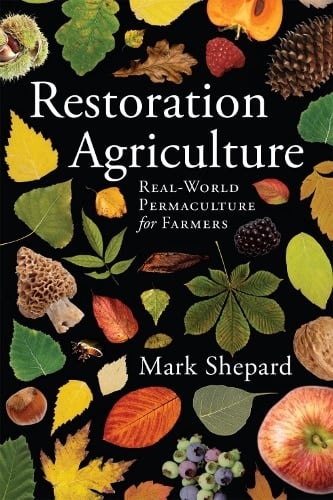
Restoration Agriculture: Real World Permaculture for Farmers is a long overdue call to revolutionize farming as we know it. Mark Shephard shares a vision of renewed soils, diverse ecosystems and healthy watersheds – filled with an abundance of nutrient rich food crops. He begins with some background information on agriculture as we know it, and then progresses to the new reality of permaculture farming – restoration agriculture.
Would you like to save this?
The Rise of Industrial Agriculture
Since WWII, our food crops have been increasingly bathed in a cocktail of herbicides, pesticides and chemical fertilizers. The industrial complex that won the war turned its’ collective might to fighting the insects and diseases that damaged crops. Farmers were told to “get big or get out”. The “Green Revolution” promised to “feed the world” with crops that produced higher yields per acre and genetically modified crops promised pest free fields free of weeds. Industrial agriculture companies such as Monsanto, Cargill and Del Monte vowed to bend nature to the will of man.
The Fall of Industrial Agriculture
The thing is, Momma Nature had other ideas. The megalithic proportioned machines that allow the planting and harvesting of huge monoculture fields compact the soil, forming a dense hardpan under the topsoil that prevents crops from accessing deeper nutrients. The huge fields that stretch for miles and miles through the heartland are ripe for erosion. Indeed, there is very little topsoil left in most of our prime agricultural regions. What soil is left is often dead and lifeless, killed by the herbicides and pesticides. Crops survive only through the application of large amounts of chemical fertilizers, often watered by rapidly depleting aquifers.
The Green Revolution and genetically modified crops were found to only give higher yield with the application of the industrial chemicals, and the seeds from these crops could not be saved from year to year like the heirloom and open-pollinated crops farmers had grown before. Around the world, farmers who had formerly been self-sufficient were now deeply in debt. Suicide rates among farmers have skyrocketed. Read “Monsanto’s GMO Seeds Contributing to Farmer Suicides Every 30 Minutes“.
A New Paradigm – Permaculture and Restoration Agriculture
The time has come to, as Mark put it, “stop trying to grow things that don’t want to grow and killing things that do want to grow”. Permaculture focuses on working with nature instead of against it. There are many variations on this theme, but all work to restore ground cover, protect (and rebuild) topsoil, conserve and clean water, and create a healthy, balanced ecosystem. The majority of crops in the system are perennial, not annual, so they are planted once to produce for many years. The permaculture food production plot is not static. The amount of food and variety of food produced evolves as the plants grow and change.
Animals also have a place in the restoration agriculture system, to help manage diseases and control plant growth, as well as to produce a valuable crop in their own right. Honey and mushrooms represent yet another facet of this amazingly productive polyculture. Instead of growing one crop, such as corn or wheat, from a plot of soil, the farmer can now grow many.
When I first started reading Restoration Agriculture, my initial reaction was, “That is so cool!”, quickly followed by, “Can you really make it work?”. The short answer is, “Yes.” mark has written this book largely based on his own successful experience at New Forest Farm, a 106-acrea commercial scale perennial agriculture ecosystem that was converted from a row-crop grain farm.
The photos of New Forest Farm towards the end of the book are rich and verdant. There is a quiet beauty to the variety of colors (mostly shades of green) and textures. It is much more visually interesting than the unending rows of grains and legumes that cover so much of our countryside. The land speaks to me. It reminds me of my own backyard on a much grander, more productive scale. (For those who aren’t familiar with my garden, you can view photos on the Gardening page.)
If you’d like to hear more in Mark’s own words, you can watch his presentation to a group of organic farmers. It touches on many of the topics included in the book.
I hope you’re as intrigued as I am about diversifying our food sources, healing the soil and providing everyone with healthy food.
I did not receive any money for reviewing this book, only a copy of the book itself.
Great book! We compost and we dump leaves and wood chips in the garden for over the winter to decompose.
Sounds like a MUST for the library.
This is an awesome giveaway! Would LOVE to add this to our library. 😀 Thank you for the opportunity!
Looks like a very interesting book. What can we do to get more individuals to learn to be more self-sustainable with gardening/farming?
I would like to see articles about different alternative crops, everything from how to grow dandelions for root harvest, to elderberry forests. Also, I have free range chickens, but still have to supplement feed for them if I am to get them to roost in the chicken house and lay eggs in there. In Indiana, where I live, there are miles of corn fields, corn, corn everywhere but not a grain to eat. They are GMO. I used to glean the corn fields next door, my neighbor didn’t mind, but now I feel I am feeding my chickens slow poison. What can I feed my chickens that isn’t GMO without spending an arm and two legs?
I’d love to more about building a cold frame….picking a good location (I’ve got a spot that faces south and is protected by the garage and the house that I’m wondering about) and how to build it with limited skills, etc.) This and building a chicken coop are two of my ‘must do’ projects for the next year!
I enjoy your blog… I live out in the country and love going back to the land and use what Mother Nature has given us
Regarding small scale permaculture – if you’re not familiar with the term ‘permaculture’ it covers a lot of ground (no pun intended) but on the agricultural aspect, permaculture essentially teaches how to mimic natural ecosystems for food production. For instance, a permaculture “food forest” is a forest garden that replicates all the components of an actual forest, so that the plants become self-sustaining, self-fertilizing, with only natural inputs, and that the output of the garden is higher than the input, without having to bring in amendments. There are many great resources on “smallifying” permaculture concepts for your urban garden.
This Geoff Lawton video clip shows a permaculture backyard with 80 medicinal plants, 30 fruit trees, 70 kilos of vegetables, vertical wall growing, 161 kilos of fruit, 22 varieties of berries on 640 SQUARE FEET.
http://www.youtube.com/watch?v=XrSlnKFLkFY
Here are two articles I wrote for Permaculture Magazine.uk for permaculture experiments in small raised beds. A ‘worm tower’ which composts directly into the bed, and raised bed hugelkultur. Hugelkultur is the world’s simplest permaculture system. Basically you cover a pile of wood with dirt. The rotting wood has a tremendous capacity to store water, supports beneficial soil organisms, fungal webs, and as it decays, is self-tilling (in the sense that it reduces soil compaction) and generates nutrients that feed the plants. This system takes several years to establish, but can have positive benefits for 20-25 years.
What could be simpler than covering a pile of wood with dirt? Not much.
Worm tower
http://highlyuncivilized.com/2011/01/22/worm-tower/
Raised bed hugelkultur
http://highlyuncivilized.com/2011/11/21/experimenting-with-hugelkultur/
As a cranberry farmer, I’m very interested
Love the information you are giving, We will be putting it gradually into effect this coming growing season.
I would like to know more about how to care for my strawberry patch from year to year and how to grow other not so common fruits, like kiwis, in zone 5.
Always look forward to learning something new!
This book was mentioned in ‘The Resilient Farm and homestead’ which ii read recently. It was a fantastic book, and I have been desiring to read all the books referenced in it, I am looking forward to checking out this tittle, thanks!
Ooo – that sounds like a good book!
This is very interesting and I’d love to read more!
Can’t wait to read this!
This is a great concept. Even better to see permaculture put into practice on a commercial scale. Woo too!
I live in a mobile home with a little postage stamp garden in the back (5’x25′). My neighbors on both sides have put up fences with treated wood. How far away from the fences can I safely plant my garden and is there anything I can do to minimize contamination from rainwater? My friend suggested planting flax along the fence lines.
Thank you,
Laura Tucker
Hi Laura. We used to have a very small garden with the same issue. A couple of suggestions, you can make your own raised beds and fill them so the plants are less likely to get exposed to toxic material. Galvanized feeding troughs come in various sizes and can be used for this. You may here some concerns about the zinc but if you do a little reading on natural and organic sites they say that zinc is only released in very acidic environments. So they don’t recommend brewing, drinking orange juice, or things like that from a zinc container. But galvanized tanks for swimming, gardening, feeding animals are claimed to be safe.
You can also use a “bio swale” along the fence, which is a kind of natural catchment system. Imagine a small indentation running along the fence line that will catch water and allow it to settle. You’ll want to fill it with plants that capture (sequester) the pollution in their root and stem systems. The idea of planting flax along the fence line is basically doing that. Different climates will have different plants recommended for a bio-swale system that you can usually find on google – my state has a lot of resources about their experimental systems. And different plants are often used for different toxins, for instance I have frequently read about using sunflowers for to take lead out of the soil, but I haven’t done this myself. The only downside for bio swale is your small garden size, so high raised beds may give you more planting space and more comfort about the toxin exposure.
Thank you for sharing this. This nation is going to have to embrace sustainability and self-sufficiency. Those five states of endless GMO corn I drove through this summer were a clear reminder to me that what I do on my own little plot is much more natural and normal than industrial ag.
I am really interested in permaculture and sustainability.
I am very interested in growing heirloom vegetables and fruits. Sustainable agriculture!